Electronic Chemicals and Materials Market Snapshot

Key Players

  • BASF SE (Germany)
  • Dow Inc. (USA)
  • Cabot Microelectronics Corporation (USA)
  • Solvay S.A. (Belgium)
  • Sumitomo Chemical Co. Ltd. (Japan)
  • Samsung Electronics Co. Ltd. (South Korea)
  • Linde Plc (Ireland)
  • Honeywell International Inc. (USA)
  • Air Products and Chemicals Inc. (USA)
  • SK Materials Co. Ltd. (South Korea)

Market Size

Base Year 2024
$65.83 Bn
CAGR
6.15%
Forecast 2034
$119.57 Bn

Market Segments

By Product
  • Solid
  • Liquid
  • Gas
By Application
  • Silicon Wafers
  • PCB Laminates
  • Specialty Gases
  • Wet Chemicals and Solvents
  • Photoresists
  • Others

Market Dynamics

Drivers
  • Rising semiconductor production
  • Increasing demand in electronics industry
Restraints
  • Stringent environmental regulations
  • High product substitution risk
Opportunities
  • Growing semiconductors industry
  • Increasing electronic devices demand

Market Size

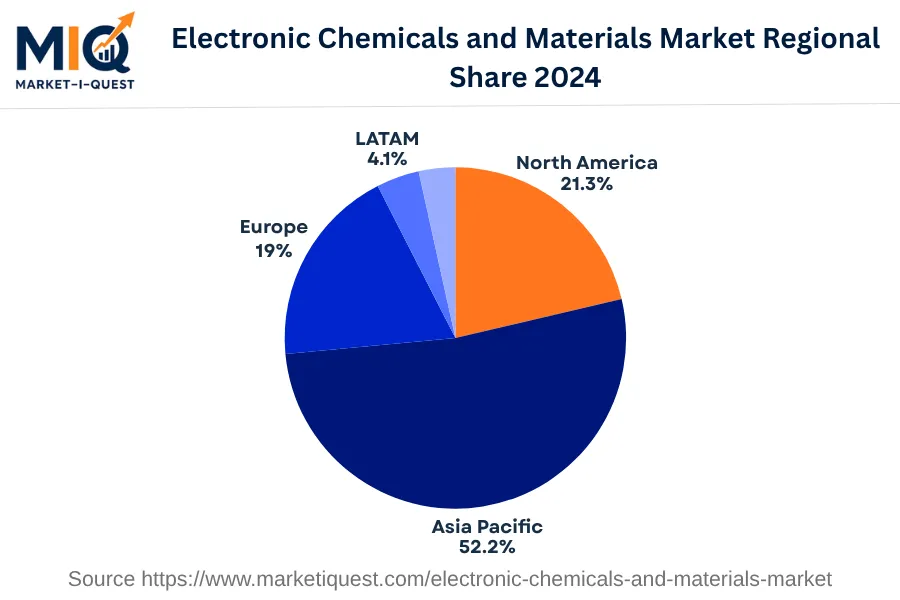
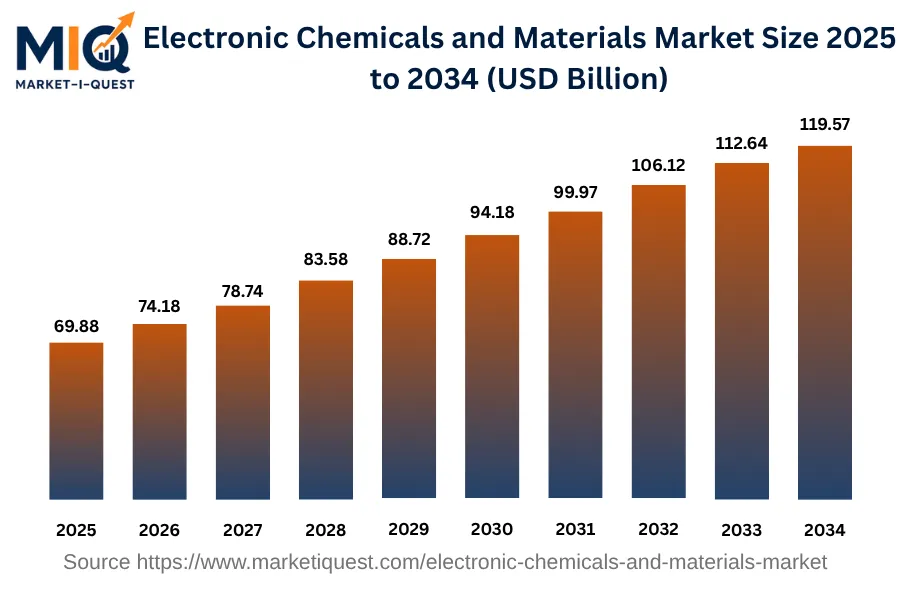
The Electronic Chemicals and Materials Market valued at 69.88 billion USD in 2025 and is expected to expand to 119.57 billion USD by 2034, reflecting a CAGR of 6.15%. The journey of this market growth begins with a value of 65.83 billion USD in 2024, gradually escalating to 69.88 billion USD in 2025, and eventually reaching 119.57 billion USD in 2034. This growth trend can be attributed to evolving technology demands, increasing innovation in electronics, and the rising adoption of advanced electronic materials in various industries. The regional market shares in 2024 present an uneven distribution, with the Asia Pacific leading by accounting for 52.2% of the total market share due to its enormous electronics industry. North America held the second-largest regional share at 21.3%, followed by Europe at 18.96%. Meanwhile, LATAM and MEA's shares stood relatively lower, at 4.06% and 3.46% respectively.

Key Takeaways

  • By Product - Solid subsegment held a significant position in the Electronic Chemicals and Materials Market.
  • By Application - Silicon Wafers led the market accounting for a substantial share.
electronic-chemicals-and-materials-market market size

Key Driving Factors

Increased Proliferation of Consumer Electronics

A significant driving factor for the electronic chemicals and materials market is the accelerating dispersion of consumer electronics globally. As developed markets continue to replace, upgrade, and expand their range of digital technologies such as smartphones, tablets and wearable devices, the demand for electronic chemicals and materials increase proportionately. Emerging markets are seeing an explosion in first-time adoption of these technologies, placing further demand. This dynamic places stress on the underlying supply chains, resulting in the push for advanced production lines and more efficient distribution channels, directly favoring the electronic chemicals and materials sector.

Stringent Environmental Regulations in Electronics Manufacturing

Government-enforced regulations surrounding eco-friendly manufacturing and disposal practices in electronics production are driving the electronic chemicals and materials market. For instance, regulations like the Restriction of Hazardous Substances (RoHS) by the European Union, enforce legal scrutiny on the use of certain hazardous substances in electrical and electronic product manufacturing. Thus, the industry is propelling towards the use of alternative, safer materials and technologies. This environmental emphasis leads to increased demand for innovative electronic chemicals and materials that comply with these stringent rules, further stimulating the market growth.

Market Evolution by Timeline

2019-2023
During these years, semiconductors and flat panel display industries primarily drove the demand for electronic chemicals and materials. Emergence of IoT enabled devices increased China's consumption, making it one of the largest markets for electronic chemicals. Constraints included supply disruptions due to trade tensions between the US and China. Notably, REACH regulations in Europe enforced stringent environmental rules on manufacturers. Price negotiation emerged as a common commercial model where long-term contracts with suppliers maintained raw material consistency. Risks in this period were mainly associated with potential environmental damage and regulatory penalties.
2024
In 2024, the electronic chemicals and materials market saw increased demand from the energy storage industry, which required advanced chemicals for manufacturing high-performance batteries. The advent of 5G technology accelerated demand as it required more electronic devices such as routers and antennas. The market faced supply disruption due to unpredictable weather patterns impacting raw material availability. The EU's Green Deal imposed stricter carbon emission standards influencing production process. Typical commercial contracts included buying groups where companies collaboratively purchased materials, thus reducing costs. Major risks involved sourcing issues and compliance with emission standards.
2025-2029
The electronic chemicals and materials market will likely continue to flourish, with particularly high demand from electric vehicle manufacturers and green energy producers. Countries like Germany and Japan may emerge as top consumers due to their advances in renewable energy. Initiatives like China's Made in 2025 may increase demand while potentially facing supply challenges due to over-dependence on imports. The establishment of Zero-Emission Vehicles standards by multiple countries may play a pivotal role. Subscription models may emerge in the commercial sector, offering fixed pricing and constant supply.
2030-2034
Towards 2030–2034, the electronic chemicals and materials market may see demand surge from the development of fuel cell technologies and advanced electronics. The US and China may have the highest consumption due to their increasing adoption of green technologies. The introduction of AI technology may facilitate supply chain efficiency. The Circular Economy Action Plan (CEAP) may become a guiding standard for electronic waste disposal. The typical commercial model may involve strategic partnerships for innovation in material development. The key risk may involve maintaining a balance between technological advancement and adherence to stringent environmental requirements.

Future Market Outlook

Future Opportunities

The ongoing trends in electric vehicle manufacturing are presenting substantial opportunities in the electronic chemicals and materials market. With automakers like Tesla pushing for higher battery efficiency, there is a growing need for specialized materials such as lithium-ion battery electrolytes. U.S. Department of Energy released a report highlighting the potential for new materials in enhancing battery life and performance, thus encouraging research and development in this area. Furthermore, the anticipated rollout of 6G technology is expected to drive demand for electronic materials that can support higher frequencies and better data transmission capabilities, which organizations like the Institute of Electrical and Electronics Engineers are actively exploring. In parallel, the focus on sustainability is expected to create opportunities for firms innovating in eco-friendly electronic chemicals, prompted by regulatory pressures from bodies such as the European Chemicals Agency. These factors are likely to spur partnerships between material manufacturers and tech firms to jointly develop new applications. The increasing complexity of electronics in consumer and industrial applications necessitates the use of advanced packaging materials, and companies like Amkor Technology are leading in providing solutions to address these challenges. As a result, firms that strategically align their product offerings with industry demands, such as those emerging from automotive, telecommunications, and sustainability sectors, are likely to gain a competitive edge in the evolving landscape of electronic chemicals.

Segmentation Analysis

By Product

The market is divided into subsegments including Solid, Liquid, and Gas. The Solid subsegment accounted for the largest revenue share while the Gas subsegment is expected to grow at the fastest CAGR during the forecast period.

Largest Revenue Share

Solid

Market Share Leader

The Solid subsegment primarily leads the market in terms of revenue generation. There are multiple factors contributing to this, the foremost being its wide range of applications across various industries. Solid products often offer durability and longevity which make them a preferred choice for customers, leading to high demand. Additionally, major geographies show a steady demand for solid products, especially in developed markets where robust infrastructure and manufacturing sectors facilitate their widespread use. The industry's purchasing criteria favor solid products for their ease of use, storage, and transportation, thereby boosting their revenue generation. Regulation and supply dynamics also promote solid products, as these often have fewer safety and environmental concerns compared to their liquid and gas counterparts. Switching costs pose a significant barrier since a transition from solid to other forms would necessitate substantial capital investment, making customers more inclined toward solid product purchasing, thus bolstering its market share.

Fastest CAGR

Gas

Forecast Period Growth Leader

The Gas subsegment is the fastest-growing segment within the market. This can largely be attributed to the rising environmental consciousness and policy-driven shift towards cleaner energy sources, propelling the adoption of gas products. Furthermore, advances in technology are predicted to lower the barriers to entry and operational costs, fostering a faster adoption rate. Similarly, increased capital expenditure towards energy-efficient solutions is catalyzing the growth of the gas subsegment. Growth prospects also depend on strategic partnerships that can help overcome regulatory and technical hurdles. It is worth noting that while gas subsegment is set to grow the fastest, its current share remains low, indicating a significant growth potential.

By Application

The application market comprises subsegments such as Silicon Wafers, PCB Laminates, Specialty Gases, Wet Chemicals and Solvents, Photoresists, and others. In the base year of 2024, the Silicon Wafers subsegment accounted for the largest revenue share while the Specialty Gases subsegment is expected to grow at the fastest CAGR during the forecast period.

Largest Revenue Share

Silicon Wafers

Market Share Leader

The steady rise in revenue for the Silicon Wafers subsegment can primarily due to their integral role in semiconductor devices, which are fundamental in the operation of a vast range of electronic products. These range from everyday gadgets such as mobile phones and laptops, to more sophisticated systems deployed in sectors such as energy, transport, and healthcare. Emerging technologies, such as Artificial Intelligence, Machine Learning, and Internet of Things (IoT), all require the application of semiconductors. With the sustained technology boom, the demand for silicon wafers continues to surge. Additionally, certain geographies have been pivotal to this growth; Asia Pacific, for instance, has emerged as a particularly large demand center for silicon wafers, owing to the constant expansion and evolution of electronic manufacturing industries in countries such as China, Japan, and Taiwan. Regulation has also played a critical role, encouraging steady supply, and preventing market volatility.

Fastest CAGR

Specialty Gases

Forecast Period Growth Leader

The Specialty Gases subsegment is projected to experience the fastest growth, driven by heightened demand across various industries such as healthcare, electronics, and energy. These gases are utilized for their unique properties and can significantly improve process performance. In the medical sector, they are used in a range of applications from anaesthesia to medical imaging. The electronics industry uses specialty gases in semiconductor manufacturing, where high purity grades are crucial. Additionally, environmental regulation and sustainability initiatives are also promoting the use of these gases as alternatives for more harmful, conventional substances. In terms of overcoming adoption barriers, partnerships with local distributors and investing in technologically advanced infrastructure are key strategies adopted by the major players in the segment.

Competitive Analysis

Key Market Players

Manufacturers / OEMs

BASF SE
Germany
Dow Inc.
US
Merck KGaA
Germany

Key Suppliers & Raw Materials

Cabot Corporation
US
Wacker Chemie AG
Germany
Shin-Etsu Chemical Co., Ltd.
Japan

Distributors, Integrators & Channel Partners

Mouser Electronics
US
Avnet, Inc.
US
Arrow Electronics, Inc.
US

Porter’s Five Forces Analysis

This analysis evaluates the competitive intensity and attractiveness of the Electronic Chemicals and Materials Market.

Supplier Bargaining Power

Medium

Suppliers have moderate power due to the specialized nature of materials and concentration in the market.

Buyer Bargaining Power

High

Buyers possess high power, given the number of available suppliers and the importance of price in purchasing decisions.

Threat of Substitutes

Low

Low threat due to the specific requirements and characteristics of electronic materials and chemicals.

Threat of New Entrants

Medium

Entry is moderate due to requisite technical know-how and substantial initial capital investment.

Competitive Rivalry

High

High rivalry characterized by numerous competitors, constant innovation, and sheer pace of industry growth.

Regional Analysis

Geographic market dynamics and growth opportunities across key regions

Global Market Outlook

electronic-chemicals-and-materials-market market regional share

North America

In 2024, the North American market for electronic chemicals and materials intensified, driven by numerous trends and evolving market dynamics. Increasing investments in semiconductor manufacturing and rising demand for technologically advanced electronics stimulated growth. Evolving environmental regulations in the U.S., particularly, mandated safer, greener production methods, augmenting demand for eco-friendly electronic chemicals. Electronics penetration in automotive manufacturing advanced so quickly in Mexico, it contributed to the market growth as well. Trends that emerged are the industry's use of miniature high-performance electronics components, and the use of new technology materials. Intel drove M&A and collaborations and defined the competitive environment, along with other companies as well. Distribution channels moved to online retail after the pandemic that changed the digital-first direction.

Additional policy actions included tighter regulation and guidance on environmentally responsible procurement and disposal of electronic materials in government, utility, and manufacturing sectors. Another milestone in the tech sector was the advent of bendy electronics requiring bendy materials. Thus, the North American Electronic Chemicals and Materials market in 2024 was marked by a blend of regulatory revisions, technological upgrades, and strategic industry alliances, driving tangible growth. The influence of key stakeholders such as manufacturers, policymakers, and end-users was clearly reflected in the market evolution, shaping the industry's narrative.

Asia Pacific

In 2024, the electronic chemicals and materials market in Asia Pacific was characterized by sturdy performance, with marked contributions from key economies including China, India, Japan, South Korea, Australia, and leading ASEAN countries. The strong demand was fueled by an increase in semiconductor manufacturing, particularly in China and South Korea, propelled by their economic strategies to enhance domestic high-tech industries. Industry and market changes India's regulations for disposal and recycling of chemical wastes influenced the market and spurred investment in cleaner production. Australia's electronics industry experienced fast technology adaptation which brought in demand for high-quality electronic chemicals.

Buyer behavior in 2024 continued to trend toward environmentally friendly and sustainable alternatives, as evidenced, for example, by the electronics industry in Japan. The regional market experienced evolutionary innovation in the technological content of products: South Korea is developing cutting-edge manufacturing technology for ultra-high-purity chemicals. Channel dynamics were redefined, particularly in key ASEAN markets where we observed a noticeable increase in direct sales to enterprise-level customers, bypassing traditional retail channels. High-profile partnerships and mergers, as well as stringent policy enforcement, dictated the competitive landscape, seen in China's attempts to gain technological prowess in the semiconductor industry.

Europe

In 2024, the European market for electronic chemicals and materials witnessed substantial growth due to diverse influences. Demand was driven by the escalating need for high-performance electronics, stringent regulatory requirements, and the rising investments in the semiconductor industry. Technological adoption increased remarkably, particularly in Germany and the United Kingdom, due to the advancement in nanotechnology and functional materials. Supply dynamics greatly influenced the market, with France and Italy showing significant progress in the production of high-purity chemicals.

Regarding market trends, buyer behavior favored environmentally-friendly and energy-efficient materials. A key observed shift was towards the use of silicon-based products in the manufacturing sector, mainly for semiconductors. Distribution channels evolved with online platforms gaining prominence over traditional outlets in the Nordics and Benelux regions. There was a marked increase in partnerships and merger & acquisition activities, with key players aiming for product diversification. Regulatory enforcement saw enhanced compliance with REACH standards, especially in Germany and the United Kingdom. Most prominent sectors in electronic chemicals and materials market included manufacturing, retail, and healthcare. Governments across Europe leveraged these materials and chemicals prominently in public utilities. Central & Eastern Europe showed a notable surge in demand, primarily driven by rapid industrialization and expansion of local enterprises. Overall, the European market witnessed a favorable environment for electronic chemicals and materials in 2024.

Latin America

In 2024, the Electronic Chemicals and Materials (ECM) Market in Latin America (LATAM) presented a dynamic landscape, backed by industrial transformations in Brazil, Mexico, Argentina, Colombia, Chile, and Peru. Efforts to modernize manufacturing sectors spurred demand for electronic components, stimulating the ECM market. For instance, Brazil's tech-led industrial policy encouraged wider adoption of automation equipment, robustly amplifying ECM consumption. Significant regulatory changes also reoriented the market. Tighter electronic waste laws in Mexico led manufacturers to use more recyclable materials which, as well as economic factors, impacted the market for ECMs. Investment was the other key factor. Argentina invested in big renewable energy projects which demanded high-quality electrical systems.

Likewise, 2024 was shaping up to be a great year for LATAM's ECM industry. No other trend was so pronounced as one driven by sustainability-conscious buyers seeking environmentally-friendly electronic components. Within the government sector, increased encouragement of homegrown high-tech producers, especially in Chile and Peru, changed the game entirely. Furthermore, strategic partnerships blossomed across LATAM, especially between telecom companies and electronic manufacturers, aiming at technological upgradation. In terms of sectors, manufacturing led the way in ECM demand, followed by utilities due to their heavy reliance on electronics. The rising e-commerce trend in retail was another noteworthy driver, demanding more electronic inventory and related materials, contributing to a thriving ECM market in 2024.

Middle East & Africa

In 2024, the Electronic Chemicals and Materials Market in the Middle East and Africa experienced notable activity. The surge in semiconductor manufacturing and electronics industries, specifically in Saudi Arabia, United Arab Emirates, and Israel, catalyzed the demand surge for high-purity chemicals and materials. Furthermore, prominent research investments and adoption of technological innovations in these countries accelerated the demand. Several countries such as Egypt, South Africa, Nigeria, and Kenya introduced environmental regulations that encouraged companies to purchase greener electronic chemicals and materials.

Consumer trends also contributed to the advancement of state-of-the-art electronic chemicals in key consumer and government sectors such as telecom and financial services in Israel and the UAE. Advances in technology resulting from more powerful devices with greater circuit densities had a direct impact on the growth of innovative electronic chemicals and materials. A noticeable trend was the policy enforcement of local content requirements, impacting supply chains across the region, particularly in South Africa and Nigeria. Israeli companies also exemplified a trend toward partnerships and M&A as a strategy to create competitive advantages and broaden their market reach. Furthermore, the strategic push for domestic manufacturing in Saudi Arabia and UAE to diversify economy also induced shifts in the market.

Recent Industry Developments

Latest market innovations, product launches, and strategic initiatives

November 2025

Sumitomo Chemical scaled up its manufacturing footprint by launching an expanded production facility designed to boost localized capacity of ultra-high-purity electronic materials. The expansion injects an additional 8,000 metric tonnes of high-purity polysilicon annually into the East Asian technology export markets to secure the raw wafer supply chain for South Korea, Japan, and Taiwan.

July 2025

Air Liquide officially inaugurated its first state-of-the-art Advanced Materials manufacturing center in Taichung City, Taiwan. The localized facility focuses on creating highly engineered molecules for Atomic Layer Deposition (ALD) and advanced etching, optimizing supply chain resilience for local foundries manufacturing next-generation AI and high-performance computing (HPC) chips.

Frequently Asked Questions