
Drug Discovery Outsourcing Market Snapshot

Key Players

  • Charles River Laboratories (United States)
  • Albany Molecular Research Inc. (United States)
  • GenScript (China)
  • Domainex (United Kingdom)
  • WuXi AppTec (China)
  • Evotec SE (Germany)
  • Sygnature Discovery (United Kingdom)
  • Jubilant Biosys (India)
  • Pharmaron (China)
  • ChemoMetec (Denmark)

Market Size

Base Year 2024
$5.93 Bn
CAGR
8.75%
Forecast 2034
$13.72 Bn

Market Segments

By Workflow
Target Identification & Screening, Target Validation & Functional Informatics, Lead Identification & Candidate Optimization, Preclinical Development, Others
By Service
Chemistry Services, Biology Services
By Therapeutic Area
Respiratory System, Pain and Anesthesia, Oncology, Ophthalmology, Hematology, Cardiovascular, Endocrine, Gastrointestinal, Immunomodulation, Anti-Infective, Central Nervous System, Dermatology, Genitourinary System, Others

Market Dynamics

Drivers
  • Increased demand for personalized medicine
  • Advancement in drug discovery technologies
Restraints
  • High operational costs
  • Regulatory compliance challenges
Opportunities
  • Rising R&D activities
  • Increased pharmaceutical outsourcing demand

Market Size

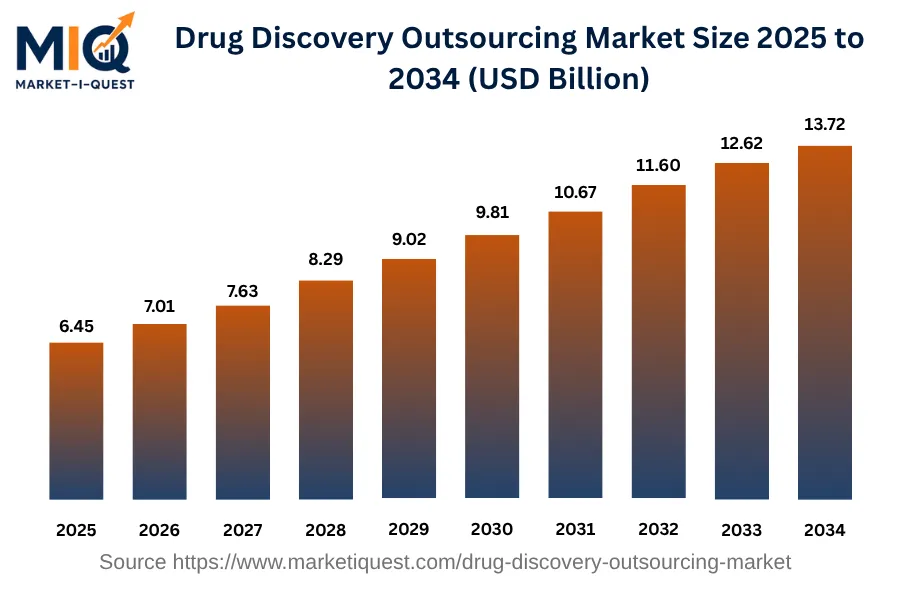
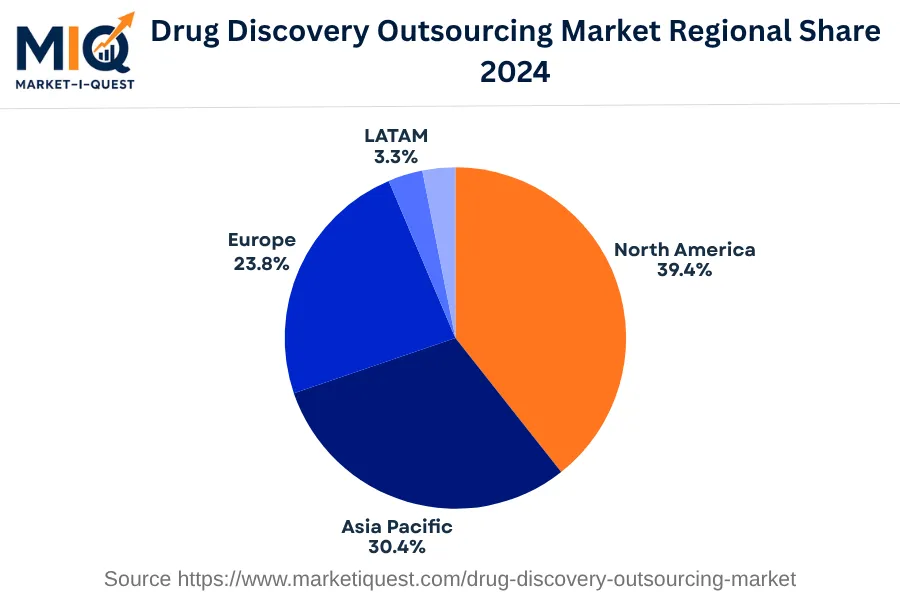
The Drug Discovery Outsourcing Market size for 2025 is estimated at $6.45 billion, up from $5.93 billion in 2024. By 2034, the market value is projected to reach $13.72 billion, marking a significant increase and representing a compound annual growth rate (CAGR) of 8.75%. The market growth between 2025 and 2034 signifies a robust expansion nearly doubling in size. This substantial uptick indicates the rising demand for drug discovery outsourcing services during the stated period. In terms of the regional share in 2024, North America accounted for a substantial piece of the market at 39.4%, followed by Asia Pacific with 30.4%. Europe's contribution was 23.8%, while LATAM and the MEA regions carried comparatively lower proportions at 3.3% and 3.1% respectively.

Key Takeaways

  • By Workflow - Lead Identification & Candidate Optimization held a notable position in the Drug Discovery Outsourcing Market.
  • By Service - Chemistry Services accounted for a significant share in the Drug Discovery Outsourcing Market.
  • By Therapeutic Area - Oncology accounted for a dominant share in the market due to increasing cancer research.
drug-discovery-outsourcing-market market size

Key Driving Factors

Implementation of AI and Machine Learning in Drug Discovery

The implementation of artificial intelligence (AI) and machine learning in drug discovery is playing a pivotal role in propelling the growth of the outsourcing market. AI applications help in accelerating the drug discovery process by pre-assessing effective compounds and predicting their success rates, thereby reducing development time and costs. Pharmaceutical companies are increasingly outsourcing these services to specialized firms with advanced AI capabilities. Machine learning, in parallel, assists in predicting the behavior of molecules, which boosts success rates and saves money. This growing synergy between digital technologies like AI and machine learning and pharmaceutical research is a strong driving force in the market for drug discovery outsourcing.
Rapid Development in Molecular Biology and Genetics

The rapid development in fields such as molecular biology and genetics is another major driver for the growth of the drug discovery outsourcing market. These branches of science are key to discovering novel therapeutic agents and genetic modification-based cures for different diseases. However, the highly complex nature of research and development activities in these fields requires specialized expertise and resources. This has led pharmaceutical companies to outsource their drug discovery processes to contract research organizations (CROs) that possess the necessary skills and infrastructure. The consistent advancement in molecular biology and genetics is significantly fueling the demand for outsourced drug discovery services.

Market Evolution by Timeline

2019-2023
During this period, Pharmaceutical companies and startups, primarily from North America, turned to outsourced drug discovery due to the high costs and risks associated with in-house drug development. BIOME (Boston Industrial for Open Medicine) was a key provider of outsourced drug discovery solutions. Regulatory guidelines witnessed changes with the FDA extending its Programs for Enhanced Drug Development Pathways. Cost-based pricing was prevalent, but value-based contracts also emerged. Value-based outsourcing allowed buyers to pay based on the success rate of the drugs. COVID-19 introduced disruptions in the supply chain disrupting customers. To mitigate this risk, service providers diversified their geographical presence.
2024
In 2024, companies from Asia-Pacific illustrated increased demand for drug discovery outsourcing fueled by their growing pharmaceutical sectors. CROs predominantly in India and China became key suppliers. Regulatory bodies, including CFDA (China Food and Drug Administration), offered remodeled guidelines, enabling smoother contract dealings. Risk-based partnerships, where risks and rewards were shared equally among parties, appeared. Fluctuating pricing based on the drug complexities added to the existing pricing trends. Meanwhile, risks linked with IP rights led to the adoption of stringent non-disclosure agreements.
2025-2029
Throughout this period, therapeutic area units in specialized fields like oncology and neurology were significant buyers from across the globe. Companies offering integrated platforms, combining different stages of drug discovery, had an upper hand. Regulations such as the EU's Medical Devices Regulation (MDR) subtly modified the interactions between CROs and buyers. Outcome-based pricing models grew due to their cost-effectiveness. Partnerships between biotechs and CROs became integral. Cybersecurity risks escalated with the growing digitalization of drug discovery, steering providers towards tighter security measures.
2030-2034
This time block saw non-profit organizations as sizeable buyers alongside pharmaceutical companies. AI-based drug discovery platforms matured, prompting effective discovery procedures. Regulatory bodies like EMA (European Medicines Agency) and FDA issued standards specific to AI utilization in drug discovery. The commercial model shifted towards Data as a Service (DaaS), per use or subscription-based contracts. Partnerships with tech companies offering AI platforms were predominant. The procurement models trended towards acquiring virtual stocks and online platforms. Amidst the increased adoption of digitization, potential risks of data breach persistently required responses.

Future Market Outlook

Future Opportunities

Looking ahead, the drug discovery outsourcing market is poised for several strategic opportunities. In 2023, the European Medicines Agency initiated a pilot program focusing on improved collaboration with contract research organizations to refine regulatory submissions for innovative therapies. This shift indicates an increasing recognition of the need for streamlined processes within the industry. Additionally, as the global biopharmaceutical sector continues its rapid expansion, there is a growing demand for specialized outsourcing services tailored to complex therapeutic areas, such as gene therapy and personalized medicine. For instance, companies like WuXi AppTec are enhancing their service offerings to cater to these niche markets, reflecting responsiveness to evolving client needs. Furthermore, partnerships between pharmaceutical firms and technology startups are expected to rise, driven by the need for rapid identification of new drug candidates through advanced analytics and bioinformatics. A notable example is the collaboration between Roche and the AI firm Genomatix, established in 2023, to utilize data analytics in discovering novel biomarkers. As regulatory frameworks evolve to support innovative therapies, outsourcing partners that can navigate these complexities will see increased relevance. This interconnectedness of technology advancements, regulatory adaptations, and partnership growth is anticipated to create a dynamic environment ripe with opportunities for both existing players and new entrants in the drug discovery outsourcing landscape.

Segmentation Analysis

By Workflow

The market is divided into subsegments including Target Identification & Screening, Target Validation & Functional Informatics, Lead Identification & Candidate Optimization, Preclinical Development, Others. Within these, Lead Identification & Candidate Optimization accounted for the largest revenue share, while Preclinical Development is expected to grow at the fastest CAGR during the forecast period.

Largest Revenue Share

Lead Identification & Candidate Optimization

Market Share Leader

Lead Identification & Candidate Optimization stands out as the highest-revenue subsegment in the base year 2024, and this is attributed to multiple factors. Primary amongst these includes its fundamental role within the pharmaceutical development process – where potential drugs are identified and perfected before progressing to trials. Given its significant role, companies value the insights derived at this stage, leading to a greater flow of capital. Geographically, the domination of this segment correlates to larger markets with robust pharmaceutical sectors such as North America and Western Europe, where most of the globally recognized pharmaceutical companies are based. The purchasing criteria lie in the effectiveness of the service in identifying and optimizing potential blockbuster drugs, thus worth the higher pricing, contributing to its high revenue. Regarding regulation, this subsegment faces stringent scrutiny due to its potential ramifications on overall drug safety, therefore requiring substantial investment that implicates its revenue. However, considering the costly nature of switching providers and the intricate knowledge needed to manage processes, the subsegment benefits from strong customer retention.

Fastest CAGR

Preclinical Development

Forecast Period Growth Leader

Preclinical Development is anticipated to grow at the fastest CAGR. There are a few key growth drivers behind this outlook. The increasing number of biotech and pharmaceutical companies looking to ensure effectual drug formulation is a significant factor. A burgeoning demand for outsourced preclinical services also fuels up this growth, as many companies are currently focusing on their core competencies. Apart from this, continuous advancements in technology, such as high-throughput screening methods and modelling software, serve as catalysts, facilitating faster and more accurate preclinical development. On the policy front, growing regulatory requirements for robust preclinical data before moving to clinical trials are promoting investments in this subsegment. However, the need for high capital expenditure can pose as a near-term risk. Justifying this fastest growth's assumption is not an easy task that can be based on common industry standards.

By Service

The market is divided into subsegments including Chemistry Services and Biology Services. Chemistry Services accounted for the largest revenue share while Biology Services is expected to grow at the fastest CAGR during the forecast period.

Largest Revenue Share

Chemistry Services

Market Share Leader

Chemistry Services holds the largest share in the market revenue for the base year 2024. A key driver for this subsegment's dominance is its broad applicability across numerous industries. From pharmaceuticals and healthcare to material science and environmental studies, there's a high demand for these services, which resonates in its large revenue generation. Regulatory factors have also played a substantial role. With stricter regulations and standards, industries require sophisticated chemistry services to ensure compliances. On the supply side, increased investment in R&D and tech advancements in analytical tools have further driven up the service offering and revenue generation ability of this subsegment. Moreover, the purchasing preferences of major players are inclined toward providers offering high-quality and precise results, adding stability to the chemistry service market's revenues.

Fastest CAGR

Biology Services

Forecast Period Growth Leader

Despite their smaller revenue share in 2024, Biology Services are anticipated to expand at the most elevated pace during the forecast period. This forecast acceleration is driven by several factors. Advancements in technology and increased understanding of biological systems have expanded the service offerings in this subsegment, driving its growth. Capital expenditure is on the rise in the biological research sector, providing impetus for more innovative services. Public-private partnerships also play a crucial role, fostering an environment encouraging the exploration of innovative biological solutions. However, barriers to adoption such as a higher degree of complexity compared to other services and the need for highly skilled personnel may pose a challenge to growth. Regardless, the overall outlook remains promising, with policy support and technological innovations serving as key growth catalysts for Biology Services.

By Therapeutic Area

The market is divided into subsegments including Respiratory System, Pain and Anesthesia, Oncology, Ophthalmology, Hematology, Cardiovascular, Endocrine, Gastrointestinal, Immunomodulation, Anti-Infective, Central Nervous System, Dermatology, Genitourinary System, and Others. Of these, the Oncology subsegment accounted for the largest revenue share, while the Immunomodulation subsegment is expected to grow at the fastest CAGR during the forecast period.

Largest Revenue Share

Oncology

Market Share Leader

Oncology, the study and treatment of tumors, dominates the market due to factors such as the high prevalence of various types of cancer worldwide and the corresponding demand for effective treatments. Advances in treatments, such as targeted therapy, immunotherapy, and personalized medicine, contribute to oncology's revenue share. Moreover, the rise in global geriatric population prone to cancer and investments into R&D of innovative oncology drugs also drives this subsegment. Given the price sensitivity in healthcare markets and the enormous scale of the cancer patient population, revenue growth in oncology has spiked significantly. Additionally, the regulatory framework has been supportive, with expedited approval processes for oncology drugs, often based on the seriousness of the condition.

Fastest CAGR

Immunomodulation

Forecast Period Growth Leader

Despite not earning the most revenue currently, the Immunomodulation subsegment, which includes treatments designed to alter the immune response, is positioned to grow at the most rapid pace. There are several catalysts for this projection. Firstly, there is the rising global incidence of autoimmune and inflammatory diseases, which necessitates immunomodulatory treatment. Secondly, the increased understanding of the human immune system has enabled the development of a broad range of immunotherapeutics. Similarly, there is high anticipation for breakthrough advances related to cell and gene therapies as well as biologics, all of which fit under the broad umbrella of immunomodulation. Adoption barriers, such as high development costs and long approval processes, are gradually being offset by regulatory efforts to fast-track innovative therapies. However, potential changes in healthcare policy and reimbursement norms remain near-term risks.

Competitive Analysis

Key Market Players

Manufacturers / OEMs

Charles River Laboratories
US
Evotec AG
Germany
WuXi AppTec
China

Key Suppliers & Raw Materials

Thermo Fisher Scientific Inc.
US
Merck KGaA
Germany
PerkinElmer Inc.
US

Distributors, Integrators & Channel Partners

Sigma-Aldrich Corporation
US
Bio-Rad Laboratories, Inc.
US
BioDuro LLC
US

Porter’s Five Forces Analysis

This analysis illustrates the competitive dynamics in the drug discovery outsourcing market.

Supplier Bargaining Power

Medium

Key supplies are commoditized, but highly specialized knowledge can enhance supplier power.

Buyer Bargaining Power

High

Large pharmaceutical companies often have multiple potential outsourcing partners, enhancing bargaining power.

Threat of Substitutes

Low

In-house drug discovery is costly and time-consuming, limiting feasible substitutes.

Threat of New Entrants

Medium

Regulatory barriers and required scientific knowledge act as entry deterrence, but significant market growth can attract new entrants.

Competitive Rivalry

High

Rivalry is heightened due to multiple capable competitors and high stakes for contract wins.

Regional Analysis

Geographic market dynamics and growth opportunities across key regions

Global Market Outlook

drug-discovery-outsourcing-market market regional share

North America

In the base year 2024, the North American Drug Discovery Outsourcing Market was characterized by robust activity, chiefly driven by increased investment, technology adoption, and regulatory factors in the US, Canada, and Mexico. Key market drivers included escalating demand for advanced therapies to combat rising chronic diseases, with pharmaceutical enterprises leveraging technological advancements, specifically in bioinformatics and high-throughput screening. Regulatory changes were also integral, with policy shifts such as the US government's prioritization of rare disease research fostering an enhanced environment for outsourcing.

Several trends were shaping the 2024 market landscape. A notable shift among biotech firms and pharmaceutical companies was the preference for strategic partnerships and mergers, propelling resources and know-how consolidation. The implementation of AI and machine learning in drug discovery witnessed an upsurge, increasingly seen as time and cost-effective alternatives in the extensive drug discovery process. There was a pronounced shift towards target-based discovery, attributed to the advent and adoption of genomics and related technologies. Lastly, the heightened focus on personalized medicine underlined a significant trend, with healthcare providers benefiting from tailor-made treatments, thus fueling demand in the outsourcing market. This robust interplay of drivers and trends presented an evolving dynamic in the North American Drug Discovery Outsourcing Market in 2024.

Asia Pacific

In 2024, the Drug Discovery Outsourcing Market in Asia Pacific represented an integral element of the pharmaceutical industry's research and development ecosystem. Primary drivers of market growth included increased demand for new drug research amidst an aging population, particularly in Japan. Streamlined regulatory procedures, such as China's accelerated drug approval process, had also facilitated market expansion. Additionally, countries like India, with a robust supply of skilled scientists and lower operating costs, attracted significant foreign investment. Furthermore, in South Korea and Australia, rapid adoption of cutting-edge technologies, like Artificial Intelligence for drug discovery, provided competitive advantages to market participants.

Trends shaping the Drug Discovery Outsourcing Market comprised shifts in buyer behavior, with pharmaceutical firms increasingly leveraging outsourcing to mitigate risk and fast-track product development. A surge in strategic partnerships and M&As was also notable, especially across key ASEAN markets. Big pharmaceutical enterprises collaborated with contract research organizations to harness specialized strengths, while smaller biotech firms sought mergers for scale and capital. Moreover, China's enforcement of tighter quality control standards had reshaped outsourcing considerations. Notably, this market predominantly served sectors such as healthcare, pharmaceuticals, and biotechnology, significantly impacting drug development timelines, quality, and costs across these industries throughout Asia Pacific in 2024.

Europe

In the base year of 2024, Europe's Drug Discovery Outsourcing Market showed pronounced dynamism. Key drivers included heightened demand due to rapidly ageing populations particularly in Germany, the United Kingdom, France, and Italy, stimulating increased outsourcing of drug discovery. Advancements in technology, especially AI-enabled drug discovery techniques, both spurred adoption and intensified investment across Europe. Regulatory shifts in the European Union also played a crucial role, with stricter guidelines on clinical trials necessitating external expert services, thereby boosting the market.

Notable trends included an observed shift towards personalized medicine in Spain and the Nordics, increasing the demand for outsourcing services specializing in genomic and proteomic drug discovery. Additionally, partnerships and mergers & acquisitions became increasingly conspicuous, imprinting a sharp direction for market expansion. Sharing of technology and expertise through these collaborative initiatives have fostered innovation and extended service portfolios. Particularly noticeable was the enforcement of the EU Clinical Trial Regulation, powering balance between the quality and efficiency of drug trials, enhancing trust in outsourced drug discovery. Key sectors impacted by these dynamics included healthcare and research institutions, with consequences cascading to retail as higher efficacy medication emerged. Government involvement indirectly influenced the market through regulatory changes and considerations, while investment was crucial from enterprise actors with high stakes in pharmaceuticals.

Latin America

In 2024, the Latin American Drug Discovery Outsourcing Market witnessed significant growth primarily due to industry drivers and evolving trends. Key drivers included regional government policies promoting pharmaceutical R&D investment, a surge in infectious and lifestyle diseases necessitating new drug formulation, and increasing investment in technology adoption for more efficient drug discovery. In countries like Brazil and Mexico, regulatory reforms encouraged private investment into local drug discovery markets which enhanced supply dynamics. Moreover, cost-effectiveness of outsourced drug discovery catalyzed its adoption throughout the LATAM region, presenting attractive options to global pharma giants.

Prominent trends involved a shift towards strategic partnerships and M&As, especially in Brazil and Argentina, aimed to consolidate market presence while leveraging shared technology and expertise. There was also an increased focus on personalized medicine discovery, particularly in oncology, due to its high demand in healthcare sectors of Colombia, Chile, and Peru. Regulatory bodies' strict compliance enforcement on drug discovery standards further shaped the LATAM market landscape. Overall, the market’s dynamics in 2024 were driven by enterprises in the pharma sector, healthcare organizations seeking innovative drug solutions, and governments establishing conducive environments for drug discovery. Despite differing national regulations, drug discovery outsourcing was increasingly recognized throughout Latin America as a cost-efficient, technologically advanced strategy to meet public health challenges.

Middle East & Africa

In 2024, the Drug Discovery Outsourcing Market in the Middle East and Africa region was characterized by a keen focus on infectious diseases and genetic disorders. Drivers included an intensified demand for faster therapeutic solutions, primarily for neglected tropical diseases in Nigeria, South Africa, and Kenya. Substantial government investment in healthcare infrastructure in the affluent Gulf countries, particularly Saudi Arabia, Qatar, and the United Arab Emirates, fueled market growth. Additionally, the adoption of cutting-edge technologies like AI and ML in drug discovery process by healthcare companies and research institutions in Israel was significant.

Among the visible trends were increased collaboration between pharmaceutical manufacturers and research institutions for drug development. For instance, institutions in Egypt were increasingly teaming up with large pharmaceutical companies. There was also a noticeable shift towards personalized medicine in countries like Saudi Arabia and UAE, guided by their wealth and advanced healthcare infrastructure. Gaining momentum was the mandatory observance of stringent drug discovery protocols and policies across the region, particularly in South Africa and Israel. Lastly, an inclination towards open innovation models for drug discovery was evident throughout the region, supporting a more cost-effective and faster path to market for new drugs.

Recent Industry Developments

Latest market innovations, product launches, and strategic initiatives

July 2025

Atombeat Inc. a leader in AI for drug discovery, and BioDuro, a global CRDMO, announced a strategic partnership to launch an AI-powered platform for accelerated peptide drug discovery.

October 2025

Sai Life Sciences announced an integrated CMC partnership offering services spanning from drug discovery to process development and early-phase supplies, all the way to commercial launch and life cycle management.

Frequently Asked Questions