Drug Discovery Informatics Market Snapshot

Key Players

  • IBM (United States)
  • Biovia Corp (United States)
  • PerkinElmer Inc. (United States)
  • Thermo Fisher Scientific Inc. (United States)
  • Genedata AG (Switzerland)
  • BIOVIA (France)
  • Illumina Inc. (United States)
  • Infosys (India)
  • Schrodinger LLC (United States)
  • Benchling Inc. (United States)

Market Size

Base Year 2024
$4.94 Bn
CAGR
11.48%
Forecast 2034
$14.65 Bn

Market Segments

By Product
  • Discovery Informatics
  • Development Informatics
By Mode
  • In-House Informatics
  • Outsourced Informatics
By Service
  • Sequencing and Target Data Analysis
  • Docking
  • Molecular Modeling
  • Clinical Trial Data Management
  • Others

Market Dynamics

Drivers
  • Increasing prevalence of chronic diseases
  • Advancements in bioinformatics tools
Restraints
  • High implementation costs
  • Data privacy concerns
Opportunities
  • Increasing bioinformatics applications
  • Advancements in drug discovery technologies

Market Size

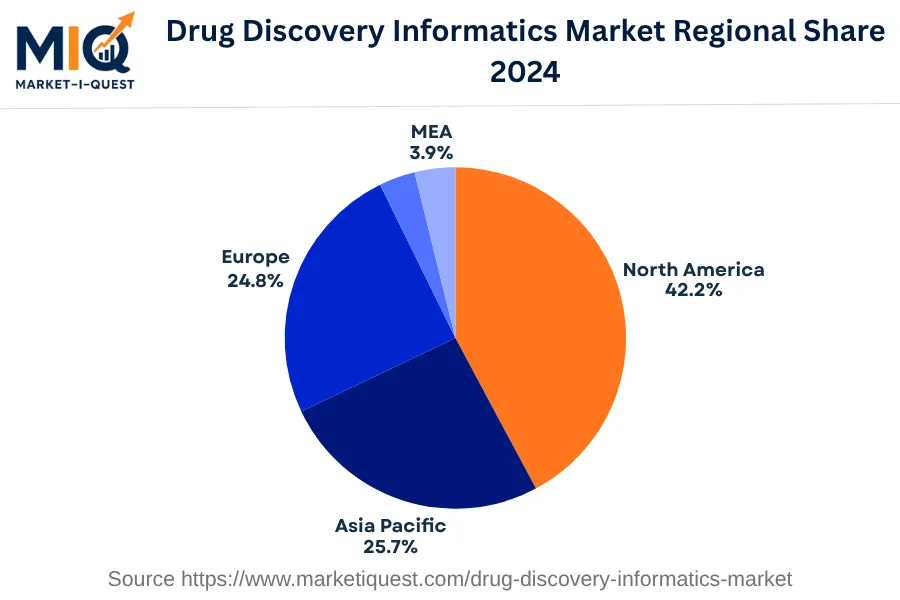
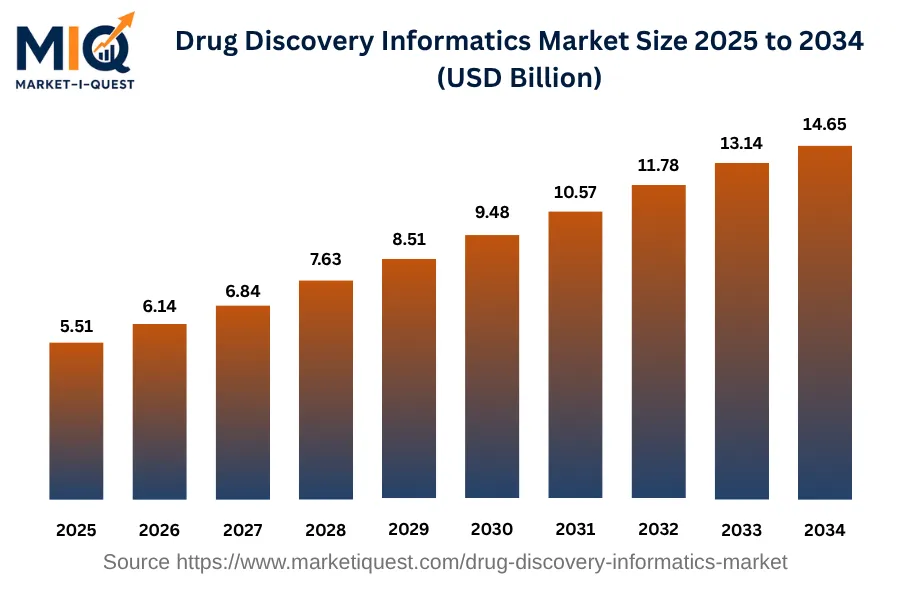
The Drug Discovery Informatics market size was $4.94 billion in 2024 and increased to $5.51 billion in 2025. By the end of 2034, the market value is expected to escalate substantially to $14.65 billion. This significant growth, from 2025 to 2034, represents a Compound Annual Growth Rate (CAGR) of 11.48%. Assisting this growth is a noticeable rise in bioinformatics tools for drug discovery, as well as an enhancement in information science technologies. Furthermore, the clinical and health informatics integration has been extensively assisting in driving the market size upwards. By region, North America claimed the largest market share in 2024, with 42.2%, while Asia Pacific and Europe followed with shares of 25.7% and 24.8%, respectively. The LATAM and MEA regions held smaller market shares, contributing 3.4% and 3.9% in 2024, respectively.

Key Takeaways

  • By Product- Discovery Informatics dominates the industry's revenue share.
  • By Mode section - In-House Informatics maintained a significant lead through the period.
  • By Service - Sequencing and Target Data Analysis showed the fastest growth in the forecasts period.
drug-discovery-informatics-market market size

Key Driving Factors

Implementation of Artificial Intelligence in Drug Discovery

Increasing adoption of Artificial Intelligence (AI) in drug discovery process can be seen as a major driver for the Drug Discovery Informatics Market. AI can help in streamlining the drug development process by providing predictive models for the simulation and analysis of drug interactions, thereby expediting the process of identifying viable drug candidates. This not only improves the efficiency of drug discovery but also reduces the overall cost associated with the development of new drugs. Major pharmaceutical companies and research institutions are recognising the potential of AI in generation of novel drug candidates and are integrating AI-driven informatics tools into their workflows, thereby augmenting the growth of the market.

Regulatory Policies Encouraging Precision Medicine

The advancement in regulatory policies that encourage precision medicine is an important driver for the Drug Discovery Informatics Market. Precision medicine, which requires genetic and genomic data to tailor treatments to individual patients, relies heavily on the informatics strategies for the handling, analysis and interpretation of such large-scale data. Regulatory bodies such as the U.S. Food and Drug Administration (FDA) and European Medicines Agency (EMA) are encouraging pharmaceutical companies to move towards personalised medicines, and this is influencing the companies to invest more in drug discovery informatics. This trend towards more targeted treatments is driving the pharmaceutical industry's growing need for advanced informatics solutions.

Market Evolution by Timeline

2019-2023
In this period, demand for drug discovery informatics was primarily driven by pharmaceutical companies and biotech firms, notably in the United States and Western Europe, aiming to streamline their drug discovery processes. Suppliers responded by launching cloud-based informatics platforms that integrated with existing lab technologies. However, technological constraints, such as the lack of standardized data formats and interoperability, posed a challenge. Policy-wise, GDPR regulations in the EU specifically impacted the handling and storage of patient data. Typical pricing models involved subscription-based contracts with tiered pricing. The main risk was data security, with solutions such as encryption being increasingly adopted.
2024
By 2024, drug discovery informatics had broadened buyer segments to include universities and research institutes, especially in Japan and South Korea, in addition to the prior segments. Suppliers had begun piloting AI and machine learning technologies to improve discovery outcome. However, issues of integration with pre-existing systems persisted. The adoption was partially driven by the HIPAA regulations in the US and Japan's My Number system that promoted digitization and strict data handling procedures. Commercially, partnerships between software providers and research institutions were emerging. The risk factor remained data security and protection.
2025-2029
During this timeframe, emerging markets such as China and India demonstrated growing demand; they sought ways to accelerate their domestic drug discovery initiatives. In terms of supply, innovations in predictive analytics and automation technologies made strides, although integration issues remained. Regulations, such as China's Cybersecurity Law, influenced adoption patterns and data handling protocols. Contractually, pay-per-use models grew in popularity alongside traditional subscription models, while software vendors partnered with local research institutions. The issues related to integrating new technologies with traditional systems was a noteworthy risk sliding into this period.
2030-2034
In the period 2030-2034, demand traces to less developed regions like Africa are expected as their research capabilities mature. Technological advancement would likely see more thorough exploitation of AI, boosting integration maturity. The emergent cyber regulatory environment from nations catching up to conventions like the African Union Convention on Cyber Security and Personal Data Protection could shape adoption attitudes. The commercial model might lean towards a hybrid of subscription and pay-per-use models and cross-industry collaborations might become commonplace. The risk would remain around data handling and integration of new technologies with legacy infrastructures.

Future Market Outlook

Future Opportunities

The future landscape of the drug discovery informatics market is expected to center on enhanced data integration capabilities, a need driven by the growing complexity of biological systems. As evidenced by the partnership between Novartis and Microsoft in 2023, developments in cloud technology and machine learning create opportunities for improving predictive analytics in drug discovery. The increased emphasis on personalized medicine, highlighted by advancements in targeted therapies, suggests future demand for informatics that can analyze large datasets to identify patient-specific responses to treatments. As regulatory bodies like the FDA refine guidelines for the use of real-world evidence in drug submissions, the incorporation of informatics tools capable of mining clinical data will become critical. Additionally, the rising prevalence of rare diseases and the need for tailored therapies, as seen in collaborations like the one between Pfizer and the NIH, positions informatics as a strategic asset in accelerated clinical trials and drug approval processes. The ongoing shift towards precision health initiatives drives interest in informatics solutions that support genetic data analysis, with companies such as Illumina leading advancements in genomic sequencing technologies. Moreover, investment in cybersecurity measures to protect sensitive research data will remain paramount, as highlighted by recent policy discussions at the World Health Organization concerning data protection in healthcare innovations. Such factors signal a robust environment for targeted investments in drug discovery informatics technologies.

Segmentation Analysis

By Product

The market is divided into subsegments including Discovery Informatics and Development Informatics. Discovery Informatics accounted for the largest revenue share while Development Informatics is expected to grow at the fastest CAGR during the forecast period.

Largest Revenue Share

Discovery Informatics

Market Share Leader

Discovery Informatics dominates the industry's revenue share primarily due to its crucial role in early-stage pharmaceutical research. This subsegment directly contributes to the processes of drug discovery, significantly accelerating time-to-market. Its endless possibilities for application in disease understanding, target identification, and lead compound selection make it a top choice for pharmaceutical companies. In addition, current market trends show an increase in data volumes due to the rise in genomics studies and clinical trials. This results in a higher demand for informatics solutions to efficiently manage and interpret this data. Market wise, the North America region is leading in revenue generation for this subsegment, owing to robust research and development infrastructure and investments. Furthermore, stringent regulatory requirements in certain regions are actually enhancing Discovery Informatics' revenue as these conditions necessitate the need for sophisticated informatics solutions to adequately meet regulatory standards. The key purchasing criteria for this subsegment are proven reliability and efficacy of the informatics solutions, reputation of provider, and robust customer support and service, upon which basis preferable channels are established.

Fastest CAGR

Development Informatics

Forecast Period Growth Leader

While Discovery Informatics maintains the largest revenue share, Development Informatics is poised as the fastest-growing subsegment. One of the primary drivers for this growth is the intensifying need for data management in clinical trials and other late-stage pharmaceutical development processes. Development Informatics offers advantages such as enhanced data accuracy, reduced time in data collection, and streamlined report generation. Quick advancements in technology and the increasing adoption of cloud-based solutions are acting as catalysts for the growth of this subsegment. The decrease in costs related to adopting such a system has removed previous barriers, allowing even small-to-midsize businesses to implement development informatics. Nevertheless, data security threats and privacy issues present near-term risks to the subsegment's growth. In conclusion, based on the trends and data security measures, Development Informatics has a robust growth outlook in the forecast period.

By Mode

The market is divided into two subsegments - In-House Informatics and Outsourced Informatics. Out of these, In-House Informatics had the most revenue in 2024, while Outsourced Informatics is projected to grow at the fastest rate.

Largest Revenue Share

In-House Informatics

Market Share Leader

In-House Informatics has been in the lead since 2024 because companies tend to have more control and customization over in-house systems. The drive for automation and efficient data management within organizations has fueled the In-House Informatics segment. This sub-segment benefits from organizations' preference for maintaining proprietary databases and applications in-house, which provides them with significant competitive advantages. Digitization of several processes within a business setup requires constant internal surveillance, which necessitates In-House Informatics. Essential factors such as managing regulatory requirements and data privacy concerns have also aided the subsegment's strong performance. On the basis of geographies, mature markets with substantial IT spending have generated significant revenue for this segment due to their greater demand for high-quality, in-house data processing capabilities.

Fastest CAGR

Outsourced Informatics

Forecast Period Growth Leader

Outsourced Informatics is expected to grow at the fastest rate, driven by several key factors. Outsourcing can provide essential cost savings by minimizing infrastructure and staffing costs. More businesses are keen to collaborate with specialized IT companies to focus on their core competencies, driving the growth of Outsourced Informatics. The rise in remote working set-ups and cloud technology's evolution also plays a part in encouraging companies to hand over their data management to external experts, catalyzing growth potential for this segment. However, concerns over data security and regulatory issues may pose a barrier to adoption. To mitigate these risks and further stimulate segment growth, providers should focus on improving data security measures and complying with transnational regulations.

By Service

The market is divided into subsegments including Sequencing and Target Data Analysis, Docking, Molecular Modeling, Clinical Trial Data Management, and Others. Of these, Clinical Trial Data Management accounted for the largest revenue share, while Sequencing and Target Data Analysis is expected to grow at the fastest CAGR during the forecast period.

Largest Revenue Share

Clinical Trial Data Management

Market Share Leader

Clinical Trial Data Management has emerged as the significant revenue generating segment in 2024. This can be attributed to the rising complexities of clinical trial protocols and there being a surge in the generation of clinical trial data, which needs to be accurately captured, managed, and analyzed. The pharmaceutical companies increasingly outsource their data management tasks to derive potential insights and conclusions from the data collected during trials. Furthermore, increasing drug discovery and development activities being carried out globally are also propelling the need for effective data management solutions to manage such colossal amounts of data. Governments' emphasis on digitization of healthcare data combined with stringent regulatory guidelines for clinical data management is acting as a catalyst, thus leading to this subsegment capturing the largest revenue share currently.

Fastest CAGR

Sequencing and Target Data Analysis

Forecast Period Growth Leader

Sequencing and Target Data Analysis is set to witness the fastest growth during the forecast period. This is owing to the rapid advancements in next-generation sequencing (NGS) technologies and surging genomics research activities worldwide. Industries are leveraging the high-throughput sequencing & analysis of DNA/RNA to understand genetic variations associated with diseases, which could accelerate the development of personalized medicine. Despite the high cost associated with sequencing technologies, falling sequencing costs owing to technological advancements work as a catalyst for faster adoption. Partnerships and collaborations between leading genomics firms and software companies for developing advanced analysis tools are likely to further fuel the growth. However, data privacy and standardization issues pose a short-term barrier for this segment's growth.

Competitive Analysis

Key Market Players

Manufacturers / OEMs

IBM
US
Thermo Fisher Scientific
US
Infosys
India

Key Suppliers & Raw Materials

Dassault Systemes
France
Schrodinger, LLC
US
Agilent Technologies
US

Distributors, Integrators & Channel Partners

Oracle Corporation
US
SAP SE
Germany
Tripos, Inc.
US

Porter’s Five Forces Analysis

This analysis evaluates the competitive landscape of the Drug Discovery Informatics Market.

Supplier Bargaining Power

Medium

Suppliers hold power due to the specialized nature of advanced data analytics and proprietary databases.

Buyer Bargaining Power

High

Buyers have high negotiating power due to availability of several service providers and customizable packages.

Threat of Substitutes

Low

Low threat due to the specialized knowledge and technological capabilities needed in this market.

Threat of New Entrants

Medium

The need for high initial investment and domain expertise could deter some new entrants.

Competitive Rivalry

High

High competition amongst established players focusing on innovation and advanced analytics.

Regional Analysis

Geographic market dynamics and growth opportunities across key regions

Global Market Outlook

drug-discovery-informatics-market market regional share

North America

In 2024, North America's Drug Discovery Informatics Market was defined by its pivotal role in the pharmaceutical domain, providing optimized solutions for drug discovery and development. This market was driven by factors such as the increasing demand for new drug discovery due to high prevalence of chronic diseases. Regulatory initiatives from authorities, such as the U.S. FDA, encouraged use of informatics in making drug discovery more efficient and robust. Furthermore, significant investments in the development of robust and advanced predictive tech by enterprises contributed to market momentum.

The trend of integrating artificial intelligence in drug discovery informatics was particularly prominent in the U.S. and Canada, serving as a catalyst for faster and more accurate drug innovation. The alliance of tech giants with pharmaceutical companies, as seen with Google's DeepMind and GSK, was a notable trend, leveraging computational methods to expedite the drug discovery process. A shift in policy enforcement towards data protection and integrity also shaped the market in 2024. The main beneficiaries were the pharmaceutical and biotechnology sectors looking for advanced informatics solutions. The growing adoption of cloud-based drug discovery platforms among these sectors indicated the rising interest and trust in informatics. Meanwhile, government initiatives for funding such projects in the U.S. and Canada promoted use of informatics technology for drug discovery and development.

Asia Pacific

In 2024, the Drug Discovery Informatics Market in the Asia Pacific experienced robust growth aided by various drivers and significant trends. Key drivers included sustainable investment in healthcare informatics by China and India, practical application of Artificial Intelligence and Machine Learning technologies across Australia and Japan, and lenient data sharing regulations aiding drug development in ASEAN markets. Increasing collaborations amongst pharmaceutical companies and academia further facilitated market expansion. Key trends shaping the market included the rising focus on personalized medicine, particularly in China and Japan, and adoption of cloud-based solutions for drug discovery across the region. There was a surge in strategic partnerships and mergers and acquisitions, especially in South Korea and India, aimed at enhancing drug discovery data management capabilities. The implementation of data security standards and enforcement of stringent data privacy policies was a significant trend in Australia and ASEAN markets.

Primarily, this market growth was realized across the healthcare sector, academic and research institutes, contract research organizations (CROs), and pharmaceutical companies. Coupled with government support, these sectors have adopted drug discovery informatics to streamline research and development activities and expedite the delivery of novel therapeutic agents to the market. In 2024, the Asia-Pacific Drug Discovery Informatics market portrayed a complex, yet dynamic landscape.

Europe

In 2024, the European Drug Discovery Informatics market was robust, shaped by increasing investment, policy shifts, and technology adoption. Significant drivers included regulations such as the European Union’s Medical Device Regulation (MDR), which prompted a surge in digital platforms to expedite drug discovery processes while maintaining regulatory compliance. Additionally, an influx of capital investment nurtured the growth of startups and sustained R&D activities among established companies, particularly evident within German and UK markets. Growing demand from healthcare and allied sectors drove the market further, as increased need for cost-effective and efficient drug development strategies supported the deployment of informatics solutions. These dynamics were predominant in France, Italy, and Spain, where healthcare infrastructural upgrades were prominent.

Simultaneously, evolving technology adoption trends fostered an environment conducive to advances in artificial intelligence and machine learning, especially within the Nordics and Benelux, renowned for keen tech integration. Furthermore, a notable trend was the rise of multinational partnerships and mergers, marked by a stringent policy enforcement that necessitated collaborative efforts towards shared resources and expertise, mostly in Central and Eastern Europe. In summary, the European Drug Discovery Informatics market in 2024 was energized by regulatory changes, investment inflows, and the burgeoning demand for efficient drug discovery strategies. Moreover, technology adoption and strategic partnerships amplified the market's strength and influence.
Latin America

In 2024, the Drug Discovery Informatics Market in Latin America (LATAM) was characterized by active adoption within the healthcare and pharmaceutical sectors. Demand was driven by increasing investments in life sciences, fostering the adoption of advanced technologies for efficient drug discovery. The implementation of stricter regulations for drug approval in countries like Brazil and Mexico further propelled the use of informatics in streamlining drug discovery processes.

In terms of trends, there was a shift towards cloud-based solutions in drug discovery informatics, driven by the need for scalable, accessible and cost-effective services, particularly in Argentina and Chile. Collaborations and partnership agreements among key players were prominent, primarily to enhance their offerings and expand their reach. Policy enforcement in countries like Colombia and Peru promoted the standardization in drug discovery informatics, ensuring reliability and accuracy. The main customers of drug discovery informatics solutions in 2024 were pharmaceutical companies, looking to expedite the drug discovery and approval process; and government health agencies, seeking to ensure that the drugs entering the market were safe and effective. With significant development in drug discovery informatics, LATAM’s healthcare landscape was notably shaped, demonstrating the region's commitment to fostering innovation in the pharmaceutical industry.

Middle East & Africa

In 2024, the Drug Discovery Informatics Market witnessed substantial growth in the Middle East and Africa. High incidence of chronic diseases drove the demand for advanced solutions, coupled with growing regulatory support for the use of informatics in drug discovery. Countries like Saudi Arabia and United Arab Emirates championed investments in digital health, enabling easier adoption of informatics. Affordable pricing strategies and improved supply dynamics also contributed to market growth.

Key trends observed involve changes in buyer behavior and technology shifts. Governments, healthcare, and financial services sectors became primary customers, eager to leverage data for improved drug discovery. Israel led in deploying artificial intelligence in drug discovery, whereas countries like South Africa, Nigeria, and Kenya saw a rise in public-private partnerships for knowledge sharing and funding. Adoption of international standards for data management and policy enforcement significantly increased in countries such as Egypt, Qatar, and the United Arab Emirates. In conclusion, factors like disease prevalence, supportive policies, investment in technology and standards adoption shaped the Drug Discovery Informatics Market in the Middle East and Africa in 2024. Trends like advanced technology adoption, an increase in public-private partnerships, and adoption of international standards also played a crucial role.

Recent Industry Developments

Latest market innovations, product launches, and strategic initiatives

January 2026

The U.S. FDA released draft guidance titled Considerations for the Use of Artificial Intelligence To Support Regulatory Decision-Making, providing opportunities to enhance AI credibility, transparency, and regulatory compliance across the drug product life cycle.

September 2025

Eli Lilly launched Lilly TuneLab, an AI/ML platform providing biotech companies access to drug discovery models trained on Lilly's research data, representing over $1 billion in proprietary data. The platform uses federated learning, enabling biotechs to tap into Lilly's AI models without exposing their proprietary data.

Frequently Asked Questions