Disposable Endoscopes Market Snapshot

Key Players

  • Ambu A/S (Denmark)
  • Boston Scientific Corporation (United States)
  • Johnson & Johnson (United States)
  • ConMed Corporation (United States)
  • Arthrex Inc. (United States)
  • Hoya Corporation (Japan)
  • KARL STORZ SE & Co. KG (Germany)
  • Olympus Corporation (Japan)
  • Fujifilm Holdings Corporation (Japan)
  • Medtronic plc (Ireland)

Market Size

Base Year 2024
$2.984 Bn
CAGR
16.84%
Forecast 2034
$14.15 Bn

Market Segments

By Product Type
  • Bronchoscopes
  • Cystoscopes
  • Duodenoscopes
  • Hysteroscopes
  • Laryngoscopes
  • Ureteroscopes
  • Others
By Clinical Use
  • Diagnostic
  • Surgical
By End Use
  • Hospitals
  • Ambulatory Surgical Centers
  • Others

Market Dynamics

Drivers
  • Increased Concerns for Cross-Contamination
  • Advancements in Endoscopic Technology
Restraints
  • High equipment costs
  • Stricter regulatory policies
Opportunities
  • Growing healthcare sector
  • Technological advancements in endoscopy

Market Size

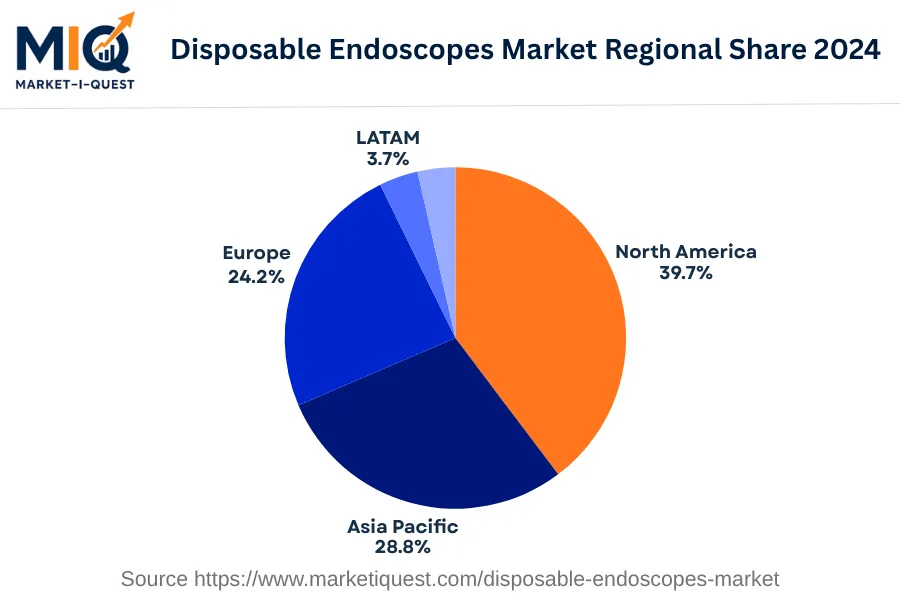
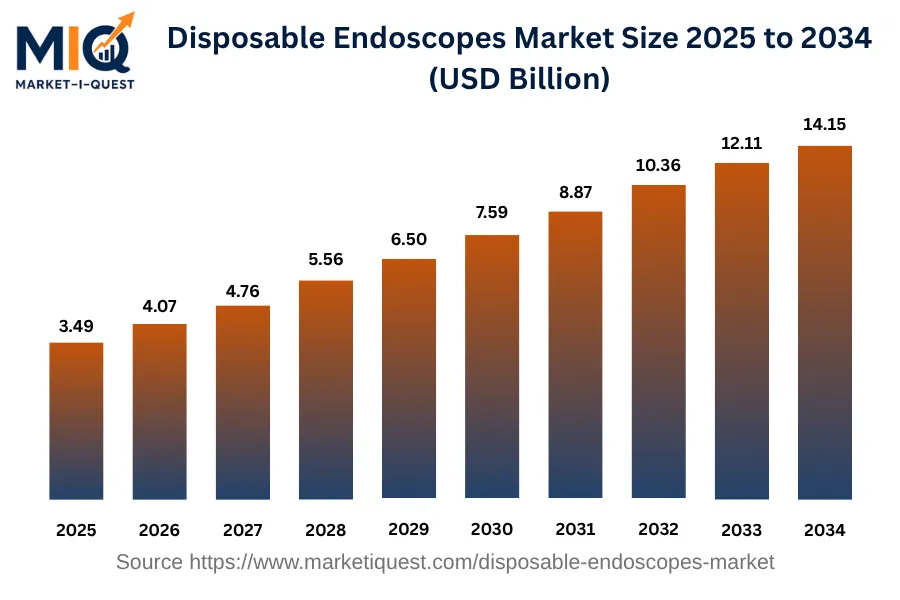
The Disposable Endoscopes Market was valued at USD 3.49 Billion in 2025, surging from a value of USD 2.98 Billion in 2024. By 2034, it is projected to reach a size of USD 14.15 Billion, growing at a Compound Annual Growth Rate (CAGR) of 16.84%. This remarkable market growth from 2025 to 2034 is primarily attributed to rapid technological advancements in medical image quality and the development of cost-effective disposable endoscopes. Moreover, the growing awareness of the transmission of infections due to reusable endoscopes also contributes to the swift uptake of disposable endoscopes, thereby driving the market forwards. On a regional basis in 2024, North America commanded a substantial market share of 39.72%, followed by Asia Pacific with 28.84%, Europe with 24.18%, Latin America with 3.69%, and the Middle East and Africa with 3.57%.

Key Takeaways

  • By Product Type - Bronchoscopes held the preeminent position in 2024.
  • By Clinical Use - Diagnostic led the market demonstrating a significant share in the same year.
  • By End Use - Hospitals emerged as the leading sector accounting for the majority market share in 2024.
disposable-endoscopes-market market size

Key Driving Factors

Infection Control Measures in Medical Facilities

One of the key driving factors for the disposable endoscopes market is the increasing emphasis on infection control in healthcare facilities. Institutions such as the Centers for Disease Control and Prevention (CDC) have established guidelines for the prevention of healthcare-associated infections. These guidelines have placed particular importance on the need for single-use or disposable medical devices like endoscopes. The use of disposable endoscopes reduces the risk of cross contamination between patients, as each device is used once and then safely discarded. As healthcare facilities continue to prioritize patient safety and adhere to stringent infection control standards, they are expected to increasingly incorporate disposable endoscopes into their device arsenals to help meet those objectives.

Stringent Cleanup and Sterilization Processes for Reusable Endoscopes

A second driving factor for the disposable endoscopes market is the labor-intensive and stringent cleanup and sterilization requirements for reusable endoscopes. After each use, reusable endoscopes must undergo rigorous washing, disinfection, and drying procedures to ensure they are safe for the next patient. These procedures are not only time-consuming, but also require technical skills and resources that could otherwise be allocated to patient care. Disposable endoscopes eliminate these cumbersome processes, as they are intended for single use. This time and resource saving characteristic of disposable endoscopes makes them an attractive option, especially for facilities with a high volume of endoscopic procedures or limited sterilization resources.

Market Evolution by Timeline

2019-2023
In this period, hospitals and diagnostic centers in urban areas predominantly purchased disposable endoscopes, specifically in North America and Europe. Reasons included the reduction of cross-infection risks and costly decontamination processes. Manufacturers focused on improving image quality and device flexibility. Integration of digitalization and artificial intelligence was in its formative stage, with logistical constraints in supply chain and distribution. No new major policy developments affected market operations during this period. Devices were typically priced based on usage and quality. Major manufacturers engaged in partnerships with healthcare providers for bulk supply agreements. The key challenge and risk in this period was the lack of trained professionals to operate these devices and an apparent digital divide in accessibility in comparably less-developed regions.
2024
Throughout 2024, increasing demand was seen from general clinics, especially in Asia - specifically China and India - because of their growing healthcare services. In terms of supply, advanced, high-resolution disposable endoscopes started being produced, though high cost and limited manufacturing facilities were constraints. A significant standard was the implementation of ISO 13485:2016 for Quality Management System, affecting manufacturers' compliance. Pricing strategies started shifting towards subscription models with partnerships between manufacturers and healthcare providers. The main risk in this period was the ever-looming threat of non-compliance with rapid advancements in global regulatory standards.
2025-2029
From 2025 to 2029, the need for disposable endoscopes expanded to rural healthcare centers and mobile clinics in South America and Africa. This was largely driven by the increased mobile health initiatives in these regions. Manufacturers were located mainly in industrialized nations, resulting in supply chain complexities. AI integration became more pronounced, improving diagnostic accuracy. The policy dominated this period was the EU's Medical Device Regulation (MDR) implemented in 2020, pushing manufacturers towards alignment. Ongoing trial-and-error in commercial models was common, with 'pay-per-procedure' models becoming popular. Procurement inefficiencies posed risks, heightening due to increasing demands in new markets.
2030-2034
By 2030-2034, disposable endoscopes were utilized extensively in teleconsultations globally. Driving factors included pandemic learnings and technological advancements. Production streamlined, focusing on low-cost, high-quality endoscopes catering to a wider demographic. The integration of AI and other digital solutions became the norm. The US FDA's Pre-market Approval (PMA) for certain devices became critical for manufacturers. Fixed contract agreements based on patient volume became a common commercial model. Increased attention was given to overcoming delivery and distribution challenges in remote areas for a wider reach. Cybersecurity emerged as a potent risk during this period, demanding stringent controls in place for securing patient data.

Future Market Outlook

Future Opportunities

The growing focus on patient safety and efficient healthcare delivery creates significant opportunities within the disposable endoscopes market. With the implementation of stricter hygiene protocols across healthcare facilities since 2020, the need for single-use endoscopic devices has surged, giving rise to partnerships between key players and healthcare providers. In 2022, Boston Scientific Corporation collaborated with regional healthcare systems to evaluate the clinical impact of disposable endoscopes, highlighting a shift in perception regarding reusable versus single-use devices. As more healthcare facilities explore ways to minimize healthcare-associated infections, the market potential for these devices becomes increasingly evident. Furthermore, advancements in material science, specifically biocompatible materials, are anticipated to support product durability while maintaining the disposable nature of these endoscopes. Opportunities also emerge from the expansion into emerging markets, where healthcare infrastructure improvements can allow for the integration of disposable endoscopy solutions. Countries like India and Brazil are witnessing rising investments in healthcare technology, as indicated by government initiatives aiming to improve medical facilities. Additionally, as regulatory bodies continue to evolve their guidelines, such as the FDA's focus on user-friendly designs, manufacturers can tailor their products to meet specific regional requirements, paving the way for market penetration and tailored solutions. These factors collectively suggest a promising future for disposable endoscopes in enhancing procedural efficiency and addressing key patient safety concerns on a global scale.

Segmentation Analysis

By Product Type

The market is divided into subsegments including Bronchoscopes, Cystoscopes, Duodenoscopes, Hysteroscopes, Laryngoscopes, Ureteroscopes, and Others. The Bronchoscopes segment accounted for the largest revenue share, while the Duodenoscopes subsegment is projected to grow at the fastest CAGR during the forecast period.

Largest Revenue Share

Bronchoscopes

Market Share Leader

The Bronchoscopes subsegment is leading the market in terms of revenue generation due to a variety of factors. A critical driver is the increase in respiratory diseases such as chronic obstructive pulmonary disease (COPD) and asthma, which require bronchoscopy procedures for diagnosis and treatment. Globally, the prevalence of these conditions is on the rise, creating a substantial market for bronchoscopes. More so, advancements in Bronchoscopy technology have enhanced the preference for bronchoscopic procedures in diagnosing and managing lung conditions which subsequently increases overall market revenue. In addition, regulatory approvals and the existence of supportive reimbursement policies in many developed regions creates an encouraging environment for the growth of this segment. A readily available customer base in high population countries coupled with a critical need for bronchoscopy procedures solidifies this subsegment's leading position. However, it's worth noting that the high costs associated with Bronchoscopes could pose a challenge to the market's success in low-income regions.

Fastest CAGR

Duodenoscopes

Forecast Period Growth Leader

The Duodenoscopes subsegment is poised for a rapid growth trajectory. This growth can be traced to various catalysts such as technological advancements and the increasing prevalence of duodenal conditions. Common disorders like Gastrointestinal bleeding, pancreatic and bile duct diseases often require duodenoscope-assisted procedures for diagnosis and intervention. This growing incidence rate drives the demand for duodenoscopes. Furthermore, increased investment in healthcare infrastructure, particularly in emerging economies, is expanding the reach and availability of intricate diagnostic procedures, such as those involving duodenoscopes, which fuels the subsegment's growth. Potential future partnerships between hospitals and duodenoscope manufacturers hold an avenue of expanded growth. However, the risk of infection from contaminated duodenoscopes and the high cost of these devices could potentially dampen the subsegment's growth rate if not addressed appropriately.

By Clinical Use

The market is divided into subsegments including Diagnostic and Surgical where the Diagnostic subsegment accounted for the largest revenue share while the Surgical subsegment is expected to grow at the fastest CAGR during the forecast period.

Largest Revenue Share

Diagnostic

Market Share Leader

The Diagnostic subsegment being the leader in revenue generation posits several reasons. One prominent factor can be linked to the global increase in disease prevalence, which has driven the requirement for early and accurate disease detection. Diagnostic services are the initial step in the patient care pathway, which assists in a proper medical decision-making process. This segment includes various medical examinations, blood tests, imaging, genetic tests, and other kinds of tests which play a crucial role in decision making about the required medical treatment. Additionally, widespread insurance coverage across developed regions that covers diagnostic procedures have contributed significantly to the revenue generation in this segment. This phenomenon has resulted in more people being able to afford diagnostic procedures, increasing the demand and revenue. Coupled with the rapid technological advancements in diagnostic tools leading to higher adoption, this segment dominates in terms of revenue.

Fastest CAGR

Surgical

Forecast Period Growth Leader

Although Surgical subsegments do not earn the most revenue, the segment is projected to have the fastest growth due to various emerging trends and factors. Advancements in technology have led to the widespread adoption of minimally invasive surgeries that offer reduced hospital stays, lower infection risks, and quicker recovery times. These factors have resulted in a significant demand surge for surgical procedures. Furthermore, increasing patient awareness and preference towards better quality of life are driving more patients to opt for surgical solutions to their health conditions. Additionally, effective governmental policies encouraging the adoption of newer surgical procedures and increased expenditure in healthcare sector are contributing to the fast-paced growth of this segment. However, this growth may be restrained by the costs associated with these advanced surgical procedures and a lack of skilled professionals to perform them.

By End Use

The market is divided into subsegments including Hospitals, Ambulatory Surgical Centers, and Others. Hospitals accounted for the largest revenue share while Ambulatory Surgical Centers are expected to grow at the fastest CAGR during the forecast period.

Largest Revenue Share

Hospitals

Market Share Leader

Hospitals are the largest revenue contributor in this sector due to a few key reasons. Hospitals typically have larger budgets and equipment capacities compared to other end-use segments like ambulatory surgical centers or other facilities. This allows them to purchase, maintain, and upgrade their equipment more frequently and in larger bulk. Additionally, hospitals handle a more diverse range of procedures and patient demographics, meaning they need to have a broad inventory of equipment at their disposal. The continuous operation, the high flow of patients and the wide variety of medical conditions treated in a hospital setting also contribute to increased equipment usage and hence, greater revenue generation. Geographically, well-funded hospitals in developed regions account for a significant portion of this revenue. However, hospital expansion in developing regions is also supporting this growth. It should be noted that the regulation of medical equipment in hospitals is quite stringent, and compliance with these regulations can be a determining factor in purchasing decisions.

Fastest CAGR

Ambulatory Surgical Centers

Forecast Period Growth Leader

Ambulatory surgical centers (ASCs) are predicted to be the fastest-growing subsegment. This growth is driven by several factors. First off, policy changes favoring outpatient care and an increasing trend of minimally invasive procedures are catalyzing a shift from hospitals to ASCs. The typical cost-effectiveness and convenience of ASCs compared to hospitals is also appealing to both patients and health insurers. In the near term, the adoption of ASCs can be accelerated by strategic partnerships with hospitals and health systems, thereby improving referral networks and patient accessibility. However, the adoption could be hindered by capital expenditure required for setting up such centers, especially sophisticated technologies. The near-term risks include an unexpected change in health policies or sudden technological obsolescence. While the revenue share is currently not as high as hospitals, the expected CAGR indicates a structural shift in the market dynamics.

Competitive Analysis

Key Market Players

Manufacturers / OEMs

Ambu A/S
Denmark
Boston Scientific Corporation
US
KARL STORZ SE & Co. KG
Germany

Key Suppliers & Raw Materials

Fortimedix Surgical B.V.
Netherlands
Conmed Corporation
US
Becton, Dickinson and Company
US

Distributors, Integrators & Channel Partners

Medtronic
Ireland
Stryker Corporation
US
Johnson & Johnson Services, Inc.
US

Porter’s Five Forces Analysis

A competitive analysis of the Disposable Endoscopes Market focusing on buyer/supplier power, substitutes, new entrants and industry rivalry.

Supplier Bargaining Power

High

Specialized components and stringent quality requirements make suppliers' bargaining power high.

Buyer Bargaining Power

Medium

Important purchasing decisions made by healthcare institutions allow moderate bargaining power.

Threat of Substitutes

Low

Unique functionality and limited alternatives result in low threat from substitutes.

Threat of New Entrants

Low

High capital investment, regulatory barriers and patent protection limit the threat from new entrants.

Competitive Rivalry

High

Competition among established players is high due to continuous technological innovation.

Regional Analysis

Geographic market dynamics and growth opportunities across key regions

Global Market Outlook

disposable-endoscopes-market market regional share

North America

In 2024, North America's Disposable Endoscopes Market exhibited a robust growth trend driven by several market dynamics. The market was driven initially by increasing healthcare investments in the region, particularly in the United States, enabling health facilities to adopt advanced technologies. Regulations on infection control also stimulated demand; disposable endoscopes provided an effective solution to mitigate cross-contamination risks in healthcare settings. Technology adoption was further fueled by factors such as creating more efficient workflows and reducing overhead costs associated with device sterilization. A rise in endoscopic procedures prompted manufacturers to ramp up production, enhancing supply dynamics. Pricing competitiveness among suppliers also spurred growth, making disposable endoscopes more accessible.

In terms of market trends, a shift towards minimally invasive surgical procedures was evident. This fueled a preference for disposable endoscopes, given their superiority in managing infection risks. In the healthcare sector specifically, partnerships and M&As were rife, as companies sought to capitalize on the market's growth prospects. For instance, prominent healthcare providers increasingly collaborated with leading device manufacturers in the United States. Further popularizing disposable endoscopes was the rise in enforceable standards and policies that favored their use over reusable options due to safety concerns.

Asia Pacific

In 2024, the Asia Pacific market for disposable endoscopes witnessed notable development owing to multiple factors. Increased investment in healthcare infrastructure, particularly in emerging markets like China, India, and key ASEAN countries, coupled with wider technology adoption, spurred market growth. Government regulations in Japan and Australia also heightened demand, prompting manufacturers to increase supply. Pricing dynamics varied across nations, underpinned by factors such as healthcare budgets and economic stability.

Customer buying behavior tended to favor technologically advanced, user-friendly disposable endoscopes, a notable trend across all Asia Pacific markets. Growing awareness of cross-contamination risks linked to reusable endoscopes induced a shift to disposable alternatives in hospitals and clinics. Innovative product launches drew enterprise-level interest, creating a ripple effect on channel dynamics. Partnerships and M&A activities were primarily concentrated in China, where large scale manufacturing capabilities attracted international brands. Regulatory bodies across the region, particularly in South Korea and Japan, enforced stringent quality and safety standards for disposable endoscopes, shaping the market's course. Accounts of product malfunction were treated with severity, prompting manufacturers to enhance product quality and safety. Consequently, the disposable endoscopes market in the Asia Pacific region experienced a transformational shift regarding regulatory adherence and risk mitigation in 2024.

Europe

In 2024, the European Disposable Endoscopes Market saw a marked surge in demand, driven primarily by the region's strong healthcare systems. Increased investment in healthcare technology, particularly in Germany and the United Kingdom, significantly boosted the market. Biomedical advancement was a key driver in Italy and Spain, as manufacturers sped up their adoption of advanced endoscopic technologies. Additionally, stricter regulatory compliance, especially in Nordics and Benelux, ensured high standards of patient safety, also stimulating market growth. Pricing remained competitive across Central & Eastern Europe, due to the rising supply dynamics.

Simultaneously, certain trends shaped the market landscape. These include the rapid shift towards remote patient monitoring, particularly visible in the healthcare sector. Hospitals across France and the United Kingdom led changes by embracing digital technology to monitor patients' health conditions. In addition, a significant rise in innovation partnerships and M&A activity was noted, mainly in Germany and France, to drive product development and geographical reach. Finally, policy enforcement, primarily concerning the disposal of medical waste, increasingly shaped business practices across all the covered regions, notably affecting the utilities and manufacturing sectors. These drivers and trends together shaped the European Disposable Endoscopes Market in 2024.

Latin America

In 2024, the disposable endoscopes market in Latin America surged, predominantly driven by evolving healthcare practices and technological advancements across Brazil, Mexico, Argentina, Colombia, Chile, and Peru. An increased demand for minimally invasive procedures amplified the utilization of disposable endoscopes. Regulatory pressure for reducing cross-contamination in healthcare settings also escalated the adoption of these devices. Investment from private and public sectors into healthcare infrastructure and technology saw an uptick, especially targeting endoscopy units, underpinning market growth.

Consumer preferences shifted towards single-use endoscopes due to their potential for lowering hospital-acquired infection risks. Digitalization and AI growth within endoscopy practice evidenced a pronounced trend in the base year, particularly in Brazil and Mexico, leading manufacturers to prioritize digital endoscopes development. Moreover, increased incidences of partnerships and mergers among endoscopy device manufacturers widened the reach and accessibility of disposable endoscopes across the region. Integral to these trends were policies enforcing high sterilization standards in hospitals and clinics, ensuring tighter adherence to quality regulations across the region, which, in turn, boosted overall demand for disposable endoscopes. Key sectors reaping benefits from these trends included government-owned hospitals, private healthcare practices, and specialized clinics dedicated to gastroenterology and pulmonology. The surge in market activity showcased the changing dynamics of the healthcare sector in LATAM nations.

Middle East & Africa

In the key year of 2024, the Disposable Endoscopes Market in the Middle East and Africa experienced substantial growth and transformation. This expansion was primarily driven by growing healthcare investments by governments, such as the Saudi Vision 2030 in Saudi Arabia aiming to boost medical device infrastructure. Similarly, the adoption of advanced medical technologies in countries like Israel and the United Arab Emirates significantly enlarged the market. The regulatory bodies' cohesive policies on efficacious healthcare improved the accessibility of disposable endoscopes, spurring further growth.

Changing trends played an equally critical role in market dynamics. As infection cases continued to rise, healthcare service providers began prioritizing the use of disposable endoscopes over reusable ones, promoting significant buyer behavior change. In Egypt and South Africa, industries saw a shift towards manufacturing these one-time-use medical devices, influenced by their demand. Increasing partnerships, such as the one between Nigeria's health ministry and international medical-equipment manufacturers, allowed for increased disposable endoscope accessibility and affordability. The relentless emphasis on maintaining robust procedural standards markedly changed policy enforcement, ensuring patient safety remained paramount. These market drivers and changing trends predominantly determined the landscape of Disposable Endoscopes Market in 2024 for the Middle East and Africa.

Recent Industry Developments

Latest market innovations, product launches, and strategic initiatives

June 2026

UroViu received FDA 510(k) clearance for its new cordless endoscope platform, which is compatible with the company’s portfolio of disposable endoscope cannulas, graspers, and biopsy forceps. UroViu has also filed a 510(k) application for a Wi-Fi-enabled model (UV5000W) for wireless connection to external displays.

January 2026

SciSparc acquired the patents for the MUSE system, a single-use device for treating GERD, marking its entry into the disposable endoscopes market. The company plans to replicate Xylo’s licensing model for global distribution, targeting the rapidly growing segment projected to reach $5.64 billion by 2030 at a 13.6% CAGR.

Frequently Asked Questions