
Dental Sterilization Market Snapshot

Key Players

  • STERIS plc (Ireland)
  • Sirona Dental Systems (Germany)
  • Planmeca Oy (Finland)
  • Dentsply Sirona Inc (USA)
  • Midmark Corporation (USA)
  • Nakanishi Inc. (Japan)
  • W&H Group (Austria)
  • SciCan Ltd (Canada)
  • Biolase Inc. (USA)
  • Tuttnauer Co. Ltd (Israel)

Market Size

Base Year 2024
$1.58 Bn
CAGR
8.6%
Forecast 2034
$3.61 Bn

Market Segments

By Product
  • Instruments
  • Consumables and Accessories
By End User
  • Hospitals
  • Dental Clinics
  • Others

Market Dynamics

Drivers
  • Increasing dental diseases
  • Advancements in sterilization technology
Restraints
  • High initial investment costs
  • Complex regulatory frameworks
Opportunities
  • Emerging dental technologies
  • Increasing oral health awareness

Market Size

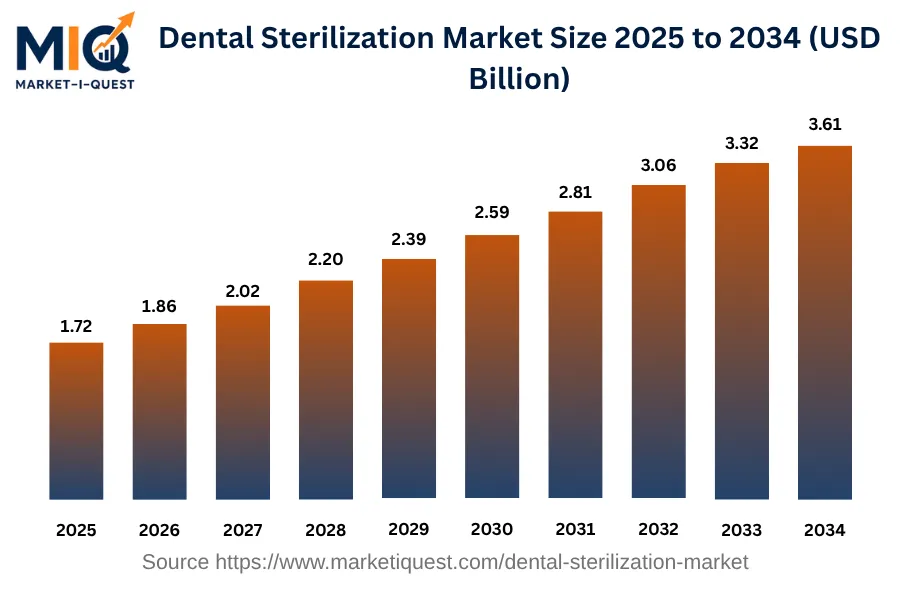
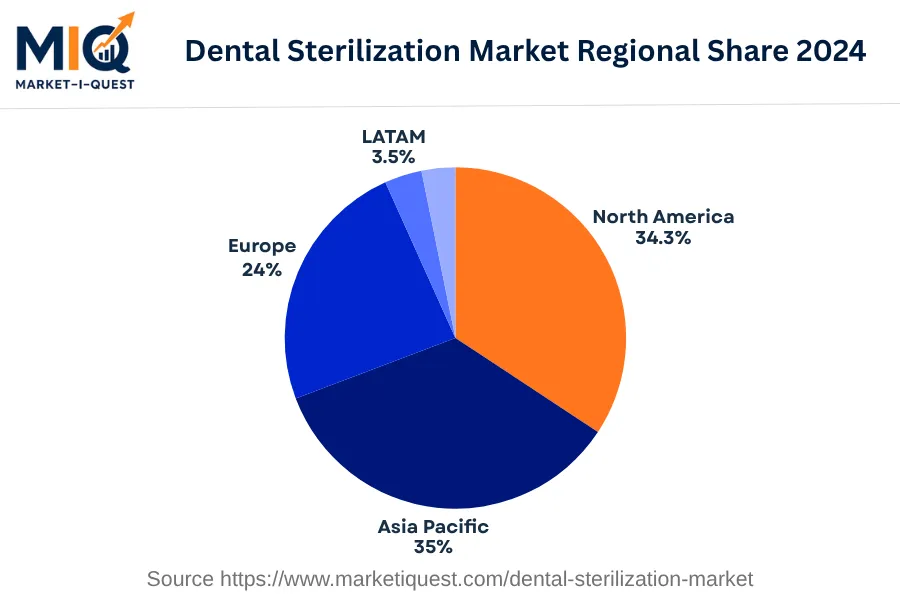
The Dental Sterilization Market is expected to grow from 1.72 billion USD in 2025 to a size of 3.61 billion USD by 2034, representing a Compound Annual Growth Rate (CAGR) of 8.6%. This solid growth trajectory fundamentally illustrates a steadily rising demand for dental sterilization methodologies throughout the period under review. A significant part of this growth pattern can be linked to a rise in the recognition of the importance of sterility in dental procedures. While in 2024 the market size stood respected at 1.58 billion USD, by 2025 it expanded to 1.72 billion USD, indicating a continued upswing over the succeeding years up to 2034. In terms of regional market share in 2024, North America took 34.3% of the Dental Sterilization Market, closely followed by Asia Pacific with a share of 35.0%. Europe held a smaller piece of the pie, having a share of 24.0% while Latin America and the Middle East and Africa had a minor fraction of the market, each contributing to 3.5% and 3.2% respectively.

Key Takeaways

  • By Product - Instruments dominated the market accounting for the largest share in 2024.
  • By End User - Hospitals held the largest share of the segment in the market in 2024.
dental-sterilization-market market size

Key Driving Factors

Stringent Regulatory Standards for Infection Control

The dental sterilization market is heavily influenced by the rigorous regulatory standards implemented to control infection. Organizations such as the Occupational Safety and Health Administration (OSHA) and the Center for Disease Control and Prevention (CDC) in the U.S, routinely update their guidelines for infection control, including sterilization procedures for dental instruments and surfaces. Changes to these guidelines can directly impact the nature and volume of sterilization products used in dental practices. A tightened regulation on infection control invariably necessitates improved and more frequent sterilization, thereby pushing the demand for sterilization products and equipment in the dental industry. It's noteworthy that due to the prevalence of airborne pathogens and the intimate nature of dental procedures, adherence to these regulations is not only mandatory but a quality determinant for dental practices.
Significant Rise in Oral Diseases Globally

There has been a substantial increase in the prevalence of oral diseases worldwide, such as dental caries, periodontal diseases, and oral cancer. Because these diseases often require invasive procedures for their treatment, these incidences significantly impact the dental sterilization market. High infection risk associated with these invasive procedures requires rigorous sterilization of both the instruments and the dental settings. Consequently, heightened incidences of dental issues lead to increased demand for sterilization products and equipment. Therefore, it's the high disease prevalence and subsequent rise in treatments requiring sterilization that provides a significant driving factor for the dental sterilization market.

Market Evolution by Timeline

2019-2023
During this period, the major buyers in the Dental Sterilization Market were primarily dental clinics, hospitals, and healthcare institutions in developed nations. User preference shifted towards automated dental sterilizers for their reliability and efficiency. The most remarkable technological trend was the introduction of high-precision heat sterilizers. However, these technologies were relatively new and required integration with existing dental equipment. The EU passed the Medical Devices Regulation (MDR) in 2020, putting increased focus on sterilization and infection control. Pricing trends tended towards bundling sterilization equipment with other dental hardware. Major risks included mismanagement of sterilization processes and procedural gaps, and were addressed through enhanced staff training and stricter procedural implementation.
2024
In 2024, emerging economies saw an expansion of dental healthcare facilities, leading to increased demand for sterilization equipment. Suppliers released cost-efficient sterilizers, allowing poorer countries to upgrade their dental sterilization methods. Yet, the integration of new technologies into existing procedures remained a challenge. No new policy or regulation specifically impacted the dental sterilization market this year. Economical pricing became an important strategy for companies, with extended warranties and service agreements becoming standard. Potential safety hazards from faulty sterilization equipment were the biggest risk, with companies addressing this risk through rigorous quality control and post-sale service.
2025-2029
This period saw the rapid adoption of dental sterilizers in Asia-Pacific countries, leading to a surge in demand. Efficiencies in the manufacturing process allowed suppliers to offer quality dental sterilizers at a lower cost, making them more accessible to less developed regions. The World Health Organization's Universal Health Coverage initiative strongly influenced this uptick in usage. Several manufacturers adopted subscription-based pricing models, providing regular maintenance and upgrades. The major risk was the potential shortage and disruption of supply chains due to geopolitical factors which companies mitigated by diversifying their supply sources.
2030-2034
This time period was characterized by widespread adoption of AI-guided dental sterilizers. Demand from Africa increased unexpectedly, driven by improved healthcare infrastructure. The main area of development in supply was automated sterilizers with AI integration. IC Medical Standards, a global regulator issued new safety standards for sterilization devices. Competitively priced leasing models encouraged widespread use. As AI technology was new, risks stemmed primarily from regulatory uncertainty and user trust issues. In response, companies ramped up user education, and worked closely with regulators.

Future Market Outlook

Future Opportunities

The expanding dental sterilization market presents numerous opportunities driven by regulatory changes and a growing emphasis on infection control. For instance, the World Health Organization has recommended stringent sterilization protocols in dental settings, leading to increased adoption of sterilization technologies across Europe and North America. As dental practices aim to comply with these evolving standards, partnerships between dental care providers and technology firms are anticipated to increase, fostering innovations in sterilization solutions tailored to specific procedural requirements. In 2023, Phillips Dental introduced an eco-friendly sterilant, opening pathways for sustainable practices within the market. Moreover, the growing awareness of infectious disease transmission, highlighted by the COVID-19 pandemic, has prompted dental practices to seek more effective sterilization methods. The FDA's 2022 report on infection control protocols in dental clinics intensified the focus on investing in state-of-the-art sterilizers and training for staff. Additionally, as dental procedures become more complex, the demand for customizable sterilization solutions that cater to specialized instruments is likely to rise. The integration of digital technologies for monitoring and documenting sterilization processes presents another opportunity, with companies like 3M developing solutions that enhance traceability and compliance. These evolving requirements are fostering a favorable environment for technological advancements, robust partnerships, and the establishment of innovative products in the dental sterilization segment worldwide.

Segmentation Analysis

By Product

The market is divided into subsegments including Instruments, Consumables and Accessories. Instruments accounted for the largest revenue share, while Consumables are expected to grow at the fastest CAGR during the forecast period.

Largest Revenue Share

Instruments

Market Share Leader

In the base year of 2024, the Instruments subsegment made the most revenue in the Products market segment. This can be credited to the high demand for various types of instruments in different industries, aided by the continual growth of the global economy and panel of industries. High investments in R&D by instrument manufacturers coupled with a growing emphasis on accuracy and precision in various operations have also contributed majorly toward Instruments' market dominancy. Furthermore, the demand for instruments is also driven mostly by end-user industries including healthcare, manufacturing, automotive, and defense. Strict regulations, especially in healthcare and manufacturing sectors continually push for better and more precise instruments, thus bolstering the growth of this subsegment. Another reason why Instruments lead the market is due to the high switching and replacement costs associated with these products, making customers reluctant to switch brands and maintain a steady source of revenue for this subsegment.

Fastest CAGR

Consumables

Forecast Period Growth Leader

Despite being outperformed revenue-wise by Instruments in 2024, the Consumables subsegment holds promising growth prospects in the upcoming years and is expected to grow at the fastest CAGR. Factors contributing to this include the consistent demand for consumables across various sectors. Their affordability compared to Instruments also makes them more accessible and therefore, more adopted across different sectors. Technological advances are also playing a huge role. Suppliers are increasingly turning to technology to improve product quality in response to the increasing expectations of consumers seeking higher quality consumables. Partnerships with tech companies also hold potential in driving growth, enabling suppliers to capitalize on technological advancements while sharing the risks and costs of development. However, higher quality often comes with a higher price tag, creating a barrier for adoption among cost-sensitive consumers. To achieve considerable growth, suppliers need to balance between cost and quality.

By End User

The market is divided into subsegments including Hospitals, Dental Clinics and Others. Of these, Hospitals accounted for the largest revenue share while Dental Clinics is expected to grow at the fastest CAGR during the forecast period.

Largest Revenue Share

Hospitals

Market Share Leader

Hospitals dominate the revenue share in 2024, primarily rooted in the sheer volume of operations and high demand for medical services that they facilitate. Equipped with multiple departments and staffed with a large number of professionals, they inherently draw in substantial income. Additionally, hospitals offer a wide variety of services, ranging from basic health check-ups to complex surgeries, which expands their customer base. The geographical diversity of these establishments further intensifies their reach, ensuring steady revenue streams as they cater to both urban and rural populations. Regulatory policies have also spurred the proliferation of hospitals, with governments lending significant support and investing in healthcare infrastructure. These robust framework conditions enable hospitals to incessantly upgrade their offerings, drawing in more customers and, by extension, more revenue. Ongoing partnerships with medical equipment manufacturers, pharmaceutical companies and health tech firms also play into the hands of hospitals, offering gateways into new innovations and amplifying their service excellence.

Fastest CAGR

Dental Clinics

Forecast Period Growth Leader

Though smaller in scale, Dental Clinics are showing rapid growth, driven largely by increasing awareness of oral hygiene and growing prevalence of dental disorders. Coupled with this is people's rising disposable income, allowing more to invest in preventative and cosmetic dental procedures. Furthermore, advancements in dental technology have catalysed the evolution of procedures, making treatments more efficient and less invasive. This has resulted in a surge in the acceptance and adoption of dental services, consequently propelling the growth of dental clinics. However, this growth could face challenges in the near term, including high capital expenditure and stringent regulatory standards. Moreover, the lack of skilled professionals in the industry might also act as a barrier. Yet, persistently rising demand for dental services is likely to outweigh these potential setbacks, sustaining the robust growth of Dental Clinics. Partnerships with dental schools and training institutions, as well as with medical equipment manufacturers, are seen as promising strategies for overcoming these hurdles.

Competitive Analysis of the Dental Sterilization Market

Key Market Players

Manufacturers / OEMs

Danaher Corporation
US
Dentsply Sirona Inc
US
Planmeca OY
Finland

Key Suppliers & Raw Materials

3M Company
US
Coltene Group
Switzerland
Mitsui Chemicals
Japan

Distributors, Integrators & Channel Partners

Henry Schein Inc
US
Patterson Dental Supply Inc
US
Benco Dental Supply
US

Porter’s Five Forces Analysis

The following analysis showcases the dynamics and competitiveness of the Dental Sterilization Market.

Supplier Bargaining Power

Medium

Suppliers hold moderate power due to the dependence on advanced technologies and high-quality materials for dental sterilization.

Buyer Bargaining Power

Low

Buyers face high costs of switching between suppliers, limiting their bargaining power.

Threat of Substitutes

Low

The threat of substitutes is low due to the crucial nature of dental sterilization for patient safety.

Threat of New Entrants

Medium

Entry to the market is possible yet challenging due to regulatory scrutiny and substantial capital outlay.

Competitive Rivalry

High

High due to presence of multiple established players constantly innovating for market share.

Regional Analysis

Geographic market dynamics and growth opportunities across key regions

Global Market Outlook

dental-sterilization-market market regional share

North America

In 2024, North America's dental sterilization market flourished as the demand for stringent infection control in dentistry surged. Key drivers centered around increased investment in dental practices, the imminence of regulatory compliance in sterilization procedures and the flourishing adoption of advanced sterilization technologies. The implementation of the CDC sterilization protocols became mandatory in dental practice, propelling the need for specialized sterilizing equipment. An inflow of capital invested in upgrading dental clinics particularly across the US and Canada spurred demand for efficient sterilization devices. Novel sterilization technologies like single-use devices and ultraviolet germicidal irradiation saw increased adoption in Mexico, reflecting an attempt towards standardization in sterilization measures.

Conspicuous trends shaping the dental sterilization market included a shift towards the digitalization of sterilization processes, the inception of strategic partnerships and rising quality standards. The digitization wave evident across healthcare echoed in dentistry with smarter sterilization solutions gaining traction. Partnerships between sterilization equipment providers and dental clinics amplified, especially in the US, optimizing clinic efficiency and patient safety. Enforcement of stringent safety norms by regulatory bodies across North America catalyzed the adoption of high-quality sterilization methods. The growing consumer awareness about cross-infection risks in dental setups necessitated rigorous sterilization control, indicating an upscale in client-driven accountability in the dental sector.

Asia Pacific

In 2024, the dental sterilization market in the Asia Pacific region represented a substantial segment within the overall healthcare field. Rapid urbanization and increasing healthcare expenditure were the predominant drivers, particularly in emerging markets such as China and India. The push for advanced infection prevention measures boosted the demand for dental sterilization procedures. Regulatory bodies especially in Japan and South Korea, prioritized stringent sterilization standards, instigating a surge in technological adoption across dental healthcare centers.

Technological innovations in sterilization procedures became a prominent trend with countries like Australia leading in the adoption of modern sterilization equipment. E-commerce emergence saw the shift of procurement channels, enabling convenient access to sterilization materials, particularly for booming private dental practices. Key ASEAN markets saw increased partnerships between dental institutions and sterilization solution providers, aiming at ensuring stringent adherence to sterilization standards.

Sectors that prominently contributed to the dental sterilization market comprised healthcare and enterprise sectors. Government policies, particularly in China and India, reinforced the demand for dental sterilization. Meanwhile, the retail sector, accounting for a considerable share in Australia and key ASEAN markets, contributed to the supply side of the market, playing an instrumental role in shaping market dynamics. Overall, robust regulations and evolving technology marked the dental sterilization market dynamics in Asia Pacific in 2024.

Europe

In 2024, the European Dental Sterilization Market saw noteworthy changes driven by several key factors. Increased focus on maintaining hygiene in dental clinics throughout Germany, the United Kingdom, France, Italy, Spain, the Nordics, Benelux, and Central & Eastern Europe contributed to the demand. Regulatory laws aimed at reducing infections in healthcare settings, particularly in the dental sector, continued to drive market growth. Investment in advanced sterilization equipment such as autoclaves was significant, with Italy and Spain leading the way. New technology adoption saw an uptake, particularly in Central and Eastern Europe, modifying the supply dynamics.

Simultaneously, a shift in buyer behavior was observed, with an increase in preference for high-tech, digitally integrated models, notably in Germany and the UK. A trend of partnerships and M&A activities shaped the competitive landscape of the dental sterilization market in Europe, aiming to increase market shares and strengthen distribution networks. In terms of channel dynamics, there was a significant move towards online platforms for procuring dental sterilization equipment in the Nordics and Benelux regions. Policy enforcement became stricter, especially with regards to the use of sterilization products in healthcare settings, leading to a more regulated marketplace. This significantly impacted sectors such as healthcare, utilities, and manufacturing, increasing their stake in the market.

Latin America

In 2024, the dental sterilization market witnessed considerable traction in many Latin American countries, particularly Brazil, Mexico, Argentina, Colombia, Chile, and Peru. A few key drivers that shaped the market included the rising prevalence of dental diseases among these nations, heightened awareness of oral hygiene, the implementation of strict healthcare regulations, and an increased investment in dental infrastructure by governmental and private entities.

New dental disease treatments and innovative sterilization technologies represented significant trends within the LATAM market. In response to burgeoning dental disease incidences, the uptake of advanced dental sterilization products, such as autoclaves and ultrasonic cleaners, noticeably increased. Concurrently, the adoption of digital dentistry, exemplified by 3D imaging and computer-aided design and manufacturing (CAD/CAM) systems, gained momentum. These trends resulted from their potential to improve treatment outcomes and the patient experience.

Operational efficiency has driven clinics and hospitals, which comprise the main customer sectors, to invest in high-speed sterilization technologies. Consequently, partnerships and mergers & acquisitions witnessed an uptick as companies strategized to manufactured region-specific products. This alignment of their offerings with existing health policies further enforced regulatory compliance. Thus, already in 2024, the LATAM dental sterilization market was shaped by strong regulatory dynamics, advanced technology adoption, increasing disease burden, and a strategic corporate focus towards market-specific products.

Middle East & Africa

In the base year 2024, the Dental Sterilization Market witnessed considerable traction in the Middle East and Africa, largely driven by expanding healthcare infrastructure and stringent sterilization regulations. Saudi Arabia and UAE, with their rapidly growing healthcare sectors, witnessed soaring demand for dental sterilization, fostered by government investments and adoption of advanced sterilization technologies. In Egypt and South Africa, increased awareness about oral health prompted a surge in demand, while supply dynamics were major drivers in Nigeria and Kenya.

Key trends shaping the market included a sizeable shift towards automation in dental sterilization, notably in Israel and Qatar with high-tech healthcare setups. A noticeable buyer behavior involved an increased preference for advanced, non-toxic sterilization methods, particularly in Saudi Arabia and UAE due to stringent policy enforcement. South Africa saw a rise in partnerships and Mergers & Acquisitions within the dental sector to cater to the growing consumer demand, and new dental sterilization standards introduced in this region prompted other countries to follow suit. On another note, the healthcare sector in Nigeria and Kenya ambitiously engaged in technology adoption, striving to improve their dental sterilization practices. A critical balance between demand factors, regulations, and supply dynamics formed the bedrock of this sector's growth in the Middle East and Africa during 2024.

Recent Industry Developments

Latest market innovations, product launches, and strategic initiatives

January 2026

Midmark Corporation expanded commercial rollouts for its Next Generation Midmark Steam Sterilizers (including the M9 and M11 models). The updated autoclave ecosystem utilizes specialized digital data loggers to automate audit compliance, directly syncing sterilization cycle metrics and diagnostics to cloud tracking platforms.

Frequently Asked Questions