
Dental Lasers Market Snapshot

Key Players

  • BIOLASE Inc. (United States)
  • Danaher Corporation (United States)
  • Fotona D.o.o. (Slovenia)
  • AMD Lasers (United States)
  • Sirona Dental Systems Inc. (Germany)
  • The Yoshida Dental Mfg. Co. Ltd. (Japan)
  • Lumenis Ltd. (Israel)
  • A.R.C. Laser GmbH (Germany)
  • Ivoclar Vivadent AG (Liechtenstein)
  • Zolar Technology & Mfg Co. Inc (Canada)

Market Size

Base Year 2024
$0.476 Bn
CAGR
8.47%
Forecast 2034
$1.073 Bn

Market Segments

By Product
  • Dental Surgical Lasers
  • Dental Welding Lasers
By Application
  • Conservative Dentistry
  • Endodontic Treatment
  • Oral Surgery
  • Implantology
  • Peri-implantitis
  • Periodontics
  • Tooth Whitening
By End User
  • Hospitals
  • Dental Clinics
  • Others

Market Dynamics

Drivers
  • Increasing prevalence of dental diseases
  • Technological advancements in dental procedures
Restraints
  • High equipment costs
  • Lack of skilled professionals
Opportunities
  • Technological advancements in dental procedures
  • Growing awareness towards oral hygiene

Market Size

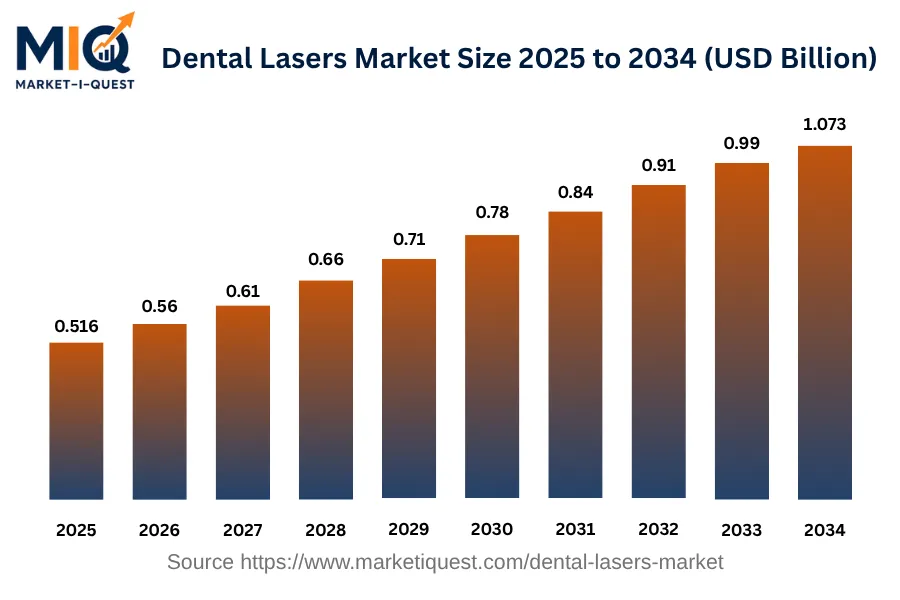
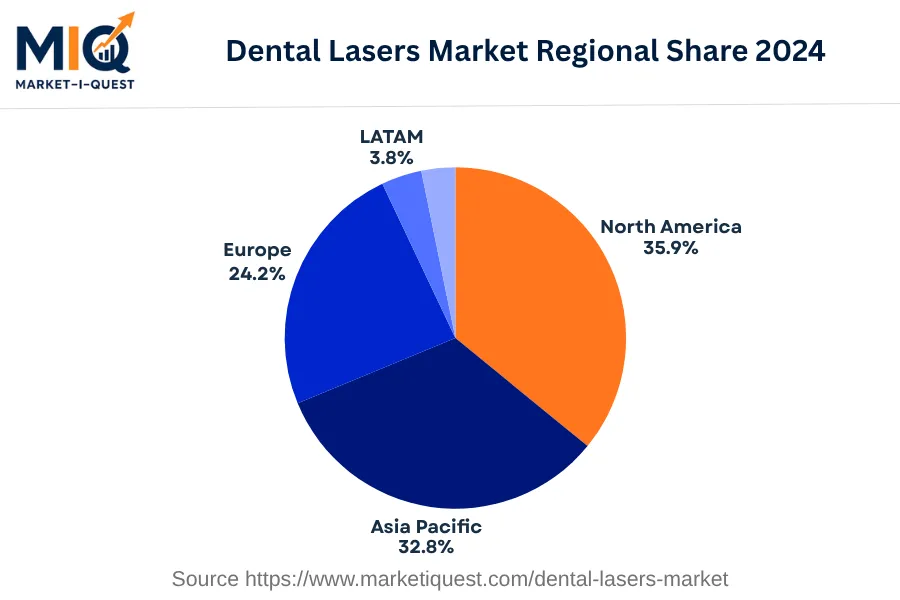
The Dental Lasers Market size stood at 0.52 billion USD in 2025, increasing from 0.48 billion USD in 2024. By 2034, the market size is projected to reach 1.07 billion USD, growing at a compound annual growth rate (CAGR) of 8.47%. This sustained growth over a decade is primarily attributed to the rising demand and advancement in dental laser technology. Additionally, more dental practitioners are adopting laser technology due to its benefits such as faster recovery time, less bleeding, and less damage to surrounding tissues which contributes to the expansion of the market size. In 2024, the regional share of the Dental Lasers Market was distributed as follows: North America held 35.9%, Asia Pacific contributed 32.84%, Europe accounted for 24.21%, while LATAM and MEA had smaller shares of 3.83% and 3.21% respectively.

Key Takeaways

  • By Product - Dental Surgical Lasers led the market accounting for the highest share in 2024.
  • By Application - Oral Surgery held a dominant position in 2024.
  • By End-user - Hospitals led the market in 2024.
dental-lasers-market market size

Key Driving Factors

Adoption of Minimally Invasive Procedures

In recent years, the desire to reduce patient discomfort during dental procedures has encouraged the adoption of minimally invasive techniques in dentistry, effectively driving the dental lasers market. Dental lasers, compared to traditional oral surgical methods, provide patients with less pain, fewer infections, and quicker recovery periods. Dentists are motivated to give their patients a comfortable, pain-free experience, thus they have been adopting dental lasers which favor minimally invasive procedures. Dental laser technology is steadily gaining acceptance due to these benefits, resulting in its market expansion. The embrace of this technology varies depending upon the geographic region, available funds for technologic investments, and level of education and technical skill among practicing dentists.
Stringent Regulatory Standards for Dental Treatments

Enhanced scrutiny and an increase in regulatory standards for dental procedures and devices are becoming significant factors propelling the dental lasers market forward. Regulatory bodies such as the U.S. Food and Drug Administration (FDA) and European Medicines Agency (EMA) have stringent requirements for approving dental devices, including lasers. These agencies require that these devices should not only be safe and effective, but also should reflect improvement over existing treatments or products. Hence, market players that develop dental laser products focus on achieving these standards, which facilitates advancements in the technology. The laser technology's ability to meet these high standards then drives their acceptance and use in dental treatments, contributing to the growth of the market.

Market Evolution by Timeline

2019-2023
The period from 2019–2023 saw North America dominating the Dental Lasers Market, underpinned by tech-savvy dental professionals and higher patient affordability for dental procedures. Common end-use case was in periodontics and conservative dentistry. On the supply end, manufacturers like Biolase and Dentsply Sirona reported frequent product launches to focus on ease of use and procedure versatility. However, the High upfront costs of dental lasers posed a restraint. FDA regulations were influencing the adoption through safety standards for handheld lasers. Bundled package systems, which included training and maintenance, emerged as popular procurement model. Towards the end of period, there were visible risks of market saturation in higher income regions like the USA and Canada.
2024
In 2024, demand from the Asia-Pacific broke out as essential buyer segment for Dental Laser companies, driven by higher disposable incomes, improving healthcare infrastructure, and the growing number of dental practitioners. Dental clinics formed the primary sales channel in this region. Diode lasers, known for portability and affordability, were strong selling products. However, laser-assisted new attachment procedure (LANAP) played a significant role in the growth of Nd:YAG lasers. Regulatory support increased in Asian markets with local regulatory authorities specifying operational safety standards that impacted product design and usage guides. The volatility in raw materials supply witnessed during the year did impact the manufacturing cycle.
2025-2029
Between 2025 and 2029, there was substantial growth in the utilization of Dental Lasers in the North American region in cosmetic dentistry and dental aesthetics owing to the rapidly increasing demand for improvement of smile aesthetics. On the supply side, more compact and portable dental lasers were brought to market. Laser manufacturers highlighted ease-of-integration as a key feature for dentistry practices. Affordability emerged as a key commercial model with most manufacturers opting for competitive pricing strategies. Despite this, risks associated with the competence of the practitioner in handling lasers was noted by the industry, leading to stricter regulations and certification requirements.
2030-2034
By 2030–2034, the European Union saw increased application of lasers in dental practices, driven by rising geriatric population and their need for corrective and restorative dentistry. In terms of supply, manufacturers targeted the Orthodontics and Endodontics sectors with specially designed lasers. Regulations also evolved with EU's Medical Device Regulation (MDR) enforcing stricter evaluations. Performance based pricing models began gaining traction with insurers and healthcare providers initiating tie-ups. The lack of standardized guidelines in operating procedures, however, posed challenge in the standardization of dental laser practices which demanded structured educational programs for the practitioners.

Future Market Outlook

Future Opportunities

The dental lasers market presents several new opportunities driven by ongoing technological developments and regulatory changes. In March 2023, the FDA approved the use of lasers for hard tissue procedures, expanding the range of applications for dental lasers and attracting new manufacturers to invest in product development. As patient awareness regarding oral health issues continues to rise, dental practitioners are looking for advanced solutions. This trend is evident as the World Health Organization emphasizes preventive care to combat dental diseases, creating demand for effective tools like lasers. Moreover, ongoing partnerships between dental technology companies and educational institutions are likely to foster a pipeline of innovations; for example, a collaboration announced in January 2023 between the University of Illinois and a software company aims to create a training module for laser applications, expected to broaden the skill set of dental professionals. Training initiatives by prominent industry bodies, such as the International Association for Dental Lasers, are expected to enhance the credibility and utilization of dental lasers across diverse applications. The augmentation of telehealth capabilities, which surged during the COVID-19 pandemic, may also catalyze remote consultations involving laser technology. As regulatory frameworks continue evolving, particularly in emerging markets like Southeast Asia, a rise in laser-adopting clinics can be anticipated, bolstering the overall dental care ecosystem.

Segmentation Analysis

By Product

The market is divided into subsegments including Dental Surgical Lasers and Dental Welding Lasers, with Dental Surgical Lasers accounting for the most significant revenue share while Dental Welding Lasers is estimated to grow at the fastest CAGR during the forecast period.

Largest Revenue Share

Dental Surgical Lasers

Market Share Leader

Dental Surgical Lasers represents the subsegment with the highest revenue, a trend attributable to its wide-ranging applications in periodontology, endodontics, and oral surgery. These instruments simplify complex procedures and provide patients with less invasive alternatives, driving up demand. Besides, the prevalence of oral diseases demands robust and efficient diagnosis and treatment solutions, leading to a surge in Dental Surgical Lasers usage. The emphasis on precision in dental procedures has facilitated technological advancements, adding to this subsegment's popularity. Furthermore, the streamlining of dental practices globally and the development of laser dentistry standards in developed countries contribute to this growth. As the uptake of advanced dental technologies furthers in developing geographies, Dental Surgical Lasers can expect a sustained revenue lead. However, the high cost of these lasers could impact the subsegment's growth rate in price-sensitive markets.

Fastest CAGR

Dental Welding Lasers

Forecast Period Growth Leader

Dental Welding Lasers are projected to experience the fastest growth rate. The imminent evolution towards digitization in the dental industry acts as a significant enabler for this subsegment—the use of these lasers simplifies the joining of small parts, improving dental lab workflow efficiency. Technological advancements have broadened their application range, including implantology and orthodontics, spurring demand. The rising disposable income and growing consumer consciousness about oral hygiene and aesthetics induce more dental procedures requiring Dental Welding Lasers. Besides, the market may encounter a catalyst in the form of partnerships or mergers among key players, introducing innovative solutions. The major obstacle to this subsegment's growth lies in the initial high investment, which may deter small and medium-sized dental practices. Therefore, the affordability factor might pose a near-term risk.

By Application

The market is divided into subsegments including Conservative Dentistry, Endodontic Treatment, Oral Surgery, Implantology, Peri-implantitis, Periodontics, and Tooth Whitening. Oral Surgery accounted for the largest revenue share while Tooth Whitening is expected to grow at the fastest CAGR during the forecast period.

Largest Revenue Share

Oral Surgery

Market Share Leader

Oral Surgery emerged as the leading subsegment in terms of revenue generation in the application sector of the market in 2024 given its essential role in addressing important oral health issues. The prevalence of various dental issues requiring surgical intervention, such as impacted teeth removal, corrective jaw surgery, and oral cancer diagnosis and treatment, has driven the demand for oral surgery, thereby boosting its revenue share. Furthermore, the increased awareness of oral health, especially in developed countries, has facilitated the accessibility and availability of oral surgery services. The ability to charge premium prices for these procedures due to their complex nature and cost-intensive equipment also contributes to the high revenue generated. Additionally, the stringency of dental regulations globally encourages individuals to seek professional oral healthcare services, subsequently contributing to the Oral Surgery subsegment dominance.

Fastest CAGR

Tooth Whitening

Forecast Period Growth Leader

The Tooth Whitening subsegment is anticipated to register the highest growth rate in the forecast period. This growth is primarily driven by rising consumer interest in cosmetic dentistry and improved self-consciousness about dental aesthetics. The proliferation of over-the-counter tooth whitening products together with professional tooth whitening treatments offered by dental clinics provides a range of options for consumers seeking to improve their dental appearance. Furthermore, advancements in dental technology have made tooth whitening procedures more effective and safer, thereby encouraging more consumers to opt for these treatments. However, the potential risks of tooth sensitivity and gum irritation associated with tooth whitening treatments might act as barriers to its adoption. Thus, continued research and development to mitigate these risks and enhance the comfort of these procedures are of paramount importance.

By End User

The market is divided into subsegments including Hospitals, Dental Clinics, and Others. Hospitals accounted for the largest revenue share while Dental Clinics is expected to grow at the fastest CAGR during the forecast period.

Largest Revenue Share

Hospitals

Market Share Leader

Hospitals form the largest subsegment within the end user market, due to their vast infrastructural capacity and the ability to cater to a wide variety of medical needs. Hospitals traditionally have larger purchasing power and the ability to provide comprehensive care, including complex procedures and inpatient services that aren't typically offered by smaller practice groups like dental clinics. As such, hospitals' need for a wider variety of medical equipment, pharmaceutical products, and healthcare technologies fuels their large revenue share in this industry. These realities in combination with increasing regulatory pressures for hospitals to adopt advanced healthcare technologies largely explains their significant market position. Looking ahead, we note that the demand for care within hospital settings will continue to be strong given the importance of hospitals in acute care delivery, particularly as populations age and the incidences of chronic conditions increase.

Fastest CAGR

Dental Clinics

Forecast Period Growth Leader

Despite hospitals' larger revenue share, dental clinics stand out as the subsegment with the fastest projected growth rate. This can be attributed to several factors including a growing awareness and attention towards dental health, technical advances in dentistry, increased healthcare spending, and rising disposable income. Modern technology breakthroughs including laser dentistry and 3D imaging are revolutionizing dental care, bringing about improvements in diagnosis and treatment. These advancements coupled with a generally lower barrier of entry as compared to hospitals allow for the rapid proliferation of dental clinics. however, the expansion of the subsegment may face hurdles from cost-concerns and lack of insurance coverage for many dental procedures. It is also important to note that potential policy decisions could impact how dental clinics are allowed to operate in the future.

Competitive Analysis for Dental Lasers Market

Key Market Players

Manufacturers / OEMs

Biolase, Inc.
US
SIRONA DENTAL SYSTEMS, INC.
US
AMD Lasers
US

Key Suppliers & Raw Materials

NKT Photonics A/S
Denmark
Oclaro, Inc.
US
II-VI Optical Systems
US

Distributors, Integrators & Channel Partners

Patterson Dental Supply Inc.
US
Henry Schein, Inc.
US
Dental Health Products, Inc.
US

Porter’s Five Forces Analysis

Analysis of the dental lasers market using Porter’s Five Forces, considering the various market dynamics.

Supplier Bargaining Power

Medium

Limited suppliers but high product specificity affects the supplier bargaining power.

Buyer Bargaining Power

Medium

Buyers have moderate power due to various dental laser product options available.

Threat of Substitutes

Low

Few substitutes are available, as dental lasers are technologically advanced.

Threat of New Entrants

High

Technology advancements and investments in dental healthcare sector increase threat of new entrants.

Competitive Rivalry

High

Strong competition among existing players due to technological innovations and brand reputations.

Regional Analysis

Geographic market dynamics and growth opportunities across key regions

Global Market Outlook

dental-lasers-market market regional share

North America

In the base year of 2024, the North American Dental Lasers Market was witnessing significant growth driven by diverse factors. First, high rates of dental disorders necessitating laser treatments spurred market demand in the U.S., Canada, and Mexico. Second, government regulations like the U.S. Food and Drug Administration's approval of dental lasers for various treatments bolstered technology adoption across the region. Finally, there was a clear preference for non-invasive surgical procedures among patients, thereby driving demand for dental lasers.

Several trends were identifiable within the dental lasers space throughout 2024. Notably, a prominent shift toward diode lasers, particularly among specialist practitioners in the United States, was due to their effective results and versatility. Within healthcare settings, the move towards digitization and use of advanced technologies to improve patient outcomes also impacted the adoption of dental lasers. Furthermore, strategic partnerships between dental institutions and technology providers were playing a key role in propelling the dental lasers market, whereby providers were training dental professionals in utilizing the latest techniques and advancements. Sector-wise, private practices represented a significant customer base due to the nature of the technology and its application in performing complex dental procedures.

Asia Pacific

In 2024, the Dental Lasers Market in the Asia Pacific was characterized by increased uptake and robust growth, led by key markets such as China, India, Japan, South Korea, Australia, and key ASEAN countries. Driving this expansion were factors like the rising prevalence of dental disorders, large-scale investment in healthcare infrastructure, positive regulatory scenario, and the increasing sophistication of dental laser technology itself.

In China and South Korea, government initiatives aimed at improving oral health were instrumental in driving demand. India saw significant private sector investment in dental clinics, bolstering access to, and the use of, laser technology. Advanced Australian practitioners adopted newer laser types like diode lasers and All-Tissue lasers, impacting supply dynamics.

Trends in the Asia Pacific dental lasers market revolved around patient preferences and technological innovation. There was a noticeable shift towards minimally invasive dental procedures and quick recovery, making dental lasers a favored choice across patient demographics. In Japan and key ASEAN markets, sales of dental lasers through e-commerce platforms gained traction, reflecting a change in channel dynamics. Partnerships amongst laser manufacturers and dental clinics to deliver advanced care marked the competitive landscape. In terms of standardization, countries like China and Australia enforced stricter regulations on the quality and safety of dental laser devices. The overall market response was geared towards increased technology adoption to enhance dental care services.

Europe

In 2024, the dental lasers market in Europe witnessed significant growth. Drivers included increased demand for minimally invasive dental treatments, improved investment in dental infrastructure, and technological advances. Countries such as Germany, the United Kingdom, France, Italy, and Spain demonstrated notable market growth due to heightened dental health awareness and sophisticated healthcare systems. Particularly in Germany, technological adoption was accelerated by government support and the presence of key market players. On the other hand, cost constraints and lack of adequate reimbursement policies limited market growth in Central and Eastern Europe. Stringent regulations in Benelux and the Nordics put a temporary halt to market growth.

Market trends were largely shaped by shifts in patient preference towards painless and efficient dental procedures. This led to the widespread adoption of dental lasers in cosmetic dentistry and periodontics, primarily in private practice and specialized dental clinics. The development of compact, portable dental lasers increased product accessibility, even for remote and rural healthcare providers. Moreover, key players have leveraged strategic partnerships and mergers to expand their market footprint and sustain competitive advantage. These alliances have fostered technology transfers and boosted innovation within the dental lasers market. As regulatory bodies continue to enforce medical device standards, safety and efficacy remain central to product development and demand strategies across Europe.

Latin America

In 2024, the Dental Lasers Market in Latin America experienced a notable growth impelled by a combination of contributing factors. Increasing health awareness, better insurance coverage, and rising disposable income led to a surge in demand for non-invasive dental procedures. Governments in Brazil, Mexico, Argentina, Colombia, Chile, and Peru introduced regulations endorsing the application of advanced dental treatments, including the use of dental lasers. These regulations, coupled with substantial investment in healthcare infrastructure, propelled the adoption of modern dental equipment. Consolidation of suppliers also intensified the supply dynamics, resulting in relatively competitive pricing in this market segment.

Shifts in purchasing tendencies were also discernible. Patients increasingly preferred laser-assisted treatments over traditional approaches due to their precision, less pain, and speedy recovery time. This preference notably influenced the technological shifts towards such advanced dental technologies. An uptick in strategic partnerships and mergers & acquisitions was observed among the key players in the market to gain a competitive advantage. The strengthening of policy enforcement regarding healthcare standards improved the procurement and use of dental lasers in dental clinics, hospitals, and healthcare institutions across the region. Furthermore, the healthcare sector in these countries, particularly in private and corporate dental clinics, emerged as a major consumer of dental lasers, driving the sales for the year.

Middle East & Africa

In 2024, the Dental Lasers Market in the Middle East and Africa demonstrated a dynamic growth trajectory due to key drivers and notable trends. Investment in advanced dental technology, particularly in Saudi Arabia, the United Arab Emirates, and Qatar, fueled the expansion of the market. Increased demand for minimally invasive or non-invasive dental procedures, particularly in South Africa and Kenya, propelled adoption of dental lasers in these regions.

Regulatory requirements advocating for enhanced dental procedural outcomes in Egypt and Israel also bolstered market growth. Rise in dental medical tourism, especially in the United Arab Emirates and South Africa, enhanced the market as it increased the need for high precision dental procedures. Across the region, cost-effective, portable dental lasers increased accessibility and utilization, further driving this market. As for trends shaping this landscape, discernible shifts towards faster healing and less invasive technology were noticeable, especially in high-traffic medical tourism destinations. Consolidation activities between healthcare insurance providers and dental clinics in Saudi Arabia, Nigeria and Qatar were notable, fostering dental laser adoption as a strategy for differentiation. The push was towards standardizing laser use in dental procedures across government and private healthcare institutions, while simultaneously enforcing policies for safer and more effective patient procedures. Hence, the stakeholders in the Dental Lasers Market ranged from public healthcare bodies to private dental clinics and insurance providers.

Recent Industry Developments

Latest market innovations, product launches, and strategic initiatives

June 2026

MegaGen Implant announced a major commercial reorganization for the dental laser market. Effective July 1, 2026, MegaGen America officially absorbed all of BIOLASE’s domestic sales, customer support, and training infrastructure. Concurrently, MegaGen began deploying its international distribution infrastructure to expand dental laser sales across untapped global markets.

September 2025

MegaGen Implant, a prominent global developer of dental implant systems, successfully finalized the acquisition of BIOLASE, Inc., a prominent global player in dental laser technologies. The transaction was structured to combine MegaGen’s global implant footprint with BIOLASE's clinical laser patents.

Frequently Asked Questions