Dental Compressors Market Snapshot

Key Players

  • Dürr Dental SE (Germany)
  • Air Techniques Inc. (USA)
  • Cattani S.p.A. (Italy)
  • Tech West Inc. (USA)
  • DentalEZ Inc. (USA)
  • Foshan CoreDeep Medical Apparatus Co. Ltd. (China)
  • Best Dent Equipment Co. Limited (China)
  • Metasys Medizintechnik GmbH (Austria)
  • Bambi Air (UK)
  • Werther International S.p.A. (Italy)

Market Size

Base Year 2024
$0.468 Bn
CAGR
4.35%
Forecast 2034
$0.716 Bn

Market Segments

By Type
  • Dental Lubricated Compressors
  • Dental Oil-Free Compressors
By Technology
  • Desiccant Based Compressors
  • Membrane Based Compressors
By Application
  • Hand pieces
  • Scalers
  • Chair Valves
  • Others

Market Dynamics

Drivers
  • Rising dental health awareness
  • Increasing technological advancements
Restraints
  • High maintenance costs
  • Strict government regulations
Opportunities
  • Rising dental health awareness
  • Emerging dental tourism markets

Market Size

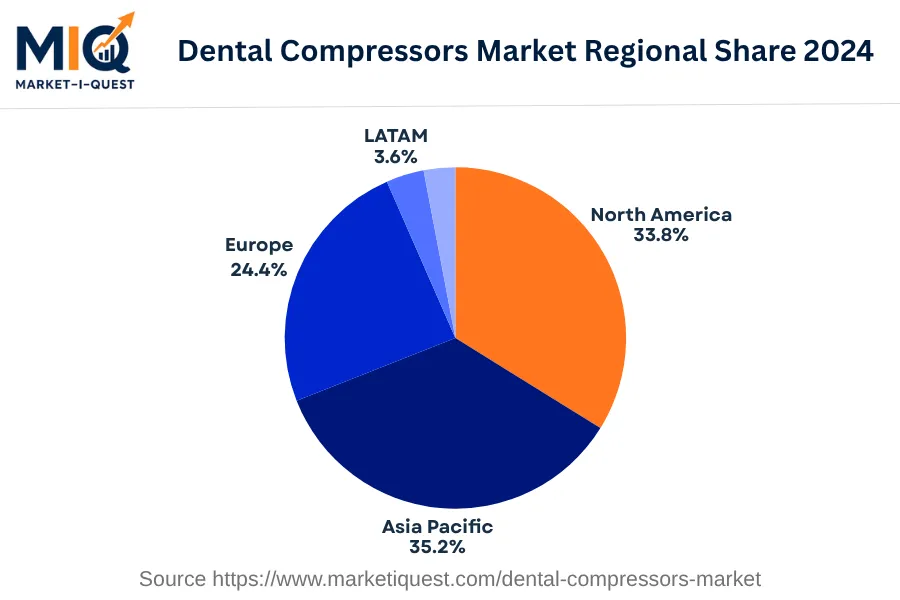
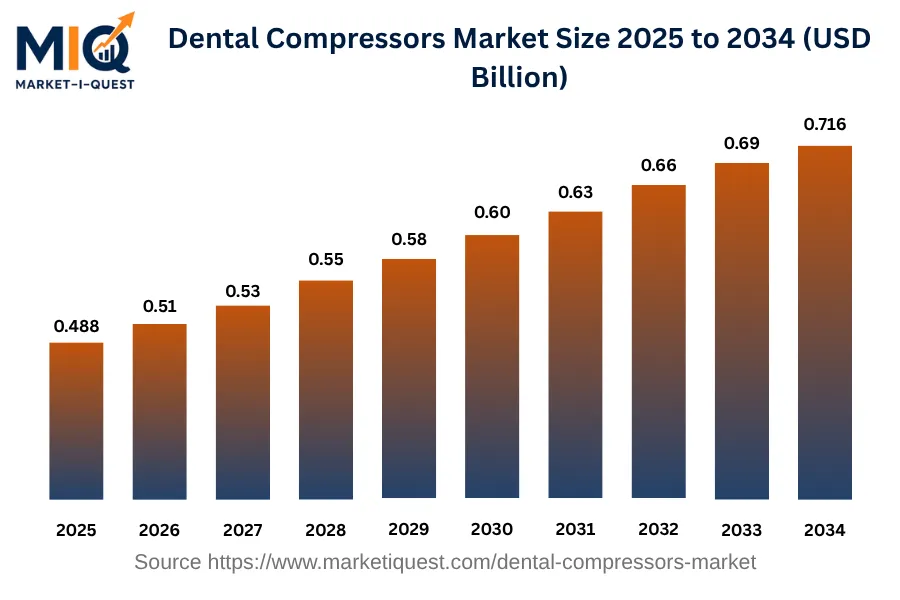
The Dental Compressors Market was valued at approximately $0.47 billion in 2024, rising to about $0.49 billion in 2025. It steadily increases over the next decade, reaching about $0.72 billion in 2034, representing a Compound Annual Growth Rate (CAGR) of 4.4% from 2025 to 2034. This increase arises due to a multitude of factors, such as advancements in dental compressor technology and the growing global awareness concerning oral health. Additionally, the escalating demand for dental services due to an aging population and mounting prevalence of dental diseases further amplifies the growth trajectory. In terms of regional share in 2024, Asia Pacific led at around 35.2%, followed closely by North America at 33.8%. Europe accounted for 24.4%, while Latin America and the Middle East and Africa (MEA) held significantly smaller shares of 3.6% and 3.0%, respectively.

Key Takeaways

  • By Type - Dental Lubricated Compressors held the major share in the dental compressors market in the base year.
  • By Technology - Desiccant Based Compressors led in innovation and market growth.
  • By Application - Hand pieces emerged as the leading segment in the dental compressors market in the base period.
dental-compressors-market market size

Key Driving Factors

Enforcement of Strict Hygiene Standards

In recent years, there has been a heightened emphasis on maintaining high hygiene standards in dental practices worldwide, driven primarily by regulatory bodies like FDA in U.S and EMA in Europe. Authorities underscore the importance of using dental compressors - a device that supplies clean and dry pressurized air, free from oil and impurities - to prevent cross-infection among patients. These regulations dictate that all tools used in oral care, including air-driven devices, must uphold certain sterilization benchmarks, thus fuelling the demand and growth of the dental compressors market. The more stringent these regulations become, the higher the need for reliable, high-quality dental compressors able to meet these hygiene standards.

Emergence of Portable Dental Compressor Units

The growing trend of mobile dental clinics, especially in areas with limited access to dental healthcare, has created a niche demand for compact and portable dental compressors. These units serve as a lifeline for mobile dental clinics and military medical units that provide oral healthcare services in remote and underserved areas. Compared to their traditional, larger counterparts, portable units are easy to transport and set up, making them an ideal choice for this specific buyer segment. As more attention is focused on making dental services more accessible, the demand for portable dental compressors is expected to significantly drive market growth.

Market Evolution by Timeline

2019-2023
During this period, the Dental Compressors Market witnessed an increased demand in North America and Europe, with the primary buyers being dental clinics and hospitals. This was due to the growing focus on oral hygiene and aesthetic dentistry. Companies like DÜRR DENTAL and Midmark Corporation launched new products with advanced noise reduction technologies, indicating a high level of design and integration maturity. Certain FDA regulations became influential, including ISO 10079-3:2014 addressing medical suction equipment. Pricing models leaned towards outright purchases or lease agreements for the equipment. Risks were held with increasing competition and limited technological upgrades, to which manufacturers responded by investing more in R&D.
2024
In 2024, institutional buyers, such as universities and research facilities, joined dental clinics and hospitals in demand. Specific interest came from high-income Asian countries, such as Japan and South Korea, alongside steady demand in North America. Manufacturers like Atlas Copco and Kaeser Kompressoren released newer models complying with stricter environmental regulations like ISO 8573-1:2010. Pricing dynamics remained stable, but partnerships started to emerge between manufacturers and suppliers to streamline distribution. A risk was the tighter emission standards, with companies typically responding by investing in R&D to develop eco-friendly technologies.
2025-2029
During this phase, the market expansion was noted in middle-income APAC and South American countries driven by burgeoning dental tourism. Notably, oil-free dental compressors experienced an upswing with a rise in environmentally conscious decisions. Companies such as Tech West Inc. have been shipping compressors that comply with changing noise pollution standards. The pricing trend of dental compressors demonstrated an incline due to the integration of advanced technologies such as AI and IoT. However, high equipment and maintenance costs and lack of skilled workforce were major practical blockers, prompting suppliers to involve in staff training programs and after-sale services.
2030-2034
Public health facilities in African countries began investing heavily in dental care infrastructure in this period, thereby fostering dental compressor demand. Meanwhile, mature markets in North America, Europe, and richer Asian countries were replacing older equipment with quieter, more efficient models. New releases conformed to rules such as ISO 13485:2016 concerning quality management in medical devices. A noticeable shift towards subscription-based procurement models was observed, aiming to smooth cash flow. Manufacturers also sought collaborations with tech firms for AI-powered predictive maintenance. A foreseeable risk was stringent energy consumption standards, pushing companies to invest more in developing energy-efficient designs.

Future Market Outlook

Future Opportunities

Various factors indicate that the dental compressors market will present numerous opportunities in the coming years. The rising number of dental practices in countries such as India, which recorded a notable increase in dental clinics from 2015 to 2020, is expected to fuel demand for reliable compressed air systems. Collaborations between manufacturers like A-dec and dental service organizations are fostering the development of tailored compressor systems that cater specifically to the needs of emerging dental enterprises. Furthermore, increasing regulatory guidelines from the Dental Board of Australia regarding infection control practices have heightened the need for better air purification systems. Industry bodies, such as the American Dental Association, continuously advocate for advanced technologies that ensure safety and efficiency in procedures. Additionally, the integration of automation and artificial intelligence in managing compressor operations presents an opportunity for enhancing productivity and reducing operational costs. The shift toward eco-sustainability is prompting manufacturers to explore new materials and innovative designs that align with green practices. Partnerships among technology firms focused on IoT applications and compressor manufacturers are also anticipated to grow, enabling smarter solutions for dental facilities. As the focus on patient experience continues to rise, dental practices are likely to increasingly invest in advanced compressor technology that combines efficiency, safety, and a reliable air supply.

Segmentation Analysis

By Type

The market is divided into sub-segments including Dental Lubricated Compressors and Dental Oil-Free Compressors, with Dental Lubricated Compressors accounting for the largest revenue share, while Dental Oil-Free Compressors is expected to grow at the fastest CAGR during the forecast period.

Largest Revenue Share

Dental Lubricated Compressors

Market Share Leader

The Dental Lubricated Compressors sub-segment holds the largest market share in terms of revenue. This prominence can be attributed to a variety of factors. First off, lubricated compressors are generally more durable and reliable than their oil-free counterparts. This reliability makes them a popular choice among dentists, who often use these tools in strenuous, high-pressure procedures. Also, lubrication reduces the instance of wear and tear, lowering maintenance costs and extending the lifespan of the compressor. Geographically, regions with a high number of dental clinics and large patient population significantly contribute towards this sub-segment's revenue. At a regulatory level, medical equipment such as these compressors, which comply with stringent sterilization and maintenance requirements, typically record higher sale volumes. As the demand for dental services continues to grow, primarily driven by increased awareness about oral hygiene and advancements in dental procedures, the market for Dental Lubricated Compressors sees a positive pull.

Fastest CAGR

Dental Oil-Free Compressors

Forecast Period Growth Leader

The Dental Oil-Free Compressors sub-segment is projected to register the fastest growth rate. A key driver for this growth is the increasing demand for these devices from environment-conscious consumers and organizations, given their cleaner operation compared with lubricated compressors. Also, in anticipation of stricter environmental regulations, dentists, hospitals, and clinics are starting to replace their old compressors with oil-free models. Oil-free compressors also have comparatively lower operating costs since they do not require oil change and disposal, making them attractive for cost-conscious clinics. Yet, adoption has barriers such as higher upfront costs and perceptions about lower durability. However, technological improvements are leading to more robust and long-lasting oil-free compressors. Furthermore, partnerships between manufacturers and dental clinics, along with financing options, are smoothing out the cost issue. The main risk is the fast pace of technology, which could render current models obsolete. Another risk is potential regulatory changes affecting dental clinics and equipment.

By Technology

The technology segment of the market is divided into subsegments including Desiccant Based Compressors and Membrane Based Compressors. In 2024, Desiccant Based Compressors accounted for the largest revenue share while Membrane Based Compressors are expected to grow at the fastest CAGR during the forecast period.

Largest Revenue Share

Desiccant Based Compressors

Market Share Leader

In 2024, Desiccant Based Compressors led the technology market in terms of revenue. This can be attributed to their high efficiency and reliability, which makes them the preferred choice for many industries including manufacturing, pharmaceutical and food & beverage. The demand for these compressors is also driven by their ability to provide clean, dry air which is crucial in preventing machinery rust and product spoilage. In terms of geography, North America and Europe continue to represent the largest markets for Desiccant Based Compressors due to their robust industrial sectors. Regulatory pressures to reduce energy consumption and environmental impact further reinforce the adoption of these compressors. Also, minimal switching costs and established distribution channels continue to sustain the market share of Desiccant Based Compressors.

Fastest CAGR

Membrane Based Compressors

Forecast Period Growth Leader

Despite their current smaller market share, Membrane Based Compressors are anticipated to exhibit the fastest growth in the coming years. Factors propelling this growth include emerging technological innovations and increasing efforts towards reducing energy consumption. As industries strive to operate more eco-friendly, the use of membrane compressors, which work without oil, is on the rise. Moreover, their compact size and lower noise level enhance their appeal for indoor and urban use. However, initial adoption costs could be a hurdle for small and medium enterprises. To mitigate this, manufacturers are investing in research and development to lower production costs, and partnering with finance firms to provide favorable payment schemes. Nonetheless, risks such as technology maturity and market acceptance could hamper near-term growth rate.

By Application

The market is divided into subsegments including Hand pieces, Scalers, Chair Valves, and Others. Among these, Hand pieces accounted for the largest revenue share while Scalers is expected to grow at the fastest CAGR during the forecast period.

Largest Revenue Share

Hand pieces

Market Share Leader

Hand pieces constitute a crucial segment in the market, accounting for the largest revenue share in 2024. This preeminence can be attributed to the fact that they form an indispensable part of all dental procedures, whether they are complex treatments or routine check-ups. A hand piece is used in various applications such as drilling, shaping, cleaning, and for many other diversified uses in a dental procedure. In addition, hand pieces have unique and complex configurations, making their production cost high, which in turn contributes to their leading share in revenue generation. The absolute necessity of this tool across dental establishments and procedures around the globe plays a direct role in the dominant revenue generation. Furthermore, technological advancements in the hand piece segment, coupled with its high durability, adds to its demand, bolstering revenue generation.

Fastest CAGR

Scalers

Forecast Period Growth Leader

While hand pieces hold the majority of the market share in terms of revenue, Scalers are projected to witness the highest growth rate during the forecast period. This can be attributed to a range of factors. Firstly, the growing awareness around oral hygiene and the increasing importance given to preventive dental care are leading to a rise in routine dental cleanings, where Scalers are typically used. Secondly, advancements in design and technology have enabled the production of Scalers that cause less patient discomfort and increase efficiency for dentists, thus fostering their adoption. However, there could be potential issues in terms of high initial costs for advanced Scalers and potential regulatory barriers that manufacturers need to account for. Nonetheless, partnerships with dental associations and continuous technology improvements are poised to drive the growth for this subsegment.

Competitive Analysis

Key Market Players

Manufacturers / OEMs

Dürr Dental SE
Germany
Midmark Corporation
US
Cattani S.p.A.
Italy

Key Suppliers & Raw Materials

Atlas Copco
Sweden
Gardner Denver, Inc.
US
Kaeser Kompressoren
Germany

Distributors, Integrators & Channel Partners

Henry Schein, Inc.
US
Patterson Dental Supply, Inc.
US
Pearson Dental Supplies, Inc.
US

Porter’s Five Forces Analysis

This analysis provides critical insights into the competitive dynamics within the dental compressors market.

Supplier Bargaining Power

Medium

Market features several suppliers of parts, but proprietary technologies can increase power.

Buyer Bargaining Power

High

Large customer base with multiple suppliers and low switching costs enhance buyer power.

Threat of Substitutes

Low

Technological aspects and specific usage limit the threat of substitutes in dentistry.

Threat of New Entrants

Medium

Potentially limited by the need for FDA approvals, domain knowledge, and technology innovations.

Competitive Rivalry

High

A multitude of established companies vying for market share intensifies rivalry.

Regional Analysis

Geographic market dynamics and growth opportunities across key regions

Global Market Outlook

dental-compressors-market market regional share

North America

In 2024, North America's Dental Compressors Market was characterized by a strong demand landscape and several noteworthy trends. Drivers underlying the sector's dynamics include rising dental healthcare needs, driven by greater health awareness and aging demographics, particularly in the U.S and Canada. An increase in government and private investments in healthcare infrastructure across the U.S, Mexico, and Canada has further bolstered the demand for dental compressors. Technological advances in compressor efficiency and reliability have been a key escalation point, with dentist practices across the region seeking to enhance patient experience and operational efficiency. Intensifying competition among manufacturers has also played an essential role in the pricing of dental compressors.

Transformations in the market are apparent, with changes in buyer behavior leaning towards energy-efficient and quieter dental compressors. Technological shifts include an accelerated adoption of oil-free compressors, driven by their superior hygiene standards and reduced maintenance requirements. Recent partnerships and M&A activity focus on expanding reach and accelerating technological advancements, with companies like Danaher Corp and A-Dec Inc. in the lead. Rigorous policy enforcement is noticed, particularly in the U.S., ensuring adherence to stringent hygiene and compression standards, thereby influencing the demand for advanced, compliant devices. It is clear that dentist practices, both independent and those part of healthcare systems, have been driving these market trends.

Asia Pacific

In 2024, the Dental Compressors Market in Asia Pacific experienced notable development, with China, India, Australia, Japan, South Korea, and key ASEAN markets playing significant roles. This growth was driven primarily by an increase in dental diseases, health-oriented population, sophisticated healthcare structure, and rising dental tourism in countries such as India and Thailand. Additionally, the market was boosted by the adoption of technological advancements in compressor devices that ensured cleaner and drier air supply. Regulatory bodies, like China's National Health Commission, provided stringent guidelines across the region for the use of safe and efficient dental equipment, contributing to increased investment in the sector.

The trend in the market suggested a transition towards oil-free dental compressors due to their low maintenance and ecological benefits, influencing product shifts within the industry. Other discernible trends included preference for portable and compact dental compressors in private practices and homecare settings. Various partnerships were observed, such as India's W&H and Japan's Morita, focusing on expanding product portfolios and innovation. Furthermore, strict policy enforcement by government and healthcare sectors led to mandatory comprehensive after-sale services by manufacturers to ensure long-term reliability of equipment. These dynamics influenced the Dental Compressors Market throughout the Asia Pacific region in 2024.

Europe

In 2024, the European Dental Compressors Market exhibited significant dynamism. High prevalence of dental disorders and an increasing elderly population propelled the demand for dental compressors across key regions including Germany, the United Kingdom, France, Italy, Spain, the Nordics, Benelux, and Central & Eastern Europe. Government regulations, such as the EU Medical Devices Regulation, encouraged investment in advanced dental equipment, resulting in technology adoption and impacting supply dynamics positively.

Customer-centric innovations, partially influenced by the pandemic's aftermath, shaped the market trends. There was a noticeable shift towards oil-free and low-noise dental compressors, predominantly driven by enhanced focus on patient comfort and eco-friendly operations. Direct purchasing became a preferred channel, with dentists and small clinics leaning towards online platforms to ensure quick delivery and competitive pricing. Numerous partnerships emerged between dental compressor manufacturers and healthcare institutions, enhancing the accessibility and availability of these products. Furthermore, the enforcement of EU noise regulations led players to innovate towards less noise-emitting solutions.
The key customers included dental clinics and hospitals across all considered regions, with an increased penetration in healthcare institutions aiming to upgrade their dental care facilities. Consequently, the dental compressor landscape in Europe, in 2024, reflected a blend of regulatory adherence, technological innovation, and altered buyer behaviour, collectively shaping a robust growth pattern.

Latin America

In 2024, the dental compressors market in Latin America denotes a vibrant sector, with digital technologies shaping product offerings and operational efficiencies. Brazil and Mexico lead in high demand due to increasing dental health awareness and government regulations. A rise in private investments in Argentina and Colombia's dental care emphasizes the importance of high-quality dental equipment, accelerating technology adoption. Price stability in Chile and Peru due to fair competition among dental compressor suppliers further fuels the market progression.

The dominant purchasing trend observed throughout LATAM was a shift towards energy-efficient and noise-reduction dental compressors. Technology advancements fostered the development of oil-free compressors, providing cleaner air supply and reduced maintenance requirements. In Mexico and Argentina, a noticeable trend was the incremental purchase of portable dental compressors due to their convenience. Partnerships between dental compressor manufacturers and healthcare clinics intensified in Brazil, expanding the product reach. The enforcement of stricter safety standards by governments across all six nations maintained an adequately regulated market, ensuring consumer protection. Principal customer sectors of the dental compressors market, including healthcare institutions, dental clinics, and government bodies, showcased distinctive purchasing behavior and demands. For instance, healthcare establishments in Brazil and Colombia prioritized energy-efficient models. In contrast, dental clinics in Chile and Peru showed a preference towards portable models due to lower space availability. This range of customer preferences shaped the dental compressor market in the base year.

Middle East & Africa

In 2024, the Middle East and Africa dental compressors market experienced significant progression due to various drivers. The adoption of advanced technologies in dental healthcare facilities increased the demand for dental compressors. The governments of nations like Saudi Arabia, Egypt and South Africa showed heightened interest towards improving dental health, which escalated investments in dental infrastructure. This regulatory support from government combined with increasing dental tourism in United Arab Emirates and Israel further boosted the market growth.

There were several observable trends in this period. A notable one was the growing preference for oil-free dental compressors among healthcare providers in Kenya, Nigeria, and Qatar due to the advantages they confer in maintaining a sterile environment. Additionally, channel dynamics saw a shift towards online platforms for procurement, specifically in wealthier nations such as UAE and Saudi Arabia. Acquisitions strengthened several players' market positions, while partnerships enabled better technological integration. The key sectors driving the demand for these products extended beyond healthcare, including educational institutions that offer dentistry. However, the primary customers remained within the dental clinics, hospitals, and laboratories. This market has shown a significant range of dynamics and trends in 2024, largely driven by technological advancements, government initiatives, and investment flow throughout the Middle East and African regions.

Recent Industry Developments

Latest market innovations, product launches, and strategic initiatives

February 2025

A-dec expanded its integrated dental operatory systems featuring advanced oil-free air compressor technology, demonstrating increased investment in hygienic and digitally connected dental infrastructure.

September 2024

Dürr Dental launched next-generation oil-free compressor systems with integrated digital monitoring and noise-reduction technology, reflecting the industry's focus on hygienic, energy-efficient solutions for modern dental clinics

Frequently Asked Questions