
Conformal Coatings Market Snapshot

Key Players

  • MG Chemicals (Canada)
  • Kisco (Japan)
  • Shin-Etsu Chemical (Japan)
  • Dow Inc. (United States)
  • H.B. Fuller (United States)
  • Chase Corporation (United States)
  • Electrolube (United Kingdom)
  • Henkel (Germany)
  • Dymax Corporation (United States)
  • Europlasma NV (Belgium)

Market Size

Base Year 2024
$1.54 Bn
CAGR
5.2%
Forecast 2034
$2.56 Bn

Market Segments

By Product
  • Epoxy
  • Acrylic
  • Urethane
  • Parylene
  • Silicone
  • Others
By Technology
  • Solvent-Based
  • Water-Based
  • UV-Cured
  • Others
By End Use Industry
  • Automotive
  • Medical
  • Aerospace & Defense
  • Consumer Electronics
  • Others

Market Dynamics

Drivers
  • Increasing Electronics Industries
  • Rising Demand for Durable Electronics
Restraints
  • High production cost
  • Regulatory restrictions
Opportunities
  • Increasing electronics production
  • Growing automotive industry

Market Size

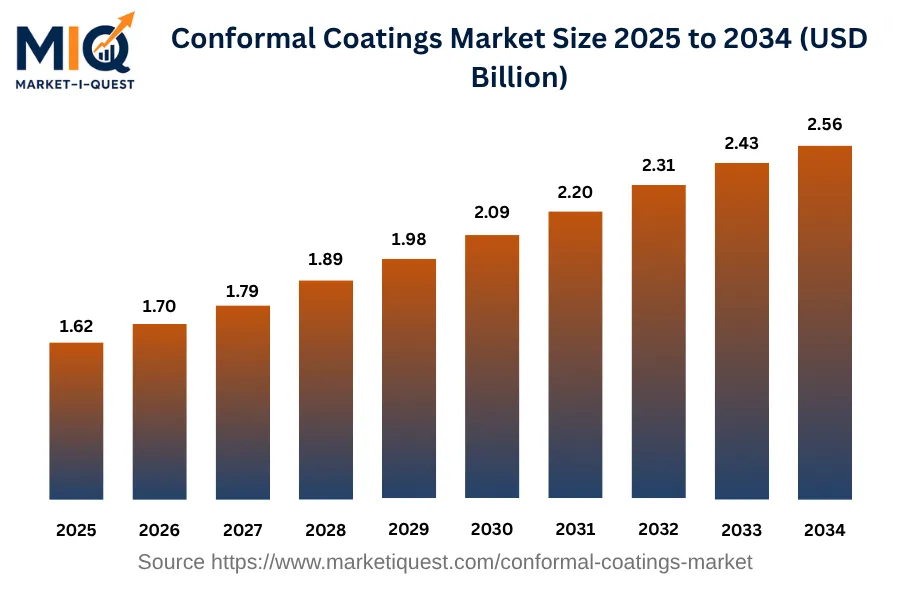
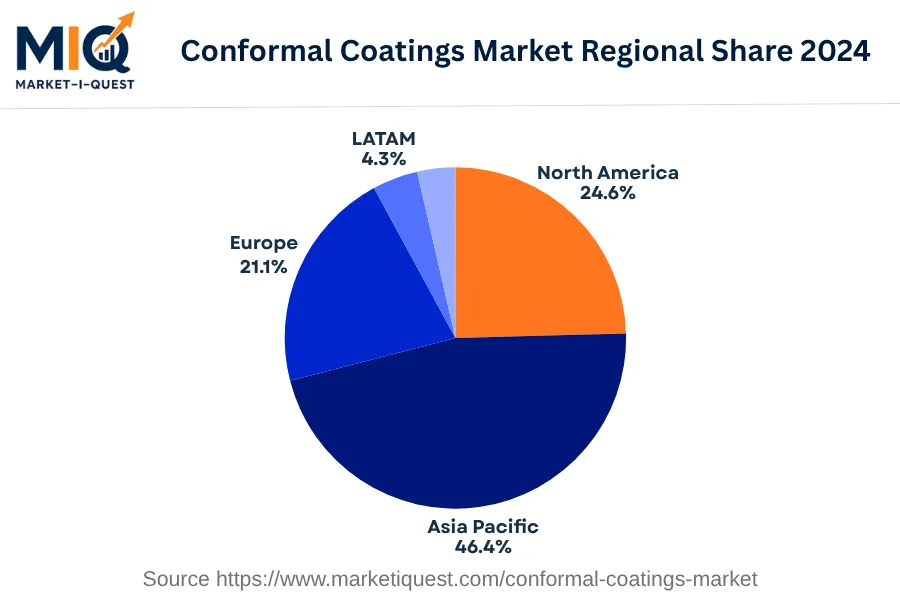
The Conformal Coatings Market was valued at $1.62 billion in 2025, and is projected to expand to $2.56 billion by 2034, growing at a CAGR of 5.2%. This surge in the market size over the decade is due to the increasing demand, and a consistent growth is observed from 2025 onwards. The initial value in 2024 was $1.54 billion, indicating a moderate but steady increase in the initial years. Delving into the regional shares for the year 2024, the Asia Pacific region held the lion's share of the market at 46.4%, while North America accounted for 24.6%. Europe had a share of 21.1% in the overall market. Meanwhile, the market shares for both Latin America and the MEA region were significantly less, with LATAM accounting for 4.3% and MEA for 3.6%. These market shares illustrate the concentration of the Conformal Coatings Market chiefly in the Asia Pacific, North America, and Europe.

Key Takeaways

  • By Product - Epoxy held a significant market share in the Conformal Coatings Market for the base year.
  • By Technology - Solvent-Based coatings led the market in terms of popularity and usage in the year prior.
  • By End Use Industry - Automotive industry accounted for the highest consumption of Conformal Coatings in the provided base year.
conformal-coatings-market market size

Key Driving Factors

Implementation of Strict Environmental Regulations

One significant role-driving factor for the Conformal Coatings Market is the enforcement of rigorous environmental regulations globally. These regulations, such as the Restriction of Hazardous Substances (RoHS) directive and the Waste Electrical and Electronic Equipment (WEEE) directive, demand that electronics manufacturers reduce the use of hazardous substances in their products and manage electronic waste responsibly. A strategy to meet these requirements has been the use of conformal coatings, as these coatings encapsulate the circuitry and protect it from environmental hazards, thereby reducing the potential leakage of hazardous substances. As such, an increase in regulatory compliance is directly driving the growth in the demand for conformal coatings.
Emergence of High-Density Interconnect Technology

The rise of High-Density Interconnect (HDI) technology in electronic devices is also significantly promoting the Conformal Coatings Market. HDI technology enables the miniaturization of electronic devices. However, this miniaturization results in complex circuits that are more susceptible to environmental factors like dust, moisture, and high temperature. To counter this vulnerability, manufacturers are progressively using conformal coatings to shield these fragile circuits. Conformal coatings provide primary-level protection, ensuring the longevity and reliability of these miniaturized devices serving in challenging environments. Hence, the wider adoption of HDI technology in electronics manufacturing is contributing to an escalating demand for conformal coatings.

Market Evolution by Timeline

2019-2023
In this period, conformal coatings use surged in the automobile and aerospace sectors due to their reliable protective properties. North America led the engine, followed by Europe. Materials like acrylic and silicone became popular due to their cost-effectiveness and versatility. However, the manufacturing process faced issues with volatile organic compound emissions, affecting supply. Thus, environmental regulations like REACH imposed specific usage conditions. Contract Manufacturing Organizations (CMOs) began offering coatings application services, typically on a per-piece pricing model. A typical barrier faced by regional markets was the lack of adequate technology for coating application and removal, prompting industry-wide research and development.
2024
In 2024, the adoption of conformal coatings expanded into consumer electronics and medical device industries, especially in Asia-Pacific regions where manufacturing was robust. UV curable coatings gained traction due to increased productivity and reduced environmental impact. Manufacturing constraints remained due to strict adherence to RoHS and WEEE norms around chemical composition. Private labeling became a typical commercial deal, offering a customer-specific product at a premium price. Risks included potential intellectual property disputes over coating compositions, resulting in a rise in patent filing activities.
2025-2029
The period from 2025 to 2029 saw conformal coatings further permeate the renewable energy sector, with demand soaring in South America and Middle East due to increased solar panel production. Technological advancements ushered in nano coating technology, offering superior protection at reduced material consumption. However, such advancements stretched the capability of prevailing environmental norms, leading to updated versions of regulations like REACH and RoHS. Greater adoption of leasing models was observed, allowing customers to access latest coatings technologies without upfront capital investment. Developing supply chain efficiency became an established challenge during this period, needing systematic responses.
2030-2034
By 2030–2034, Africa emerged as a significant market due to burgeoning electronics and automotive industries. Polyurethane coatings became dominant, owing to their superior moisture and chemical resistance. Producers faced increased pressure to confirm to environmentally friendly manufacturing practices according to revised ISO 14001 regulations. Integrated service solutions became more common, grouping supply, application, and maintenance of coatings into a single contract. Market participants faced risks such as fluctuating raw material prices and supply chain disruptions due to rising geo-political tensions, necessitating robust risk management strategies.

Future Market Outlook

Future Opportunities

The conformal coatings market stands at a crossroads of emerging opportunities driven by various industry needs and regulatory changes. As electric vehicles gain prominence, companies like Tesla and Rivian are likely to increase their reliance on conformal coatings to ensure the longevity of electronic components. In 2023, the United Nations announced a resolution targeting increased sustainability measures within manufacturing processes, creating a significant push for environmentally friendly coating solutions. This resolution is encouraging manufacturers, including 3M, to explore biodegradable options that comply with new international environmental protocols. Additionally, the aerospace sector, guided by the Federal Aviation Administration's updated regulations, is looking for conformal coatings that can withstand extreme conditions, such as high temperatures and corrosive environments. The incorporation of smart coatings featuring self-healing properties is anticipated to gain traction among manufacturers and research institutions, with pilot projects underway in the United Kingdom demonstrating their effectiveness in protecting electronic devices. Furthermore, with the ongoing development of 5G technology and related infrastructure, conformal coatings that ensure signal integrity and device protection are set to attract significant attention from telecom companies. The alignment of industry demand with regulatory guidance creates a fertile landscape for conformal coating suppliers to leverage their offerings in future applications across multiple sectors.

Segmentation Analysis

By Product

The market is divided into subsegments including Epoxy, Acrylic, Urethane, Parylene, Silicone, and Others. The Epoxy subsegment accounted for the largest revenue share while Silicone is expected to grow at the fastest CAGR during the forecast period.

Largest Revenue Share

Epoxy

Market Share Leader

Epoxy resins have a high demand, making it the subsegment responsible for the largest revenue share. The major driving factors for this include its diversified applications across various industries, including electronics, construction, automotive, and marine sectors. Epoxy boasts of superior properties such as high thermal stability, comprehensive mechanical strength, efficient electrical insulation, and excellent resistance to chemicals or moisture, which makes it a preferred choice in many industries. Particularly in electronics, they are used for component protection and insulation, which is crucial given the incessant growth of this industry, further accelerating epoxy’s demand. The growth has been stable across major geographic regions with Asia being a dominant player due to the presence of robust manufacturing sectors. The purchasing decision generally revolves around performance requirements of the end product application, attracting higher switching costs. Direct channels and e-commerce have been primary channels for this product's purchase.

Fastest CAGR

Silicone

Forecast Period Growth Leader

Silicone is projected as the fastest-growing subsegment in the product market, primarily driven by its increasing application in various in-demand industries such as medical devices and electric vehicles. Silicone exhibits high thermal resistance, flexibility, and biocompatibility, making them an ideal material for these applications. In healthcare, silicone's biocompatibility is catalyzing its use in medical implants, thereby increasing its demand. Technological advancements in silicone processing and product development are further expected to boost the segment's growth rate. Meanwhile, in the booming electric vehicle (EV) market, silicone is essential for insulation and encapsulation purposes. However, regulatory challenges associated with the biocompatibility of silicone in medical applications could present potential near-term risks. This paragraph assumes the trend of increasing silicone use in the aforementioned industries and the continued rise of these industries for future growth.

By Technology

The Technology segment is subdivided into Solvent-Based, Water-Based, UV-Cured, and Others. In the base year of 2024, Solvent-Based is known to lead in terms of revenue whereas the UV-Cured subsegment is identified as the fastest-growing.

Largest Revenue Share

Solvent-Based

Market Share Leader

In 2024, the Solvent-Based technology claims the largest segment in the market revenue-wise. This subsegment primarily thrives due to its widespread application across various industries. Solvent-Based technologies are commonly used due to their favorable properties such as durability, resistance to harsh conditions, and strong adhesion, which are desirable in various industrial settings. Its dominance is also reinforced by the significant investment in product innovation and the development of solvent-based coatings with lesser environmental impacts. This shift is driven mainly by strict regulations regarding VOC emissions and the need to maintain coating performance. Furthermore, there is strong demand from emerging markets such as the Asia-Pacific region, primarily driven by growth in the construction and automotive industries. The stable raw material supply chains and established distribution channels further contribute to its substantial market share.

Fastest CAGR

UV-Cured

Forecast Period Growth Leader

Despite not leading in revenue, the UV-Cured subsegment is projected to be the fastest-growing in the technology division. The primary growth driver for this Subsegment is its potential in reducing environmental impact while maintaining high coating performance. UV-Cured technology provides energy efficiency, low production costs, and produces high-quality finishes, thus emerging as an apt replacement for conventional solvent-based technologies. Adoption barriers include initial technology cost and a lack of awareness about its potential benefits. Government policies supporting lower environmental emissions might accelerate adoption, and strategic partnerships with key players across adjacent industries might lower entry-barriers for smaller entities. Concrete risks include potential regulatory changes around the use of UV-Cured technology and fluctuating raw material prices. Nevertheless, considering the intensified focus on sustainability in recent years, the UV-Cured subsegment is expected to experience an accelerated growth trajectory.

By End Use Industry

The market is divided into subsegments including Automotive, Medical, Aerospace & Defense, Consumer Electronics, and Others. The Automotive subsegment accounted for the largest revenue share, while the Medical subsegment is expected to grow at the fastest CAGR during the forecast period.

Largest Revenue Share

Automotive

Market Share Leader

There are several driving forces behind the dominance of the Automotive subsegment. Primarily, the demand is driven by the global increase in car manufacturing and the trend towards more advanced, tech-loaded vehicles. Gaining traction is the shift towards electric and autonomous vehicles, which require considerably more, often more sophisticated, components and systems. Another important factor is the after-sales market, which continues to buoy overall industry revenue. Across geographies, regions with high automotive production like Asia-Pacific (especially China and Japan) and North America, contribute substantially to the revenues. Partly regulation driven, safety standards across the globe have consistently been made more strict, therefore necessitating more components and systems. Durability and functionality are the primary purchasing criteria, with cost-effectiveness playing a significant role. Switching costs are high due to each component's interoperability requirements, and automotive manufacturers tend to prefer long-standing relationships to uncertain cost-saving opportunities. Overall, this substantial and diverse demand, along with the afford mentioned barriers to switching suppliers, propels the Automotive subsegment to the lead in terms of revenue generation.

Fastest CAGR

Medical

Forecast Period Growth Leader

The Medical subsegment holds significant growth potential. There are several important drivers and catalysts at play. Technological advancements, rapidly evolving medical practices, which increasingly rely on state-of-the-art devices and equipment, and an aging global population underline high growth prospects. The push is to develop remotely operable and wearable medical devices to consistently monitor patient health, driving the demand. Furthermore, the ongoing COVID pandemic has put a spotlight on the importance of the medical industry, thus facilitating greater investments and partnership in medical tech advancement. However, high barries exist as well. Substantial initial investments (CAPEX), long approval processes and stringent regulation slow down adoption rates. Near-term, potential changes to regulations and volatile trade relationships, particularly involving China, pose risks. Long-term, however, the outlook is extremely promising. These dynamics portray a high-growth scenario for the Medical subsegment.

Competitive Analysis

Key Market Players

Manufacturers / OEMs

Dow Inc.
US
Henkel AG
Germany
Chase Corporation
US

Key Suppliers & Raw Materials

BASF SE
Germany
ExxonMobil Chemical
US
DuPont de Nemours, Inc.
US

Distributors, Integrators & Channel Partners

RS Components
UK
Digi-Key Electronics
US
Mouser Electronics
US

Porter’s Five Forces Analysis

This analysis evaluates the competitive forces within the Conformal Coatings Market.

Supplier Bargaining Power

Medium

Interplay of few suppliers, raw materials scarcity, and proprietary technologies influence supplier power.

Buyer Bargaining Power

High

Diverse application industries and switching ease lead to high buyer's power.

Threat of Substitutes

Low

Unique properties and diverse applications of conformal coatings lower the threat of substitutes.

Threat of New Entrants

Medium

Regulatory hurdles and high R&D costs pose moderate barrier to new entrants.

Competitive Rivalry

High

Intense competition with established players focusing on innovation and strategic alliances.

Regional Analysis

Geographic market dynamics and growth opportunities across key regions

Global Market Outlook

conformal-coatings-market market regional share

North America

In 2024, the North American conformal coatings market showed augmented dynamism driven principally by robust demand across sectors like automotive, aerospace, and electronics manufacturing. Upward demand dynamics were mainly steered by heightened concerns around component longevity, thermal management, and corrosion resistance in these sectors. Concurrently, stringent regulations in the US and Canada regarding environmental sustainability fostered industry investments into bio-based and VOC-free conformal coatings. Moreover, advancements in nanotechnology underpinning transparent and flexible conformal coatings were witnessing pervasive adoption, provoking a shift in the supply landscape.

Prevailing trends depicted a substantial tilt towards online channels for purchase due to the surging prevalence of e-commerce in the US and Mexico, drastically impacting distribution dynamics. Additionally, an upsurge in strategic partnerships was observed, particularly in the US, aiming at technological integration and diversification of conformal coatings offerings. Enforced policy measures around electronic waste management, especially in Canada, impelled the industry to adopt safer conformal coating applications. Meanwhile, buyer behavior reflected an increased preference for halogen-free silicone and acrylic coatings owing to their superior performance and lesser environmental footprint, stimulating a major product shift in the market. Consequently, these developments championed a highly adaptive and progressively green North American conformal coatings market in 2024.

Asia Pacific

In 2024, the Conformal Coatings Market in Asia Pacific witnessed a distinctive surge. The increase in demand was primarily fueled by robust electronics manufacturing sector in countries like China, India, and South Korea, specifically in the area of automotive, defense, and aerospace electronics where conformal coatings prevent device failures. Particularly, China's "Made in China 2025" initiative amplified production, which necessitated higher adoption of conformal coatings. Moreover, regional policies such as India’s Production-Linked Incentive scheme prompted more investments into local manufacturing, subsequently driving the market.

On the trend front, there was a noticeable shift towards environmentally friendly coating varieties; customers increasingly favored silicon and acrylic-based conformal coatings over traditional toxic compounds due to strict environmental regulations implemented by governments. The rising penetration of online sales channels was also a prominent trend as manufacturers aimed to cater to the de-centralized demand. Furthermore, partnerships amongst key players were evident to secure raw materials supply amid high demand; for instance, Japan's Showa Denko's agreed to increase production of semiconductor-grade hydrogen peroxide. Lastly, standards moved towards being more stringent to improve durability and reliability, enforced by government bodies such as the Standards Australia and the Bureau of Indian Standards. Overall, the conformal coating market in the Asia Pacific region in 2024 was heavily impacted by manufacturing incentives, regulatory norms, and evolving customer preferences.

Europe

In 2024, the Conformal Coatings Market in Europe was marked by steady growth and industry collaboration. One of the primary drivers accelerating growth was the expansive demand from the automotive industry, where the coatings were sought after for their effectiveness in preventing corrosion sustainably and cost-efficiently. Changes in environmental regulations also fueled the market, as countries such as Germany, France, and the United Kingdom mandated stricter standards for electronic components, sparking increased demand for conformal coatings. Moreover, technological innovation led to heightened adoption rates, emphasizing the increase in the production of smart electronic devices in the region.

The market trends showcased a notable evolution. Buyer preference shifted towards silicone and acrylic-based coatings due to their superior performance and environmental safety profiles over traditional materials. Moreover, several partnerships and M&A activities highlighted the year, particularly in the Nordics and Benelux regions, enhancing supply chain efficiency. Notably, the utilities and manufacturing sectors emerged as key consumers, given the high need for conformal coatings in order to ensure longevity and efficient performance of their electronic components. Furthermore, strict policy enforcement around electronic component standards by government entities across the region put additional impetus on conformal coatings adoption. Thus, 2024 proved to be a decisive year for the Conformal Coatings Market in Europe.

Latin America

In 2024, the Conformal Coatings Market in Latin America saw significant evolution. Key drivers included heightened demand in the electronics sector across Brazil, Argentina, and Mexico, stimulating heightened investment in technology adoption for conformal coatings. Regulatory changes, notably in Colombia with its stringent safety standards for electronic components, further necessitated the market's expansion. Supply dynamics altered with the increased local manufacturing capacity, especially in Brazil and Mexico, fostering more competitive pricing in the market.

Several trends emerged. Shifting buyer behavior became prominent, with a marked preference for solvent-free conformal coatings in response to increasing environmental concerns. There was a tangible shift towards parylene and nano-coating technologies in countries like Chile and Peru due to their enhanced protection features. Adopting online channels for distribution and customer engagement proliferated across most countries, enhancing the market reach. Partnerships and merger and acquisition activities intensified, particularly within the enterprise sector in Brazil and Argentina, as firms sought to solidify their market presence. Finally, the year saw stricter enforcement of standards concerning the safety of electronic products, making conformal coatings a necessary component in manufacturing across all countries in LATAM.

Middle East & Africa

In 2024, the Conformal Coatings Market in the Middle East and Africa displayed robust growth, primarily driven by demand from specific sectors and regulatory climates. Increased investment in sectors like telecom, utilities, and manufacturing was a key propellant, particularly in Saudi Arabia and the United Arab Emirates, where streamlined regulations facilitated business expansions. Advances in technology also catalyzed market growth, as nations like Qatar and Israel adopted more sophisticated electronics systems, necessitating protective coatings.

The year witnessed shifting buyer behaviors, with a noticeable preference for high-quality, eco-friendly conformal coatings across Egypt, South Africa, and Kenya. Additionally, a prevalent trend was the rise of online sales channels, driven by the growth of E-commerce in nations like Nigeria. Partnerships and mergers occurred at a strong pace, evident in across-the-board industries to acquire resources and expand market reach, stimulated by supportive government policies. Moreover, increased enforcement of product quality standards by regulatory bodies across the region influenced the market trend towards higher-end products. Remarkably, stringent environmental policies in Israel drove the shift towards sustainable and less toxic conformal coating materials. Overall, the Conformal Coatings Market in the Middle East and Africa in 2024 strongly thrived amidst increased investments, technology adoption, transforming buyer practices, and evolving regulatory norms.

Recent Industry Developments

Latest market innovations, product launches, and strategic initiatives

February 2026

Henkel introduced a new protective coating called Loctite Stycast UV 7998. This product protects home appliances and car electronics from damage, and it was specifically made without harsh chemical solvents to meet safer environmental standards.

November 2025

The organization received an international technology award for its new inspection system. The machine uses artificial intelligence to automatically look at electronic boards and find mistakes in the protective coating, which speeds up production and reduces human error.

Frequently Asked Questions