
Concrete Reinforcing Fiber Market Snapshot

Key Players

  • Sika AG (Switzerland)
  • BASF SE (Germany)
  • Propex Operating Company LLC (United States)
  • Nycon Corporation (United States)
  • Euclid Chemical Company (United States)
  • GCP Applied Technologies Inc. (United States)
  • Barchip Inc. (Australia)
  • Fibercon International Inc. (United States)
  • MICRO FIBRE GROUP (Bangladesh)
  • Chengdu Polycomp International Corp (China)

Market Size

Base Year 2024
$2.74 Bn
CAGR
5.7%
Forecast 2034
$4.76 Bn

Market Segments

By Product
  • Polyethylene
  • Polypropylene
  • Steel
  • Basalt
  • Others
By Physical Form
  • Monofilament
  • Multifilament
  • Composite
By End User
  • Residential
  • Commercial
  • Infrastructure
  • Industrial

Market Dynamics

Drivers
  • Increasing infrastructure development
  • Advancements in fiber technology
Restraints
  • High production cost
  • Fluctuating raw material prices
Opportunities
  • Infrastructure development surge
  • Advancements in fiber technology

Market Size

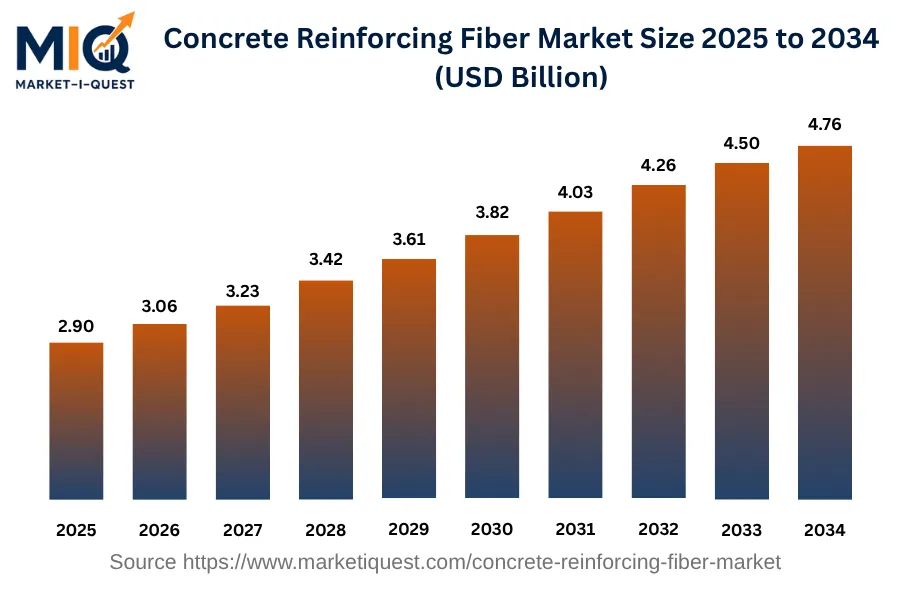
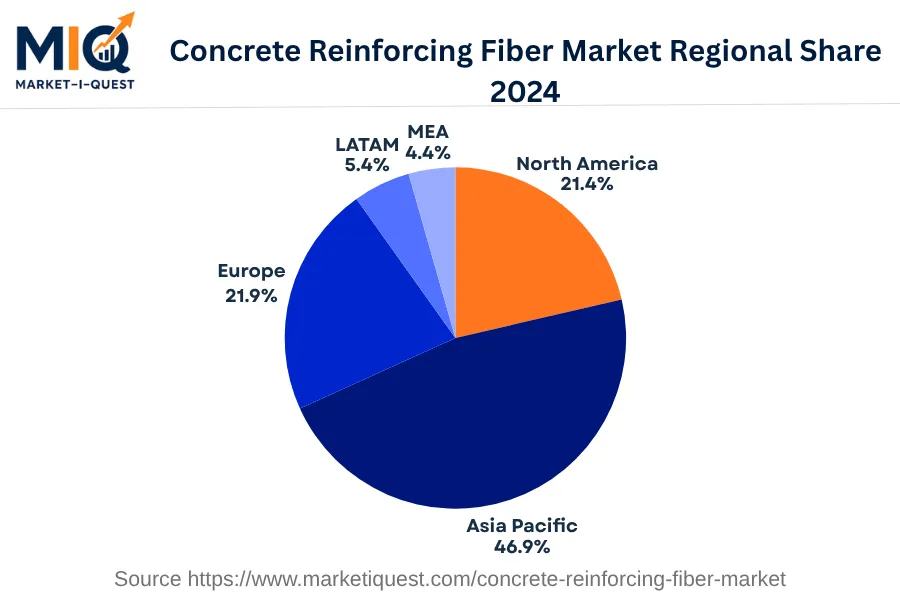
The Concrete Reinforcing Fiber market size stood at $2.89 billion in 2025, and it is projected to reach $4.76 billion by 2034, expanding at a 5.7% CAGR during the nine-year forecast period. The market has exhibited steady growth since 2025. Factors contributing to the market’s expansion include increasing demand in construction, infrastructure, and industrial sectors, propelled by the fiber’s superior properties, such as crack resistance and durability, compared to traditional materials. In terms of geography, the market distribution in 2024 revealed Asia Pacific as the leading region with a 46.9% share, followed by Europe and North America contributing 21.9% and 21.4% respectively. Meanwhile, LATAM and MEA held smaller shares of 5.4% and 4.4% respectively.

Key Takeaways

  • By Product - Polyethylene held a significant share in the Concrete Reinforcing Fiber Market.
  • By Physical Form - Monofilament led the market accounting for a notable position in recent years.
  • By End User - Industrial segment was the highlighting the largest portion of the segment.
concrete-reinforcing-fiber-market market size

Key Driving Factors

Adoption of Lightweight Construction Materials

Modern engineering frameworks increasingly favor the use of lighter and more flexible materials in construction. As part of this shift, concrete reinforcing fibers see growing adoption due to their ability to lend significant durability without substantial weight addition. These fibers are several times stronger than traditional steel, making them an appealing option for reinforcing concrete structures. Also, the relatively simplified handling and installment process of such fibers are reducing the need for skilled labor and heavy equipment, which subsequently lowers construction expenditure. Particularly in urban areas where high-density housing and commercial building projects necessitate efficient utilization of space, compromising neither strength nor durability, the concrete reinforcing fiber finds its niche.
Stricter Building Codes and Standards

Stricter adherence to construction safety standards and building regulations across the world is also driving the concrete reinforcing fiber market. Such regulations, including the International Building Code (IBC) and Eurocode Standards, require that structures demonstrate higher resistance to seismic, thermal, and other environmental stresses, hence necessitating robust reinforcements. Concrete reinforcing fibers offer enhanced strength, longevity and resistance to environmental factors, thus meeting these stringent requirements. Regulatory authorities and insurers also encourage the use of such materials due to their potential to reduce failure rates and related liabilities. As governments continue to tighten their building codes and standards, the demand for concrete reinforcing fibers is expected to further increase.

Market Evolution by Timeline

2019-2023
During this period, infrastructure projects and the construction industry, primarily in the United States, China, and India, drove demand for concrete reinforcing fibers. Manufacturers like Sika AG and BASF SE were key suppliers in these regions, producing synthetic micro and macro fibers. Building standards such as ACI 318-19 and ACI 544 started to recognize the strength benefits of fiber reinforcement, thus impacting market adoption. Forward contracts were common procurement models, helping to stabilize price fluctuations. However, supply constraints due to raw material scarcity and logistics issues posed a significant risk, leading suppliers to invest increasingly in research to utilize different raw materials.
2024
In 2024, the market witnessed a shift, with southeast Asian countries like Vietnam and Indonesia emerging as significant buyers of concrete reinforcing fibers, driven by modernization efforts and increased urbanization. Suppliers enhanced their production techniques, deploying automation to expedite output and reduce raw materials waste. Standards such as EN14889 began to be adopted in Europe, promoting the use of fibers. In response to a surge in demand, suppliers often entered long-term agreements, reducing price volatility. High transportation and labor costs, however, remained potential risks.
2025-2029
In this period, the demand was fed by retail and commercial building projects in the Middle East and South America, with contractors looking for safer and more durable materials. Technological advances enabled suppliers to introduce hybrid fibers, combining macro and micro-fibers to achieve optimal strength. Governments such as in Saudi Arabia, pressed for adopting safety standards like ACI-544, which required the use of reinforcing fibers in concrete structures. Long-term supply agreements were common to ensure sustainable supply from producers like Owens Corning and Euclid Chemical Company. The predominant risk was fluctuating prices of energy and transportation affecting the product's final cost.
2030-2034
During 2030-2034, interest from commercial and residential construction segments in Africa is likely due to economic developments. Manufacturers are expected to leverage technologies like 3D printing for more efficient fiber production. As part of their green initiatives, countries like Ghana and Kenya were seen likely to implement international building standards necessitating the use of fibers. Short-term contracts might gain popularity due to the evolving market conditions. Possible risks could include increased raw material costs and environmental regulations on manufacturing processes, which are expected to shape suppliers' strategies.

Future Market Outlook

Future Opportunities

The future of the concrete reinforcing fiber market appears promising, given current trends in infrastructure development and sustainability. Governments worldwide, particularly in emerging economies like India and Brazil, are increasing investments in construction projects to support urbanization efforts, presenting opportunities for fiber-reinforced concrete applications. The U.S. Department of Transportation, in its 2023 strategic plan, prioritized the modernization of infrastructure, which includes the use of advanced materials such as fiberglass and steel fibers in bridges and pavements. Moreover, trends towards increased urban resilience are prompting engineers to explore hybrid concrete mixes containing natural and artificial fibers, aiming to improve earthquake resistance in regions such as California and New Zealand. Additionally, as the demand for precast concrete elements rises, manufacturers such as Boral and CEMEX are beginning to integrate reinforcing fibers into their product lines to enhance durability and reduce maintenance needs. With ongoing research in nanotechnology, such as that conducted by MIT since 2021, the possibility of developing nanoscale fibers that can significantly enhance the mechanical characteristics of concrete is an exciting area of exploration. Consequently, companies that adapt to these trends and invest in partnerships focusing on sustainable practices and advanced material research are likely to position themselves favorably in the evolving market landscape over the coming years.

Segmentation Analysis

By Product

The market is divided into subsegments including Polyethylene, Polypropylene, Steel, Basalt, among others. Polyethylene accounted for the largest revenue share while Steel is expected to grow at the fastest CAGR during the forecast period.

Largest Revenue Share

Polyethylene

Market Share Leader

Polyethylene is leading the product market segment due to its exceptional versatility and low-cost production, fueling its outsized revenue share versus others. Polyethylene's demand is driven by a wide range of applications, which include packaging, containers, pipes, and insulation. It is the most commonly used plastic globally, thanks to its durability, light weight, easy moldability, and resistance to moisture and chemicals. As a result, it enjoys a dominant position across sectors such as consumer goods, food & beverage, and construction. Its growth is significantly driven by developing economies, especially in Asia-Pacific, where the rapid urbanization and expanding middle class continue to increase plastic consumption for everyday items. Furthermore, the absence of strict regulations on polyethylene products in many regions also contributes to its substantial market share. However, it's crucial to note that the increasing environmental concerns over plastic waste may affect its future growth prospects.

Fastest CAGR

Steel

Forecast Period Growth Leader

Steel is forecasted to witness the fastest growth in this product market segment. There are several catalysts behind this strong CAGR outlook. The primary driver for the growing demand for steel is the rise in construction and infrastructure projects globally, due to urbanization and industrialization trends, particularly in emerging economies. The strength, durability, and recyclability make steel a preferred choice for sustainability-driven construction projects. Increasing investments in renewable energy projects, where steel is a significant component for structures and machinery, additionally propel its demand. Barriers to its growth may include fluctuating raw material prices and availability, and environmental regulations due to its high carbon footprint. Yet, technological advancements and policies promoting the use of clean and green production methods are likely to mitigate the environmental impact, ensuring steady growth for this segment.

By Physical Form

The market is divided into subsegments including Monofilament, Multifilament, and Composite. Monofilament accounted for the largest revenue share, while Multifilament is expected to grow at the fastest CAGR during the forecast period.

Largest Revenue Share

Monofilament

Market Share Leader

Monofilament has dominated the market in terms of revenue generation basics due to its wide range of applications in various industries such as fishing, home textiles, and automotive. Its advantages, including high tensile strength, resistance, and durability have made it a preferred choice in these sectors. Additionally, constant technological advancements have been a key driver for its increased adoption. For instance, the development of anti-UV, anti-microbial, and flame-resistant monofilaments has provided a substantial boost to its market potential. It is expected that the stable supply chain strategies, focused marketing efforts, and competitive pricing will keep Monofilament at the top of the revenue charts.

Fastest CAGR

Multifilament

Forecast Period Growth Leader

Multifilament, although not the biggest revenue generator, is projected to have the most significant growth rate. Its versatility and adaptability have made it a rising star in various fields, including medical, automotive, and textile sectors. Its efficiency, coupled with its light weight, durability, and high tear-resistance, gives it an edge over its competitors. Market dynamics such as ongoing R&D and increased industrial applications will provide the impetus for this growth. Significantly, advances in technology, such as the development of high-strength, anti-static, and temperature-resistant multifilaments, are anticipated to stimulate demand. However, the higher cost compared to monofilaments could be a potential barrier to its adoption. Overall, the Multifilament segment is set for high growth, and potential market players should be on the lookout for opportunities in this area.

By End User

The market is divided into subsegments including Residential, Commercial, Infrastructure, Industrial. In the base year of 2024, the Industrial sector accounted for the largest revenue share while Commercial is expected to grow at the fastest CAGR during the forecast period.

Largest Revenue Share

Industrial

Market Share Leader

The Industrial segment takes the leading position in terms of revenue in 2024, a reflection of a combination of industry drivers. This predominance is tracked back to the high demand for improved, efficient, and controlled operations within industries, necessitating the widespread adoption of technological advances. Rapid industrialization, particularly in developing economies, along with the increasing adoption of smart manufacturing and Industry 4.0, are significantly contributing to the segment's revenue. The transition to mechanized and automated systems from conventional manufacturing processes within the industrial sector has further increased this segment's size. Regulations favoring industrial advancement and the need for cost containment and efficiency are also instrumental in this segment's growth. Industrial purchasers show significant interest in integrated solutions enabling improved operational productivity, enhancing their industry's value, and boosting their market share. Considering these purchasing criteria and the high switching costs, the industrial segment shows strength in terms of revenue.

Fastest CAGR

Commercial

Forecast Period Growth Leader

The Commercial segment points to a high CAGR outlook, driven by the digital transformation that encompasses all aspects of the commercial sector. This fast-paced growth, however, is not without its adoption barriers. The initial high-cap expenditure is a factor, although the projected long-term return on investments and improved efficiency serve as a counterbalance. The acceleration in the adoption of smart technologies, resource optimization solutions, and energy efficiency mandates have paved the path for commercial segments to witness rapid growth. Moreover, strategic partnerships between tech companies and commercial businesses have further fostered the segment's growth. Nevertheless, prevalent risks like data security and privacy concerns may hamper progress. Despite these challenges, if carefully navigated and mitigated, the sector shows promising growth potential as businesses strive to gain a competitive edge, improve customer experiences, and streamline operations.

Competitive Analysis

Key Market Players

Manufacturers / OEMs

BASF SE
Germany
Sika AG
Switzerland
Propex Operating Company, LLC
US

Key Suppliers & Raw Materials

Reliance Industries Limited
India
Royal Dutch Shell
Netherlands
Exxon Mobil Corporation
US

Distributors, Integrators & Channel Partners

ABC Polymer Industries, LLC
US
Euclid Chemical Company
US
Beijing Leidi Technology Co., Ltd.
China

Porter’s Five Forces Analysis

This analysis evaluates the five forces shaping the competitive dynamics within the Concrete Reinforcing Fiber Market.

Supplier Bargaining Power

Medium

Suppliers' power is balanced due to standardisation of fiber and availability of multiple vendors.

Buyer Bargaining Power

High

Buyers possess high negotiating power due to low switching costs and ample alternative suppliers.

Threat of Substitutes

Low

Alternative solutions lack the unique durability and tensile strength of concrete reinforcing fiber.

Threat of New Entrants

Medium

Entry barriers due to initial setup costs are counterbalanced by lack of technical complexity to manufacture.

Competitive Rivalry

High

Intense competition due to low differentiation between products and a high number of established manufacturers.

Regional Analysis

Geographic market dynamics and growth opportunities across key regions

Global Market Outlook

concrete-reinforcing-fiber-market market regional share

North America

In 2024, the Concrete Reinforcing Fiber Market within North America saw substantial changes due to varying demand patterns, regulatory conditions, and technological adoption. U.S. infrastructure spending significantly drove demand, while in Canada, stringent environmental regulations promoted the use of eco-friendly reinforcing fibers, spurring market growth. Investment in Mexico's construction sector also impacted the market positively. A surge in technology adoption in the manufacturing sector, especially in the U.S. provided an additional push. However, supply chain disruptions, due to a volatile global political landscape, impacted raw material availability and pricing.

Emerging market trends in 2024 included a shift towards synthetic fibers and away from traditional steel fibers due to environmental considerations. On the consumer end, there was a notable preference for high-performance reinforcing fibers in the North American residential construction sector. Channel strategies evolved, with digital sales platforms gaining prominence, boosting market visibility for leading players. Partnership and M&A activity heightened, particularly in the U.S., as companies sought to bolster their footprint. In terms of standards, there was an increased implementation of sustainability and quality controls, largely driven by policy enforcement in the U.S. and Canadian markets. Customer sectors included government infrastructure projects, private residential construction, and commercial developments.

Asia Pacific

In 2024, the Asia Pacific concrete reinforcing fiber market saw substantial growth. This surge was predominantly driven by increasing construction activities in countries like China, India, and South Korea due to an uptick in urbanization efforts, accelerated government spending on infrastructural development, and rising private investments in real estate. Technology adoption rates also skyrocketed, as advanced manufacturing techniques became more affordable and widely available. In China, regulatory guidelines like mandatory use of concrete reinforcing fibers in earthquake-prone zones further fueled market expansion.

Shared market trends included buyers increasingly prioritizing products exhibiting enhanced durability and performance traits. Rapid innovations in concrete reinforcing fiber technology, particularly in developed nations like Japan and Australia, brought to market innovative variants offering superior load-bearing capacities and heightened weather-resistance. Strategic M&A activity was noted among major players trying to extend their market footprints across key ASEAN markets. Countries including India showed renewable policy enforcement aimed at ensuring sustainable construction practices. Manufacturers responded through creating eco-friendly alternatives from recycled materials. Dominant end-users included construction firms in the enterprise sector and government-backed infrastructure projects. However, evolving needs of retail industry for modern, technologically advanced infrastructure also fed into this demand. In 2024, the concrete reinforcing fiber market in Asia Pacific indisputably reflected a blend of regulatory influence, technological advancements, and changing consumer preferences.

Europe

In 2024, the Concrete Reinforcing Fiber Market in Europe was highlighted with significant growth. Drivers included high demand from the construction sector in Germany and the United Kingdom due to increasing urbanization, and impressive investment in infrastructure development in France, Italy, and Spain. Stricter European Union regulations seen in this base year around the durability and resilience of constructions also bolstered the demand for Concrete Reinforcing Fiber. Technological advancements, particularly in the Nordics and Benelux, have facilitated wider product options and improved supply dynamics across Europe.

Market trends revealed a clear move towards the adoption of synthetic and steel fibers, primarily driven by their superior strength and resistance qualities. This shift indicated a significant change in buyer behavior from traditional materials to these advanced options. There were notable partnerships and M&A activities in Central & Eastern Europe that consolidated the market and enhanced the supply chain. In the base year, a stronger policy enforcement was observed relevant to sustainability and green building standards, influencing the market significantly.
Major customers of this market were spread across sectors such as enterprises and government with specific interest observed in utilities, manufacturing, and retail, owing to new construction projects and maintenance of existing structures. This provided an insight into the broad application range of concrete reinforcing fiber in the European market during 2024.

Latin America

In 2024, the concrete reinforcing fiber market in Latin America posted favorable growth, supported by increased construction activities, government regulations, and shifting supply dynamics in Brazil, Mexico, Argentina, Colombia, Chile, and Peru. Demand picked up significantly due to expanding urbanization, and regulatory pressures opted for the use of sustainable materials. Furthermore, governments committed to larger infrastructure projects, leading to greater investment in the sector. Technological adoption accelerated owing to advancements in synthetic fibers, facilitating their higher adoption over traditional steel counterparts.

Notable trends impacting the market included shifts in buyer preferences towards cost-effective, environmentally friendly products. This propelled innovation in the sector as manufacturers sought to produce high-performance, recycled fibers. Engagement in strategic partnerships and mergers and acquisitions was also on the rise, primarily to enhance production capacity and expand product offerings. Efforts to enforce stringent quality standards and policies boosted the industry's credibility, assuring consumers of product reliability. Outstanding sectors driving demand included utilities and manufacturing, which showed a heightened interest in incorporating fiber reinforcement in their concrete structures such as pipelines, roads, and building foundations due to its enhanced durability and cost-effectiveness.

Middle East & Africa

In 2024, the concrete reinforcing fiber market in the Middle East and Africa was defined by demand, technological innovations, and policy enforcement. Drivers included the unprecedented construction boom in the Gulf Cooperation Council (GCC) countries, especially Saudi Arabia, the United Arab Emirates, and Qatar. Investment in infrastructure development by governments and the private sector boosted the market as concrete reinforcing fiber is critical in building resilience in structures. Furthermore, the adoption of advanced technologies in manufacturing fiber-reinforced concrete drove the market.

In terms of trends, customer preference shifted towards high-strength, durable concrete for construction purposes. Green building standards endorsed by the governments of Egypt and South Africa necessitated the use of concrete reinforcing fiber, impacting buyer behavior significantly. Company mergers and acquisitions were also noted, such as that between leading reinforcing fiber manufacturers in Kenya and Nigeria, aiming to meet the rising demand. In key sectors like oil and gas, utilities, and telecom, these fibers were used extensively to enhance the durability of structures. Policy enforcement by regulatory bodies in countries like Israel further stipulated the usage of concrete reinforcing fibers in construction, positively affecting the market. Overall, the market landscape was shaped by strategic investments, technological incorporation, policy implementations, and evolving customer preferences.

Recent Industry Developments

Latest market innovations, product launches, and strategic initiatives

December 2025

Sika launched new fiber-reinforced concrete products designed to prevent cracking and improve durability in housing and public infrastructure projects.

September 2025

Tata Steel expanded its steel fiber manufacturing operations. This physical expansion was executed to directly supply the surging material demands of local highway and metro rail projects, bypassing the need to rely on imported materials.

Frequently Asked Questions