Cell Separation Market Snapshot

Key Players

  • Terumo BCT (United States)
  • GE Healthcare (United Kingdom)
  • Thermo Fisher Scientific (United States)
  • Pluriselect Life Science (Germany)
  • STEMCELL Technologies (Canada)
  • Bio-Rad Laboratories (United States)
  • Miltenyi Biotec (Germany)
  • Becton Dickinson and Company (United States)
  • F. Hoffmann-La Roche Ltd (Switzerland)
  • Danaher Corporation (United States)

Market Size

Base Year 2024
$12.95 Bn
CAGR
10.76%
Forecast 2034
$35.98 Bn

Market Segments

By Cell Type
Human Cells, Animal Cells
By Product
Consumables, Instruments
By Technique
Centrifugation, Surface Marker
By Application
Biomolecule Isolation, Cancer Research, Stem Cell Research, Tissue Regeneration, In Vitro Diagnostics, Therapeutics, Others

Market Dynamics

Drivers
  • Increasing prevalence of cancer
  • Technological advancements in cell separation methodologies
Restraints
  • High cost of instruments
  • Lack of skilled professionals
Opportunities
  • Emerging biomedical research fields
  • Increasing geriatric population

Market Size

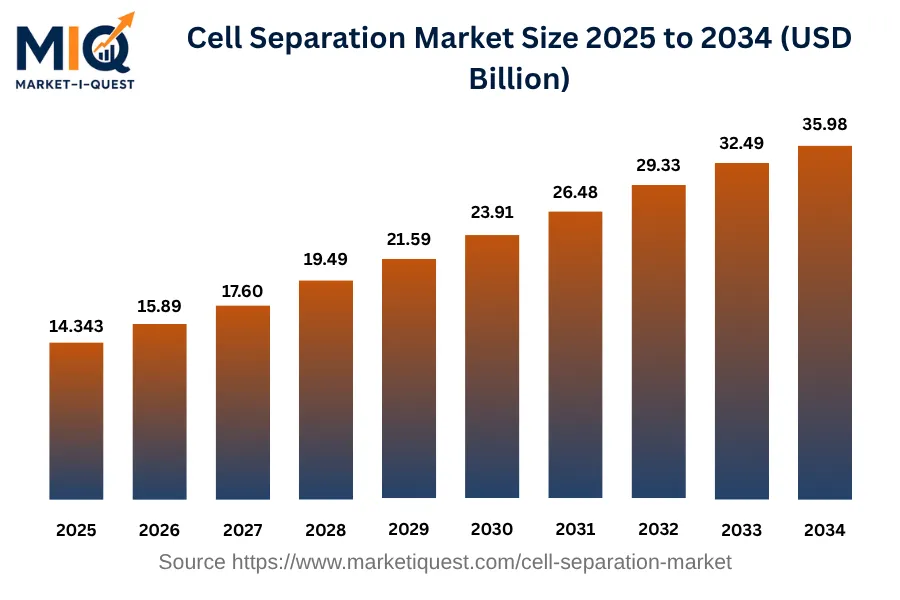
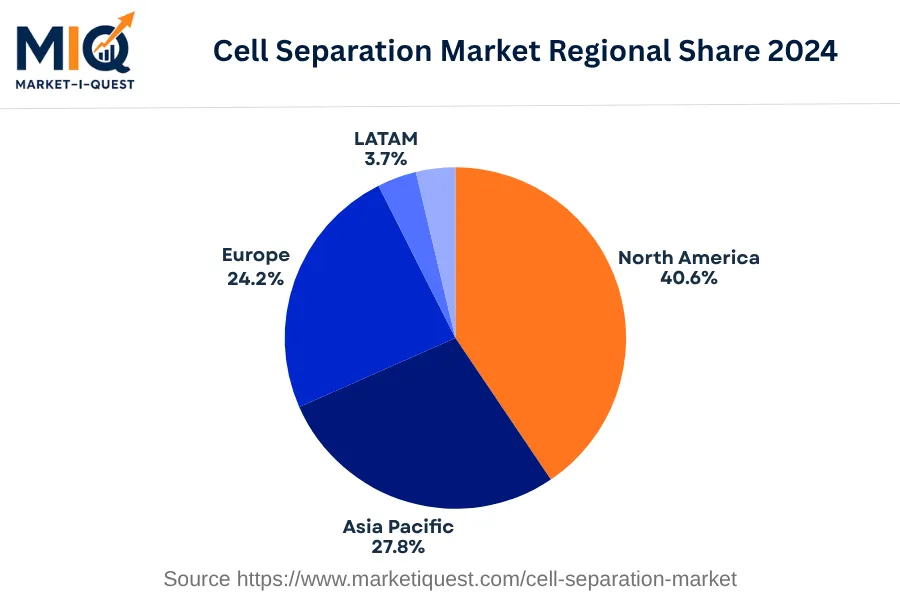
The Cell Separation Market size was at USD 14.34 billion in 2025, followed by a rise to USD 35.98 billion by 2034, expanding at a CAGR of 10.76% over this period. The significant growth trajectory started from USD 12.95 billion in 2024, escalating notably by the subsequent year and continues to 2034. The market expansion is mainly due to an increase in technological advancements leading to improved cell separation techniques and a heightened usage rate. The rise in research and development activities has also played a part in boosting the market size. As for the regional share mix in 2024, North America held the leading position with 40.56%, followed by Asia Pacific at 27.82%, Europe at 24.18%, and both LATAM and MEA at 3.72% each.

Key Takeaways

  • By Cell Type - Human cells assumed a leading role with the majority share.
  • By Product - Consumables led the market with significant share in the year.
  • By Technique - Centrifugation accounted for the largest market share.
  • By Application - In Vitro Diagnostics was in the forefront taking up a notable position.
cell-separation-market market size

Key Driving Factors

Adoption of Microfluidics-Based Cell Separation Techniques

The adoption of microfluidics-based techniques for cell separation is a significant driving factor for the cell separation market. Microfluidics provide a high-throughput, cost-effective, and less invasive method for cell separation, enabling the isolation of specific cell fractions that are essential for research, clinical diagnostics, and therapeutics. Laboratories, pharmaceutical companies, and research institutions are increasingly utilizing these techniques in place of traditional methods like fluorescence-activated or magnetic-activated cell sorting, largely due to their improved efficiency and scalability. The increased adoption of these techniques holds the potential to largely define the trajectory of growth within the cell separation market.
Formulation of Precision Medicine Approaches

The formulation of precision medicine approaches is another substantial driving factor for the cell separation market. As personalized medicine becomes pivotal in healthcare, the need for cell separation techniques to understand cellular behavior and devise targeted treatments is becoming more crucial. For example, researchers are using cell separation techniques to derive tumor cells from a patient's tissue sample, further analyzing these cells to design personalized treatment options. This shift towards precision medicine is significantly fostered by regulatory bodies such as the FDA and the European Medicines Agency who have recognized its potential for improving patient outcomes.

Market Evolution by Timeline

2019-2023
This period witnessed expansion of the Stem cell research sector, particularly in North America and Europe regions which led to higher demand in cell separation technologies. Immuno-oncology treatments were at the forefront with research bodies heavily investing in cell-based treatments. Supply front saw companies like Miltenyi Biotec and Thermo Fisher launch technologies like MACS and Dynabeads which became popular in cell separation methods. While there weren't any concrete global policy regulations, local FDA and European commission standards guided the adoption of these techniques. Typical contracts during this period were mostly annual volume-based tied with performance guarantees. Risks included technical complexities in capturing the right cells and lack of skilled labor.
2024
In 2024, the therapeutic areas expanded covering diseases like diabetes and epilepsy, with Asia-Pacific emerging as a prominent buyer due to rise in government funding towards stem cell research. Beacon and HalioDx introduced use of AI and other advanced tools in their cell separation systems like ClearEdge. Clinical Laboratory Improvement Amendments (CLIA) in the US provided a regulatory framework for laboratories. The commercial models continued like the last period with long-term volume based contracts, however contract research organizations showed growing influence. The major risk during the year was heavy reliance on AI tools leading to issues with data privacy.
2025-2029
Demand may continue to grow across the pharmaceutical and biotechnology industries, research institutes, and hospitals. Countries in Latin America and the Middle East could increasingly explore cell-based therapies, creating new market opportunities. Advances in fluorescence-activated cell sorting (FACS) technology may support broader applications, while companies such as Becton Dickinson and Shionogi could contribute to technological developments. The EU's In Vitro Diagnostic Medical Devices Regulation (IVDR 2017/746) may continue to influence the regulatory landscape. Commercial models could diversify further, with pay-per-use and rental agreements gaining traction among smaller hospitals and research facilities.
2030-2034
The cell separation market may continue to expand as gene therapy and regenerative medicine advance toward broader clinical adoption. Laboratories across Australia, New Zealand, and African countries could increasingly adopt cell separation techniques. Companies such as Sony and RareCyte may contribute to the development and adoption of advanced acoustic cell separation technologies. European Medicines Agency (EMA) guidelines, including CPMP/ICH/2711/99, could help shape regulatory frameworks for gene therapy product development. Commercial models may increasingly feature partnerships between healthcare institutions and biotechnology companies.

Future Market Outlook

Future Opportunities

The landscape for the cell separation market is set for considerable evolution, particularly due to increasing regulatory support for cell-based therapies globally. The U.S. FDA streamlined the approval pathway for regenerative medicine, which includes cell therapeutics, thereby fostering innovation in separation technologies to meet new clinical standards. Companies are exploring partnerships and collaborations to enhance capabilities; for instance, the collaboration between Thermo Fisher Scientific and academic institutions aims to develop next-generation cell separation systems. In addition, the growing emphasis on point-of-care diagnostics, as noted in a WHO report suggests that portable cell separation devices will gain traction in emerging markets, where accessibility is critical. Furthermore, biopharmaceutical firms are actively investing in custom separation solutions to refine cell therapies and ensure compliance with increasingly stringent regulations. The recent trend toward the utilization of artificial intelligence in biological research, as evidenced by various studies indicates that merging AI with cell separation technology may unlock new avenues for innovation. Moreover, the focus on sustainable practices is prompting companies to develop environmentally friendly separation methods, responding to global sustainability initiatives establish. Therefore, ongoing advancements and collaborations in the field will likely shape the future trajectory of the cell separation market, creating a robust environment for growth.

Segmentation Analysis

By Cell Type

The market is divided into subsegments including Human Cells and Animal Cells. Human Cells accounted for the largest revenue share while Animal Cells are expected to grow at the fastest CAGR during the forecast period.

Largest Revenue Share

Human Cells

Market Share Leader

The Human Cells subsegment is leading in terms of revenue based on a combination of factors. The human cell culture techniques serve as the backbone for the biopharmaceutical industry, which is experiencing a continual surge in demand, thereby fueling the revenue growth. Human cells are extensively used in research, drug discovery, and therapeutic applications, contributing to higher sales. They are also vital resources for modeling diseases and testing new drugs, further driving up their use. Secondly, many pharmaceutical and biotech companies in developed regions like North America and Europe are heavy investors in this domain, amplifying the demand for human cells. Regulation is another aspect to consider. Stringent regulations ensure quality and safety which indirectly propels the demand, despite imposing a higher purchase price. Furthermore, the evolution of supply chain capabilities has facilitated easier access to human cells, effectively lowering purchasing barriers and appealing to a wider consumer base. Despite potential switching costs, consumer retention is high due to the vital nature of human cells in biopharmaceutical research and production.

Fastest CAGR

Animal Cells

Forecast Period Growth Leader

Animal Cells subsegment is expected to witness rapid growth in the future. The key growth driver for this segment is its usage in the preliminary stages of research and drug discovery. Animal cells serve as simplified models, thus are often preferred for early stage, high-throughput studies, which bolsters their adoption. However, ethical concerns and regulatory restrictions related to animal usage pose a non-trivial barrier to growth. On a positive note, advancements in technology and growing collaborations among academic institutions, biotech firms, and pharmaceutical companies are accelerating the progress in animal cell research. Such catalysts can be transformative for the subsegment growth.

By Product

The market is divided into subsegments including consumables and instruments. Of these, consumables accounted for the largest revenue share while instruments are expected to grow at the fastest CAGR during the forecast period.

Largest Revenue Share

Consumables

Market Share Leader

Consumables have been the dominant subsegment in the product market, primarily due to their constant demand across numerous applications and sectors. With their routine use in the everyday operations of laboratories, research centers, and industrial units, the revenue generated from this subsegment is typically high. The regulatory standards set by governing bodies have also necessitated the regular replacement of consumables to ensure quality and accuracy, thereby contributing to their sales volume. Furthermore, advancements in technologies and constant inflow of investments globally have led to the development of superior quality consumables, strengthening the growth of this subsegment. The ease of procurement, coupled with cost-effectiveness, makes consumables an attractive purchase for both existing and potential customers. However, the purchasing criteria involves high priority for quality and approval, given the direct impact these products have on result accuracy.

Fastest CAGR

Instruments

Forecast Period Growth Leader

Instruments are poised to show the fastest growth of all subsegments over the forecast period. They serve as robust platforms that enable the execution of numerous operations and tasks. Though the initial investment for these instruments can prove substantial, their long-term use and versatility can compensate for this outlay. Moreover, the advent of automation and digitization in instruments has significantly improved operational efficiency and output quality, and this is attracting numerous customers from diverse sectors to invest in these tools. A supportive policy landscape has also increased funding and support for instrument development and procurement, which could act as a strong growth catalyst.

By Technique

The market is divided into subsegments including Centrifugation and Surface Marker techniques. In 2024, Centrifugation accounted for the largest revenue share, while Surface Marker is projected to experience the fastest growth rate during the forecast period.

Largest Revenue Share

Centrifugation

Market Share Leader

Centrifugation techniques hold the largest market share due to a variety of factors that are driving its revenue. Centrifugation's versatility as a procedure lends itself well to numerous applications in clinical and research settings. It's utilized in a variety of industries, ranging from pharmaceuticals and biotechnology to food production. Compared to other techniques, centrifugation is often more cost-effective and efficient, which makes it a preferred choice for many users. Moreover, advancements in the technology have made high-speed and ultracentrifugation more accessible, which is another major contributing factor. Furthermore, the global demand is supported by continuous improvements in medical infrastructure, especially in developing regions, alongside with generally increasing health expenditures. In addition, the regulatory environment favors companies investing in centrifugation technologies, offering incentives to develop and adopt these techniques.

Fastest CAGR

Surface Marker

Forecast Period Growth Leader

Surface Marker is projected to be the fastest-growing subsegment. This significant growth is driven by several catalysts. Technological advances in bioengineering have facilitated progress in Surface Marker techniques. They offer a higher level of precision and specificity when identifying particular cell types, which is crucial in various fields such as targeted therapies and precision medicine. Furthermore, the increasing trend towards personalized treatments in healthcare is accelerating the adoption of Surface Marker techniques, as they allow for more accurate patient stratification. On the policy front, the potential for these techniques to revolutionize healthcare has caught the attention of regulatory bodies, leading to favorable policies to spur their growth. However, barriers to adoption include the high cost of implementing such technologies and the complexity of their operation. As these barriers are being addressed, the Surface Marker technique continues its rapid growth trajectory.

By Application

The market by application is divided into subsegments including Biomolecule Isolation, Cancer Research, Stem Cell Research, Tissue Regeneration, In Vitro Diagnostics, Therapeutics, and Others. Of these, In Vitro Diagnostics accounted for the largest revenue share while Stem Cell Research is expected to grow at the fastest CAGR during the forecast period.

Largest Revenue Share

In Vitro Diagnostics

Market Share Leader

In Vitro Diagnostics (IVD) holds the highest share in the revenue generated by this segment in the base year 2024. There are several factors contributing to this lead. A prominent one is the high demand for IVD services due to the prevalence of chronic diseases like cancer and diabetes. Also, as a global population continues to age, the need for preventative and diagnostic healthcare services will continue to rise. This trend propels the need for efficient, accurate, and quick diagnostic tools, a need that the IVD subsegment answers. Improved technologies within the IVD subsegment, like point-of-care testing, also increase the adoption rate and thus, revenue generation. Regional factors also contribute to IVD's dominance: developed regions have regulatory support for IVD testing and developing regions are witnessing an increased healthcare investment, both of which spur growth in this subsegment. The purchasing criteria typically include the accuracy and speed of results, the reliability of the equipment, and compatibility with existing systems, further pushing the preference towards IVD.

Fastest CAGR

Stem Cell Research

Forecast Period Growth Leader

Stem Cell Research is forecasted to have the fastest growth rate. As medical sciences progress, the understanding of stem cells and their potential applications in various areas like regenerative medicine and drug discovery grows parallelly. This understanding acts as a strong catalyst for the growth of this subsegment. Major technological innovations, including organoid technology and 3D cell culture techniques, have expanded the possibilities for stem cell research, thereby drastically improving its potential growth. Yet, several global governments and organizations are launching initiatives to fund and support stem cell research, providing the necessary impetus to overcome these bumps and contribute to its rapid growth. Therefore, while it doesn't top the revenue chart currently, its promising outlook earns Stem Cell Research a place as the fastest-growing subsegment.

Competitive Analysis

Key Market Players

Manufacturers / OEMs

GE Healthcare
US
Bio-Rad Laboratories, Inc.
US
Stemcell Technologies Inc.
Canada

Key Suppliers & Raw Materials

Merck KGaA
Germany
Thermo Fisher Scientific
US
ImmunoStep, S.L.
Spain

Distributors, Integrators & Channel Partners

Sartorius AG
Germany
Miltenyi Biotec
Germany
Pluriselect Life Science UG
Germany

Porter’s Five Forces Analysis

This analysis summarizes the competitive forces impacting the cell separation market.

Supplier Bargaining Power

Medium

Limited number of suppliers provides moderate bargaining power due to specialized equipment requirements.

Buyer Bargaining Power

High

Wide range of buyers with significant purchasing power due to high demand for cell separation technologies.

Threat of Substitutes

Low

No effective alternatives available due to the specificity and complexity of cell separation techniques.

Threat of New Entrants

Medium

Significant barriers due to high research & development costs and regulatory requirements, despite growing interest.

Competitive Rivalry

High

Intense competition among established companies to develop more cost-effective and accurate cell separation techniques.

Regional Analysis

Geographic market dynamics and growth opportunities across key regions

Global Market Outlook

cell-separation-market market regional share

North America

In 2024, the North American cell separation market was defined by strong demand running parallel with dynamic technological development. The growth was primarily driven by heavy investment in cell-based research in the healthcare and life sciences sectors, with a notable emphasis on cancer research and regenerative medicine. Governments of the United States, Canada, and Mexico have been promoting supportive regulations for stem cell research, further bolstering the market momentum. Technological advancement was another major driver. The adoption of novel biotechnologies, such as microfluidics and next generation centrifugation, have increased separation efficiency and speed. On the supply side, competitive pricing and the presence of established market players have kept supply consistent with demand.

As for the market trends, a shift in buyer behavior towards automated cell separators for improved throughput was observed. Biotech and pharmaceutical companies in the region showcased keen interest in advanced cell separation technologies for drug discovery and cellular therapies. Partnerships and mergers & acquisitions abounded in 2024 with companies seeking to widen their product portfolios and strengthen their technological capabilities. The enforcement of stringent safety standards by regulatory bodies influenced the development and adoption of cell separation systems, with companies focusing on producing versions that meet high-quality specifications.

Asia Pacific

In 2024, the Cell Separation Market in the Asia Pacific region was influenced strongly by factors such as escalating demand, advancements in technology, and significant market investments. Rising prevalence of chronic diseases in China, India, and Japan led to greater demand for cell-based therapies thereby pushing this market upwards. High government investments from Australia and South Korea in healthcare and biological research amplified the growth in cell separation technology adoption. Key trends that prevailed included increased reliance on stem cell research and a shift towards automated cell separation methods for accuracy and efficiency. Consumer behavior gravitated toward companies offering advanced cell separation products in Japan and South Korea. There was an observable rise in strategic partnerships and M&A activities, particularly within ASEAN markets such as Singapore, aimed at broadening product portfolios and market reach. Policymakers enforced stricter regulations ensuring safe and ethical use of cell technologies.

Cell separation technology saw major applications in the healthcare sector, largely within hospitals and clinical research laboratories. Wellness centres and therapeutic companies also significantly contributed to market growth. Retail channels saw increased penetration with robust sales of cell separation kits and reagents. This market, considered foundational for further breakthroughs in healthcare and biological research continued to stimulate innovation and business opportunities in the wider Asia Pacific region.

Europe

In 2024, the Cell Separation Market in Europe demonstrated significant growth due to a range of contributory factors. One primary driver was the rising prevalence of diseases such as cancer and HIV, which increased demand for biomedical research involving cell separation technologies. Governments across Germany, the United Kingdom, and France further stimulated market growth with substantial investments in medical research and development activities. Moreover, technological advancements led to the widespread adoption of new cell separation methods in healthcare facilities, pharmaceutical companies, and research institutes. Pricing dynamics also shifted, with more affordable options emerging due to increased competition among suppliers.

Contemporary trends in the market showcased buyer preference for innovative and efficient cell separation products. There was also a shift towards automated cell separation methods in countries like Italy and Spain due to their enhanced precision. Notably, partnerships and M&A activities became more prevalent, with companies in Scandinavia and Benelux seeking to leverage collective expertise and resources. The healthcare sector, in particular, demonstrated strong purchasing behavior for cell separation technologies, underpinned by robust policy enforcement by European health regulatory bodies. In Central & Eastern Europe, manufacturing sectors engaged increasingly with cell separation functionalities, thereby diversifying the market's customer base.

Latin America

In 2024, the LATAM cell separation market showcased significant growth augmented by distinct driving factors and trends. Emergent demand from pharmaceutical and biotechnology companies, governmental backing of healthcare research, and the adoption of novel cell separation technologies primarily drove the market. Mirroring this uptick, Brazil exhibited a strong surge in biopharmaceutical research, resulting in greater demand for cell separation technologies. A similar pattern was discernible in Argentina due to the government's strategic investment in medical research infrastructure. Further, regulatory reforms in Mexico encouraged local cell separation supply dynamics, stimulating availability and affordability of these technologies.

A notable market trend was the progressive alteration in buyer behavior, with a noticeable preference towards magnet-based cell separation techniques due to their higher output efficiency. A shift was also identified in vendor strategies, with significant partnerships and M&A activities observed across Colombia, Chile, and Peru. Channel dynamics varied, with a pronounced trend towards direct-to-consumer sales. Peruvian start-ups introducing advanced and user-friendly cell separation technologies played a pivotal role, causing ripple effects across the LATAM region. Reflecting these drivers and trends, customer sectors such as healthcare, pharmaceuticals, biotechnology companies, and academic research institutions substantiated significant market share.

Middle East & Africa

In 2024, the Cell Separation Market in the Middle East and Africa demonstrated noteworthy dynamism. A key driver was the expanding healthcare sector in countries like Saudi Arabia, UAE, and Kenya where a rise in health awareness fueled investments into new biotechnological facilities. Israel's renowned technological integrations also boosted this sector, specifically in medical analytics and cellular therapy. Moreover, governments' commitment towards healthcare improved in countries such as Qatar and South Africa, stimulating the cell separation market. Simultaneously, robust trends became evident in the adoption of novel technologies and buyer behavior. An increased preference for automated cell separation was seen among laboratories and hospitals in Saudi Arabia and UAE. Furthermore, a shift towards non-magnetic cell separation methods was broadcasted in Egypt and Nigeria, driven by the healthcare industry's escalating requirement for advanced technologies.

Another trend was the growing number of partnerships and transactions between domestic and international manufacturers in order to leverage superior technology and gain market share, especially in countries like Israel and South Africa. For instance, multinational companies began operating from Dubai and Nairobi, pushing regional standards. An increased policy enforcement was observed throughout the region to regulate cell separation processes consistent with global practices, validating the sector's depth and maturity in 2024.

Recent Industry Developments

Latest market innovations, product launches, and strategic initiatives

October 2025

Alfa Laval introduced the Culturefuge 200 B separator tailored specifically for medium-scale, high-density cell harvesting. Utilizing specialized hermetic design and Bactofuge technologies, the system allows for continuous, low-shear separation of suspended proteins and fragile cell fragments without compromising target cell viability.

January 2025

Miltenyi Biotec launched the MACS GMP Tyto Cartridge HS, updating its high-speed clinical cell separation platform. The closed, sterile cartridge system delivers faster processing throughput and higher magnetic-activated cell sorting (MACS) yields required for manufacturing advanced cellular therapies.

Frequently Asked Questions