Carborundum Market Snapshot

Key Players

  • Saint-Gobain (France)
  • Carborundum Universal Limited (India)
  • Grindwell Norton (India)
  • 3M (United States)
  • CoorsTek (United States)
  • Washington Mills (United States)
  • Snam Abrasives Pvt. Ltd (India)
  • Sak Industries (India)
  • E. I. Du Pont De Nemours and Company (United States)
  • Bosai Minerals Group Co. Ltd. (China)

Market Size

Base Year 2024
$5.94 Bn
CAGR
13.7%
Forecast 2034
$21.45 Bn

Market Segments

By Type
  • Black SiC
  • Green SiC
  • Metallurgical SiC
  • Coated SiC
  • Micro Grit SiC
  • Refractory SiC
By End Use
  • Steel & Energy
  • Electronics & Semiconductors
  • Automotive
  • Aerospace & Defense
  • Medical
  • Others

Market Dynamics

Drivers
  • Increasing industrial applications
  • Advancements in carborundum production technology
Restraints
  • High production cost
  • Environmental regulations
Opportunities
  • Increased industrial applications
  • Rising abrasive material demand

Market Size

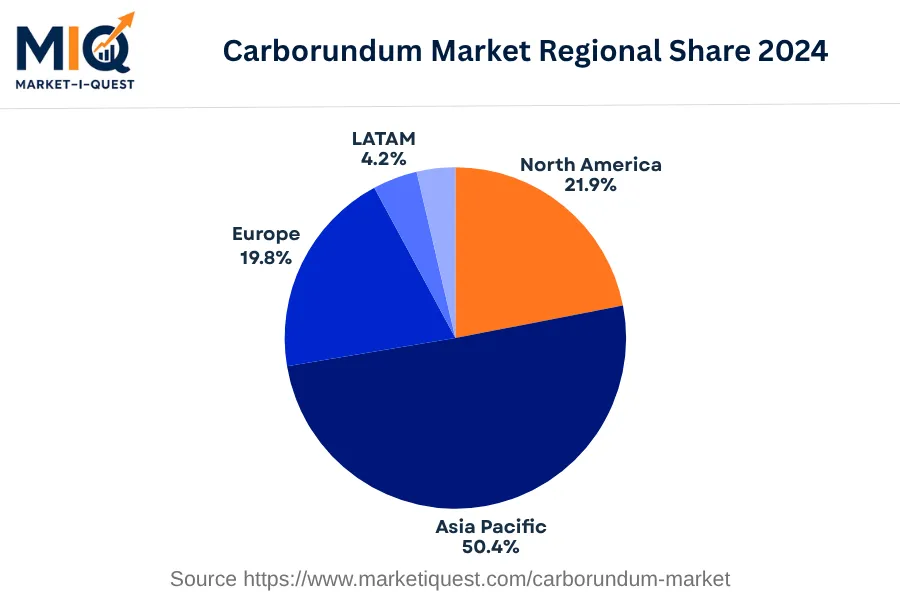
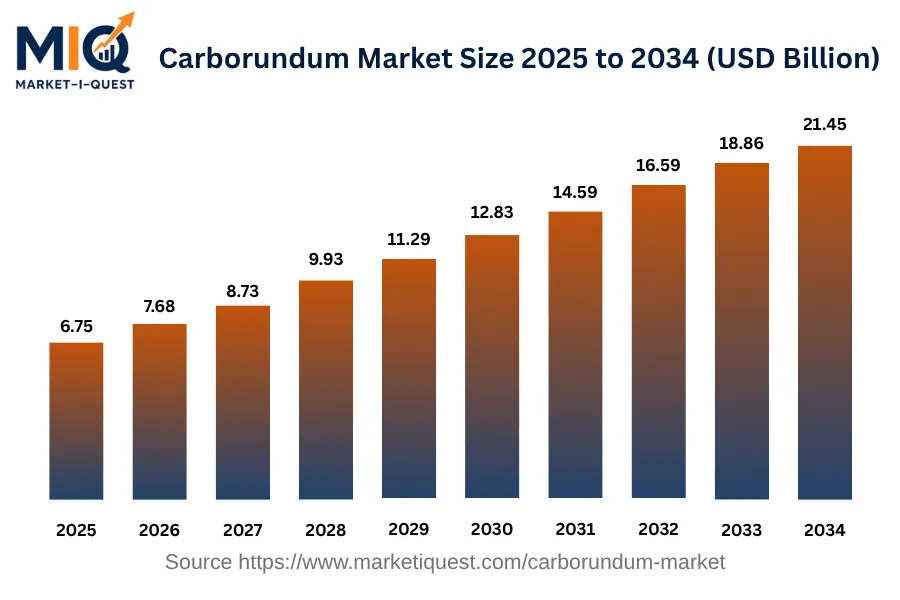
The Carborundum market valued at $6.75 billion in 2025 and is projected to reach $21.45 billion in 2034, demonstrating a steady CAGR of 13.7%. This substantial rise in the industry is undoubtedly linked to the values over the years, with the market starting from $5.94 billion in 2024, making a notable increase to $21.45 billion in 2034. The regional perspective for the 2024 Carborundum market held North America with a 21.94% share, followed by Europe at 19.76%. However, the regional share distribution indicated the Asia Pacific region held the largest market piece, amounting to 50.42%, whereas LATAM and the MEA regions accounted for smaller slices of the market, at 4.23% and 3.65% respectively.

Key Takeaways

  • By Type - Black SiC held the major share accounting for remarkable coverage in the Carborundum market.
  • By End Use - Automotive showed promising growth marking significant contribution to the Carborundum market.
carborundum-market market size

Key Driving Factors

Enhanced Use in Electronics Industry

One driving factor for the Carborundum market is its enhanced use in the electronics industry due to its specific property of semiconductivity. Carborundum, also known as silicon carbide, possesses a mixture of conductivity and insulating properties. This unique combination makes it an ideal material for use in electronic equipment, such as semiconductors, transistors, and diodes. Its inherent thermal stability and resistance to thermal shock also make it indispensable in the manufacturing of power electronics. Specifically, major manufacturers in the electronics industry are increasingly seeking for carborundum in their production processes, thus leading to a rise in demand and consequently, the growth of the carborundum market.

Stringent Environmental Regulations

A second critical driving factor is the implementation of stringent environmental regulations. Carborundum, due to its high endurance and less environmentally harmful production process compared with other abrasives, is more compliant with current strict environmental norms. Regulatory bodies globally, such as the United States Environmental Protection Agency (EPA), are enforcing rules to minimize industrial pollution. These regulations mandate industries for reducing the utilization of harmful abrasives and encourage the use of eco-friendly alternatives. As such, industries are increasingly choosing carborundum as their preferred abrasive material to align with these environmental regulations.

Market Evolution by Timeline

2019-2023
During this period, demand for carborundum arose mainly from sectors such as automotive, aerospace and electronics, primarily in North America and Asia. The market witnessed an increase in carborundum use for thermal resistant and anti-corrosive components. Supply was dominated by major manufacturers such as Saint-Gobain and Grindwell Norton, with few new entrants due to high entry barriers. Several countries adopted the ISO 9001 quality standard to ensure product quality. The average pricing was stable for bulk contracts, with overall sales mainly conducted through direct sales channels. The main risk was supply disruption from one primary region, China, which reignited considerations about diversifying source markets.
2024
In 2024, the carborundum market deepened in regions like Europe and the Middle East, specifically in sectors such as manufacturing and engineering, responding to the 'Go Green' movement. There was a surge in integrating carborundum in renewable energy technologies. Manufacturers started to offer bespoke solutions to industries yet kept facing supply chain constraints due to geopolitical tensions. Carborundum-based products were encouraged due to updated EU regulations regarding environment-friendly materials. Moving towards performance-based contracts began. One significant risk was the elevated demand unpredictability, leading many companies to invest in predictive analytics.
2025-2029
The demand for carborundum might witness an rise in consumer electronics and electric vehicles production in this period, notably in regions such as East Asia. Usage of nanocrystalline carborundum will likely witness a rise in innovative applications, like to enhance battery lifetime. The introduction of the 'Green Electronics Standard' might further boost the usage of carborundum. Collaborations between different players (manufacturers and procurers) may start becoming predominant. There is a projection for a certain risk of over-reliance on a few suppliers, leading to discussions about long-term contracts as a solution.
2030-2034
During this period, countries such as India and Brazil might start to gain demand in the carborundum market. Noticeable demand is expected to come from semiconductor production and construction sectors. The drive for using bio-based carborundums will likely become more apparent with more integrated technological solutions in place. Suppliers are expected to take measures to meet the 'Sustainability and Energy Efficiency Standards' in production. The commercial models will likely shift towards the subscription, offering carborundum on a rate contract basis. The main risk may be the steep increase in raw material prices, leading to discussions on strategic reserves and partnerships.

Future Market Outlook

Future Opportunities

The growing focusing on sustainability and energy efficiency presents several future opportunities within the carborundum market. The European Union's Green Deal has set ambitious targets for reducing carbon emissions, generating pressure to adopt materials that offer better efficiencies. This regulatory environment encourages companies to integrate carborundum into energy-conserving technologies. For instance, in Germany, multiple automotive manufacturers are actively exploring the integration of silicon carbide components in electric vehicle powertrains to improve overall performance. Furthermore, the increasing investment in renewable energy infrastructure, as seen in the offshore wind projects initiated in the North Sea, is likely to create a rise in demand for carborundum products. The trend toward miniaturization in electronic devices calls for advanced materials capable of efficient heat management, positioning carborundum favorably in the semiconductor market. Research partnerships, such as the collaboration announced between MIT and a leading semiconductor manufacturer, aim to explore novel applications for carborundum in next-generation devices. As carborundum technologies mature, businesses could leverage advancements in recycling and reuse practices for mitigating supply chain risks associated with raw material procurement.

Segmentation Analysis

By Type

The market is divided into subsegments including Black SiC, Green SiC, Metallurgical SiC, Coated SiC, Micro Grit SiC, Refractory SiC. Of these, Black SiC accounted for the largest revenue share in 2024, while Metallurgical SiC is expected to grow at the fastest CAGR during the forecast period.

Largest Revenue Share

Black SiC

Market Share Leader

Black SiC has gathered the highest revenue in the base year 2024 because it is widely used across a variety of industries, including automotive, electronics, and metallurgy. This broad application base drives its volume demand and subsequently, its revenue share. Predominantly, its increasing demand in the automotive segment, for its use in cutting and grinding operations, has largely contributed to its growth. Moreover, the high heat resistance and hardness of Black SiC make it an ideal choice for refractory applications, further increasing its demand. Geographically, the Asia-Pacific region, particularly China, contributes significantly to this demand due to its vast manufacturing base. Moreover, its distribution is well-facilitated through both online and offline channels, enabling easy accessibility to consumers.

Fastest CAGR

Metallurgical SiC

Forecast Period Growth Leader

Projections indicate Metallurgical SiC to be the fastest growing subsegment in the foreseeable future. The major contributing factor is its extraordinary ability to withstand extreme temperatures, which makes it indispensable in metal smelting and steel manufacturing. Potential technological advancements and increasing cooperation between manufacturers might further enhance its utilization as deoxidizing agent in steel manufacturing, becoming a significant growth catalyst. Beneficial government policies and increasing capital expenditure in the metal industry, especially in emerging economies, are expected to fuel its demand. However, noteworthy is the potential risk of fluctuations in the price of raw materials and supply chain disruptions, which might affect its steady growth.

By End Use

The market is divided into subsegments including Steel & Energy, Electronics & Semiconductors, Automotive, Aerospace & Defense, Medical, and Others. In 2024, the Automotive segment accounted for the largest revenue share while the Medical segment is expected to grow at the fastest CAGR during the forecast period.

Largest Revenue Share

Automotive

Market Share Leader

In 2024, the Automotive segment held the lions share of revenue in the market because of several key factors. The continuous growth in the automobile industry, driven by increasing disposable income and growing urbanization, has led to a rise in vehicle production, thereby propelling the demand in this segment. Technological advancements including autonomous vehicles and electric cars have contributed to the deepening penetration of this segment into the market, with key players striving to innovate and capture a larger market share. Geographic regions such as APAC, with countries like China and India, play a crucial role in this dominance due to their expansive automotive industry. Additionally, strict emission regulations worldwide are steering the demand towards hybrid and electric vehicles, subsequently driving this segment's revenue. The durable nature of the product, coupled with its cost-effectiveness, has led to its high demand in the automotive industry.

Fastest CAGR

Medical

Forecast Period Growth Leader

The Medical subsegment is expected to be the fastest-growing during the forecast period. A large factor behind this rapid growth rate is the increasing technological innovations in the medical sector. As the capabilities of technology continue to expand, new applications within medical devices and healthcare services are being found. Furthermore, there are several different external aspects driving this growth. These include an aging global population, increasing prevalence of chronic diseases, and a greater focus on health and wellbeing among consumers. Regulations that encourage the use of technology to improve patient healthcare also play a role. However, the pandemic has also led to an increased reliance on healthcare, creating opportunities for further growth and development within this sector.

Competitive Analysis

Key Market Players

Manufacturers / OEMs (Core Producers for Carborundum Market)

Saint-Gobain
France
Washington Mills
US
Carborundum Universal Ltd
India

Key Suppliers & Raw Materials

Cumi Minerals
India
Gorka Cement Sp.zo.o.
Poland
CoorsTek, Inc
US

Distributors, Integrators & Channel Partners

Fiven ASA
Norway
Elkem ASA
Norway
Kyocera Corporation
Japan

Porter’s Five Forces Analysis

Analysis of competitive forces within the Carborundum market, including suppliers, buyers, substitutes, threats from new entrants, and industry rivalry.

Supplier Bargaining Power

Medium

Suppliers are limited, but diversified sources can mitigate bargaining power to some extent.

Buyer Bargaining Power

High

Buyers have high bargaining power due to a wide selection of suppliers and low switching costs.

Threat of Substitutes

Low

Threat of substitutes is low as Carborundum has unique abrasion and heat resistance properties in industrial applications.

Threat of New Entrants

Medium

Relatively high initial capex and technical expertise may pose barriers, but no significant regulatory restrictions.

Competitive Rivalry

High

The market is characterized by a high level of competition, with several established players operating internationally.

Regional Analysis

Geographic market dynamics and growth opportunities across key regions

Global Market Outlook

carborundum-market market regional share

North America

In 2024, the Carborundum market in North America saw a distinct shift caused by several drivers and trends. The demand for this material grew significantly in industries including electronics, automotive, and defense. Regulatory pressure to reduce carbon emissions drove the adoption of carborundum in automotives for energy-efficient combustion systems. The U.S. Department of Defense’s investment in advanced materials boosted this substance’s use in body armor applications. In addition, the continued expansion of the semiconductor industry in the U.S. and Canada increased the demand for carborundum due to its thermal conductivity properties. Pricing changes also shaped the industry, with an increased supply from Mexico contributing to more competitive prices and fostering market growth.

Trends observed in 2024 include a shift toward digital sales channels, as B2B e-commerce platforms became more popular for their efficiency and ease of use. Standardization efforts, notably ASTM International’s creation of new industrial standards for carborundum, gave way to greater product consistency and reliability. Additionally, the rise of green manufacturing policies drove the adoption of carborundum in green abrasive applications. We also noticed a trend of partnerships and M&As, especially between U.S. and Canadian companies, which expanded their product portfolios in a bid to tap into new market segments.

Asia Pacific

In 2024, the Carborundum market in the Asia Pacific region witnessed significant transactions. On the drivers front, China's increased infrastructure spending bolstered demand for Carborundum in the construction industry. Simultaneously, South Korea's adoption of newer technology in the electronics industry created an upward pull in demand. India's policies favoring industrialization and large-scale manufacturing, combined with substantial foreign investment, opened new avenues for Carborundum. Concurrently, constraints in supply, primarily from China again, kept prices moderately high throughout the year.

In terms of trends, Australia's shift towards renewable energy solutions amplified the requirement of Carborundum in solar panel manufacturing. In response to evolving consumer preferences in the automotive sector, Japan accelerated the production of electric vehicles, indirectly driving the demand for Carborundum for its use in lithium-ion batteries. The presence of well-established e-commerce channels in ASEAN markets facilitated widespread distribution, thus stimulating regional demand. Major partnerships and M&A were observed, notably with Chinese and Indian manufacturers forming alliances to tap into untapped markets. Furthermore, stringent enforcement of environmental safety standards forced several markets, including China and Australia, to adopt Carborundum due to its non-toxic nature, thus increasing its relevance in industries such as abrasives, refractories, and ceramics.

Europe

In 2024, the European carborundum market was characterized by steady growth driven by various specific factors. Industrial demand for carborundum, particularly in Germany and Italy’s robust manufacturing sectors, increased significantly due to its application in abrasives, refractories, and electronics. Moreover, regulatory emphasis on sustainable and energy-efficient production processes contributed to its higher adoption rates, particularly in the Nordics and Benelux regions. Furthermore, advances in manufacturing technology facilitated larger scale production, stabilizing supply and pricing across the market.

Dominant market trends were mainly shaped by shifts in buyer preferences, technology disruptions and strategic partnerships. There was a notable shift towards green and recycled carborundum as consumers in the United Kingdom and France demanded more eco-friendly products. Additionally, widespread adoption of AI and machine learning enabled real-time monitoring and predictive maintenance of production lines, enhancing overall efficiency in Central and Eastern Europe. Strategic partnerships, like the one between Spain's leading carborundum producers and retail giants, effectively streamlined distribution channels, strengthening the market further. Regulatory bodies across the region also maintained stringent enforcement of safety and performance standards. Sectors like enterprise manufacturing, electronics, and retail played key roles in the 2024 European carborundum market landscape.

Latin America

In 2024, the Carborundum market in Latin America experienced a remarkable shift. Regulatory changes in Brazil and Mexico, stressing environmentally benign manufacturing practices, caused increased demand for carborundum – a non-toxic abrasive and cutting material. Argentina's significant public infrastructure investment stimulated further demand, particularly with widespread adoption of carborundum-coated tools in construction. Moreover, Colombian manufacturers also integrated technologically advanced carborundum applications into their production processes, following successful trials in automotive manufacturing. Unstable silica sand supply in Chile affected pricing, leading to a shift towards carborundum abrasives, used widely in the metalworking sector. Peru saw increased exploitation of local carborundum deposits, directly affecting supply dynamics.

Key market trends included diversified buyer behavior across LATAM. For example, telecommunications companies in Mexico adopted carborundum in optical fibre production, a product shift driven by its superior heat resistance. Several Brazilian mining companies also secured partnerships with carborundum suppliers, in an effort to reduce operational costs. Additionally, Colombia enforced stricter policy on hazardous industrial materials, encouraging a move to safer alternatives like carborundum. Meanwhile, Chile witnessed growth in the retail sector, with carborundum-coated consumer goods, such as kitchenware, gaining popularity due to their durability. The Argentine critical infrastructure sector, notably power utilities, embraced carborundum for its high thermal conductivity in heat dissipating applications. Changes in demand factors, regulations, technological adoption, supply dynamics, and pricing distinctly shaped the 2024 LATAM Carborundum market.

Middle East & Africa

In 2024, the Carborundum market in the Middle East and Africa demonstrated robust development driven by varied factors and exhibited distinctive trends. The market growth was primarily fueled by the escalating demand in metal fabrication and electronics manufacturing sectors, particularly in countries like Saudi Arabia, South Africa, and Israel. A trend of adopting high-performance materials in these sectors significantly escalated the consumption of Carborundum. Increasing investments in stringent industrial operations led by governments in the United Arab Emirates and Qatar, coupled with automotive industry's incentive to adopt advanced materials in Egypt, further escalated growth. The steady price of Carborundum stimulated its widespread adoption, detailed by the increasing supply dynamics in Nigeria and Kenya.

Observers noted a shift towards environment-friendly abrasives in industries, boosting the demand for Carborundum. Partnerships and M&A activities, such as between manufacturing and mining companies, became a common strategy to secure raw material supplies. High compliance to industry standards and better enforcement of policies was evident in major economies like Saudi Arabia and Israel. Finally, the market marked the shift from traditional sales channels to digital platforms, particularly in the retail sector, enhancing the product accessibility and reach in the region.

Recent Industry Developments

Latest market innovations, product launches, and strategic initiatives

May 2026

Carborundum Universal Limited (CUMI) completed a strategic equity acquisition, securing a 29.58% stake in Putrim Renewables Private Limited. This targeted investment expands CUMI's clean energy supply integration footprint to support its long-term manufacturing operations and sustainability targets.

March 2026

Carborundum Universal Limited (CUMI) officially commenced commercial production at its newly established facility in Hosur, India. Backed by a capital investment of approximately $10 million (Rs 83 crore), the expansion targets peak capacity utilization capable of generating substantial incremental revenue in high-grade abrasives and technical industrial ceramics.

March 2025

onsemi introduced its first-generation 1200V Silicon Carbide MOSFET-based SPM 31 Intelligent Power Modules (IPMs). The product launch features compact form-factor packaging aimed at optimizing energy density and thermal efficiency, significantly cutting systemic development costs for industrial power automation and advanced heating systems.

Frequently Asked Questions