Car Air Freshener Market Snapshot

Key Players

  • Febreze (United States)
  • Air Wick (United Kingdom)
  • Yankee Candle (US)
  • LITTLE TREES (United States)
  • Godrej Aer (India)
  • Ambi Pur (United States)
  • Renuzit (US)
  • Glade (US)
  • Armor All (United States)
  • Procter & Gamble (US)

Market Size

Base Year 2024
$3.27 Bn
CAGR
4.65%
Forecast 2034
$5.15 Bn

Market Segments

By Product Type
  • Vent Clips
  • Hanging Air Fresheners
  • Gels
  • Sprays
  • Others
By Material
  • Paper
  • Gel
  • Plastic
  • Others
By End User
  • Private Users
  • Commercial Users

Market Dynamics

Drivers
  • Increasing car ownership rates
  • Growing consumer hygiene awareness
Restraints
  • Consumer health concerns
  • Increasing popularity of electric vehicles
Opportunities
  • Rise in car ownership
  • Increased consumer spending on car accessories

Market Size

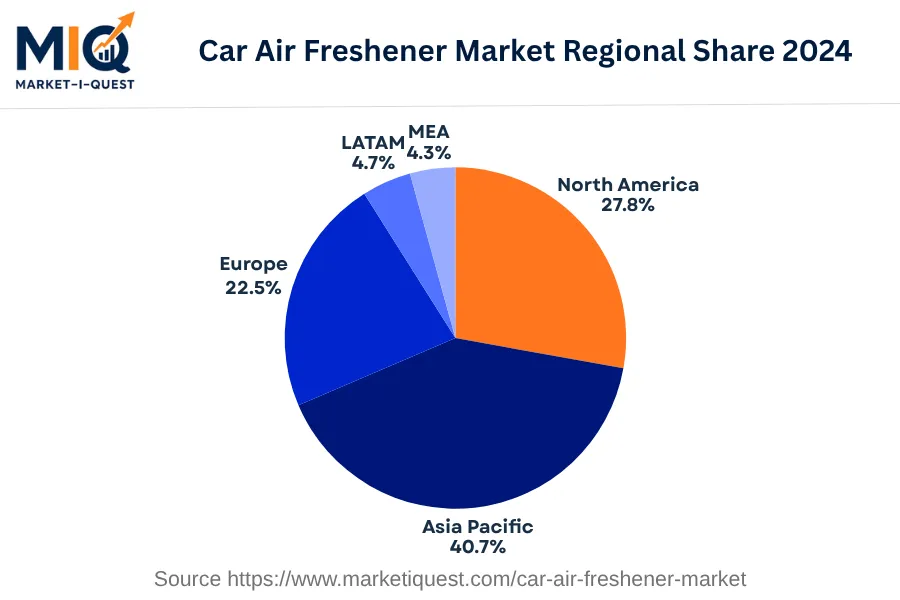
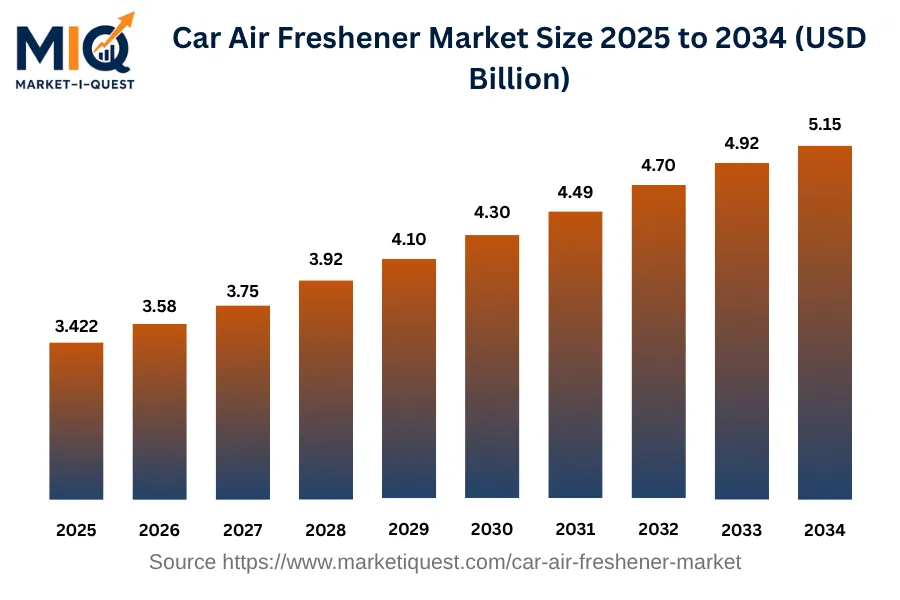
The Car Air Freshener Market will scale from $3.42 billion in 2025 to $5.15 billion by 2034, growing at a CAGR of 4.65%. In the initial year of the analysis period, the market size was $3.27 billion. The continuous rise in market size from $3.27 billion in 2024 to $3.42 billion in 2025 and then to $5.15 billion in 2034 showcases a consistent expansion track. Growth in this market is chiefly due to increased demand for car air fresheners during the analysis period. With regards to regional share in 2024, the Asia Pacific accounted for the highest share of 40.7%. Following this, North America held a share of 27.8%, while Europe constituted 22.5% of the market share. The least market shares were held by LATAM at 4.7%, and MEA at 4.3%.

Key Takeaways

  • By Product Type - Sprays led the Car Air Freshener Market with a significant share in the base year.
  • By Material - Paper was the top preferred material in Car Air Freshener Market in the base year.
  • By End User - Commercial Users dominated the market of the Car Air Freshener Market in the base year.
car-air-freshener-market market size

Key Driving Factors

Shifting Consumers' Preference towards Organic Air Fresheners

Increasing health consciousness among consumers is driving interest in organic and natural products, extending to the car air freshener market as well. Air fresheners often contain chemicals and artificial fragrances that are perceived to be harmful to health over prolonged use. This growing interest in health and well-being is pushing consumers to opt for organic and natural air fresheners that promise to purify the car's environment without harmful side effects. The demand is particularly strong among parents or pet owners who want to reduce their families' exposure to synthetic substances. Many air freshener companies are now developing products with organic essential oils, recycled materials, and biodegradable packaging to cater to this market sector.

Boost in Car Ownership in Developing Markets

Rapid urbanization and increased income in developing economies have intensified the demand for private cars, indirectly influencing the growth of the car air freshener market. Regions like Asia-Pacific and Latin America are experiencing a boom in car sales, where it's becoming a status symbol to own a personal vehicle. With car ownership comes the desire to maintain the car's interior environment as pleasant as possible, as it not only enhances the overall driving experience but also influences passengers' perception. As a part of maintaining the car's internal aesthetics and ambiance, the use of car air fresheners has seen a substantial rise in these regions. This trend is expected to continue as automotive sales in these markets continue to grow.

Market Evolution by Timeline

2019-2023
During the period of 2019–2023, the market saw a shift among car owners primarily in urban areas across North America and Europe towards long-lasting, natural ingredients-based air fresheners. Manufactures, in response, launched eco-friendly and biodegradable products. However, elevated costs became an impediment. Regulatory frameworks like the US EPA's Safer Choice Standard became significant guides for manufacturers. While high-end freshener brands explored subscription models, most retailers continued with traditional sales methods. The risk of undue exposure to volatile organic compounds (VOCs) was a common concern, which led to the development and adoption of less toxic alternatives.
2024
In 2024, there was increased adoption of smart air fresheners in the United States, Japan, and South Korea. Smart car air fresheners that could be controlled via smartphone apps and in-built car systems allowed users to control intensity and frequency. While there was an initial uptick in smart air freshener related tech developments, integration with existing car systems proved challenging. Monthly payment models for refills gained some traction in urban areas. The presence of IoT devices in cars raised privacy concerns, and manufacturers offered privacy protection measures as competitive differentiation.
2025-2029
Demand patterns between 2025–2029 were influenced by clean air initiatives in densely populated cities like Delhi, Beijing, and Mexico City where the need for quality car air fresheners escalated with worsening air quality. China's 'Blue Sky' initiative saw an increase in local product development. Many manufacturers faced supply chain constraints due to raw material sourcing complications, and a distinct shift towards renewable sourced components was observed. Policies regarding waste from packaging led some manufacturers to introduce refill packs. Price wars intensified with local brands entering markets.
2030-2034
The period of 2030–2034 saw a rise in demand for car air fresheners in emerging economies owing to an increase in car sales. Latin American countries like Brazil and Argentina saw local brands compete with international counterparts. Technological innovations focused on minimizing carbon footprint and maximizing scent longevity. Moreover, Europe's Green Deal pushed companies to improve product sustainability. Rigid contractual agreements between supply partners and manufacturers led to steady pricing. The risk of raw material price fluctuations was mitigated via long-term partnerships.

Future Market Outlook

Future Opportunities

The ongoing shifts in consumer preferences and environmental consciousness present significant opportunities in the car air freshener market. As of 2023, an expanding demographic of eco-conscious consumers is prioritizing products made from organic materials, spurring companies to innovate natural fragrance solutions. Brands such as Poo-Pourri are gaining traction for their environmentally friendly formulations and packaging practices. Moreover, the rise in global car ownership, particularly in emerging markets like India and Brazil, indicates a potential increase in demand for air freshening solutions catered to diverse consumer preferences. Furthermore, legislation in various regions promotes awareness of indoor air quality, prompting increased interest in products that combat allergens and odors in vehicles. The growing trend toward personal customization also offers brands potential avenues for product differentiation. For example, the introduction of customizable scent pods by companies like Little Trees in 2022 allows consumers to curate their desired aromatic experience. Partnerships between car manufacturers and air freshener brands could also emerge, as seen in collaborations like that of Toyota and Airre, where integrated scent systems enhance customer experience in new vehicle models. As consumer expectations evolve towards premium experiences, sectors such as luxury automotive brands may seek collaborations with scent experts to offer exclusive fragrance lines, marking a new frontier for growth in the car air freshener market.

Segmentation Analysis

By Product Type

The market is divided into subsegments including Vent Clips, Hanging Air Fresheners, Gels, Sprays, Others. Sprays accounted for the largest revenue share while Vent Clips are expected to grow at the fastest CAGR during the forecast period.

Largest Revenue Share

Sprays

Market Share Leader

In the year 2024, the 'Sprays' subsegment led the market in terms of revenue, a testament to their longstanding popularity and high demand across all geographies. This preference for spray air fresheners can be attributed to a variety of factors, key among them being their ease of use and immediate activation of scent. Consumers value the ability to control the fragrance intensity, a thorough scent distribution, and the instantaneous nature of sprays. Furthermore, sprays are commonly available across various distribution channels, from supermarkets and convenience stores to e-commerce platforms, boosting their accessibility and thus, revenue generation capacity. Additionally, regulations favoring sprays over other product types due to their less harmful environmental impact have influenced their market dominance. Innovation in formulation and scent variety has also played a significant role in the revenue-generating capability of this subsegment, providing customized options to a diversified customer base with varying preferences.

Fastest CAGR

Vent Clips

Forecast Period Growth Leader

The 'Vent Clips' subsegment is expected to witness the fastest growth in the coming years. An understanding of the key drivers for this growth reveal market dynamics such as the rising trend of personalized vehicular interiors - including fragrance, the growing influence of car culture, and an increase in car ownership rates, especially in emerging markets. On the technology front, newer iterations of vent clip air fresheners are more effective in maintaining a sustained release of fragrance, hence enhancing the product value. The advancement of online retailing has also served as a catalyst to ease access for consumers, supported by strategic partnerships between manufacturers and e-commerce giants. However, potential near-term risks could stem from fluctuating raw material prices and stringent regulations regarding synthetic fragrances. The increasing willingness of consumers to invest in car-care products and personal comfort signifies a promising future for the vent clips subsegment.

By Material

The market is divided into subsegments including paper, gel, plastic, and other materials. Paper material dominated the largest revenue share, while plastic was the fastest growing segment in 2024.

Largest Revenue Share

Paper

Market Share Leader

Given the pervasiveness and versatility of paper products across multiple industries such as packaging, printing, stationery, and more, it is not surprising that paper commanded the largest revenue share among the materials in 2024. Paper products offer benefits including cost-effectiveness, printability, recyclability, and ease of use which make them attractive to both manufacturers and consumers. The demand for paper materials has remained resilient, especially due to packaging needs spurred by the burgeoning e-commerce industry. Paper's appeal remains strong due its renewability, recyclability, and biodegradability, meeting sustainability goals for many companies in these eco-conscious times. Innovations in paper manufacturing, such as the development of lightweight paper products and improvement in printing technologies also add to the paper segment's growth. However, it's important to note the larger-than-average impact of environmental regulation on this segment, as paper production can often be resource-intensive.

Fastest CAGR

Plastic

Forecast Period Growth Leader

The plastic segment has exhibited the fastest growth rate in 2024. The growth of this segment is being driven by numerous factors such as advancements in plastic manufacturing technology, increasing plastic applications across industries, and versatile nature of plastic. The light weight, durability, and chemical resistance of plastic make it ideal for applications in healthcare, electronics, food & beverage and automobile industry. Also, the emergence of biodegradable plastics and recycling initiatives gives optimism for the mitigation of environmental concerns associated with plastic use. The adoption of plastic as a preferred material in developing regions due to its cost-effectiveness support the segment's rapid growth. The investment in capacity expansion and enhancing the plastic supply chain by manufacturers further propels the subsegment's progress. Nonetheless, the imposition of stringent environmental regulations and the sensitive public opinion towards plastic use present challenges for the growth of this segment.

By End User

The market is divided into subsegments which include Private Users and Commercial Users. In the base year of 2024, Commercial Users accounted for the largest revenue share, while Private Users is expected to grow at the fastest CAGR during the forecast period.

Largest Revenue Share

Commercial Users

Market Share Leader

Commercial Users subsegment is driving the majority of the market revenue in 2024 due to numerous determining factors. Many businesses are increasingly investing in commercial goods with a view to improve efficiency and productivity, leading to a direct impact on their bottom line. An increase in urbanization, alongside industrial growth, has led to greater demand from Commercial Users. This category includes diverse business types, from SMEs to large corporations, all of which are contributing to this growth. Moreover, regulatory policies have played a pivotal role, offering a supportive business environment for commercial activities. Geographical factors have also greatly influenced the revenue generation from Commercial Users, especially in the developing countries where commercial activities have witnessed a substantial boost. Even other factors such as purchasing criteria, switching costs, and distribution channels play a significant role in driving the high revenue for this segment

Fastest CAGR

Private Users

Forecast Period Growth Leader

In contrast, the Private Users subsegment is projected to have the fastest CAGR. This growth can be attributed to the increased disposable income and rising living standards, leading to higher personal spending capability. In addition, the advent of new technology is expected to catalyze the growth further, making devices more affordable and accessible. However, adoption barriers such as lack of awareness and limited technical expertise, might somewhat slow the pace of growth. Companies would benefit from establishing partnerships to counter these challenges and ensure steady growth. Potential risks in the near term could include fluctuating market demand due to economic uncertainties or supply chain disruptions. By understanding these factors, firms can better navigate the market and establish a strong foothold in the fastest growing subsegment.

Competitive Analysis for Car Air Freshener Market

Key Market Players

Manufacturers

Procter & Gamble Co.
US
Reckitt Benckiser Group Plc
UK
Yankee Candle Company
US

Key Suppliers & Raw Materials

Firmenich International SA
Switzerland
International Flavors & Fragrances Inc.
US
Symrise AG
Germany

Distributors, Integrators & Channel Partners

AutoZone, Inc.
US
Advance Auto Parts, Inc.
US
Amazon.com, Inc.
US

Porter’s Five Forces Analysis

A strategic evaluation of the competitive forces impacting the Car Air Freshener Market.

Supplier Bargaining Power

Low

Raw materials are readily available, resulting in low supplier power.

Buyer Bargaining Power

High

Preference variation and multitude of options allow high buyer power.

Threat of Substitutes

Medium

Home remedies and luxury scent systems form a moderate substitute threat.

Threat of New Entrants

Medium

Minimal capital requirements create medium entry barriers.

Competitive Rivalry

High

A saturated market enhances the intensity of competitive rivalry.

Regional Analysis

Geographic market dynamics and growth opportunities across key regions

Global Market Outlook

car-air-freshener-market market regional share

North America

In 2024, the North American car air freshener market experienced significant growth, driven by various factors and underlined by noticeable trends. Increased car sales, greater customer demand for pleasant car environments, and popular interest in diverse, high-quality scents were integral in driving the market. Regulations, prioritizing non-toxic and eco-friendly materials in air fresheners, prompted manufacturers to invest in research and development for safer, greener products. Technological adoption in manufacturing contributed to advanced product offerings, such as smartphone-controlled devices, enhancing freshener efficacy and consumer convenience. Supply dynamics played a role too: high-quality, sustainable raw materials were in demand, affecting product pricing significantly.

Notably, consumer behaviour towards car fresheners shifted, with a leaning towards luxury and custom fragrances. Digitalization impacted the market too; online retail saw stronger sales compared to brick-and-mortar stores in the U.S., Canada, and Mexico, driven by greater product assortment and compelling offers. Mergers and acquisitions were a key strategy for companies aiming to expand their product lines and boost their customer bases. Tighter enforcement of air quality policies also influenced product standards, guiding companies towards cleaner, healthier fragrance formulas. Key customer sectors included enterprise—particularly ride-share providers and rental agencies—and retail, with supermarkets and online platforms taking the lead in product sales. Consumer preference for high-end scents and long-lasting products continued to shape the market's dynamics in 2024.

Asia Pacific

In 2024, the Asia Pacific car air freshener market thrived due to an escalating demand for luxury cars and rising automobile sales. The demand was driven by growing urbanization and increasing per capita income primarily in China and India. Furthermore, strict regulations over car air quality in countries like Japan accelerated the adoption of air fresheners among car owners. Additionally, aggressive investment into automobile-related businesses and technologies, particularly in South Korea and Australia, led to growth in freshener supply.

The market saw a devout trend of consumer preference towards organic and biodegradable air fresheners over synthetic, promoting a surge in sales of such products. Novelty in technology, such as smart air fresheners compatible with car's infotainment system were appreciated by tech-savvy customers whereas, e-commerce platforms were increasingly used for the purchase of car accessories in a region dominated by digital natives. Partnerships and mergers & acquisitions were also evident, with major auto manufacturers tying up with air freshener companies. In terms of policy enforcement, China and ASEAN markets enacted measures to regulate car air freshener ingredients, ensuring the product's eco-friendliness. The demand largely stemmed from the retail sector due to increased car sales coupled with a rising trend of personal vehicle ownership, despite an initiative in public transport optimization in urban areas.

Europe

In 2024, the car air freshener market in Europe demonstrated a steady growth spurred by specific driving elements and distinguished trends. Low vehicle production costs, coupled with high disposable income, were influential drivers for consumer demand, particularly in the UK, France, and Germany. Recycling initiatives also played a role, as Benelux and the Nordics saw the rise of eco-friendly, reusable air fresheners, fueled by stringent environmental regulations. Additionally, technological adoption, such as smart diffusers with customizable fragrances and intensity settings, significantly impacted the market, predominantly in Italy and Spain.

Key trends in consumer behavior included a shift toward natural and organic scents, particularly in France and the UK, while app-connected air fresheners gained popularity in Germany and Central & Eastern Europe. Replacement air fresheners sold in retail stores dominated the market, especially in the UK. However, a surge in online shopping due to the convenient home delivery option was noted across the entire region. Several collaboration partnerships took place in 2024, including a noteworthy tie-up between a major car manufacturer and a leading air freshener brand to offer preinstalled fresheners in new cars. The growing emphasis on in-car comfort and aesthetics combined with an increased awareness about vehicle hygiene amongst European drivers shaped the market considerably in the base year.

Latin America

In 2024, the Latin American car air freshener market experienced noticeable dynamism due to changing consumer preferences and increased importance placed on in-car aesthetics and hygiene. Drivers of growth included the increased production and sales of vehicles in major markets such as Brazil, Mexico, Argentina, and Colombia. With a significant rise in private transportation due to concerns related to public health, these countries saw a higher demand for car-related accessories, including air fresheners.

Technological adoption in the form of customizable, battery-powered air fresheners further incentivized demand, particularly in urban areas of Chile and Peru. The surge in e-commerce platforms and online retail also opened new avenues for the availability and purchase of sophisticated car fresheners. Conversely, challenges in supply chain due to intermittently enforced COVID-19 restrictions put upward pressure on the prices of car air fresheners, which partially offset the growing demand.

Trends in the LATAM car air freshener market in 2024 included a clear shift towards organic and natural products, reflecting consumers' increasing awareness for health and environment. Partnerships between car freshener manufacturers and automobile companies for co-branding were also observed, primarily in Brazil and Mexico. The evolving regulatory landscape emphasized stricter rules regarding ingredients used in air fresheners, and stricter policy enforcement regarding product labeling and advertising. This led to a market environment that mandated greater transparency, benefiting the consumers amid evolving trends in the region.

Middle East & Africa

In 2024, the Car Air Freshener Market in the Middle East and Africa demonstrated significant growth due to various key factors. A surge in car sales, alongside an increased awareness on vehicle hygiene and standard of living, primarily drove demand. In countries like Saudi Arabia and UAE, the implementation of regulations requiring vehicles in public transportation and car hiring services to maintain specific cleanliness and hygiene standards also bolstered the market.

Noteworthy trends were primarily shaped by changes in consumer preferences and product developments. A move towards natural and organic fragrances was evident, reflecting an increased health consciousness among consumers in areas like Israel and South Africa. Transition from traditional gel or aerosol based products to more efficient vent clip-ons and diffusers was also observed. Consolidation proved to be advantageous, with significant partnerships like the one between Unilever and Procter & Gamble providing an expansive product portfolio across these regions. Notably, the retail sector, mainly supermarkets and car accessory outlets, played a primary role in the distribution and sales, making them the leading contributors towards revenue in this market. Other crucial sectors involved were e-commerce platforms, which saw a heightened activity in countries like Nigeria and Kenya, owing to the convenience of online shopping.

Recent Industry Developments

Latest market innovations, product launches, and strategic initiatives

July 2026

Luminous expanded its eco-friendly air freshener line with two new scents—Xtream Ice and Cherry—featuring a water-based, biodegradable formula designed for high-volume professional use.

May 2026

Carfume, the UK luxury car fragrance brand, was acquired by FRSH Scents Ltd (part of the Simply Brands group) in a multi-million-pound deal. The acquisition unites two rapidly growing automotive air freshener brands, enabling international expansion through Simply Brands' distribution infrastructure across the UK, US, Europe, and Asia.

Frequently Asked Questions