Capacitive Sensor Market Snapshot

Key Players

  • Microchip Technology Inc. (US)
  • Cypress Semiconductor Corp. (US)
  • STMicroelectronics NV (Switzerland)
  • NXP Semiconductors N.V. (Netherlands)
  • Texas Instruments Inc. (US)
  • Analog Devices Inc. (US)
  • Infineon Technologies AG (Germany)
  • Renesas Electronics Corp. (Japan)
  • Cirque Corporation (US)
  • Synaptics Incorporated (US)

Market Size

Base Year 2024
$36.95 Bn
CAGR
6.86%
Forecast 2034
$71.74 Bn

Market Segments

By Type
  • Touch Sensors
  • Motion Sensors
  • Position Sensors
  • Proximity Sensors
By End User
  • Consumer Electronics
  • Automotive
  • Oil and Gas
  • Healthcare
  • Food and Beverages
  • Aerospace and Defense
  • Others

Market Dynamics

Drivers
  • Rising demand in consumer electronics
  • Increasing automation in industries
Restraints
  • High manufacturing costs
  • Technological complexities
Opportunities
  • Increasing digitization trends
  • Higher demand in consumer electronics

Market Size

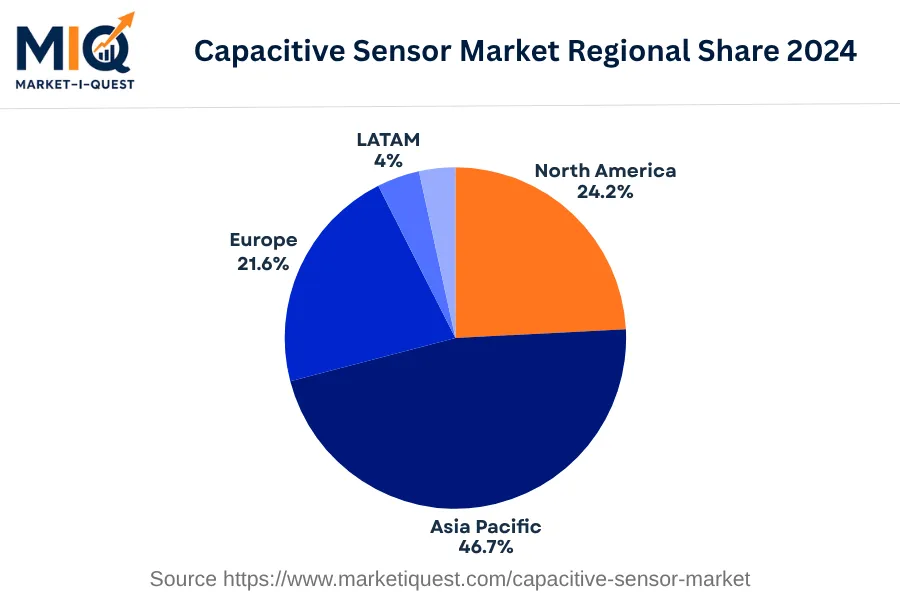
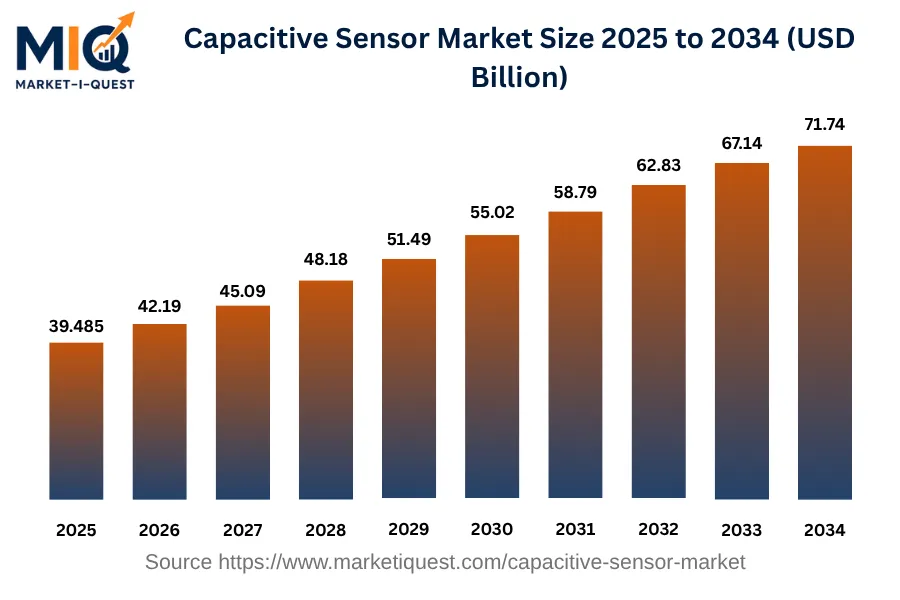
The Capacitive Sensor Market began with a size of $39.48 billion in 2025 and expanded to a worth of $71.74 billion by 2034, reflecting a compound annual growth rate (CAGR) of 6.86%. This near doubling of the market over a span of nine years stands as a testament to the sustained growth trajectory it undertook in this period. The intensity of this growth was fuelled by a solid decade of continuous expansion, mirrored by the year-on-year increase in the market size. Lastly, it is interesting to note the regional share in 2024. Asia Pacific held the maximum chunk at 46.7%, followed by North America at 24.2% and Europe commanding a share of 21.6%. The shares for LATAM and MEA were less, but still impactful, at 4.0% and 3.4% respectively.

Key Takeaways

  • By Type - Motion Sensors dominated the Capacitive Sensor Market with the highest market share.
  • By End User - Consumer Electronics sector led the Capacitive Sensor Market.
capacitive-sensor-market market size

Key Driving Factors

Stringent Vehicle Emission Regulations

Several countries around the world are implementing strict emission regulations to mitigate the harmful effects of vehicle pollution. These regulations are directly influencing the automakers to incorporate environment-friendly and fuel-efficient technologies into their new models. Capacitive sensors play a crucial role in fuel efficiency, as they accurately measure fuel levels and optimize fuel consumption. Thus, this enforcement of emission standards is compelling the auto industry to source more capacitive sensors, thereby promoting growth in the capacitive sensor market.

Rise of Smart Homes and IoT Integration

The smart home industry is witnessing swift growth, which is another vital force driving the capacitive sensor market. Smart homes rely heavily upon IoT integrated systems for seamless operation of devices like touch-controlled lighting systems, home appliances, and security systems. Capacitive sensors, due to their sensitivity and precision, are becoming a preferred choice in these applications. They provide interactive user interfaces, enhancing the usability and functionality of smart devices. Consequently, the rising adoption of smart homes and increased integration of IoT is stimulating the demand for capacitive sensors in the residential sector.

Market Evolution by Timeline

2019-2023
Consumer electronics, along with automotive sectors in regions such as Asia Pacific and Europe, were primary buyers of capacitive sensors due to technological integration. Key suppliers included companies like Microchip, Cypress Semiconductor, and STMicroelectronics. However, limitations in extreme conditions hindered wider usage. Government programs like 'Make in India' propelled manufacturing and local supply, prompting a decrease in prices, making it affordable for more products. Many suppliers often struck partnerships for end-use specific applications, commonly using licensing agreements. Existing standards like ISO 26262 for automotive safety relevant systems were critical for market adoption. Challenges in this period included interference and low robustness in harsh settings, with the industry progressively adapting to answer these issues.
2024
A striking demand trend included a heightened interest from the healthcare sector and household appliances, particularly in North American and European territories. Suppliers encountered technology constraints with miniaturization of sensors, although innovations were ongoing. Regulatory matters like RoHS compliance in the European Union influenced sensor design. Suppliers typically offered volume-based pricing contracts as a commercial model to retain competitive positioning. The risk landscape signified mounting concerns around durability and reliability, pushing manufacturers to explore higher quality materials and sophisticated technology. Distribution took place predominantly through direct channels, yet a few suppliers had started exploring e-commerce channels.
2025-2029
Noteworthy expansion in usage was seen in industrial controls, home security, and energy sectors worldwide, moving from primarily consumer electronics-based applications. Micro/nano technological advances catapulted supply potential, predominantly from tech hubs in East Asia and North America. Governments' sustainability plans likely led to the application of capacitive sensors in clean energy projects, influencing standard-settings for energy efficiency. The industry started to adopt contract structures involving maintenance and updation assistance. Supply chain instability due to geopolitical tensions posed a significant risk, leading suppliers to diversify their manufacturing footprint. E-commerce became a typical channel for both B2B and B2C segments.
2030-2034
Exploration and possible use in futuristic spaces like space travel and advanced robotics in regions like North America and Western Europe marked the demand trend. Advanced futuristic innovations like self-healing sensors provided a boost to the supply side. Regulations would likely focus on extreme use-case scenarios, guiding adherence to quality and safety controls. Resultantly, contract deals started including strict performance clauses, providing security against failures. The key risks were from potential over-reliance on a still-maturing technology, with contingency measures being deployed in unison. Direct and e-commerce channels maintained their popularity, with the latter showing a likely prevalence due to convenience and efficiency.

Future Market Outlook

Future Opportunities

Future opportunities in the capacitive sensor market are strongly linked to raising demand in various sectors such as healthcare and automotive. The aging population across Europe, projected to reach over 20% by 2030, is driving the requirement for smart healthcare devices, many of which utilize capacitive sensors to monitor patient vitals efficiently. Companies like Medtronic are currently exploring capacitive sensor technology for their next-generation health monitoring systems. In automotive applications, the rollout of the Euro 7 emissions standard has triggered manufacturers to invest in touch-sensitive controls to improve driver interactions while maintaining compliance with regulations. Additionally, the burgeoning trend of smart home systems in North America is creating new use cases for capacitive sensors in appliances and controls, enhancing energy efficiency. As of 2023, leading companies like Philips are integrating capacitive technology to enable smarter control in lighting systems. Moreover, the rapid expansion of the Internet of Things is creating demand for capacitive sensors in various devices that will connect seamlessly to networks. Notably, many tech firms are actively pursuing partnerships to develop advanced sensing solutions; for instance, the collaboration between IBM and Samsung aims to innovate within the smart wearable market, highlighting the potential for capacitive technology in diverse applications. This evolving landscape presents diverse opportunities for integration and innovation, guiding the market towards a broader range of viable applications.

Segmentation Analysis

By Type

The market is divided into subsegments including Touch Sensors, Motion Sensors, Position Sensors, and Proximity Sensors. Motion Sensors accounted for the largest revenue share, while Position Sensors are expected to grow at the fastest CAGR during the forecast period.

Largest Revenue Share

Motion Sensors

Market Share Leader

Motion Sensors dominate the revenue share in the sensor market. Geographically, they are adopted across the globe, mainly due to their versatility in multiple sectors ranging from consumer electronics to advanced robotics, security systems, and automation. The principle customers are manufacturers who integrate these sensors into their products such as smartphones, tablets, and wearable devices. Also driving their adoption is the increasingly smart and connected homes trend, where Motion Sensors play a critical role in security and energy conservation. Additionally, strict regulations requiring the installation of security systems in commercial entities contribute to their significant demand. Purchasing criteria for the customers often include sensitivity, reliability, and durability which leading manufacturers focus on to attract high volume purchases. Further, the substantial switching costs linked with the incorporation of these sensors in devices make customers stick to their sensor type, thus reinforcing the dominance of Motion Sensors.

Fastest CAGR

Position Sensors

Forecast Period Growth Leader

Position Sensors are anticipated to witness the fastest growth rates in the coming years. This poised growth is driven by the technological advancements that propel their wider application in industries such as automotive, manufacturing, electronics and aviation. The rapid adoption of Industry 4.0 trends calls for precise sensing to aid in efficient machine operation and automation, creating a favorable market for Position Sensors. While high capital expenditure serves as a barrier, strategic partnerships with Original Equipment Manufacturers (OEMs) help to propel the momentum. On policy front, strict regulations governing vehicle safety will drive increased adoption of these sensors in automotive sector. However, near-term risks include vulnerability to external environment that may affect sensor performance, and global economic uncertainties which could hamper capital-heavy sensor upgrade projects. Despite these challenges, the outlook for Position Sensors remains promising.

By End User

The market is divided into subsegments including Consumer Electronics, Automotive, Oil and Gas, Healthcare, Food and Beverages, Aerospace and Defense, among others. In terms of revenue, Consumer Electronics dominated the market share in 2024, while the Healthcare segment is anticipated to grow at the fastest pace during the forecast period.

Largest Revenue Share

Consumer Electronics

Market Share Leader

In 2024, the Consumer Electronics subsegment accounted for the significant chunk of market revenue. This growth can astutely be attributed to a myriad of factors. The proliferation and incessant advancements in technology, coupled with ever growing consumer demand for the latest and most advanced electronic products, has been a significant growth driver. Additionally, the market has benefited from increased purchasing power, particularly in emerging economies, which has facilitated higher consumption of consumer electronics. Geographically, regions like North America and Asia Pacific, due to high consumer disposable income and the presence of major market players, have propelled the revenue growth for this subsegment. There are regulatory supports too that foster market growth by encouraging fair competition and product quality. The trend of digitalization and online shopping has also greatly influenced the consumer electronics market positively, contributing to high revenue generation.

Fastest CAGR

Healthcare

Forecast Period Growth Leader

Despite not being the largest revenue contributor in 2024, the Healthcare subsegment is projected to grow at the fastest rate in the succeeding years. This projection comes on the back of global trends supporting improved healthcare infrastructure. Technological innovations, especially in telehealth and remote patient monitoring systems, are pivotal to this fast growth. Government policies that endorse and mandate the adoption of electronic medical records and digitalization of healthcare data also act as catalysts. The outlays on healthcare are increasing across nations, and partnerships between tech companies and healthcare providers are on the rise, paving the way for advanced patient care solutions. The growth, however, does come with challenges. Data security issues and the need for large initial investments can act as adoption barriers. Nevertheless, the long-term benefits seem to override these challenges, promising a high rate of growth for this segment.

Capacitive Sensor Market Competitive Analysis

Key Market Players

Manufacturers / OEMs

Hoffmann-Krippner
Germany
Cypress Semiconductors
US
STMicroelectronics
Switzerland

Key Suppliers & Raw Materials

DuPont
US
Azoteq
South Africa
SensorDynamics
Austria

Distributors, Integrators & Channel Partners

Digi-Key Electronics
US
Arrow Electronics
US
Avnet
US

Porter’s Five Forces Analysis

This analysis examines the competitive intensity and attractiveness of the Capacitive Sensor Market.

Supplier Bargaining Power

Medium

The controls over inputs like hardware components and raw materials are moderately distributed.

Buyer Bargaining Power

High

With numerous options available, buyers have substantial power to negotiate prices.

Threat of Substitutes

Low

The unique design and superior performance of capacitive sensors minimise the substitutes threat.

Threat of New Entrants

Medium

Technological know-how and high capital investment slightly deter new entrants.

Competitive Rivalry

High

The expanding market has attracted many players leading to intense competition.

Regional Analysis

Geographic market dynamics and growth opportunities across key regions

Global Market Outlook

capacitive-sensor-market market regional share

North America

In 2024, the North American Capacitive Sensor Market demonstrated a firm growth trajectory. Driving factors ranged from increased adoption of the Internet of Things (IoT) across diverse sectors, which necessitates advanced sensory technologies, to smarter manufacturing processes promoting efficiency across Canada, the U.S., and Mexico. Regulatory incentives, like the U.S. government's push for Industry 4.0, have bolstered investment in capacitive sensor production and adoption. Additionally, significant shifts in supply dynamics, with local manufacturers scaling up production to rival imported products' pricing, have spurred market growth. Furthermore, the burgeoning smartphone market, particularly in the U.S., increased capacitive touch sensor demand dramatically.

Trends in the market have been shaped largely by changes in buyer behavior and technological advances. Consumers, seeking smarter, touch-enabled devices, are driving demand, especially in sectors like healthcare, retail, and utilities. Evolution in technology shifted focus towards the development and manufacturing of compact, energy-efficient capacitive sensors. Channel dynamics have also changed, with e-commerce emerging as a major distribution channel for capacitive sensor sales due to convenience and easy accessibility. Also, increased partnerships and M&A among key market players have fostered market expansion. For instance, the acquisition of Cypress Semiconductor by Infineon in 2020 was aimed at capitalizing on the growing market potential of capacitive sensors in North America. Finally, the enforcement of stricter product quality and safety standards by agencies such as the U.S. Consumer Product Safety Commission further cultivated a robust market environment.

Asia Pacific

In 2024, the Asia Pacific capacitive sensor market was significantly influenced by demand from industries like consumer electronics, automotive, and manufacturing. Driven by rapid digitalization across regions, particularly China, India, South Korea, and ASEAN countries, the adoption of smart devices and Industry 4.0 acceleration created immense demand for capacitive sensors. Strict regulations put forth by governments in China and Japan for vehicle safety increased investments in the automotive sensor sector, boosting the market. Simultaneously, ongoing technological advancements in touch interface and multi-touch sensors fuelled market growth in Australia and ASEAN, while cost-effective manufacturing and implementation of capacitive sensors in China and India made them favorable choices for various applications. Supply of these sensors was also high due to robust semiconductor industries in these regions.

Major trends seen in the sector include advancements in sensor technology, particularly relating to Internet of Things (IoT). India's digital infrastructure policy supported IoT advancement, in turn, bolstering the capacitive sensor market. Another trend was the rise in e-commerce platforms, especially in China and South Korea, primarily for electronic devices. Also, increased partnerships between tech giants and local companies were prevalent in Japan and ASEAN, aimed at gaining a share in the booming market. Lastly, an increased focus on policy enforcement concerning cybersecurity standards, especially in Australia, ensured the secure incorporation of these sensors across sectors.

Europe

In the base year 2024, the European Capacitive Sensor Market experienced notable dynamism due to a mix of drivers and trends. Advancements in touch screen technology and the surge in consumer electronics demand, particularly from countries such as Germany and the UK, served as significant motivators. France’s strict regulations regarding industrial safety likely bolstered market growth by enforcing the use of capacitive sensors in the manufacturing sector. High levels of investment in industries like healthcare and utilities in Italy and Spain have seen an increased adoption of capacitive sensors to enhance operational efficiency and precision.

The market trend was primarily dominated by buyer preference for compact and energy-efficient sensors, a shift most notable in the Nordics and Benelux countries with their penchant for sustainability. The rise of Industry 4.0 in Central & Eastern Europe saw the growing digitization of manufacturing industries, favoring smart sensors. Furthermore, strategic partnerships amongst leading players have gained momentum, with companies focusing on developments in nanotechnology for sensor miniaturization. An upswing was also observed in policy enforcement measures regarding sensor standards and quality, particularly visible in the automotive and healthcare sectors, which favor accuracy and consistency in sensor performance. The market in 2024 was thus marked by high technological adoption, regulation compliance, and strategic collaboration.

Latin America

In 2024, the Capacitive Sensor Market in Latin America witnessed a significant growth, particularly evident in countries such as Brazil, Mexico, Argentina, Colombia, Chile, and Peru. This growth was primarily driven by rising industrial automation, stringent government regulations supporting the adoption of capacitive sensors, and increased investment in sensor technologies. Specifically, the market in Brazil saw a boom due to increased demand in the automotive sector, while Mexico’s growth can be attributed to the significant use of capacitive sensors in the manufacturing sector.

The market trends for the year demonstrated a shift towards the adoption of micro-electromechanical systems (MEMS) technology across different sectors. There was a marked inclination towards capacitive touch sensors in retail and consumer electronics sectors, while the healthcare industry witnessed an increased use of these sensors in medical devices. Additionally, the year also saw heightened activities in partnerships and mergers and acquisitions, particularly in Colombia and Peru's mining industries, to leverage capacitive sensor technologies for improved safety and productivity. Regulatory standards to ensure the quality and reliability of sensors were more stringently enforced in Argentina and Chile, thereby shaping the market dynamics in these countries. Ultimately, the burgeoning demand from various sectors and prevailing market trends underscored the robust growth of the capacitive sensor market in LATAM in 2024.

Middle East & Africa

In 2024, the Capacitive Sensor Market in the Middle East and Africa region witnessed robust growth across several sectors. The drivers of this growth were primarily the increasing investments in technological advancements, strict government regulations, and the rising demand from various industries such as oil and gas, telecom, and healthcare. A notable example was Saudi Arabia, where the application of capacitive sensors in oil extraction significantly heightened due to its accurate detection.

Significant trends influencing the market encompass shifts in product technology, the proliferation of strategic partnerships, and changes in buyer behavior. A noteworthy shift was observed in healthcare sectors of regions like United Arab Emirates and South Africa, where capacitive sensors' demand increased due to their precision in touchless gesture recognition, contributing to hygiene and infection control. Furthermore, collaborations between sensor manufacturers and tech firms, such as that in Nigeria and Egypt, accelerated the integration of advanced capacitive sensors into smartphones for better user experience. In essence, the increased adoption of capacitive sensors in 2024 across critical sectors like oil and gas, healthcare, and telecom, coupled with favorable government policies, investment in technology and partnerships, largely propelled the Capacitive Sensor Market in the Middle East and Africa.

Recent Industry Developments

Latest market innovations, product launches, and strategic initiatives

May 2026

Minyuan Sensing Technology launched the MC1081A, an automotive-grade ten-channel multi-mode wideband digital capacitive sensor chip. The chip has passed AEC-Q100 Grade 0 reliability certification and operates stably in extreme temperatures from -40°C to +150°C. It supports 10 single-ended or 5 differential capacitance measurements with resolution up to 1 fF, targeting applications including steering wheel touch sensing, fluid level detection, and battery pack safety sensing.

June 2025

UltraSense Systems launched CapForce™ Edge, claimed as the industry's first fully integrated "capacitive touch sensing + high-resolution piezoelectric force sensing" controller for smart surfaces in automotive, consumer, industrial, and robotics markets.

Frequently Asked Questions