Building Integrated Photovoltaics Market Snapshot

Key Players

  • Onyx Solar (Spain)
  • Solaria Corporation (USA)
  • Sharp Corporation (Japan)
  • Canadian Solar (Canada)
  • SunPower Corporation (USA)
  • FreeVolt Technologies (UK)
  • Polysolar (UK)
  • Hanergy Thin Film Power Group (China)
  • ISSOL Group (Belgium)
  • AGC Glass Europe (Belgium)

Market Size

Base Year 2024
$24.86 Bn
CAGR
18.5%
Forecast 2034
$135.73 Bn

Market Segments

By Product
  • Roofs
  • Wall Integrated Solution
  • Glass
  • Facade
  • Others
By Technology
  • Crystalline Silicon
  • Thin Film Technologies
By End Use
  • Residential
  • Commercial
  • Industrial

Market Dynamics

Drivers
  • Rising energy demand
  • Advancements in solar technology
Restraints
  • High installation costs
  • Lack of consumer awareness
Opportunities
  • Rising energy demand
  • Technological advancements in PV sector

Market Size

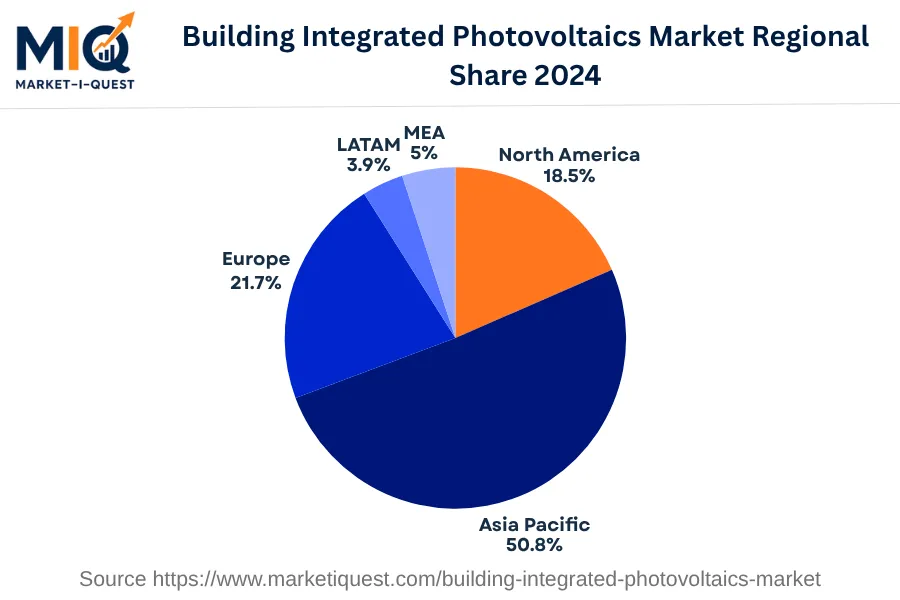
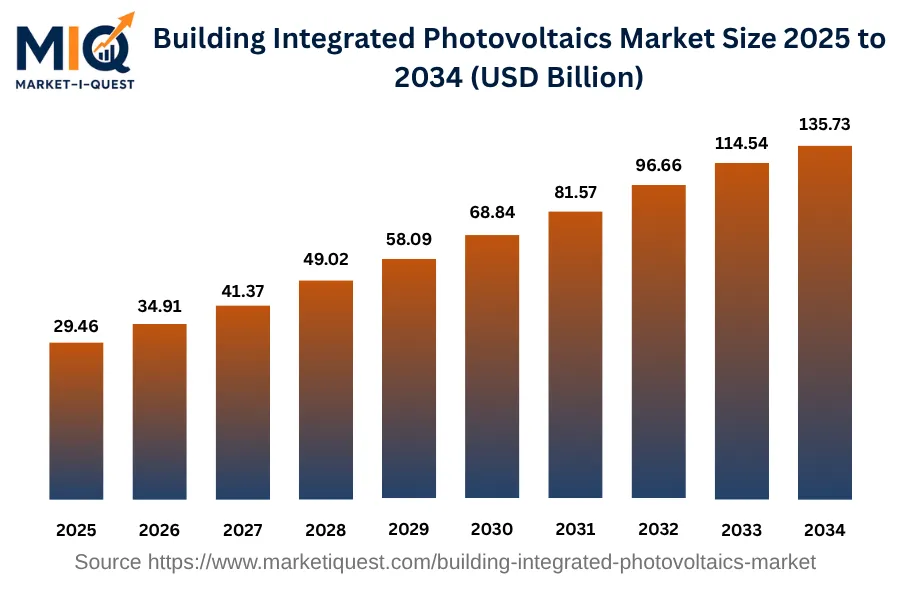
The Building Integrated Photovoltaics Market was valued at $29.46 billion in 2025 and is projected to grow to $135.73 billion by 2034, reflecting a CAGR of 18.5%. The substantial increase from $24.86 billion in 2024 to nearly $30 billion in 2025 set the momentum for this upwards trajectory. The growth over these years is primarily attributed to the rising global demand for energy-efficient solutions, coupled with regulatory norms favoring the utilization of sustainable energy sources. In the regional distribution of the market in 2024, Asia Pacific dominated with a 50.8% share, followed by Europe at 21.7% and North America with 18.5%. The remaining shares were held by LATAM at 3.9% and MEA at 5.1%, indicating a lesser penetration of building integrated photovoltaics in these markets. This snapshot of regional market share provides an understanding of the geographical distribution of the building integrated photovoltaics market in its early growth phase.

Key Takeaways

  • By Product - Roofs led the Building Integrated Photovoltaics Market holding a significant share in the base year.
  • By Technology - Crystalline Silicon held a dominant position in the market demonstrating robust growth.
  • By End Use - Industrial segment led the market retaining a considerable share in the base year.
building-integrated-photovoltaics-market market size

Key Driving Factors

Implementation of Strict Environmental Regulations

A key driving factor for the Building Integrated Photovoltaics Market is the enforcement of stringent environmental laws designed to combat climate change. Governments worldwide, such as those in the European Union and the United States, are enhancing their commitment to reducing carbon footprints by imposing firm regulations. Being an eco-friendly technology that allows buildings to produce their own clean energy, Building Integrated Photovoltaics (BIPV) market is gaining momentum. For instance, California's solar mandate requires all new single-family homes and multi-family residential buildings up to three stories, built from 2020 onwards, to include solar power generation measures like BIPV.

Focus on Energy-Efficient Buildings

Another significant driver for the Building Integrated Photovoltaics Market is the growing interest in minimizing energy consumption through energy-efficient building measures. In recent years, both corporate entities and residential property developers have put a strong emphasis on reducing operational energy costs and also demonstrating their commitment to sustainable practices. Implementing BIPV technology in buildings not only reduces grid-based electricity consumption, but it can also provide potential energy surplus that can be sold back into the grid. As more design and construction professionals demand integrated sustainable solutions, the BIPV market stands set for substantial growth.

Market Evolution by Timeline

2019-2023
During this period, commercial property developers and educational facilities in the US and European Union showed increased interest in building-integrated photovoltaic (BIPV) technology for energy-saving motives. However, high installation and maintenance costs were deterrents. Manufacturers such as Onyx Solar and SolarWindow were prominent, focusing on improving solar panel efficiency and integration techniques. The EU funded several BIPV projects under the Horizon 2020 programme, encouraging standardization of BIPV products. BIPVs were largely sold through direct sales and partnerships with construction firms. Yet, lack of trained personnel for installation and repair was a notable challenge.
2024
In 2024, residential buyers in solar-rich Australia and Spain indicated increasing interest in BIPVs for new constructions. Supply aspect witnessed the entry of new Asian manufacturers, producing cost-effective, customizable BIPV solutions. Enforcement of stricter clean energy policies, especially California's 2020 Solar Mandate, further facilitated the BIPV adoption. Commercial models saw a shift towards leasing contracts, reducing the burden of upfront costs on buyers. Still, variability in regional building regulations posed a considerable risk, causing uncertainties for manufacturers and buyers.
2025-2029
Later, demand from retail and hospitality sectors in South America and Asia, especially in countries with strong daylight hours like Brazil and India, grew appreciably. Technological advancement facilitated the production of lighter, durable, and aesthetically appealing BIPVs, optimizing for tropical climate. Named programs such as India's National Solar Mission contributed to BIPV promotion through subsidies and incentives. Construction contracts began incorporating long term performance guarantees. However, the risk of high operational costs appeared as adoption increased, leading to greater emphasis on skill development and training initiatives.
2030-2034
By the 2030s, growing awareness and commitment towards sustainable infrastructure saw greater demand from the middle-east, particularly from UAE and Saudi Arabia. Technology evolved to incorporate BIPVs into varied construction materials, increasing versatility. Internationally, BIPVs began to be recognized under Green Building Certifications, influencing their adoption. Interestingly, the B2C online sales model was observed to gain popularity during this time. However, chances of technical failure and high replacement costs continued to pose risks, pushing manufacturers to build more robust after-sales service networks.

Future Market Outlook

Future Opportunities

Opportunities for advancing BIPV technologies are increasingly apparent as urbanization accelerates globally. By 2021, the United Nations reported that over half of the world's population resides in cities, leading to heightened demand for sustainable infrastructure. Nations such as Japan are actively investing in retrofitting existing buildings to integrate solar solutions, directed by government initiatives aimed at reducing carbon emissions. The growing emphasis on energy-efficient building codes has prompted companies like 3M to develop advanced solar films that can be applied to various surfaces, supporting the use of existing structures. Additionally, partnerships among technology firms and construction agencies are fostering innovations in materials that allow for thinner, more flexible solar panels. In March 2023, the U.S. Department of Energy announced a push for a national standard for BIPV installations, promoting consistency and safety in deployment. The rise of smart city projects worldwide provides further avenues for BIPV applications, as cities seek integrated solutions to balance energy demands. Moreover, as energy prices fluctuate, the desire for self-sufficient energy systems will drive demand for BIPV technologies. As the green building certifications like LEED gain traction, the integration of BIPV solutions will correspond with evolving consumer and regulatory preferences, positioning companies to capitalize on these expanding market dynamics.

Segmentation Analysis

By Product

The market is divided into subsegments including Roofs, Wall Integrated Solution, Glass, Facade, and Others. Among these, Roofs accounted for the largest revenue share while Glass is expected to grow at the fastest Compound Annual Growth Rate (CAGR) during the forecast period.

Largest Revenue Share

Roofs

Market Share Leader

Roofs topped the list as the subsegment with the highest earnings for the base year 2024, primarily driven by its broad market penetration and high-priority use in residential, commercial, and industrial buildings. The ineluctable importance of roofs in constructions, combined with the periodic need for repair and replacement, contributes to its significant revenue share. Customer preference for durable and weather-resistant roofing solutions further pushes demand in this segment. Geography too plays a part, with regions experiencing extreme weather conditions leading the consumer demand. Regulatory factors, including building safety laws and energy-efficiency standards, strengthen the roofs segment’s dominance in the market. Purchasing decisions are most often based on quality, longevity, and cost, with established channels through construction companies and home improvement stores facilitating easy access for consumers. Furthermore, switching costs are relatively high given the critical functionality and installation complexities associated with roofs, subsequently bolstering its market position.

Fastest CAGR

Glass

Forecast Period Growth Leader

Despite not claiming the largest revenue share as of 2024, the glass subsegment is forecasted to grow at the fastest CAGR. This rapid growth is propelled by several factors, including technological advancements, policy support, and increasing consumer preference for aesthetically pleasing and energy-efficient solutions in both residential and commercial buildings. Novel technologies are developing low-emissivity and smart glass products that enhance energy-efficient and controllable transparency properties. These innovations serve to drive consumer adoption and reduce barriers. Government policies advocating for energy efficiency and ecological designs further stimulate market growth. Still, it warrants mention that despite promising prospects, the glass segment faces potential risks in raw material price fluctuations and competition from alternative materials. Nevertheless, strategic partnerships with design and construction firms and investment in research and development may further accelerate the growth of this subsegment in the near term.

By Technology

The market is divided into subsegments including Crystalline Silicon and Thin Film Technologies. In 2024, Crystalline Silicon accounted for the largest revenue share while Thin Film Technologies is expected to grow at the fastest CAGR during the forecast period.

Largest Revenue Share

Crystalline Silicon

Market Share Leader

Crystalline silicon is the technology responsible for the most significant portion of the revenue in the photovoltaic industry in 2024. The high efficiency, proven track record, and low cost of pure silicon make it a popular choice. The material is abundant, which makes the supply chain robust and reliable. In addition, regulations favoring renewable energy sources have contributed to the increasing adoption of this technology. Customers like utilities and industrial companies value high efficiency and long-term reliability, which are attributes of this technology. Geographically, regions with high solar irradiation and favorable policy environments, such as the Asia-Pacific and North America, dominate the market. High switching costs for already installed capacities further ensure a steady revenue stream for this subsegment.

Fastest CAGR

Thin Film Technologies

Forecast Period Growth Leader

Projected to show the fastest CAGR, Thin Film Technologies is a quickly emerging subsegment. These possess lower efficiency compared to crystalline silicon, but they offer advantages in terms of lower costs and greater ease of installation, driving their rapid adoption. The thin film technology's ability to perform well in low-light and high-temperature climates gives it an edge in certain geographies, further catalyzing its growth. Policy catalysts promoting the adoption of greener technologies and increased capital investment in renewable are also factors driving the growth of this subsegment. However, it is essential to watch for near-term risks like fluctuating raw material prices and policy changes in key markets. Despite these uncertainties, partnerships and tech innovations in the industry are likely to continue propelling its growth.

By End Use

The 'End-use' segment of the market is divided into subsegments including Residential, Commercial, and Industrial, with the Industrial subsegment accounting for the largest revenue share and the Commercial subsegment expected to grow at the fastest CAGR during the forecast period.

Largest Revenue Share

Industrial

Market Share Leader

The Industrial subsegment holds the largest share in the revenue in the base year of 2024. This is primarily due to the extensive usage and high demand for products and services in this subsegment. The industrial sector typically comprises high-value transactions, large scale operations, and long-term contracts which contribute to substantial revenue generation. Furthermore, industrial end-users often have specific, non-negotiable needs that necessitate consistent expenditure, rendering the demand level relatively inelastic to price changes. Notably, the regulatory environment often supports market expansion in the industrial space, especially in scenarios where product or service adoption has positive environmental or safety implications. As such, improvements in technology, coupled with potentially beneficial regulations, could also drive future revenue growth in the Industrial subsegment.

Fastest CAGR

Commercial

Forecast Period Growth Leader

Contrasting to the highest revenue generator, the Commercial subsegment is projected to grow at the fastest CAGR. While the commercial sector may involve smaller-scale operations relative to the industrial sector, the sheer volume of potential customers and transactions across commercial businesses is enormous and continues to expand. Driving this growth is an increasing consciousness about cost and efficiency advantages, coupled with a greater willingness among businesses to embrace change for enhancement in their day-to-day operations. Regulatory and policy shifts also act as significant catalysts - for instance, government initiatives promoting energy-efficient practices have spurred high adoption rates in the commercial subsegment. However, the adoption speed might face barriers like upfront capital investment or integration issues with existing systems. Technological advancements and strategic partnerships can mitigate these risks and further catalyse growth.

Competitive Analysis

Key Market Players

Manufacturers / OEMs

Solaria Corporation
US
Sunpreme
US
Onyx Solar Group
Spain

Key Suppliers & Raw Materials

AGC Inc.
Japan
Dupont
US
BASF SE
Germany

Distributors, Integrators & Channel Partners

Beacon Solar
US
Solexel
Malaysia
ViaSol Energy Solutions
Spain

Porter’s Five Forces Analysis

This is a comprehensive analysis of the competitive dynamics within the Building Integrated Photovoltaics Market.

Supplier Bargaining Power

Medium

Suppliers' power is moderated by the commoditized nature of solar cell production.

Buyer Bargaining Power

High

Buyers, primarily construction companies and contractors, have high power due to multiple competing vendors.

Threat of Substitutes

Medium

Substitute energy solutions like green roofs or energy-efficient materials pose medium threats.

Threat of New Entrants

Medium

High capital costs and technical expertise required can limit new entrants.

Competitive Rivalry

High

The market has intense competition among established players and new entrants alike.

Regional Analysis

Geographic market dynamics and growth opportunities across key regions

Global Market Outlook

building-integrated-photovoltaics-market market regional share

North America

In 2024, the North American Building Integrated Photovoltaics (BIPV) market experienced significant growth, largely driven by interest in sustainable infrastructure and the green energy ethos. Key drivers included increased demand for energy-efficient buildings, particularly in the United States where stricter regulations from the Environmental Protection Agency mandated improved energy usage. The Canadian government’s renewable energy investment, specifically in Quebec and Ontario, also played a pivotal role. Simultaneously, Mexico’s adoption of BIPV technology in massive urban projects spurred growth in the market.

Observing trends, consumers showed preference for the aesthetic of BIPV systems which facilitated their seamless integration into building design. This was particularly evident in the architecture sector. Technological advances, such as the emergence of thin-film BIPV, considerably increased market accessibility and commercial viability. More flexibility in product design also allowed BIPV to cater to a range of specifications, broadening its appeal across residential, enterprise, government, and utilities sectors. Channel dynamics shifted as integrated design, production, and distribution partnerships became more common. This led to the emergence of innovative business models, such as XsunX and Canadian Solar’s joint venture in California and Ontario. Despite being in its nascent stages, it’s clear that BIPV had substantial impact on North America’s energy policy, market dynamics, and socio-economic factors in 2024.

Asia Pacific

In 2024, the Building Integrated Photovoltaics (BIPV) market in Asia Pacific experienced distinct market dynamics driven by various factors. High demand for clean energy solutions, encouraging government regulations, and substantial investment in R&D propelled this as a crucial growth sector. Countries like China, India, and South Korea, noted for their robust technological adoption, adopted BIPVs primarily due to their potential in reducing energy costs and footprint. In Japan and Australia, stringent emission standards and policies supported swift BIPV uptake.

Trends revealed a clear shift in buyer behavior towards sustainability, vis-à-vis purchase decisions by enterprises and government bodies. Product innovations, specifically durability and aesthetics of BIPV installations, gained significant momentum across China, Australia, and key ASEAN markets. Channel dynamics diversified, with digital marketplaces emerging as robust platforms for procurement, especially in India and South Korea. Frequent partnerships and M&A activities were also observed, aimed at strengthening supply chains and expanding product portfolios. Sectors such as utilities and manufacturing visibly turned towards BIPVs to achieve renewable energy mandates and secure long-term, low-cost energy supply. The retail sector, particularly large-scale players, integrated BIPV structures into their buildings, promoting sustainability and energy self-sufficiency. As such, the BIPV market in 2024 exhibited substantive growth and adoption patterns across Asia Pacific.

Europe

In 2024, the Building Integrated Photovoltaics (BIPV) market in Europe is vibrant and diverse, driven by multiple factors that significantly influence its dynamics. Market drivers include healthy demand from the construction sector, with progressive government regulations in key areas such as Germany, the United Kingdom, and the Nordics fueling the adoption of BIPV installations as a mainstream solution for renewable energy generation. Furthermore, the increased environmental awareness among businesses, particularly in the retail and manufacturing sectors, fostered a significant increase in investment in BIPV technologies, especially in France and Italy.

Transposing these drivers, the market trends are characterized by a shift in buyer behavior as preference grows for eco-friendly buildings equipped with energy-producing surfaces, notably so in Spain and Benelux. The evolving technology trend in BIPV focuses on improving panel efficiency and aesthetic integration. In response, partnerships and M&A activities have spiked up across Europe, seeking to provide this next-level BIPV solution to the market, particularly in the public sector. Standardization efforts are also on the rise, primarily driven by the EU policy enforcement of energy efficiency in buildings, making it easier for providers to achieve regional penetration. Central & Eastern Europe has shown significant progress in this area, adopting the energy efficiency principles into their national building regulations.

Latin America

In 2024, the Latin American Building Integrated Photovoltaics (BIPV) market experienced robust growth, buoyed by increased adoption of green technologies across sectors. Multiple drivers facilitated this growth: increased government policies favoring renewable energy in countries like Brazil and Mexico inspired greater investment in BIPV technologies. Argentina and Chile further supported these efforts by offering subsidies and tax incentives for BIPV implementation. In Peru, increasing energy demand from fast-growing sectors such as manufacturing and healthcare drove much of the adoption of BIPV solutions to reduce grid dependency and promote sustainability.

Key trends emerged from the growing BIPV market in Latin America. Buyers increasingly preferred customized and aesthetically designed BIPV systems that blend seamlessly with the building architecture. A significant shift was perceived in the technology, with polycrystalline silicon panels experiencing a surge in popularity due to their advanced energy efficiency. Market liberalization across LATAM had also led to new entrants offering innovative BIPV solutions, stimulating a dynamic market scenario. Furthermore, strategic partnerships and M&A activities were seen among BIPV manufacturers and construction firms, aiming to streamline the adoption of these technologies. For example, Colombia enforced stringent energy standards incorporating BIPV in building architecture, propelling the overall market in LATAM during 2024.

Middle East & Africa

In 2024, the Building Integrated Photovoltaics (BIPV) market in the Middle East and Africa saw substantive movement due to several key factors. Notably, drivers such as rigorous energy efficiency regulations in countries like Saudi Arabia and UAE, heightened adoption of renewable energy sources to diversify energy mix in Qatar, aggressive investment in solar technology by governments in Egypt and South Africa, and increasing supply of cost-effective photovoltaic solutions primarily drove market growth and adoption rates.

Simultaneously, various trends also shaped the dynamics within these markets. Demand shifted towards high-efficiency thin-film photovoltaic products due to increased focus on aesthetic integration, especially in residential and commercial sectors. Moreover, the adoption of online sales channels surged, changing the way BIPV manufacturers interact with consumers. Additionally, partnership agreements and alliances between local vendors and international giants flourished, a notable example being Nigeria's adoption of Israel's BIPV technology in governmental buildings. Implementation of building codes mandating the use of BIPV across the Middle East also influenced product sales. The influence of these drivers and trends was markedly seen across key sectors such as government infrastructure, manufacturing, and healthcare, ushering a new era of sustainable energy use in these regions.

Recent Industry Developments

Latest market innovations, product launches, and strategic initiatives

January 2026

Thin-film manufacturing alliances ramped up deployment of ultra-lightweight glass-facade panels weighing just 6 kg/m². Developers launched commercial solar-integrated designs leveraging highly efficient TOPCon and CIGS glass matrices to comply with tightening EU Energy Performance of Buildings directives.

July 2025

The Eindhoven University of Technology (TU/e) secured a €1.5 million development grant via the Clean Energy Transition Partnership for its UPSCALE project. The initiative accelerates the commercialization of perovskite-based BIPV systems, targeting Next-Gen, spectrally tunable tandem cells for flexible, lightweight architectural glass.

January 2025

Swiss startup Climacy introduced the CLI400M10, a 400W semi-transparent, glass-glass BIPV panel engineered for facades. Achieving 17.25% efficiency and 20% visual transparency, the dual-glass structure optimizes natural light in commercial atriums, advancing the market for aesthetically integrated solar building skins.

Frequently Asked Questions