
Automotive Lighting Market Snapshot

Key Players

  • Osram Licht AG (Germany)
  • Valeo S.A. (France)
  • Stanley Electric (Japan)
  • Hella KGaA Hueck & Co. (Germany)
  • Koninklijke Philips N.V. (Netherlands)
  • Koito Manufacturing Co.
  • Ltd. (Japan)
  • Lumileds Holding B.V. (Netherlands)
  • Varroc Lighting Systems (United States)
  • Hyundai Mobis (South Korea)
  • ZKW Group GmbH (Austria)

Market Size

Base Year 2024
$36.8 Bn
CAGR
5.3%
Forecast 2034
$61.68 Bn

Market Segments

By Technology
  • Halogen
  • LED
  • Xenon
  • Laser
By Application
  • Exterior Lighting
  • Interior Lighting
  • Signaling Lighting
  • Accent Lighting
By Vehicle Type
  • Passenger Cars
  • Commercial Vehicles
  • Two Wheelers
  • Buses

Market Dynamics

Drivers
  • Increasing vehicle production
  • Advancements in lighting technology
Restraints
  • High production costs
  • Regulatory complexities
Opportunities
  • Emerging LED technology
  • Increased demand for energy-efficient lighting

Market Size

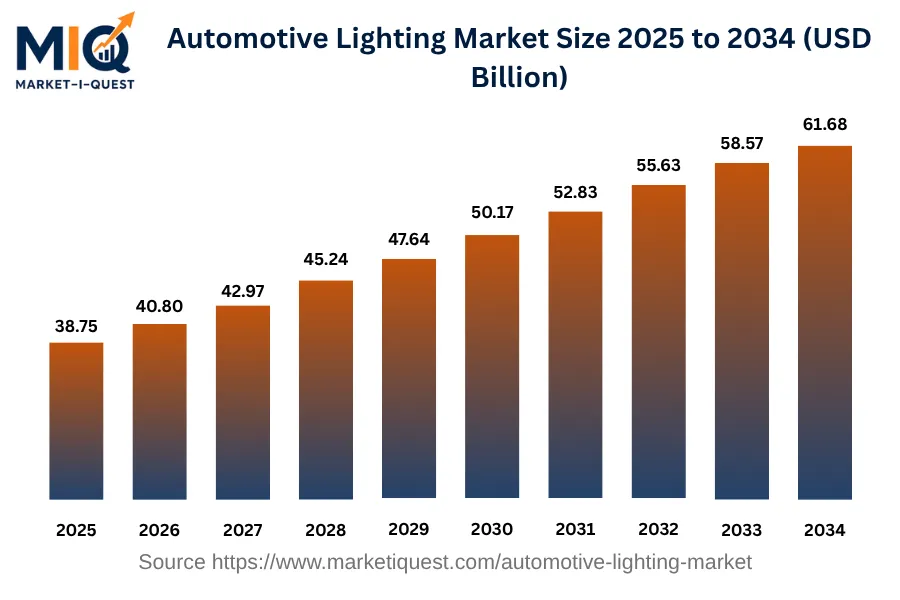
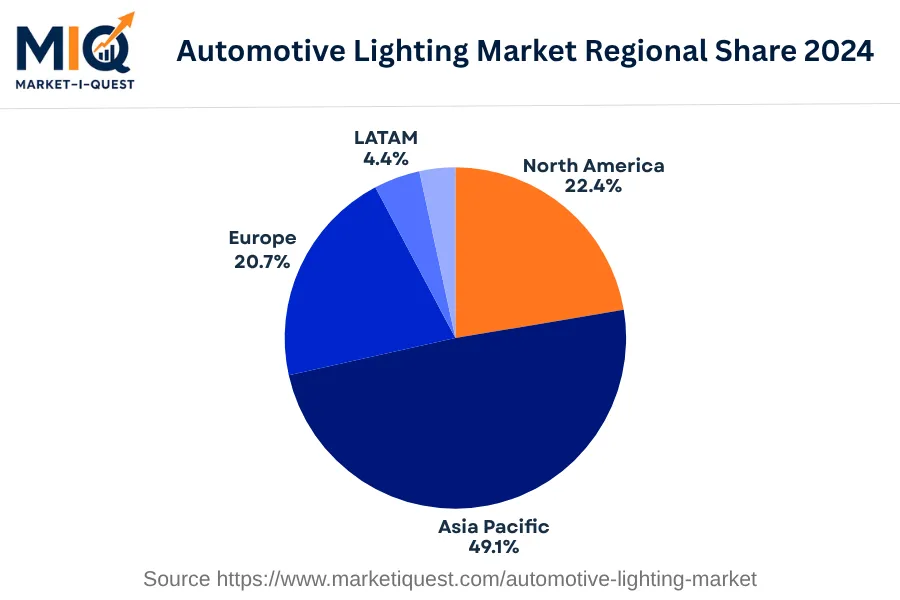
The Automotive Lighting Market had a size of 38.75 billion USD in 2025, and by 2034, it increases to 61.68 billion USD, growing at a CAGR of 5.3% from 2025 to 2034. The growth in the market size from 36.8 billion USD in 2024 to 38.75 billion USD in 2025 marked the start of a steady progression characterized by continuous expansion. This growth trajectory persists throughout the decade as evidenced by the ascend to 61.68 billion USD in 2034. As for regional shares in 2024, the contribution from different global regions varied. Asia Pacific held the most significant portion, accounting for 49.1% of the market share. The second-largest contributor was North America, holding 22.4% of the market share. Europe followed, standing at 20.7%. The regions with the least contributions were LATAM at 4.4% and MEA with 3.4%.

Key Takeaways

  • By Application - Exterior Lighting held the top position in 2024.
  • By Vehicle Type - Passenger Cars dominated the market share in 2024.
  • By Technology - LED is predicted to grow fastest expanding swiftly during the forecast period of 2025 to 2034.
automotive-lighting-market market size

Key Driving Factors

Implementation of Strict Vehicle Safety Regulations

Government agencies worldwide are tightening vehicle safety regulations to reduce road accidents. For instance, the European Union's directive 76/756/EEC mandates the installation of day-time running lights on all new vehicles. Such legal requirements increase demand for advanced automotive lighting solutions that comply with regulatory standards. Enhanced illumination, multimodal functionality and energy efficiency in lighting products not only improve visibility for drivers but also signalling effectiveness to others on the road. The urgency of adhering to these regulations encourages both established auto manufacturers and new entrants to prioritize strategic investments in high-quality automotive lighting systems as a critical route to market compliance.
Incorporation of LED and Laser Light Technologies in Automobile Designs

Leading automobile manufacturers are integrating innovative lighting technologies, such as LEDs and lasers, into their vehicle designs. These technologies offer advantages, including superior brightness, longer lifespan and lower energy consumption, which foster better performance, sustainability and cost-effectiveness of automobiles. Furthermore, they afford manufacturers the flexibility to incorporate stylish designs and sophisticated aesthetic features in their vehicle models. This is particularly favored in the luxury car segment, where unique and eye-catching styles are appreciably valued by target customers. Hence, the trend of using advanced lighting technologies as a vehicle design and branding strategy is another significant driver of the automotive lighting market.

Market Evolution by Timeline

2019-2023
From 2019 to 2023, there was a steady rise in the adoption of LED lights in the automotive industry, largely driven by consumer demand for energy-efficient and durable lighting solutions. Major manufacturers like Philips and Osram dominated the supply side, offering high-quality LEDs that outperformed traditional halogen bulbs. North American and European markets were specifically interested in leveraging this technology. Nonetheless, high-cost remained a significant barrier to the accelerated adoption of these lighting solutions. Regulatory standards like the EU's 'Eco-design of Energy-using Products' directive encouraged the use of energy-efficient automotive lights, guiding the market's trajectory. Typical contracts with manufacturers were long-term to ensure consistent supply, with pricing models skewed towards premium pricing due to the perceived value of LED lights.
2024
In 2024, the strong trend towards electric vehicles (EVs) pushed demand for smart automotive lighting systems. This demand largely originated from Asia, particularly China, due to its strong governmental support for EVs. Recent advancements in adaptive driving beam (ADB) technology led major players to develop intelligent lighting systems that improved safety and enhanced driver experience. The integration of these lighting systems into EV design was still in its infancy. Regulatory standards around EV design and safety influenced the adoption of smart lighting. Manufacturers typically formed partnerships with automakers to integrate lighting systems into new EV models. The main commercial risk was the dependence on EV adoption rates.
2025-2029
Between 2025 and 2029, the global adoption of EVs continued to drive advancements in and adoption of smart automotive lighting systems. Integration challenges that plagued earlier attempts were now being effectively addressed. Major automakers operating in Europe and North America also started integrating these lighting systems into their EV models, thus widening the customer base. Regularities for EVs worldwide had an indirect influence on the adoption pattern of smart automotive lighting. Companies found more stability in pricing due to matured manufacturing procedures and wide market acceptance. However, the ability of these companies to meet growing demand remained a question.
2030-2034
During the period from 2030 to 2034, the continual rise in EVs pushed the demand for sophisticated automotive lighting systems that ensure road safety in fully autonomous vehicles. This demand primarily came from developed nations where autonomous vehicles were heavily adopted. Manufacturers grappled with the challenge of designing lighting systems that can communicate effectively with other road users in lieu of human drivers. Regulations centered on autonomous vehicle safety significantly influenced the features of these lighting systems. Pricing models began tilting toward value-based pricing, rather than on a per-unit basis. The major risk was the ability to ensure reliability and safety in lighting systems for autonomous vehicles.

Future Market Outlook

Future Opportunities

The automotive lighting market presents substantial opportunities driven by current regulations and technological advancements. The increasing emphasis on safety features, as mandated by the National Highway Traffic Safety Administration in the United States, pushes manufacturers to innovate lighting systems that improve visibility. In 2022, General Motors unveiled its Super Cruise technology which incorporates advanced lighting solutions for enhanced driver assist capabilities. Alongside this, growing consumer interest in electric vehicles encourages the development of integrated lighting systems that capitalize on energy efficiency, as seen with the Hyundai Ioniq 5, which features ambient lighting that reacts to user preferences. The expansion of connected car technology further opens avenues for lighting applications. Automakers have begun exploring lighting as a communication tool, utilizing features like welcome lighting and health monitoring notifications. In Europe, the European Commission's upcoming regulations on automated driving could lead to new lighting requirements for autonomous vehicles. This regulatory landscape will likely encourage manufacturers to rethink lighting design and utility. Collaborations such as the partnership between Audi and a lighting technology company to develop OLED tail lights signal a shift toward personalized and flexible lighting solutions, ultimately enhancing user experience. As companies continue to adapt to changing consumer expectations, there will be an ongoing need for innovative lighting technologies that not only meet legislative requirements but also elevate the driving experience.

Segmentation Analysis

By Technology

The market is divided into subsegments including Halogen, LED, Xenon, and Laser; where LED accounted for the largest revenue share, while Xenon is expected to grow at the fastest CAGR during the forecast period.

Largest Revenue Share

LED

Market Share Leader

The LED subsegment holds the dominant position in the technology market due to its numerous advantages. LEDs have high energy efficiency, resulting in a lower operating cost over their lifespan compared to other lighting technologies. Many regulations promote energy-saving technologies, which has boosted their adoption. In addition, many establishments prefer LED lights due to their longer lifespan, thus reducing the frequency and cost of replacements. It's also worth noting that LEDs provide superior lighting, crucial in applications such as automobiles and electronics displays, among others. LEDs' compact size offers flexibility in design, which makes them preferable in various applications. The swiftly growing electronics industry, particularly in the Asia-Pacific region, also fuels the demand for LEDs. The continuous advancements in the technology, such as the integration of IoT with LED lighting systems, are further enhancing its appeal to the market.

Fastest CAGR

Xenon

Forecast Period Growth Leader

The fastest-growing subsegment is Xenon, primarily driven by its extensive usage in the automobile industry. Xenon lighting, often used in headlights, provides brighter and whiter light, improving drivers' visibility and, therefore, safety. Moreover, the longer lifespan and reduced energy consumption of Xenon lights when compared to typical halogen bulbs give them an edge over the competition. The trend towards electric and hybrid vehicles, which demand more energy-efficient systems, is expected to propel the demand for Xenon lights. Partnerships between lighting manufacturers and automobile producers also contribute to the haven of opportunities for this subsegment. However, xenon bulbs are more expensive than their LED and Halogen counterparts, which may hamper their growth. As such, manufacturers' capex towards innovative technologies for reducing production cost could serve as an effective catalyst for the Xenon segment growth.

By Application

The market is divided into subsegments including Exterior Lighting, Interior Lighting, Signaling Lighting, and Accent Lighting. In 2024, Exterior Lighting accounted for the largest revenue share while Interior Lighting is expected to grow at the fastest CAGR during the forecast period.

Largest Revenue Share

Exterior Lighting

Market Share Leader

Exterior lighting holds the lion's share of the market in 2024. This dominance can be attributed to a combination of factors such as regulatory standards, customer preference, and superior product performance. Regulatory bodies in many countries have established stringent safety standards which mandate the use of certain exterior lighting systems in vehicles. Customers generally prefer vehicles with efficient and aesthetic lighting systems, thus influencing manufacturers to install high-quality exterior lighting. The demand for these systems is mainly driven by the automotive industry, where vehicles are equipped with various exterior lights for visibility and signaling purposes. Additionally, advanced technologies such as LED and laser are being increasingly adopted in exterior lighting systems due to their enhanced performance and energy efficiency. Given their importance for safety and aesthetics, the sales of exterior lighting systems are expected to remain robust in the foreseeable future.

Fastest CAGR

Interior Lighting

Forecast Period Growth Leader

Despite its current smaller share in the market, interior lighting is forecast to grow at the fastest CAGR. The expected growth revolves around several catalysts. Firstly, the propensity of consumers to seek additional comfort and aesthetic appeal while driving supports the demand for enhanced interior lighting. Also, innovation in the automotive industry regarding the design and functionality of interior lighting systems is increasing its application across premium and luxury vehicle segments. Moreover, technology advancements, like the integration of smart ambiance lighting systems catering to personal preferences are acting as a significant catalyst for growth. However, comparatively higher costs and complex installation processes may serve as significant barriers towards rapid adoption. Alliances between car manufacturers and lighting system providers could potentially offset adoption barriers and spur growth. Alongside the growth drivers, a key risk to monitor would be regulatory guidelines regarding interior vehicle lighting which might affect the rate of adoption.

By Vehicle Type

The market can be bifurcated into several subsegments including Passenger Cars, Commercial Vehicles, Two Wheelers, and Buses. In the base year 2024, Passenger Cars accounted for the largest revenue share while Two Wheelers are projected to emerge as the fastest-growing subsegments in the near future.

Largest Revenue Share

Passenger Cars

Market Share Leader

The passenger cars subsegment emerged as a leader in terms of revenue in 2024. This can be attributed to a host of factors. Foremost among these is the substantial increase in disposable income, which has fostered a consumer shift towards private mobility. Government initiatives promoting the purchase of electrical vehicles and their corresponding infrastructure expansion have also played a significant role. There has been a rise in the adoption of ride-sharing services, which primarily operate via passenger cars, feeding the segment's growth. These services have been expanding their fleet to meet the rising demand, thus promoting the purchase of passenger cars. Certain geographies play key roles in driving the segment's revenue. Regulatory bodies worldwide are implementing stringent emission regulations, promoting the sale of electric and hybrid passenger cars, further fueling the market growth. The increasing propensity towards luxury and comfort features has also been a demand driver. These factors, when combined, make passenger cars the subsegment with the highest revenue.

Fastest CAGR

Two Wheelers

Forecast Period Growth Leader

Although passenger cars dominate the revenue share, the two-wheelers subsegment is expected to witness the fastest growth rate. The primary drivers for this trend include the soaring population in developing countries and congested urban traffic conditions making two-wheelers a viable commute option. Apart from these, advancements in technology serve as a major catalyst for this subsegment's growth. Manufacturers are increasingly incorporating features that were previously exclusive to cars in their two-wheeler offerings, such as ABS and fuel-injection system, thereby enhancing their appeal. Furthermore, policy interventions aimed at controlling pollution levels and promoting electric vehicles have opened up new growth avenues for electric two-wheelers. The market could face risks related to the adoption barriers. Despite the rapid growth rate, the high cost of electric two-wheelers and the scarcity of charging infrastructure remain significant adoption barriers. Besides, ongoing research, tech innovations, and strategic alliances among manufacturers are expected to improve these conditions and spur the market growth.

Competitive Analysis

Key Market Players

Manufacturers / OEMs

Stanley Electric Co. Ltd
Japan
Osram GmbH
Germany
Koito Manufacturing Co. Ltd
Japan

Key Suppliers & Raw Materials

Cree, Inc.
US
Lumileds Holding B.V
Netherlands
Gentex Corporation
US

Distributors, Integrators & Channel Partners

HELLA GmbH & Co. KGaA
Germany
Valeo S.A.
France
Magna International Inc.
Canada

Porter’s Five Forces Analysis

A focused analysis of competition and market dynamics in the global automotive lighting market.

Supplier Bargaining Power

Medium

Increased consolidation and orientation towards few global players limit supplier bargaining power.

Buyer Bargaining Power

High

Consumers have high bargaining power due to competitive markets and price transparency.

Threat of Substitutes

Low

Low threat from substitutes as automotive lighting is mandatory for vehicle operation.

Threat of New Entrants

Medium

Entry barriers such as high setup costs and technology expertise limit newcomers.

Competitive Rivalry

High

Intense competition due to global presence of numerous major players in the market.

Regional Analysis

Geographic market dynamics and growth opportunities across key regions

Global Market Outlook

automotive-lighting-market market regional share

North America

In 2024, the North American automotive lighting market underwent a significant transformation driven by increased demand for advanced lighting solutions, regulatory directives, and new technology adoption. A rising need for safety-enhanced, efficient lighting in vehicles accelerated the market, largely due to strict road safety regulations imposed in the U.S., Canada, and Mexico. Government investment in road infrastructure and electric-vehicle infrastructure also acted as catalysts to navigate the growth of the automotive lighting market. Meanwhile, technological advancements like LED and Laser lighting further facilitated the market expansion.

Trends in the market indicated a shift from conventional lighting systems to LED and Laser based intelligent lighting systems due to their energy efficiency and durability. This preference shift was also prompted by lighting standards enforced by the government to reduce CO2 emissions. Digitalization played a critical role as automakers opted for integrated software solutions for lighting. The market also witnessed a rise in partnerships and mergers among the automotive light manufacturers and tech companies to enhance product portfolios and capture larger market shares. Furthermore, policy enforcement on lighting standards upheld market integrity and incentivized a transition to more sustainable and efficient lighting solutions. Overall, the demand from automakers, consumers' concern for safety and efficiency, and government regulations steered the course of the automotive lighting market in North America in 2024.

Asia Pacific

In 2024, Asia Pacific was a principal region in the global automotive lighting market. Expanding automobile production platforms, particularly in China and India, catalyzed demand. Stricter vehicle safety norms implemented across Japan and Australia stimulated the use of advanced lighting systems, while increased economic prosperity in key ASEAN markets bolstered the purchasing of high-end vehicles equipped with premium lighting features. Hyper-competition generated robust investments in cutting-edge technologies, providing a push from the supply side.

Predominant trends included a pronounced shift towards energy-efficient lighting solutions driven by consumers’ heightened environmental awareness. LED and Laser light technologies gained momentum, specifically in markets like South Korea, empowered by their high luminosity and low energy consumption. The digital revolution across the retail automobile sector boosted the online purchase of automotive lighting, reshaping the traditional sales channel paradigm. There was an uptick of strategic alliances between manufacturers and technology providers aimed at gaining competitive benefits, exemplified by industry giants like Hyundai partnering with local technology startups. Enhanced policy enforcement around vehicle safety standards in countries like China had a significant impact, compelling auto manufacturers to adhere to stringent lighting specifications. Notably, a pivot towards electric vehicles, especially within the government and enterprise sectors, laid the ground for innovative lighting solutions to drive the market.

Europe

In the base year 2024, the automotive lighting market in Europe saw significant developments in line with evolving technologies and stringent regulations. Drivers for growth included heightened demand for advanced vehicle lighting, seamless adaptation to LED and laser technologies, and substantial investments from major car manufacturers such as Volkswagen, Mercedes-Benz, and BMW. Pricing considerations have also played a role, with more affordable technologies enabling widespread adoption. Regulation-driven change was a key theme in 2024, notably the European Union's regulations on the compulsory installation of daytime running lights. Meanwhile, manufacturers were shifting their supply dynamics to adopt energy-efficient technologies that comply with environmental guidelines.

Notable trends encompassed alteration in buyer behavior favoring cars equipped with advanced lighting systems, including adaptive and ambient lighting. Additionally, increased digitization ushered in software-defined lighting solutions. Germany and the United Kingdom, for instance, saw significant growth in the deployment of these technologies, driven by partnerships and M&A activities among automotive and tech companies. In Italy and Spain, we observed a push in standardization efforts to create a more uniform market, alongside enforcement of policy that incentivized the switch to low energy consuming lighting systems. Lastly, automotive lighting played an increasingly important role in the EV sector, with customized lighting solutions being a crucial selling point for companies such as Tesla and Renault raging across the Nordic, Benelux, and Central and Eastern Europe regions.

Latin America

In 2024, Latin America's Automotive Lighting Market saw significant progression due to demand factors, shifting dynamics, regulations, and technology adoption. Shift in consumer preference toward advanced efficient lighting, increased demand for luxury vehicles with improved aesthetics, and a surge in vehicle production spurred the market. Notably, emission standards in countries like Chile and Colombia pushed for efficient lighting systems as a part of mandatory vehicle requirements, enhancing the LED penetration in the market. In terms of trends, customer preference leaned towards integrating safety features with lighting systems, pushing manufacturers towards the development of adaptive headlights. Argentina's increasing adoption of regulations on daytime running lights for new vehicle models further nudified this consumer trend. As a result, original equipment manufacturers (OEMs) partnered with lighting companies, evidenced by the collaboration of prominent OEMs and LED manufacturers in Brazil.

Additionally, wholesalers and retailers saw effectively enforced regulations in LATAM, leading to increased quality control and reinforcement of product safety standards. Economical production in countries like Peru and Mexico, as a result of relatively inexpensive labor, further escalated the supply dynamics. However, fluctuating raw material prices impacted the overall market ambiance. Consumer sectors, including enterprise and manufacturing, expressed heightened interest in efficient and advanced automotive lighting.

Middle East & Africa

In 2024, the automotive lighting market in the Middle East and Africa demonstrated significant dynamism. Demand factors were primarily driven by government regulations in South Africa and Saudi Arabia mandating energy-efficient automotive lighting, leading to a surge in LED lighting adoption. Additionally, substantial investment from major automotive companies in regional manufacturing facilities cultivated a robust supply chain, especially evident in Egypt and Nigeria. Quicker technology adoption was noted particularly in Israel, a technology hub, as it focused on advanced technologies, such as intelligent lighting systems. Dynamic pricing was another crucial driver caused by fluctuating raw material costs, making impacts across the region, especially in the United Arab Emirates and Qatar.

The primary market trends were characterized by shifts in buyer behaviour, more embracing of advanced lighting technologies across all vehicle segments. Notably, in Kenya, there was a marked inclination towards energy-efficient solutions due to increasing environmental consciousness. A significant technology shift was observed towards laser and OLED lighting systems, particularly evident in more affluent regions such as Qatar. Partnerships and mergers & acquisitions, specifically in Saudi Arabia and the United Arab Emirates, were evolving as strategies to penetrate the growing market. Strict policy enforcement, particularly in relation to safety standards for automotive lighting, was evident throughout the region, with South Africa's government taking a leading role. The sectors greatly affected were primarily automotive manufacturing and retail, with effects also noted in related service industries.

Recent Industry Developments

Latest market innovations, product launches, and strategic initiatives

April 2026

Marelli debuted its next-generation automotive lighting ecosystem at Auto China 2026, targeting software-defined vehicles. The platform integrates smart RGB LED configurations and adaptive lighting systems to enable real-time vehicle-to-surrounding communication and customized brand lighting signatures.

January 2026

ZKW equipped the new Audi Q3 with high-resolution digital Matrix LED headlights developed in partnership with Audi. Each compact SUV spotlight module houses 25,600 individually controllable pixels, enabling precise, glare-free high beams and dynamic projection functions onto the road.

Frequently Asked Questions