Aerospace Composites Market Snapshot

Key Players

  • Toray Industries Inc. (Japan)
  • Hexcel Corporation (United States)
  • Solvay S.A. (Belgium)
  • Teijin Limited (Japan)
  • Royal DSM N.V. (Netherlands)
  • General Electric Company (United States)
  • Mitsubishi Chemical Holdings Corporation (Japan)
  • Huntsman International LLC (United States)
  • SGL Carbon SE (Germany)
  • BASF SE (Germany)

Market Size

Base Year 2024
$29.72 Bn
CAGR
12.4%
Forecast 2034
$95.66 Bn

Market Segments

By Product
  • Carbon Fiber
  • Glass Fiber
  • Others
By Application
  • Commercial Aircraft
  • Business & General Aviation
  • Military Aircraft
  • Other

Market Dynamics

Drivers
  • Rising demand for fuel-efficient aircraft
  • Advancements in composite manufacturing technologies
Restraints
  • High production costs
  • Regulatory compliance challenges
Opportunities
  • Rising aerospace industry demand
  • Advancements in composite technology

Market Size

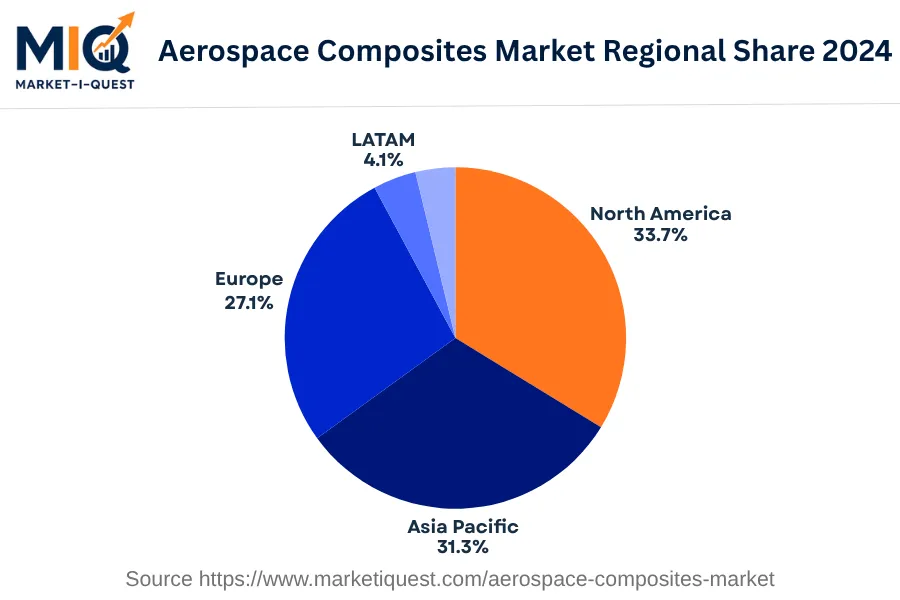
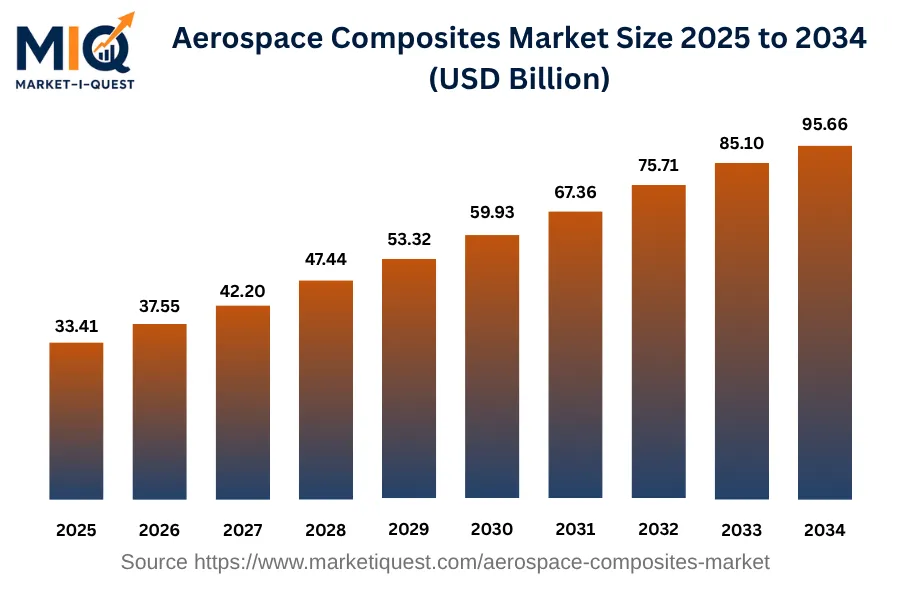
The Aerospace Composites Market size was USD 33.41 billion in 2025, and it is estimated to reach USD 95.66 billion by 2034, advancing at a CAGR of 12.4%. This growth from 2025 to 2034 indicates a significant increase in market size, more than tripling in less than a decade. The main reasons behind this growth are the consistent advancements in the aerospace sector and the increasing demand for composite materials due to their exceptional properties including high strength, low weight, and resistance to heat and corrosion. The regional share data for 2024 showed that North America held the largest share of the market with 33.7%, followed by Asia Pacific at 31.3%, and then Europe at 27.1%. Meanwhile, the shares held by LATAM and MEA were relatively smaller at 4.1% and 3.8% respectively.

Key Takeaways

  • By Product - Carbon Fiber led the Aerospace Composites Market accounting for a significant share in the base year.
  • By Application - Commercial Aircraft held a prominent position contributing a strong influence on market growth.
aerospace-composites-market market size

Key Driving Factors

Implementation of Carbon Fiber-Reinforced Polymers (CFRPs)

The aerospace industry is increasingly leaning towards the use of Carbon Fiber-Reinforced Polymers (CFRPs). This material is lighter yet stronger compared to traditional metals used in aircraft manufacturing. By using CFRPs, the overall weight of aircraft can be drastically reduced, leading to significant reductions in fuel consumption—a key objective for most airlines aiming to increase operational efficiency and sustainability. This is especially critical in the current context, as airlines are under immense pressure both from fuel price instabilities and from environmental regulations pushing for lower carbon emissions.

Increasing Defense Budgets for Aerial Units

Robust defense budgets, particularly for aerial units, is another distinct driver in the aerospace composites market. In geopolitically sensitive regions like the Middle East, Asia Pacific, and Eastern Europe, countries are investing heavily in upgrading their current aircraft fleets and acquiring new advanced military aircraft. These aircraft predominantly use composites due to their stealth capabilities and resilience under harsh conditions. The need for such advanced, durable aircraft in regions of strategic military importance drives the market for these composite materials, as countries continually aim to maintain or enhance their national security capabilities.

Market Evolution by Timeline

2019-2023
During 2019–2023, aerospace composites were in high demand in Asia, specifically in China and India, because of rising commercial aviation. Carbon fiber reinforced plastics dominated from a supply side due to their higher strength and resistance. However, supply demand was a constraint due to high production costs and slow manufacturing speed. The 'Clean Sky' EU initiative propelled eco-efficient composite adoption in aerospace but posed certification challenges. Fixed price contracts became prevalent, prompting manufacturers and suppliers to form strategic partnerships for better risk management. Key risks included supply chain disruptions due to geopolitical issues between major manufacturers and suppliers.
2024
In 2024, demand skyrocketed in North America primarily because of NASA's Artemis program which accelerated lunar exploration. New materials like graphene composites emerged that offered enhanced characteristics but needed rigorous testing for safety and reliability. FAA regulations related to carbon composites in aircraft design evolved impacting integration. Although the market held consistent in value-based pricing, more suppliers adopted the Risk and Revenue Sharing Partners (RRSP) agreements to evenly distribute the financial risks. High raw material costs continued posing threats to profitability.
2025-2029
Between 2025-2029, demands in Europe multiplied rapidly due to expansion of non-aerospace industries (automotive and wind) using aerospace-grade composites. Hybrid materials bridged the performance and cost advantage, but manufacturing remained a challenge. The implementation of stringent recycling rules by European Union influenced composites disposal standards. An increase of performance-based logistics contracts was observed, aligning suppliers and customers' interests. However, repeated violation of intellectual property rights was a significant risk upsetting market stability.
2030-2034
In 2030-2034, demands shifted to military applications in North America and APAC regions due to the high-level defense sector investments. Advanced Ceramics played a pivotal role in composite supplies, offering high resistance to elevated temperatures. The DOD's acquisition reforms affected procurement and design standard for military composites. An upsurge in long-term supply agreements encouraged collaborations between OEMs and material suppliers. The evolving geopolitical factors, natural disasters disrupting supply chains, were significant risks.

Future Market Outlook

Future Opportunities

Future opportunities in the aerospace composites market are closely linked to current industry shifts and ongoing projects. The urgent drive for sustainability and reduced carbon emissions is leading aerospace firms to explore lightweight materials and manufacturing processes. As European aerospace manufacturers integrate sustainability goals into their production protocols, composite materials are increasingly viewed as essential for meeting these benchmarks by providing superior weight-to-strength ratios. Collaborations among major companies, such as the partnership between Hexcel and Boeing for the development of eco-friendly composite materials announced in 2023, highlight the growing industry focus on minimizing environmental impact. Efforts to recycle composite materials and the recent initiatives by the International Air Transport Association (IATA) to promote sustainable aviation fuels are likely to create new market avenues. Furthermore, the anticipated return to passenger demand in regions like Asia Pacific, following the pandemic recovery of 2022, presents potential growth for composite utilization in expanding aircraft fleets. The shift towards urban air mobility, driven by companies such as Joby Aviation and their electric vertical takeoff and landing vehicles, also underscores the need for ultralight composite materials. Consequently, these avenues for innovation and collaboration may pave the way for increased penetration of aerospace composites within the broader aviation sector.

Segmentation Analysis

By Product

The market is segmented into Carbon Fiber, Glass Fiber, and Others. Carbon Fiber accounted for the largest revenue share while Glass Fiber is expected to grow at the fastest CAGR during the forecast period.

Largest Revenue Share

Carbon Fiber

Market Share Leader

In terms of revenue, the Carbon Fiber subsegment emerges as the largest contributor. The dominant position of this subsegment can be attributed to various factors including the product's high tensile strength, light weight, and superior thermal resistance. These attributes make carbon fiber immensely valuable for several industries - notably, automotive, aerospace, and sports equipment. In these sectors, the emphasis on lighter, stronger, and more resilient materials is at an all-time high. Geographically, regions with substantial manufacturing and industry presence, such as Asia Pacific and North America, are driving this demand. Regulatory trends focused on reduced emissions and increased efficiency, in automotive and aerospace in particular, also underpin the demand for carbon fibers. The purchasing criteria often emphasize the aforementioned product benefits, and a well-established supply chain ensures the availability of carbon fiber products across diverse industries.

Fastest CAGR

Glass Fiber

Forecast Period Growth Leader

On the other hand, Glass Fiber is forecasted to have the fastest CAGR. This subsegment's growth can be attributed to significant advantages, including ease of handling, cost-effectiveness, and high thermal insulation. Although glass fiber's intrinsic strength is less than carbon fiber, recent technological advancements have enhanced its attributes, making it competitive in various applications. Additionally, it's worth noting that policy interventions promoting energy-efficient buildings are fueling this growth, as glass fibers play a crucial role in insulation applications. Adoption barriers such as the relative brittleness of glass fiber are being offset by innovations improving its flexibility. The near-term risks include volatile raw material prices and stringent environmental regulations regarding disposal. It is also essential to consider the influence of capital investments and strategic partnerships on expansion of production capabilities and improvement of glass fiber properties.

By Application

The market is divided into subsegments including Commercial Aircraft, Business & General Aviation, Military Aircraft, and others. Among these, Commercial Aircraft accounted for the largest revenue share while Military Aircraft is expected to grow at the fastest CAGR during the forecast period.

Largest Revenue Share

Commercial Aircraft

Market Share Leader

The Commercial Aircraft subsegment emerged as the leader due to a variety of underlying factors. For instance, the increasing number of passengers globally due to the surge in tourism and business activities strongly fuels the demand for commercial aircraft. Geographically specific trends, such as increasing air travel in Asia-Pacific regions due to rising disposable income and urbanization, have also contributed to the expansion of this subsegment. Government regulation promoting open skies and liberalization of the airlines industry is another driver. The various purchasing criteria, such as fuel efficiency and aircraft range, to cater to long-haul flights further enhance the position of commercial aircrafts in the market. The high switching cost associated with aircraft purchase decisions creates barriers for entry and thus solidifies the existing market shares. The increased reach through various channels such as direct purchase and leasing agreements further secure the commercial aircraft subsegment's dominance.

Fastest CAGR

Military Aircraft

Forecast Period Growth Leader

Military Aircraft subsegment represents the fastest growing sector in the aviation market. The growth in this segment is primarily driven by heightening geopolitical tensions and the escalating need for advanced defense mechanisms globally. Technology has served as a key catalyst in this scenario, with advancements in aircraft design, stealth capabilities, weaponry, and surveillance technology prompting nations to invest heavily in upgrading their fleets. While high costs and technology barriers create substantial hurdles for adoption, nation's security concerns outweigh these factors. Government policies and increased defense budget allocations, particularly in countries witnessing political instability, also drive the growth in this segment. However, despite the growth drivers, near-term risks such as environmental concerns regarding carbon emissions and the pressure to reduce defense budgets pose significant challenges to the rapid expansion of the military aircraft sector.

Competitive Analysis

Key Market Players

Manufacturers / OEMs

Hexcel Corporation
US
Toray Industries, Inc.
Japan
Teijin Limited
Japan

Key Suppliers & Raw Materials

SGL Carbon
Germany
Mitsubishi Chemical Carbon Fiber and Composites, Inc.
Japan
Hyosung Advanced Materials
South Korea

Distributors, Integrators & Channel Partners

Dunstone Company, Inc.
US
L&L Products
US
Park Aerospace Corp.
US

Porter’s Five Forces Analysis

An investigation into the competitive dynamics of the aerospace composites market.

Supplier Bargaining Power

Medium

Raw material providers have moderate power due to high demand and low substitution of materials.

Buyer Bargaining Power

Low

Large aerospace companies and OEMs dictate terms, reducing buyer power.

Threat of Substitutes

Low

High-performance needs minimize material substitution options in aerospace.

Threat of New Entrants

Low

High capital costs and stringent safety and certification barriers deter new entrants.

Competitive Rivalry

High

Intense competition among established suppliers to secure contracts with large OEMs.

Regional Analysis

Geographic market dynamics and growth opportunities across key regions

Global Market Outlook

aerospace-composites-market market regional share

North America

In 2024, the North American Aerospace Composites Market was a critical sector, driven by multiple factors. Increasing demand from aerospace manufacturers, including Boeing and Airbus, due to the inherent advantages of composites such as strength and lightweight characteristics, was instrumental. Regulatory policies from the Federal Aviation Administration, mandating safety and fuel-efficient standards, prompted a significant rise in composites usage. High investment in R&D, particularly by defense departments in the U.S. and Canada, coupled with swift adoption of advanced technologies like 3D printing, directly impacted the market favorably. However, supply chain disruptions due to global semiconductor shortages posed a challenge.

In terms of trends, the preference for synthetic composites over traditional material saw a considerable rise. Technology again played a pivotal role, as Carbon Fiber Reinforced Polymer (CFRP) usage skyrocketed due to its superior toughness and heat resistance. Strategic alliances and partnerships characterized market dynamics, with Lockheed Martin and Hexcel Corporation collaboration catching industry-eye. Policy implementation regarding environmental impact and sustainability also steered the directions of bio-composites usage. Key market participants spanned from enterprise OEMs, defense entities and governmental bodies. While the U.S. maintained the dominant share, Canada's defense sector and Mexico's growing manufacturing infrastructure also significantly contributed to the North American Aerospace Composites Market towards the end of 2024.

Asia Pacific

In 2024, the Aerospace Composites Market in Asia Pacific was characterized by sustained growth due to consistent demand and advanced manufacturing capabilities. Drivers of this performance included the mounting reliance in countries like China, India, and Japan on aerospace composites for aircraft construction due to their strength and weight advantages. Regulatory legislation across the region, such as China's revised Civil Aviation Law and Australia’s National Aerospace Policy, boosted market activity by encouraging domestic production and sourcing. Further, significant investments in technology adoption, from Korea and the ASEAN markets, were observed boosting manufacturing efficiency and supply chain integration.

This year witnessed several key trends: Chinese and Indian airlines exhibited a preference for lighter, fuel-efficient aircraft, leading to an increased adoption of carbon fiber composites. Partnership formation and M&A activity, particularly in Japan and Australia, resulted in improved technical expertise and product expansion. In terms of policy enforcement, stringent emission standards, observed across the region, led to a surge in demand for aerospace composites due to their superior environmental footprint compared to traditional materials. Adoption of aerospace composites spanned both government and enterprise sectors, with manufacturers and military/defense organizations contributing significantly to the demand. In conclusion, the amalgamation of legislative support, technology adoption, and increasing demand was instrumental in shaping the Asia Pacific Aerospace Composites Market in 2024.

Europe

In 2024, the European Aerospace Composites Market was characterised by growing demand, regulatory guidance, and technological advancements. Factors such as increasing aircraft production and advancements in composite technology drove market dynamics significantly. Countries like Germany and France prioritised investments in efficient, light-weight materials to reduce fuel consumption and CO2 emissions in compliance with the European Union's green aviation policies. These regulatory guidelines accelerated research and development for advanced composites.

Furthermore, a noticeable market trend was the shift towards bio-composites, particularly in countries such as the United Kingdom and Italy, to further sustainability goals. The rise of digital technologies in aerospace manufacturing also gained momentum, with countries like Spain adopting intelligent manufacturing systems for composite structures. The trend of partnerships and mergers, especially in Benelux countries and Central & Eastern Europe, expanded the market's capacities. Finally, in sectors like enterprise and government, the use of composites increased significantly. Large retail enterprises' growing inclination towards procuring commercial aircraft contributed notably to demand, and government contracts for military aircraft in the Nordics bolstered the use of advanced composite materials. Consequently, the European Aerospace Composites Market in 2024 was marked by innovative demand factors and rapidly evolving market trends.

Latin America

The Latin American Aerospace Composites Market was characterized by heightened activity in 2024. Boosted by growing demand for fuel-efficient and lightweight aircraft and increased defense spending, major economies including Brazil, Mexico, Argentina, and Chile showcased significant commitments to technological adoption. Brazil's military modernization program rose as a key driver, bolstering investment in advanced composites. Mexico capitalized on resurgent tourism, translating into surges in commercial aircraft demand, leveraging on advanced composites for enhanced performance.

Market trends largely revolved around sustainability and technological integration. The rise in ecotourism in Colombia and Peru triggered increased adoption of bio-based composites. Companies responded by modifying their product portfolios to accommodate this sustainable shift, fueling sectoral growth. In parallel, the gradual penetration of digital manufacturing techniques, namely in Argentina's military sector, indicated a shift towards smart factories, which extensively use composites in autonomous aircraft. In regards to sectors, governments led demand, driven by defense spending and policy support for environmentally friendly practices. The manufacturing sector followed suit, with companies in Brazil and Mexico using technologically advanced composites in the production of aircraft parts. The private sector, particularly airlines, equally invested in composite-based aircraft due to their fuel efficiency, lower maintenance costs, and compliance with strict environmental standards. This confirmed a thriving aerospace composites market in LATAM for the year 2024.

Middle East & Africa

In 2024, the Aerospace Composites Market in the Middle East and Africa maintained sturdy growth fueled by several driving factors. An increasing demand for lightweight yet durable materials in aircraft production propelled market growth across countries like Saudi Arabia and the United Arab Emirates. The escalation in defense expenditures by regional governments, especially in Qatar and Israel, also contributed heavily to the rising demand. Moreover, stringent environmental regulations led to enhanced demand for composites as they help reduce fuel consumption rates and CO2 emissions in aircraft. Significant investments in technology adoption and research, particularly in Egypt and South Africa, boosted supply dynamics and improved the quality of aerospace composites.

Several trends played pivotal roles in shaping the market in 2024. There was a marked shift in buyer behavior toward bio-based composites, reflecting the sustainability ambitions of the aviation industry. The use of carbon fiber composites spiked significantly, driven by their superior strength-to-weight ratio. Innovative manufacturing techniques like automated fiber placement (AFP) were increasingly adopted in countries like Saudi Arabia and the United Arab Emirates. Partnerships and mergers were common, facilitating access to advanced technologies and encouraging knowledge transfer. Meanwhile, tighter policy enforcement on CO2 emissions stressed the importance of using aerospace composites, particularly in countries with thriving aviation sectors like Qatar and Israel.

Recent Industry Developments

Latest market innovations, product launches, and strategic initiatives

June 2026

Deutsche Aircraft and Hexcel finalized a long-term partnership agreement to supply lightweight advanced materials for the new D328eco regional aircraft program, focusing on reducing overall aircraft weight to improve fuel efficiency.

March 2026

Applied Aerospace & Defense acquired Ultracor, a supplier of honeycomb core materials, to bring the production of specialized, lightweight aerospace structures completely in-house and speed up their overall manufacturing process.

February 2025

The Thermal Group officially acquired Applied Composite Technology (ACT Aerospace) to expand their manufacturing capabilities, adding lightweight structural materials to their existing line of defense and aviation components.

Frequently Asked Questions