Aerosol Refrigerants Market Snapshot

Key Players

  • The Chemours Company (United States)
  • Honeywell International Inc. (United States)
  • Arkema Group (France)
  • Daikin Industries Ltd. (Japan)
  • Sinochem Group (China)
  • Perstorp AB (Sweden)
  • Scharr CPC GmbH (Germany)
  • Harvestar Chemical Co. Ltd. (Taiwan)
  • GLS Refrigerants Ltd. (United Kingdom)
  • Mexichem SA (Mexico)

Market Size

Base Year 2024
$1.24 Bn
CAGR
4.5%
Forecast 2034
$1.93 Bn

Market Segments

By Refrigerant Type
  • Hydrofluorocarbons (HFCs)
  • Hydrofluoroolefins (HFOs)
  • Natural Refrigerants
  • Fluorinated Ketones
By Application
  • Air Conditioning
  • Refrigeration
  • Propellants
  • Foam Blowing Agents
By End Use
  • Residential
  • Commercial
  • Industrial

Market Dynamics

Drivers
  • Increasing HVAC system demand
  • Rising environmental concerns
Restraints
  • Environmental regulation constraints
  • Increased product substitute availability
Opportunities
  • Increasing environmental awareness
  • Implementation in advanced cooling systems

Market Size

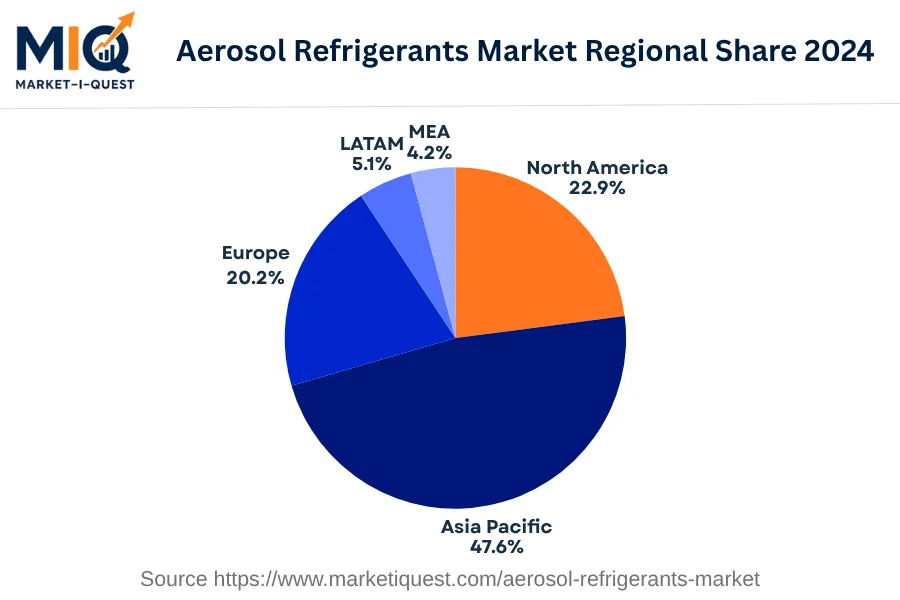
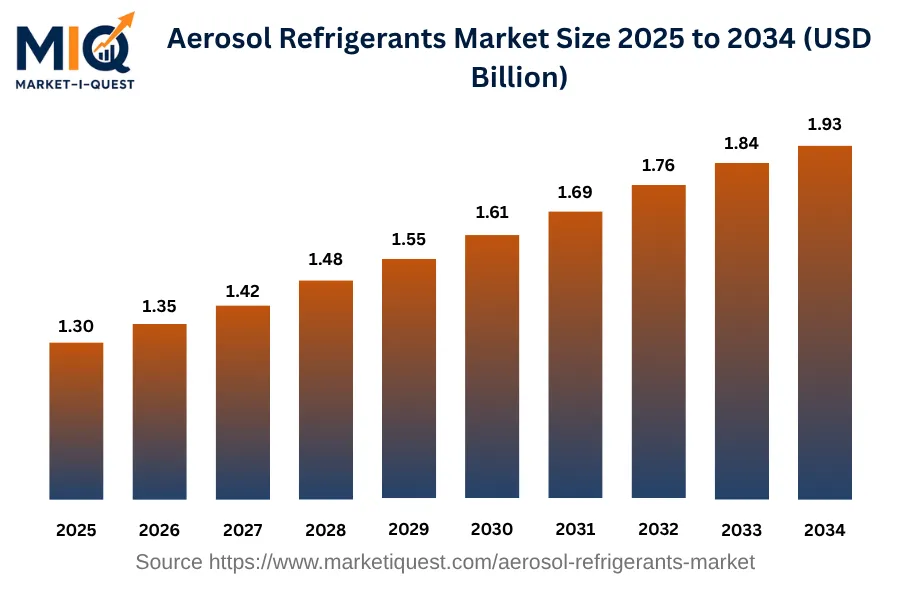
The Aerosol Refrigerants Market size, in USD Billion, valued at 1.30 in 2025 and is projected to expand to 1.93 by 2034, growing at a CAGR of 4.5%. This ten-year period of continuous market expansion, starting from 1.24 in 2024 to nearly 1.93 in 2034, testifies to the substantial and sustained uptake of aerosol refrigerants. The rise in demand for advanced cooling solutions in various industries, particularly in high-temperature operations, has led to an increase in the adoption of aerosol refrigerants. Moreover, the growing demand for energy-efficient cooling solutions and the replacement of old systems with new, advanced ones has also contributed to the market growth. In terms of regional share in 2024, Asia Pacific held the majority share of 47.6%, followed by North America at 22.9%, Europe 20.1%, LATAM 5.1%, and MEA 4.2%.

Key Takeaways

  • By Refrigerant Type - Hydrofluorocarbons (HFCs) held the majority share in 2024.
  • By Application - Air Conditioning led the Aerosol Refrigerants Market in terms of demand in the base year.
  • By End Use - Industrial segment accounted for a significant market position in 2024.
aerosol-refrigerants-market market size

Key Driving Factors

Stricter Environmental Regulations

Globally, governments are becoming more environmentally conscious and enacting stringent regulations to protect the ozone layer. These standards strictly limit the use of many traditional refrigerants, specifically those with high ozone depletion potential like Hydrochlorofluorocarbons (HCFCs). The demand for developing and usage alternatives with minimal environmental impact is becoming progressively crucial. A key alternative that has emerged is aerosol refrigerants, which are specifically designed with lower global warming potential (GWP) and ozone depletion potential (ODP). Companies in HVAC systems, refrigeration, and air conditioning sectors are being nudged to make the needed adjustments.

Transition to Sustainable Cooling Systems

Addressing to these climatic changes, industries are shifting towards more sustainable cooling systems. Companies in the food and beverage, pharmaceutical and cold storage sectors, among others, require efficient cooling systems for maintaining the quality of their products. Traditional coolant system have been major contributors to greenhouse gas emissions. Aerosol refrigerants, with their environmental benefits, are becoming an attractive alternative to traditional coolants. The requirement of less energy for the same cooling effect compared to conventional refrigerants also adds to their appeal. This shift towards sustainable cooling systems is a major driving factor in the aerosol refrigerants market.

Market Evolution by Timeline

2019-2023
During this period, the Aerosol Refrigerants Market was primarily driven by demand from the HVAC industry, particularly in North America and Europe. Manufacturers focused on producing HFC-based aerosol refrigerants due to their eco-friendly properties and energy efficiency. However, the supply was limited by concerns over the environmental impact of aerosol refrigerants and the cost of transitioning to more sustainable alternatives. Policymakers often mandated the strict compliance to environmental standards such as the Montreal Protocol and Kigali Amendment, which regulate the production and consumption of certain ozone-depleting substances. Commercial contracts mainly featured fixed pricing models, with long-term agreements preferred.
2024
The Aerosol Refrigerants Market experienced changes this year as alternative technologies started to emerge. While the HVAC industry continued to be the primary buyer, demand also rose in automobile applications, especially in Asia. The release of HFO-based aerosol refrigerants became more prominent due to their significantly lower global warming potential. This pattern was partly driven by tighter environmental regulations and increased customer awareness. Commercially, contracts often included supply assurance clauses due to the threats of supply constraints. The risk of non-compliance with environmental regulation became a major concern for manufacturers.
2025-2029
In this period, there will likely be an increase in demand from emerging markets such as India and China due to rapid urbanization and the growth of the automotive sector. The supply is expected to be characterized by the rise of low-GWP refrigerants, fuelled by continuous improvement in technology and integration with existing systems. Policies such as the US Clean Air Act and EU F-gas Regulation will likely have a significant impact on the industry, driving for further reduction in the usge of high-GWP refrigerants. The market might witness a decrease in long-term contracts due to increasing unpredictability in supply. Regulatory compliance risk might remain a key concern.
2030-2034
In these years, the Aerosol Refrigerants Market is projected to experience a growing demand in developing countries due to increasing disposable income and modern lifestyle adaptations which might involve usage of air conditioning systems. The supply side will likely witness the development of advanced low-GWP refrigerants with the enhanced capacity of climate control systems. Market regulations might focus on the sustainability and eco-friendly aspects of the refrigerants, with regulations such as the Climate Action Plan playing a major role. Commercially, order-based contracts might become prevalent as they are expected to provide flexibility in a rapidly changing market. The major risk may involve adapting and integrating with rapidly evolving and improving climate control technologies.

Future Market Outlook

Future Opportunities

The future landscape of the aerosol refrigerants market is expected to be shaped by the evolving regulatory environment and increased sustainability commitments from industry players. Given the mounting pressure from environmental advocacy groups as witnessed UN Climate Change Conference, companies are likely to pursue innovative formulations that align with global efforts to mitigate climate change impacts. For instance, developments in biobased refrigerants are gaining traction as organizations look for substances derived from renewable resources. Collaborations between environmentally focused startups and established corporations are poised to drive breakthroughs in the formulation of aerosol refrigerants. Companies such as ArcelorMittal and Clariant have begun initiatives to leverage bioengineering techniques, responding to anticipated consumer demand for greener alternatives. Furthermore, emerging markets in Latin America and Africa may provide platforms for adoption of these advanced refrigerants, driven by rising industrialization and urbanization. The application of stricter building codes, such as those enacted by the International Code Council, encourages the incorporation of efficient cooling technologies in the construction sector. Additionally, the growing use of smart technologies in HVAC systems opens avenues for integrating more efficient refrigerant applications, leading to enhanced energy performance. Manufacturers will likely focus transparency regarding the lifecycle impacts of their refrigerants, aligning their strategies with established global environmental frameworks.

Segmentation Analysis

By Refrigerant Type

The market is segmented by refrigerant type, including Hydrofluorocarbons (HFCs), Hydrofluoroolefins (HFOs), Natural Refrigerants, and Fluorinated Ketones. Of these, Hydrofluorocarbons (HFCs) holds the largest revenue share, while Hydrofluoroolefins (HFOs) is expected to grow at the fastest CAGR during the forecast period.

Largest Revenue Share

Hydrofluorocarbons (HFCs)

Market Share Leader

Hydrofluorocarbons (HFCs) have historically dominated the refrigerant market, largely due to their widespread application in air conditioning and refrigeration systems. HFCs' effectiveness, versatility, and relatively low cost compared to alternatives have made them the refrigerant type of choice in numerous industries. Additionally, their non-ozone-depleting properties have led to their adoption in place of now-banned chlorofluorocarbons (CFCs) and hydrochlorofluorocarbons (HCFCs), driving significant demand for HFCs. Geographically, regions with established HVAC markets such as North America, Europe, and parts of Asia contribute heavily to HFCs' revenue generation. Regulatory positions also play a role; in regions where authorities have not yet imposed stringent regulations to phase out HFCs, their usage remains widespread. The sheer utility, economic feasibility, and regulatory landscape of some key markets are primary factors contributing to HFCs' leading revenue share in the refrigerant sector.

Fastest CAGR

Hydrofluoroolefins (HFOs)

Forecast Period Growth Leader

Hydrofluoroolefins (HFOs) are on track to witness the fastest growth in the market. This rapid growth can be attributed to their low global warming potential (GWP), making them an attractive alternative to HFCs amid increasing environmental and regulatory pressures. Market adoption of HFOs is being driven by their increasing inclusion in international agreements on ozone-depleting substances, such as the revised Montreal Protocol. Manufacturers are also forming partnerships to scale HFOs production and distribution, reducing their historically high costs and making them more accessible to the market. However, the initial capital investment required to shift manufacturing from HFCs to HFOs remains a barrier to entry for some companies. Despite these challenges, the growth of HFOs is expected to outpace that of other segments in the near term as the refrigerants market increasingly favors environmentally friendly options.

By Application

The market is divided into subsegments including Air Conditioning, Refrigeration, Propellants, and Foam Blowing Agents. In 2024, the Air Conditioning subsegment accounted for the largest revenue share while the Propellants subsegment is expected to grow at the fastest CAGR during the forecast period.

Largest Revenue Share

Air Conditioning

Market Share Leader

The Air Conditioning subsegment holds the largest market share due to the rising global temperature and increasing urbanization. High temperature is driving the demand for air conditioning systems in households, commercial establishments and industrial setups, thereby boosting the revenue of this segment. The majority of revenue comes from developed and developing nations where high temperatures, increasing population, and urbanization have accelerated the demand for air conditioning systems. Product innovation and energy efficiency have also become key purchasing criteria influencing the market trend. Actions by government regulatory bodies to enforce energy efficiency in cooling solutions is further driving this subsegment's growth. In addition, the availability of easy financing options for consumers has reduced the switching costs, making air conditioning systems more affordable, thereby bolstering the subsegment's revenue share.

Fastest CAGR

Propellants

Forecast Period Growth Leader

The Propellants subsegment is anticipated to witness the fastest CAGR growth. Strong demand in the aerospace and defense sector serves as the primary growth driver. The rise in global defense expenditure and the pursuit of space exploration have dramatically increased the demand for propellants. Further, technological advancements like reusable rockets and expansion in space fleet are amplifying its demand. At the same time, environmental regulation could pose a barrier to growth, as propellants often contain ozone-depleting substances. The industry is working towards environmentally friendly propellant alternatives, though, and these innovations might catalyze the market's development even further. However, the high capital expenditure and complexities associated with the manufacturing and transportation of propellants could potentially limit growth in the short term. Regardless, the long-term outlook remains positive with continued advancements and growing demand from aerospace and defense.

By End Use

The market is divided into subsegments including Residential, Commercial, and Industrial. It was observed that in 2024, the Industrial subsegment accounted for the largest revenue share whereas the Commercial subsegment is expected to grow at the fastest CAGR during the forecast period.

Largest Revenue Share

Industrial

Market Share Leader

The Industrial subsegment drew the biggest profits in the year 2024 owing to the extensive uses of the product in manufacturing processes across sectors such as automotive, chemical, and construction. The massive consumption is propelled by its applications in diverse areas from machinery maintenance and pollutant filtration, to production line facilities. A steady economic outlook and continuous industrialization have been encouraging robust development in this sector. Its superiority lays also in the purchasing criteria as the industrial sector is known for heavy consumption, resulting in higher revenue inflows. Regulation or supply is also a significant factor as most industrial procedures abide by stringent environmental regulations that warrant the use of these products. Furthermore, minimal switching costs from alternatives also contribute to the larger share of the Industrial segment. However, it is also essential to note that future growth is greatly influenced by underlying market conditions, legal and regulatory framework, and prevailing economic situation.

Fastest CAGR

Commercial

Forecast Period Growth Leader

However, the Commercial subsegment is projected to register the fastest growth in the ensuing years. This can be attributed to a multitude of factors, including rapid urbanization, rise in disposable income, an expanding middle class, and changes in lifestyle patterns. It is increasingly observed that commercial spaces require more of these solutions due to higher footfall and subsequent requirement maintenance and cleanliness. Partnerships with local suppliers and retailers have helped in pushing wide-scale adoption of these solutions, thus paving the way for solid growth. Nevertheless, key barriers to faster adoption could be the higher upfront capital investment required and a general lack of awareness about the advantages. In spite of this, with the continued technological advancements, and the advent of cost-effective and environmentally-friendly solutions, we can expect steady growth in the Commercial segment.

Competitive Analysis

Key Market Players

Manufacturers / OEMs

Honeywell International
US
Arkema Group
France
Chemours Company
US

Key Suppliers & Raw Materials

Linde plc
UK
Praxair, Inc
US
Air Products and Chemicals, Inc.
US

Distributors, Integrators & Channel Partners

AGC Inc.
Japan
Harvest Energy
UK
Airefrig Australia
Australia

Porter’s Five Forces Analysis

This summary examines the competitive dynamics in the aerosol refrigerants market.

Supplier Bargaining Power

Medium

Suppliers hold modest power given limited resources but broad supplier base.

Buyer Bargaining Power

High

Buyers, primarily industries, have high power due to availability of alternatives and low switching costs.

Threat of Substitutes

High

Potential substitutes like natural coolants pose a high threat to the aerosol refrigerant market.

Threat of New Entrants

Low

Regulatory barriers and high development costs restrict the entry of new players.

Competitive Rivalry

Medium

The market is moderately competitive with several well established players.

Regional Analysis

Geographic market dynamics and growth opportunities across key regions

Global Market Outlook

aerosol-refrigerants-market market regional share

North America

In the base year of 2024, the North American aerosol refrigerants market was central to the region's cooling, air conditioning, and refrigeration industries. The primary drivers for this market were the growing demand in the commercial sector, stringent environmental regulations, and substantial investments in technological advancements. The robust growth in the region's food and beverage industry heightened demand for refrigeration units, propelling the aerosol refrigerants market. Regulatory changes, including the U.S.'s Clean Air Act Section 608 and Canada's Ozone-depleting Substances and Halocarbon Alternatives regulations, further stimulated the need for compliant solutions. Additionally, significant investments have boosted innovation and adoption of eco-friendly refrigerants.

Key market trends in 2024 included shifts in buyer preference towards non-ozone depleting refrigerants, the advent of low Global Warming Potential (GWP) products, and increased strategic partnerships. Concern for environmental sustainability directed buyer behavior towards environmentally friendly aerosol refrigerants. Technological shifts saw the development and acceptance of low GWP refrigerants, adopted widely across sectors, including retail, manufacturing, and utilities. Moreover, partnerships and mergers and acquisitions among market players, including those in the U.S., Canada, and Mexico, became a common strategy, fostering market consolidation and shared regulatory compliance responsibilities.

Asia Pacific

In 2024, the Aerosol Refrigerants Market in Asia Pacific demonstrated a considerable growth trajectory. Key drivers included China's stringent environmental regulations triggering a shift towards eco-friendly refrigerants, and India's robust demand supported by its flourishing automotive sector requiring refrigerant for air conditioning in vehicles. Significant investments in technology adoption heightened by Japan's prominent electronics industry also facilitated the market expansion. Price dynamics indicated a rise in aerosol refrigerants cost due to raw material price inflation and supply chain disruption in South Korea and ASEAN markets, prompted by geopolitical tensions.

Trends that influenced the market pertained to changing buyer preferences for sustainable and energy-efficient refrigerants, driven largely by Australia's SMEs and utilities sector, and the manufacturing sector in China and Japan. Adopting IoT and AI-enabled refrigerant management systems emerged as key technology shifts in India's and South Korea's enterprise sector. Channels dynamics featured e-commerce platforms facilitating B2B sales in China and key ASEAN markets. Partnerships were evident in the investment by Japanese and Australian firms in local refrigerant manufacturers. Lastly, policy enforcement regarding refrigerant quality and safety standards intensified, primarily in China and Japan, influencing the market's direction. These dynamics played a significant role in shaping the Asia Pacific Aerosol Refrigerants Market scenario in 2024.

Europe

In 2024, the Aerosol Refrigerants Market in Europe experienced noteworthy developments. The need for aerosol refrigerants increased because of the growing demand for air conditioning and refrigeration applications in various sectors, including retail, manufacturing, and utilities. Regulations in Europe, such as F-Gas Regulation, significantly drove the adoption of next-generation refrigerants like Hydrofluoroolefins (HFOs) and natural refrigerants, thus impacting the market positively. Further, advancements in energy-efficient cooling technologies led to innovative refrigerant solutions, propelling the market growth. Supply chain improvements, particularly in Germany and France, also facilitated favourable pricing dynamics in the industry.

In terms of consumer behaviour, buyers leaned towards environmentally friendly aerosol refrigerants, driven by policy enforcement on reducing greenhouse gas emissions and the growing awareness about global warming. Customer preference for superior-quality refrigerants in the UK and Italy led to technological changes, including the shift from Hydrochlorofluorocarbons (HCFCs) to HFOs. There was an increased tendency for partnerships and mergers among industry players, as observed in the Nordics and Benelux region, aiming to enhance the production volume and product offerings. In Central & Eastern Europe, manufacturers adhered to stringent quality standards to ensure product safety and compliance. These trends collectively influenced the Aerosol Refrigerants Market in Europe significantly in 2024.

Latin America

In 2024, the Aerosol Refrigerants Market in Latin America was characterized by robust growth guided by key demand factors, technological advancements, and pricing mechanisms. Emerging consumer needs, stringent carbon emission regulations, and strategic investments stimulated substantial demand. Rising environmental concerns necessitated low-GWP (global warming potential) aerosol refrigerants, reflecting a significant technology shift in Brazil and Mexico. Additionally, government incentives in Argentina and Colombia propelled eco-friendly refrigerant adoption, fostering sustained market growth. Disparities in supply dynamics, marked by high import reliance in Chile and Peru, influenced regional pricing trends, affecting overall market stability.

Consumer behavior illustrated a palpable trend towards energy-efficient and eco-friendly refrigerants, with a marked preference for hydrofluorocarbons (HFCs) and hydrofluoroolefins (HFOs). Moreover, proactive policy enforcement in Mexico and Argentina encouraged R&D, fostering product diversification in the enterprise sector. Retailers in these regions actively bridged the technological gap, forming strategic partnerships to meet escalating market demands. However, standardization challenges persisted across LATAM, causing integration complications for multinational manufacturers.

As for customer-specific trends, the utilities and manufacturing sectors dominated the demand pie, while increasing interest from the healthcare sector revealed the market's expanding clientele. The relentless pursuit of sustainability and efficiency became a universal enterprise ethos, serving as the cardinal driver for LATAM's aerosol refrigerants market in 2024.

Middle East & Africa

The Aerosol Refrigerants Market witnessed significant movement in 2024 within the Middle East and Africa. The surge in demand was driven primarily due to climate change phenomena, the rapidly growing retail sector, and the expansion of the manufacturing industries, particularly in locales such as Saudi Arabia, United Arab Emirates, and South Africa. Noteworthy investments by these nations into HVAC (Heating, Ventilation, and Air Conditioning) projects in residential and commercial buildings significantly augmented the market. Additionally, the adoption of advanced cooling technologies by oil and gas and utilities sectors in countries like Nigeria, Egypt, and Qatar played a critical role in pushing market dynamics.

Market trends in 2024 were considerably shaped by shifts in buyer behavior, with preference leaning towards eco-friendly refrigerants due to stringent environmental regulations, specifically in Israel and Kenya. An evident technology transformation was channel dynamics, where direct-to-consumer sales started dominating traditional routes. There were few instances of M&A, especially in the telecom sector in the Middle East, which served to consolidate the market. Lastly, the implementation of international standards on refrigerants notably influenced policy enforcement, compelling sectors such as healthcare and financial services to adjust their consumption patterns.

Recent Industry Developments

Latest market innovations, product launches, and strategic initiatives

May 2026

A technical working group co-led by Chemours and Solstice Advanced Materials released a comprehensive industry study identifying a roadmap to reduce cumulative automotive air conditioning refrigerant emissions across Europe by approximately 50% between 2030 and 2050 through value-chain coordination.

March 2026

The European Patent Office upheld the process patent for HFO-1234yf (a low-GWP hydrofluoroolefin refrigerant), a critical legal milestone that reinforces the supply chain and manufacturing legitimacy for next-generation refrigerants used in automotive and stationary applications.

January 2026

The implementation of the American Innovation and Manufacturing (AIM) Act took full effect, prohibiting the use of high-GWP HFCs in new commercial and industrial refrigeration and HVAC systems, officially mandating a shift to lower-GWP alternatives like R-32 and R-454B.

Frequently Asked Questions