

Aerosol Caps Market Snapshot

Key Players

  • Lindal Group (Germany)
  • Precision Valve Corporation (United States)
  • AptarGroup (United States)
  • Summit Packaging Systems (United States)
  • Clayton Corporation (United States)
  • Coster Tecnologie Speciali (Italy)
  • Mitani Valve Co. Ltd (Japan)
  • Newman-Green Inc. (United States)
  • Cobra Plastics Inc. (United States)
  • LOSODENT SAS (France)

Market Size

Base Year 2024
$0.948 Bn
CAGR
4.98%
Forecast 2034
$1.541 Bn

Market Segments

By Product Type
  • Single Wall
  • Cans and Rim Caps
  • Double Wall
  • Necked-In
  • Snap Lock
  • CRC
  • Caps for PU Foam
  • Domed Caps
  • Others
By Application
  • Personal Care
  • Household
  • Automotive & Industrial
  • Foods
  • Paints
  • Medical
  • Others

Market Dynamics

Drivers
  • Increasing aerosol product demand
  • Advancements in cap technology
Restraints
  • Environmental concerns
  • Regulatory pressure
Opportunities
  • Emerging ecommerce industry
  • Increasing environmental consciousness

Market Size

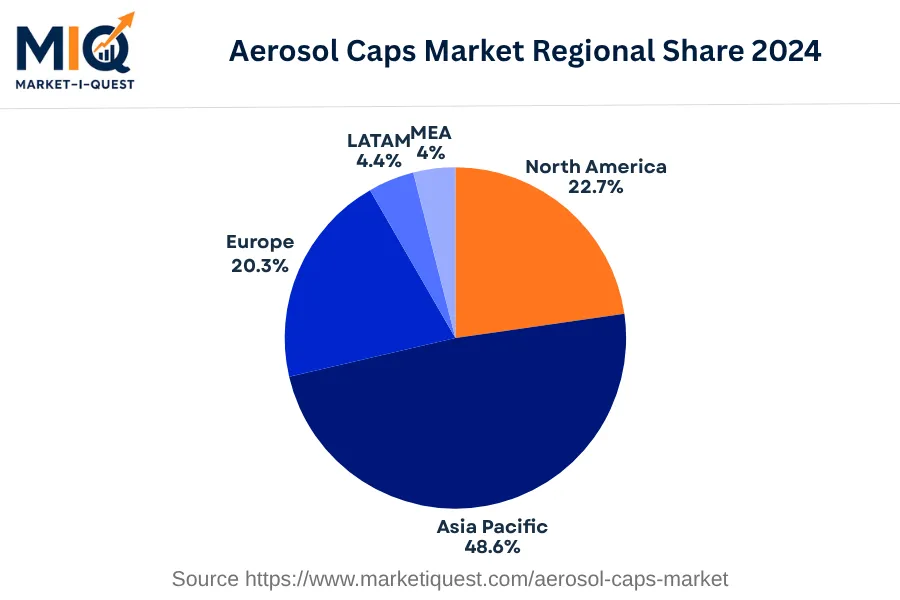
The Aerosol Caps Market size was $0.95 billion in 2024 and grew to $0.99 billion in 2025, before escalating to reach $1.54 billion by 2034, reflecting a compound annual growth rate (CAGR) of 4.9% during the interval from 2025 to 2034. This market ascended from shy of a billion dollars in 2024 and expanded over $0.59 billion in the subsequent decade. This development is a result of incremental and compound growth rather than a singular significant surge, reflecting consistent industry efforts and perhaps favorable market conditions throughout the examined interval. In 2024, the regional distribution of the Aerosol Caps Market was as follows: Asia Pacific had the highest share at 48.6%, followed by North America at 22.7%, Europe at 20.3%, while LATAM and MEA made smaller contributions with 4.4% and 4% respectively.

Key Takeaways

  • By Product Type - Cans and Rim Caps held a dominant share accounting for significant portion of the Aerosol Caps Market in base year.
  • By Application -Medical led accounting for a major share in the Aerosol Caps market in base year.
aerosol-caps-market market size

Key Driving Factors

Increasing Compliance to Environment-Friendly Packaging in Multiple Industries

With globalization and spread of environmental consciousness, enterprises across the globe are striving to comply with strict rules for environment-friendly packaging. This trend is conspicuous among pharmaceuticals, cosmetics, and food & beverage manufacturers, who are favoring sustainable aerosol caps as opposed to traditional alternatives. They are moving away from materials like plastic, particularly single-use plastic, which have considerable negative environmental impact. Aerosol caps, especially those made from metallic alloys or recyclable polymeric compounds provide an effective substitute. These alternatives are not merely environment-friendly but they also maintain the integrity of the products, promising optimum utility to the consumers. Hence, commitment to responsible packaging is driving expansion in the aerosol caps market.
Emergence of Online Retail and E-Commerce Platforms

The emergence of online retail and E-commerce platforms has substantially heightened the demand for efficient packaging solutions. Sellers on these platforms need to assure that the products reach the consumers without any damage. Robust and secure packaging guarantees the safety and integrity of the product during transit. Among various packaging fixtures, aerosol caps have gained popularity due to their reliability and compactness. These caps offer superior sealing thereby preventing any spillage or seepage of the product, making them ideal for long-distance shipping. Additionally, aerosol caps enhance the aesthetics of the product which can be pivotal in the online marketplace where the visual appeal can influence the buying decision of the consumers. Consequently, the burgeoning online retail and E-commerce platforms are driving the growth in the aerosol caps market.

Market Evolution by Timeline

2019-2023
During these years, the Aerosol Caps Market is seen to gain traction majorly among cosmetic and personal care product manufacturers due to the ease in application that aerosol caps provide. Markets in Asia-Pacific regions, specifically China and India, dominate the demand-side due to significant increase in consumers' purchasing power coupled with rising popularity of easy dispensable products. From a supply perspective, plastic aerosol caps became popular due to their cost-effectiveness and lightweight features. However, businesses faced challenges due to minimal recycling infrastructure causing environmental concerns. Environmentally friendly policies such as the EU Plastic Strategy in Europe influenced companies to focus on developing biodegradable aerosol caps. Prices were mainly driven by production costs and volumes required. Partnerships between spray manufacturers and cap dealers were commonly seen to reduce costs and optimise logistics.
2024
For 2024, buyers were primarily from the homecare industry, lured by convenience that aerosol caps offer for dispensing cleaning products. In terms of geography, North American markets strengthened their position due to upsurge in homecare products demand. Manufacturers started incorporating more eco-friendly bio-plastics in caps formulation because of strict environmental policies, like California's plastic waste resolution. The extent of eco-friendly integration in production lines was only semi-mature due to high costs. Technological constraints limited biodegradable cap production. Cap pricing slightly escalated due to higher production costs of biodegradable materials. On the risk side, high bio-plastic prices and challenges in altering existing manufacturing processes proved to be hurdles.
2025-2029
The trend in these years saw increased usage of aerosol caps in the food and beverage industry for spices, whipped cream, etc. The demand for aerosol caps in South American regions like Brazil boosted due to increased consumption of convenient packaged food products. From the technology perspective, advancements allowed more efficient, cost-effective production of biodegradable aerosol caps. However, the supply chain wrestled with fluctuating raw material prices. Initiatives such as the Green Economy Policy in Brazil compelled aerosol cap manufacturers to further reduce plastic usage. Pricing strategies leaned towards premium pricing for biodegradable caps, a vital revenue source for manufacturers. A typical risk involved uncertain regulations about plastics.
2030-2034
In this period, pharmaceutical industries began incorporating aerosol caps in their products, especially in inhalers for better dose regulation. The Middle East and Africa regions saw an increase in import of aerosol caps addressing pharmaceutical needs. The maturity of technology integration reached its peak, offering sturdy, eco-friendly aerosol caps at rationalized costs. Policy-wise, strict global rules for plastic waste like UN's Global Plastics Agreement affected manufacturing strategies. As production costs stabilized due to technological advancements, prices maintained a steady state. Concerning risks, any raw material scarcity might lead to delivery delays, leading manufacturers to keep buffer stock.

Future Market Outlook

Future Opportunities

Opportunities in the aerosol caps market are evolving as brands strive to meet shifting consumer preferences and regulatory mandates. The surge in eco-conscious behavior among consumers, particularly in North America and Europe, presents a ripe opportunity for manufacturers focusing on biodegradable and recyclable aerosol cap technologies. In 2022, Unilever reinforced its commitment to sustainability by setting goals to reduce plastic use, which could drive demand for innovative packaging solutions within aerosols. The investment trend in R&D by companies like AptarGroup reflects a strategic move to enhance cap functionality, including child-resistant features, as influenced by recent legislative changes in the U.S. regarding household product safety. Emerging markets such as Southeast Asia showcase a growing demand for aerosol products, particularly in personal care, which could encourage international investments from established firms exploring regional partnerships. The collaboration between companies like easy2 Technologies and Viropro in 2023, aiming to enhance automated sealing processes, highlights the push toward efficiency and quality in manufacturing. As regulations on volatile organic compounds intensify globally, companies that specialize in low-emission aerosol cap solutions stand to benefit from expanding compliance requirements. Additionally, the convergence of technology and design in aerosol applications, emphasizing user interaction and customization, will likely create further market niches. Continuous assessments of consumer behavior and regulatory frameworks will guide future strategic decisions, directing market trajectories for aerosol caps in the coming years.

Segmentation Analysis

By Product Type

The market is divided into various subsegments, these being Single Wall, Cans and Rim Caps, Double Wall, Necked-In, Snap Lock, CRC, Caps for PU Foam, Domed Caps, and Others. Among these, Cans and Rim Caps accounted for the largest revenue share, while the Snap Lock subsegment is predicted to grow at the fastest CAGR during the forecast period.

Largest Revenue Share

Cans and Rim Caps

Market Share Leader

Cans and Rim Caps have led the market revenue in the recent past owing to their universal usage in several industries, from food and beverage to personal care products, paints, and aerosols. Companies often favor these components because of their effective sealing properties and ease of production, translating into cost efficiencies. Additionally, the strong market presence of major brands utilizing cans and rim caps in their packaging has consolidated this subsegment's dominance. Geographically, markets with robust consumer goods sectors, like North America and Europe, contribute significantly to the sales of cans and rim caps. Meanwhile, the continuing urbanization in emerging economies has introduced new consumer clusters, thereby expanding the reach of this subsegment. Last but not least, the consistent regulatory approval for these materials in product packaging ensures their sustained demand. This analysis assumes a regular market situation without disruptive changes in buyer preferences or supplier structure.

Fastest CAGR

Snap Lock

Forecast Period Growth Leader

The Snap Lock segment is projected to grow at the fastest rate during the forecast period, driven by its advanced functionality, which eases container sealing and unsealing. This efficiency is particularly beneficial for products that require frequent use, hence the adoption of snap lock closures in industries like food, personal care, and homecare products is rising swiftly. Key catalysts for this subsegment's growth include ongoing innovations in product design and material technology, as businesses endeavor to enhance user experience and differentiate their offerings. Moreover, strategic partnerships among manufacturers, suppliers, and retailers potentially speed up the market entry of new snap lock variants and expand their availability across multiple sales channels. In contrast, the principal barriers affecting the adoption of Snap Lock are the initial capital investment and the process changes required for its large-scale production. Future trends should be monitored for signs of capex rationalization and policy interventions that could accelerate the wholesale switch to snap lock closures. The assumption here is that customers prioritize convenience and durability over cost for certain product categories.

By Application

The market is divided into subsegments including Personal Care, Household, Automotive & Industrial, Foods, Paints, Medical, and Others. The Medical subsegment accounted for the largest revenue share while the Personal Care subsegment is expected to grow at the fastest CAGR during the forecast period.

Largest Revenue Share

Medical

Market Share Leader

The Medical subsegment is leading in terms of revenue owing to several reasons. The primary driver is the rising demand for advanced medical equipment, devices, and products necessary in treating various health conditions. This increase can be traced back to the growing health consciousness among people and the increase in illnesses due to lifestyle changes. This has majorly contributed to the surge in investments from both private and government entities into medical research and development activities. Furthermore, regulatory policies in several regions have been relaxed to facilitate the introduction of new products in the market. Geographically, developed regions with robust healthcare infrastructure contribute a significant share to the segment's revenue. However, developing countries are not lagging far behind due to the rapid evolution of their healthcare sectors. The purchasing criteria within this segment are primarily governed by quality, regulatory compliance, and innovation.

Fastest CAGR

Personal Care

Forecast Period Growth Leader

The Personal Care subsegment is poised to register the fastest growth rate during the forecast period. This is spurred by factors such as changes in consumer ideologies regarding beauty and wellness, alongside an increase in disposable incomes. These factors have led to a surge in demand for personal care products across a wide demographic. Technological advancements have also played a crucial role by enabling the creation of more sophisticated and consumer-friendly products. While the higher cost of premium quality products can pose a barrier for some sections of customers, strategic partnerships and investment in research & development by major companies are providing impetus for the growth of this segment. Despite the optimistic outlook, one of the key risks in the near term is the intense competition that can exert downward pressure on prices and subsequently the profit margins of the companies.

Competitive Analysis

Key Market Players

Manufacturers / OEMs

Precision Valve Corporation
US
Lindal Group
Germany
Summit Packaging Systems
US

Key Suppliers & Raw Materials

Ball Corporation
US
Toyo Seikan Group
Japan
Crown Holdings
US

Distributors, Integrators & Channel Partners

Berlin Packaging
US
TricorBraun
US
Alpha Packaging
US

Porter’s Five Forces Analysis

This is a quantitative exploration of the competitive forces influencing the Aerosol Caps Market.

Supplier Bargaining Power

Medium

Dependency on a few key suppliers and material price fluctuations create moderate bargaining power.

Buyer Bargaining Power

High

Numerous suppliers and standardization of products increase buyer bargaining power.

Threat of Substitutes

Low

Lack of practical alternatives limits the threat of substitutes.

Threat of New Entrants

Low

High entry barriers due to technical expertise and capital expenditure hinder new entrants.

Competitive Rivalry

High

Intensive competition, high market maturity, and varied product offerings fuel competitive rivalry.

Regional Analysis

Geographic market dynamics and growth opportunities across key regions

Global Market Outlook

aerosol-caps-market market regional share

North America

In 2024, North America's Aerosol Caps Market was characterized by steady demand from diverse sectors and constant innovation. Key drivers included increased usage in consumer-based sectors such as personal care products, household chores, and pharmaceuticals. Because of strict regulations, companies invested in developing environmentally friendly aerosol caps, driving technology adoption. Supply dynamics also played a significant role, with local North American suppliers gaining prominence due to minimized transportation costs and increased demand for quicker delivery.

The American market was largely influenced by changing buyer behavior, with increased preference for sustainable and easy-to-use products. Demand for technologically advanced aerosol caps escalated, particularly those offering improved ease of use and increased functionality. Companies leveraged sales through e-commerce channels, after observing an upward swing in online shopping trends. The aerosol caps market witnessed a few significant partnerships/M&A, primarily to expand product portfolio and improve distribution networks. Regulatory bodies maintained strict compliance standards for manufacturing aerosol caps, with particular emphasis on ensuring safety, sustainability, and quality.

The market served several sectors including healthcare, with pharmaceutical companies widely using aerosol caps for various drugs. The cosmetics sector followed closely, as several beauty and personal care products employed aerosol caps. Aerosol caps were also found in retail sectors, in products catering to household chores. Overall, the North American Aerosol Caps market in 2024 illustrated a strong blend of consistent demand and innovation.

Asia Pacific

In 2024, the Asia Pacific Aerosol Caps Market was fundamentally driven by diverse product application across industries. Rapid urbanization was fuelling consumer product demand, resulting in an increased need for aerosol caps. Stricter regulations imposed by environmental bodies in China and Australia necessitated industry-wide adaptations, which spurred advancements in sustainable production methods, particularly in China. Furthermore, significant overseas investment into India and ASEAN markets bolstered supply dynamics and promoted local manufacturing endeavors. A dip in raw material prices across Asia Pacific notably eased production costs, propelling manufacturing intensification.

Simultaneously, an observable trend indicated a shift in buyer behavior towards sustainable and user-friendly products. Whether it be in India's personal care sector or Australia's automotive industry, the demand for aerosol caps that provide better precision and minimal leakage was on the rise. Consequently, technological growth leaned in favor of overcap types with optimal spray and consistency outcomes. Market players in Japan and South Korea faced stiffer competition, compelling several prominent manufacturers into alliances and M&A to build stronger footholds. Stricter implementation of aerosol recycling policies in China amplified the recycling rate, forcing manufacturers to prioritize environmental impact in their production strategies. Lastly, the omnichannel approach dominated retail strategies across the region, emphasizing the growing importance of ecommerce platforms in the aerosol cap market.

Europe

In 2024, the aerosol cap market in Europe represented a varied and dynamic sector. Driving the market were several key factors, starting with a clear demand from different consumer sectors. For example, retail and manufacturing sectors, especially in industrial strongholds like Germany and the United Kingdom, saw a reasonable uptake in aerosol cap procurement due to the rise in consumer packaged goods production. Moreover, heightened sanitation concerns in the wake of health crises prompted a surge in investment from healthcare facilities across France, Italy, and Spain, leading to increased adoption of aerosol caps. Other drivers included EU-wide recycling directives stimulating the use of recyclable aerosol caps, and the competitive pricing strategies of manufacturers in Eastern Europe.

In terms of market trends, shift towards eco-friendly caps was observed across retail commerce platforms in the Nordics and Benelux region. Advances in biodegradable material technology were adopted by market leaders, further enforced by the EU's Circular Economy Action Plan. Significant customer preference for brands committed to environmental sustainability was seen across all sectors, although more pronounced in enterprise and government procurement. Furthermore, there was an increase in partnerships between aerosol cap manufacturers and CPG companies, aiming to secure long-term supply contracts and maximize market share.

Latin America

In 2024, the Latin American aerosol caps market displayed substantial growth, fueled primarily by Brazil, Mexico, Argentina, Colombia, Chile, and Peru. Higher demand for aerosol products in personal care, home care, and automotive sectors significantly drove market expansion. Proactive government regulations supporting environment-friendly packaging solutions also heightened interest in sustainable aerosol cap technologies. Increasing investments in manufacturing by players to meet escalating demand further stimulated the market.

Consumers displayed strong preference for user-friendly designs, steering product innovation trends. Technological advancements witnessed a shift towards eco-friendly, recyclable materials, transforming the aerosol cap industry across Argentina and Colombia. In Mexico, robust growth in e-commerce propelled market dynamics, shifting sales from traditional retail outlets to online platforms. Key players engaged in strategic partnerships and mergers to capitalize on market potential, especially in Brazil and Peru.

Retail and manufacturing sectors emerged as leading consumers of aerosol caps. In Chile, retails and utilities showed a significant uptake, while in Peru, aerosol cap demand soared in healthcare and manufacturing sectors. In Argentina and Brazil, home care and personal care industries marked high aerosol cap consumption. Thus, in 2024, the aerosol cap market in LATAM witnessed growth influenced by shifts in consumer preference, technological advancements, regulations, and an expanding e-commerce sector.

Middle East & Africa

In 2024, the Aerosol Caps market in the Middle East and Africa showed positive expansion guided by numerous drivers and trends. Consumer demand for aerosol-packaged products, influenced by a rise in disposable income and growing urbanization, particularly in nations like Saudi Arabia, United Arab Emirates, and Qatar, endorsed the market. Regulatory focus on environmental sustainability also stimulated the adoption of environmentally friendly aerosol caps, specifically in South Africa, Kenya and Israel.

The market witnessed burgeoning investments in the aerosol industry, stimulating technological developments in caps design, safety, and functionality. Kenya and Nigeria's manufacturing and retail sectors played a significant role in supply chain dynamics, showing increased usage of aerosol packaged products and thereby influencing demand for aerosol caps.

On the trends spectrum, consumer preferences shifted towards premium and innovative aerosol caps, bolstered by an increasing health and beauty sector in Egypt and South Africa. Technology drove a surge in smart caps, integrating intelligent features and enhancing user experience, particularly in high-tech nations like Israel and UAE. Policy enforcement around waste management and recycling in nations like Saudi Arabia and Egypt also triggered a shift towards recyclable aerosol caps. Lastly, the growing e-commerce channel significantly shaped the distribution dynamics, with online purchases of aerosol-based products becoming commonplace in these regions.

Recent Industry Developments

Latest market innovations, product launches, and strategic initiatives

January 2026

Dispensing leader PRECISION was formally awarded the ADF Innovation Award for its newly commercialized SMART 35 integrated overcap solution. Developed alongside Czech Aerosol, the product features a mono-resin polypropylene (PP) architecture that eliminates the need for an independent, separate overcap. The design delivers a high-durability cap replacement that matches severe e-commerce transit regulations while integrating post-consumer recycled (PCR) resin lines.

January 2025

Ball Corporation executed a long-term commercial partnership agreement with Sweden’s Meadow to develop fully recyclable, lightweight aluminum aerosol cartridge systems. The supply chain alliance centers on replacing traditional mixed-material plastic aerosol caps and enclosures with highly circular, mono-material metal caps tailored for global personal care and premium household cleaning brands.

Frequently Asked Questions