Advanced Phase Change Materials Market Snapshot

Key Players

  • BASF SE (Germany)
  • Entropy Solutions (United States)
  • Honeywell Electronic Materials Inc. (United States)
  • Cryopak Inc. (Canada)
  • Laird Plc (United Kingdom)
  • Phase Change Energy Solutions Inc. (United States)
  • Outlast Technologies LLC (United States)
  • AM FRESH GROUP (Spain)
  • Henkel AG & Co. KGaA (Germany)
  • Climator Sweden AB (Sweden)

Market Size

Base Year 2024
$2.56 Bn
CAGR
15.85%
Forecast 2034
$11.15 Bn

Market Segments

By Material Type
Organic, Inorganic, Composite
By Phase Change
Solid-Liquid, Solid-Solid, Liquid-Gas
By Application
Energy Storage, Thermal Regulation, Electronics Cooling, Others
By End-Use Industry
Construction, Manufacturing, Transportation, Others

Market Dynamics

Drivers
  • Increased sustainable building trends
  • Technological advancements in thermal energy storage
Restraints
  • High Implementation Cost
  • Technological Complexity
Opportunities
  • Expanding renewable energy sector
  • Emerging thermal energy storage solutions

Market Size

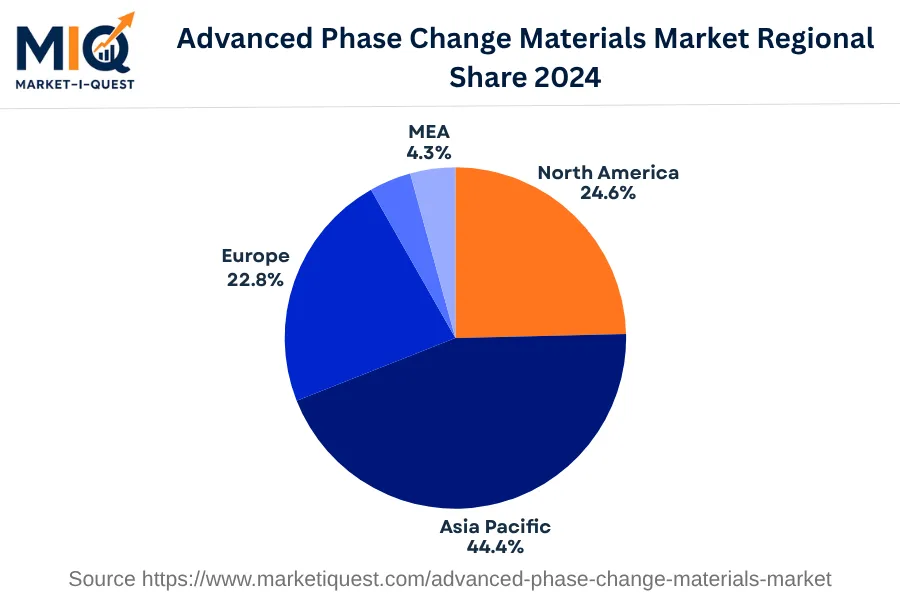
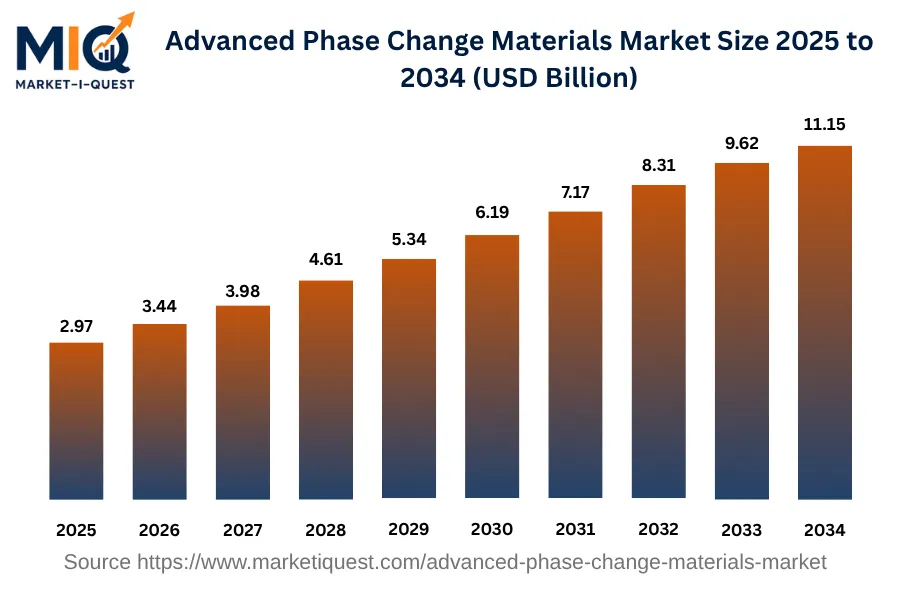
The Advanced Phase Change Materials Market was valued at $2.97 billion in 2025, and it is expected to grow to $11.15 billion by 2034, at a CAGR of 15.85%. The market saw steady growth from $2.56 billion in 2024, developing further to reach its 2025 value. The following nine years after 2025 saw an impressive expansion, reaching a total of $11.15 billion in 2034. The growth trajectory was marking significant increments year by year. This growth over the years is spread across various regions. In 2024, the regional shares were allocated as follows: North America represented 24.63% of the market, Asia Pacific held the largest share at 44.38%, Europe accounted for 22.76%, whereas smaller fractions were covered by Latin America and the Middle East & Africa, with 3.96% and 4.27% respectively.

Key Takeaways

  • By Material Type - Inorganic held a predominant position in the Advanced Phase Change Materials Market.
  • By Phase Change - Solid-Liquid led the market with a prominent share.
  • By Application - Energy Storage registered the most substantial growth accounting for a significant share.
  • By End-Use Industry - Manufacturing was the dominant sector holding the largest portion of the market.
advanced-phase-change-materials-market market size

Key Driving Factors

Adoption of advanced phase change materials in the textiles industry

One driving factor for the advanced phase change materials market is its increasing utilization in textiles industry. These materials are being used in producing thermal-regulating fabrics, which help in keeping the body temperature stable in diverse climatic conditions. With escalating demand for 'smart' and high-performance clothes, especially in activewear and militaries to maintain soldiers' comfort and safety in varying environmental circumstances, the application of these materials in textiles industry is witnessing a significant surge. As the textile industry continues to innovate and produce more efficient and effective materials, the usage of advanced phase change materials will foreseeably soar.

Trend towards energy efficiency in building & construction

Another pivotal driver of the advanced phase change materials market is the growing trend towards energy efficiency in the building and construction sector. With an aim to reduce the energy consumption and regulate the indoor temperature, advanced phase change materials are increasingly used in constructing 'green' buildings. The ability of these materials to store and release thermal energy helps to maintain an energy-efficient environment, cutting down the excessive reliance on heating and cooling systems. This is particularly significant given the push for sustainable practices in the construction industry worldwide and the growing regulatory pressure on reducing carbon footprints.

Market Evolution by Timeline

2019-2023
During this period, North America and Europe emerged as primary buyers of advanced phase change materials (APCM), with their demand driven by energy conservation initiatives. Technologically, micro-encapsulation of APCM improved their application in textiles and construction. However, high cost of these materials formed a major constraint. In terms of regulations, the EU's Energy Performance of Buildings Directive endorsed the use of APCM. Commercially, high premium pricing persisted due to costly production, almost always covered in long-term contracts with producers. New partnerships emerged especially around suppliers of raw materials key to APCM production. Challenges here included inconsistency in raw material supply, leading to fluctuating production levels. Therefore, stabilizing the supply chain became a priority.
2024
In 2024, Asia-Pacific showed particularly strong demand for APCM due to major industrial upgrades and construction booms, particularly in China and India. High thermal energy storage efficiency of micro-encapsulated APCM heightened their application in heating, ventilation, and air conditioning systems. However, a decline in raw material availability posed constraints to APCM production. No significant change in policy and regulation was observed in this year. Pricing trends saw a slow reduction due to progress in manufacturing techniques. Partnerships became increasingly common between APCM producers and construction companies. While raw material shortage remained a risk, many companies began exploring synthetic alternatives to mitigate this issue.
2025-2029
During this period, developing regions indicated rising demand for APCM, primarily stimulated by increasing emphasis on energy conservation and efficiency. The technology saw improvements in macro encapsulation of APCM particularly in cold-chain systems in the food sector. Constraints during this period include high costs and lack of technical knowledge on proper integration of APCM in major end-user industries. Policies like the Global Cooling Prize incentivized APCM adoption. Contracts continued to be long-term but began integrating cost sharing mechanisms. The common risk was the volatility in raw material pricing, pushing players to look for both procurement strategies and alternative materials.
2030-2034
In this phase, globally, the automotive and HVAC sectors served as key APCM buyers. New technological applications were witnessed in waste heat recovery and thermal energy storage. Integration of APCM in automobile interiors surfaced as a new trend. Regulatory bodies worldwide set new standards favoring sustainable material use, motivating the uptake of APCM. Business models matured into partnerships between APCM manufacturers and end-user companies for customized solutions. Costs could potentially still be an issue, with mitigation depending on successful scale-up of production or new synthesis methods. A balanced material supply to keep production consistent was seen as a likely risk.

Future Market Outlook

Future Opportunities

Future opportunities in the advanced phase change materials market hinge on applications in diverse industries such as automotive, electronics, and healthcare. In July 2023, the European Commission released a directive that emphasizes energy efficiency in industrial processes, which could lead to the adoption of phase change materials in manufacturing. For example, the automotive sector has begun integrating PCM in batteries to manage thermal conditions effectively; Tesla's Model 3 uses specialized materials for thermal management to improve battery performance. The growing trend of electrification in transportation, supported by initiatives in countries like Canada that advocate for electric vehicle adoption, paves the way for phase change materials to play a significant role in temperature moderation. Healthcare applications, particularly in drug storage systems, are expected to grow due to regulations that require maintaining strict temperature controls during transit. Companies like 3M have expanded their R&D in this area, anticipating regulatory changes regarding the transport of temperature-sensitive products. Additionally, innovations in smart textiles that incorporate phase change materials are emerging, driven by consumer demand for multifunctional clothing as noted in a 2022 report by the International Textile and Apparel Association. As global industries navigate energy transitions, leveraging phase change materials for operational efficiency presents a substantial area for growth, aligned with international climate commitments and local energy regulations.

Segmentation Analysis

By Material Type

The market is divided into subsegments including Organic, Inorganic, and Composite materials. In 2024, Inorganic materials accounted for the largest revenue share, while Organic materials are expected to grow at the fastest Compound Annual Growth Rate (CAGR) during the forecast period.

Largest Revenue Share

Inorganic

Market Share Leader

The Inorganic material segment leads today's market due to a variety of factors including its broad range of applications, durability, and cost-effectiveness. Inorganic materials, frequently used in industries such as construction, electronics, and healthcare, showcase versatility, thereby amplifying their demand. These materials are known to be heat and chemical-resistant due to their tightly-packed atomic structures, hence their high durability. This high resilience has made them favorable for utilization in harsh environments. Additionally, the synthesis of inorganic materials from abundant naturally occurring raw substances lowers the production cost significantly, making it economically advantageous. Regulatory policies, especially in the construction and electronics industries, often favor the use of inorganic materials because of their fire-proof and environmentally friendly properties. Finally, their established supply chains and the high switching costs for alternatives have consolidated the position of the inorganic materials segment in the market.

Fastest CAGR

Organic

Forecast Period Growth Leader

The Organic material segment is poised for the fastest growth in the market. It's well-documented that organic materials, with their environmentally friendly profiles, are becoming increasingly prominent due to rising concern about environmental sustainability. The improved public perception and regulations have encouraged industries to shift towards adopting these materials. Additionally, technological advancements are playing a leading role in this growth trajectory. Research and investment into organic materials have unlocked new potential applications across a range of sectors, from agriculture to electronics. This expansion in utility, coupled with the development of efficient production methods, is set to reduce the cost barrier and speed up the adoption rate. However, short-term growth could be impaired by the ongoing supply-chain disruptions due to unpredictable geopolitical conditions and raw material shortages. Nonetheless, the long-term outlook for organic materials remains strongly positive with continued tech innovation and policy support.

By Phase Change

The market is divided into subsegments including Solid-Liquid, Solid-Solid, and Liquid-Gas transitions. As of 2024, the Solid-Liquid subsegment accounted for the largest revenue share while the Liquid-Gas subsegment is expected to grow at the fastest CAGR during the forecast period.

Largest Revenue Share

Solid-Liquid

Market Share Leader

The Solid-Liquid phase change market segment in 2024 currently has the highest revenue within this sector. This can be attributed to its extensive utilization in an array of industries which have solid raw materials that need to be melted or liquified for processing. These industries range from metal and glass manufacturing to food and beverage industries – where raw materials are constantly being transformed from their original solid state to a liquid state for processing and refining. Moreover, the high purchasing criteria within these well-established industries also significantly contribute to this segment's overall revenue. Geographically, regions with strong industrial profiles contribute heavily to the segment's revenue. Stringent regulations regarding waste treatment and recycling have also fostered growth within this segment, as solid waste materials often require liquification before treatment. High switching costs associated with changing processing methods further secure the revenue base.

Fastest CAGR

Liquid-Gas

Forecast Period Growth Leader

The phase change from liquid to gas is projected to experience the fastest growth. This subsegment is primarily driven by its widespread application in energy production sectors such as geothermal and nuclear power plants, where heated water is transformed into steam to drive turbines. Catalysts for growth within this subsegment are diverse, ranging from advancements in energy generation technology to policy efforts aimed at optimizing and revamping conventional power generation facilities. Increasing focus on sustainability and efficient energy use are also major drivers steering growth in this direction. Near-term risks include capital-intensive setup and operation costs and potential regulatory hurdles. However, strategic partnerships and ongoing technical developments aim to mitigate these adoptive barriers, promising strong potential for growth within this subsegment.

By Application

The market is divided into subsegments including Energy Storage, Thermal Regulation, Electronics Cooling, and Others. Among these subsegments, Energy Storage accounted for the largest revenue share while Electronics Cooling is expected to grow at the fastest CAGR during the forecast period.

Largest Revenue Share

Energy Storage

Market Share Leader

The Energy Storage segment leads in revenue due to increasing demand for efficient energy management across various industries including utilities, residential, commercial, automotive, and others. Its involvement in creating a sustainable energy future by enabling grid stability, peak shaving, energy time shift, and smoothing of renewable energy generation further fuels its growth. Technologies like Lithium-ion, lead-acid, and flow batteries dome this segment, providing high efficiency, reliability, and cost-effectiveness. The increasing mandates for renewable energy installations along with growing electric vehicle penetration globally contributes to its vast scale. The increasing investments in smart grids and micro-grids, combined with emerging battery technologies, further drive demand. Recognizing these benefits, industries are increasingly shifting towards the adoption of energy storage solutions, facilitating high revenue in this segment.

Fastest CAGR

Electronics Cooling

Forecast Period Growth Leader

In contrast, the Electronics Cooling segment is expected to exhibit the fastest CAGR. As the IT and Telecom sector continues to expand globally, the need for advanced cooling systems to prevent overheating of electronic appliances experiences a rise. This segment's growth is fueled by the increasing demand for energy-efficient solutions and the need to maintain optimal functioning and longevity of electronic products. The rapid technological advancements, including miniaturization and increasing processor speeds, necessitate advanced cooling systems for effective thermal management. These pressures, along with stringent regulations to decrease energy consumption, act as the main growth catalysts for this segment. However, the high cost of these advanced cooling solutions coupled with technical complexities may pose as adoption barriers hindering growth in the near term. With strategic investments and partnerships, these growth drivers can lead to increasing market penetration of the Electronics Cooling segment.

By End-Use Industry

The market is divided into subsegments including Construction, Manufacturing, Transportation, and Others, with Manufacturing accounting for the largest revenue share, while Construction is expected to grow at the fastest CAGR during the forecast period.

Largest Revenue Share

Manufacturing

Market Share Leader

In 2024, the manufacturing subsegment emerged as the sector with the highest revenue. This is primarily attributable to its vast scope and the wide range of industries it covers. The manufacturing industry serves several key sectors, including transportation, health, defense, and technology, amongst others. Countless businesses depend on the manufacturing sector for their functional equipment and tools, propelling its high need and consequentially, revenue. Additionally, the industry's sophistication and constant innovation have resulted in robust purchasing criteria, strengthening its position further. It has a secure and extensive distribution network that further bolsters its reach and revenue generation. The regulation policies in place also favor the manufacturing sector, lending it additional stability. Generally, the high costs associated with switching to alternative suppliers deters customers, providing a steady consumer base for this subsegment.

Fastest CAGR

Construction

Forecast Period Growth Leader

The construction subsegment is forecasted to exhibit the fastest CAGR growth. The rising urbanization trend and increasing infrastructural investment are the key drivers for this anticipated growth. More elaborate construction projects and expanding residential, commercial, and industrial needs contribute to this subsegment's increased uptake. However, usual barriers like extended approval processes, stringent building regulations, and high initial investment costs could hamper growth. Technological advancements and incorporation of sustainable construction practices could act as effective catalysts, driving growth in this sector. Moreover, various government policy support and increasing capital expenditure in infrastructure development are expected to propel growth. Nonetheless, potential risks, such as raised commodity prices or potential economic instabilities, could affect near-term industry performance.

Competitive Analysis

Key Market Players

Manufacturers / OEMs

BASF
Germany
Entropy Solutions LLC
US
Phase Change Energy Solutions
US

Key Suppliers & Raw Materials

Dow Chemical Co.
US
Outlast Technologies LLC
US
Honeywell Electronic Materials, Inc.
US

Distributors, Integrators & Channel Partners

Cryopak
Canada
Sumitomo Chemical Co., Ltd.
Japan
Sonoco Products Company
US

Porter’s Five Forces Analysis

An analysis of the competitive landscape and power dynamics in the Advanced Phase Change Materials Market.

Supplier Bargaining Power

Medium

Providers of rare materials for Advanced PCM may exercise significant influence.

Buyer Bargaining Power

High

End users can choose from numerous PCM manufacturers, driving competition and choice.

Threat of Substitutes

Medium

Traditional insulating materials present alternative options, but lose out on performance.

Threat of New Entrants

Low

High R&D cost and specialized technical knowledge act as barriers to entry.

Competitive Rivalry

High

Industry is competitive, with several prominent companies contending for market share.

Regional Analysis

Geographic market dynamics and growth opportunities across key regions

Global Market Outlook

advanced-phase-change-materials-market market regional share

North America

In 2024, the North American market for Advanced Phase Change Materials (APCM) witnessed progressive growth driven by several factors and trends. Increased demand for energy-efficient cooling solutions across sectors such as manufacturing, utilities and retail boosted the APCM market growth. Rigorous energy-saving standards and regulations in the U.S., Canada, and Mexico advocated industry-wide adoption of APCM for thermal management. Investments in APCM by local governments and energy utilities were significant, enabling advancements in technology and wider adoption. Evolving supply dynamics, coupled with competitive pricing, pushed market expansion, particularly in Southern U.S. states and Mexican manufacturing hubs.

On the trend front, buyer behavior shifted towards sustainable and efficient energy alternatives, propelling APCM demand. Emerging partnerships and mergers amongst major APCM manufacturers and technology firms pointed towards strategic business growth. Policy enforcement related to carbon emissions and energy efficiency standards by North American governments were propagating the usage of APCM. Broadly, these trends suggested cross-sector customer interest in APCM, from enterprises to governments. The healthcare sector, for example, leveraged APCM in temperature-controlled transportation and storage. Meanwhile, the retail sector was seen adopting APCM in cooled display units. Thus, in 2024, the APCM market in North America was driven by regulatory mandates, investment influx, technology adoption, and an evolving customer base.

Asia Pacific

In 2024, the Advanced Phase Change Materials (APCM) market in Asia Pacific was characterized by surging demand and robust technological intervention. Drivers primarily included escalating demand in sectors such as manufacturing, healthcare, and retail, given their increasing need for energy conservation and temperature regulation. Regulatory reforms in markets such as China, India, Japan, and Australia fundamentally stimulated the market, pushing for greener practices in energy-intensive sectors. Emerging investments and technological adoption, especially in key ASEAN markets, formed the crux of supply dynamics, leading to favorable pricing conditions.

Predominant trends in the APCM market involved shifts in buyer behavior favoring environment-friendly products, and robust technological progress. A paradigm shift towards green technology in response to stringent environmental policies was evident in countries such as China, South Korea, and Japan. Evolving channel dynamics were apparent, as digital selling platforms became increasingly prevalent. The industry also witnessed partnerships and M&A on a significant scale, notably in the manufacturing and healthcare sectors. Policy enforcement, especially in government and utility sectors, had a pivotal role in market evolution. For example, the Indian government's policy to promote energy efficiency in public buildings created a ripple effect on APCM demand. Overall, the APCM market in Asia Pacific in 2024 was shaped by greater demand, policy shifts, and technological innovation.

Europe

In 2024, the advanced phase change materials market in Europe demonstrated a solid performance. Market drivers included a growing demand for temperature control in myriad sectors, with manufacturing and retail leading the uptake. Regulations aimed at decreasing energy consumption and carbon emissions have also prompted wider adoption of these materials, particularly in the green construction business in Germany and the UK. Additionally, Italian and Spanish fashion and retail enterprises have increased investment in advanced phase change materials for thermal regulation in apparel.

Trends within the market indicated a focus on improving product efficiency and lifespan. In particular, a shift towards microencapsulation technology was noted across European manufacturers, especially in the Nordics and Benelux region. This trend aligns with a broader move across industries toward innovative and sustainable solutions. The year also saw a significant increase in partnerships and M&A activities, with large corporations acquiring local start-ups to broaden their portfolio in response to dynamic customer needs in Central and Eastern Europe. Lastly, tougher policy enforcement in domains like healthcare and utilities mandated the adoption of efficient temperature control solutions, supporting the market demand for advanced phase change materials. Overall, both drivers and trends suggest a robust market for advanced phase change materials in Europe for 2024.

Latin America

In 2024, the Advanced Phase Change Materials (APCM) market in Latin America represented a significant growth area in the renewable energy sector. Strong investments in renewable energy infrastructure across Brazil, Mexico, Argentina, Colombia, Chile, and Peru fueled the demand for APCMs. Regulatory shifts in these countries incentivised the adoption of green technologies, with APCMs playing an essential part. Heightened sustainability consciousness spurred market growth, with major supply dynamics leaning towards bio-based and organic phase change materials.

Consumer preferences showed a trend towards eco-friendly products, propelling industries such as retail and manufacturing to integrate APCMs into their goods. In technology, there was active exploration into APCM-based systems for thermal energy storage, pushing the boundaries of their applications. Partnerships between technology firms and material manufacturers further expanded the APCM market's reach. Government sectors across LATAM enforced strict energy-saving standards with progressive policies backing APCMs' use, thus spurring production.

The healthcare sector witnessed increased APCM application in medical transportation and storage, particularly for temperature-sensitive pharmaceuticals. Simultaneously, utilities companies increasingly explored APCMs for electricity storage, reducing dependency on traditional methods. The APCM market in 2024, driven by these factors, positioned LATAM as a crucial player in renewable energy development.

Middle East & Africa

The Advanced Phase Change Materials (PCM) Market in the Middle East and Africa was marked by a heightened level of activity in 2024, with noticeable uptake in countries like Saudi Arabia, United Arab Emirates, Qatar, Egypt, South Africa, Nigeria, Kenya, and Israel, amongst others.

Key drivers in this market were primarily linked to significant investments in infrastructural developments and technology adoption across sectors, particularly in manufacturing and utilities in countries like Israel, Saudi Arabia, and the UAE. Regulations requiring energy efficiency in these sectors further propelled demand. The oil and gas sector in countries like Qatar and Saudi Arabia notably adopted these materials for high temperature applications, thus impacting supply dynamics and creating price escalations.

Market trends manifested distinctly in 2024 with an apparent shift towards bio-based PCMs, which was prominently observed in Egypt, Nigeria, and Kenya due to the increasing emphasis on sustainability. Similarly, a significant behavioral shift in buyers choosing multiple sourcing strategies resulted in increased partnerships and M&A activities, primarily in Israel, UAE, and South Africa. Concurrently, the policy enforcement standardizing PCM characteristics and methods of testing across the MEA region notably influenced buyer decisions in sectors such as retail, telecom, and financial services, among others. Channel dynamics also shifted towards e-commerce, particularly in countries like UAE, Israel, and South Africa, marked with strategic partnerships for wider distribution coverage.

Recent Industry Developments

Latest market innovations, product launches, and strategic initiatives

July 2025

The Indian Ministry of New and Renewable Energy (MNRE) officially enacted a new subsidy framework targeting thermal energy storage systems used across off-grid and hybrid solar installations. The newly introduced policy directly covers and incentivizes phase change material-based solutions to drive rural electrification and grid-independent green energy projects.

June 2025

PLUSS Advanced Technologies formed a strategic commercial partnership with Ecodome Logistics to roll out reusable, IoT-enabled cold-chain distribution boxes throughout India. The collaboration utilizes validated phase change material technology to secure precise temperature-controlled transport for biological materials and sensitive pharmaceuticals, minimizing environmental waste relative to conventional single-use packaging.

Frequently Asked Questions