Thermal Energy Storage Market Snapshot

Key Players

  • Abengoa Solar (Spain)
  • SolarReserve (United States)
  • BrightSource Energy (United States)
  • Caledonian Geothermal (Scotland)
  • Evapco (United States)
  • DN Tanks (United States)
  • Dunham-Bush (Malaysia)
  • Baltimore Aircoil Company (United States)
  • Ice Energy (United States)
  • Steffes Corporation (United States)

Market Size

Base Year 2024
$2.93 Bn
CAGR
4.2%
Forecast 2034
$4.42 Bn

Market Segments

By Storage Material
  • Water
  • Molten Salt
  • Phase Change Materials (PCM)
  • Others
By Technology
  • Latent
  • Thermochemical
  • Sensible
By Application
  • District Heating
  • Industrial Processes
  • Building Heating and Cooling
  • Concentrated Solar Power

Market Dynamics

Drivers
  • Increasing renewable energy adoption
  • Advancements in storage technologies
Restraints
  • High installation cost
  • Lack of awareness
Opportunities
  • Growing renewable energy sector
  • Emerging smart grid technologies

Market Size

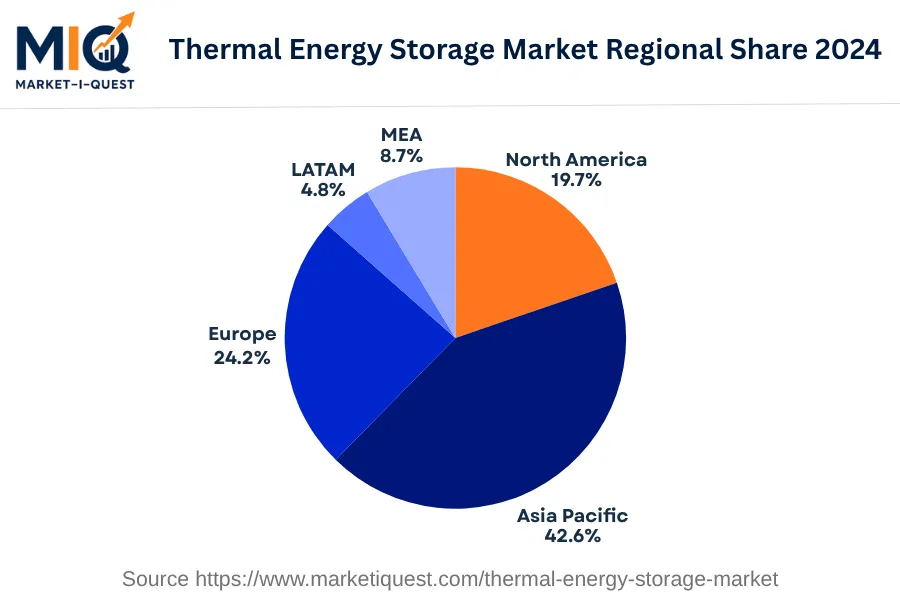
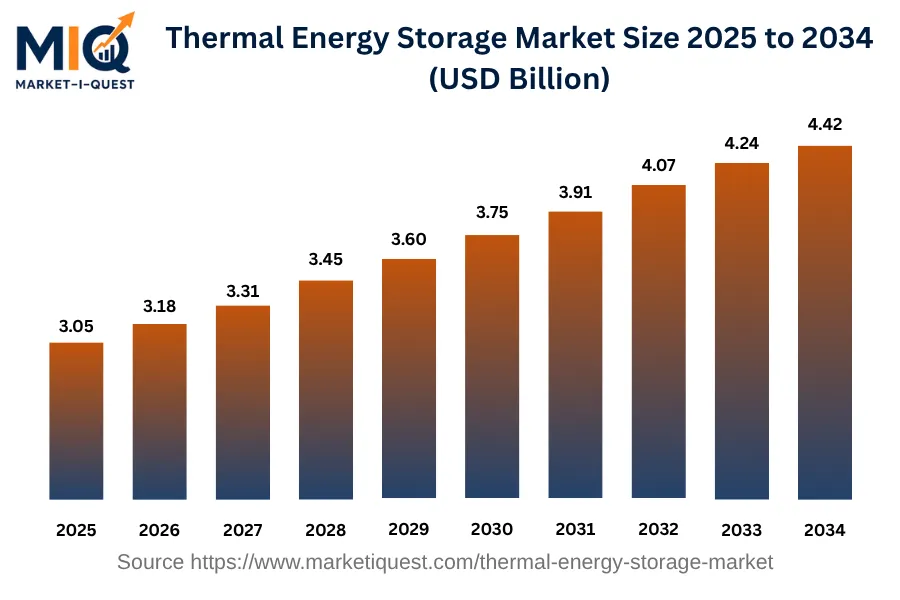
The Thermal Energy Storage Market was valued at USD 3.05 billion in 2025 and is projected to reach USD 4.42 billion in 2034, expanding at a CAGR of 4.2%. This growth from 2025 to 2034 represents an increase of nearly 45% over these years, indicating a steady expansion of the thermal energy storage sector in sync with energy demands and environmental regulation. Enhancements in technology, combined with global recognition of the cost and environment benefits, have proven instrumental in the growth demonstrated in these numbers. On a regional level, the Thermal Energy Storage Market in 2024 revealed a distribution with Asia Pacific claiming the largest share at 42.6%, followed by Europe at 24.2% and North America at 19.7%. The remaining portions were held by the MEA at 8.7% and LATAM at 4.8%. This regional variance is reflective of the geographical distribution of thermal energy resources and the corresponding infrastructure.

Key Takeaways

  • By Storage Material - Water led the segment accounting for the largest share.
  • By Technology - Thermo-Chemical held the largest revenue share of the segment.
  • By Application - Factory Processes held a largest share of segment of the market in 2024.
thermal-energy-storage-market market size

Key Driving Factors

Adoption of District Heating Systems

In urban centers across the globe, the move towards district heating systems is driving the growth of the thermal energy storage market. District heating uses a centralized heat source to supply thermal energy to multiple buildings, saving resources compared to individual heating solutions. These systems are often more cost effective and energy efficient. However, they require a simultaneous shift towards thermal energy storage solutions to retain excess energy during low demand periods and distribute it during peak demand times. This dynamic is particularly prevalent in colder countries like Sweden or Canada where district heating is becoming more commonplace.

Transition towards Renewable Energy Sources

The global transition towards renewable energy sources is another major driver of the thermal energy storage market. Countries are increasing their reliance on solar and wind energy to reduce environmental impact and attain energy security. However, renewable energy output is subject to variability due to weather conditions, creating a need for energy storage solutions. Thermal energy storage systems can store surplus energy generated during peak production periods and provide it when production is low, aiding in grid stability. Therefore, as renewable energy dependence rises, so does the demand for thermal energy storage systems such as molten salt energy storage used in concentrated solar power plants.

Market Evolution by Timeline

2019-2023
In this period, the demand for thermal energy storage solutions was noted to be particularly strong among utilities and commercial industries, driven primarily by the increased awareness of energy efficiency and renewable integration in regions like North America and Europe. On the supply side, phase change materials dominated as the primary technology used for storing thermal energy, despite being somewhat resource-intensive. From a regulatory standpoint, the Renewable Portfolio Standards played a pivotal role in motivating utilities to adopt thermal energy storage systems. As for commercial models, performance contracting emerged as a favored approach, offering benefits like minimized risks and guaranteed savings. However, high upfront costs and technical installation challenges posed as significant barriers to widespread adoption.
2024
During 2024, the thermal energy storage market observed an onset of transformative changes. Utilities continued to be the leading buyers, but the residential sector also became a promising segment, driven by the need for load shifting and offsetting peak electricity prices. The market saw a shift from phase change materials to thermochemical storage technologies, offering high energy density and reduced environmental impact. Government initiatives, such as the US Department of Energy's Grid Modernization Initiative, were instrumental in encouraging such technological shifts. Concerning business models, power purchase agreements became an increasingly popular procurement method as they mitigated financial risk. The prominent challenges during this time remained system efficiency and profitability concerns.
2025-2029
From 2025 to 2029, both commercial and residential demands surged for thermal storage solutions, with a distinctive interest in Asia-Pacific. The necessity for energy storage in integrating renewable energy resources, maintaining grid stability, and enhancing energy efficiency led to this upward trend. Molten salt storage technology became commonly used, marking a shift from thermochemical storage, primarily because of its relatively lower cost and higher energy storage capacity. Regulations like the EU's Clean Energy for All Europeans package played a critical role in boosting the market. The Energy-As-A-Service model flourished, providing turnkey, off-balance-sheet financing. However, concerns about the scalability, reliability, and lifespan of systems still persisted.
2030-2034
The period from 2030 to 2034 saw a more diversified buyer market for thermal energy storage. Industrial sector demand grew substantially, complemented by ongoing demand from the utilities and residential sectors. Latent heat storage technologies witnessed increased adoption, largely due to their ability to provide a high-energy storage density with minimal space. Policies like China's Energy Storage Action Plan paved the way for accelerated adoption. Commercially, bundled services contracts were observed to gain traction, combining equipment, maintenance, and financing under one agreement. These agreements reduced the burden on customers and facilitated market growth. Challenges of cost-effective integration and system interoperability remained, necessitating further technological development.

Future Market Outlook

Future Opportunities

The thermal energy storage market presents various growth avenues rooted in ongoing regulatory developments and increasing technological integration. The European Union's Green Deal, initiated in 2019, reinforces the imperative for energy efficiency and decarbonization across member states, which facilitates the adoption of TES solutions as part of centralized and decentralized energy systems. In particular, countries like Sweden and Denmark have demonstrated successful large-scale implementations of district heating systems that integrate thermal storage capabilities. Reports from the International Renewable Energy Agency in 2023 underscore how jurisdictions are exploring the potential of seasonal thermal energy storage to manage energy supply fluctuations more effectively. Collaboration between organizations such as the International Solar Alliance and various governments is also fueling interest in TES projects tailored to enhance renewable energy usage. In 2022, the California Energy Commission officially recognized TES as a vital component of its clean energy strategy, paving the way for incentives and funding opportunities. Companies like EnergyNest are capitalizing on shifting policies, showcasing their proprietary technology for high-temperature thermal storage applications. As more countries, including Australia and China, seek solutions for grid resilience and energy independence, the thermal energy storage market is poised to benefit from these strategic initiatives and technological alignments that enhance energy diversification and security.

Segmentation Analysis

By Storage Material

The market is divided into subsegments including Water, Molten Salt, Phase Change Materials (PCM), and Others. Among these, Water storage held the largest revenue share, while Phase Change Materials (PCM) is projected to grow at the fastest CAGR during the forecast period.

Largest Revenue Share

Water

Market Share Leader

Water storage took the lead in terms of revenue attributable to several key factors. Water storage systems' dominance is driven by their broad range of applications in various end-use sectors, such as residential, commercial, and industrial. The need for thermal energy storage in these sectors creates significant demand for water storage systems. These systems are also commonly used in solar thermal energy storage, further driving demand. Geographically, regions such as Asia-Pacific are significant contributors to revenue due to the presence of many developing economies where the need for energy and hence, energy storage is high. The quick adoption of green energy solutions in these areas is another driving factor. Additionally, a robust regulatory framework surrounding the correct storage and usage of water for energy production also supports the growth of this subsegment. Their ease of procurement and usage, along with relatively lower switching costs compared to other alternatives, are key aspects attracting customers.

Fastest CAGR

Phase Change Materials (PCM)

Forecast Period Growth Leader

Phase Change Materials (PCM) is identified as the subsegment with the fastest growth outlook. The growth of this subsegment is largely due to the evolving technologies and numerous advantages offered by PCMs, like a higher energy storage density and the ability to deliver heat at a constant temperature. Also, advanced PCM systems are safer and offer better long duration energy storage solutions which makes them increasingly popular in sectors needing effective thermal management such as building and construction, and electronics. Customer adoption, however, could be slowed by the relatively high initial cost of PCM systems and the complexities involved in their integration. Collaborations and partnerships among key providers are important catalysts, allowing for shared research and development resources, and enabling quicker breakthroughs in PCM technology. The capital expenditure involved is significant but necessary for securing a foothold in this rapid-growth area. On the policy front, measures promoting the use of renewable energy and energy efficiency can stimulate PCM adoption.

By Technology

The technology market is divided into subsegments including Latent, Thermochemical, and Sensible technologies. Thermochemical technology delivered the largest revenue share, while Latent energy storage technology is expected to grow at the fastest CAGR during the forecast period.

Largest Revenue Share

Thermochemical

Market Share Leader

Thermochemical technologies represent the segment with the largest revenue in 2024 due to their manifold applications and high energy efficiency. Thermochemical storage systems work on the principle of heat conversion into chemical energy, which is stored and converted back into heat energy when required. This technology is an established sector with various innovative solutions employed across multiple industries, including energy, chemical, and manufacturing sectors. Its demand is majorly driven by the need for sustained industrial operations, uninterrupted power supply, and stringent emission norms. The players are consistently investing in the R&D activities to innovate and expand the application scope of thermochemical technologies, which further underpins its dominance in terms of revenue. High thermal efficiency, low operational costs, and excellent load management capabilities are a few factors that have attracted a wide customer base and hence, have a positive impact on revenue.

Fastest CAGR

Latent

Forecast Period Growth Leader

Latent energy storage technology is set to grow at the fastest pace during the forecast years. This technology stores thermal energy in the form of latent heat, ensuring higher energy storage density and smaller temperature fluctuations, which drive demands in sectors like construction, power generation, and HVAC. Despite higher initial investment costs, its better efficiency and longer lifespan, in comparison to classical technologies, ensures a strong growth potential. Insights suggest that government regulations for energy conservation may act as a catalyst for rapid adoption of this technology. Moreover, partnerships between tech companies and storage operators aimed at implementing advanced energy-efficient solutions may speed up adoption. However, near-term risks include fluctuating raw material prices and the impact of global economics. Data-driven strategies will be instrumental in overcoming these barriers and bolstering the adoption of Latent energy storage technology.

By Application

The market is divided into subsegments including District Heating, Industrial Processes, Building Heating and Cooling, and Concentrated Solar Power. Industrial Processes accounted for the largest revenue share while Concentrated Solar Power is expected to grow at the fastest CAGR during the forecast period.

Largest Revenue Share

Industrial Processes

Market Share Leader

Industrial Processes hold the most substantial portion of the revenue among all subsegments in 2024. The revenue dominance can be attributed to the broad utilization of heat energy in various industrial procedures, such as those found in the pharmaceutical, petrochemical, and ceramic industries. The upsurge in industrial growth globally and the escalating demand for cost-efficient energy sources have strengthened this subsegment's position. Furthermore, regulatory shifts towards cleaner fuel sources and energy conservation have prodded industries to adopt more efficient heating systems that contribute to this subsegment's performance. Lastly, industries' purchasing decisions are largely dictated by the dual need for cutting operational costs and complying with environmental regulations.

Fastest CAGR

Concentrated Solar Power

Forecast Period Growth Leader

While the Industrial Processes segment dominates in terms of revenue, it's the Concentrated Solar Power (CSP) segment which presents the strongest growth prospects. Spurring this growth are technology advancements lowering CSP costs and increased regulatory pressure to adopt renewable energy sources. Sunbelt countries hold significant growth potential due to the high intensity and reliability of solar radiation. Large capital investments by major global energy players in CSP projects showcase the market’s latent potential. Even with its potential, CSP faces challenges. Its high-cost relative to other renewable energy sources is a significant barrier. Additionally, factors such as land requirements and the need for strong sunlight exposure could restrict growth in certain regions. However, ongoing improvements in storage technologies, combined with governmental support via subsidies and feed-in-tariffs, are expected to drive CSP’s growth in the near term.

Competitive Analysis

Key Market Players

Manufacturers / OEMs

Abengoa Solar SA
Spain
Calmac
US
Ice Energy
US

Key Suppliers & Raw Materials

Goss Engineering, Inc.
US
Evapco, Inc.
US
Baltimore Aircoil Company
US

Distributors, Integrators & Channel Partners

Steffes Corporation
US
Axiom Energy
US
DN Tanks
US

Porter’s Five Forces Analysis

A comprehensive review of the external competitive environment impacting the Thermal Energy Storage Market

Supplier Bargaining Power

Medium

Moderate due to specific technical requirements, but mitigated by the presence of numerous suppliers.

Buyer Bargaining Power

High

Customers have high bargaining power due to a broad range of available technologies and solutions.

Threat of Substitutes

Medium

Potential substitute technologies such as Lithium-Ion batteries pose a medium threat.

Threat of New Entrants

High

Low regulatory barriers and growing interest in renewable energy sources makes market entry highly feasible.

Competitive Rivalry

High

Significant competition due to surge in innovative products and collaborative strategies amongst key players.

Regional Analysis

Geographic market dynamics and growth opportunities across key regions

Global Market Outlook

thermal-energy-storage-market market regional share

North America

In 2024, the North American Thermal Energy Storage Market experienced considerable change due to several factors. Firstly, rising electricity prices and fluctuating demand propelled enterprises and utilities to seek energy storage technologies that could stabilize costs and improve operational reliability. Secondly, heightened environmental awareness and stricter regulations on carbon emissions supported the deployment of thermal energy storage technologies in the U.S., Canada, and Mexico. Lastly, robust investment and advancements in storage technologies enabled a faster, more cost-effective integration of renewable energy into the grid.

In terms of trends, consumers, particularly in the manufacturing and retail sectors, showed a growing preference for flexible, reliable energy sources, leveraging innovations in thermal energy storage. Additionally, strategic partnerships and mergers and acquisitions intensified, as firms sought to bolster their market presence while driving product development and technological advancements. While commercial and residential sectors continued to drive demand, utilities companies increasingly utilized thermal storage for peak load management. High-profile policies, like Canada's Pan-Canadian Framework for Clean Growth and Climate Change, enforced the adoption of renewable energy technologies, indirectly fostering thermal energy storage market growth in North America. Overall, the market dynamic in 2024 demonstrated how efficiency concerns, policy enforcements, and technology advancements interacted to shape the thermal energy storage landscape.

Asia Pacific

In 2024, the Asia Pacific Thermal Energy Storage market saw robust expansion due to multiple demand and supply triggers. Economic growth combined with industrial development, particularly in China, India, and Japan, facilitated increased energy demand, bolstering the uptake of thermal energy storage solutions. Regulations promoting renewable energy usage, as evidenced by China's Renewable Energy Law and India’s National Clean Air Programme, incentivized investments and adoption of advanced thermal storage technologies. Lastly, improving supply dynamics and competitive pricing augmented the market sentiment.

Shifts in consumer behavior towards energy-efficient solutions intensified, especially among enterprise and manufacturing sectors. Technological innovations in phase change materials and molten salt storage, primarily in Japan and South Korea, redefined product landscape. Channel dynamics leaned towards direct-to-consumer and e-commerce sales, especially in rapidly digitalizing markets like China and India. An increase in partnerships and mergers, such as between SunPower of Australia and Tomakomai of Japan, was noted, facilitating cross-border technology transfers. Stricter policy enforcement, such as the Renewable Energy Certificates in India, accelerated adoption, steering market trends.

This era in the thermal energy storage market was marked by a powerful interplay of demand factors, regulatory support, innovative technology adoption, and changing buyer behavior, particularly in China, India, Japan, South Korea, and Australia.
Europe

In 2024, the thermal energy storage market in Europe displayed robust growth, particularly within Germany, the United Kingdom, France, Italy, Spain, the Nordics, Benelux, and Central & Eastern Europe. Key drivers included rising demand for energy-efficient storage solutions, driven by the efforts of utilities and manufacturing sectors. Stringent government policies, such as the EU’s energy efficiency directive, catalysed investments in the market by encouraging the adoption of energy-saving technologies. With the adoption of renewable energy sources, price volatility of conventional energy sources further drove the demand for thermal energy storage systems.

Conversely, market trends showcased a shift towards advanced storage technologies, with steam-based thermal storage gaining prominence due to its high energy density and efficiency. Market consolidation took a front seat, with significant partnerships and mergers and acquisitions that created synergetic effects, favouring economies of scale. The enforcement of CO2 emission standards further encouraged utilities to switch to renewable and stored energy, leading to a spike in enterprise-level demand for thermal energy storage systems. The customer base predominantly consisted of utilities, manufacturing entities, and commercial enterprises. Healthcare facilities increasingly bought into thermal storage as an effective means for managing energy demand, setting a new trend in the sector's application.

Latin America

In 2024, the Thermal Energy Storage Market in Latin America experienced significant progress, primarily driven by an increasing demand for reliable and efficient energy sources across Brazil, Mexico, Argentina, Colombia, Chile, and Peru. Key drivers of this growth included strong regulatory support, such as the renewables support policy in Mexico, which fostered innovation and encouraged investment in the sector. Additionally, the adoption of advanced thermal energy storage technologies to meet local energy demands, particularly in the manufacturing sector of Argentina, accelerated the market. Predominantly, favorable pricing dynamics and supply chain efficiencies impelled by local governments stimulated market growth.

The year exhibited key trends that influenced the thermal energy storage market. There was a visible shift in buyer behavior, with utilities and enterprises opting for thermal energy storage solutions to reduce carbon footprints and combat electricity costs in Chile and Brazil. Further, many companies started adopting thermal energy storage technologies as a part of their corporate sustainability initiatives. Notably, burgeoning partnerships and mergers among leading market players emphasized technology improvements and widened scope for market expansion. End-user sectors primarily influenced by these trends included utilities, manufacturing, and healthcare enterprises, which collectively contributed to the sizable progress of the thermal energy storage market in Latin America in 2024.

Middle East & Africa

In 2024, the Middle East and Africa's thermal energy storage market observed marked growth and advancement. Drivers included increased demand for efficient and cost-effective power solutions, particularly in oil-rich economies like Saudi Arabia and UAE, where an abundance of natural resources spurred investment in energy storage technology. Regulatory efforts, such as South Africa's Integrated Resource Plan, also catalyzed market expansion, promoting renewable energy and technology adoption. Rising electricity prices across the region, notably in Egypt and Nigeria, further stimulated the search for alternative energy storage solutions.

Trends that defined the market involved shifts towards phase change materials (PCMs) for its higher capacity and efficiency. Countries like Israel demonstrated an increasing interest in adopting this technology for residential and commercial use. Additionally, heightened policy enforcement, visible in Kenya’s renewable energy policy framework, encouraged clean energy initiatives, fortifying ties with international technology providers. Major utilities and oil and gas firms started partnering with energy storage companies to integrate thermal storage into their operations. Notably, there was a trend in telecom and data centers in UAE and Qatar seeking energy storage solutions for constant power supply. Lastly, increased sustainability standards within the manufacturing sector, particularly in South Africa and Nigeria, fostered the adoption of thermal energy storage, helping companies mitigate their carbon footprint.

Recent Industry Developments

Latest market innovations, product launches, and strategic initiatives

November 2025

Rondo Energy announced the deployment of a 100 megawatt-hour heat battery at a HEINEKEN plant, using solar power provided by EDP to supply the constant heat needed for the brewing process.

Frequently Asked Questions