Untitled Report Snapshot

Key Players

  • Quest Diagnostics (United States)
  • Roche Diagnostics (Switzerland)
  • Celestis Inc. (United States)
  • Luminex Corporation (United States)
  • Altona Diagnostics (Germany)
  • Euroimmun AG (Germany)
  • Chembio Diagnostic Systems Inc. (United States)
  • Artron Laboratories Inc. (Canada)
  • ELITechGroup (France)
  • Rapid Labs (United Kingdom)

Market Size

Base Year 2024
$0.246 Bn
CAGR
4.4%
Forecast 2034
$0.378 Bn

Market Segments

By Test Type
  • Molecular Testing
  • Serological Testing
By Application
  • Clinical Testing
  • Blood Screening
  • Others
By End User
  • Hospitals and Clinics
  • Diagnostic Laboratories
  • Blood Banks
  • Others

Market Dynamics

Drivers
  • Increased global travel
  • Rising healthcare awareness
Restraints
  • Limited public awareness
  • Regulatory constraints
Opportunities
  • Rising global health concerns
  • Increased government funding for testing

Market Size

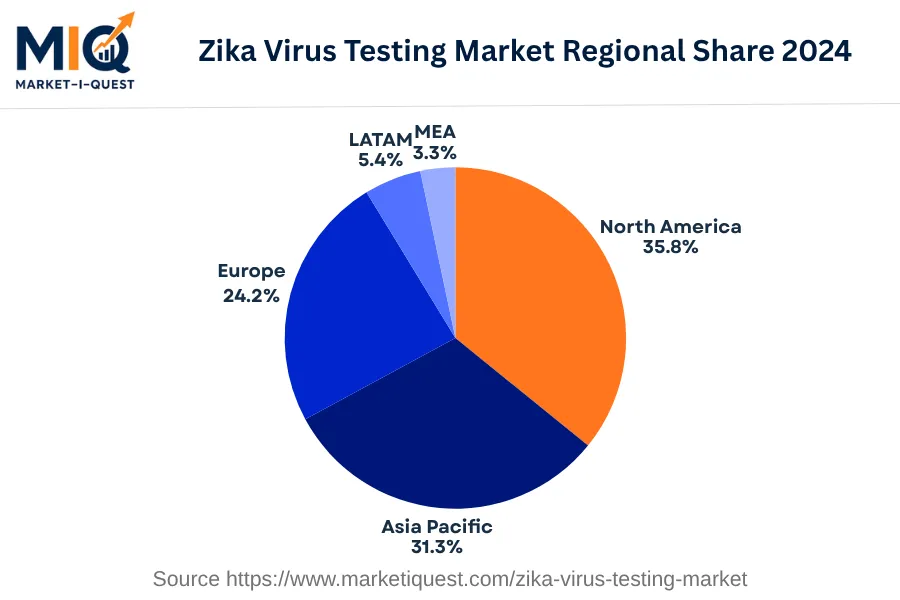
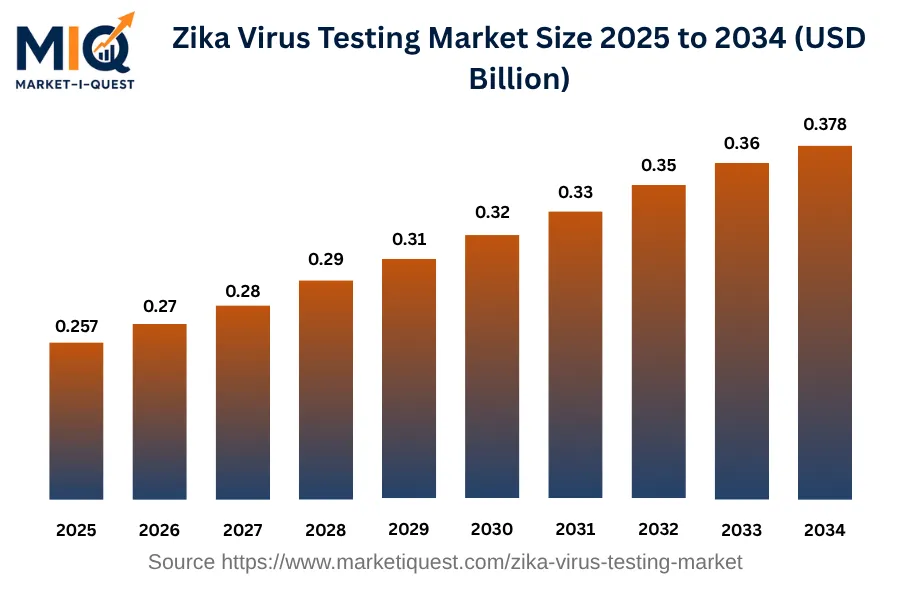
The Zika Virus Testing Market was valued at USD 0.26 billion in 2025 and is estimated to reach a value of USD 0.38 billion by 2034, growing at a CAGR of 4.4%. The growth trajectory witnessed an upsurge from the 2024 valuation of USD 0.25 billion, demonstrating a steady rise in market appeal. The growth in the Zika Virus Testing Market is primarily due to the increased prevalence of Zika virus infections and a rise in strategic initiatives towards better diagnostics. In an analysis of regional market shares in 2024, North America held 35.8% of the market, followed closely by Asia Pacific at 31.3%. Europe claimed a slightly lower proportion of 24.2%, while LATAM and MEA held smaller shares at 5.4% and 3.3%, respectively.

Key Takeaways

  • By Test Type - Molecular Testing led the market accounting for a significant share in the base year.
  • By Application - Clinical Testing held the largest portion dominating the base year.
  • By End User - Hospitals and Clinics held the major share in the base year.
zika-virus-testing-market market size

Key Driving Factors

Rising International Travel

The increase in international travel, especially to and from Zika virus-prone regions such as South and Central America, is driving the Zika virus testing market. As traveling becomes more frequent and accessible, the risk of spreading infectious diseases like the Zika virus escalates. To mitigate these risks, more individuals are getting tested before and after their journeys, contributing to the growth of the Zika virus testing market. In specific, travel agencies and airlines are implementing regulations that require passengers to provide health status, including testing for infectious diseases. This trend forces a scale-up of routine screenings, posing an absolute necessity for reliable and efficient Zika virus testing.

Government Regulations and Policies

Government policies focusing on public health are also contributing to the expansion of the Zika virus testing market. Governments worldwide, especially in regions with high incidences of the Zika virus, impose policies that necessitate early detection and reporting of this condition. This regulatory framework is aimed at controlling the spread of the infection and managing the disease effectively once identified. As a result, more healthcare institutions and laboratories are offering Zika virus testing, supporting market growth. Further, government funding in healthcare infrastructure also propagates comprehensive and affordable testing, making the procedure more accessible to a wider population.

Market Evolution by Timeline

2019-2023
During this time, primary demand for Zika Virus Testing predominated from public health departments, private medical practitioners and diagnostic laboratories, mainly in regions like South America, Central America and the Southern US states. Point-of-care test kits introduced by manufacturers increased accessibility. However, high production costs resulted into high prices reducing accessibility in low-income regions. The lack of a universal Zika virus testing standard caused confusion and hindered adoption. In response, the World Health Organization issued guidance on Zika virus testing options in 2019. Unavailability of a gold standard assay for Zika virus testing posed major challenge.
2024
In this year, the Zika virus testing market was still led by South and Central American countries, and the US. Advances in testing technology occurs, including the development of molecular tests providing rapid results within four hours. However, these tests tended to have high prices due to the development costs. Governments across affected regions started to allocate more public funds, following international calls led by the WHO to increase the global biosecurity. Uncertainty about the specificity of serological tests remained unresolved.
2025-2029
Increased adoption of rapid diagnostics tests shaped the market dynamics in this period. In response to the continued Zika threat, governments in affected regions boosted research funding. This, alongside collaboration between biotech companies, resulted in reduction of prices for Zika virus tests. However, the market faced other challenges like the comparable symptoms of Zika with other diseases, which led to misdiagnoses thereby underutilizing the testing capacity. To mitigate this, diagnostic laboratories, began adopting multiplex tests capable of identifying various pathogens simultaneously.
2030-2034
The Zika Virus Testing Market continued experiencing demand shifts towards rapid diagnostic tests. Private practitioners across the world started incorporating Zika testing as part of routine checkups for pregnant women, owing to the associated birth defects. Widespread use of multiplex tests and advanced molecular tests like RT-PCR tests became common. Further research funding sparked the development of more cost-effective and accurate tests, leading to moderately falling prices. As the global health community garnered more understanding of the Zika virus, WHOs guidance on Zika virus testing became more refined.

Future Market Outlook

Future Opportunities

Opportunities in the Zika virus testing market are expanding due to evolving public health priorities and regulatory frameworks. The Global Health Security Agenda, initiated in 2014, includes emerging infectious diseases like Zika, which will enhance funding and resources for testing infrastructure in vulnerable regions. Partnerships between health organizations and tech firms, such as those formed in 2023 between the CDC and private biotech companies, are paving the way for the development of point-of-care testing solutions that can be deployed in remote areas. The increasing demand for at-home testing kits reflects a shift in consumer preferences for more accessible health solutions, as seen in trial partnerships by companies like Scanwell Health. Additionally, there is a growing call for expanded surveillance programs to monitor Zika virus trends, as emphasized by recent frameworks set by the CDC in the Americas, suggesting that regulatory focus will intensify. Collaborations to integrate artificial intelligence into diagnostic processes are being explored, potentially transforming data analysis in real-time scenarios. Collectively, these developments indicate that the market landscape for Zika virus testing will likely adapt significantly as health stakeholders prioritize agility, accessibility, and accuracy in public health systems.

Segmentation Analysis

By Test Type

The market is divided into subsegments including Molecular Testing and Serological Testing. Molecular Testing accounted for the largest revenue share while Serological Testing is expected to grow at the fastest CAGR during the forecast period.

Largest Revenue Share

Molecular Testing

Market Share Leader

It's no surprise that Molecular Testing leads in revenue generation. This can be ascribed to its widespread usage for diagnosis due to its higher sensitivity and specificity when compared with other testing types. Moreover, the advancement of technologies in molecular diagnostics and the availability of a diverse range of tests catering to numerous clinical conditions have helped to maintain the dominance of this subsegment. Further, with increasing health consciousness, many individuals are opting for routine check-ups that often include these tests, aiding the adoption of Molecular Testing even further. It's important to note the governmental influence too. Regulatory authorities worldwide have provided favorable guidelines and frameworks concerning Molecular Testing, underlining its credibility and thereby driving its acceptance in the market. Lastly, the well-established distribution channels of Molecular Testing kits add to their convenience and accessibility, preserving their significant revenue share.

Fastest CAGR

Serological Testing

Forecast Period Growth Leader

Expected to grow at the fastest CAGR, Serological Testing's growth is driven by a number of factors. It's worth noting that these tests are often less expensive and less complex than molecular tests, making them attractive to healthcare systems in emerging markets. Further, technological advancements have led to the development of novel tests with enhanced accuracy and efficiency, catalyzing their adoption. The ongoing COVID-19 pandemic has also demonstrated the usefulness of serological tests for identifying past infections, leading to more widespread adoption. However, there are barriers to adoption, such as concerns around the accuracy of test results and regulatory hurdles. Near-term risks include potential changes in policy or funding that could impact the provision of these tests. In spite of the risks, partnerships between companies developing serological tests and those with distribution networks, or facilities capable of large-scale test administration could further amplify growth in this subsegment.

By Application

The market, segmented by application, is divided into subsegments including Clinical Testing, Blood Screening, and Others. Among these, Clinical Testing weighed in with the largest revenue share, while Blood Screening is projected to expand at the fastest CAGR during the forecast period.

Largest Revenue Share

Clinical Testing

Market Share Leader

Clinical Testing holds the lion's share in terms of revenue in the base year 2024, and there are several factors behind this dominance. First and foremost, the increasing prevalence of chronic diseases, ongoing medical research, and the continuous quest for early disease detection all contribute to the extensive utilization of clinical testing. Furthermore, the growing global population, coupled with the rising awareness about disease prevention and treatment among individuals, especially in developing economies, has led to an upsurge in demand for clinical testing services. In addition, healthcare regulatory bodies worldwide are increasingly promoting the use of clinical tests for timely diagnosis, contributing to its substantial market share. The advent of advanced technologies in diagnostic procedures and their incremental adoption in the clinical testing realm also bolsters the segment's revenue. Lastly, well-established supply chains and vast consumer reach enhance the purchasing accessibility of these tests, thereby augmenting its overall revenue contribution.

Fastest CAGR

Blood Screening

Forecast Period Growth Leader

The Blood Screening subsegment is expected to achieve the fastest growth rate, driven primarily by the elevating need for blood transfusions and donations globally. Adopting efficient blood screening procedures is crucial for verifying donor blood for potential infectious diseases, thus ensuring safe transfusion and reducing transfusion-transmitted infections. Moreover, advancements in blood screening technologies and their growing incorporation in healthcare facilities serve as powerful growth catalysts. Regulatory approvals and supportive policies have also endorsed the adoption of these screening methods, promoting market growth. However, high capital expenditure and potential supply chain disruptions pose near-term risks. Hence, the expansion of partnerships across the value chain, combined with investment in developing cost-effective screening technologies, are vital for charting growth in this segment.

By End User

The market is divided into subsegments including hospitals and clinics, diagnostic laboratories, blood banks and others. Amidst these, hospitals and clinics accounted for the largest revenue share while diagnostic laboratories are expected to grow at the fastest CAGR during the forecast period.

Largest Revenue Share

Hospitals and Clinics

Market Share Leader

In the base year 2024, hospitals and clinics represented the segment with the greatest revenue. This can be attributed to a variety of factors. Hospitals and clinics typically have higher patient influx compared to other end users fragments due to the broad range of services they provide, which span virtually all areas of healthcare. A significant percentage of diagnosis and treatment procedures are performed within these settings, leading to a higher demand for services therein. Additionally, in many geographies, hospitals and clinics are the primary healthcare providers, especially in regions where private healthcare facilities are less prevalent. This helps create a steady stream of revenue. Furthermore, due to their critical role in healthcare delivery, hospitals and clinics benefit from various government regulations and policies promoting healthcare access and financing, which indirectly contribute to their revenue generation.

Fastest CAGR

Diagnostic Laboratories

Forecast Period Growth Leader

Although hospitals and clinics currently generate the most revenue, diagnostic laboratories are projected to grow at the fastest CAGR during the forecast period. The growth in this subsegment is driven by the increasing demand for early and precise disease diagnosis, advances in diagnostic technologies, and rising awareness about preventive healthcare. Diagnostic laboratories play a critical role in supporting healthcare providers with the clinical decision-making process through accurate identification and measurement of various health indices. Advancements in technology have led to the development of next-generation sequencing, advanced molecular diagnostics, and automation of laboratory processes, further enhancing the efficiency and accuracy of diagnosis. In addition, an aging population, the proliferation of chronic diseases, and a growing emphasis on preventive healthcare have fueled the demand for advanced diagnostic solutions. However, implementation complexities, high capital expenditure, and regulatory challenges could pose as potential growth barriers.

Competitive Analysis

Key Market Players

Manufacturers / OEMs

Alere Inc.
US
Roche Diagnostics
Switzerland
Siemens Healthineers
Germany

Key Suppliers & Raw Materials

Thermo Fisher Scientific
US
Bio-Rad Laboratories
US
Merck KGaA
Germany

Distributors, Integrators & Channel Partners

Abbott Laboratories
US
Quidel Corporation
US
Luminex Corporation
US

Porter’s Five Forces Analysis

This analysis assesses the competitive dynamics of the Zika Virus Testing Market.

Supplier Bargaining Power

Medium

Suppliers are chemical reagent and assay providers with a moderate level of influence.

Buyer Bargaining Power

Low

Buyers like hospitals and testing labs, have limited choice due to stringent regulatory compliances.

Threat of Substitutes

Low

Few alternative testing solutions exist due to scientific and regulatory constraints.

Threat of New Entrants

Medium

Scientific advancements lower entry barriers, but regulatory compliance and reputational hurdles remain.

Competitive Rivalry

High

Several major players exist, driving significant competition and innovation in the testing market.

Regional Analysis

Geographic market dynamics and growth opportunities across key regions

Global Market Outlook

zika-virus-testing-market market regional share

North America

In 2024, the Zika virus testing market in North America, including the U.S., Canada, and Mexico, experienced several significant changes. Driven by heightened public health awareness and government initiatives, demand for Zika virus testing became more prominent. Reflecting this, increased investment in healthcare infrastructure and an upswing in research funding occurred, enhancing diagnostic capabilities and testing capacity. Advancements in technology also played a significant role; the adoption of more precise and faster diagnostic tests, particularly in remote areas, increased accessibility and accuracy. This was complemented by economic influences, as ongoing pricing strategies attempted to balance cost-efficiency and product quality.

Trends in 2024 showed a shift towards more automated and AI-driven testing equipment, fuelling changes in buyer behavior, especially within the healthcare sector. Changes in disease patterns propelled institutions to update their testing kits regularly, influencing manufacturing trends. Strategic partnerships between diagnostic companies and healthcare providers gained momentum, aiming at facilitating the swift distribution of testing kits to needed areas. Moreover, policy enforcement for standardized testing protocols to ensure reliable results emerged as a vital concern, particularly in the U.S. and Canada. The necessity for routine screening among pregnant women significantly impacted the retail sector, leading to a rise in over-the-counter testing options. These market drivers and trends underlined North America's Zika virus testing landscape in 2024.
Asia Pacific

In 2024, the Zika Virus Testing Market in the Asia Pacific region witnessed significant growth as a result of rising health consciousness and advancements in diagnostic technology. Key drivers included heightened awareness of the virus, particularly in India and China. China adopted stricter regulations around infectious diseases, increasing the demand for point-of-care testing kits. Investment in research and development for advanced serological and molecular diagnostic tests was prevalent in Japan and South Korea, influenced by substantial government funding. Moreover, Australia’s strong health infrastructure supported this growth, with cost-effective testing solutions driving affordability.

Trends within the region included the preference for rapid testing kits, particularly in ASEAN markets such as Indonesia and Vietnam, due to their increased efficiency and accuracy. South Korea witnessed a surge in online diagnostic services, as consumers shifted toward remote healthcare. Partnerships between local testing firms and international healthcare companies, especially noticeable in India, enhanced their market visibility and technical capacity. As countries like China enforced stringent quality standards, there was a consequential rise in CE-marked products. Furthermore, Australian policy on obligatory Zika testing for blood donors echoed across the region, driving market demand. Across healthcare and government sectors, the comprehensiveness and affordability made these tests an instrumental tool in public health campaigns against the Zika virus.

Europe

In 2024, the Zika virus testing market in Europe demonstrated robust growth, primarily driven by an increased prevalence of Zika virus infections along with enhanced awareness and preventative initiatives from major countries. A surge in government investment, particularly in healthcare infrastructure and disease surveillance across Germany, France, UK, Italy, Spain, the Nordics, Benelux, and Central & Eastern Europe significantly heightened the demand for rapid and effective diagnostic tools. A growing trend towards the early detection of the disease due to potential health risks to pregnant women also acted as a critical driver in market expansion.

The year saw a major shift towards the adoption of advanced diagnostic technologies such as PCR (Polymerase Chain Reaction) and ELISA (Enzyme-linked Immunosorbent Assay), spurred by the healthcare sector’s eagerness to improve diagnostic time efficiency and accuracy. The trend of increased collaborations and acquisitions strengthened market competitiveness and widened the access to Zika testing across various sectors such as government healthcare authorities, private diagnostic labs, and hospitals. Enforcement of stringent quality standards and regulations by European Union for Zika testing products ensured high quality and reliability. These policies, along with the amplified need for Zika testing, shaped the growth of the market in Europe in 2024.

Latin America

In 2024, the Zika Virus Testing Market in Latin America witnesses a boost, primarily dominated by countries like Brazil, Mexico, Argentina, Colombia, Chile, and Peru. As governments increase investment in healthcare infrastructure due to increased cases of Zika virus, demand for diagnostic kits escalates, driving market growth. Technological advancements in rapid testing kits also fuel the market as they ensure timely diagnosis. Additionally, intensive training programs accompanied by guidelines from the World Health Organization (WHO) upgrade skillsets of laboratory technicians, promoting more insightful diagnostic expertise.

A pivotal trend remains evident in consumer behavior, as increased awareness about the virus and its consequences promotes preventive check-ups, leading to increased product demand. Product development shows a shift towards affordable rapid testing kits to cater to the economically underprivileged who often reside in mosquito-prone regions. Channel dynamics in 2024 underline the significant role played by public health laboratories in conducting Zika Virus tests. Moreover, partnerships between government bodies and diagnostic companies enable wider kit dissemination. Views on protocol enforcement, adhered to strictly by healthcare bodies, persist as a critical trend, lifting the overall service quality in Zika Virus Testing across Latin America. Consequently, healthcare becomes the most notably impacted sector in 2024.

Middle East & Africa

In 2024, the Zika Virus Testing Market in the Middle East and Africa witnessed significant dynamics. Key drivers included mounting demand due to increasing incidences of the Zika virus, particularly in Egypt and South Africa, and stringent government regulations pushing for extensive virus screening in Saudi Arabia and the UAE. Technological adoption further spurred the market, with advanced molecular diagnostics becoming a standard for Zika virus testing in Israel and South Africa. Drop in the testing kit prices, prompted by heightened competition among suppliers, also played a substantial role in market expansion.

In terms of trends, buyer behavior leaned towards non-invasive testing methods, predominantly in the UAE and Qatar due to their advanced healthcare infrastructure. A noticeable shift towards Rapid IgM/IgG Zika Tests was observed, offering faster, accurate results. Healthcare sectors in Kenya and Nigeria continuously integrated portable point-of-care (POC) tests mainly in rural areas. On the policy-enforcement front, countries like Saudi Arabia, Israel enforced strict policies to contain the virus spread, including mandatory testing for pregnant women and travellers from Zika-prevalent regions. A significant M&A trend was observed with Nigeria’s leading diagnostics firm, partnering with a global molecular diagnostics company to expand its Zika testing capabilities. These drivers and trends shaped the characteristics of the Zika Virus Testing Market in Middle East and Africa in 2024.

Recent Industry Developments

Latest market innovations, product launches, and strategic initiatives

November 2025

Thermo Fisher Scientific released a portable diagnostic device designed specifically for rural environments. This tool allows medical staff to process patient samples on the spot rather than shipping them to a distant lab, drastically reducing the time it takes to contain an outbreak.

September 2025

Roche launched a single testing kit that screens for Zika and several other mosquito-borne viruses at the exact same time. Because symptoms for these diseases look identical, this combined test prevents hospitals from having to run multiple separate blood draws on a single patient.

May 2025

The FDA finalized new classification rules for how Zika blood tests are regulated. This legal update removed significant red tape for manufacturers, allowing new diagnostic tools to reach the commercial market much faster.

Frequently Asked Questions