X-Ray Detectors Market Snapshot

Key Players

  • Varex Imaging Corporation (United States)
  • Fujifilm Holdings Corporation (Japan)
  • Teledyne Technologies Incorporated (United States)
  • Canon Inc. (Japan)
  • Hamamatsu Photonics (Japan)
  • Thales Group (France)
  • Koninklijke Philips N.V. (Netherlands)
  • Analogic Corporation (United States)
  • Rigaku Corporation (Japan)
  • PerkinElmer Inc. (United States)

Market Size

Base Year 2024
$3.28 Bn
CAGR
6.75%
Forecast 2034
$6.30 Bn

Market Segments

By Type
Flat Panel Detectors, Line-Scan Detectors, Others
By Panel Size
Large-Area Detectors, Medium-Area Detectors, Small-Area Detectors
By Portability
Fixed Detectors, Portable Detectors
By Application
Medical Imaging, Dental Imaging, Others
By End User
Hospitals, Specialty Clinics, Others

Market Dynamics

Drivers
  • Rising prevalence of diseases
  • Technological advancements in detectors
Restraints
  • High equipment costs
  • Safety regulations compliance
Opportunities
  • Technological advancements
  • Increased healthcare expenditure

Market Size

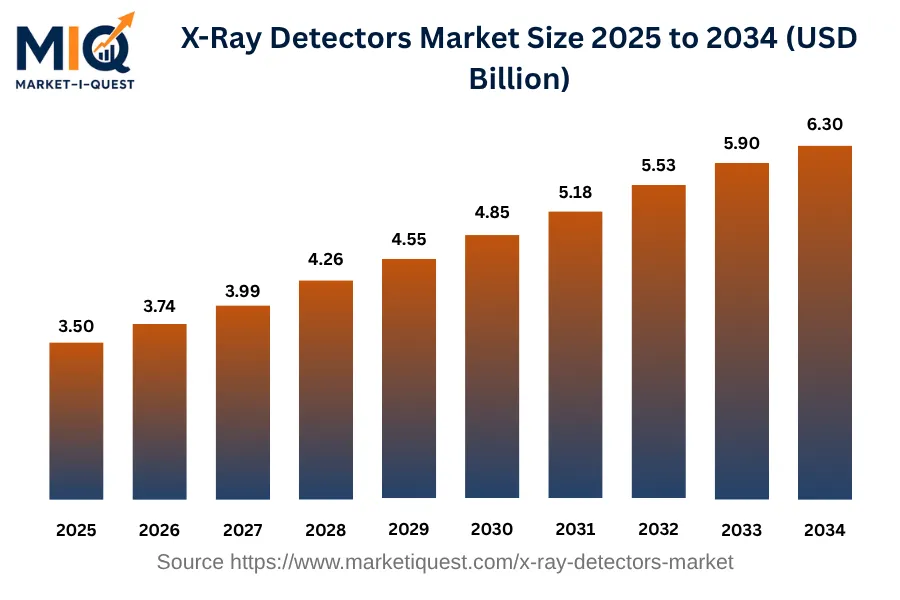
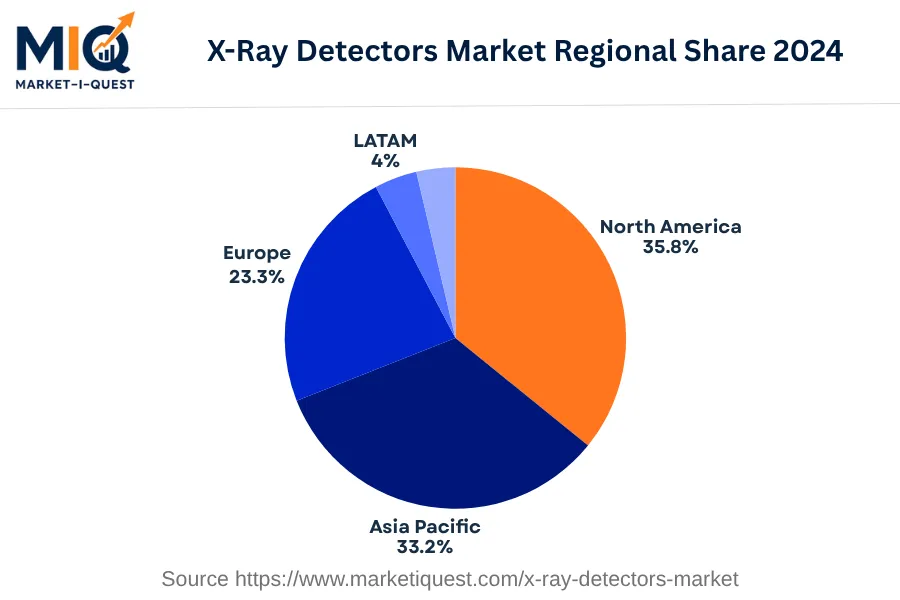
The X-Ray Detectors Market size is projected at $3.50 Billion in 2025, and is expected to reach $6.30 Billion in 2034, growing at a Compound Annual Growth Rate (CAGR) of 6.75%. This growth trajectory indicates a steady rise in the value of the X-Ray Detectors Market, almost doubling from its 2024 size of $3.28 Billion to its projected size in 2034. Regionally, there is a diverse mix in the market share with North America leading the pack at 35.84% in 2024, followed by Asia Pacific at 33.17%. Europe comes next with a still significant 23.28% of the market share, while LATAM and MEA register comparatively smaller shares at 4.03% and 3.68% respectively.

Key Takeaways

  • By Type - Flat Panel Detectors led the segment holding a significant market share.
  • By Panel Size - Large-Area Detectors led the segment highlighting notable growth.
  • By Portability - Fixed Detectors held the leading position in terms of adoption and use.
  • By Application - Medical Imaging dominated the Application segment accounting for the major share.
  • By End User - Hospitals as the most significant contributor in the market.
x-ray-detectors-market market size

Key Driving Factors

Shift Towards Digital Imaging in Medical Diagnosis

A major driving factor for the X-ray detectors market is the global shift towards digital imaging in the field of medical diagnosis. Digital imaging facilitates immediate processing, high image resolution, and delivery of diagnostic reports to remote areas, thereby reducing processing time and improving patient care. Moreover, it offers pictures that are more detailed and clear compared to analog imaging, improving accuracy in diagnosis. Healthcare providers are increasingly adopting digital imaging techniques, significantly fuelling the demand for modern, high-quality X-ray detectors in hospitals and clinics across the globe.

Heightened Security Measures at Public Spaces

Another significant factor driving the X-ray detectors market is the heightened security measures being implemented at public spaces, such as airports, railway stations, and institutional buildings. In order to maintain high security standards and to prevent prohibited items from passing through, security bodies are investing in advanced detection devices equipped with high-resolution X-ray detectors. These detectors are capable of effectively identifying suspicious items, helping to prevent potential threats. The increase in security concerns around the world, therefore, contributes directly to the growing need for X-ray detectors for safety and security applications.

Market Evolution by Timeline

2019-2023
During 2019–2023, the X-Ray Detectors market saw interest from medical imaging and industries employing security scanning. Despite large demand from North America and Europe, Asia was emerging as a significant buyer. Portable Detectors gained traction as they added convenience for medical professionals in point-of-care testing. Integrated solutions with software compatibility were pivotal for optimized performance, a trend noted in the value chain. Regulatory norms such as the reform of the EU Medical Device Regulation in Europe influenced the market towards increased product quality and efficacy. Flat pricing models were predominant during this period. The primary risk was under-production and supply chain constraints due to higher-quality, higher-cost products.
2024
In 2024, dental clinics led the demand due to a rising focus on oral health. With strong demand in developed regions, Africa was also recording substantial growth. Mobile detectors were on the increase, while the US Affordable Care Act impacted adoption rates. Technological constraints remained around chip integration and sensitivity. Improved supply chain integration allowed for more efficient assembly and distribution. The UN Millennium Development Goals influenced industry policies to create lower cost detectors for developing nations. Contract-based partnerships became popular. Counterfeit devices posed a significant risk, prompting stricter regulatory enforcement.
2025-2029
From 2025–2029, industrial applications were growing, using X-ray detection for quality control and fault detection. Demand shifted towards direct flat-panel detectors due to increased digital capabilities and improved resolution. Asia-Pacific region emerged as the leading buyer, backed by manufacturing sector growth. Technological advances, especially in wireless connectivity and AI, facilitated remote monitoring. Flexible pricing models based on feature offerings became wide-spread. Regulatory changes, such as the US FDA's push for increased patient safety, probable influence on the X-ray detectors market. Surging e-commerce sales indicated a shift from traditional sales channels. Potential trade and tariff risks grew due to growing geopolitical tensions.
2030-2034
During 2030–2034, veterinary medicine became a significant buyer segment for X-Ray Detectors to diagnose animal disorders. Demand for high-resolution devices increased due to the need for detailed diagnosis. Countries like India and China saw an increased demand backed by economic growth and improved healthcare facilities. A constraint was the restricted production of rare earth metals, crucial for sensor technology. Market players responded by exploring alternative materials. Quantum detectors were being tested, which could revolutionize the industry. In the commercial side, annual subscription models surfaced for SaaS. Notable risk was the competition from MRI and CT technologists providing radiation-free techniques.

Future Market Outlook

Future Opportunities

Future opportunities in the X-ray detector market are closely tied to the ongoing evolution of healthcare delivery models. As healthcare systems in regions like North America and Europe prioritize telemedicine and remote diagnostics, the demand for portable X-ray detectors is set to rise. Strategic partnerships, such as the collaboration between Fujifilm and Imprivata announced in 2023, indicate a trend toward enhancing security in digital imaging and protecting patient data. Organizations are increasingly adopting cloud-based solutions, enabling better data access and storage, which can facilitate remote consultations. Additionally, the impact of regulatory changes, such as the FDA’s encouragement of innovative imaging techniques, paves the way for early adoption of advanced detector technologies in clinical settings. Countries like India are focusing on enhancing their healthcare infrastructure, creating a fertile ground for the introduction of mobile X-ray units that can serve underserved populations. Furthermore, integration of machine learning algorithms in the X-ray analysis process is generating interest for its potential to reduce diagnostic errors. Companies are exploring the manufacturability of detector materials like cadmium telluride and organic semiconductors, which offer enhanced sensitivity. Overall, the interplay of healthcare policy, technological integration, and the move towards accessible medical imaging will shape strategic initiatives, presenting exciting opportunities for manufacturers and healthcare providers alike.

Segmentation Analysis

By Type

The market is divided into subsegments including Flat Panel Detectors, Line-Scan Detectors, and Others, with Panel Detectors accounting for the largest revenue share, while Line-Scan Detectors are expected to grow at the fastest CAGR during the forecast period.

Largest Revenue Share

Flat Panel Detectors

Market Share Leader

The Flat Panel Detectors subsegment is leading the market share owing to various factors. Featuring higher sensitivity and providing superior image quality, these devices have been a preferred choice of many sectors like health care, security screenings, and industrial applications. The advancement in digital imaging technology also adds to their expanding usability. This adaptability expands the customer base for Flat Panel Detectors, ensuring a steady stream of revenue. Additionally, their use in different geographies is driven by the need for increased efficiency and precision in sectors like medical diagnostics and industrial monitoring. Regulatory norms have also played a role in promoting the extensive use of Flat Panel Detectors, as they have safety standards and guidelines that the sectors using these devices must adhere to. Purchasing criteria for these detectors generally consist of quality, sensitivity, durability and applicability which this segment fulfils effectively. Indeed, the switching costs to alternative technologies are very high since industries are already adapted to this familiar technology, making them the highest revenue earner in this market.

Fastest CAGR

Line-Scan Detectors

Forecast Period Growth Leader

The Line-Scan Detectors are projected as the fastest-growing subsegment. Facilitating high-speed processing and the ability to handle a large line of vision, they are ideal for fast robotics and automated sorting applications. Dynamic applications in various industries, including food processing, logistics, pharmaceuticals, and electronics, are driving their rapid adoption. A significant impetus is provided by the continuous technological advancements and innovation in sensor technology, stimulating growth in this segment. Strategic partnerships and collaborations between major manufacturers have also expedited the development and implementation of Line-Scan Detectors. However, the initial CapEx for adopting these detectors remains high, posing a significant barrier to their adoption. Yet, initiatives to overcome such barriers are underway, including collaborations that focus on cost-effectiveness and flexible payment models. While these detectors show immense growth potential, near-term risks such as the challenge of integrating these detectors into existing systems and managing maintenance could affect the growth rate. Regardless, with the aforementioned catalysts, Line-Scan Detectors are expected to have the fastest growth rate in the market.

By Panel Size

The market is divided into subsegments including Large-Area Detectors, Medium-Area Detectors, and Small-Area Detectors. Large-Area Detectors holds the majority of the market share in terms of revenue, while Small-Area Detectors is expected to grow the fastest in the coming years.

Largest Revenue Share

Large-Area Detectors

Market Share Leader

Large-Area Detectors generate the highest revenue within the panel size market mostly due to their extensive application in various industries such as nuclear medicine, non-destructive testing, security screening and astrophysics. These sectors require large detectors for advanced scanning and imaging purposes where precision is paramount. Industrial users prefer to use these detectors, despite the high initial investment, as their potential for high-resolution outputs is instrumental in preventing major catastrophic events or high-cost operational errors. Geo-graphically, demand from developed regions with established industries like North America, Europe fuels the adoption — regulatory mandates in these regions often necessitating the use of advanced detectors for safety concerns. The core purchasing criteria are accuracy and precision, which tend to hold even above cost considerations. Their differentiated offering and unique advantages create high switching costs for users, which strengthens their revenue position.

Fastest CAGR

Small-Area Detectors

Forecast Period Growth Leader

The Small-Area Detectors segment is expected to show the fastest compound annual growth rate. Their rapid adoption is driven by their increased flexibility, ease of integration, lower costs, and significant technological advancements. Although traditionally these detectors faced adoption barriers due to lesser precision, technological advancements and improvements have served as catalysts to boost their uptake. Increased application in sectors such as medicine for detailed imaging and diagnosis, industrial quality control, and security systems are propelling their growth. Reduction in capital expenditure due to their smaller size and lower costs are driving small and medium enterprises towards its adoption. Moreover, strategic partnerships among the players to enhance the technological capabilities are keeping the momentum for the segment. However, potential short-term risks include market acceptance of the advanced technology and economic fluctuations that may impact the overall capital expenditure of potential clients.

By Portability

The market is divided into subsegments including Fixed Detectors and Portable Detectors. In 2024, Fixed Detectors accounted for the largest revenue share while Portable Detectors is expected to grow at the fastest CAGR during the forecast period.

Largest Revenue Share

Fixed Detectors

Market Share Leader

Fixed Detectors emerged as the subsegment with the largest revenue in 2024. This could likely be attributed to their widespread application across a host of sectors including manufacturing, oil & gas, and transport logistics where constant monitoring is required. High-volume sectors whose operations rely on consistent and automated safety measures, prefer fixed detectors. Permanently installed at various locations on site, they provide constant environmental screening contributing substantially to workplace safety. They typically offer lower costs over their product life cycle due to fewer replacement requirements and long operational lifespan. Moreover, advancements in fixed detectors have expanded their capabilities to detect multiple types of gases further improving their value proposition and thus, boosting their uptake. Fixed detectors' compliance with stringent safety regulations further enhances their demand. Their high upfront costs are often justified by their long-term benefits, driving their adoption in numerous industries.

Fastest CAGR

Portable Detectors

Forecast Period Growth Leader

Although Fixed Detectors hold the largest market share, Portable Detectors are expected to register the highest growth rate during the forecast period. This growth is driven by their flexibility and portability, allowing safety personnel, inspectors, and engineers to carry these devices around and use them to detect hazardous gases in any area rather than relying on fixed installation points. Portable Detectors are particularly valuable in the dynamic and complex environmental conditions that exist in industries such as construction, emergency services, and high-risk, confined spaces, such as mining where workers tend to be mobile. The rapid development of sensor technology and the increasing use of IoT in industrial applications are further expected to fuel the demand for these devices due to their improved precision, real-time detection capabilities, and facilitated data analytics. However, the high cost of these advanced detectors and the need for regular maintenance and calibration could pose as potential hurdles to their rapid adoption.

By Application

The market is divided into subsegments including Medical Imaging, Dental Imaging, and Others. Medical Imaging accounted for the largest revenue share while Dental Imaging is expected to grow at the fastest CAGR during the forecast period.

Largest Revenue Share

Medical Imaging

Market Share Leader

Medical Imaging dominates the market due to its wide variety of applications and extensive use in the healthcare industry. Medical imaging is a powerful tool used by healthcare professionals to visualize internal body structures and scrutinize an array of complex diseases. The rise of chronic conditions such as cancer, cardiac disorders, and neurological disorders has further surged the demand for diagnostic accuracy and early detection, resulting in increased reliance on medical imaging. The significant technological advancements in the field have also been key drivers, with innovations like 3D and 4D imaging providing highly detailed information to physicians, thus improving diagnosis accuracy. Regulatory bodies' increasing support, coupled with the expansion of healthcare infrastructure globally, has contributed to this segment's large revenue share. Furthermore, the widespread adoption of medical imaging, by both large hospitals and small diagnostic centers, is evidence of the increasing access to, and affordability of, these imaging devices across various geographies.

Fastest CAGR

Dental Imaging

Forecast Period Growth Leader

Dental Imaging is projected to grow at the fastest CAGR during the forecast period. Dental health is becoming a priority in majority of the households, leading to increased dental visits and regular screenings. This trend, coupled with the advancements in imaging techniques, has led to a higher adoption rate of dental imaging systems in both large and small-scale dental practices. Besides, the rising prevalence of dental disorders, such as tooth decay, periodontal diseases, and oral cancers, is a significant growth catalyst for this segment. Technological advancements have made dental imaging more efficient and accurate, further accelerating its adoption by dental professionals. The increasing popularity of digital imaging systems and the move away from traditional radiography has also stimulated growth in this sector. However, the high cost of advanced imaging systems and the lack of skilled professionals to operate these systems are barriers that could hinder growth. Government policies encouraging regular dental checkups and investments in dental health education would, no doubt, provide the impetus for growth in this segment.

By End User

The market is divided into subsegments including Hospitals, Specialty Clinics, and Others. Hospitals accounted for the largest revenue share while Specialty Clinics are expected to grow at the fastest CAGR during the forecast period.

Largest Revenue Share

Hospitals

Market Share Leader

Given their vital role in healthcare provision, hospitals tend to be the larger subsegment in revenue generation. This can be attributed to several factors. First and foremost, hospitals cater to a larger patient population due to their comprehensive service availability, implying a broader revenue stream. Secondly, the increasing prevalence of chronic illnesses requires ongoing extensive medical intervention, which hospitals can cater to more capably than clinics. Alongside this, higher investment capabilities of hospitals compared to the other segments enable the adoption of advanced technologies, expanding their service range and increasing their patient appeal. Furthermore, various government policies are geared toward improving hospital capabilities and capacities, strengthening their growth and revenue generation. However, it's important to note that these conclusions are made based on typical market structure, as hard data on revenues per segment is not provided.

Fastest CAGR

Specialty Clinics

Forecast Period Growth Leader

On the other end of the spectrum, Specialty Clinics are projected to register the highest growth rate in the market. This can be attributed to multiple reasons. Firstly, the rising trend of specialized health care is steering patients towards these clinics. Driven by an increasingly health-conscious population, the demand for specialized areas, e.g. dermatology, reproductive health, and orthopedics, have skyrocketed. Additionally, Specialty Clinics tend to have lower patient wait times due to their focused service, making them a more attractive option. Lastly, collaborative ventures and partnerships have also been catalysts in driving growth within this subsegment. Despite strong growth prospects, potential barriers to their expansion could stem from stricter regulations and high initial CapEx requirements. Sustainably overcoming these hurdles will thereby play a key role in ensuring continued growth within this subsegment.

Competitive Analysis for X-Ray Detectors Market

Key Market Players

Manufacturers / OEMs

Varian Medical Systems
US
Teledyne DALSA Inc.
Canada
Hamamatsu Photonics K.K.
Japan

Key Suppliers & Raw Materials

Thermo Fisher Scientific
US
Canon Inc.
Japan
Hologic, Inc.
US

Distributors, Integrators & Channel Partners

Agfa-Gevaert Group
Belgium
FUJIFILM Holdings Corporation
Japan
Siemens Healthineers
Germany

Porter’s Five Forces Analysis

The following is an analysis of the X-Ray Detectors Market using Porter’s Five Forces model.

Supplier Bargaining Power

Medium

Supplier power is moderate given the presence of a few major providers of key components.

Buyer Bargaining Power

Low

Buyer power is low due to the critical nature of x-ray detectors in medical and industrial applications.

Threat of Substitutes

Low

The threat of substitutes is low as the alternative technologies are still in early development stages.

Threat of New Entrants

Medium

Entry barriers are moderate, driven by substantial capital requirements and regulatory barriers.

Competitive Rivalry

High

Intense competition driven by major multinational companies investing heavily in R&D.

Regional Analysis

Geographic market dynamics and growth opportunities across key regions

Global Market Outlook

x-ray-detectors-market market regional share

North America

In 2024, the North American market witnessed robust growth, driven by factors like technological advancements, rising demand across healthcare, manufacturing and retail sector. Key drivers of this expansion include increased adoption of advanced technologies, such as flat-panel detectors, which offer improved image quality and lower radiation doses. Investment in research and development by market players for producing more efficient and cost-effective detectors has also fueled market growth. The implementation of strict safety regulations by North American governments, particularly in the U.S and Canada, mandated the use of X-ray detectors across different industries.

Emerging trends indicated a shift in buyer behavior towards portable, wireless X-ray detectors, predominantly in the healthcare and manufacturing sector for enhanced flexibility and accessibility. Agreements and partnerships among enterprises have gained momentum, with firms seeking to utilize synergies and deliver innovative solutions. The focus on integrating AI in X-ray detection systems is another notable trend, driven by the demand for improved accuracy and efficiency. Meanwhile, the adoption of strict policies on radiation exposure in workplaces has influenced product standards, leading to the development of detectors offering minimal radiation exposure.

Asia Pacific

In 2024, the X-Ray Detectors Market remained vibrant in the Asia Pacific region. Several drivers contributed to the market dynamism including significant investment in healthcare by governments and private institutions. This was particularly notable in economies like China and India, which saw a rise in public-private partnerships dedicated towards improving healthcare infrastructure. Technological adoption, crucially the shift towards digital X-Ray equipment especially across Australia and key ASEAN markets, further spiced up market dynamics, stimulating supply while impacting pricing models.

Phenomenal market trends are seen dominant in buyer behavior. There is a clear preference amongst healthcare providers for innovative, high-resolution imaging capabilities, promoting a shift towards advanced detectors. Additionally, strategic partnerships and consolidation were observed throughout Japan and South Korea an attempt by players to strengthen their market position. In the enterprise sector, increased regulations surrounding workplace safety in manufacturing hubs such as India and China accelerated demand for advanced X-Ray detectors for non-destructive testing.

Europe

In 2024, the market in Europe experienced significant growth driven by a range of factors. Market drivers included increasing healthcare expenditure in regions such as Germany and the United Kingdom, advancements in X-Ray technologies adopted by Italy and Spain and stricter regulations on radiation exposure implemented by the European Union. Increased investments in healthcare infrastructure, particularly in Central and Eastern Europe. The introduction of high-resolution digital detectors further boosted demand, contributing to favourable supply dynamics and competitive pricing models.

Underlying trends that shaped the market included shifts towards decentralisation of healthcare services and a strong demand for portable X-Ray detectors in home healthcare settings. There was an observed trend of large healthcare providers partnering with tech firms for the production of AI-powered X-Ray detectors, particularly in the Nordics and Benelux region. Furthermore, the enforcement of stricter radiation protection standards by governing bodies significantly influenced product development and customer demand. Key sectors driving the demand included enterprise-level healthcare providers, government-backed hospitals, and mobile healthcare services.

Latin America

In 2024, the Latin American (LATAM) X-Ray Detectors Market experienced significant changes due to both market drivers and evolving trends. Regulatory compliance and increased health expenditure were major drivers boosting demand. New national mandates required medical facilities to upgrade outdated radiographic equipment, resulting in increased investments in digital detectors by institutions across Brazil, Mexico, Argentina, Colombia, Chile, and Peru. Furthermore, with nations like Mexico allocating more budget towards healthcare, the accessibility and affordability of X-ray procedures were improved, positively affecting the market.

Prevailing trends revolved around technology adoption and modernization. Focus on high-end technology characterized buyer behavior across LATAM, with countries such as Brazil leading in the adoption of advanced flat panel detectors. Channel dynamics shifted towards online sales caused also by the pandemic’s long-lasting effects. Additionally, there was an increase in partnerships, especially in the healthcare and manufacturing sectors, aiming at optimizing radiology department workflows in hospitals. Examples comprise collaborations between big players and local enterprises seeking a broader market reach.

Middle East & Africa

In 2024, the X-Ray Detectors Market in the Middle East and Africa witnessed substantial growth due to several key drivers. Technological adoption surged as healthcare providers across Saudi Arabia, United Arab Emirates, Qatar, Egypt, to mention few, increasingly invested in advanced medical imaging technologies to improve diagnostic accuracy. Demand for energy-efficient and cost-effective X-ray detectors sharply increased in these regions, fueled by heightened focus on reducing healthcare costs. Regulatory support, especially in South Africa and Nigeria, also bolstered the market as policies aimed at promoting healthcare infrastructure development were implemented.

Several trends emerged during the year. Buyer behavior shifted towards digital X-ray detectors due to their superior image quality and reduced radiation exposure. An increase in strategic partnerships and acquisitions among major players, such as those seen in Israel's booming tech industry, underscored the market's competitive nature and the need for continual innovation. In terms of technology, the tilt was towards wireless detectors, with their ease of use and flexibility appealing to the healthcare and manufacturing sectors. Government initiatives in countries like Kenya also played a significant role in driving the adoption of such technologies. Notably, the market witnessed an increased demand from the oil and gas industry, where X-ray detectors are used for non-destructive testing applications.

Recent Industry Developments

Latest market innovations, product launches, and strategic initiatives

May 2026

Varex Imaging showcased its Pyxis Photon-Counting CT Detection Platform at European clinical conferences. This structural update to the imaging chain introduces proprietary Multi-Beam X-ray (MBX) technology, which replaces traditional mechanical gantry rotation with a solid-state detector panel array capable of processing single-photon energy distributions.

February 2025

KUBTEC officially announced the market launch of its PICASSO® Plus Specimen Radiography System. The system integrates high-resolution Amorphous Selenium Direct Capture Technology, a specialized direct-conversion X-ray detector infrastructure engineered to suppress light scatter and maximize spatial clarity for precision specimen imaging.

Frequently Asked Questions