Wireless Video Surveillance Market Snapshot

Key Players

  • Axis Communications (Sweden)
  • Honeywell International Inc. (United States)
  • Bosch Security Systems (Germany)
  • Dahua Technology Co. Ltd (China)
  • Johnson Controls (Ireland)
  • Avigilon (Canada)
  • FLIR Systems (United States)
  • Huawei Technologies Co. Ltd (China)
  • Tyco International (Ireland)
  • Uniview Technologies Co. Ltd (China)

Market Size

Base Year 2024
$31.86 Bn
CAGR
5.2%
Forecast 2034
$52.89 Bn

Market Segments

By Component
  • Cameras
  • Monitors
  • Storage Devices
  • Software
  • Accessories
By Deployment Type
  • Cloud-Based
  • On-Premise
By Application
  • Residential
  • Commercial
  • Industrial
  • Government

Market Dynamics

Drivers
  • Increased Security Concerns
  • Rapid Technological Advancements
Restraints
  • High installation costs
  • Data security concerns
Opportunities
  • Growing smart city initiatives
  • Advancements in surveillance technology

Market Size

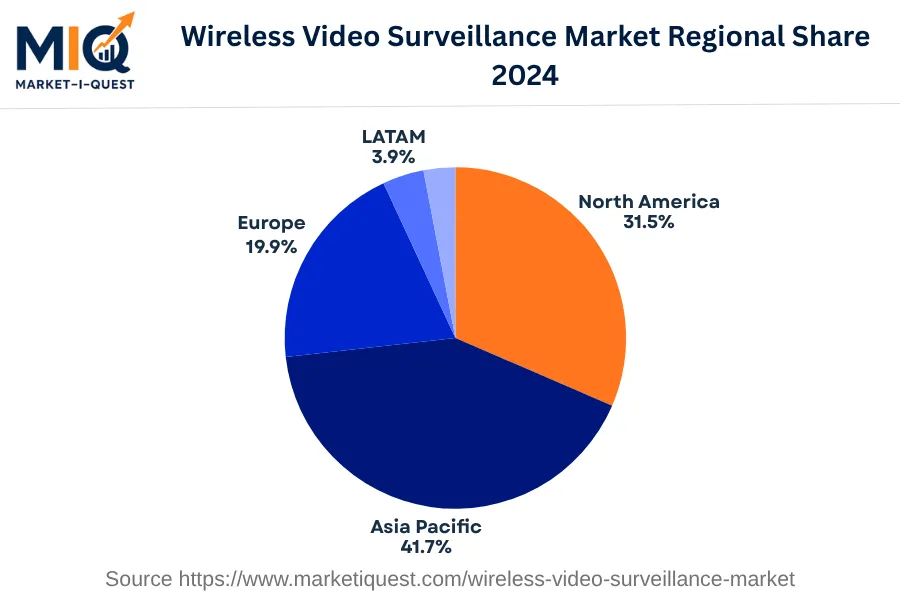
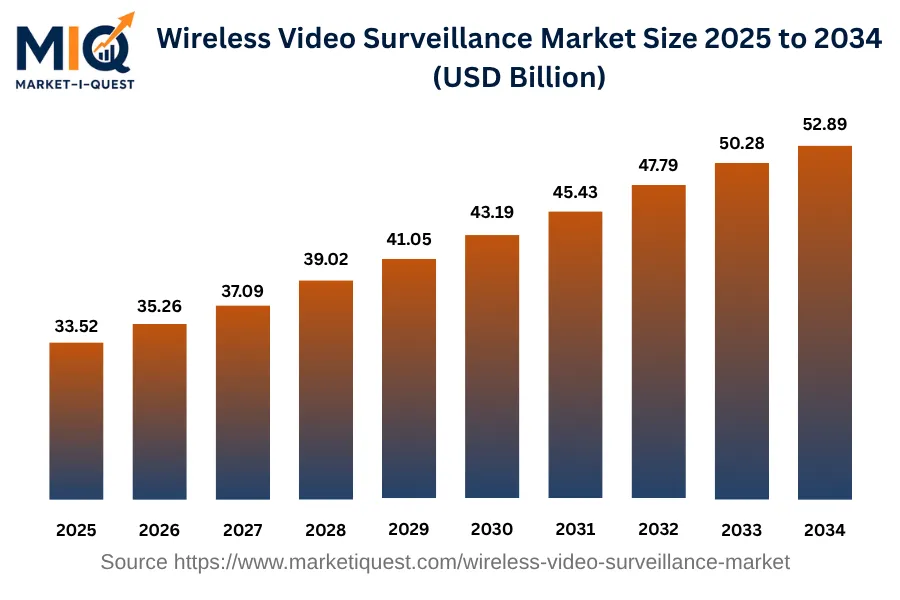
The Wireless Video Surveillance Market valued at $33.52 billion in 2025, and it is projected for expanding to $52.89 billion by 2034 with a CAGR of 5.2%. The market witnessed a rise from $31.86 billion in 2024 to the $33.52 billion in 2025, suggesting a progressively widening scope in the wireless video surveillance field. This consistent increase over the years can be integrated with the crucial demand for effective monitoring possibilities. In 2024, the regional market share was led by Asia Pacific with 41.7%, followed by North America with 31.5%. Europe held the third highest share with 19.9%, while Latin America and the Middle East & Africa (MEA) accounted for 3.9% and 3.0% respectively.

Key Takeaways

  • By Component - Cameras held a significant position accounting for the largest share.
  • By Deployment Type - On-Premises held a dominant position in the market by the base year.
  • By Application - Commercial sector led the segment by holding the largest share of the segment.
wireless-video-surveillance-market market size

Key Driving Factors

Enhanced Network Infrastructure

One of the major driving factors for the wireless video surveillance market is the rapid development in network infrastructure. In the current digital age, regional and global telecom operators are pursuing for enhancing their network capabilities with the goal of providing efficient and reliable services to consumers and businesses. This includes improving existing connections to fiber optics and promoting 5G networks. These improvements enable the way for high-speed, low-latency data transmission, which is integral for the operation of wireless video surveillance systems. This allows for real-time, high-quality video monitoring and analysis, boosting the usage.

Increasing Adoption by Law Enforcement and Security Agencies

The another driving factor is the increasing adoption of wireless video surveillance by law enforcement and security agencies. Agencies recognize the value of these systems in improving safety and ensuring law and order, as they can efficiently monitor public spaces and quickly respond to potential threats or incidents. For instance, municipalities globally have started introducing city surveillance projects using these systems. Similarly, business owners use them for securing their principles against theft or vandalism.

Market Evolution by Timeline

2019-2023
During this time, the market was dominated by consumer households and urban law enforcement. Rising security concerns in cities such as New York and London pushed the demand. Companies such as Arlo and Ring were offering the latest wireless surveillance technologies with improved integration. National Digital Strategy initiated by the UK government pushed the adoption further. Predominantly, the pricing was based on the subscription model and generally tied to cloud storage. Partnerships were common with internet service providers.
2024
In 2024, there was a substantial shift towards small and medium businesses. Companies were offering personalized solutions promoting the increased adoption in regions such as Asia and Africa. 5G networks became more common, offering an enhancement in bandwidth. The Personal Data Protection Bill in India affected the wireless video surveillance market due to stringent regulations. The business model shifted to bundled packages combining hardware, cloud services and AI-based analytics.
2025-2029
This period is expected to witness robust adoption in sectors such as education and healthcare. Geographical expansion will likely reach remote areas in countries such as Brazil and Russia. Advanced computing integration with surveillance technology to help data processing on the device in forecasted period. The General Data Protection Regulation (GDPR) compliance will likely be mandatory across Europe. Vendors will likely introduce innovative strategies such a hybrid of subscription and license-based models. IoT device manufacturers are expected to come into partnership with video surveillance providers.
2030-2034
The rise in smart cities projected advanced use cases for wireless video surveillance, especially in traffic management and sustainable development projects. Regions such as North America and Europe will likely remain at the focus. AI and ML will likely become integral in surveillance technology. GDPR II will likely roll out across Europe reinforced data security standards. Manufacturers will likely start offering flexible pricing based on users demands.

Future Market Outlook

Future Opportunities

As wireless video surveillance technology evolves, distinct opportunities are emerging for various sectors. The increasing prevalence of remote work, propelled by shifts noted during the COVID-19 pandemic, is driving demand for secure surveillance solutions in corporate environments. Regions such as North America experienced a surge in smart building technologies, creating an opportunity for integrated surveillance systems that monitor both security and operational efficiency. Additionally, the retail sector is seeing substantial interest in wireless video analytics companies such as Axis Communications are developing solutions aimed at optimizing inventory management through customer behavior analysis. Furthermore, municipal governments are exploring wireless video applications for public safety, with cities such as Los Angeles implementing networks of connected cameras to enhance urban surveillance. As smart home adoption continues to climb, manufacturers like Ring are expanding their offerings to include comprehensive wireless security systems that integrate with other IoT devices. The regulatory landscape is adapting, as evidenced by ongoing discussions on privacy guidelines that will shape technology deployment.

Segmentation Analysis

By Component

The market is divided into subsegments including Cameras, Monitors, Storage Devices, Software, and Accessories. Cameras accounted for the largest revenue share while Software is expected to grow at the fastest CAGR during the forecast period.

Largest Revenue Share

Cameras

Market Share Leader

Cameras have emerged as the key revenue-generating segment in the market. There are multiple driving factors for this dominance. Cameras constitute the primary capture devices in digital imaging systems. Evolution in technology has led to the development of advanced cameras with advanced capabilities such as high-resolution capture, advanced sensors and connectivity features. Adoption across industries for purposes including security surveillance, entertainment, and automotive. Geographically, developed economies with high spending power lead the adoption of advanced cameras. Regulatory environment also played a integral role in certain sectors such as automotive where certain safety features involving cameras are made mandatory. Customers prioritize quality, resolution, and tech capabilities when choosing cameras. Sales channels are well established with online platforms leading the way in recent times.

Fastest CAGR

Software

Forecast Period Growth Leader

Software is projected to be the fastest-growing subsegment. The rise of digital imaging has led directly to increased software demand as software forms the backbone for image processing, storage and editing. The growth in software adoption can largely due to technological advancements and increased investment in developing high-quality imaging software. There has also been a notable increase in partnerships between software developers and hardware manufacturers for creating seamless image capture, process and sharing systems. The advent of AI-powered and automated imaging software tools could serve as major catalysts for growth.

By Deployment Type

The market is divided into subsegments including Cloud-Based and On-Premise deployment types. In 2024, the On-Premise segment accounted for the largest revenue share while the Cloud-Based segment is expected to grow at the fastest CAGR during the forecast period.

Largest Revenue Share

On-Premise

Market Share Leader

The On-Premise deployment type dominated the market in terms of revenue. This high revenue can be attributed to several factors. For a start, a number of organizations, especially in data-sensitive sectors such as banking and healthcare. These institutions are typically ready for investing in the necessary IT infrastructure and personnel to manage and maintain the system. Additionally, certain regions with relatively high technological maturity see a pronounced preference for on-premise solutions. On-premise solutions are also preferred by larger organizations who require more robust solutions that can be tailored to their specific demands.

Fastest CAGR

Cloud-Based

Forecast Period Growth Leader

The Cloud-Based is projected to experience the fastest growth over the forecast period. The major growth drivers for this segment include easy access to data from remote locations, lower upfront capital expenditure, scalability and flexibility options. In the recent years, technology advancements and robust internet connectivity have enabled secure cloud storage and efficient data management. Meanwhile, partnerships between cloud service providers and other technology companies have also increased the availability and capabilities of cloud solutions. The segment's growth potential is massive, particularly in emerging markets where investment in IT infrastructure may be a challenge for businesses.

By Application

The market is divided into subsegments including Residential, Commercial, Industrial, and Government, among which the Commercial subsegment accounted for the largest revenue share while the Industrial subsegment is expected to grow at the fastest CAGR during the forecast period.

Largest Revenue Share

Commercial

Market Share Leader

The Commercial subsegment leads the market in terms of generating the highest revenue, which can be largely attributed to the increasing consumer demands and purchasing power. Commercial enterprises, ranging from small businesses to large corporations, typically have significant budget deployment for this application. From geographical perspectives, developed regions like North America and Europe show robust engagement in the Commercial subsegment, significantly contributing to its revenue due to their high concentration of commercial enterprises. Ongoing swift technological advancements serve exactly to the commercial sector's progressive demands. The commercial sector's wide adaptability to new advancements and willingness to ramp up infrastructural capabilities invest heavily.

Fastest CAGR

Industrial

Forecast Period Growth Leader

The Industrial subsegment has the potential to exhibit the fastest growth rate due to various factors. The shifts towards integration and automation in the industrial sector presents an opportunity for significant growth. The increasing rise towards Industry 4.0 and smart factories are drivers for the segment's expansion. Furthermore, technological development in the realm of IoT devices, AI, and machine learning is propelling the adoption in the industrial domain. Therefore, partnerships with technology providers and government initiatives supporting the digitalization of industries can be critical to push forward the segment's growth.

Competitive Analysis

Key Market Players

Manufacturers / OEMs

Axis Communications
Sweden
Hikvision
China
Bosch Security Systems
Germany

Key Suppliers & Raw Materials

Galaxywind Network Systems Co., LTD.
China
Hanwha Techwin
South Korea
Panasonic Corporation
Japan

Distributors, Integrators & Channel Partners

Anixter International
US
Scansource, Inc.
US
ADT Security Services
US

Porter’s Five Forces Analysis

An analysis of competitive factors affecting the Wireless Video Surveillance Market.

Supplier Bargaining Power

Medium

Reliance on technical components and software elevates supplier power somewhat.

Buyer Bargaining Power

High

Numerous alternatives and low switching costs grant buyers substantial influence.

Threat of Substitutes

Medium

Potential substitute products exist but may not offer similar convenience and functionality.

Threat of New Entrants

Low

High initial investment and regulatory barriers limit new entrants.

Competitive Rivalry

High

Well-established companies engage in intense competition, especially in terms of innovation and technological advancement.

Regional Analysis

Geographic market dynamics and growth opportunities across key regions

Global Market Outlook

wireless-video-surveillance-market market regional share

North America

In 2024, the North American wireless video surveillance market was redefined by advanced technologies. Regulatory changes such as the introduction of strict security policies in public sectors fueled the market demand. Increasing investments in smart city initiatives, notably in the United States and Canada. Supported by the rapid adoption of cloud-based services across enterprises, this led to an increased need for wireless video surveillance systems. Furthermore, the cost-effectiveness of wireless systems over wired ones increased their competitiveness in the market.

Consumer behavior indicated a growing preference for IP-based surveillance cameras due to their remote accessibility and high image resolution. Partnerships and M&As were witnessed among the leading companies focusing to innovate and offer integrated surveillance solutions. The enforcement of stricter data privacy standards triggered companies for prioritizing secure data transmission in their products. The primary adopters of wireless surveillance systems were sectors with high security demands such as government facilities, healthcare infrastructures, and retail stores. Utilities and manufacturing sectors in Mexico also saw an increased application due to the rising need for remote monitoring and maintenance.

Asia Pacific

In 2024, the Asia Pacific market was significantly matured, with the demand injection primarily coming from China, India, Japan, South Korea and key ASEAN markets. Major drivers for this included advanced technology adoption such as high-definition and real-time monitoring systems for security purposes, increased investments in public infrastructure by both private and government sectors, and stricter government regulations. For instance, China's sweeping security camera legislation for public places and India's increasing investments in smart city projects drove market growth significantly.

In terms of trends, customers highlighted preference for IP-based systems due to their scalability and easy installation. There was also a shift towards software-as-a-service (SaaS) model which allowed real-time remote access and improved data analytics. This shift was fueled by partnerships and M&A activities among major players aiming to offer extensive video surveillance solutions. Furthermore, enhanced enforcement of data privacy standards led to the introduction of encrypted surveillance systems. The primary customer sectors included enterprises for asset monitoring, governments for public safety, healthcare for patient monitoring. The manufacturing and utility sectors also relied heavily on video surveillance for operational and safety measures.

Europe

In 2024, the European Wireless Video Surveillance Market experienced a significant surge in demand, attributable to various drivers and emerging trends. On the drivers' side, the market growth was fueled by stringent security regulations particularly in sectors like healthcare and manufacturing, which necessitated comprehensive surveillance. High capital investment in security infrastructure in enterprise and government sectors across Germany and the United Kingdom also facilitated growth.

The telecommunication industry's accelerated adoption of next-generation wireless technologies, particularly in Benelux and the Nordics, enriched the supply dynamics, contributing to a competitive pricing environment in the surveillance market. In the same year, buyer behavior witnessed a pivot towards integrated surveillance solutions with features such as cloud storage and real-time analytics. Rising product innovation and technological shifts towards AI and IoT-enabled surveillance systems characterized the market trends. Further, the high incidence of partnerships/M&A, especially in Central & Eastern Europe, intensified market competition. The consistent enforcement of GDPR across regional markets reinforced data protection and privacy standards, shaping product development and deployment strategies in the market.

Latin America

The Wireless Video Surveillance Market in Latin America registered significant growth in 2024. Increased security concerns in Brazil, Mexico, Argentina, Colombia, Chile, and Peru propelled market expansion. Governments invested heavily in surveillance infrastructure to combat crime and maintain public safety. Further, enterprises across healthcare, utilities, manufacturing, and retail sectors bolstered demand adopting video surveillance to enhance operational efficiency and asset security. Rising urbanization in Mexico and Brazil also influenced the market positively, necessitating improved city surveillance.

Emerging trends included a shift towards AI-based video surveillance, particularly in Brazil, where larger corporations modernized security systems. An increase in strategic partnerships—for example, the collaboration between Argentine utilities and technology providers to equip aging infrastructure with modern surveillance—was noticed. Furthermore, a drive towards standardized policies regarding surveillance use and data protection was observed, led by the Mexican government. The expansion of digital connectivity in Chile and Peru saw a surge in IP-based surveillance systems, steering away from traditional analogue systems. However, these trends were balanced with amplified concerns about privacy and data protection, leading governments to stress on the ethical deployment of surveillance tools.

Middle East & Africa

In 2024, the Middle East and Africa Wireless Video Surveillance Market experienced noteworthy developments. Drivers of growth were mainly due to an increasing demand for public safety, stringent regulations and improvements in wireless technology. Countries like Saudi Arabia and UAE prioritized public security, which spurred the need for advanced surveillance systems. Regulatory policies such as Saudi Arabia's Vision 2030 indirectly supported the adoption of these technologies.

Consumer trends in the region aligned with the global shift towards smart cities, which spurred demand for wireless surveillance systems. The markets in Egypt, Nigeria, and Kenya witnessed increased interest in integrated systems and cloud-based surveillance options. Standardization efforts by entities such as the Communications Authority of Kenya aided this uptake. Channel dynamics saw a surge in partnerships within the telecom industry, such as South Africa's Telkom forming alliances to streamline surveillance solutions. As for the customer base, it spanned across several sectors. Government bodies were the primary customers, but sectors like oil and gas, utilities, healthcare, manufacturing, retail, and financial services all demonstrated interest in wireless video surveillance.

Recent Industry Developments

Latest market innovations, product launches, and strategic initiatives

March 2026

Axis Communications announced the AXIS TP3604-E Private Cellular Back Box. This device allows heavy-duty surveillance cameras to operate completely wirelessly by connecting directly to private cellular networks, eliminating the need to dig trenches for wired cabling in remote industrial areas.

January 2026

TP-Link introduced the Tapo C660 KIT, an outdoor solar-powered security camera. The system operates entirely without wiring, using solar energy and cellular connections to provide uninterrupted monitoring and artificial intelligence tracking without ever needing to be plugged in.

November 2025

Hikvision launched the AOV 4G Solar Camera Series. This fully wireless system is meant to monitor remote locations like agricultural lands and temporary construction sites that completely lack access to electrical grids and internet infrastructure.

Frequently Asked Questions