
Wireless Temperature Sensor Market Snapshot

Key Players

  • Emerson Electric Co. (US)
  • ABB Limited (Switzerland)
  • Honeywell International Inc. (US)
  • Texas Instruments Incorporated (US)
  • STMicroelectronics NV (Switzerland)
  • Microchip Technology Inc. (US)
  • Calex Electronics Limited (UK)
  • EnOcean GmbH (Germany)
  • Aranet – SAF Tehnika JSC (Latvia)
  • Shenzhen RAK Wireless Technology Co. (China)

Market Size

Base Year 2024
$6.84 Bn
CAGR
6.84%
Forecast 2034
$13.26 Bn

Market Segments

By Type
Thermocouple, Thermistor, Infrared Temperature Sensor, Resistance Temperature Detector (RTD), Semiconductor Temperature Sensor, Others
By Channel Output
Single-Channel and Multi-Channel
By Technology
Wi-Fi, Bluetooth, Zigbee, Radio Frequency Identification (RFID), Others
By End-Use Industry
Healthcare, Consumer Electronics, Food & Beverages, Automotive, Oil & Gas, Aerospace & Defense, Energy & Power, Chemicals, Others

Market Dynamics

Drivers
  • Increasing IoT adoption
  • Advancements in sensor technology
Restraints
  • High device costs
  • Lack of technical expertise
Opportunities
  • Emerging IoT applications
  • Smart home advancements

Market Size

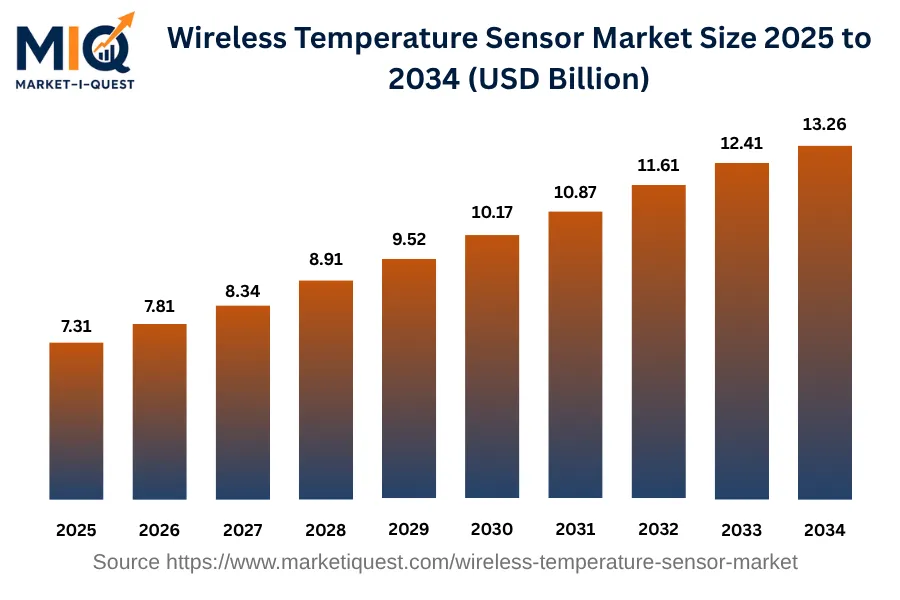
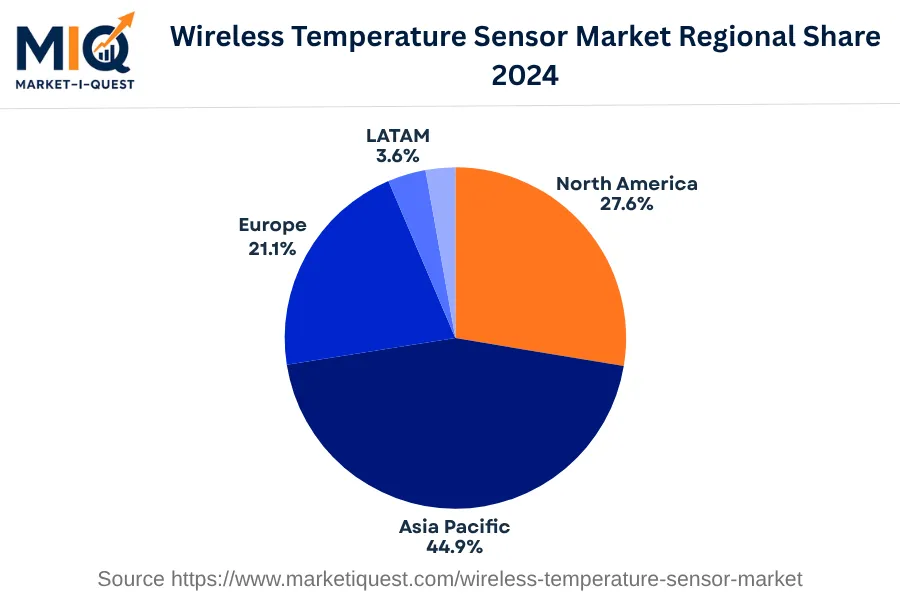
The Wireless Temperature Sensor Market was valued at USD 7.31 billion in 2025 and is anticipated to escalate to USD 13.26 billion by 2034, registering a CAGR of 6.84%. This growth is tied to expansion in various industries that have a high dependency on temperature regulation and monitoring due to operational, safety, or quality control requirements and remote monitoring capabilities of these devices. The course of this advancement traces several significant junctures, with the market's initial valuation of USD 6.84 billion in 2024, which then grew to USD 7.31 billion in 2025. By 2034, there's a near doubling of this value to the market's ultimate worth of USD 13.26 billion. Looking at the regional distribution in the year 2024, Asia Pacific commanded the most considerable share of 44.9%, followed by North America with 27.6%, and Europe with 21.1%. The remaining portions were covered by LATAM and MEA, accounting for 3.6% and 2.8% of the market respectively.

Key Takeaways

  • By Type - Thermocouple segment led accounting for significant market share.
  • By Channel Output - Single-Channel held a dominant position in the base year.
  • By Technology - Wi-Fi held the largest share the segment.
  • By End-Use Industry - Healthcare sector led capturing a notable market share.
wireless-temperature-sensor-market market size

Key Driving Factors

Implementation of Industry 4.0 in manufacturing sector

The rise of Industry 4.0 in the manufacturing sector has been a significant driving factor for the wireless temperature sensor market. Industry 4.0, otherwise known as the fourth industrial revolution, is about leveraging automation and data exchange within manufacturing technologies. Within this ecosystem, wireless temperature sensors play a key role, helping machines maintain optimal operational conditions, thus preventing potential machinery breakdowns and improving overall productivity. These sensors are key in enabling predictive maintenance capabilities to the machines, thereby reducing downtime, costs and enhancing efficiency. The growing adoption of Industry 4.0 principles in manufacturing units across the globe, such as those in China, Germany and the US, are subsequently driving the demand for wireless temperature sensors.
Increased prevalence of smart homes

The increasing prevalence of smart homes, especially in developed nations, has been one of the driving factors for the wireless temperature sensor market. Smart home devices prioritize ease of use, comfort, and energy efficiency, where wireless temperature sensors play an integral role. They contribute to intelligent heating, ventilation, and air conditioning (HVAC) systems, where they constantly monitor and report temperature change, enabling automatic adjustments for optimal indoor climate and energy use efficiency. With homeowners becoming more and more conscious of energy conservation and personal comfort, the demand for intelligent HVAC systems, and by extension, wireless temperature sensors has surged.

Market Evolution by Timeline

2019-2023
In this period, the growth of the wireless temperature sensor market was shaped by a surge in demand from industries such as healthcare, manufacturing, and food and beverage. Healthcare providers deployed the sensors for monitoring and controlling storage conditions for medications and vaccines. Manufacturing firms embraced them for process control and predictive maintenance. The food and beverage industry leveraged the technology to maintain its cold chain systems. On the supply side, the sensors were primarily integrated with Wi-Fi, Bluetooth, ZigBee, and other wireless communication technologies for operation. Policy-wise, the adoption was influenced by guidelines such as the FDA's rules for temperature control in the distribution of pharmaceuticals. The contracts were usually based on purchase with maintenance clauses, and small, medium-sized enterprises made the most significant chunk of suppliers. High initial purchasing costs posed a challenge to adoption.
2024
This year was notable for a significant boost in wireless temperature sensor application in smart homes. Residents all over the globe used the sensors for environmental monitoring and control, improving the comfort and energy efficiency of their houses. On the supplier front, focus shifted to enhancing sensor longevity, miniaturization and battery performance in response to consumer demand. Regulatory initiatives like the European Union's Energy Efficiency Directive encouraged this adoption by setting standards for energy savings and reduction of carbon emissions. Commercially, the growth of online marketplaces increased accessibility of the devices to consumers. The lucrative subscription-based models emerged for niche applications. However, concerns about data security became prominent, forcing suppliers to focus on addressing cybersecurity issues.
2025-2029
In these years, the wireless temperature sensor market expanded significantly in industrial IoT (IIoT) deployment. Industries took advantage of the technology for applications in harsh and hazardous areas because of the sensors' reliability and robustness. The supply side saw improvements in sensor circuitry, architectures, and interfaces, enabling higher precision and accuracy. Further regulation like RoHS directive in the EU pepped the market by promoting eco-friendly electronic devices. Also, it was during these years that a large share of procurement began switching to long-term agreements to guarantee steady supply. Moreover, innovative business models like Sensor-as-a-Service started to emerge. Despite the progress, challenges, mainly in the form of deploying and maintaining the network of wireless sensors, persisted.
2030-2034
In this time frame, demand for wireless temperature sensors from agriculture and environmental monitoring segments became dominant. Regions such as Africa and Asia, with economies heavily relying on agriculture, were significant adopters. Suppliers, in turn, focused on developing solar and kinetic energy-based sensors to overcome the energy constraints faced in remote and underdeveloped regions. In terms of regulations, the IoT Cybersecurity Improvement Act in the United States set the tone for a globally adopted rule emphasizing secure IoT device design. The commercial model transitioned further towards subscription-based services, with sensors provided as part of a broader IoT solution. However, interoperability among different sensor networks surfaced as a crucial challenge requiring standardized protocols.

Future Market Outlook

Future Opportunities

Future directions in the wireless temperature sensor market will likely be influenced by ongoing developments in smart technology and regulatory frameworks. For instance, the increased emphasis on environmental sustainability from the United Nations has led to renewed interest in precision agriculture and energy conservation initiatives that utilize wireless temperature sensors. In this context, companies like DHT11 are already providing low-cost sensor options that can facilitate large-scale deployment in agricultural settings. Additionally, the aging global population necessitates improved healthcare solutions, leading to heightened demand for patient monitoring systems incorporating wireless temperature sensors. Companies like Philips are focusing on developing comprehensive health monitoring systems that combine wireless temperature sensors with other metrics such as heart rate and mobility. Partnerships between tech firms and healthcare providers can accelerate adoption; for instance, IBM's collaborations with various European healthcare institutions showcase potential for integrated temperature monitoring in patient care. Moreover, as regulatory bodies like the FDA outline more comprehensive standards for remote patient monitoring, manufacturers will need to innovate to meet these requirements. The 2023 FDA guidance on digital health technologies is an example of how regulatory clarity can foster market growth. These trends, rooted in current industry movements, highlight promising avenues for development and integration of wireless temperature sensors in multiple sectors, paving the way for broader adoption and more sophisticated applications.

Segmentation Analysis

By Type

The market is divided into subsegments including Thermocouple, Thermistor, Infrared Temperature Sensor, Resistance Temperature Detector (RTD), Semiconductor Temperature Sensor, and Others. The Thermocouple subsegment accounted for the largest revenue share while the Semiconductor Temperature Sensor is expected to grow at the fastest CAGR during the forecast period.

Largest Revenue Share

Thermocouple

Market Share Leader

Thermocouples are the leading source of revenue within the market, asserting a dominant presence due to their proven reliability, affordability, and extensive temperature range coverage. Distinct technical advantages such as rapid response time, simple structure, and high temperature-taking ability make them an ideal choice for a wide gamut of applications across various industries. Predominantly, they find high usage in industrial, automotive, and scientific applications where precise temperature measurements are critical, thus driving the revenue growth. Geographically, robust industrial growth in North America and Asia-Pacific region contributes significantly to the thermocouple revenue. From a regulatory perspective, developments favor safer and more reliable temperature measurement devices, further cementing the position of thermocouples in the market. Furthermore, temperature measurement being an integral part of operations, purchasers prefer sticking to tried and tested devices like thermocouples, hence, contributing to switching costs. Channels such as direct sales and third-party distribution through industrial equipment suppliers aid in widespread availability and penetration of these sensors, thereby leading to substantial revenue intake.

Fastest CAGR

Semiconductor Temperature Sensor

Forecast Period Growth Leader

The Semiconductor Temperature Sensor subsegment is projected to grow at the fastest pace during the forecast period. Technological advancement is the linchpin driving this rapid growth. While semiconductor temperature sensors historically lagged behind others like thermocouples in terms of temperature range and accuracy, ongoing research and innovation have begun to cut this gap significantly. Furthermore, the semiconductor temperature sensors market stands to benefit from supportive policy measures intended to encourage energy efficiency. The introduction of increasingly stringent energy regulations worldwide pushes for more effective thermal management in electronic devices, thereby catalyzing the adoption of such sensors. The cost of investing in semiconductor temperature sensors is becoming less prohibitive due to economies of scale and advancing fabrication techniques, which acts as additional growth catalyst. Nevertheless, adoption barriers including the need for integration within circuits and perceived lesser reliability than traditional temperature sensing solutions pose near-term risks. Yet the increasing prevalence of smart electronics and IoT, coupled with continuous technology improvements, points toward a high-growth trajectory for the semiconductor temperature sensor space.

By Channel Output

The market segmented by channel is divided into subsegments including Single-Channel and Multi-Channel in 2024. The Single-Channel subsegment accounted for the largest revenue share while the Multi-Channel subsegment is expected to grow at the fastest CAGR during the forecast period.

Largest Revenue Share

Single-Channel

Market Share Leader

The Single-Channel subsegment reaped the most significant revenue in 2024 due to a combination of several market dynamics. Single-channel marketing offers a streamlined and focused approach, providing businesses with a clear, undiluted understanding of their customer base and marketing strategies. A big factor is the ability to directly control and fine-tune the customer journey, reducing the margin for error and uncertainty inherent in multi-channel approaches. Single-channel strategies perhaps work best in well-defined and established markets, where customer behaviors and purchasing patterns are well understood. Regulatory environments that favor or simplify single-channel operation would also drive adoption. For example, in markets where consumer protection is high or switching costs for consumers are low, single-channel strategies could see high success. These factors, coupled with the ever-growing digitalization of commerce, have led to an increase in e-commerce sites focusing solely on online sales as an effective single-channel strategy.

Fastest CAGR

Multi-Channel

Forecast Period Growth Leader

Despite the current dominance of the Single-Channel subsegment, the Multi-Channel subsegment is projected to grow at a higher CAGR. The growth drivers for this subsegment are manifold. In an increasingly digital world, businesses understand the need to interact with customers across multiple platforms and touchpoints. Brands are continuously striving to offer a seamless customer experience, regardless of channel or device. Additionally, multi-channel strategies allow companies to tap into a much more comprehensive data pool, enabling them to create more tailored advertising and marketing campaigns. Yet, some barriers could slow this growth. These include complexities of managing different channels, ensuring consistent messaging across platforms, and investing in technologies or partnerships necessary to manage this approach. Regardless, the potential for growth in this subsegment far outweighs these hurdles, making it the fastest-growing segment by channel.

By Technology

The market is divided into subsegments including Wi-Fi, Bluetooth, Zigbee, Radio Frequency Identification (RFID), and Others. In 2024, the Wi-Fi technology accounted for the largest revenue share while Zigbee technology is expected to grow at the fastest CAGR during the forecast period.

Largest Revenue Share

Wi-Fi

Market Share Leader

In the base year 2024, the Wi-Fi subsegment dominates the market in terms of revenue. This is largely due to the ubiquitous nature of Wi-Fi technology, which has been widely adopted in both personal and commercial settings. Wi-Fi connectivity has become a standard feature in a wide range of electronic devices, including smartphones, PCs, and smart home devices. Heavy investment in Wi-Fi infrastructure across urban settings, residential areas, and business spaces drives this segment's lucrative position. The utilization of Wi-Fi in public domains, like cafes, airports, and hotels, has further boosted its revenue growth. Consumers prioritize Wi-Fi for its high-speed connectivity, flexibility in device connectivity, and low maintenance cost, which attributes to its leading position in terms of revenue in 2024.

Fastest CAGR

Zigbee

Forecast Period Growth Leader

Although Wi-Fi holds the largest revenue share, Zigbee technology is anticipated to witness the highest growth. Zigbee is a slice of the automotive, healthcare, and smart home industries because of its low power consumption and cost-effective nature. The increasing adoption of smart homes and cities is expected to spur the demand for Zigbee tech, as it provides seamless control over numerous devices. A surge in innovative partnerships between Zigbee technology providers and manufacturers of home automation products is another catalyst for its growth. However, compatibility issues and lack of awareness pose as hindrances to its rapid adoption. In the near term, regulatory changes promoting energy efficiency and carbon footprint reduction could potentially encourage the wider application of Zigbee technology, thereby fueling its growth.

By End-Use Industry

The market is divided into subsegments including Healthcare, Consumer Electronics, Food & Beverages, Automotive, Oil & Gas, Aerospace & Defense, Energy & Power, Chemicals, and Others. Among these, the Healthcare subsegment accounted for the largest revenue share, while the Consumer Electronics segment is projected to grow at the fastest CAGR during the forecast period.

Largest Revenue Share

Healthcare

Market Share Leader

The Healthcare sector emerges as the predominant contributor to revenue in 2024. There are several factors attributing to this lead. Firstly, the growing demand for advanced diagnostic and therapeutic equipments, coupled with the ongoing innovations in medical technology, fuel the sector's growth. Aging populations globally and soaring chronic disease rates are escalating the demand for improved healthcare services. The sector's growth is also spurred by regulations promoting the use of upgraded technologies and digital healthcare. Geographically, regions with more developed healthcare infrastructure, such as North America and Europe, contribute significantly to the revenue. However, increasing healthcare expenditure in emerging economies like Asia-Pacific is also notable. Buyers in this industry prioritize products' performance, reliability, and long-term cost-effectiveness. Market players are reaching their customers through both online and offline channels, focusing on partnerships with healthcare institutions.

Fastest CAGR

Consumer Electronics

Forecast Period Growth Leader

The Consumer Electronics subsegment is anticipated to grow at an exceptional pace. Its rapid growth can primarily be attributed to increasing consumer demand for innovative and connected devices, such as smartphones, smart TVs, and wearable tech. Digital transformation, amplified by the COVID-19 pandemic, has led to the expansion of consumer electronics in both developed and emerging markets. While barriers to entry might include high capital expenditure and heavily competitive landscape, strong R&D capabilities and strategic alliances can navigate these challenges. Policy-backed initiatives to promote local manufacturing in growing economies will further spur growth. Nonetheless, potential risks could be fluctuating consumer preferences and technological obsolescence, requiring constant innovation. The transition towards IoT and AI-based devices is a strong catalyst for potential growth in this sector.

Competitive Analysis

Key Market Players

Manufacturers / OEMs

Honeywell
US
Emerson Electric Co.
US
Siemens AG
Germany

Key Suppliers & Raw Materials

Amphenol Advanced Sensors
US
TDK Corporation
Japan
Omega Engineering Inc.
US

Distributors, Integrators & Channel Partners

Keyence Corporation
Japan
B+B Thermo-Technik GmbH
Germany
ABB Ltd.
Switzerland

Porter’s Five Forces Analysis

Analysis of the wireless temperature sensor market using Porter’s Five Forces.

Supplier Bargaining Power

Medium

Limited suppliers of specialised components can demand higher prices.

Buyer Bargaining Power

High

Numerous competitors and standardized products enable buyers to compare and switch easily.

Threat of Substitutes

Low

Few alternatives exist for wireless temperature sensors due to advances in wireless technology.

Threat of New Entrants

Medium

Technology standardization & low switching costs can attract new entrants, despite significant R&D investments.

Competitive Rivalry

High

Intense competition due to low entry barriers and the strategic importance of wireless sensors in diverse industries.

Regional Analysis

Geographic market dynamics and growth opportunities across key regions

Global Market Outlook

wireless-temperature-sensor-market market regional share

North America

In 2024, North America's wireless temperature sensor market witnessed a significant surge, particularly in the U.S., Canada, and Mexico. Driving factors included the expanding adoption of sophisticated technology across industries, particularly manufacturing and healthcare sectors. Increased governmental investment in smart cities projects, which often utilize these sensors for environmental monitoring, also played a role. Finally, regulatory mandates for temperature monitoring in cold-chain logistics, primarily for vaccine distribution, fueled the demand for more advanced and reliable wireless temperature sensors.

Market trends in 2024 showed considerable shifts in buyer preferences and product technologies. Buyers, particularly in the enterprise and retail sectors, increasingly prioritized integrated solutions, favoring sensors that could seamlessly communicate with broader IoT systems. Additionally, the market saw an increase in partnerships and mergers & acquisitions between leading technology firms and emerging sensor manufacturers, aiming to meet rising demand and diversify product offerings. Meanwhile, standardization efforts were reinforced in wireless protocols and policy enforcement to ensure data accuracy and security, further changing the face of the wireless temperature sensor landscape. Overall, North America's wireless temperature sensor market in 2024 was characterized by increased demand driven by regulation, technological adoption, and considerable shifts in industry dynamics.

Asia Pacific

In 2024, the wireless temperature sensor market in Asia Pacific was characterized by substantial growth modalities. Key drivers included robust demand from diverse sectors like healthcare, manufacturing, utilities, and retail, which spurred investments into technology adoption. Regulated by supportive policies, China and India witnessed an influx of sensor technology dissemination throughout enterprises. In addition, localized supply dynamics saw reductions in pricing across Japan and South Korea, which catalyzed industrial demand.

Significant trends observed involved shifts in buyer behavior, primarily moving towards more innovative, low-energy consuming sensors. The advent of IoT technology was a major influencer across markets, particularly within Australia and leading ASEAN countries. The channel dynamics seemed to shift towards online markets due to their versatility and cheap procurement options. In turn, this incited a surge of partnerships and M&A activities, with companies eyeing scope for international business expansion. Standard enforcement policies implemented by governments also garnered attention, especially in key markets likes China and India where these sensors are used extensively in government-led initiatives. Simultaneously, the healthcare sector continued to dominate demands across all regions due to heightened health awareness and need for temperature-regulated environments. All these factors collectively link to the growth observed within the wireless temperature sensor market in Asia Pacific in 2024.

Europe

In 2024, the Wireless Temperature Sensor Market demonstrated a significant uptick in Europe. Increased industrial automation in Germany, France, and the UK led by Industry 4.0, enhanced energy efficiency regulations, and the adoption of IoT solutions primarily drove this growth. The push for digitalization and smart factories augmented the demand for wireless temperature sensors in Italy, Spain, and Central & Eastern Europe. Additionally, significant investment in sensor technologies in all European countries further advanced market development.

Concurrently, changing buyer behavior was evident. Many enterprises shifted their focus towards adopting predictive maintenance systems in their operations, showing increased buyer preference for wireless temperature sensor-integrated systems. The emergence of cloud-based remote monitoring systems in manufacturing, healthcare, utilities, and retail sectors, underscored this trend. Innovation partnerships increased in Benelux and the Nordics region, focusing on enhanced sensor accuracy. Moreover, as part of the European Green Deal's energy efficiency directive, stricter policy enforcement increased the use of wireless temperature sensors in the enterprises and government sectors. The increased popularity and integration of wireless temperature sensors were seen in renewable energy projects, particularly wind and solar. Companies aimed to enhance productivity and reduce maintenance costs via real-time supervision of temperature levels through wireless sensors, thereby strengthening the market presence of these devices in Europe in 2024.

Latin America

In 2024, the Wireless Temperature Sensor Market in Latin America was characterized by robust growth due to several key factors. Increasing demand for precision temperature control in industries such as healthcare, manufacturing, and utilities significantly drove the market. With the adaption of advanced technology in these sectors, IoT devices were widely utilized for accurate temperature measurements. The shift towards smart cities in nations like Brazil and Mexico fueled the uptake.

Regulations also played a crucial role, particularly in Argentina and Chile where stringent product quality norms necessitated the use of precise temperature monitoring systems. Investment in the sector was boosted by government-backed initiatives in countries such as Colombia, supporting the growth of IoT infrastructure. Conversely, buyer behavior trends revealed a preference for energy-efficient and environmentally friendly products. As a direct response, tech companies rolled out sensor models integrating low-energy Bluetooth technology. Channel dynamics also evolved with a notable shift towards e-commerce platforms for purchasing these devices.

Meanwhile, in Peru, the emphasis on food safety led to policy enforcement necessitating the use of accurate temperature sensors in the retail food sector. Finally, partnerships and M&A activities increased as market players sought to expand their footprint in the LATAM region, fortifying local production capabilities and enhancing the overall technology landscape.

Middle East & Africa

In 2024, the wireless temperature sensor market in the Middle East and Africa robustly expanded due to a series of factors. Rigorous implementation of regulatory standards in sectors such as healthcare and food processing, specifically in the United Arab Emirates and Saudi Arabia, drove the adoption of wireless temperature sensors. Increased investment in IoT technologies across industries such as oil and gas sparked growth, particularly in Qatar and Nigeria, with firms utilizing sensors to monitor temperatures for efficiency and safety. The demand for energy-efficient systems in South Africa pushed the requirement for these sensors in the utilities sector.

Changing buyer behavior reflected a trend towards remote monitoring of systems in sectors such as telecom and healthcare, particularly evident in Egypt and Kenya respectively. In Israel, the growing trend of smart homes further increased the usage of such sensors. A noticeable technology shift in wireless temperature sensors was the substantial adoption of MEMS-based devices due to their miniaturization and cost-effectiveness. Mergers and acquisitions among technology companies, exemplified by the United Arab Emirates, became prominent, aiming to expand their footprint and improve product lines. Overall, in 2024, the wireless temperature sensor market in the Middle East and Africa was strongly propelled by regulatory norms, technology adoption, and market dynamics.

Recent Industry Developments

Latest market innovations, product launches, and strategic initiatives

February 2026

Broadsens released a major system update for its wireless temperature and vibration sensors, allowing the devices to automatically adjust their own sensitivity and process machine health data internally before sending it over the network.

August 2025

PQSense launched a wireless temperature sensor system that operates entirely without batteries, using standard radio signals to power the device while monitoring heat levels inside high-voltage electrical equipment.

June 2025

Sensirion introduced a new line of extremely durable digital temperature sensors built specifically with protective covers to survive harsh industrial environments while integrating into existing wireless factory networks.

Frequently Asked Questions