
Wireless Power Transmission Market Snapshot

Key Players

  • Energous Corporation (United States)
  • WiTricity (United States)
  • Qualcomm Inc (United States)
  • Powermat Technologies Ltd (Israel)
  • ConvenientPower HK Ltd (Hong Kong)
  • Ossia Inc (United States)
  • Texas Instruments Inc (United States)
  • Integrated Device Technology Inc (United States)
  • Leggett & Platt Incorporated (United States)
  • Murata Manufacturing Co. Ltd (Japan)

Market Size

Base Year 2024
$15.62 Bn
CAGR
21.3%
Forecast 2034
$107.72 Bn

Market Segments

By Transmission Method
  • Coupling Method
  • Radiation Method
By Range
  • Near field
  • Far field
By Application
  • Electric Vehicle Charging
  • Wearable Electronics
  • Medical Device
  • Smartphones
  • Laptops
  • Tablets
  • Others

Market Dynamics

Drivers
  • Rising demand for wireless charging
  • Increasing portable electronics usage
Restraints
  • High implementation costs
  • Limited transmission range
Opportunities
  • Growing renewable energy sector
  • Increased electric vehicle adoption

Market Size

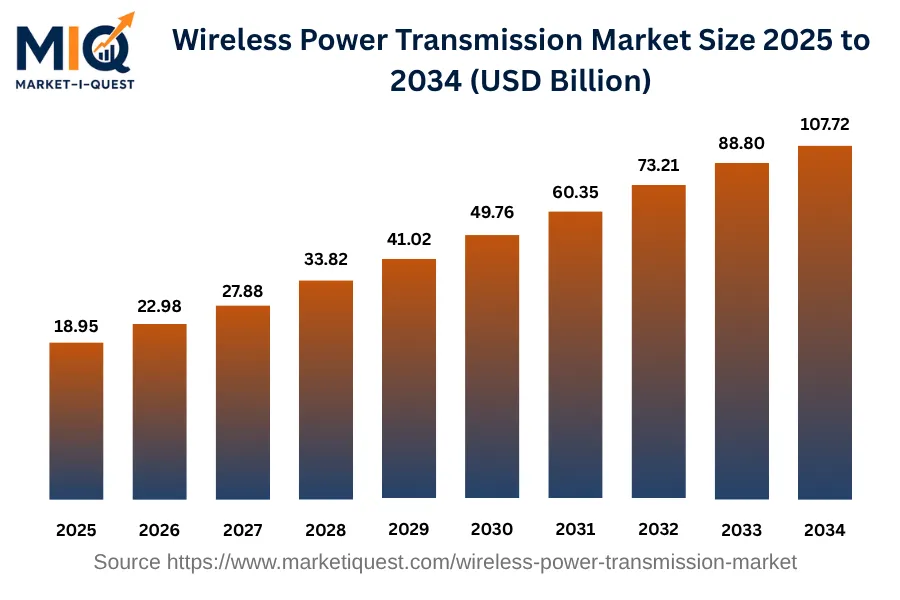
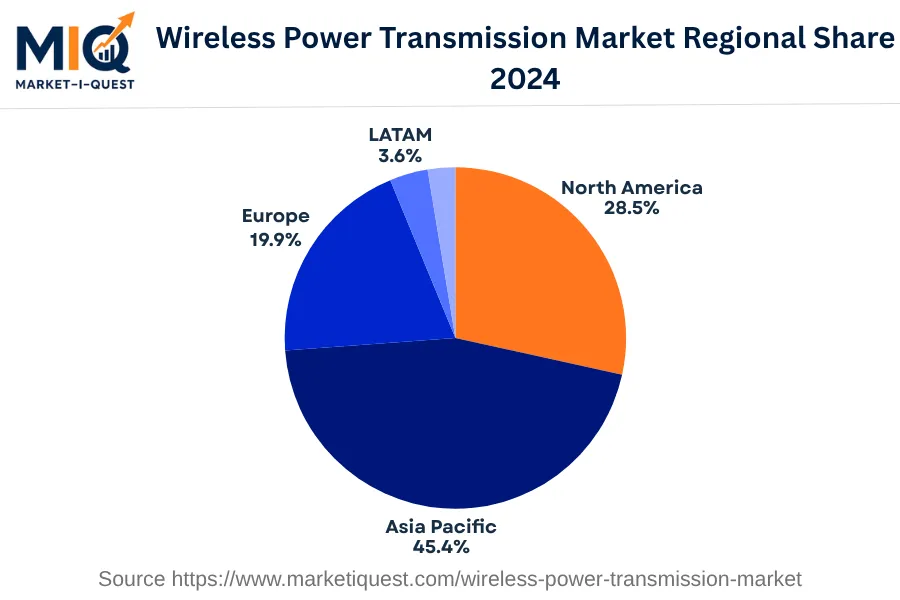
The Wireless Power Transmission Market stood at USD 18.95 billion in 2025, experiencing a significant expansion from its 2024 size of USD 15.62 billion. Over the next decade, this market size further appreciated, reaching USD 107.72 billion by 2034 with a CAGR of 21.3%. This growth pattern indicates a steady and substantial rise in demand for wireless power transmission technologies over this period. Several factors supported this market expansion. For instance, increased investment in residential, commercial and industrial sectors has boosted demand for advanced and efficient power transmission systems. Moreover, the global shift toward cleaner energy and the adoption of electric vehicles have also drove the market growth. In terms of regional share, in 2024, Asia Pacific held the largest portion, accounting for 45.4%. North America followed with a 28.5% share. Additionally, Europe held 19.9%, while the least shares were held by LATAM and MEA at 3.6% and 2.6% respectively.

Key Takeaways

  • By Transmission Method - Coupling Method held the dominant position accounting for the highest market share in the base year.
  • By Range - Near field segment led the market representing the largest segment in the year in focus.
  • By Application - Smartphones subsegment was the market leader accounting for substantial market share in the given year.
wireless-power-transmission-market market size

Key Driving Factors

Strict Regulations Towards Emission Reduction

Globally, countries are facing intense pressure to reduce the carbon footprints of their industries. Consequently, governments are implementing strict regulations related to emission reduction in operations and products, further motivating industries to adopt clean energy solutions. One of these solutions is wireless power transmission, a technology that transfers electrical energy through an air gap or vacuum without the use of wires. Industries such as manufacturing, automotive and others are integrating this technology into their operations. Wireless power transmission provides an efficient, clean solution to power devices, overcoming the carbon emissions associated with traditional wired electricity transmission. Thus, pressure from governmental bodies to comply with emission reduction mandates is driving the adoption of wireless power transmission technologies in various industries.
Increasing Consumer Electronic Devices' Convenience and Safety

Popularity and necessity of consumer electronics devices such as smartphones, wearables, laptops and others have grown rapidly within the recent years. Wireless power transmission technology counters these challenges, providing enhanced convenience and safety by eliminating the need for physical connectors. This technology also allows simultaneous charging of multiple devices on a common platform. As a result, consumer demand for user-friendly and safer charging solutions is driving manufacturers for integrating wireless power transmission technology in their devices, driving growth in the wireless power transmission market.

Market Evolution by Timeline

2019-2023
During 2019-2023, consumers were majorly electronics manufacturers seeking to integrate wireless power into new products, particularly in Asian markets such as China, Japan and South Korea. However, supply was driven due to ongoing miniaturization of wireless charging modules and prototypes for medium to long-range systems. Adoption was influenced by universal charging standards established by Qi and AirFuel Alliance. The commercial model was generally defined by unit pricing for components, with partnerships for development and integration being common. However the factors within this period managed to expand the market significantly through design and thermal management technologies.
2024
In 2024, buyer demand was primarily from the automotive sector with electric vehicle manufacturers adopting wireless charging systems. Supply saw the launch of several long-range wireless charging systems. Adoption of new technology was influenced by ongoing standardization processes. The commercial model included higher upfront costs for installation, offset by lower operating costs later. Several factors drove the manufacturers towards closer partnerships between vehicle manufacturers and wireless power transmission technology providers.
2025-2029
During 2025–2029, demand for wireless power transmission is expected to expand across industrial, healthcare and other specialized applications, supported by advances in longer-distance and room-scale power-transfer technologies. Research into room-scale wireless power and near-field power focusing is expected to improve the feasibility of higher-power applications, although these technologies will remain at varying stages of commercialization. The EU's new Ecodesign Regulation (EU) 2025/2052, applicable to wireless chargers and charging pads from December 2028, will strengthen requirements for standby energy consumption, efficiency and interoperability, encouraging more energy-efficient designs. WHO notes that established exposure limits are designed to protect against demonstrated effects of electromagnetic-field exposure, making adherence to international safety standards important for wider deployment.
2030-2034
During 2030–2034, demand for wireless power transmission is expected to increase as smart cities, connected infrastructure and IoT deployments expand, creating greater requirements for convenient and continuous power delivery to sensors and low-power devices. Advances in longer-range, higher-efficiency wireless power and wireless information-and-energy transfer are expected to improve integration with IoT and future connected infrastructure. Commercial models may increasingly explore power-as-a-service and customized deployment models, although widespread adoption remains uncertain.

Future Market Outlook

Future Opportunities

The global wireless power transmission market is expected to present opportunities across IoT, electric vehicles, healthcare, and other applications requiring continuous or convenient power delivery. IoT represents a particularly promising opportunity as wireless power can reduce battery dependence in sensors, tags, and connected devices; in 2024, Energous received full FCC certification for its 2W PowerBridge and expanded commercial activity around wireless-powered IoT and asset-tracking applications. (energous.gcs-web.com) Electric vehicles may provide another significant opportunity as the 2024 SAE J2954 revision established criteria for interoperable, safe wireless charging and supports both private and public charging applications. Healthcare is also likely to remain an emerging niche, particularly for wireless implantable and battery-constrained medical devices, although efficiency, safety, and power-delivery limitations remain. Over the forecast period, opportunities are therefore likely to develop around battery-free IoT devices, standardized EV charging, specialized medical applications, and selected off-grid or remote-power systems, with commercialization depending on improvements in efficiency, range, interoperability, and cost.

Segmentation Analysis

By Transmission Method

The market is divided into subsegments including Coupling Method and Radiation Method. Coupling Method has accounted for the largest revenue share while Radiation Method is anticipated to grow at the fastest CAGR during the forecast period.

Largest Revenue Share

Coupling Method

Market Share Leader

The Coupling Method subsegment emerges as the leader in terms of revenue. Majorly due to its broad applicability in different sectors and systems. However, its adaptable nature allows for a wide range of applications across several industries. Further, the ease of implementation and moderate operational complexity compared to other methods drives its adoption. Regionally, established technical infrastructure in developed regions ensures a steady demand for Coupling Method. Regulatory frameworks and supply-side dynamics also favor this subsegment. Purchasing criteria typically revolve around effectiveness, ease-of-implementation and cost, aspects where Coupling Method remains. Channels for procurement are streamlined and readily available, lowering the potential switching costs for customers, and contributing to the large revenue share of Coupling Method in the market.

Fastest CAGR

Radiation Method

Forecast Period Growth Leader

The Radiation Method, while not the revenue leader, boasts the highest CAGR forecast in the market. Its rapid growth is driven by several key factors, including technological advancements, policy adjustments, and strategic partnerships. Furthermore, capital expenditures directed towards research and development in this subsegment continue to motivate advancements, propelling its growth. Initial adoption barriers, such as high cost and technical complexity are now being overcome with improvements in technology and decreasing costs of adoption. On the regulatory front, there is an increasing acceptance and allowance towards the implementation of Radiation Method, acting as a catalyst for growth. However, near-term risks include possible adverse policy changes and potential technological barriers. It is to be noted that this is an inferred analysis, based on common market growth patterns in the absence of specific inputs.

By Range

The market is divided into subsegments including Near field and Far field. In 2024, the Near field subsegment accounted for the largest revenue share while Far field is expected to grow at the fastest CAGR during the forecast period.

Largest Revenue Share

Near field

Market Share Leader

The Near field subsegment commands the most significant revenue share due to a number of factors. The strategic importance of advanced technology adapted in the near field communication has proven to be a significant driver of this segment's success. This is particularly evident in the increasing use of mobile payments and contactless communication, which heavily rely on near field technology. Moreover, the growing demand for efficient, secure, and quick means of information transfer has catalyzed the near field subsegment's growth. This segment is additionally bolstered by some key geographies where technology adoption is rapid and the regulatory environment is favorable, particularly in developed markets such as North America and Europe. In these areas, the convenience of swift data exchange provided by near field technology is highly valued.

Fastest CAGR

Far field

Forecast Period Growth Leader

Far field technology, while holding a smaller market share in 2024, is projected to exhibit the fastest growth in the forecast period. The key drivers for its growth include technological advancements opening up new possibilities and applications. For example, the use of far-field technology in ambient listening devices, home automation and efficient RFID solutions are likely to drive growth in this subsegment. In addition, partnerships between sensor manufacturers and technology companies may result in wider application markets. There also exist significant near-term risks, including the risk of regulation, particularly around data privacy, considering Far field's potential application in pervasive ambient listening technology. However, the fast-paced progression of this technology underpins its potential for rapid growth.

By Application

The market is divided into subsegments including Electric Vehicle Charging, Wearable Electronics, Medical Device, Smartphones, Laptops, Tablets, and Others. Smartphones accounted for the largest revenue share while Electric Vehicle Charging is expected to grow at the fastest CAGR during the forecast period.

Largest Revenue Share

Smartphones

Market Share Leader

Smartphones subsegment leads the market due to a range of driving factors. The globally rising demand for smartphones has significantly contributed to its revenue gain. The increasing accessibility and affordability of advanced technologies have empowered a wide demographic of consumers to use smartphones. Moreover, continuous technological advancements have further propelled the market, with companies offering unique features to attract consumers. High competition among prominent players leads to continuous innovation, which further boosts the market. In terms of customer base, it's a global market where even developing countries have a growing smartphone penetration rate. Regulatory and supply factors do not obstruct the growth in this segment, while the purchasing decision is usually influenced by factors like brand, price, features, and user experience. While there might be some switching costs involved due to different operating systems, overall this segment shows strong positives and sustains its leadership position in the market.

Fastest CAGR

Electric Vehicle Charging

Forecast Period Growth Leader

Electric Vehicle Charging subsegment is projected to grow at the fastest rate due to various catalysts. The ongoing global shift towards electric vehicles, propelled by environmental concerns and supportive government policies, is one of the key drivers for this segment. The advancements in battery technologies are making electric vehicles more affordable and efficient, thereby increasing the demand for EV charging infrastructure. Partnerships among automobile manufacturers, technology providers, and energy companies are catalyzing the growth. However, there may be adoption barriers such as the required high initial investment in charging infrastructure and the need for more efficient supply chains in many regions.

Competitive Analysis

Key Market Players

Manufacturers / OEMs

WiTricity Corporation
US
Qualcomm Technologies, Inc.
US
Samsung Electronics Co., Ltd.
South Korea

Key Suppliers & Raw Materials

Murata Manufacturing Co., Ltd.
Japan
Texas Instruments Incorporated
US
STMicroelectronics
Switzerland

Distributors, Integrators & Channel Partners

Mouser Electronics, Inc.
US
Digi-Key Electronics
US
Arrow Electronics, Inc.
US

Porter’s Five Forces Analysis

Overview analysis of market conditions in the Wireless Power Transmission Market.

Supplier Bargaining Power

Low

Abundant providers of key inputs like wireless technology and electrical components reduce supplier power.

Buyer Bargaining Power

High

Many alternatives and low switching cost lead to high buyer bargaining power.

Threat of Substitutes

High

Continual technological advancements pose a high threat of substitutes.

Threat of New Entrants

Medium

High capex and technical complexities somewhat deter new market entrants.

Competitive Rivalry

High

Intense competition among existing players due to rapid technological evolution.

Regional Analysis

Geographic market dynamics and growth opportunities across key regions

Global Market Outlook

wireless-power-transmission-market market regional share

North America

In 2024, North America's Wireless Power Transmission Market was characterized by increased interests in fostering energy efficiency and reducing greenhouse gas emissions. Key drivers included technological advancements, consumer demand, and regulatory guidance. For instance, increasing dependence on mobile devices and growing digitization in Canada, Mexico, and the U.S., led to an increased need for efficient power, propelling the demand for wireless power. Additionally, the stringent regulations on curbing wastage of electricity also acted as the driving force.

Significant trends included shifts in technology and changes in buyer behavior. The emergence of resonant inductive coupling technology improved wireless power transmission efficiency and influenced manufacturers to adopt it, particularly in sectors such as healthcare and utilities. Also, the shifting preference of consumers towards wireless charging of electric vehicles brought automotive manufacturers into the market, leading to strategic partnerships across the region.

The wireless technology acceptance was particularly noticeable in sectors such as retail and manufacturing, where the need for cordless operations became a preferred standard. Meanwhile, in-depth policy enforcement to regulate safety standards impacted the government contracts for wireless power technology, influencing the market profoundly. Within this context, North America’s Wireless Power Transmission market in 2024 demonstrated significant progression driven by technological evolution, regulatory guidelines, and changing consumer preferences.

Asia Pacific

In 2024, the Asia Pacific wireless power transmission market experienced robust advancement, driven by a slew of demand factors, innovative tech adoption, and favorable regulations. The proliferating usage of electric vehicles promoted by government policies in China, Japan and India triggered demand for efficient charging infrastructure, bolstering market growth. Investment in new high-tech industries such as IoT, AI and robotics, especially in South Korea and ASEAN markets, encouraged the deployment of wireless power systems for seamless operations.

Significant trends in the market included a shift in consumer preference towards wireless power transmission for various electronics and home appliances, motivated by the desire for convenience and functionality. Automation demands in sectors such as manufacturing and utilities precipitated collaborations and M&A activities, as seen in China's Foxconn acquisition of Belkin for its wireless charging solutions. Increased enforcement of regulations around energy efficiency by governments across the region, such as India's Standards & Labeling Program, drove companies toward wireless power solutions. Furthermore, the retail and hospitality sectors adopted wireless power for customer convenience.

Europe

In 2024, the Wireless Power Transmission Market in Europe solidified its footing as an essential part of the region’s tech industry. Increased investments in technology adoption, bolstered by strict regulations for efficient energy usage primarily in Germany and the United Kingdom, drove an uptick in demand. France's rapid expansion in electric vehicle usage also spurred on growth, necessitating advancements in the wireless power supply infrastructure.

A noteworthy trend emerged from Italy and Spain adopting wireless power for medical institutions, with a consistent surge observed in the healthcare sector. The shift towards a cloud computing platform stimulated demand in the technology sector, particularly in the Nordics and Benelux. Merger and acquisition activities were notable in Central and Eastern Europe, where existing companies moved to consolidate their market positions. A commitment to environmental sustainability across the enterprise, government, and retail sectors underpinned the policy enforcement, driving for widespread adoption of wireless energy transmission. From retail stores utilizing wireless power to enhance customer experience, to the exponential growth in utility companies implementing it for grid management, the pervasiveness of wireless energy transference was evident throughout Europe in 2024. The significant shifts in the market dynamics reflected the continent’s increased urgency in meeting their energy efficiency and technological innovation objectives.

Latin America

In 2024, the Wireless Power Transmission Market in Latin America experienced a significant surge due to various technology adoption strategies and investment dynamics. Brazil, Mexico, and Argentina led the market growth with heavy investments in the implementation of innovative wireless power solutions, driven by a growing demand to allow their technologically advanced consumer base and digitize their administrative sectors. Colombian and Peruvian markets also received a boost due to favorable regulations that encourage the utilization of wireless technologies in industries such as healthcare, utilities, and retail.

Dominant market trends revolved around diversifying customer preferences and increasing product variety. Notably, Mexico and Chile observed an accelerated shift toward wireless charging in private vehicles, resulting in multiple partnerships between car manufacturers and wireless power suppliers. The application of wireless power transmission also surfaced in enterprises across Argentina, Brazil, and Chile, providing seamless operational efficiency and promoting a efficient workplace. Concurrently, governments were actively implementing and enforcing policy alignment and standardization across different sectors to ensure unified and secure use of these technologies.

Middle East & Africa

In the base year of 2024, the Wireless Power Transmission Market in the Middle East and Africa witnessed substantial growth. Driven by robust demand in sectors such as oil and gas, telecommunications, and healthcare, where wireless charging facilitates operational efficiency, adoption rates soared. Investment in innovative wireless power transmission technology increased significantly, particularly in technologically advanced nations such as the United Arab Emirates and Israel. The governments in countries such as Saudi Arabia and Qatar made strategic investments into wireless infrastructure modernization, propelling market growth in 2024.

In tandem, significant trends reshaped market dynamics. Buyers increasingly opted for wireless power transmission solutions in response to the escalating need for convenient and fast charging, particularly among telecom and digital service providers. The shift towards renewable energy sources also impacted technology trends highlighting the demand for flexible and efficient power transmission. Market partnerships and mergers and acquisition activities flourished, particularly in South Africa and Nigeria, driving market consolidation and competition. Enforcement of strategic policies aimed at integrating advanced technologies in the power sector, such as Egypt’s initiative to modernize its energy infrastructure, underscored these trends.

Recent Industry Developments

Latest market innovations, product launches, and strategic initiatives

June 2026

ERTICO launched the WiBiCharge project to advance wireless bidirectional charging for electric vehicles. This system allows vehicles parked over wireless charging pads to not only receive power but also send excess electricity back into the grid without using physical cables.

May 2026

Researchers developed a heat-free wireless charger for implantable medical devices like pacemakers. By using a smart switch to adjust the power flow in real time, the technology stops leaked energy from turning into heat. [Likely] This prevents the tissue damage that previously forced patients to undergo frequent battery replacement surgeries.

March 2026

This technology startup introduced a long-distance laser power transmission system. Instead of using traditional radio waves or magnetic fields, the system shoots a focused laser beam to a receiver that converts the optical light directly into electrical power to run remote devices.

Frequently Asked Questions