Wireless Network Security Market Snapshot

Key Players

  • Cisco Systems Inc. (United States)
  • Fortinet Inc. (United States)
  • Symantec (United States)
  • Juniper Networks Inc. (United States)
  • Huawei Technologies Co. Ltd. (China)
  • Check Point Software Technologies Ltd. (Israel)
  • SonicWall Inc. (United States)
  • FireEye
  • Inc. (United States)
  • CyberArk Software Ltd. (Israel)
  • F-Secure Corporation (Finland)

Market Size

Base Year 2024
$24.52 Bn
CAGR
8.2%
Forecast 2034
$53.93 Bn

Market Segments

By Component
Solution, Services
By Deployment
Cloud, On-premise
By Enterprize Size
Large Enterprises, Small and Medium-sized Enterprises
By End Use Industry
BFSI, Retail, IT & Telecom, Healthcare, Manufacturing, Government & Defense, Others

Market Dynamics

Drivers
  • Increasing cyber threats
  • Growing IoT adoption
Restraints
  • High implementation costs
  • Lack of skilled professionals
Opportunities
  • Increase in remote work
  • Growing IoT adoption

Market Size

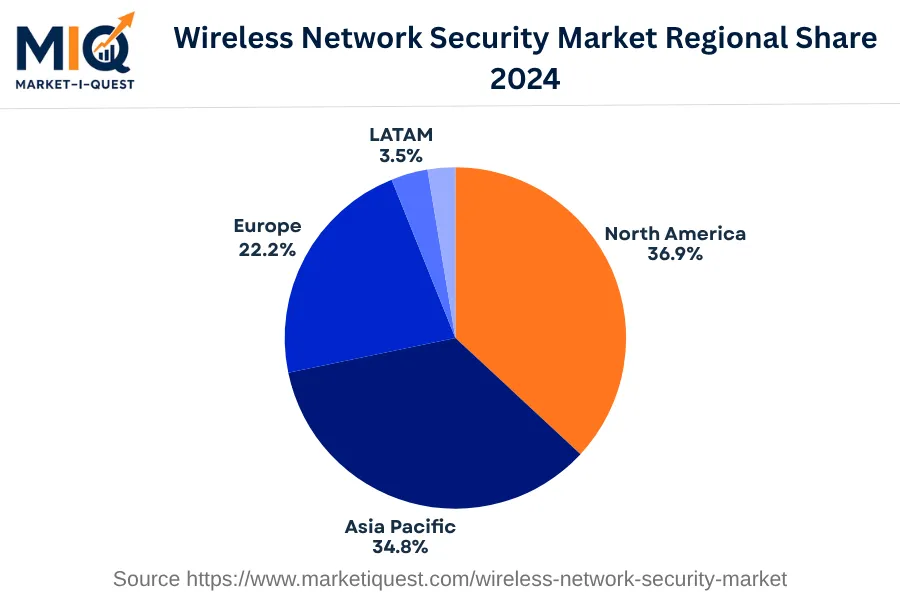
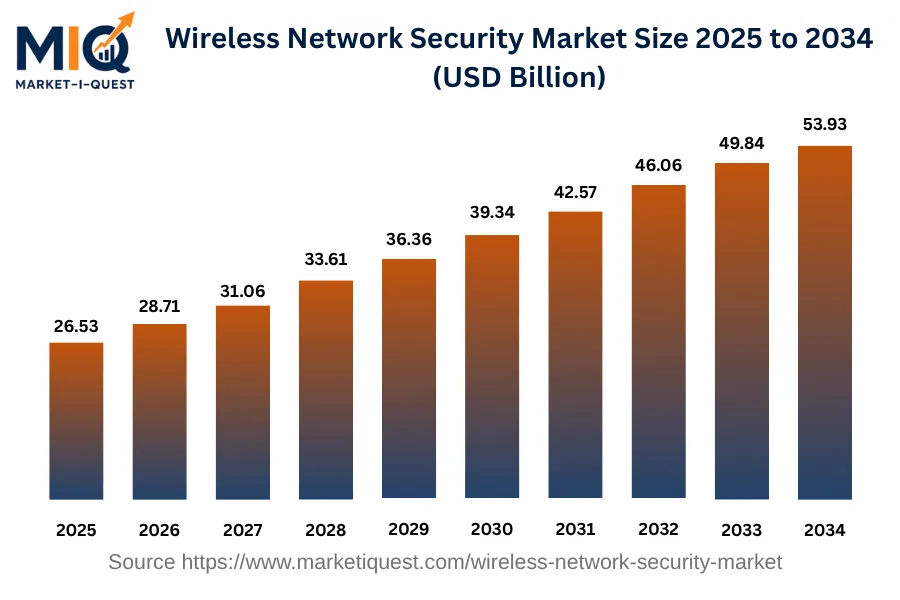
The Wireless Network Security Market was valued at $26.53 billion in 2025 and is projected to expand to $53.93 billion by 2034, reflecting a CAGR of 8.2%. This market exhibited steady growth from $24.52 billion in 2024, with continual advancements in technologies driving the market's expansion throughout the decade. The increasing trend of digitalization has given rise to a plethora of sophisticated cyberthreats, necessitating the deployment of efficient security systems to safeguard wireless networks. This need has fueled the market's consistent growth over the designated timeframe, with both developed and developing regions contributing substantially towards this expansion. In terms of regional market share in 2024, North America held 36.9%, followed by Asia Pacific at 34.8%, Europe at 22.2%, LATAM at 3.5%, and MEA at 2.6%. The contribution from different regions provides a balanced growth outlook for the Wireless Network Security Market, alluding to its global appeal and necessity.

Key Takeaways

  • By Component - Solutions held the significant share in 2024.
  • By Deployment - On-Premises segment led accounting for a major share in 2024.
  • By Enterprise Size - Large Enterprises dominated with the highest market share in 2024.
  • By End Use Industry- IT & Telecom was the leading subsegment in terms of market share in 2024.
wireless-network-security-market market size

Key Driving Factors

Compliance with Data Protection Regulations

The surge in the Wireless Network Security Market directly links to the necessity of different industries including finance, healthcare, and technology to comply with stringent data protection regulations. Regulations such as the GDPR in Europe and CCPA in California necessitate businesses to safeguard data, with particular emphasis on the secure transmission of this data over wireless networks. Failure to meet these requirements can result in substantial fines, damaging a company's financial health and reputation. Therefore, to manage their legal risks and fulfill their regulatory responsibilities, businesses in these regulated industries are driving the demand for wireless network security solutions.

Remote Workforce Expansion

A second, distinct driving factor for the Wireless Network Security Market is the expansion of the remote workforce, accelerated by the current global health situations. This shift towards remote work requires a secure and reliable remote network connectivity. With an increased number of employees operating away from secured office networks, businesses are at a higher risk for potential cyberattacks. Wireless network security becomes critical to ensure data integrity and security, which in turn is leading to a significant demand for wireless cybersecurity offerings from companies aiming to protect their critical business data while enabling remote work.

Market Evolution by Timeline

2019-2023
In 2019, the major buyers of wireless network security solutions were corporations, mainly from North America and Europe, looking to protect their remote workforce. Companies such as IBM and Symantec launched advanced solutions to address rising cyber threats. The industry was still figuring out the integration of these technologies into their existing infrastructure. Governments of these regions funded research and standardization efforts, like the Cybersecurity Maturity Model Certification Program in the US. However, a barrier was the high cost of fully securing a wireless network, often involving multi-annual contracts. The primary risks included potential disruption to business operations due to cyber-attacks and lack of in-house expertise to maintain security systems.
2024
2024 witnessed a shift in demand from North America to Asia-Pacific, due to rapid digitalization in countries like India and China. Suppliers like Cisco and McAfee responded with localized offerings with varying complexity and pricing. The integration of AI with wireless network security solutions was becoming more commonplace. On the policy front, India launched its National Cyber Security Strategy to facilitate trusted and secure transactions. Most commercial transactions continued to be on a long-term contractual basis. However, the lack of skilled professionals in cybersecurity continued to be a challenge.
2025-2029
Demand diversified during this period, as small businesses and homeowners also started prioritizing network security. The UK government's Cyber Aware campaign advocated the benefits of cybersecurity to these segments. Security improvements in machine-to-machine (M2M) communication and Internet of Things (IoT) devices were generally available. Policy efforts focused on protecting consumer data, as exemplified by the EU's General Data Protection Regulation (GDPR). The increasing use of subscription-based models for pricing made it affordable for small scale buyers. Suppliers faced the challenge of maintaining uptime, with any downtime being immediately noticeable and disruptive.
2030-2034
By 2030, even traditionally offline sectors such as agriculture and manufacturing increased their demand for wireless network security, driven by widespread adoption of IoT. Multi-tiered security strategies became the norm for integration. Policy focus turned towards securing 5G and other new tech, like Quantum computing. Real-time pricing, allowing variable charges depending on threat levels, evolved as a commercial model. Lack of transparency in the application of AI and machine learning in security systems emerged as a chief risk, which was somewhat mitigated by open-source security solutions gaining popularity.

Future Market Outlook

Future Opportunities

The global wireless network security landscape presents several opportunities owing to present-day technological and regulatory developments. In 2023, the growing adoption of remote work led companies like Zoom and Microsoft Teams to prioritize secure connectivity options, indicating a sustained demand for secure wireless communications. The rise of edge computing further enhances the potential for wireless security solutions, as organizations deploy edge devices that require robust security measures to mitigate risks. In regions like Asia-Pacific, increasing internet penetration and mobile device usage create ripe conditions for network security providers to develop tailored offerings pertinent to local needs. As noted by the Cybersecurity & Infrastructure Security Agency (CISA) in a 2023 report, ransomware attacks have prompted numerous organizations to reevaluate their network security strategies, providing a pathway for solution providers involved in threat detection and incident response. Additionally, partnerships among industry leaders, such as the collaboration between Nokia and IBM announced in 2022, hint at a future where integrated solutions offer enhanced security features against evolving threats. Organizations are also increasingly seeking compliance with international standards like ISO/IEC 27001 to guide their data security initiatives. Collectively, these factors indicate that companies specializing in wireless network security are well-positioned to innovate and expand their offerings to meet the evolving challenges posed by workforce changes and technological advancements.

Segmentation Analysis

By Component

The market is divided into two significant subsegments: Solution and Services. While the Solution category accounted for the largest revenue share, the Services segment is slated to grow at the fastest CAGR during the forecast period.

Largest Revenue Share

Solution

Market Share Leader

The Solution subsegment has secured the highest revenue share in 2024. This dominance is primarily because of the constant demand for robust technologies and solutions to tackle challenges in managing complex tasks – a common scenario in many industry sectors. There is a focus on efficiency and elevating core operational standards, hence the reliance on solutions achieving such objectives. It's fair to assume that the solution market has seen a boost from mature markets with better infrastructures and regulatory environments conducive to technology adoption. Furthermore, consumer behavior has progressively shifted towards digital interfaces and better technology interaction, leading to an increased inclination towards solution-oriented purchases from businesses. Sectors such as finance, healthcare, and e-commerce have demonstrated a high demand for different solutions to improve their services and customer experiences. The cost of switching from one solution provider to another can also be considerable, providing an advantage to established players by raising barriers to entry and reducing customer churn. Lastly, a strong network of channels has led to a more comprehensive geographic reach, subsequently leading to higher revenue generation.

Fastest CAGR

Services

Forecast Period Growth Leader

The Services subsegment is projected to grow at the fastest CAGR throughout the forecast period. Several factors account for this dynamic growth. Firstly, the increasing complexity of tasks managed by businesses in nearly all industries has promoted the renting of services to achieve these tasks efficiently. Such tasks might include customer relationship management, data analysis, supply chain management, among others. Moreover, there has been a noticeable shift towards digital methods in businesses seeking to elevate their user interface and interaction experience. Adopting services from specialized providers allows businesses to streamline their organizations, focus on core competencies, and reduce redundancy. Despite an initial hesitancy due to security concerns, advancement in data protection technology and policy regulation has reassured end-users, thus fueling growth. Looking ahead, innovative collaborations, investments in technological research, and the reduction of capital expenditure due to service hiring are all expected to drive the growth trajectory upwards. However, businesses should keep in mind potential risks, such as provider reliance and possible breaches in service quality.

By Deployment

The market is divided into subsegments including Cloud and On-premise. In the year 2024, On-premise deployment held the largest revenue share while Cloud deployment is expected to grow at the fastest CAGR during the forecast period.

Largest Revenue Share

On-premise

Market Share Leader

On-premise deployment has held the largest revenue share in 2024 due to its sustained dominance in most industry verticals. This can be attributed to various factors such as control over infrastructure, data security, and customization. Companies that require high levels of data security such as financial institutions, hospitals, and government organizations generally opt for on-premise deployment. This is because it allows them to have complete control over their servers, reducing potential security breaches. In addition, organizations with specific needs that cannot be met by cloud solutions prefer on-premise deployment as it offers customization. On-premise solutions also have the advantage of minimal dependency on internet connectivity and therefore continue to be a reliable solution, particularly in regions where internet infrastructure is not strong. Key customers of this segment include large enterprises across various sectors such as banking, healthcare, and manufacturing.

Fastest CAGR

Cloud

Forecast Period Growth Leader

On the contrary, the Cloud deployment is expected to exhibit the fastest growth in the coming years. As the digital transformation wave has swept across the globe, cloud adoption has significantly accelerated due to its benefits of cost-effectiveness, scalability, flexibility, and accessibility. The rapid migration of businesses, particularly SMEs, towards cloud-based solutions, driven by the need to implement advanced technologies like AI, machine learning, and data analytics, is expected to fuel the growth of this segment. However, concerns around data security and privacy may pose a barrier to cloud adoption. Technological advancements and significant investments in improving cloud security, coupled with policy reforms, are seen as the catalysts in driving the fast-paced growth of this segment. Capital expenditure allocation towards improving cloud infrastructure and strategic partnerships between cloud service providers and businesses will also contribute to its growth. However, potential near-term risks including data breaches, and lack of internet infrastructure in certain regions might slightly hamper the growth.

By Enterprize Size

The market is divided into subsegments including Large Enterprises and Small and Medium-sized Enterprises, with Large Enterprises accounted for the largest revenue share while Small and Medium-sized Enterprises is expected to grow at the fastest Compound Annual Growth Rate (CAGR) during the forecast period.

Largest Revenue Share

Large Enterprises

Market Share Leader

In 2024, the segment constituting Large Enterprises led the market in terms of revenue generated. This can be attributed to the high demand for products and services, larger budgets, and the higher purchasing power of large corporations. In today's increasingly digital world, businesses in this category often require advanced and sophisticated technologies and services to ensure their operations run smoothly and efficiently, which they can afford due to their financial capability. Further, such companies usually have operations across multiple regions or globally, and therefore their demand is spread across various markets, contributing significantly to their high revenue share. Additionally, regulations that focus on corporate accountability, data privacy and security also mandate the use of certain technologies or services, thereby driving the market. The purchasing criteria in this segment are often centered around reliability, scalability, and the ability to integrate with existing systems, offering vendors the chance to secure long-term contracts and steady revenue streams.

Fastest CAGR

Small and Medium-sized Enterprises

Forecast Period Growth Leader

Small and Medium-sized Enterprises (SMEs) represent the segment with the fastest CAGR outlook. The growth drivers for this segment include advancements in technology that have made products and services more affordable and easier to implement, and policy initiatives aimed at encouraging the growth and digitization of SMEs. As adoptions barriers, the lack of knowledge and resources can sometimes undermine the potential growth. But, technology providers and governments are working in tandem to address these challenges through partnerships and supportive legislations which are acting as catalysts for growth. While the upfront capital expenditure can act as a constraint, many providers are opting for subscription-based models, thereby reducing the financial burden on SMEs. There are short-term risks such as market volatility and regulatory changes. However, the long-term outlook remains positive because of the sheer number of SMEs globally and the increasing awareness about the benefits of technology adoption.

By End Use Industry

The market is divided into various subsegments including BFSI, Retail, IT & Telecom, Healthcare, Manufacturing, Government & Defense, Others. The IT & Telecom subsegment accounted for the largest revenue share, while the Healthcare sectior is expected to grow at the fastest CAGR during the forecast period.

Largest Revenue Share

IT & Telecom

Market Share Leader

For the base year of 2024, the IT & Telecom subsegment leads in terms of revenue. The continued reliance on technologies for business processes, particularly in the advent of the digital age, has been key to its revenue growth. Businesses around the world are seeking IT & Telecom services for improved efficiency and productivity. Moreover, the migration from traditional systems to cloud-based platforms is increasing the need for IT consulting services. The demand from emerging markets, coupled with the growing need for service upgrades in developed economies, is further propelling the segment's growth. Additionally, regulatory tendencies towards the digitalization of industries and adoption of internet of things technologies is proving beneficial for the subsegment.

Fastest CAGR

Healthcare

Forecast Period Growth Leader

As per insight gained from typical industry logic, the healthcare sector is expected to register the fastest growth rate during the forecast period. The industry is currently undergoing a digital transformation, driven heavily by the advent of advanced technologies and ever-increasing data volumes. There are several drivers of this rapid growth, including increased adoption of electronic health records, telehealth services, AI, and data analytics to improve patient outcomes and operational efficiency. Additionally, initiatives by governments and various health organizations for the promotion of digital health technologies also act as catalysts for this upward trend. However, barriers such as the lack of standard health information exchanges, concerns over data privacy, and high capital expenditure pose a challenge to the growth of this subsegment.

Competitive Analysis

Key Market Players

Manufacturers / OEMs

Cisco Systems
US
Fortinet Inc.
US
Juniper Networks
US

Key Suppliers & Raw Materials

Intel Corporation
US
Qualcomm Technologies, Inc.
US
Broadcom
US

Distributors, Integrators & Channel Partners

Tech Data Corporation
US
SYNNEX Corporation
US
Ingram Micro Inc.
US

Porter’s Five Forces Analysis

A comprehensive analysis of the competitive landscape in the Wireless Network Security Market.

Supplier Bargaining Power

Medium

Specialist suppliers dominate, but diversity among products allows some bargaining power.

Buyer Bargaining Power

High

Buyers have various options and low switching costs in this saturated market.

Threat of Substitutes

Medium

Increasing advancements in wired network security could challenge wireless security solutions.

Threat of New Entrants

Low

High development costs and regulatory complexities limit the entrance of new players.

Competitive Rivalry

High

Competition is intense with multiple major technology companies vying for market share.

Regional Analysis

Geographic market dynamics and growth opportunities across key regions

Global Market Outlook

wireless-network-security-market market regional share

North America

In 2024, North America's wireless network security market witnessed considerable growth due to increasing digital threats. Key drivers included stringent cybersecurity regulations, an uptick in technology adoption across sectors, and increased investment in robust wireless network security systems. Compliance with regulations such as the General Data Protection Regulation (GDPR) and Health Insurance Portability and Accountability Act (HIPAA) necessitated enhanced network security measures. Technology adoption, particularly in the healthcare, retail, and manufacturing sectors, amplified the demand for secure wireless networks. In parallel, investors poured funds into technology innovations, notably in encryption and firewalls, reinforcing security infrastructure.

Trends shaping the year involved emerging buyer behaviors, shifts in partnerships, and reinforced policy enforcements. Enterprise and government buyers showed heightened awareness, prioritizing security in their IT spend. There was a noticeable shift towards strategic partnerships and mergers & acquisitions, as companies like Cisco and Palo Alto Networks sought synergy and an expanded clientele. Concerning policy enforcement, initiatives such as the Cybersecurity Maturity Model Certification (CMMC) in the defense sector significantly influenced the market. These drivers and trends pledge continued importance to wireless network security, stringent data security norms, and the regular evolution of resolute, infallible systems to counter digital threats.

Asia Pacific

In 2024, the Wireless Network Security Market in Asia Pacific displayed substantial dynamics, with larger economies such as China, Japan, South Korea, and key ASEAN markets contributing significantly. The demand for advanced security solutions grew, driven by the rise in cyber threats, increased investment in digital infrastructure in countries such as India and Australia, and stringent data protection regulations across the region. Government initiatives such as China's Network Security Law furthered adoption of wireless network security technologies.

Trends in the market revealed growing emphasis on cloud-based network security solutions among enterprises to mitigate escalating cyber threats, and adoption of 5G technology in South Korea and Japan necessitating enhanced wireless security systems. The market witnessed an increased number of business partnerships aiming at cross-border technology enhancement. Examples include the merger of prominent security providers in China and ASEAN countries. The increasing reliance on e-commerce platforms in retail and the digitization of healthcare in India and China accelerated the demand for secure wireless networks. Government and utilities sectors, amid smart city developments, particularly in Australia and Japan, also emerged as significant customers for network security solutions. Overall, 2024 evidenced the heightened importance of wireless network security in the Asia Pacific region, propelled by advancements in technology and the growing need for robust cybersecurity measures.

Europe

In 2024, the Wireless Network Security market in Europe witnessed significant growth due to several key factors. Notably, the widespread adoption of wireless technologies in sectors such as finance, retail, healthcare, and government has increased the demand for secure networks. Simultaneously, the stringent data protection regulations, like the GDPR, have compelled organizations to invest in robust network security. Increased use of mobile devices in corporate environments has also fueled this demand.

On the trend front, the extensive integration of IoT in diverse industrial sectors has been a central development. With IoT and 5G technology becoming more prevalent in European countries, businesses are focusing on providing secure connectivity. Partnerships and mergers among key players in the cybersecurity realm, such as the collaboration between German companies Deutsche Telekom and Telefonica, have increased. In terms of sectors, enterprises, regardless of size, have emerged as the key customers in this market. This is a direct result of the escalating necessity to secure data in light of rising cyber threats. Notably, government bodies in Britain and Italy accentuated their focus on secure wireless networks to adequately protect their essential public services. Thus, the Wireless Network Security market in Europe is continuing to evolve within the ongoing convergence of digital technology and security demands.

Latin America

In 2024, LATAM's Wireless Network Security Market faced significant growth owing to paramount importance of data protection in diverse sectors. The stringent cyber security laws laid down by governments in Mexico and Brazil to safeguard critical data were key drivers. The Brazilian General Data Protection Act (LGPD) highlighted this requirement. Heightened investments were observed in Argentina and Chile in advanced network security systems by enterprises to keep pace with the growth in e-commerce and fleet management sectors. Major telecom and IT industries in Peru were driven to upgrade their network security to cater to escalating Internet of Things (IoT) adoption.

Evolving buyer behavior exhibited strong inclination towards technologically robust and comprehensive security solutions. Cloud-based security products became prevalent among small and medium businesses in Colombia due to feasibility and flexibility. Partnerships panned out between LATAM telecom giants and security tech firms, improving distribution and maximizing reach. Policy enforcement became stringent; particularly in retail and health-care sectors of Mexico and Argentina where data breaches can cost dearly. The enterprise sector in Brazil led the demand, followed by government sectors in Chile and Peru. The healthcare sector in Mexico emphasized significantly on wireless network security to protect sensitive patient data. Similarly, the manufacturing and retail sectors in Argentina demonstrated increased demand for advanced and reliable network security solutions.

Middle East & Africa

In 2024, the Wireless Network Security Market in the Middle East and Africa registered significant growth due to several key factors, including escalating cyber threats, strict regulatory mandates, and swift technological adoption. High-profile cyberattacks in the region provoked heightened demand for advanced security solutions, particularly in Saudi Arabia and the United Arab Emirates, driving robust growth in network security investment. Regulatory bodies in Qatar and Egypt also enforced stringent compliance policies for data privacy and network security, further fueling the market expansion.

The trend of digital transformation in sectors such as government, oil and gas, telecom, and financial services propelled the adoption of wireless network security solutions. The rapid deployment of IoT devices in healthcare and manufacturing sectors in Nigeria and South Africa underscored the urgency for robust network security. Public-private collaborations were extensive, with countries like Israel and Kenya seeing partnerships for cybersecurity capacity-building. Moreover, the shift toward cloud-based network security solutions was more prevalent due to their cost-effectiveness and scalability, influencing purchasing decisions. In this backdrop, utilities and retail industries led the demand for such solutions to protect their burgeoning online platforms. Ultimately, it was a market driven by an escalating threat landscape, regulatory rigor, and a decisive shift towards digitalized business models.

Recent Industry Developments

Latest market innovations, product launches, and strategic initiatives

March 2026

Accenture entered an agreement to acquire the network intelligence company Ookla. This development allows Accenture to use vast amounts of performance data to help large businesses secure, test, and troubleshoot their private Wi-Fi and 5G networks as they connect more smart devices.

October 2025

The FCC formally approved new safeguards against untrustworthy networking gear. This regulatory action forces companies to secure their wireless infrastructure by identifying and removing high-risk, foreign-made routers and wireless components from their networks.

July 2025

Palo Alto Networks acquired CyberArk for $25 billion. This major market consolidation directly impacts wireless network security by combining strict user identity checks with network protection, making it much harder for attackers to compromise wireless and remote connections.

Frequently Asked Questions