Untitled Report Snapshot

Key Players

  • Vestas Wind Systems A/S (Denmark)
  • Siemens Gamesa Renewable Energy S.A. (Spain)
  • General Electric Company (United States)
  • Goldwind Science & Technology Co. Ltd. (China)
  • Nordex SE (Germany)
  • Enercon GmbH (Germany)
  • Suzlon Energy Ltd (India)
  • Sinovel Wind Group Co. Ltd (China)
  • Ming Yang Smart Energy Group Ltd (China)
  • LM Wind Power (Denmark)

Market Size

Base Year 2024
$31.42 Bn
CAGR
4.6%
Forecast 2034
$49.26 Bn

Market Segments

By Component
  • Rotary Blade
  • Gearbox
  • Generator
  • Nacelle
  • Tower
  • Others
By Installation
  • Onshore
  • Offshore
By End Use
  • Residential
  • Commercial & Industrial
  • Utility

Market Dynamics

Drivers
  • Rising environmental concerns
  • Growing renewable energy projects
Restraints
  • High installation costs
  • Unpredictable wind reliability
Opportunities
  • Rising environmental concerns
  • Increasing renewable energy policies

Market Size

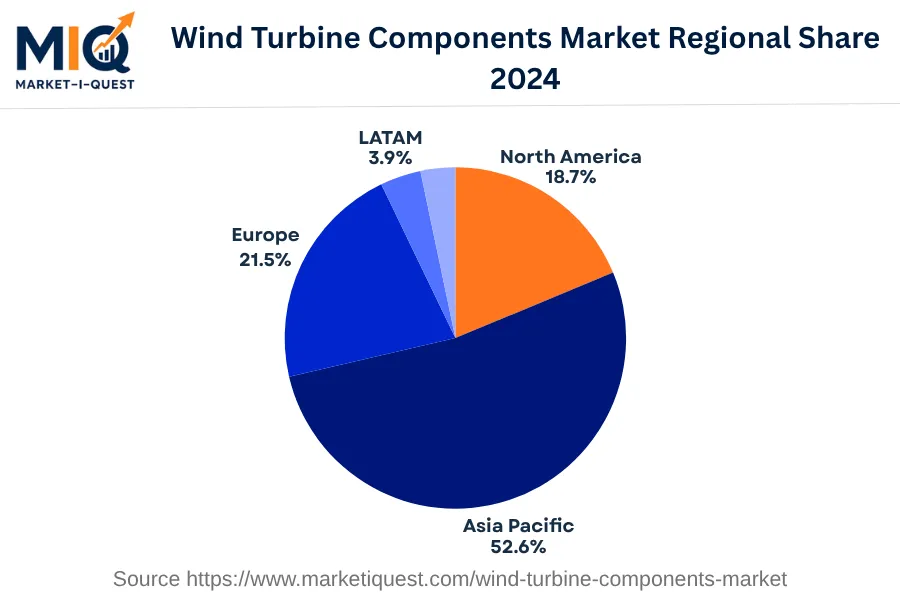
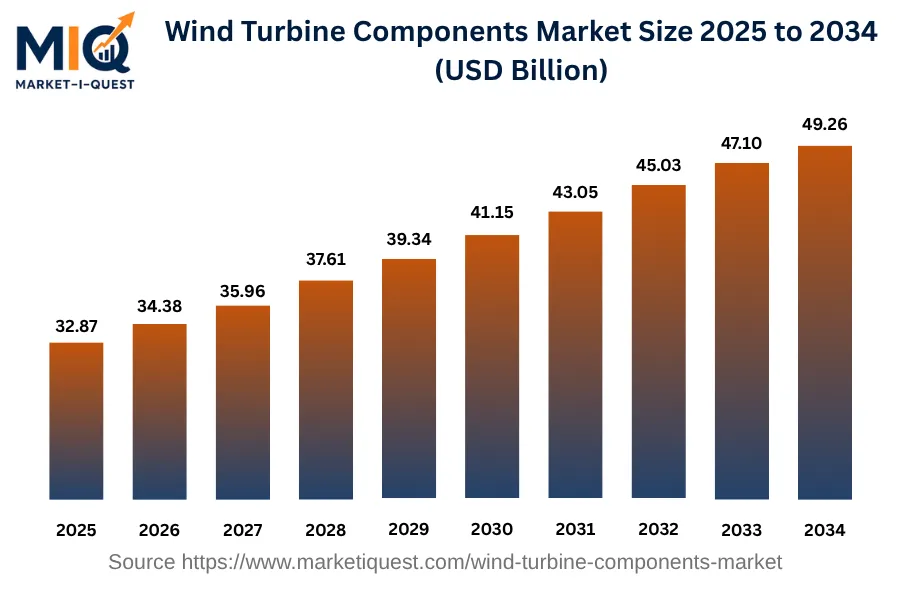
The Wind Turbine Components Market was sized at USD 32.87 billion in 2025 and is projected to grow to USD 49.26 billion by 2034, with a CAGR of 4.6%. This growth in market size from 2025 to 2034 evidences a consistent upward trajectory over the decade. The increase in market value is tied to the steady progression in value year after year; for example, the market value rose from USD 31.42 billion in 2024 to USD 32.87 billion in 2025. This growth can be attributed to the rise in demand for renewable energy and the increasing adoption of wind energy on a global scale. On the regional front, 52.63% of the market share in 2024 was held by the Asia Pacific, followed by Europe with a 21.48% share, and North America with an 18.74% share. The remaining regions, LATAM and MEA, accounted for 3.86% and 3.29% respectively.

Key Takeaways

  • By Component - Generator segment led accounting for a significant share in 2024.
  • By Installation- Onshore held the largest share of the segment in 2024.
  • By End Use - Commercial & Industrial is held the largest share of the segment in 2024.
wind-turbine-components-market market size

Key Driving Factors

Offshore Wind Farm Developments

A vital driving factor for the Wind Turbine Components market is the rapid proliferation of offshore wind farms across the globe. This increase stems from the ability of offshore winds to produce a significantly higher amount energy in comparison to onshore winds. Countries with extensive coastlines like the UK, the US, and China are tapping into this potential, urging international and local companies to invest in and build offshore wind farms. Moreover, these jurisdictions do not face the same space restrictions or community objections often encountered with onshore wind farms. The development of these offshore projects consequently stimulates demand for wind turbine components such as blades, gearboxes, generators, and rotor hubs.

Governmental Policy Support

Another major instigator for the advancement of the Wind Turbine Components market is the governmental policy support for renewable energy sources. Governments world over are setting ambitious targets for renewable energy generation and are implementing policies that strengthen the wind energy sector. For instance, feed-in tariffs and power purchase agreements provide longer-term security for wind energy projects. Similarly, tax credits and grants are encouraging the production of wind energy and the development of related industries. This support, at both a federal and local level, facilitates an increased demand for wind turbines, and consequently, for the associated components required for their construction and maintenance.

Market Evolution by Timeline

2019-2023
During this period, the primary customers for wind turbine components were utilities, independent power producers, and industrial end-users, especially in Asia, Europe, and North America. Manufacturers focused on delivering components with improved efficiency and less maintenance cost. The market saw a substantial increase in demand in China, Germany, the US, and India. The adoption of clean energy was driven by regulations such as the Renewable Energy Sources Act in Germany and the Renewable Portfolio Standard in multiple US states. Cost-competitive pricing became the norm, aided by long-term power purchase agreements. Despite these advances, supply chain issues posed frequent disruptions.
2024
By 2024, the focus shifted towards expanding offshore wind projects. European countries such as the UK and Denmark emerged as strong markets. These locations necessitated advanced components to withstand harsh marine conditions. Significant product development was seen for the outermost parts of the turbines, including blades and nacelles. With added complexity in offshore installations, producers adopted performance-based contracts. The Offshore Renewable Energy Strategy of the EU supported these developments. Risks posed by potential damage from saltwater corrosion and logistical complexities in offshore placements were routinely assessed.
2025-2029
From 2025 to 2029, projects in emerging markets of Latin America and Africa increased, and demand drivers shifted towards rural electrification and sustainable industrial growth. OEMs were heavily invested in developing components suitable for variable wind speeds common in these regions. New supply chains were established with local and regional suppliers. Policies like Africa's Renewable Energy Initiative (AREI) drove business expansion. Partnership and lease-based contract structures were prevalent. Large-scale storage integration was the primary technical challenge, coupled with the need for localized manufacturing capabilities.
2030-2034
In the period from 2030 to 2034, the requirement for wind turbine components adapted to extreme environments, such as deserts or Arctic regions, increased. Regions like the Middle East and Canada showed increased interest in wind power installation. The technology was mature with highly durable, versatile components. Programs like the Arctic Renewable Energy Network boosted market growth. Commercial models shifted to direct digital sales channels. Meanwhile, the risk of material scarcity and recycling concerns came into focus, prompting development of durable, minimal maintenance components built from recyclable materials.

Future Market Outlook

Future Opportunities

Future opportunities within the wind turbine components market are emerging as countries continue to adopt stricter environmental policies. In 2021, the United States emphasized renewable energy goals through the Infrastructure Investment and Jobs Act, which encourages investment in wind energy infrastructure. The International Energy Agency reported in early 2022 that the global offshore wind capacity is projected to grow, prompting countries like China and Germany to expand their offshore wind installations. Siemens Gamesa has announced partnerships aimed at enhancing grid integration capabilities, reflecting an anticipated demand for smarter, more interconnected energy systems. Regulatory movements, such as the United Kingdom's commitment to achieving net-zero by 2050, signal increased government support for the wind energy sector. As of 2023, the potential incorporation of artificial intelligence in predictive maintenance practices by companies like Nordex stands to create more reliable operations, thereby increasing system uptime. Additionally, emerging markets in Southeast Asia, such as Vietnam, are beginning to invest in wind energy, spurred by favorable fiscal policies and investment incentives. The growing necessity for localized manufacturing due to supply chain disruptions, illustrated by the COVID-19 pandemic's impact, will likely cultivate opportunities for companies to establish regional production facilities. This evolving landscape sets the stage for diversification and innovation, as market participants navigate increasing consumer demand for sustainable energy solutions worldwide.

Segmentation Analysis

By Component

The market is divided into subsegments including Rotary Blade, Gearbox, Generator, Nacelle, Tower, and Others. Among these, the Generator accounted for the largest revenue share while the Tower segment is expected to grow at the fastest CAGR during the forecast period.

Largest Revenue Share

Generator

Market Share Leader

The Generator subsegment leads the market revenue, driven principally by its high instrumental value in power generation activity. With an increasing demand for reliable and efficient energy sources, the need for high-performing generators is expanding in most geographies. End-users attribute high value to durable, efficient, and cost-effective generators, driving manufacturers to continuously innovate their product offering in this sphere. The global shift towards cleaner and renewable sources of energy demands efficient generators to convert and supply power, reinforcing the subsegment's position in the market. Regulatory bodies and government policies also seem to favor this shift toward renewable sources, further fueling demand. The relatively high purchase price of generators and their long lifecycles contribute to significant revenue. Though the initial switching costs might be high due to installation and setup needs, the long-term benefits of efficiency and reliability make it an economically sound choice, as substantiated by the subsegment's leading revenue position.

Fastest CAGR

Tower

Forecast Period Growth Leader

Despite not being the highest revenue earner, the Tower subsegment is projected to grow at the fastest rate. This growth can be attributed to several factors. Chief among them is the increased demand for taller towers for efficient energy capture as wind speed increases with height. The shift toward renewable energy necessitates the efficient harnessing of wind power, which in turn requires taller towers. Technical advancements and new materials have lowered the manufacturing costs relative to the benefits, making it more economical. Additionally, capex in the renewable energy sector, including partnerships between private firms and governments, is facilitating growth. Key risks in the near term center around the supply chain, involving raw material availability and transportation hurdles due to the tower's size. Regulatory changes addressing these challenges can serve as a major catalyst for the segment's growth.

By Installation

The market is divided into subsegments including onshore and offshore installations. In 2024, the Onshore subsegment accounted for the largest revenue share while the Offshore subsegment is expected to grow at the fastest CAGR during the forecast period.

Largest Revenue Share

Onshore

Market Share Leader

Onshore installations have historically dominated the market by offering a cost-effective and easy-to-implement solution. The already mature infrastructure, particularly in developed economies, offers an ideal framework for additional installations, thus reducing upfront capital costs. The geographical proximity also makes these installations more efficient to maintain and monitor, leading to lower operational costs and stronger return on investment. Onshore installations' comparatively straightforward regulatory compliances are another key aspect of their attractiveness. Factor in the buildout of charging networks and grid distribution adjustments in regional areas, and the appeal of pursuing onshore installations is clear. Furthermore, expanding urbanization and growing population trends inherently support demand for these installations close to load centres, buoying this subsegment's revenue share.

Fastest CAGR

Offshore

Forecast Period Growth Leader

Offshore installations, although accounting for a smaller revenue share in 2024, are projected to grow at the fastest pace moving forward. This growth is predominantly due to the unique advantages these installations provide, such as unhindered wind flow and increased power output. Additionally, advances in technology, such as floating wind farms, are making offshore installations more viable and sustainable. Increased governmental incentives and a more progressive regulatory landscape that encourages the creation of new wind farms offshore also serve as major growth catalysts. However, high installation and operational costs, logistical challenges, and harsh operating conditions remain significant adoption barriers and potential risk factors that could impact short-term growth. Despite these challenges, the ongoing drive towards renewable energy, potentially lower long-term maintenance costs, and growing public awareness of climate change underline the potential for this subsegment to outpace the onshore market over the forecast period.

By End Use

The market is divided into subsegments including Residential, Commercial & Industrial, and Utility. The Commercial & Industrial sector accounted for the largest revenue share, while the Residential segment is expected to grow at the fastest CAGR during the forecast period.

Largest Revenue Share

Commercial & Industrial

Market Share Leader

The Commercial & Industrial sub-segment leads the market revenue largely due to the expansive scale of operations and the substantial volume of energy usage. These sectors, which involve manufacturing entities, commercial spaces, and industrial plants, often require a high and constant level of energy supply for their operations. This demand is driving revenue growth. Important markets include developed economies where commercial and industrial activities are robust. Regulatory support in certain regions also incentivizes commercial and industrial entities to opt for more sustainable energy solutions, reinforcing this segment's revenue share. Besides, the purchasing criteria often prioritize long-term energy cost savings and efficiency, which is generally fulfilled by the products and services offered under this subsegment. The lower switching costs because of favorable policies, established supply chains, and diversity of available technologies have further contributed to this sub-segment's dominance.

Fastest CAGR

Residential

Forecast Period Growth Leader

The Residential segment is expected to grow at the fastest rate, influenced by several growth drivers. The increasing awareness of sustainable energy practices among homeowners is a significant factor. Additionally, the declining costs of residential energy solutions, the convenience of managing energy usage down to the appliance level, and the increasing prevalence of 'smart homes' are creating a renaissance in residential energy consumption. While initial setup costs can be a barrier to adoption, policy incentives and financing schemes are increasingly available to homeowners to offset these costs. Technology is another catalyst, as improvements in energy storage and management systems can enhance usability and cost-effectiveness for end users. There may be near-term risks as the market is heavily policy-dependent; any significant policy changes could impact market growth.

Competitive Analysis

Key Market Players

Manufacturers / OEMs

Vestas
Denmark
Siemens Gamesa
Spain
GE Renewable Energy
US

Key Suppliers & Raw Materials

ArcelorMittal
Luxembourg
TPI Composites
US
NGC Gears
China

Distributors, Integrators & Channel Partners

Geronimo Energy
US
Windspace A/S
Denmark
Vortex Energy
Poland

Porter’s Five Forces Analysis

The analysis reveals the competitive landscape of the Wind Turbine Components Market.

Supplier Bargaining Power

Medium

Limited suppliers and high specialization give notable negotiating power.

Buyer Bargaining Power

Low

Energy producers have limited options due to technology and regulatory constraints.

Threat of Substitutes

Low

Few substitutes for wind energy exist given climate change imperatives.

Threat of New Entrants

Medium

High capital expenditure and expertise barriers, but growing interest in renewable energies.

Competitive Rivalry

High

Intense competition among established players with proprietary technologies and OEM partnerships.

Regional Analysis

Geographic market dynamics and growth opportunities across key regions

Global Market Outlook

wind-turbine-components-market market regional share

North America

In 2024, North America's Wind Turbine Components Market experienced robust growth due to rising demand and favorable regulations. The key drivers included government initiatives such as the US Renewable Electricity Production Tax Credit and similar programs in Mexico and Canada that incentivize renewable energy investment. Companies across the region, especially in the utility and manufacturing sectors, also adopted wind turbine technology at an accelerating rate, driven by sustainability goals and the falling costs of components.

Ongoing trends in 2024 were largely shaped by evolving buyer behavior towards more sustainable and efficient energy sources. The shift towards larger and more efficient wind turbines also significantly marked the technology landscape. Increased use of digital channels for sales and service of wind turbine components also continued, with companies leveraging these platforms to reach a wider customer base. The year witnessed a rise in partnerships and M&A activity as firms sought to consolidate their positions in the growing market. Lastly, rigorous policy enforcement was seen in all three countries, ensuring adherence to environmental standards and accelerating the industry's transformation.

Key customers in 2024 included utilities seeking to diversify their energy mix and heavy manufacturing industries keen to reduce their carbon footprint. The market's acceleration demonstrated the pivotal role wind energy plays in North America's journey toward a sustainable, carbon-neutral future.

Asia Pacific

In 2024, the Wind Turbine Components Market in the Asia Pacific experienced significant growth, powered by sustainability initiatives and favorable government policies. Drivers of this include advanced technology adoption, with China's major wind firms such as Xinjiang Goldwind maximizing efficiency through advanced rotor designs and control systems optimization. Renewable energy investment also increased dramatically, particularly in India and Japan, stimulated by government programs such as India's National Wind-Solar Hybrid Policy. Regulatory frameworks further spurred the market, with South Korea's Third Energy Master Plan mandating higher renewable energy exploitation.

The primary trends shaping the market included a shift towards larger wind turbines. China and Australia led in implementing these higher capacity, more efficient units in their energy infrastructure. Additionally, the demand for offshore wind energy took a considerable leap in the region, prompted by Japan and other ASEAN markets. A shift to hybrid wind-solar systems became more pronounced, particularly within India and China, to maximize renewable energy productivity. There were also considerable partnerships and M&As, especially between international and domestic firms seeking to navigate localized regulatory landscapes. Lastly, stricter policy enforcement around reduction of carbon emissions significantly increased the shift towards renewable energy sources, impacting the utilities sector considerably.

Europe

In 2024, the European Wind Turbine Components Market exhibited marked growth, owing to the increasing demand for renewable energy sources from various sectors like utilities and manufacturing, and strong regulatory support. This rise was prompted by Germany's Energiewende policy, fostering investment into wind power technology, and France's energy transition law encouraging greater adoption of clean energy. In the UK, there was a notable drive towards offshore wind installations, leading to increased demand in robust wind turbine components. Moreover, technology advancements improved turbine efficiency and longevity, proving to be a key market driver.

In terms of trends, collaboration became evident among manufacturers across Europe. A prime example was the Germany-Italy partnership aimed at enhancing the quality and performance of components. Emerging trends included the increased use of digital channels for the procurement and delivery of components. Furthermore, enforcement of stringent EU standards (for instance, EN 50308 standard for safety of wind turbines) influenced design and manufacturing practices, promoting quality and safety. The market saw an uptake of M&A activity, like the deal between Nordex and Acciona Windpower, boosting supply capabilities. Spain and Benelux regions mirrored similar trends, while Central and Eastern Europe witnessed a steady increase in adoption rates of wind energy, hence driving the demand for wind turbine components.

Latin America

The Latin American wind turbine components market in 2024 was influenced by buoyant demand factors, legislative impulses, and competitive market dynamics. Enhanced investment in renewable energy infrastructure by Brazil, Mexico, and Argentina, accelerated by government incentives, powered an increase in demand for wind turbine components. Technological advancements in turbine design and materials, coupled with supply chain optimization, catered to the growing energy needs in the region. Key trends included an increased focus on cost-efficiency and sustainability. Both industry players and the end-users, predominantly utilities and large-scale manufacturing units, demanded high-efficiency, low-maintenance components. This led to increased application of advanced materials and smart operational technologies in component manufacturing.

Growing collaborations among regional and international manufacturers, as seen in Brazil and Mexico, instigated a healthy competitive environment and expanded the availability of technologically advanced products. Concurrently, the governments of Peru and Chile continued to enforce strict compliance with international environmental standards, encouraging green practices across the sector. The rise of digital platforms and e-commerce channels boosted direct customer engagement and widened market outreach in Colombia and Argentina. In sum, the LATAM wind turbine components sector in 2024 was characterized by increased demand, technological innovations, and strategic partnerships, all encouraged by supportive government policies and regulations.

Middle East & Africa

In 2024, the Wind Turbine Components Market in the Middle East and Africa exhibited considerable growth characterized by increased demand and advantageous policies. Drivers of this market expansion included increased energy demand, particularly in rapidly developing nations such as Saudi Arabia and Nigeria. Furthermore, government regulations aimed at reducing carbon emissions propelled investments in greener energy sources, bolstering the wind turbine market. The adoption of advanced technologies in components manufacturing, especially in countries like Israel and South Africa, improved supply dynamics.

Evident trends in the market include a shift in buyer behavior, notably in the utilities and manufacturing sectors, towards more sustainable energy sources. The offering of products with improved efficiency due to technological advancements gained traction. The market witnessed an increase in partnerships and M&A activities, especially in the UAE and Qatar, as key players aimed to consolidate their market positions. Policy enforcement favoring wind energy, such as Saudi Arabia’s Vision 2030 and South Africa’s Renewable Energy Independent Power Producer Procurement Program, shaped the market landscape. These factors formed the dynamics of the Wind Turbine Components Market in the Middle East and Africa in 2024.

Recent Industry Developments

Latest market innovations, product launches, and strategic initiatives

May 2026

The organization finished making the longest onshore wind turbine blade in the country, measuring over 91 meters. This moves the local market away from relying on imported parts and toward building large-scale pieces locally.

February 2026

The government officially extended a tax discount on importing critical wind turbine parts, such as gearboxes and blade materials, until March 2028. This directly lowers the cost for local factories that put these components together.

April 2025

The company announced a massive new offshore wind turbine prototype that is 280 meters tall. Building much larger turbines forces suppliers across the globe to completely change how they make and transport basic parts like towers and blades.

Frequently Asked Questions