Weather Information Technologies Market Snapshot

Key Players

  • IBM The Weather Company (United States)
  • Vaisala Oyj (Finland)
  • MeteoGroup (United Kingdom)
  • DTN (United States)
  • Fugro (Netherlands)
  • Meteomatics AG (Switzerland)
  • Campbell Scientific (United States)
  • KISTERS AG (Germany)
  • Earth Networks (United States)
  • Schneider Electric (France)

Market Size

Base Year 2024
$8.32 Bn
CAGR
7.4%
Forecast 2034
$16.99 Bn

Market Segments

By Component
Communication Devices, Monitoring Devices, Software, Others
By Application
Air Quality Monitoring, Weather Monitoring and Forecasting
By Range
Short-Range Forecast, Medium-Range Forecast, Long-Range Forecast
By End Use
Agriculture, Industrial, Transportation, Power & Energy, Government & Defence, Meteorology & Weather Service Provider, Others

Market Dynamics

Drivers
  • Increasing weather-related disasters
  • Rising demand for efficient forecasting technologies
Restraints
  • Limited technological infrastructure
  • Data privacy concerns
Opportunities
  • Growing climate change awareness
  • Increasing demand for accurate forecasting

Market Size

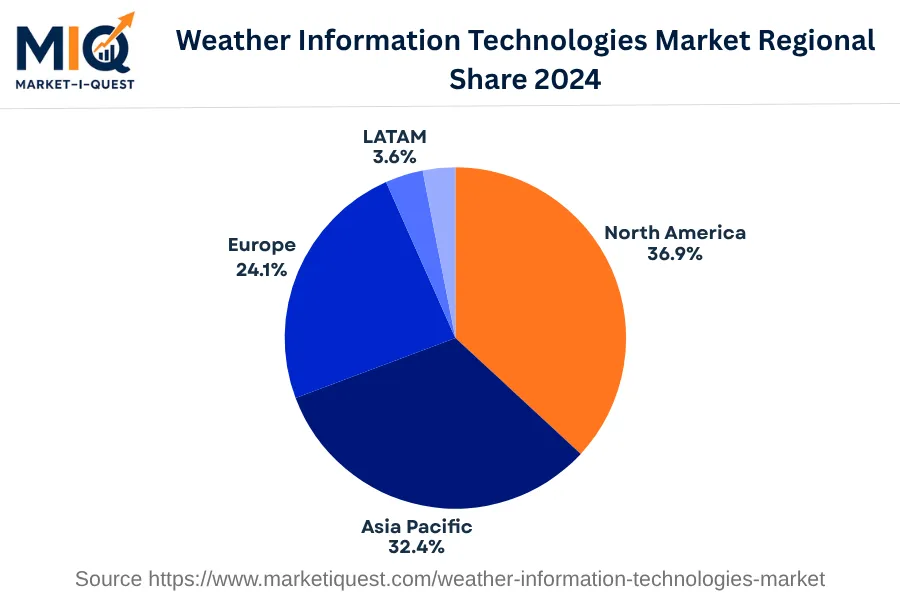
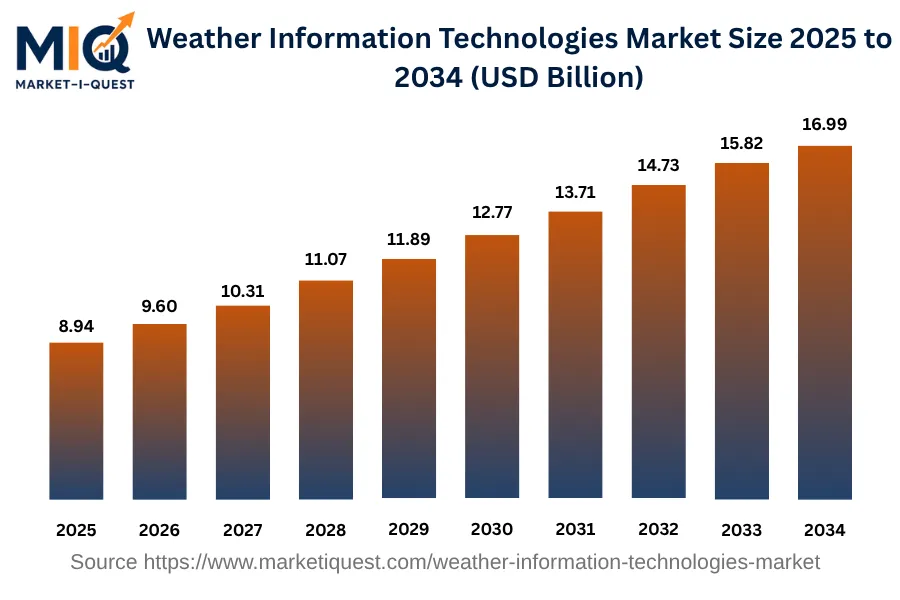
The Weather Information Technologies Market stood at USD 8.94 billion in the year 2025, slightly up from 8.32 billion in 2024. Based on the historical growth trajectory, the market is predicted to approximately double by 2034, reaching a value of USD 16.99 billion at a CAGR of 7.4%. This substantial leap is largely a product of increasing global reliance on accurate weather information technologies to predict environment-related anomalies and natural disasters. Improvement in technological infrastructure also contributed towards the market growth, making sophisticated weather information systems accessible to a larger section of the global population. The regional breakdown of market share in 2024 depicted North America with the highest stake at 36.9%, closely followed by Asia Pacific at a 32.4% share. Europe stood third, accounting for 24.1% of the global market while Latin America and the Middle East & Africa (MEA) held comparatively minor shares at 3.6% and 3.1%, respectively.

Key Takeaways

  • By Component- Communication Devices led accounting for a substantial market share in 2024.
  • By Application - Weather Monitoring and Forecasting held a leading position in 2024.
  • By Range - Long-Range Forecast led the market with a significant share in 2024.
  • By End Use - Power & Energy subsegment led the market holding a significant position in 2024.
weather-information-technologies-market market size

Key Driving Factors

Proliferation of Precision Agriculture

In farming, the ability to forecast weather conditions accurately is critical and often the difference between a successful harvest and a damaged crop. This is especially true for precision agriculture, an approach gaining traction in the farming industry globally. Precision agriculture hinges on exact data and uses technology to optimize yields and efficiency. With weather information technologies, farmers receive precise weather updates and predictions, enabling them to time planting, harvesting, and other actions optimally. Therefore, increased adoption of precision agriculture directly contributes to the growth of demand for weather information technologies.

Growth in Renewable Energy Sector

Renewable energy projects depend heavily on weather conditions, and weather information technologies are indispensable in this domain. Solar energy production, for instance, relies on clear sunshine while wind energy production thrives in gusty climates. Accurate weather forecasting allows renewable energy companies to predict their energy production levels reliably, leading to better planning and grid management. The renewable sector's growth, particularly in wind and solar initiatives, drives the need for advanced weather information technologies for enhanced precision in weather data and forecasts.

Market Evolution by Timeline

2019-2023
During this phase, the Cloud-based platforms made a strong entry into the market, used mainly by shipping and logistics companies needing to plan operations around weather conditions. Most technologies shipped were weather satellites and radars, while major constraints were the high costs and lack of technical expertise. Policy-wise, the World Meteorological Organization (WMO) established the WIS (WMO Information System) standard, promoting global exchange of meteorological and related data. Commercially, organizations leaned towards subscription-based models, given the stiff upfront costs of these technologies, often forming partnerships with service providers to manage these. The primary risk was data security, which was mitigated by heavy investments into cybersecurity measures.
2024
This period saw noteworthy adoption of weather informatics by the agriculture and renewable energy sectors, largely in North America and Europe. Weather balloon technologies became more sophisticated, but faced deployment challenges due to harsh weather conditions. Regulation wise, the European Union boosted the European Meteorological Satellite Programme, aiming for better weather predictions and risk management. Service contracts started featuring performance clauses linking quality of weather forecasts to payments. Here, data accuracy became a prominent risk; it was typically managed via stricter SLAs (Service Level Agreements) with technology providers.
2025-2029
By now, weather technologies saw higher adoption in developing countries for disaster management purposes. The technology supply chain was flush with weather drones which faced regulations on flying zones and hours. Policy-wise, the UN's Sendai Framework for Disaster Risk Reduction encouraged nations to adopt early weather warning systems for disaster management. The commercial model shifted to include on-demand pricing for data, and vendor partnership models were common, bridging the technology affordability gap. The risk was primarily regulatory, due to stringent drone laws; this was typically managed with country-specific compliance frameworks.
2030-2034
The adoption of weather technologies was widespread across sectors, globally. Advanced weather satellites dominated the supply side, but their large-scale integration was a challenge due to interoperability issues. More space-friendly regulations, such as NASA's Commercial Smallsat Data Acquisition Program, arrived to facilitate widespread data exchange. Pricing models evolved to incorporate usage-based models. Partnerships between technology companies and satellite operators became more frequent. The most significant risk arose from potential space debris causing damage to satellites, which was managed by leveraging space situational awareness services.

Future Market Outlook

Future Opportunities

The emergence of climate change as a significant global concern is creating various opportunities within the weather information technologies market. With the 2021 UN Climate Change Conference highlighting the urgent need for adaptation strategies, companies are now exploring tools that integrate weather data with disaster readiness initiatives. A notable example is The Weather Company’s partnership with local governments across the United States, launched in 2023, aimed at developing bespoke warning systems for natural disaster preparedness. Information issued by the National Oceanic and Atmospheric Administration in 2022 emphasized the growing importance of predictive analytics in anticipating climate extremes. In Australia, the Bureau of Meteorology is expected to enhance its services by integrating marine weather information systems, a development initiated in 2021, reflecting a wider trend in coastal management efforts. The ongoing rise of smart city initiatives globally positions weather technologies as critical components in urban planning and infrastructure development. The European Union’s Green Deal, introduced in 2019, necessitates data-driven decisions that could empower weather tech firms to collaborate with municipalities for sustainable resource management. As these governmental bodies focus on building resilience against climate impacts, firms equipped with advanced analytics and forecasting capabilities may find robust opportunities to serve niche markets effectively. These ongoing trends highlight a growing interconnection between weather forecasting and environmental management strategies, indicating significant reliance on accurate weather information in planning and responsive measures.

Segmentation Analysis

By Component

The market is divided into subsegments including Communication Devices, Monitoring Devices, Software, and Others. Communication Devices accounted for the largest revenue share while Software is expected to grow at the fastest CAGR during the forecast period.

Largest Revenue Share

Communication Devices

Market Share Leader

Communication devices lead the way in revenue generation for the market segment due to a variety of factors. Primarily, the increasing addiction to smart devices and internet among all age groups globally is driving the need for advanced and sophisticated communication devices. The role of communication devices in our daily lives is indispensable, which further magnifies their importance across all regional markets. Besides, with the digital transformations across industries, businesses are heavily relying on communication devices, providing a significant boost to this sub-segment. There is also a regulatory push in developing economies for enhancing communication infrastructure. Purchasing decisions often hinge on the device’s compatibility with various formats and protocols, its speed, and costs. The presence of big-ticket players and the proliferation of resellers and distributors make this segment further attractive in terms of revenue generation. It's worth noting that while demand is high, so too is the competition, which may impact future share of revenue.

Fastest CAGR

Software

Forecast Period Growth Leader

Despite not leading in terms of revenue, Software sub-segment is expected to witness the fastest growth. As digitization continues to permeate every sector, the requirement for software solutions has seen a sharp surge. Key drivers for this growth include the rapid technological advancements and continuous innovation in software development. The shift towards software-defined infrastructure across industries is also catalyzing this growth. Regulatory changes, with many governments pushing for digital adoption, are compelling businesses to invest more in software solutions. However, barriers like high acquisition and switching costs could decrease the rate of adoption. Partnership between software developers and educational institutions for skill development can increase understanding and usage. Near-term risks include cybersecurity threats and compliance with different regulations. Assuming a sustained focus on digital transformation across industries, the software subsegment is likely to maintain a high CAGR.

By Application

The market is divided into subsegments including Air Quality Monitoring, Weather Monitoring and Forecasting. In the base year 2024, Weather Monitoring and Forecasting accounted for the largest revenue share while Air Quality Monitoring is expected to grow at the fastest CAGR during the forecast period.

Largest Revenue Share

Weather Monitoring and Forecasting

Market Share Leader

Weather Monitoring and Forecasting emerged as the largest revenue producing segment in 2024 due to a surge in demand driven by various factors. Primarily, increasing extreme weather events resulting from global climate change have highlighted the need for reliable and timely weather forecasts. Implementation of sophisticated technologies, such as satellite monitoring and radar technologies, have introduced new capacities for weather prediction, thereby driving demand and revenue. Geographically, developed markets, with their advanced technological capabilities have contributed significantly towards this revenue. From an economic perspective, key customers for this sector include not only governmental meteorological agencies, but also private entities in the transportation, agriculture, and energy sectors, where weather prediction is integral to operation and risk management strategies. Implementation regulations and policies regarding disaster management also play a role in driving the demand for Weather Monitoring and Forecasting.

Fastest CAGR

Air Quality Monitoring

Forecast Period Growth Leader

Despite not being the largest revenue subsegment, Air Quality Monitoring is forecasted to have the fastest CAGR during the forecast period. The urgent need to address environmental concerns provides the foundational driver pushing its growth. Amid growing awareness and regulatory pressure, industries and governments are moving towards more rigorous air quality control systems, lending momentum to the segment's growth. Innovative technology adoption and the integration of internet of things (IoT) into air quality monitoring systems also serve as significant growth catalysts, enabling real-time quality mapping and remote pollution surveillance. Key adoption barriers include high initial capital costs and technical complexities of advanced monitoring equipment. Near-term risks include inconsistent regulatory landscapes across regions and challenges related to data management and analysis.

By Range

The market is divided into sub-segments including Short-Range Forecast, Medium-Range Forecast, and Long-Range Forecast. Based on the 2024 base year data and market trends, the Long-Range Forecast accounted for the largest revenue share, while Short-Range Forecast is expected to grow at the fastest compounded annual growth rate (CAGR) during the forecast period.

Largest Revenue Share

Long-Range Forecast

Market Share Leader

The Long-Range Forecast currently leads in revenue contribution due to several driving factors. The global business landscape is witnessing a rise in strategic planning endeavors where organizations rely heavily on long-term forecasting for their major decisions which ranges from capacity expansion to entry into new markets and long term resource allocation. This has facilitated a steady demand for Long-Range Forecasts. Geographically, developed regions such as North America and Europe are particularly contributing to this trend, owing to the presence of many large organizations and a mature market environment. Additionally, regulatory norms and compliances across several industries compel businesses to undertake long-range forecasting aiding this subsegment's growth. Furthermore, the feasibility of switching between different forecast ranges is relatively low once businesses align their strategy to a certain range, thus contributing to sustained revenue dominance for the long-range forecast.

Fastest CAGR

Short-Range Forecast

Forecast Period Growth Leader

Despite not leading in revenue as of the base year 2024, the Short-Range Forecast subsegment is projected to grow at the quickest pace in the market. Businesses are finding value in short-term forecasting for quick decision-making, adjustments, and agility, especially amidst volatile market conditions. Technological advancements have fostered the adoption of short-range forecasting with improved accuracy, enabling businesses to get instant insights for operational decisions. The rise in the number of small and medium-sized enterprises, particularly in emerging markets, is accelerating this growth. These companies often lack the resources to commit to long-range forecasts, therefore, prefer short-term predictions. However, near-term risks include market oversaturation and the increasing adoption of AI and machine learning could pose challenges in the traditional market setup. As businesses invest in infrastructure and partnerships with tech firms to overcome these barriers, the short-range forecast subsegment is set to see an accelerated growth rate.

By End Use

The end use market is segmented into sub-sectors including agriculture, industrial, transportation, power & energy, government & defense, meteorology & weather service provider, and others. In 2024, the power & energy sector accounted for the largest revenue share while the agriculture sector is expected to grow at the fastest CAGR during the forecast period.

Largest Revenue Share

Power & Energy

Market Share Leader

The dominant position of the power & energy subsegment stems largely from the increasing global demand for energy and the subsequent investment in infrastructure to meet this demand. It's a sector that encompasses various industries including oil & gas, renewable energy, and nuclear power, all of which require intensive data collection, monitoring, and management. This combination of growing demand and technological advancement has created a constant cycle of investment, innovation, and implementation, driving substantial revenue into the sector. Furthermore, factors such as rising energy consumption, emergence of smart grids, evolving energy policies, and increasing electricity generation capacities are fueling its growth. On the regulatory front, many governments are encouraging the use of renewable energies and investing heavily in this direction, which is further driving the segment's revenue share.

Fastest CAGR

Agriculture

Forecast Period Growth Leader

The agriculture subsegment is projected to grow at the fastest rate over the forecast period. Technological advancements and the integration of advanced analytics are transforming agricultural practices. Precision farming and data-driven decision making in agriculture are leading to increased crop yield and optimised use of resources, which is driving the subsegment’s growth. Adoption barriers include limited technical know-how and high initial investment required for advanced solutions, but this is being increasingly mitigated by government interventions and initiatives promoting the benefits of data-driven and sustainable farming practices. As digital transformation continues to revolutionize the agriculture sector, factors such as climate change, population growth, and food security will continue to drive demand for these solutions and services, thereby influencing the sector's growth positively.

Competitive Analysis for Weather Information Technologies Market

Key Market Players

Manufacturers / OEMs

IBM
US
Kachelmann Group
Switzerland
Sutron Corporation
US

Key Suppliers & Raw Materials

Vaisala
Finland
Met One Instruments Inc.
US
Scientific Sales, Inc.
US

Distributors, Integrators & Channel Partners

Campbell Scientific, Inc.
US
WeatherBuild Inc
US
Airmar Technology Corporation
US

Porter’s Five Forces Analysis

An examination of the competitive dynamics within the Weather Information Technologies Market.

Supplier Bargaining Power

High

Suppliers dominate due to specialist technology and domain-specific data requirements.

Buyer Bargaining Power

Medium

Buyers show moderate power due to various vendor options, but switching costs can be considerable.

Threat of Substitutes

Low

Alternative systems are hard to design due to high R&D costs and technical expertise needed.

Threat of New Entrants

Low

High capital expenditure, technical complexity, and certification barriers make entry difficult.

Competitive Rivalry

High

Numerous competitors offer similar technologies, amplifying the competition.

Regional Analysis

Geographic market dynamics and growth opportunities across key regions

Global Market Outlook

weather-information-technologies-market market regional share

North America

In 2024, North America's Weather Information Technologies Market experienced noteworthy growth primarily driven by varied market forces. Technological adoption rose as enterprises across the U.S., Canada, and Mexico leveraged weather data for operational efficiency. Regulatory standards emphasized accurate, timely weather forecasting, stoking greater demand for specialized technologies. Investments surged, with stakeholders exploring advanced solutions for predictive analytics.

Trends in the market included a shift toward AI and machine learning for data processing and meteorological predictions. Industries, namely utilities and retail, adopted these technologies to drive decision-making processes and manage supply-chain risks. The U.S. government demonstrated noticeable interest, integrating weather information technology into public safety protocols. These developments led to an increasingly competitive market landscape, driving innovation and partnerships.

Cloud-based platforms gained traction, underlining a shift in buyer behavior and channel dynamics. Standards in data security and privacy remained prominent, influencing technology design and offerings. Lastly, policy enforcement became a critical element, particularly in the U.S., contributing to market credibility and reliability. Altogether, North America's Weather Information Technologies Market saw a robust growth, reinforced by key drivers and trends. The confluence of technological adoption, investments, regulations, evolving customer behavior, and advanced products have shaped the market narrative of 2024.

Asia Pacific

In 2024, the Asia Pacific Weather Information Technologies Market thrived due to heightened demand and technological advancements. Rapid industrialization and urbanization in China and India fueled the need for accurate weather data. Government sectors, particularly in Japan and South Korea, prioritized investment in sophisticated meteorological tools for disaster preparedness and mitigation. Increasing adoption of advanced technologies, such as Artificial Intelligence and Machine Learning, also boosted market growth.

Evolving buyer behavior marked a significant trend in 2024. Growing awareness led businesses, especially utilities and manufacturing industries, to integrate weather technology into their operational strategies. In Australia, technology shifts occurred with a rise in digitally-enabled weather forecasting solutions that companies could integrate with their intelligence systems. Mergers and Acquisitions were prevalent across key ASEAN markets. For instance, the acquisition of Thailand's weather tech firm Signalware by Vietnamese enterprise OpenWeather signified a market trend towards consolidation and market share expansion. A shift towards global standards in weather information technology usage was seen, driven largely by concerns over climate change and environmental impact assessments.

Demand came from numerous sectors. Government organizations, healthcare providers, and businesses in retail and manufacturing sectors utilized these technologies extensively to support planning, risk assessment and decision-making processes. Emerging economies in the Asia Pacific demonstrated ingenuity, advancement, and astute market sense within the expanding Weather Information Technologies Market.

Europe

In 2024, the Weather Information Technologies market in Europe saw a significant evolution with regulatory changes, advances in technology, and changing environmental conditions. The introduction of stringent regulations, primarily by EU bodies, to mitigate climate change induced a heightened demand for accurate weather data. Investment in advanced weather forecasting technologies witnessed an uptick in countries such as Germany, the UK, and France due to increased awareness of climate phenomena. Rapid adoption of remote sensing and automated weather station technologies, especially in sectors like utilities and retail, also fuelled market growth. In supply dynamics, increased investment in satellite meteorology by European space agencies improved data accuracy and availability.

Trends in 2024 pointed towards the incorporation of artificial intelligence in weather forecasting and data analysis, predominantly driven by the sectors like enterprise, government, and healthcare. Notably, the Nordics saw an increase in public-private partnerships to share weather data for mitigating the effects of extreme weather conditions. In the UK and Central & Eastern Europe, online platforms became the dominant channel for dissemination of weather information, while the scope of M&A activities grew in Spain and Italy. Furthermore, enforcement of open-data policies in Benelux countries transformed access to weather information, indicating a shift towards data democratization within the industry.

Latin America

In 2024, the Weather Information Technologies Market in Latin America (LATAM) showed significant dynamism and growth potential. Drivers for this market were chiefly increased investment in the sector, evident in countries like Brazil and Mexico, adoption of advanced meteorological forecasting tools by various governmental bodies, as well as heightened demand in sectors such as retail, utilities, and manufacturing for accurate weather insights to forecast demand and adjust supply chain dynamics. Governmental policies such as Argentina's National Meteorological Service modernization initiative also spurred market growth.

Market trends for 2024 revolved around partnerships and acquisitions, with notable examples like Chile's tie-up with international meteorological tech firms to enhance weather prediction accuracy. There was also a noticeable move towards AI-based forecasting tools in sectors such as enterprise and manufacturing, particularly in Peru and Colombia. Policymaking also persistently encouraged adoption of weather tech, fostered in part by growing awareness of climate change. Standards for weather forecasting technologies were increasingly recognized and enforced within LATAM, leading to a rise in demand for certified products. These elements coalesced to shape a market that was continually evolving, adapting, and growing throughout the base year.

Middle East & Africa

In 2024, the Weather Information Technologies sector witnessed marked growth across both the Middle East and Africa, driven largely by necessity and technological advancement. Increasing environmental awareness, coupled with the critical demand for accurate weather data due to prevailing extreme weather patterns, fueled the market's expansion. The drive towards diversification from oil-centric economies, notably in Saudi Arabia and the UAE, led to significant investments in advanced climate monitoring systems, especially within the agriculture and renewable energy sectors. Concurrently, growing technological adoption in nations like Kenya and Nigeria accelerated the supply dynamics.

Key trends shaping the marketplace included a rising reliance on weather forecast technology in sectors such as tourism, aviation, and disaster management. The use of sophisticated meteorological equipment and data analysis tools became more prevalent, particularly in countries such as Egypt and Israel, recognized for their pioneering technology environments. In South Africa, regulatory bodies enforced stringent standards for weather prediction accuracy, influencing product development significantly. There was also an evident increase in collaborative efforts between weather information technology providers and channels such as telecom companies and utilities across the region, resulting in the enhancement of service capabilities and offerings. Finally, the deployment of these technologies by government agencies and financial services bore witness to the sector's widening client base.

Recent Industry Developments

Latest market innovations, product launches, and strategic initiatives

May 2026

The agency launched an AI-powered system that provides highly local weather forecasts down to a single kilometer. This model tracks monsoons to assist farmers and requires far less computer processing power than older forecasting methods.

January 2026

Nvidia released a new artificial intelligence platform designed specifically to speed up global weather forecasting. This launch demonstrates a broader trend of massive computer hardware companies pushing directly into weather prediction services.

October 2025

Vaisala introduced Elements Lite, a software program for real-time weather tracking. The platform pulls data directly from automated outdoor sensors to help businesses make quick operational decisions without needing complex in-house setups.

Frequently Asked Questions