
Weather Forecasting System and Solutions Market Snapshot

Key Players

  • IBM (The Weather Company) (United States)
  • Vaisala (Finland)
  • Fugro (Netherlands)
  • Meteo Group (United Kingdom)
  • StormGeo (Norway)
  • AccuWeather Inc. (United States)
  • Kachelmann GmbH (Germany)
  • MeteoBlue (Switzerland)
  • Weathernews Inc. (Japan)
  • Campbell Scientific
  • Inc. (United States)

Market Size

Base Year 2024
$3.6 Bn
CAGR
11.7%
Forecast 2034
$10.89 Bn

Market Segments

By Component
  • Hardware
  • Software
By Range
  • Short-Range Forecast
  • Medium-Range Forecast
  • Long-Range Forecast
By End Use
  • Agriculture
  • Industrial
  • Transportation
  • Power & Energy
  • Government & Defence
  • Meteorology & Weather Service Provider
  • Others

Market Dynamics

Drivers
  • Increasing climate change concerns
  • Advancements in prediction technology
Restraints
  • High installation costs
  • Lack of skilled professionals
Opportunities
  • Emerging smart city initiatives
  • Advancements in meteorological technologies

Market Size

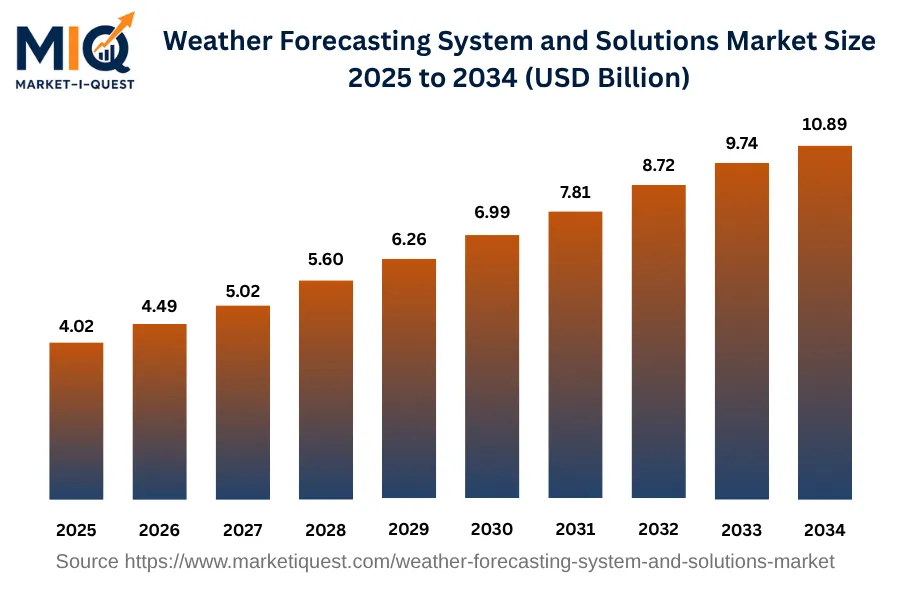
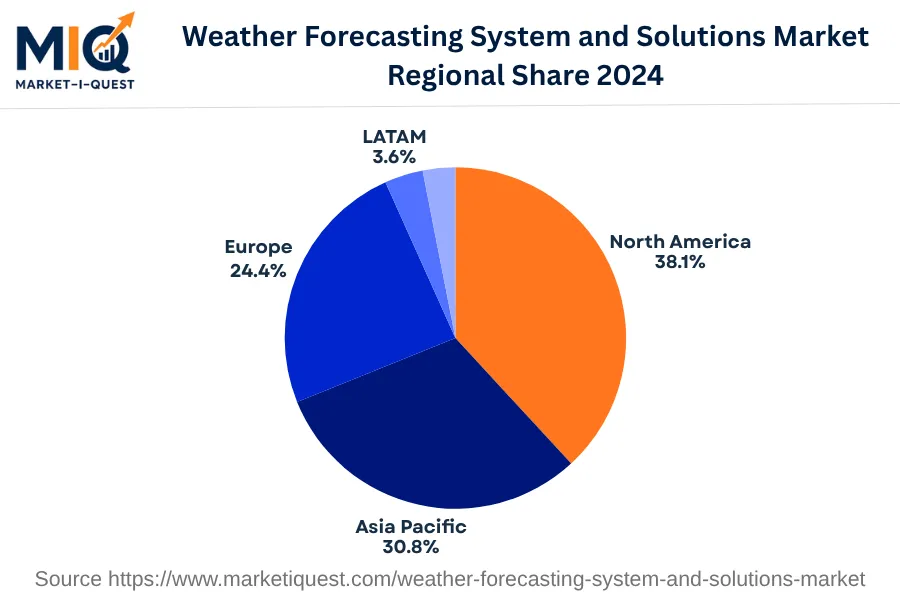
The Weather Forecasting System and Solutions Market stood at USD 3.60 billion in 2024 and then grew to USD 4.02 billion in 2025. By 2034, this market's size is projected to reach USD 10.89 billion, reflecting a CAGR of 11.7%. The market has charted a steady growth trajectory from 2025 to 2034 largely due to the continuous advancements and adoption in the technology of weather forecasting systems and solutions. Given the importance of accurate weather forecasts in sectors like maritime, aviation, agriculture, and disaster management, the demand for modern, reliable systems and solutions in weather forecasting has risen in due course. Looking at the regional share in 2024, North America had the highest share of 38.1%, followed by Asia Pacific at 30.8%. Europe accounted for 24.4% of the market size whereas Latin America and Middle East and Africa (MEA) had much smaller shares of 3.64% and 3.08% respectively.

Key Takeaways

  • By Component - Hardware held a majority share in 2024.
  • By Range - Medium-Range led the market with a significant market share in 2024.
  • By End Use - Power & Energy led the market in terms of demand in 2024.
weather-forecasting-system-and-solutions-market market size

Key Driving Factors

Surge in Aviation Industry's Demand for Weather Predictive Tools

One distinct driving factor for the Weather Forecasting System and Solutions Market is the increasing need within the aviation sector for superior weather predictive tools. The industry hinges on accurate and timely weather predictions to ensure safety and efficiency of operations. Airline companies, airports, air traffic control, and logistics and supply service providers rely on weather forecasting systems to mitigate weather-related risks. Ensuring flight safety in volatile weather conditions, planning flight paths, and coordinating ground operations and auxiliary services are all significantly influenced by these systems. This operational reliance has led to a surge in the adoption of sophisticated weather forecasting solutions in the aviation industry.
Regulation-driven Utility Integration

The second key driver for the Weather Forecasting System and Solutions Market is the obligation for utility providers, especially in the energy sector, to integrate weather forecasting systems into their operational frameworks. Regulatory bodies like the Federal Energy Regulatory Commission (FERC) in the US mandate grid operators to have advanced weather predictive capabilities for optimal energy management. These regulations aim at improving disaster management, minimising power outages, and supporting renewable energy assets whose output is highly dependent on weather conditions. Complying with such requirements has boosted the adoption and spend on weather forecasting systems and solutions by utility providers worldwide.

Market Evolution by Timeline

2019-2023
During this period, demand for weather forecasting systems predominantly came from governmental organizations, aviation and energy industries due to concern over environmental changes and climatic catastrophes. Key regions with high demand were North America and Europe due to high levels of technological adoption and environmental consciousness. Cloud-based weather forecasting systems gained traction due to their scalability and cost-effectiveness. Constraints included high setup cost and complexity of systems. GDPR compliance impacted tracking and sharing of atmospheric data in Europe. Fixed pricing model was the norm, but partnerships with tech companies like IBM began shaping the market. A key risk was inadequate meteorological knowledge and trained workforces to operate such advanced systems.
2024
In 2024, the demand surge in Asia-Pacific region due to growing investments in smart city infrastructure and disaster management systems. Early warning systems for agriculture also witnessed increased uptake. Solution integration with IoT and AI technologies were witnessed, yet maturity levels remained low. Issues around data privacy continued to challenge the market. Open source solutions began to disrupt traditional pricing models and create opportunities for new partnerships. The main risk was inaccurate predictions due to low integration maturity.
2025-2029
By mid-decade, we saw a rise in demand from the insurance industry eager to manage climate-related risks. Weather forecasting became more democratized, with apps and services offering professional-grade forecasts to everyday consumers. Weather prediction models improved due to the growing implementation of deep learning algorithms. The UN's Sustainable Development Goals drove policy shaping adoption. Monthly subscription services became common due to the widespread usage among consumers. Inaccuracy of weather forecasts and resulting litigation posed a risk, driving investment in model refinement.
2030-2034
Eventually, we saw broad-based demand due to exposure of various sectors to climate-related risks. Geographically, Africa became a key market with mobile-based weather services gaining popularity. Weather satellites and supercomputers made longer-term forecasts more accurate and reliable. As data-sharing became the norm due to eased regulations, data security remained a crucial challenge. Flexible pricing models based on usage grew ubiquitous, driving affordability of forecasting solutions. Constant technology upgrades and user adaptation became the biggest issues in this period.

Future Market Outlook

Future Opportunities

The evolving landscape of the weather forecasting system and solutions market presents numerous future opportunities driven by ongoing advancements and emerging needs. As climate variability increases, countries like Australia and the United States are prioritizing enhanced weather prediction systems to mitigate natural disaster impacts. Current pilot programs, such as those by the Federal Aviation Administration to integrate weather data into air traffic management, indicate a substantial push towards streamlined operations using accurate forecasting. Smart cities are also harnessing weather data, as evidenced by initiatives in cities like Singapore, to improve urban planning and disaster management. The push for sustainable practices has led to a rise in demand for agricultural weather solutions. In 2023, companies like DTN began deploying specialized weather solutions tailored for farmers, enhancing their decision-making processes. Additionally, the emphasis on personal weather services, exemplified by apps from AccuWeather, provides opportunities for micro-local forecasting tailored for individual users. Governments worldwide are encouraging investment in predictive analytics and IoT-based meteorological systems to foster resilience against climate impacts. The successful integration of these cutting-edge systems will likely reshape public and private sector interactions, offering an array of applications ranging from environmental monitoring to efficiency improvements in sectors such as agriculture and transportation, thereby creating a multifaceted market landscape.

Segmentation Analysis

By Component

The market is divided into subsegments including Hardware and Software. Among these, Hardware accounted for the largest revenue share while the Software is expected to grow at the fastest CAGR during the forecast period.

Largest Revenue Share

Hardware

Market Share Leader

The Hardware market has seen a dominant position in the past several years due to the consistent requirement for physical infrastructures in various industries. From manufacturing devices to operating systems, Hardware stays as the key component and inevitably positioned at the top of the revenue share. Geographically, regions with higher industrial output, especially those in transition from traditional industries to digital operations, fuelled the largest consumption. Moreover, regulations and standards that promote the use of certain types of hardware have also contributed to its share of revenue. These hardware components, once installed, have high switching costs as replacing them often requires substantial capital and operational adjustments, which further strengthens the Hardware market position. Even with the emergence of cloud computing and software, the demand for hardware remains firm as it forms the foundation for any digital platform.

Fastest CAGR

Software

Forecast Period Growth Leader

Despite Hardware's significant revenue share, the Software subsegment is seeing faster growth. As businesses digitalize their operations, the need for sophisticated software solutions accelerates. Moreover, the rise in trends such as Software as a Service (SaaS) opens up cost-effective avenues for businesses, thereby reducing the barrier to adoption. Technology trends like AI, machine learning and big data are acting as key catalysts, driving the need for advanced software solutions. However, near-term risks include security concerns and regulatory scrutiny over data privacy. Potential partnerships between software providers and end-user industries have been fueling the rapid growth rate as well. It remains to be seen how the play-off between software advancement and security concerns will influence the future growth of this segment.

By Range

The market, as segmented by range, is divided into subsegments including Short-Range Forecast, Medium-Range Forecast, and Long-Range Forecast, with the Medium-Range Forecast subsegment accounting for the largest revenue share and the Long-Range Forecast expected to grow at the fastest CAGR during the forecast period.

Largest Revenue Share

Medium-Range Forecast

Market Share Leader

The Medium-Range Forecast subsegment dominates the market in terms of revenue. This can be attributed primarily to its broad applicability and indispensability across various industries. It remains sufficiently extensive for long-term strategic planning involved in many business operations, yet detailed enough to be actionable in the short term. Unlike the Short-Range Forecast, the medium range offers a more comprehensive view of market trends, allowing for more informed business decisions. As a result, majority of businesses rely heavily on medium-range forecasts, explaining why this subsegment holds the largest market share. Furthermore, regulations requiring businesses to forecast and report their financials over a medium-term horizon are substantiating this subsegment's market dominance. Lastly, the Medium-Range Forecast benefits from well-established sales channels and minimal switching costs for customers, which encourages its uptake.

Fastest CAGR

Long-Range Forecast

Forecast Period Growth Leader

On the other hand, the Long-Range Forecast subsegment is projected to grow at the fastest CAGR, despite not holding the largest revenue share. This rapid growth is primarily facilitated by technological advancements, industry evolutions and shifts towards long-term strategic planning among corporations. Companies are increasingly recognizing the importance of long-range forecasting for assessing the viability of their strategic initiatives, fostering partnerships and conducting elaborate risk assessments. As a result, the demand for long-range forecasts is increasing expeditiously. Nevertheless, certain barriers remain. The cost of implementing advanced forecasting tools may discourage small to medium sized enterprises. Additionally, long-range forecasts can be more uncertain due to the unpredictable nature of market dynamics over extended periods. However, with continued technological improvements and declining costs, these barriers will likely diminish, further augmenting this subsegment's growth.

By End Use

The market is divided into subsegments including Agriculture, Industrial, Transportation, Power & Energy, Government & Defence, Meteorology & Weather Service Provider, and Others. Power & Energy accounted for the largest revenue share while Agriculture is expected to grow at the fastest CAGR during the forecast period.

Largest Revenue Share

Power & Energy

Market Share Leader

The Power & Energy sector stands as the subsegment with the largest revenue share in 2024. The consistent need for power generation and energy infrastructure worldwide, especially in emerging economies, is a major driver. As the world's population continues to increase, more energy is required. This leads to greater market revenue in the Power & Energy sector. Moreover, regulatory compliance and measures to curb emissions worldwide have triggered transformations in the energy & power sector, encouraging a shift toward cleaner and renewable energy. The rise in the number of power plants and grids, and the need for their regular maintenance and upgrades also support this subsegment's leading position in terms of revenue. On the supply side, various technological advancements and increasing investment in research and new product development continue to contribute to the sector’s larger share.

Fastest CAGR

Agriculture

Forecast Period Growth Leader

The Agriculture subsegment holds the strongest CAGR outlook. The consistent population growth worldwide results in an increasing demand for food and agricultural products, acting as a significant driver for the growth of this segment. Further advancements in Agro-technology, like genetically modified crops and precision farming, are expected to propel fast growth. The rise in tech-enabled farming methods and government policies supporting sustainable agriculture are key catalysts for the growth in this sector. However, the transition from traditional farming methods to technologically advanced practices is a potential barrier. There is increasing investment in developing countries to boost productivity, and partnerships between technology providers and farmers. Near-term risks could include climate change and its impact on crop yield, and potential resistance towards GMOs and other tech farming practices.

Competitive Analysis

Key Market Players

Manufacturers / OEMs

IBM Corporation
US
StormGeo
Norway
Fugro
Netherlands

Key Suppliers & Raw Materials

The Weather Company
US
Campbell Scientific
US
Davis Instruments
US

Distributors, Integrators & Channel Partners

Thales Group
France
Vaisala
Finland
MeteoGroup
UK

Porter’s Five Forces Analysis

This analysis operates on the dynamics affecting the Weather Forecasting System and Solutions Market competitiveness.

Supplier Bargaining Power

Medium

Suppliers have various technologies to offer, but the high investment in R&D limits their bargaining power.

Buyer Bargaining Power

High

Excess availability of suppliers and increasing competition boost buyer negotiation power.

Threat of Substitutes

Low

Few alternatives exist due to the specificity and complexity of weather forecasting systems.

Threat of New Entrants

Medium

Entry is limited by high capital expenditure, regulation factors, and technological know-how requirements.

Competitive Rivalry

High

The market exhibits strong rivalry due to multiple well-established competitors, product innovations, and service quality.

Regional Analysis

Geographic market dynamics and growth opportunities across key regions

Global Market Outlook

weather-forecasting-system-and-solutions-market market regional share

North America

In 2024, the Weather Forecasting Systems and Solutions Market in North America was characterized by a dynamic interplay of demand factors, technological advancements, and policies. Fundamental to its momentum was the rising demand from sectors such as government, utilities, and aviation for accurate, real-time meteorological data that is critical for operational and strategic decisions. In tandem, investment in research and development of cutting-edge weather forecasting technologies by key players such as IBM and AccuWeather contributed heavily towards ensuring efficient services demanded by these sectors.

From a trend perspective, an adoption of artificial intelligence and machine learning technologies was prominent, revolutionizing the forecasting capabilities by providing precise, long-term weather predictions. Government entities, in particular, sought after these advanced solutions due to public safety concerns during extreme weather conditions. Coupled with this was a series of alliances like the one between Microsoft and NOAA, where the former’s Azure platform was used to enhance the weather prediction capabilities of NOAA.

Moreover, policy enforcement was keenly felt in 2024 via the passage of the Weather Research and Forecasting Innovation Act in the U.S., which enabled technology developments and innovation partnerships. In Canada, the focus on Climate Data Modernization was aimed at ensuring accurate weather forecasts. By contrast, Mexico prioritized strengthening infrastructure resilience and accuracy of weather forecasts, catering to sectors like agriculture, tourism, and fisheries that are reliant on weather patterns.

Asia Pacific

In 2024, the Weather Forecasting System and Solutions Market in the Asia Pacific stood as a critical component of region's disaster risk management efforts. Increased investment in meteorological technologies by China and India, driven by a growing need to mitigate natural disasters, significantly propelled the market. Japan's adoption of advanced forecasting systems and South Korea's stringent regulations concerning the accurate prediction of weather catalyzed market growth. The voluntary price reduction by Australian weather system manufacturers to foster widespread usage also fueled market momentum.

Market trends in 2024 leaned towards sophisticated solutions with high-resolution modeling. China and India witnessed burgeoning demand for hyperlocal weather forecasting, primarily from agriculture and retail sectors needing location-specific data to optimize operations. The shift towards mobile-based platforms was significant, facilitated by strategic partnerships between tech firms and meteorological solution providers, particularly in Japan and South Korea. Australia and key ASEAN markets advanced their weather forecasting capabilities by enforcing standardization policies for data representation.

The market predominantly catered to government bodies, utilities and certain manufacturing enterprises, requiring accurate weather data for operational planning and disaster management. Healthcare sector's inclination towards weather forecasting solutions also emerged as a unique trend in 2024, making it a noteworthy customer sector.

Europe

In the base year of 2024, the Weather Forecasting System and Solutions Market in Europe witnessed significant traction. Drivers for this surge included increased demand for more accurate and real-time weather prediction systems, stricter environmental regulations, and substantial investment across several key industries like aviation, energy, and shipping. Advances in technology adoption such as AI and machine learning also drove demand, while the supply dynamics were shaped by increasing competition among service providers, leading to reduced pricing for clients.

Notable trends included shifting buyer behavior, with a notable inclination towards providers offering bespoke weather forecasting solutions catered to specific industry needs. Technology shifts incorporating IoT and Big Data analytics were prevalent. Channel dynamics showed a strong bias towards digital and cloud-based platforms. On the business front, strategic partnerships and M&A activities were commonplace, aimed at enhancing forecasting capabilities and expanding market reach.

The demand for weather forecasting systems and solutions came from a broad spectrum of sectors such as utilities, government, retail, and transport. Particularly, the enterprise and manufacturing sectors in Germany, the United Kingdom and France demonstrated a high demand, while the healthcare sector in the Nordics, Benelux, and Central & Eastern Europe also showed a growing need for advanced forecasting services. Following regulations and policies for weather-dependent operations propelled the market in these regions.

Latin America

In 2024, the Weather Forecasting System and Solutions Market in Latin America witnessed significant growth because of evolving needs and increased technological adoption across different sectors. The demand for accurate, real-time weather data drove advancements in predictive weather analytics and monitoring equipment. Notable LATAM countries such as Brazil, Mexico and Chile saw increased investment in weather forecasting technologies by the government and private sectors to mitigate the impact of adverse weather on agriculture and utilities. Regulatory changes in Argentina and Colombia promoted the adoption of cloud-based weather forecasting systems for efficient data processing and storage.

Market trends in 2024 revealed a shift towards precision technology in weather monitoring systems, favoring solutions with higher forecasting accuracy. The rise in public-private partnerships throughout Mexico and Peru enabled enhanced data sharing and increased market competitiveness. Emerging norms for interoperability standards in weather data management in LATAM significantly influenced technological evolution and shift from conventional to digitized solutions. As climate-resilient strategies gained momentum, enforcement of stringent weather data reliability policies became evident.

Sectors like utilities, manufacturing, retail, and agriculture widely utilized reliable weather forecasting systems to optimize their operations and mitigate risk. In enterprise settings, tailored weather solutions brought strategic advantages through enhanced decision-making accuracy. Evidently, the LATAM market for Weather Forecasting System and Solutions in 2024 was dynamic with multiple influential drivers and shifting trends.

Middle East & Africa

In 2024, the Weather Forecasting System and Solutions Market experienced significant progression within the Middle East and Africa, specifically within Saudi Arabia, United Arab Emirates, Qatar, Egypt, South Africa, Nigeria, Kenya, and Israel. Market drivers included an increased demand for reliable weather prediction capabilities amongst key industries – notably governments, oil and gas, utilities, telecom, healthcare, manufacturing, retail, and financial services. Moreover, the Saudi Arabian government's tech adoption policies and Egypt's investment in weather monitoring infrastructure stimulated significant growth in the sector.

Trends in market behavior saw a marked shift towards AI-based solutions, with South Africa and Israel at the helm. The Qatar Meteorology Department fostered a significant partnership with Met Office, a British weather services company, enhancing the region's forecasting quality. This move signified a rising trend in international collaborations to improve weather prediction processes. The emphasis on digital transformation strategies enforced by the United Arab Emirates, most prominently in the UAE National Climate Change Plan 2050, fueled an increased assimilation of tech-enabled weather forecasting solutions. Conversely, stringent data privacy regulations in countries like Nigeria constrained full-scale adoption of certain forecasting technologies, notably those involving cloud-based data storage.

Recent Industry Developments

Latest market innovations, product launches, and strategic initiatives

November 2025

The company launched a new physical air quality monitor that measures airborne particles as they happen. This allows forecasting agencies to track changing pollution and climate conditions alongside traditional weather data.

October 2025

Vaisala introduced a software platform named Elements Lite. It pulls raw data from physical weather stations and turns it into simple, customizable dashboards so businesses can easily understand how incoming weather will impact their daily operations.

March 2025

Google Cloud launched the WeatherNext platform to provide commercial businesses with 15-day weather predictions. They also used this launch to partner with home-appliance companies to automatically adjust heating and cooling systems based on the incoming weather forecasts.

Frequently Asked Questions