
Wearable Camera Market Snapshot

Key Players

  • GoPro
  • Inc. (United States)
  • Sony Corporation (Japan)
  • Samsung Electronics Co. Ltd (South Korea)
  • Garmin Ltd. (Switzerland)
  • Xiaomi Corporation (China)
  • Drift Innovation (United Kingdom)
  • TomTom International BV (Netherlands)
  • Apple Inc. (United States)
  • JVC Kenwood Corporation (Japan)
  • Mobius ActionCam (Taiwan)

Market Size

Base Year 2024
$9.42 Bn
CAGR
14.2%
Forecast 2034
$35.54 Bn

Market Segments

By Type
Body-Worn Cameras, Head-Mounted Cameras, Ear-Mounted Cameras, Clip-On Cameras, Others
By Connectivity
Wi-Fi, Bluetooth, GPS, Cellular, Others
By Resolution
Standard Definition (SD), High Definition (HD), Ultra-High Definition (UHD), 4K, Others
By Sales Channel
Online, Offline

Market Dynamics

Drivers
  • Rising popularity of adventure sports
  • Increasing tech-savvy population
Restraints
  • Privacy concerns
  • High device prices
Opportunities
  • Advancements in wearable technology
  • Expanding outdoor activity trend

Market Size

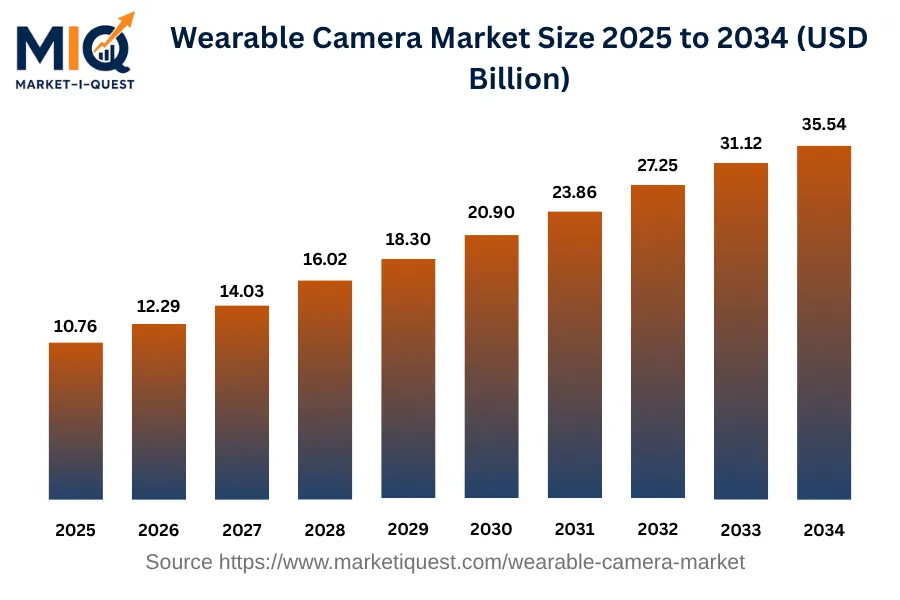
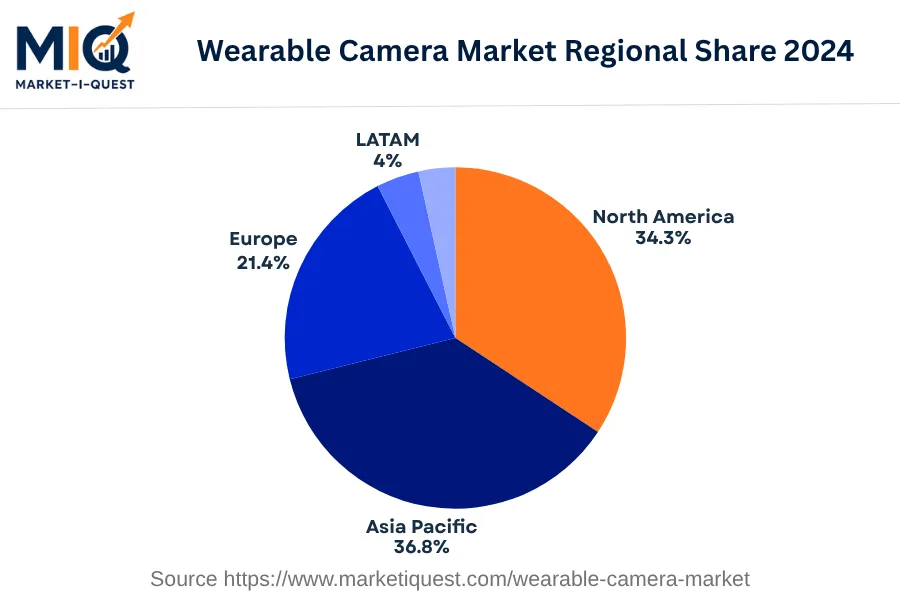
The Wearable Camera Market was valued at 10.76 billion USD in 2025 and is projected to grow at 35.54 billion USD by 2034 with a growing CAGR of 14.2%. The market's growth is primarily attributed to advancements in technology and improving quality and convenience of wearable cameras, increased adoption in industries like sports, media and healthcare, with a in growing consumer demand for sustainable gadgets for capturing real-time activities. By 2024, the regional distribution of the market showed North America accounting for the largest share at 34.3% followed by the Asia Pacific with 36.8%. Europe had a 21.4% of the market share, while the shares of Latin America and the Middle East and Africa (MEA) were at 4.1% and 3.5% respectively.

Key Takeaways

  • By Type - Body-Worn Cameras led the market accounting for the highest share in 2024.
  • By Connectivity - Cellular held the leading position in the Wearable Camera Market during the base period.
  • By Resolution - 4K grew fastest marking significant growth from 2025 to 2034.
  • By Sales Channel - Online sales dominated the market cornering a major share in 2024.
wearable-camera-market market size

Key Driving Factors

Increased Demand for Hands-free Recording by Adventure Sports Enthusiasts

One of the major driving force for wearable camera market growth is the increased interest and participation in adventure sports throughout the globe. Participants in sports like mountain biking, surfing, rock climbing and paragliding actively seek for means to record and share their adventures. While a wearable camera provides an efficient, hands-free solution to capture these activities in high resolution. With features such as compact, lightweight and engineered to sustain rough regions and weather conditions. This need to documenting the experiences from a first-person view has subsequently accelerated the wearable camera market, particularly from this buyer segment. Thus, Consumers are willing to invest in durable and high-quality wearable cameras that can accurately capture their experiences.
Integration of Advanced Features such as AI and IoT technologies

One of major driver of the wearable camera market is the integration of advanced technologies such as Artificial Intelligence and Internet of Things into these devices. These technologies enhance the functionality and convenience of wearable cameras resulting in increased accessibility towards a broader consumer base. For instance, AI can be used for automating video editing, capturing images at the exact time with face and voice recognition. IoT connectivity allows for smooth synchronization with smartphones and other digital devices for easier transfer and editing files. These enhancements directly increase the demand and usage of wearable cameras due to a increasingly focused on digital connectivity and smart technologies.

Market Evolution by Timeline

2019-2023
Between 2019–2023, North America dominated the wearable camera market due to the increased buying capability of consumers and acceptance towards advanced technology. Use cases for the products included action sports such as mountain biking, snowboarding with security purposes. Major market suppliers like GoPro and Samsung, innovated with 4K resolution cameras for enhancing picture quality. Single product sale was the prevailing commercial model while no remarkable standardization or regulation influenced the industry.
2024
In 2024, the Asia-Pacific region demonstrated increased engagement in the wearable camera market. Including regions such as China and India driving demand due to rising personal incomes and increased demand for adventure tourism. Technological advancements included smaller body size, AI-enabled wearable cameras and better battery life with key market players being GoPro and Sony. The most common purchase channel was online retail. Thus, simultaneously promoting industry leaders to form partnerships with cybersecurity firms integrating software at the production stage to strengthen privacy protection features.
2025-2029
From 2025-2029, global wearable camera market was driven by the increased influence by social media and security personnel. With several enterprises starting to leverage wearable cameras for employee monitoring. The introduction of 5G compatible wearable cameras by manufacturers reduced latency issues and improved video streaming quality. With increased demands from North America, Europe and Asia-Pacific regions. Subscription-based sales models were introduced in addition to the regular one-time purchase models. Thus, Collaborative efforts from suppliers and governments led to the establishment of new industry standards for data protection.
2030-2034
Whereas, in the phase of 2030–2034 is the wearable camera market driven by the demand for cameras in smart city applications, household surveillance and law enforcement. With the projection of increased demand in highly populated urban areas across the globe. Providers may introduce more advanced features in products like Augmented Reality-enabled cameras to improve user experience. With increasing focus on stricter privacy regulations for data handling. Increased expectation of suppliers partnering with technological firms , creating ecosystems around their products with cloud storage and connectivity assistance. Thus, the market will continue to be vigilant on data breaches.

Future Market Outlook

Future Opportunities

Future opportunities within wearable camera market are related to current technological advancements and regulatory shifts. In 2023, the increasing popularity of outdoor activities such as cycling and adventure sports are boosting demand for action cameras, encouraging companies like GoPro and DJI to develop increased robust models customized for specific sports. Furthermore, partnerships between wearable camera companies and social media platforms, highlighted by TikTok's collaboration with various camera brands, highlight the growing trend of instant content sharing. While, privacy regulations particularly in regions like Europe and California, necessitate features that allow users for controling data collection, driving manufacturers towards innovating user privacy controls. With the increased health-consciousness within the consumers subsequently increasing opportunities for wearable cameras integrated with fitness tracking features, enhancing the demand towards wellness-based markets. Additionally, developments in augmented reality (AR) and virtual reality (VR) could broaden the scope of wearable cameras with companies like Snap are exploring AR capabilities in their products. The current investments in smart city projects are expecting global acceleration, present increased channels for wearable cameras supporting in urban exploration and real-time data collection. Thus, collaboration with that sector will require companies to adapt their technologies for enhanced public safety applications, further expanding potential market channels driven by the convergence of varied industry needs.

Segmentation Analysis

By Type

The market is divided into subsegments including Body-Worn Cameras, Head-Mounted Cameras, Ear-Mounted Cameras, Clip-On Cameras, and Others. Body-Worn Cameras accounted for the largest revenue share while Clip-On Cameras are expected to grow at the fastest CAGR during the forecast period.

Largest Revenue Share

Body-Worn Cameras

Market Share Leader

Body-worn cameras are dominating the market due to their widespread use in various sectors, notably law enforcement, and for professional and personal safety applications. These cameras offer benefits in terms of accountability and transparency, especially in police-citizen interactions, thus driving their adoption in law enforcement agencies worldwide. Geographies with high crime rates are likely to invest more in these technologies which further bolsters the market size. Additionally, due to the nature of their usage, there are low switching costs as users prioritize reliability and effectiveness. Purchasing criteria are primarily driven by the features of the cameras such as high-definition recording and long battery life. Moreover, the availability of these cameras across different channels including online platforms and security solutions vendors also facilitates their higher sales.

Fastest CAGR

Clip-On Cameras

Forecast Period Growth Leader

Clip-On Cameras are projected to witness the fastest growth during the forecast period. Contributing factors to this growth include their portability, ease of use, and affordability, which are catalyzing their adoption among everyday consumers and not just industry professionals. The improvements in technology and the decrease in manufacturing cost have led to increased production, thus making them easily available and affordable. Barriers to adoption are diminishing as users become more tech-savvy and as manufacturers promote their intuitive user interfaces. However, privacy concerns could pose near-term risks to the growth of this subsegment. The ability to establish trust with consumers by addressing these concerns effectively is crucial for maintaining the growth momentum.

By Connectivity

The market is divided into subsegments including Wi-Fi, Bluetooth, GPS, Cellular, and Others. In 2024, the Cellular subsegment accounted for the largest revenue share while Wi-Fi is expected to grow at the fastest CAGR during the forecast period.

Largest Revenue Share

Cellular

Market Share Leader

Cellular technology, in the connectivity market, accounts for the highest revenue share. This can be attributed to its widespread use across various industries, from communication services to the recent advancements in Internet of Things (IoT). Cellular technology's ability to provide reliable, secure, and high-speed internet connections, even in remote locations, has led to its substantial adoption in both developed and developing economies. Especially with the rollout of 5G, cellular technology is expected to retain its dominant position due to increased demand for high-bandwidth apps and services. Regulatory support in various countries for the implementation of advanced networks further enhances its growth prospects. Additional factors include high switching costs associated with migrating from cellular to other technologies, as well as pre-existing contracts between cellular service providers and customers that create entry barriers for other connectivity solutions. Therefore, Cellular holds the largest revenue share in the base year 2024.

Fastest CAGR

Wi-Fi

Forecast Period Growth Leader

While Cellular makes up the largest share of the connectivity market currently, the Wi-Fi subsegment showcases the fastest growth rate. Particularly important to this is the fact that Wi-Fi offers high-speed internet connectivity without substantial infrastructure costs, spurring its adoption across various commercial and residential settings. The growing connected devices ecosystem, coupled with the advancing smart homes and Internet of Things (IoT) trends, is catalyzing the adoption of Wi-Fi technologies. Additionally, partnerships between Internet Service Providers (ISPs) and tech companies providing Wi-fi solutions are on the rise, fuelling this growth. However, challenges persist, such as security concerns and degradation in speed over long distances, but solutions like Wi-Fi 6 and 6E and WPA3 security protocol are formidable answers to these concerns. Consequently, Wi-Fi is predicted to be the connectivity subsegment with the fastest CAGR during the forecast period.

By Resolution

The market is divided into subsegments including Standard Definition (SD), High Definition (HD), Ultra-High Definition (UHD), 4K, and others. In 2024, the 4K subsegment accounted for the largest revenue share while Ultra-High Definition is expected to grow at the fastest CAGR during the forecast period.

Largest Revenue Share

4K

Market Share Leader

The 4K resolution subsegment holds the majority revenue share in the base year 2024, and this can be attributed to multiple factors. Firstly, the significant improvement in picture quality offered by 4K technology makes it a popular choice among consumers, particularly for home entertainment systems. With four times the resolution of HD, it offers viewers an immersive viewing experience. Secondly, the prices of 4K TVs and displays have decreased significantly in recent years, making them more accessible to a larger consumer base. Furthermore, the availability and adoption of high-speed internet globally has made streaming of 4K content feasible. Content providers and streaming services have also increasingly started offering 4k content, further fuelling its uptake. Lastly, strong supply chain dynamics and favorable regulatory ecosystem also play a crucial role in making 4K the highest revenue-earning subsegment in the base year.

Fastest CAGR

Ultra-High Definition (UHD)

Forecast Period Growth Leader

Ultra-High Definition (UHD) is projected to be the fastest growing subsegment in the forecast period. Multiple factors contribute to this growth. Firstly, the continuous evolution of display technology is leading to the creation of more advanced, clearer and real-like images that drive the consumer desire for UHD displays. The fact that UHD delivers four times the resolution of full HD and fits more closely to the human field of seeing, it provides a more immersive experience. Secondly, decline in the cost of UHD displays due to increased competition and improved manufacturing techniques is also a major growth driver. Although still costlier than 4K and HD, the price-quality trade-off is becoming increasingly favorable for UHD. Furthermore, collaborations between content providers and distributors to churn out more UHD content are also expected to fuel its adoption. However, the growth might be slighted affected short term due to infrastructure challenges, including the need for high-speed internet for smooth UHD content streaming.

By Sales Channel

The market is divided into subsegments including Online and Offline sales channels. In the base year 2024, Online sales channel accounted for the largest revenue share while Offline is expected to grow at the fastest CAGR during the forecast period.

Largest Revenue Share

Online

Market Share Leader

The online sales channel comes in as our largest revenue generator in the year 2024. Several factors can be attributed to this. The pervasiveness of the internet, proliferation of smart devices and increased consumer reliance on the convenience of online shopping have exponentially boosted the growth of the online sales channel. Geographically, developed regions with higher internet penetration rates, affluent customers, and well-established digital infrastructure such as North America and Europe have contributed significantly to its growth. On the regulatory aspect, the absence of stringent regulations controlling online sales also acts as a conducive factor. Finally, drop-shipping has eliminated conventional distribution challenges by enabling businesses to ship products directly to the consumer, significantly reducing costs and facilitating the growth of this segment. The decision to purchase online is also influenced by various factors such as website design, delivery options, and online reviews, which businesses are strategically capitalizing on to increase sales.

Fastest CAGR

Offline

Forecast Period Growth Leader

Despite the growing dominion of online sales, the offline channel is projected to grow at the fastest CAGR within the forecast period. This growth can be attributed to several key drivers. Foremost, the tangibility factor and the instant gratification that offline shopping provides cannot be underestimated. Such personal attributes as fit, feel, comfort, and immediate ownership attract a significant portion of consumers to brick-and-mortar stores. Another catalyst propelling the growth of offline sales is the emergence of 'experience stores' where customers are able to interact with products, a concept often adopted by tech companies. In addition, many companies are forging strategic partnerships and investing substantially in improving their store presence, layout, and aesthetics. While online sales continue to grow, the importance of a physical presence in strategic locations remains pivotal and offers significant growth potential. On the downside, near-term risks include economic slowdowns and retail industry under-currents.

Competitive Analysis

Key Market Players

Manufacturers / OEMs

GoPro, Inc.
US
Garmin Ltd.
Switzerland
Sony Corporation
Japan

Key Suppliers & Raw Materials

Panasonic Corporation
Japan
Samsung SDI Co., Ltd.
South Korea
LG Chem, Ltd.
South Korea

Distributors, Integrators & Channel Partners

Best Buy Co., Inc.
US
Amazon.com, Inc.
US
JD.com, Inc.
China

Porter’s Five Forces Analysis

This analysis examines the competitive dynamics in the wearable camera market.

Supplier Bargaining Power

Medium

Components are sourced globally, but specialized tech could increase supplier power.

Buyer Bargaining Power

High

Many options and low switching costs give buyers strong negotiation power.

Threat of Substitutes

High

Smartphones and other wearable technology pose a significant substitution threat.

Threat of New Entrants

Medium

High development costs balance the potential profit attractiveness for new entrants.

Competitive Rivalry

High

Several major tech corporations contribute to intense competitive rivalry in this market.

Regional Analysis

Geographic market dynamics and growth opportunities across key regions

Global Market Outlook

wearable-camera-market market regional share

North America

In 2024, the North American Wearable Camera Market showed a range of factors driving the demand and innovation. Adoption of wearable camera technology significantly increased due to a growth in outdoor activities throughout United States, Canada and Mexico boosted by the ease of capturing hands-free high-resolution images and videos. Safety regulations in various sectors and increased investment in technology development both contributed to further market expansion. Increased expansion in incomes in these regions also allowed for increased consumer spending on luxury tech items like wearable cameras.

A key trend shaping the market were growth in consumer focus on wearable cameras with augmented reality (AR) capabilities through the lens of utility and entertainment. Increase of wearable technology across sectors, from enterprise to retail, fundamentally shifted buyer behavior and product development. Furthermore, partnerships and mergers in the tech industry fuelled advancements in wearable camera technology, driving the market towards multi-functionality devices and smoother integration with other smart devices, for example, in healthcare monitoring or asset tracking in manufacturing settings. Compliance to product standards progressed significantly, compelling industry players to raise product quality and performance, underpinning a broader shift in policy enforcement in the wearable camera market landscape.

Asia Pacific

In 2024, the Wearable Camera Market in Asia Pacific witnessed significant growth. Including various driver number such as increasing demand for wearable technology in countries like China and India utilized by an expanding technological advanced young population. Followed the surge in digitalization and advancements in technology across Japan, South Korea, Australia and the ASEAN region accelerated the growth of wearable cameras. Additionally, increased investment by manufacturers in these markets further boosted the supply dynamics.

Key trends included a noticeable shift in customer behavior, with individuals shifting toward frequent use of wearable cameras in sectors such as sports, adventure, professional media and police force. Shift in product technology were clear, as major brands focused on producing cameras that are compact, lightweight and feature advanced functionalities. Furthermore, a significant increase in partnerships between wearable camera manufacturers and sports and adventure firms highlighted the growth of the market in 2024.

Government policies played an major role. Stricter safety regulations increased the adoption of body-worn cameras in sectors such as law enforcement and security in countries like China and Australia. Thus, with increasing consumers shopping online due to widespread internet access in the region, e-commerce served as a powerful channel for the distribution and purchase of wearable cameras.

Europe

In 2024, the European wearable camera market saw a marked increase in growth due to a various of driving factors. Including widespread adoption of the technology in industries such as healthcare, sports and law enforcement facilitated this demand. Stringent regulations in Germany and the United Kingdom requiring transparency in law enforcement activities spurred demand for body-worn cameras. Additionally, investment in technology infrastructure across Europe, especially in Benelux and Nordics, facilitated product accessibility, driving the market growth.

With several noticeable trends in the retail sector with frequent usage of wearable camera for improving customer service. In Spain and Italy, the rise of adventure tourism led to an increase in the usage of wearable cameras for capturing experiences. M&A activities were seen like when prominent French tech-firm acquired a leading wearable camera manufacturer, strengthening its position in the market.

Moreover, advancements in technology allowed for the production of high-resolution cameras with extended battery lives, meeting the industrial needs in the manufacturing sector. Notably, privacy concerns related to the use of wearable cameras led to tighter policy enforcement across the Central and Eastern Europe. As technology adoption continues to soar, the wearable camera market in Europe is sure to remain dynamic and full of opportunities.

Latin America

In 2024, the wearable camera market in Latin America was characterized by dynamic growth, driven by multiple factors and dictated by prevailing trends. Key drivers included the increased technological adoption in countries such as Brazil and Mexico, directly spurred by investments in consumer electronics and the relevant businesses. Argentina, leveraging regulatory policies, improved supply chain dynamics, leading to a more accessible market. Moreover, reduced pricing greatly influenced purchasing behaviors across the region, with Peru and Chile noting a significant demand boost.

Notable trends shaped the LATAM wearable camera market, underlined by changing consumer preferences and tech advances. The shift towards hands-free and wireless cameras gained traction, reshaping the product landscape. Channel dynamics also evolved, with the omnichannel retail model gathering momentum in Colombia. The year was also marked by strategic partnerships and M&A activities, concentrated mainly within the enterprise sector, as companies vied for market expansion.

Meanwhile, government policies supporting technology innovation and adoption played a pivotal role in enforcing market standards. Healthcare and utilities sectors surfaced as significant adopters of wearable cameras, with distinct applications like patient monitoring and worksite surveillance. In the retail sector, wearable cameras started gaining attention for their potential in enhancing customer service and shopping experiences. As such, the LATAM wearable camera market in 2024 emerged as a diverse and evolving landscape.

Middle East & Africa

In 2024, the wearable camera market in the Middle East and Africa experienced substantial growth driven by several key factors. Broadly, high internet penetration rates and technological advancements spurred the adoption of wearable cameras in the region. Countries such as Saudi Arabia, UAE, Qatar, and Israel saw significant demand in sectors like tourism, law enforcement, and media, where instant content creation and documentation was crucial. Government initiatives in Egypt and South Africa to modernize security protocols also bolstered demand for body-worn cameras in police force.

The year witnessed notable trends shaping the market. A shift towards wireless technology and cloud-based storage solutions drove buyer behavior, as users sought portable, easy-to-use devices with ample storage capacity. In relation to product shifts, the launch of high-resolution, lightweight wearable cameras generated interest in the retail sector and among individual buyers in Nigeria and Kenya. Israeli tech companies like OrCam leveraged partnerships with local vendors in Qatar, proposing wearable technology to aid people with visual impairments, highlighting the growing relevance of the healthcare sector in this market. Policy enforcement centered around stricter data protection laws set off demand for encrypted and secure wearable cameras across sectors like financial services and telecom, leading to an overall increased uptake of wearable cameras in the region.

Recent Industry Developments

Latest market innovations, product launches, and strategic initiatives

March 2026

EssilorLuxottica expanded its dominant wearable camera line by officially announcing the Ray-Ban Meta Blayzer and Scriber Optics frames. This marks a critical shift toward integrating AI-equipped camera hardware seamlessly into prescription-first, everyday eyewear rather than restricting the tech to novelty sunglasses.

March 2026

The BC RCMP formally announced a major milestone in one of North America's largest body-worn camera rollouts, confirming the deployment of 1,650 active cameras across 90 detachments. This deployment data was published alongside the completion of their AI pilot program, which tested automated processing for the massive influx of video evidence.

January 2026

Solos launched the AirGo V2 smart glasses at the Consumer Electronics Show (CES), marking their first model to ship with an integrated 16MP wearable camera. The device introduced a modular hardware approach, allowing the camera-equipped temples to detach from the front frames, signaling a new design standard for consumer flexibility.

Frequently Asked Questions