
Voice and Speech Recognition Market Snapshot

Key Players

  • Nuance Communications (United States)
  • Google (United States)
  • Microsoft (United States)
  • Amazon (United States)
  • IBM (United States)
  • Apple (United States)
  • Baidu (China)
  • Verint Systems (United States)
  • BBVA (Spain)
  • iFlytek (China)

Market Size

Base Year 2024
$18.63 Bn
CAGR
14.95%
Forecast 2034
$75.04 Bn

Market Segments

By Function
  • Speaker Identification
  • Speaker Verification
  • Automatic Speech Recognition
  • Text-to-Speech
By Technology
  • AI-Based
  • Non-AI-Based
By Vertical
  • Automotive
  • BFSI
  • Consumer
  • Education
  • Enterprise
  • Government
  • Healthcare
  • Legal
  • Military
  • Retail
  • Others

Market Dynamics

Drivers
  • Increasing smart device usage
  • Rapid technological advancements
Restraints
  • High implementation cost
  • Privacy concerns
Opportunities
  • Rising consumer electronics usage
  • Increasing AI integration demand

Market Size

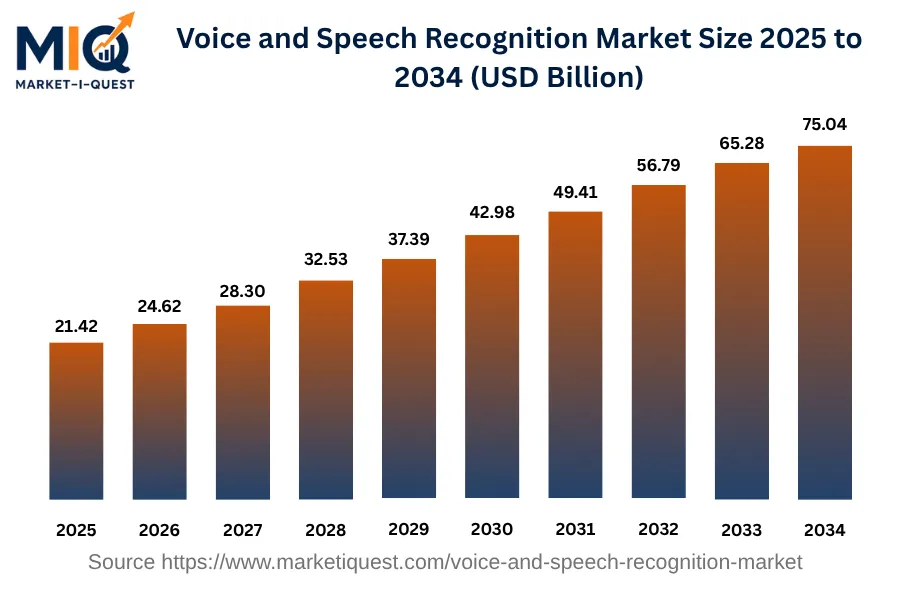
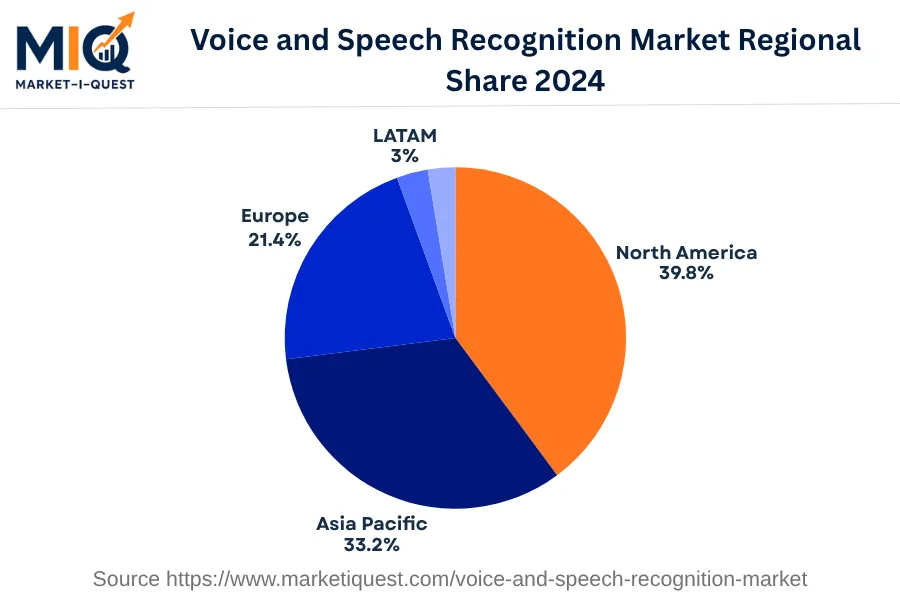
The Voice and Speech Recognition market size was valued at $21.42 billion in 2025, and it is projected to reach $75.04 billion by 2034, registering a CAGR of 14.95%. The substantial growth observed from 2025 to 2034 suggests a growing adoption and integration of voice and speech recognition technologies across various industry verticals. Factors such as advancements in machine learning and artificial intelligence are likely contributing to the surge in market value over these years. Focusing on regional shares as of 2024, North America held the largest share of 39.84%, followed by Asia Pacific with 33.18%. Europe had the third-largest share at 21.42%, while the regions of Latin America and Middle East & Africa held comparatively smaller shares, with 2.96% and 2.6% respectively.

Key Takeaways

  • By Function - Automatic Speech Recognition held the commanding position accounting for a significant market share in 2024.
  • By Technology - AI-based solutions expanded fastest reflecting the rising technological advancements.
  • By Vertical - Retail led the market leveraging voice and speech recognition for efficient patient interaction in 2024.
voice-and-speech-recognition-market market size

Key Driving Factors

Integration of Voice and Speech Recognition in Consumer Electronics

As voice and speech recognition technologies improve, they are becoming a key feature in a wide array of consumer electronics. For example, smart TVs, home automation devices, and wearable technologies are increasingly integrated with voice and speech recognition capabilities. Consumers are finding it easy and convenient to control their devices using their voice, thus driving demand for such products. This, in turn, pushes original equipment manufacturers (OEMs) to constantly innovate and implement voice and speech recognition in their products to meet consumer expectations, competitively positioning their products in the market. Therefore, the proliferation of voice-enabled consumer electronics is a powerful driver of growth in the voice and speech recognition market.
Regulatory Compliance in Healthcare Sector

Voice and speech recognition technologies have significant potential in the healthcare sector. Their ability to transcribe medical reports and patient histories quickly and accurately helps healthcare professionals to save time and improve service quality. However, the use of these technologies in the healthcare sector is heavily regulated. Laws such as the Health Insurance Portability and Accountability Act (HIPAA) in the United States mandate strict data privacy and security requirements. Therefore, voice and speech recognition systems used in healthcare need to adhere to these regulations. As technology providers are ensuring regulatory compliance, the adoption of these systems is rapidly increasing in the healthcare industry, making regulatory compliance a major driving factor for the voice and speech recognition market in this industry.

Market Evolution by Timeline

2019-2023
In this period, there was a surge in the use of voice and speech recognition technologies by tech giants like Amazon, Google in smart home devices, and customer service applications. North America, with a high adoption rate, was the leading region. Pilot projects were conducted in the healthcare sector for patient diagnosis in the US and UK. Issues such as high error rates and mistranslations acted as constraints. Standardization remained immature, with individual companies devising proprietary solutions. The primary revenue model was subscription-based. On the flip side, privacy concerns surrounding data handling popped up as a risk triggering regulatory scrutiny.
2024
The year 2024 saw a growth in demand from the automotive sector with the integration of voice assistant in vehicles. The European region showed interest in these technologies. Supply-wise, enhancements in AI and Machine Learning helped reduce translation errors, improving recognition accuracy. Regulation-wise, the European Union's GDPR set rules for data processing, impacting product design to respect user privacy. Licensing of software and technology to endpoint device manufacturers started becoming the norm. The increased dependency on internet networks was a potential risk to reliability.
2025-2029
Towards the end of the decade, the emerging economies in Asia-Pacific saw rising adoptions mainly by the corporate sector for intelligent virtual assistance. Technology-wise, integration with IoT became more common, although fears of cyber threats persisted. No distinctive global-standard policies were introduced, and companies continued to follow region-specific data and privacy laws. Usage-based pricing models started gaining traction. Cybersecurity emerged as a major risk, prompting tech companies to focus on securing their recognition software.
2030-2034
By 2030, automation in industries such as robotics and manufacturing spurred demand for voice and speech recognition, especially in Germany and Japan. The supply chain saw AI-powered translation devices with almost zero errors come into mainstream use, still, the high cost of integration limited adoption. As the technology became accessible globally, companies started adhering to ISO/IEC 2382 IT vocabulary standard. Most companies moved towards an equity-based model, partnering with manufacturers to integrate their technology directly. The significant risk was the assured quality of recognition software, which improved subsequently.

Future Market Outlook

Future Opportunities

The current landscape of global voice and speech recognition technologies presents numerous opportunities for growth, particularly in areas such as healthcare and automotive sectors. Following the establishment of the FDA guidelines in 2022 for digital health technologies, healthcare providers are increasingly adopting voice recognition applications in electronic health records to improve patient interaction and data entry efficiency. Moreover, companies like Apple are integrating voice functionality into their products, exemplified by the continued enhancements to Siri, aimed at providing healthcare-related assistance. In the automotive industry, the 2021 launch of the Mercedes-Benz MBUX system highlights the market's increasing emphasis on voice-activated controls, driving significant interest in user experience improvements. Additionally, smart home devices have seen rapid adoption, especially following the release of the Amazon Echo Dot (5th Gen) in early 2023, offering expanded functionality for users across various households. With 5G technology expanding globally, the potential for real-time processing of voice data is set to increase significantly, enabling more sophisticated applications in urban environments. Furthermore, the rise in remote working practices post-pandemic has generated new demands for voice recognition tools that support collaboration and effective communication, further amplifying the market potential. These evolving trends suggest a growing integration of voice recognition technologies into everyday applications, tapping into both existing and emerging markets globally.

Segmentation Analysis

By Function

The market by function is segmented into Speaker Identification, Speaker Verification, Automatic Speech Recognition, and Text-to-Speech. Automatic Speech Recognition leads in terms of revenue, while Speaker Verification is anticipated to grow at the fastest rate.

Largest Revenue Share

Automatic Speech Recognition

Market Share Leader

Automatic Speech Recognition (ASR), holding the highest revenue share, is the backbone of any speech technology. The reasons are diverse - high consumer demand, integration in various devices, and high usefulness in numerous industries. The demand is driven by consumers' ever-increasing need for hands-free and voice-first interactions, particularly in smartphones, smart homes, and in-car systems. It's ingrained in applications we use daily for tasks like dictation, voice-activated dialing or search. ASR is pivotal in industries such as healthcare for transcribing medical data, in customer service for voice assistants, and in education for e-learning and language translation apps. This widespread usage stems from increased accuracy thanks to advances in AI and machine learning. ASR is typically the first technology implemented in many regions, indicating a solid user-base across geographies. Regulatory support also exists - governments encourage voice-technology for accessibility reasons. ASR's channels are diversified - while tech giants have in-house software, other businesses often purchase from vendors. Market competition is high, however, creating barriers for new entrants. All these factors consolidate ASR's high revenue share today.

Fastest CAGR

Speaker Verification

Forecast Period Growth Leader

Speaker Verification (SV) is poised to grow rapidly, and there are several growth catalysts behind this trajectory. SV technology authenticates a person's claimed identity using voice as a biometric. As security becomes a priority in modern societies, the demand for voice-authentication increases, especially in banking and commerce to prevent fraud. SV has also seen technological advances, making systems more accurate, robust to noise, and language-independent, thus driving adoption. However, high setup costs and data privacy concerns may pose barriers to adoption. Nonetheless, policy advancements promoting data security and privacy, like GDPR in Europe, can serve as catalysts for SV's growth. In terms of partnerships, collaborations between speech technology providers and enterprise-level users like banks or voice assistant providers can boost its market footprint. Risks such as a high false acceptance or rejection rate could impact SV's growth negatively, making it crucial for providers to improve accuracy. In summary, while SV might not be the most significant revenue segment, its growth potential is vast due to the increasing importance of secure voice-authentication.

By Technology

The market is divided into subsegments including AI-Based and Non-AI-Based technologies. The Non-AI-Based segment accounted for the largest revenue share while the AI-Based segment is expected to grow at the fastest CAGR during the forecast period.

Largest Revenue Share

Non-AI-Based

Market Share Leader

In 2024, the Non-AI-Based technology held the largest share of the market revenue. This sector's dominance can be attributed to multiple factors. First, this segment includes traditional and established technologies that are already deeply entwined in various industries. Second, Non-AI-Based technologies generally have lower implementation costs, making them more accessible to a wider range of enterprises. Further, the widespread familiarity with these technologies and the significant amount of existing infrastructure geared towards them makes the switch to these systems less daunting for many businesses. In terms of geography, Non-AI-Based technologies continue to thrive especially in emerging markets where cost considerations often overrule the advantages offered by AI-Based technologies. Overall, established familiarity, lower costs, and an extensive existing infrastructure have allowed the Non-AI-Based segment to generate the largest revenue share on the technology side of the market.

Fastest CAGR

AI-Based

Forecast Period Growth Leader

The AI-Based technology segment is projected to grow at the fastest rate. Key growth drivers for this subsegment include increased efficiency and better decision-making capabilities, which have led to higher adoption rates across numerous sectors. Advances in technology have made AI applications increasingly accessible, lowering the adoption barriers for many enterprises. Moreover, strategic investments, partnerships, and favourable policies are acting as catalysts to the adoption of AI-based technologies. However, there are several near-term risks associated with this fast growth. These include technology maturation risks, regulatory issues around data security, privacy and ethics. On balance, while the AI-Based segment currently accounts for a smaller portion of the market revenue, its high CAGR is likely driven by greater efficiency, strategic partnerships, favourable policies and increased accessibility of technology, overshadowing the potential risks presented.

By Vertical

The market is divided into subsegments including Automotive, BFSI, Consumer, Education, Enterprise, Government, Healthcare, Legal, Military, Retail, and Others. The Retail sector accounted for the largest revenue share while the Healthcare sector is expected to grow at the fastest CAGR during the forecast period.

Largest Revenue Share

Retail

Market Share Leader

The Retail sector has been witnessing significant growth largely due to the increasing integration of digital technologies in stores and the global shift towards e-commerce. As online shopping becomes more prevalent, retail outlets are now heavily investing in tools and services that enhance the shopping experience and improve operational efficiencies. The need for better customer data, inventory management, and point-of-sale processes drives the adoption of sophisticated IT solutions in this subsegment. Geographically, the rise in disposable income and the growth of the middle-class population, especially in developing regions, have bolstered the retail industry, contributing to its large market share. Subsequently, regulatory support for the retail sector and supply chain efficiencies from global brand partnerships also foster its market dominance.

Fastest CAGR

Healthcare

Forecast Period Growth Leader

The Healthcare sector is set to witness the fastest growth, driven by the increasing adoption of digital health technologies and supportive regulations. As healthcare providers strive to improve patient outcomes and reduce costs, the implementation of AI, machine learning, and predictive analytics is accelerating. These technologies support everything from research and diagnostics to personalized medicine and patient care management. On the flip side, legacy systems and data privacy concerns are significant barriers to adoption. Notwithstanding these hurdles, growing healthcare expenditure, strategic collaborations between technology providers and healthcare institutions, and government initiatives promoting digital health are all expected to propel this sector forward. However, cybersecurity threats and the need for seamless data interoperability could impact near-term growth.

Competitive Analysis

Key Market Players

Manufacturers / OEMs

Google Inc.
US
Apple Inc.
US
Microsoft Corporation
US

Key Suppliers & Raw Materials

NXP Semiconductors N.V.
Netherlands
Cirrus Logic, Inc.
US
Dolby Laboratories, Inc.
US

Distributors, Integrators & Channel Partners

IBM Corporation
US
Amazon Web Services, Inc.
US
Nuance Communications, Inc.
US

Porter’s Five Forces Analysis

The following analysis looks into the competitive forces within the Voice and Speech Recognition market.

Supplier Bargaining Power

Medium

Suppliers primarily include tech developers and few hold a monopoly over crucial tech.

Buyer Bargaining Power

High

End-users have multiple choices for voice and speech recognition software.

Threat of Substitutes

Medium

Other UI/UX technologies remain substitutes, yet current tech trends lean towards voice interface.

Threat of New Entrants

High

The industry has low barriers to entry for tech companies with necessary expertise.

Competitive Rivalry

High

High competition between tech giants, startups, and evolving AI players.

Regional Analysis

Geographic market dynamics and growth opportunities across key regions

Global Market Outlook

voice-and-speech-recognition-market market regional share

North America

In the base year 2024, the North American Voice and Speech Recognition Market demonstrated significant traction, driven by increasing demand, technological maturation, and supportive regulations. Increased demand was catalyzed by a surge in remote working and learning needs, leading to heightened need for accurate transcription services, language translation, and virtual assistance across sectors such as business, education, and healthcare. Policy initiatives in the U.S., such as the American Disabilities Act, favored voice and speech technologies to enhance accessibility, spurring adoption. Furthermore, big tech companies like Google and Amazon expanded their footprint, fostering both innovation and competition within the market.

Among trending behaviors, customers leaned towards smart home appliances and mobility solutions, promoting voice-enabled interfaces. In response, industries shifted towards incorporating advanced machine learning and AI capabilities to improve language comprehension and context-aware responses. This saw a rise in strategic acquisitions, as seen in Canada's Nuance Communications' acquisition of Voicebox Technologies, aiming to strengthen their conversational AI portfolio. Policy enforcement around data privacy also became more stringent, with Mexico's Federal Law on the Protection of Personal Data dictating data handling standards, affecting voice technology application in areas such as personalized advertising and customer service.

Asia Pacific

In 2024, the Voice and Speech Recognition Market in the Asia Pacific region experiences significant activity. The market's growth is driven by increasing customer demand for advanced authentication methods, exemplified by the adoption of biometric technology across industries such as finance and government. Also, regulatory pressures, particularly in markets like China and India, propel businesses to integrate voice and speech recognition into their operations for data privacy and method validation purposes. Infrastructural investments in technology, as seen in South Korea and Japan, provide a solid foundation for the wide-scale deployment of voice recognition systems in the business sector.

The market observes key trends in consumer behavior in 2024, including an increased preference for smart home systems and virtual assistants, which employ voice recognition technology. Major tech companies in Asia Pacific, like Baidu and Tencent, contribute to the shift towards voice-enabled platforms through strategic partnerships and mergers. Notably, Australian government sectors enforce stricter standards for data protection, enriching the demand for advanced security measures, including voice and speech recognition. Simultaneously, growing e-commerce trends in key ASEAN markets necessitate automated customer service experiences, contributing to the adoption of voice and speech recognition systems in the retail industry.

Europe

In 2024, the voice and speech recognition market in Europe solidified its role as an influential factor in technological advancements. Key market drivers included mammoth investments in AI-based technologies, like voice assistants and chatbots, by major enterprises and governments. Widespread adoption of smart home devices which heavily rely on voice and speech recognition systems also boosted market growth. Furthermore, stringent GDPR regulations made advanced voice and speech recognition technologies a must for businesses operating across various sectors, particularly healthcare, finance, and retail to ensure data security and customer privacy.

Trends in 2024 encompassed an increasing adoption of multi-language and dialect-friendly interfaces, particularly visible in polyglot regions such as Spain and the Benelux. Mergers and acquisitions also became prominent, with tech giants in the UK and Germany seeking to expand their footprint in this sphere. Retail and manufacturing sectors began leveraging voice controlled systems for enhancing customer service and operational efficiency. Additionally, relentless enforcement of data privacy standards compelled companies to implement technologies providing an optimal balance between user personalization and privacy. Overarchingly, the European voice and speech recognition market in 2024 was highly influenced by increased investment in AI, regulatory pressures, and the ever-growing need for customer-centric, multi-lingual interfaces.

Latin America

In 2024, the Voice and Speech Recognition Market in Latin America demonstrated robust growth, driven by a confluence of technological adoption and legislative support. Government policies in Brazil, Mexico, Argentina, Colombia, Chile, and Peru fostered a conducive environment for development and deployment of voice and speech recognition technologies. Significant investments flowed into sectors like utilities, manufacturing, and retail to bolster voice-based user interfaces. In Mexico and Argentina, enhanced Internet connectivity facilitated the proliferation of such technologies. Consumer behavior greatly influenced the market dynamics. The ease and efficiency of voice-activated devices increasingly found favor among consumers across LATAM, particularly in urban centers. Retail giants in Brazil and Mexico elevated customer experience by integrating voice command features in their digital interfaces. In the healthcare sector, voice recognition applications improved patient interaction, notably in Chile and Peru.

In terms of partnerships and M&A, technology firms in LATAM sought strategic alliances to expand their technological horizons. Policy enforcement around data privacy and security remained a prominent focus in Colombia and Argentina, reflecting a growing awareness towards protecting user data. The standardization of voice and speech recognition software across different platforms was a noticeable trend in enterprises. On these notes, 2024 marked a significant year for the voice and speech recognition market in Latin America.

Middle East & Africa

In 2024, the Voice and Speech Recognition Market witnessed substantial growth in the Middle East and Africa, primarily driven by increased investment in AI technologies, widespread adoption of voice-controlled smart home devices, and stringent regulatory requirements for customer identification in banking and finance sectors. Key market drivers included the robust expansion of telecom and healthcare sectors in Saudi Arabia, United Arab Emirates, and Qatar. These countries saw significant technology adoption as they sought to enhance customer experience and operational efficiency. In the meantime, high demand for voice biometrics in Nigeria and Egypt's financial sectors provided additional impetus, driven by regulatory norms for secure customer identification.

Regarding trends, AI integration in utility and manufacturing industries, largely in South Africa and Israel, changed the sphere significantly. Adoption of speech recognition in these regions offered operational ease, becoming a standard in their manufacturing and management processes. Voice-activated retail and e-commerce, making strides in Kenya, transformed buyer behavior and the overall shopping experience. Additionally, a spike in partnerships and M&A activities within the region's tech companies further strengthened the market. In essence, in 2024, technological advancements, regulatory enforcement, and changing consumer preferences formed the backbone of Voice and Speech Recognition Market's growth in the Middle East and Africa.

Recent Industry Developments

Latest market innovations, product launches, and strategic initiatives

June 2025

BHASHINI (Digital India Bhashini Division) and CRIS (Centre for Railway Information Systems) signed an MoU to integrate BHASHINI's language technology stack—including Automatic Speech Recognition (ASR) and Text-to-Speech (TTS)—into Indian Railway platforms such as the National Train Enquiry System (NTES) and RailMadad, enabling citizen access in 22 Indian languages.

January 2026

Apple Inc. acquired Q.ai, a Tel Aviv-based audio AI startup specializing in whispered speech recognition and audio enhancement in noisy environments, for an estimated $2 billion. The acquisition aims to upgrade Siri and voice features across AirPods, iPhones, and the broader Apple ecosystem.

Frequently Asked Questions