
Variable Frequency Drive Market Snapshot

Key Players

  • ABB Ltd. (Switzerland)
  • Siemens AG (Germany)
  • Schneider Electric SE (France)
  • Rockwell Automation Inc. (United States)
  • Mitsubishi Electric Corporation (Japan)
  • Emerson Electric Co. (United States)
  • Danfoss Group (Denmark)
  • Yaskawa Electric Corporation (Japan)
  • Eaton Corporation plc (Ireland)
  • Fuji Electric Co. Ltd. (Japan)

Market Size

Base Year 2024
$26.75 Bn
CAGR
5.5%
Forecast 2034
$45.69 Bn

Market Segments

By Type
Voltage-Source Inverter (VSI) Drives, Current-Source Inverter (CSI) Drives, Direct Torque Control (DTC) Drives, Others
By Sales Channel
Direct Sales, Distributor Sales
By Application
Pumps, HVAC Systems, Fans, Conveyors, Extruders, Others
By End-use Industry
Oil & Gas, Power Generation, Building & Infrastructure, Automotive, Food & Beverage, Mining, Others

Market Dynamics

Drivers
  • Increasing industrial automation
  • Rising energy efficiency demands
Restraints
  • High installation costs
  • Complex operational processes
Opportunities
  • Increased industrial automation
  • Emerging energy-efficient technologies

Market Size

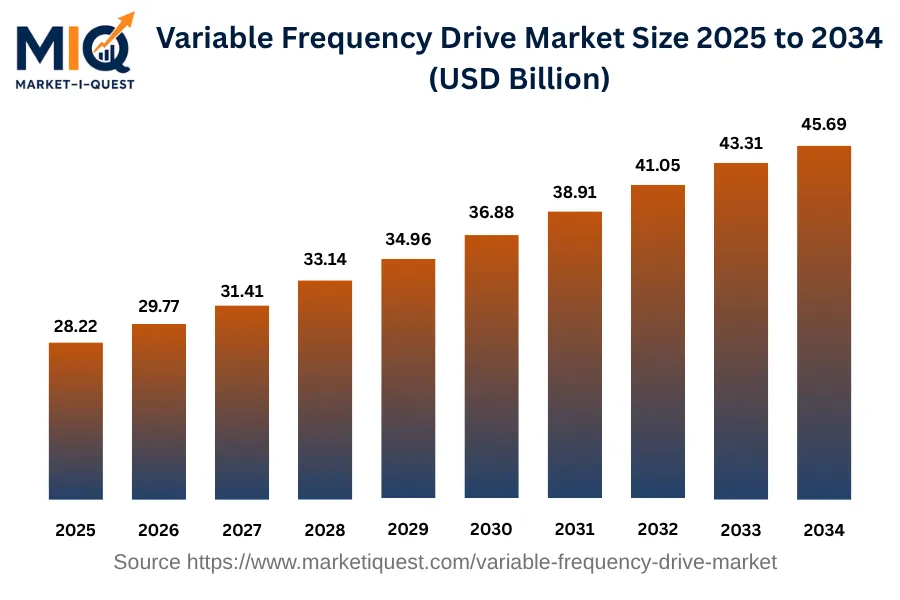
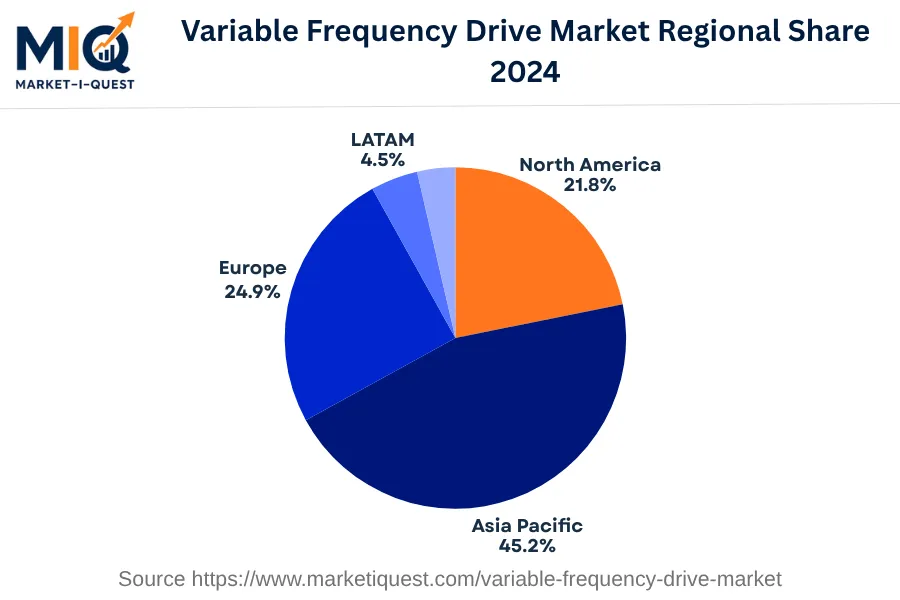
The Variable Frequency Drive Market size in 2025 is projected to be $28.22 billion, rising substantially from $26.75 billion in 2024. Over the subsequent decade, a significant rise is projected as the market size is expected to ascend to $45.69 billion by 2034, growing at a CAGR of 5.5% between 2025 and 2034. This steady growth is attributed to progressive innovations and improvements in Variable Frequency Drive technologies and growing industrial utilization and demand. A regional market share analysis in 2024 shows that Asia Pacific dominated the market with a 45.2% share. It was next followed by Europe with a 24.9% share and North America with a 21.8% share. Meanwhile, LATAM held a 4.5% share and MEA had a 3.6% share of the global market in the said year.

Key Takeaways

  • By Type - Voltage-Source Inverter (VSI) Drives emerged as leaders holding a significant market share in 2024.
  • By Sales Channel - Distributor Sales contributes the most to the market in the analysed period.
  • By Application - HVAC Systems dominates accounting for a striking market share during the base year.
  • By End-use - Automotive sector held the top position leading the Variable Frequency Drive Market in 2024.
variable-frequency-drive-market market size

Key Driving Factors

Strict Energy Efficiency Regulations

One of the main factors driving the Variable Frequency Drive (VFD) market is the International Energy Agency's (IEA) increasingly strict guidelines on energy efficiency standards for electric motors. The IEA's regulations mandate that electric motors, which massively contribute to global electricity use, must observe progressively higher energy efficiency classes. Opting for VFDs allows enterprises to meet these enhanced standards, as these offer precise control over motor speed and torque, thereby minimizing energy usage. Fundamentally, the VFD's ability to reduce power consumption and optimize energy use while still complying with international regulations incentivizes businesses across industries to invest in these drives significantly. This, in turn, fuels the VFD market growth regionally and globally.
Adoption in Water & Wastewater Industry

Another significant factor pushing VFD market is uptake in water and wastewater industry. This industry needs to control and regulate flow of water through pumps and fans with varying capacities, a task which VFDs are perfectly suited to handle. The cost of adopting VFDs is offset by long-term savings in energy costs and enhanced life of equipment this industry operates. Furthermore, the variable nature of water treatment processes, from pumping to aeration, makes VFDs a critical need due to their ability to effectively manage variations in speed and torque, reducing unnecessary wear and tear. This continuous need within water and wastewater industry, combined with cost and energy benefits, is driving rapid adoption of VFDs, stimulating market growth.

Market Evolution by Timeline

2019-2023
During this period, demand for Variable Frequency Drives (VFD) significantly increased, as industries like manufacturing, power, and oil & gas adopted energy-efficient solutions. Particularly in APAC region, where rapid industrialization occurred, the need for energy management propelled use of VFDs. Technologically, VFDs integrated with IOT capabilities were launched, enhancing device control and monitoring. But implementation complexity and high initial costs presented barriers. The ISO 50001 standard impacted this period by stipulating energy management system requirements. With regard to commercial model, VFDs were typically sold through B2B channels, with large-scale contracts the norm. In terms of risk, electrical disturbances were a notable issue, prompting manufacturers to improve design.
2024
The popularity of VFDs crossed over to the HVAC industry, used for managing energy consumption in commercial buildings, predominantly North American and European markets. More instinctive, AI-powered systems were developed but faced acceptance issues due to cybersecurity risks. Regulatory environment focused on greater energy-efficiency standards. Pricing was competitive, and cost-sharing partnerships were typical. While technology was stable, constraints like compatibility issues with old machinery and lack of skilled personnel for implementing sophisticated VFD technologies were common.
2025-2029
In this period, the Water and Wastewater segment increasingly relied on VFDs for pumping applications, mainly in developing countries focusing on infrastructure upgrades. Manufacturers introduced more user-friendly VFD interfaces, increasing product popularity. Policy saw international efforts for reducing carbon footprint, making VFD adoption almost mandatory for large industries. More flexible and tailored contract types emerged, including VFD-as-a-Service models. Product's high initial cost continued as a chief concern, albeit offset by resultant energy savings.
2030-2034
This period saw consolidation of VFDs in the renewable energy sector, especially solar and wind, predominantly in countries like China, the US, and Germany. On supply side, more companies established complete in-house VFD production lines. The enforcement of stricter global energy regulations was a notable policy influence. The value proposition shifted from mere cost to strategic benefits, like sustainability and improved system life. The risk of frequent component replacements was mitigated through more durable designs.

Future Market Outlook

Future Opportunities

As Variable Frequency Drive market evolves, companies are likely to explore new avenues for growth and expansion. In 2023, U.S. Department of Energy released a revised Energy Efficiency Standards for VFDs that could stimulate investments in modernizing existing installations. Such regulatory changes suggest companies need to upgrade their offerings in response to increased demand for energy-efficient solutions. Developments in smart grid technologies present new opportunities; for instance, the partnership between Siemens and Enedis in France aims to enhance energy distribution efficiency through advanced VFDs. There is potential for niche markets like electric vehicles and urban mobility solutions, where refined VFD technologies can drive performance and efficiency. Industries like mining and mineral processing are seeking ways to optimize operations through VFD systems that minimize energy usage while maximizing equipment longevity. Collaborative efforts like Industrial Internet Consortium’s advancements in standards showcase the need for interoperability in VFDs, opening new pathways for integrated systems across sectors. Moreover, ongoing global push for decarbonization amplifies relevance of VFDs in transitioning to renewable energy sources. Overall, companies that strategically align product development with regulatory trends and emerging technologies are poised to capture significant opportunities within evolving landscape of the Variable Frequency Drive market.

Segmentation Analysis

By Type

The Type segment in the market includes various subsegments like Voltage-Source Inverter (VSI) Drives, Current-Source Inverter (CSI) Drives, Direct Torque Control (DTC) Drives and others. Among them, Voltage-Source Inverter (VSI) Drives accounted for the largest revenue share, with Direct Torque Control (DTC) Drives projected to grow at the fastest CAGR during the forecast period.

Largest Revenue Share

Voltage-Source Inverter (VSI) Drives

Market Share Leader

Voltage-Source Inverter (VSI) Drives dominate the market primarily due to their wide range of applications in sectors like industrial automation, oil & gas, and automotive industries where they effectively control the speed of motors. Their universal applicability across various industries acts as a strong purchasing criterion, driving their higher revenue share. Geographically, regions with a robust industrial base, such as Asia Pacific and North America, contribute significantly to this subsegment's demand. From a regulatory standpoint, energy-efficient directives promoting the use of these drives account for their continued market dominance. Additionally, they are relatively easy to implement and their maintenance costs are modest, making them an ideal choice for companies across sectors. There’s an inherent inertia, or switching costs, for companies that have these drives deeply embedded in their operations, making the VSI Drives a resilient leader in terms of revenue. Taken together, these factors underpin Voltage-Source Inverter (VSI) Drives to lead in the market.

Fastest CAGR

Direct Torque Control (DTC) Drives

Forecast Period Growth Leader

Direct Torque Control (DTC) Drives are expected to grow at the fastest rate, owing to their advanced features like high torque dynamics and precise torque control which make them ideal for applications requiring swift response. They are increasingly being adopted in high-performance applications including robotics, elevators, and excavators – an area that has witnessed recent technological investments and partnerships. The main barriers to the growth of this subsegment include its complicated implementation process and the initial high capital expenditure. These obstacles are minor compared to the expected increase in demand as industries adopt automation. Moreover, policies promoting energy efficiency are tipping the scale in favor of DTC Drives. The noteworthy risk in the immediate future could be the market's possible overdependence on the industrial automation sector. However, given the current trends of digitization and smart manufacturing, this risk is pegged to be manageable and the outlook for this subsegment remains positive.

By Sales Channel

The market is divided into subsegments including Direct Sales and Distributor Sales. Distributor Sales accounted for the largest revenue share while Direct Sales is expected to grow at the fastest CAGR during the forecast period.

Largest Revenue Share

Distributor Sales

Market Share Leader

Distributor Sales recorded the highest revenue in the base year 2024. This is largely attributed to the significant role of distributors in amplifying the outreach of products and services, facilitating transactions between manufacturers and end-users, and providing insights on market trends. Distributors typically have an extensive network, allowing them to penetrate various market segments - including hard-to-reach rural areas - thus enhancing product visibility and access. Furthermore, distributors offer post-sale services including installation guidance, maintenance, and consumer education which can create product differentiation and value addition in a competitive market. Regulations tend to favor distributors due to their capability to control and monitor product distribution, hence ensuring compliance, which might not be the case with direct sales. Finally, distributors reduce the risk of supply disruptions, which is a valuable service in industries where reliability of supply drives purchasing decisions.

Fastest CAGR

Direct Sales

Forecast Period Growth Leader

Direct Sales is expected to record the fastest CAGR in the forecast period. This growth is primarily driven by the increasing recognition of its advantages, including enhanced customer relationship management, immediate feedback and customization possibilities. Internet proliferation and digital technology advancement contribute to this growing trend as they reduce the need for physical intermediaries, allowing customers and manufacturers to interact directly. However, certain barriers to adoption include the need for significant investments in infrastructure and technology to facilitate direct sales. Additionally, companies must be able to manage increased customer service demands. In the near-term, strategic investments, partnerships and favorable policies can serve as catalysts for growth in this subsegment, although the risk of supply chain complexity could dampen the pace of adoption in some regions.

By Application

The market is divided into subsegments including Pumps, HVAC Systems, Fans, Conveyors, Extruders, and Others. Among these, HVAC Systems accounted for the largest revenue share while Extruders are expected to grow at the fastest CAGR during the forecast period.

Largest Revenue Share

HVAC Systems

Market Share Leader

HVAC systems contribute to the most significant revenue share due to their widespread use. The driving factors behind its superior position include an increasing need for climate control systems to manage ever-changing weather patterns. Globally, customers value comfort, hence the requirement for quality and efficient HVAC systems. Major geographies like North America and Europe with extreme weather conditions contribute to the mass adoption of these systems. From a regulatory perspective, energy-efficiency norms and environmentally friendly operational mandates indirectly stimulate the HVAC market. This aspect favors dominant players with high-quality products and services in their portfolio. As far as supply and purchasing criteria are concerned, HVAC systems come with high switching costs, and customers tend to stick to the leading brands ensuring a sustainable revenue stream. Direct sales and channel partnership model are significant purchase channels that keep the HVAC market revenue at par, despite cyclical nature and seasonal demand fluctuations.

Fastest CAGR

Extruders

Forecast Period Growth Leader

Extruders pose the highest growth potential, driven by increasing applications in various industries such as food, plastic, ceramics, and others. The primary growth driver is technological innovations that enhance efficiency and reduce operational costs. As production companies continue to strive for a higher return on investment, cost-effective solutions such as advanced extruders become highly attractive. Adoption barriers include high capital expenditure, technical complexities associated with the operations, and maintenance. However, collaborations for technical exchange and robust training programs are gradually overcoming these obstacles. Policy regulatory changes encouraging sustainable and efficient industrial processes and capital expenditure allocated for technological enhancements are acting as catalysts to this growth. Nevertheless, there are near-term risks associated with potential economic slowdown and trade uncertainties, which investors need to consider while investing in this subsegment.

By End-use Industry

The market is divided into subsegments including Oil & Gas, Power Generation, Building & Infrastructure, Automotive, Food & Beverage, Mining, and Others. In 2024, the Automotive sector accounted for the largest revenue share while Building & Infrastructure is expected to grow at the fastest CAGR during the forecast period.

Largest Revenue Share

Automotive

Market Share Leader

The Automotive sector's leading position for the largest revenue share stems from its extensive utilization of diverse technologies and increasing consumer demand. The driving factors shape the industry's consistent growth and acquisition of a major market share from the advantages of technological advances in automobiles, such as automated driving and electric vehicles. Historically, advanced economies have demonstrated sustained demand, but emerging markets now significantly contribute to the consistent demand for automobiles. Simultaneously, increasingly stringent environmental regulations worldwide have pushed automakers to focus on producing more efficient and less polluting cars, thus driving significant sales. Furthermore, improvements in purchasing power, the necessity for transportation, and lifestyle changes are contributing to this trend.

Fastest CAGR

Building & Infrastructure

Forecast Period Growth Leader

Building & Infrastructure is recognized as the subsegment with the fastest predicted growth. Crucial drivers for this rapid expansion include the global population surge and urbanization trends that necessitate the construction of new infrastructure. Additionally, governments worldwide are investing considerably in infrastructure development to stimulate economic growth and improve living standards. Technological enhancements in the construction industry such as the use of artificial intelligence and automation are further fueling the swift industry growth. Despite the thriving outlook, potential obstacles, such as the rising cost of raw materials and labor shortage, may present near-term risks. On the other side, long-term infrastructure investment plans, public-private partnerships, and innovative construction practices mitigate these risks and propel this sector's growth.

Competitive Analysis

Key Market Players

Manufacturers / OEMs

ABB Ltd.
Switzerland
Siemens AG
Germany
Rockwell Automation
US

Key Suppliers & Raw Materials

Schneider Electric
France
GE Power Conversion
US
Eaton Corporation Inc.
Ireland

Distributors, Integrators & Channel Partners

WEG Electric Corp.
Brazil
CG Power and Industrial Solutions Limited
India
Yaskawa Electric Corporation
Japan

Porter’s Five Forces Analysis

This analysis assesses the competitive dynamics and attractiveness within the Variable Frequency Drive Market.

Supplier Bargaining Power

Medium

Driven by the limited number of high-tech component manufacturers and significant capex.

Buyer Bargaining Power

Low

Buyer power is low due to the specialized nature of the products and limited alternatives.

Threat of Substitutes

Low

Substitute products are scarce as the technology offers increased energy efficiency and adaptability.

Threat of New Entrants

Medium

Market entry is feasible for tech-intensive firms, but requires extensive R&D and compliance with rigorous standards.

Competitive Rivalry

High

The market competition is fierce due to the presence of multiple global players offering similar products.

Regional Analysis

Geographic market dynamics and growth opportunities across key regions

Global Market Outlook

variable-frequency-drive-market market regional share

North America

In 2024, Variable Frequency Drive (VFD) Market in North America was marked by increased adoption in sectors like manufacturing, utilities, and retail. Governments promoted energy efficiency which drove demand for VFD technology. Increased investment in infrastructure development led to surge in VFD usage in construction activities, specifically in U.S. and Canada. The high energy savings offered by VFD, coupled with favorable pricing dynamics in North America, also buoyed the market.

The trend of digitizing industries led companies to leverage VFDs for precision tasks in automated production lines, notably in Mexico's manufacturing sector. Buyers increasingly preferred VFDs that offered cloud connectivity, allowing them to monitor and control devices remotely. Supplier partnerships with tech firms were common, aimed at enhancing product features like predictive maintenance capabilities. Mergers and acquisitions were prevalent among VFD suppliers, striving for market consolidation and broadening product portfolios. There was a sustained push for product standardization across the U.S., Canada, and Mexico to ensure safety and quality. Regulatory agencies, like the U.S.'s National Electrical Manufacturers Association (NEMA), underlined their role by enforcing stringent policy regulations to manage emissions, resulting in increased VFD installations in carbon-intensive industries.

Asia Pacific

In 2024, Asia Pacific's Variable Frequency Drive (VFD) market was driven by several substantial factors. High demand from industrial sectors, specially manufacturing and utilities sectors, led to improved investment in VFD technology across the region. China and India witnessed significant adoption due to their expanding industrial sectors, facilitated by governmental protocols promoting energy efficiency. Japan and South Korea, renowned for their technological advancement, prioritized VFD integration for enhancing operational efficiency in their highly automated industries. Australia and key ASEAN markets used variable frequency drives to harness renewable energy resources significantly.

Several trends acted in harmony with these drivers. Buyers increasingly preferred energy-efficient devices, accelerating shift towards VFDs in industrial sector. In China, government policy emphasized high-tech manufacturing, spurring further VFD use. Channels focused heavily on partnerships and merger activities, especially in India and ASEAN region, to expand reach and improve service quality. Japan and South Korea witnessed rigorous enforcement of energy saving standards, steering industrial change toward VFD adoption. In essence, energy efficiency incentives and manufacturing sector growth significantly shaped the 2024 Asia Pacific Variable Frequency Drive market. Uptake of VFDs accelerated across diverse sectors, including enterprise, utilities, and manufacturing. Regulatory policies and changing buyer preferences further reinforced these trends.

Europe

In 2024, the European Variable Frequency Drive (VFD) Market experienced robust expansion. This growth was primarily driven by increased demands from key sectors, including manufacturing, utilities, and retail to improve plant efficiency and minimize energy consumption. Rigorous energy efficiency regulations, like European Union's Energy Efficiency Directive, and strategic investment initiatives from individual nations also contributed to market's development. Moreover, widespread technology adoption within dominant markets, particularly Germany, the United Kingdom, and France, bolstered drive for energy-efficient solutions.

Trends observed during base year revealed strong consumer inclination towards environment-friendly products. This was, in part, driven by European Union’s policy reinforcement on green energy. There was a noticeable shift towards intelligent VFD, specifically in Italy and Spain, due to rise of Industry 4.0, which favors automated and interconnected industrial environments. A significant market trend in the Nordics, Central, and Eastern Europe was the use of VFDs in cold storage facilities, due to increasing demand for preserved food. Strategic partnerships and mergers were frequently seen, especially in the Benelux region, to enhance market reach and improve technical capabilities. Consequently, in 2024, Europe emerged as a thriving market for VFDs, with policy support and strategic initiatives at its helm.

Latin America

In 2024, the Variable Frequency Drive (VFD) market in Latin America demonstrated notable growth. Increased energy efficiency regulations, investment in industrial automation, and the adoption of technology such as IoT in Brazil and Mexico drove this expansion. In Argentina, the local manufacturing sector's demand for cost-effective and energy-efficient solutions further stimulated growth. Additionally, the falling prices of VFDs due to competitive supply dynamics played a crucial role throughout the region.

Market trends in 2024 included an increase in digitally integrated VFD systems within the utilities and manufacturing sectors, primarily in Colombia and Chile. Customer preference for technologically advanced energy-saving devices became particularly evident in Peru. Furthermore, significant partnerships and mergers were observed in the region, fortifying the market position of several key players. Enforcement of energy standards was also prominent in LATAM, with policy implementation assisting the transition towards efficient motor control systems across various sectors.

Corporate and government sectors were the primary consumers of VFDs, given the rising need for energy management and sustainability. The healthcare sector also showed increased interest in solutions providing optimal power control. Altogether, the LATAM VFD market in 2024 was marked by regulatory compliance, technology adoption, and an evident shift towards energy efficiency.

Middle East & Africa

In 2024, the Variable Frequency Drive (VFD) market in the Middle East and Africa was significantly impacted by energy efficiency demands, technological prowess, and regional industrial developments. Energy conservation regulations across Saudi Arabia, UAE, and Qatar, along with their substantial investments in oil, gas and utilities sectors, were pivotal in driving the demand for Modern VFDs. The implementation of energy efficient policies, coupled with vast array of technical advancements, created an environment conducive for the growth of VFD market in these nations.

Market trends were primarily guided by shifts in technology and dynamic customer behaviors. The rapid adoption of smart grid technology in Egypt, South Africa, and Israel dramatically altered the consumption and control of energy resources. New partnerships initiated by leading VFD manufacturers for technological enhancements brought about significant shifts in the market. In Nigeria and Kenya, stringent policies and standards regarding energy consumption and emissions in manufacturing and healthcare sectors reshaped the VFD market. Awareness regarding financial savings from the reduction in energy consumption had large retail and service industry companies investing in quality VFDs. Ultimately in 2024, the Middle East and African VFD market was under the influence of a clear push towards energy conservation and technological superiority.

Recent Industry Developments

Latest market innovations, product launches, and strategic initiatives

March 2026

A Fuzzy-IoT framework utilizing VFDs was validated and published for climate-resilient agriculture in semi-arid regions. By utilizing localized fuzzy-logic decision-making at the collector node, this development allows VFDs to dynamically optimize remote water pumping operations without relying on continuous internet connectivity, addressing a major bottleneck in agricultural automation.

January 2026

A multi-sensor, early-stage fault detection system for motor-drive units was published, which uniquely integrates VFD electrical data (voltage and current) with acoustic and vibrational signatures. This marks a critical shift in the VFD market toward holistic predictive maintenance, allowing operators to identify drive electronic abnormalities and mechanical degradation long before a catastrophic failure occurs.

January 2026

Researchers introduced the ORCA-Size methodology, fundamentally challenging traditional VFD sizing practices. By replacing the binary "normal-duty versus heavy-duty" classification with a dynamic mathematical equation based on actual operational stress and switching frequencies, this development provides the specific operational margin necessary for highly reliable condition monitoring across industrial applications.

Frequently Asked Questions