Vacuum Grease Market Snapshot

Key Players

  • Dow Corning (United States)
  • Chemours (United States)
  • M&I Materials Limited (United Kingdom)
  • Inland Vacuum Industries Inc. (United States)
  • Klüber Lubrication (Germany)
  • Nyco SA (France)
  • Fomblin (Italy)
  • ULVAC (Japan)
  • Castrol Limited (United Kingdom)
  • Nye Lubricants Inc. (United States)

Market Size

Base Year 2024
$0.415 Bn
CAGR
5.17%
Forecast 2034
$0.687 Bn

Market Segments

By Base Oil Type
Silicone, Hydrocarbon, Fluorocarbon
By Form
Paste, Grease, Liquid
By Vacuum Level
Low Vacuum, Medium Vacuum, High Vacuum, Ultra-High Vacuum
By Application
Sealing and Lubrication, High-Vacuum Systems, Automotive, Aerospace, Others

Market Dynamics

Drivers
  • Increasing industrialization
  • Technological advancements in vacuum systems
Restraints
  • High production costs
  • Strict environmental regulations
Opportunities
  • Growing industrialization
  • Advancement in technology

Market Size

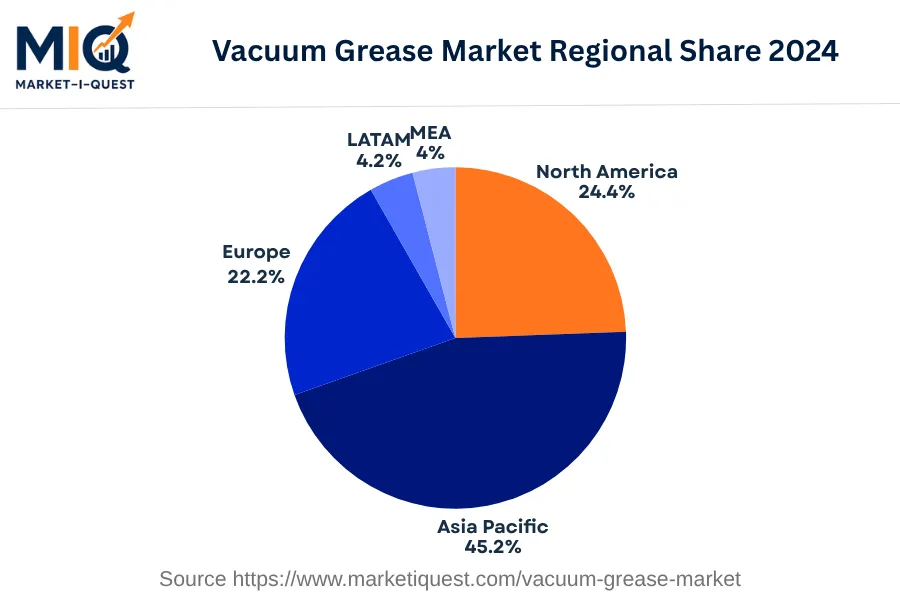
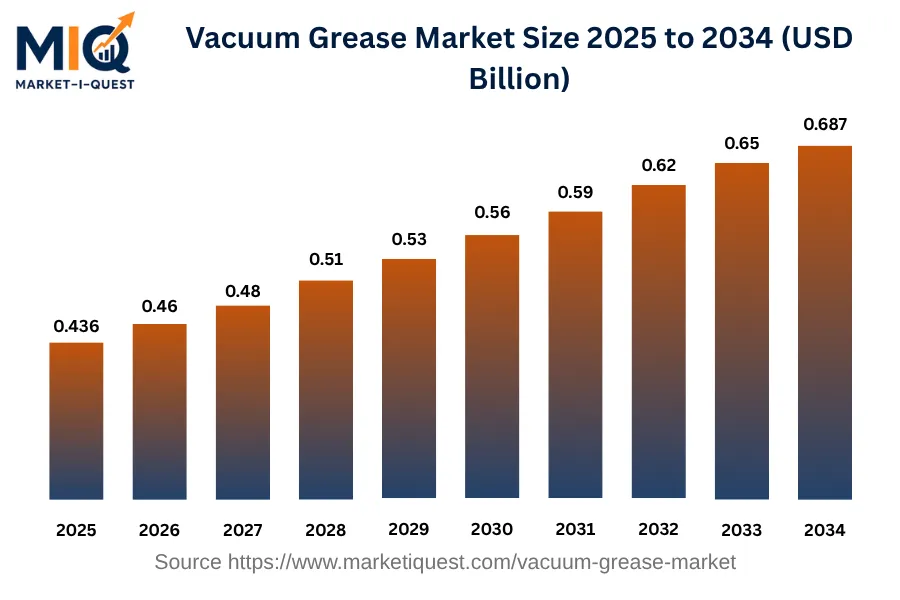
The Vacuum Grease market is projected to expand from USD 0.44 billion in 2025 to USD 0.69 billion by 2034, reflecting a compound annual growth rate (CAGR) of 5.2%. The marked growth is indicated by the escalation from USD 0.42 billion in 2024 to USD 0.44 billion in 2025, continuing to rise steadily over several years until reaching the projected market size in 2034. The course of this growth can be attributed to the steady year-on-year advances, indicated by the noteworthy CAGR. In 2024, the regional share for the Vacuum Grease market was distributed among various locations. North America accounted for 24.4% of the market, the Asia Pacific had a larger share of 45.2%, Europe constituted 22.2%, while Latin America made up 4.2%, and the Middle East and Africa had a 4.0% stake in the Vacuum Grease market.

Key Takeaways

  • By Base Oil Type - Hydrocarbon led accounting for the highest market share in 2024.
  • By Form - Grease showed remarkable growth accounting for an impressive share in 2024.
  • By Vacuum Level - High Vacuum held the top position dominating the market in 2024.
  • By Application - Automotive emerged as the leading sub-segment accounting for a considerable share in 2024.
vacuum-grease-market market size

Key Driving Factors

Demand in High Vacuum Applications

One of the major drivers in the vacuum grease market is its increasing use in high vacuum applications that primarily include industries like pharmaceuticals, and chemical manufacturing, among others. The properties of vacuum grease, such as ensuring excellent sealing and lubricating under low pressure conditions, are essential in these high vacuum environments. Industries are leveraging vacuum grease to thwart equipment contamination, which would otherwise lead to reduced efficiency and costly maintenance. Furthermore, vacuum grease's resistant character against chemicals, oils, and water make it an advantageous choice in these industrial operations.

Application in the Aerospace Sector

The second significant driver for the vacuum grease market is the increasing use in the aerospace sector. The aerospace industry requires lubricants that can withstand extreme conditions while ensuring high performance, and vacuum grease fulfills this need effectively. The grease is used to maintain and protect aeronautical instruments, facilitate mechanical processes, and reduce wear and tear of equipment exposed to severe temperature changes and high pressure. Aerospace manufacturers favor vacuum grease due to its ability to safeguard devices, leading to enhanced longevity. As the aerospace industry continues to evolve with de novo technologies, the reliance on vacuum grease also surges, hence boosting its market.

Market Evolution by Timeline

2019-2023
During this period, vacuum grease was primarily demanded by the aerospace, automotive, and manufacturing industries as a sealant and lubricant. North America and Europe were key regions due to their robust industrial sectors. The supply largely came from major petrochemical companies. However, achieving consistent product quality proved challenging. Notably, ASTM International released standards for vacuum greases during this time, which helped steer industry adoption. In most cases, vacuum grease was sold in bulk, with suppliers offering volume-based discounts. Potential risks included fluctuating oil prices and increasingly stringent environmental regulations.
2024
2024 witnessed a surge in vacuum grease demand in Asia, led by burgeoning automotive and electronics sectors in China and India. However, inconsistent product quality remained a challenge. This year saw a slight industry tilt towards bio-based grease in response to stricter environmental regulations. Increasing digitalization in the petrochemical industry also aided in enhancing product quality through smart manufacturing capabilities. One-off, large volume purchases became the norm and long-term contracts less common, with companies preferring more flexibility in supply sourcing due to unpredictability in oil prices.
2025-2029
The 2025-2029 period saw improved adoption of the ASTM standards, leading to better product quality consistency across suppliers. Environmental regulations continued to drive demand for bio-based vacuum grease, leading many companies to reconsider their production mechanisms. This was reflected in pricing models, with bio-based greases commanding a premium price. Use of vacuum grease increased in the renewable energy sector, particularly in the production and maintenance of wind turbines. There was a prevailing worry, however, about the supply of bio-based ingredients needed for producing vacuum grease.
2030-2034
By the 2030-2034 period, reliance on vacuum grease in the renewable energy sector, particularly wind energy, became firmly established. This bolstered demand and led to a more stable pricing structure. Suppliers became more refined in their production of bio-based greases, elevating product quality and mitigating concerns over consistency. This also led to improved supply of bio-based ingredients. Automation became a key trend in production, thus reducing labor costs. Despite these advancements, dependency on natural resources for bio-based ingredients reminded a potential risk.

Future Market Outlook

Future Opportunities

The growing necessity for efficient high-vacuum systems in various industries indicates significant future opportunities for vacuum grease manufacturers. As precision industries, including aerospace and pharmaceuticals, expand their operations globally, the demand for high-performance lubricants that can withstand extreme conditions is projected to rise. Notably, the 2023 rollout of NASA's Artemis I program has highlighted the critical reliance on vacuum systems for spacecraft, creating a spotlight on the associated lubricant markets. In parallel, the trend towards electric vehicles, particularly in regions like California, is prompting electric drivetrain manufacturers to seek specialized vacuum greases that accommodate heightened performance requirements. Companies such as SKF are potential beneficiaries of this trend, as they develop tailored solutions for electric motor applications. Another area poised for growth is within the medical device sector, driven by advancements in biocompatible materials. In May 2023, the FDA released updated guidelines emphasizing the importance and safety of lubricant materials in devices, thus creating demand for compliant products. The rise of end-user awareness concerning sustainability is pushing manufacturers to innovate with eco-friendly alternatives, again opening avenues for new product development. Coupling these market dynamics with the ongoing integration of Artificial Intelligence and automation in manufacturing processes enhances operational efficiencies and product viability, thus driving further investment in the vacuum grease space.

Segmentation Analysis

By Base Oil Type

The market is divided into subsegments including Silicone, Hydrocarbon, and Fluorocarbon. The Hydrocarbon subsegment accounted for the largest revenue share while Fluorocarbon is expected to grow at the fastest CAGR during the forecast period.

Largest Revenue Share

Hydrocarbon

Market Share Leader

With a strong demand across various industries, Hydrocarbon enjoys the highest revenue share among the subsegments. This dominance is primarily driven by its heavy usage in automotive, industrial, and electrical applications, where the need for lubricant base oil is highest. Based on the hydrocarbon's property of heat resistance, it has a broad field application in thermal stress environment, further driving its revenue share. Hydrocarbon's compatibility with additives, making it a staple choice for lubricants, fosters its market position. Additionally, the low cost and ready availability of hydrocarbon compared to other base oils also contribute to its leading revenue. Geographically, it is highly sought after in Asia-Pacific countries like China and India due to the booming manufacturing sectors. Market regulations have a minimal impact on this segment, due to Hydrocarbon's fairly standard environmental footprint. This analysis is based on industry norms assuming no disruptive changes in market dynamics or unforeseen regulatory shifts.

Fastest CAGR

Fluorocarbon

Forecast Period Growth Leader

The Fluorocarbon subsegment is projected to grow at the fastest rate. Its impressive growth trajectory can be accredited to properties such as chemical resistance, heat resistance, and low friction that make it an attractive choice in high-performance applications. Increasing demand from the aerospace and automotive industries, due to the operational efficiencies offered by Fluorocarbon, are major catalysts driving this growth. Moreover, ongoing technological advancements and increasing R&D efforts to improve Fluorocarbon characteristics might act as growth facilitators. The key barrier to Fluorocarbon adoption is its relatively high price; however, the long-term cost benefits have started tipping the scale to its favor. Concerning geographical expansion, North America and Europe will likely be significant contributors due to the large presence of industrial manufacturing and aerospace industries, despite near-term macroeconomic challenges. The assumption here is of standard market conditions with no drastic changes in regulatory or economic atmospheres.

By Form

The market is divided into subsegments including paste, grease, and liquid, among which, the grease subsegment accounted for the largest revenue share, while the liquid form is expected to grow at the fastest CAGR during the forecast period.

Largest Revenue Share

Grease

Market Share Leader

Grease as a form factor is dominant in the 2024 market due to its widespread use across a multitude of industries. With its excellent lubrication properties and the ability to prevent corrosion, it is most commonly used in automotive and manufacturing sectors. Its main strength lies in its resistance to high pressure and temperature, offering longevity and thus, reducing the overall operational and maintenance cost. In addition, the product is easy to handle and apply, making it a preferred choice among end users. Widespread usage in heavy machinery along with the growth and expansion of the industrial sector has led to increase in demand for the product. Furthermore, favorable regulations that prioritize safety in industries requiring high-performant lubricants also drive the market. Geographic areas with concentrated manufacturing and heavy industrial sectors such as Asia-Pacific and North America significantly contribute to the revenue of the grease subsegment.

Fastest CAGR

Liquid

Forecast Period Growth Leader

The liquid form, however, is projected to witness the fastest growth during the forecast period. This acceleration is primarily driven by the growing demand for effective cooling and cleaner emission in advanced machinery across industries such as automotive, aerospace, and energy. Moreover, the advent of new technology and continuous R&D efforts to enhance efficiency without compromising on ecological balance are acting as catalysts for the use of liquid lubricants. The growing adoption of environmentally friendly liquids that reduce carbon footprint, and increasing partnerships among manufacturers and research institutions to develop more effective formulations are other key drivers. However, high initial cost and potential risks associated with new technologies and formulations may pose challenges in its adoption. Despite this, the trend towards green innovation is a strong indicator that the liquid form will continue to witness rapid growth in the coming years.

By Vacuum Level

The vacuum market is differentiated into subsegments including Low Vacuum, Medium Vacuum, High Vacuum, and Ultra-High Vacuum. In the base year of 2024, High Vacuum secures the largest portion of the market share while Ultra-High Vacuum is predicted to demonstrate the fastest growth trajectory in the near-term future.

Largest Revenue Share

High Vacuum

Market Share Leader

High Vacuum segment led the market in the base year since it holds a widespread application spanning from metallurgy and material science to the electron microscopy domain. The dominant revenues are primarily driven by the absolute need of high vacuum conditions in several industries due to its ability to provide clean, dry environments which are essential for processes like coating, heat treatment, and physical vapour deposition. Geographically, regions with strong industrial sectors such as North America and Asia-Pacific contribute significantly to the segment's revenues, accompanied by strict regulations which necessitate the use of vacuum technologies that uphold environment-friendly operations. High Vacuum's success is also attributable to its profound integration within the healthcare sector for sterilization purposes, thereby solidifying its position as the highest revenue-garnering subsegment.

Fastest CAGR

Ultra-High Vacuum

Forecast Period Growth Leader

Although it currently does not lead in terms of revenue, the Ultra-High Vacuum segment is poised for rapid expansion, predicted to be the fastest growing subsegment in the market. This spurred growth is largely thanks to key driving forces such as technological advancements in vacuum systems and an increased demand in precision-oriented industries like semi-conductors and space technologies. More stringent policies regarding sustainable and efficient processes will catalyze growth within this segment. User industries are progressively embracing Ultra-High Vacuum technologies due to their improved performance in creating contaminant-free environments optimal for product quality. Increased capital expenditure towards improving current systems will further facilitate growth. However, barriers including high initial costs and lack of skilled personnel hamper faster adoption and pose near-term risks to its growth.

By Application

The market is divided into subsegments including Sealing and Lubrication, High-Vacuum Systems, Automotive, Aerospace, and Others. In 2024, the Automotive subsegment accounted for the largest revenue share while the High-Vacuum Systems subsegment is expected to grow at the fastest CAGR during the forecast period.

Largest Revenue Share

Automotive

Market Share Leader

The Automotive subsegment garnered the highest revenue in 2024 for a number of reasons. The sector has continually seen a surge in demand for products that rely on application-based market segments. Automobile manufacturers are increasingly pushing for innovations, leading to a high demand for sealing and lubrication products to enhance vehicle performance and longevity. Furthermore, the market is expanding due to the rising adoption of automobiles in developing regions, driven by their increasing middle-income population and growing urbanization. Government regulations mandating regular vehicle maintenance and advanced features geared towards enhancing vehicle safety also contribute to the growing revenue of this subsegment. Additionally, increased consumer awareness of the benefits of timely vehicle maintenance leads to frequent component replacements, driving the revenue further. There has also been a shift in the consumer purchasing behavior favoring a higher investment in vehicles to drive the demand in this segment significantly.

Fastest CAGR

High-Vacuum Systems

Forecast Period Growth Leader

The High-Vacuum Systems subsegment is set to grow at the most rapid pace. While its current market share may be small, its potential for growth is substantial due to several factors. With advances in technology, there is an increasing demand for high-vacuum systems in various industries including electronics, analytical, pharmaceuticals, and power plants majorly. The exploration of the use of high-vacuum systems in new applications such as space simulation also holds promising growth potential. The demand for these systems is supported by policy changes encouraging more efficient and environmentally friendly technologies. Stimulated by high capital investments and strategic partnerships among key players, there is an increasing commercial availability of these systems, which serves as a growth catalyst. However, it is essential to keep in mind that integration and maintenance costs might pose near-term risks to the adoption of high-vacuum systems.

Competitive Analysis

Key Market Players

Manufacturers / OEMs

Dow Corning
US
Shin-Etsu Chemical Co.
Japan
Ulbrich
US

Key Suppliers & Raw Materials

Castrol
UK
ExxonMobil
US
Shell
Netherlands

Distributors, Integrators & Channel Partners

ChemPoint
US
Grainger Industrial Supply
US
Fisher Scientific
US

Porter’s Five Forces Analysis

The analysis of Vacuum Grease Market using Porter's Five Forces model.

Supplier Bargaining Power

Medium

Controlled by limited manufacturers, the supply chain of vacuum grease may affect prices.

Buyer Bargaining Power

High

Variety of vacuum grease options intensify buyers' bargaining power.

Threat of Substitutes

Low

Low substitution due to technical specifications and unique properties of Vacuum grease.

Threat of New Entrants

Low

High capital expenditure and technical expertise required limit new market entrants.

Competitive Rivalry

High

Competitive landscape with multiple brands offering vacuum greases of various specifications.

Regional Analysis

Geographic market dynamics and growth opportunities across key regions

Global Market Outlook

vacuum-grease-market market regional share

North America

In 2024, the North American Vacuum Grease Market experienced significant growth in its demand, chiefly from the U.S., Canada, and Mexico. The key drivers consist of an increase in high-tech industries, stringent government regulations regarding safety and quality control, and higher consumer demand for advanced electronics. The U.S. dominance in the semiconductor industry called for a growing adoption of vacuum grease for equipment maintenance, while Canada saw an active investment in mining exploration, thereby requiring vacuum grease applications. In Mexico, surge in the manufacturing sector triggered an increase in vacuum grease usage.

Market trends illustrate a shift in buyer behavior, gravitating towards environmentally-friendly and high-performance vacuum greases. These greases, with their superior temperature stability, have been adopted espicially in the aerospace industry and high-speed machinery. Furthermore, the demand for silicon-based vacuum grease has escalated due to its wide operating temperature range and oxidation-resistance properties. Partnerships among manufacturers, suppliers, and end-user industries increased, in order to ensure streamlined supply and demand processes. Regulatory enforcement by environmental agencies such as the EPA focussed on the use of environmentally safe lubricants in industries, impacting the choice of vacuum grease among industrial users in North America.

Asia Pacific

In 2024, the vacuum grease market in Asia Pacific saw significant developments, shaped by various drivers and trends. Stringent regulations demanding superior quality in numerous industries, increased investment in research and development, and the upsurge of electrification and automation in manufacturing business from countries such as China, India and Japan spurred demand for vacuum grease products. South Korea and ASEAN nations fortified this demand with their expanding electronics industry, imposing improved standards to ensure durable and quality products.

Significant trends in this year included consumers' preference for silicone-based vacuum grease due to their long-lasting properties. This was accompanied by a sustainable adoption shift to eco-friendly, synthetic, high-performance greases. In terms of channel dynamics, online sales became more prominent as players optimized for improved distribution. China's push for 'Made in China 2025' policy enforced a technological upgrade in the manufacturing sector, indirectly affecting the vacuum grease market. Key customers of this market spanned across the healthcare sector, where vacuum grease is essential for laboratory apparatus, and manufacturing industries that demanded high-performance lubricants. Particularly in Australia's mining sector, robust, water-resistant vacuum greases were preferred. Moreover, Japan's electronic manufacturing sector was a significant contributor to this market due to its need for high-quality insulation. Finally, India’s burgeoning automotive industry constituted a substantial share of the vacuum grease market, highlighting the geographical diversity of demand.

Europe

In 2024, the Vacuum Grease Market in Europe stood as a diverse and competitive arena. Drivers of market activity included increased demand from pharmaceutical and laboratory sectors due to vacuum grease's inert nature and capability for wide temperature range operations. The German and French aerospace industries also underpinned the market with their considerable investment in technology that demands vacuum grease for fastening and sealing purposes. Moreover, stricter environmental regulations in the United Kingdom and Nordics spurred interest in vacuum grease's environmental benignity, subsequently driving its adoption rate.

Trends shaping the market included the growth in e-commerce which altered channel dynamics by increasing online sales. Collaborative partnerships were witnessed, particularly in Central & Eastern Europe, where companies paired to explore vacuum grease's diverse applications. There were shifts towards higher quality vacuum grease products in Italy and Spain in response to governmental standards intended to maintain efficient machinery operations. Notably, Germany's adoption of Industrie 4.0 policy had incited greater reliance on procedures that require vacuum grease, thus stimulating the market's expansion. Sweeping across Europe, the shift towards sustainable practices rendered vacuum grease, recognized for its negligible VOC emissions, a preferred choice in utilities and manufacturing sectors.

Latin America

In 2024, the Latin American vacuum grease market became increasingly dynamic, driven by a variety of factors and specific trends. A surge in demand for high-performance lubricants resulted from the region's rapidly evolving industrial sector, particularly in Mexico and Brazil where manufacturing operations flourished. Argentina’s substantial investment in high-tech machinery correlated with an uptick in vacuum grease usage, reflecting the crucial role of advanced lubricants in maintaining equipment health. Regulatory push towards the use of environmentally sustainable vacuum greases, notably in Chile and Peru, added another growth vector to the market.

The development of vacuum grease with enhanced thermal stability that caters to a wider range of applications became a crucial trend observed in Brazil and Colombia. Manufacturers in these regions adapted swiftly to new business models leveraging direct-to-consumer sales strategies, bypassing traditional distribution channels, while technological collaboration emerged as a prominent feature across the industry. Enforcement of rigorous product safety regulations and quality standards across LATAM drove consumer preference towards certified products. Top consumers were found in sectors such as automotive, healthcare, utilities and manufacturing where vacuum grease is a staple for equipment maintenance.

Middle East & Africa

The Vacuum Grease market in the Middle East and Africa (MEA) in 2024 was predominantly driven by its diverse applications across various industries. Increased demand for vacuum grease in the oil and gas sector, particularly in Saudi Arabia, UAE, and Qatar, due to the need for efficient sealing and lubricating components under extreme conditions, played a key role. Additionally, stringent regulations in Egypt and South Africa pertaining to environmental conservation necessitated the use of vacuum grease in utilities for prevention of leaks, stimulating the market. However, pricing volatility in key supplier markets posed a challenge.

The market in 2024 was also characterized by key trends. A shift towards adopting advanced technology in manufacturing, particularly in Israel and Kenya, led to increased usage of vacuum grease for maintenance of precision machinery. Concurrently, a rise in partnerships between regional and international firms, notable among them entities in Nigeria's telecom sector, enabled effective market penetration. In healthcare, there was a noticeable demand for vacuum grease, especially in South Africa and UAE, to maintain cleanliness in vacuum systems and prevent contamination. Lastly, stricter policy enforcement in sectors such as retail and financial services in countries like Saudi Arabia and Egypt highlighted the increasing emphasis on equipment upkeep, further driving the vacuum grease market.

Recent Industry Developments

Latest market innovations, product launches, and strategic initiatives

November 2025

M&I Materials (manufacturer of Apiezon vacuum greases) launched a sustainable feedstock challenge in partnership with Innovate UK to develop non-fossil alternatives to petroleum for vacuum grease manufacturing.

July 2025

Lubrication Engineers (LE) acquired Southwestern Petroleum Lubricants (SWEPCO), a specialty greases and oils manufacturer. This was LE's third acquisition in 2025, adding calcium sulfonate grease manufacturing capabilities and expanding its global distribution.

Frequently Asked Questions