Vacuum Cleaner Market Snapshot

Key Players

  • Dyson Ltd (United Kingdom)
  • iRobot Corporation (United States)
  • Miele & Cie. KG (Germany)
  • Electrolux AB (Sweden)
  • LG Electronics (South Korea)
  • Panasonic Corporation (Japan)
  • Philips Electronics N.V. (Netherlands)
  • SharkNinja Operating LLC (United States)
  • BISSELL Inc. (United States)
  • Samsung Electronics (South Korea)

Market Size

Base Year 2024
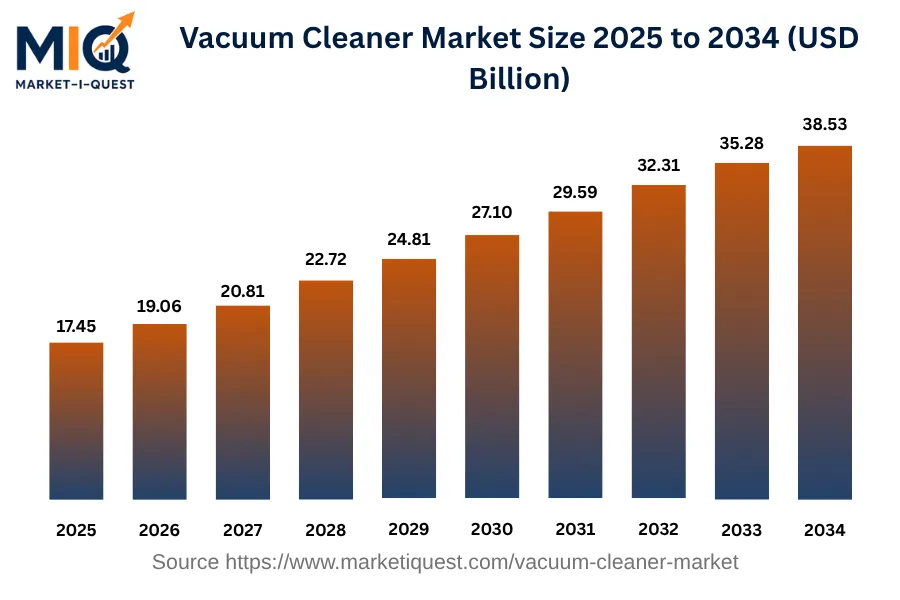
$15.98 Bn
CAGR
9.2%
Forecast 2034
$38.53 Bn

Market Segments

By Product
  • Canister
  • Central
  • Drum
  • Robotic
  • Upright
  • Wet & Dry
  • Others
By Distribution Channel
  • Online
  • Offline
By End Use
  • Residential
  • Commericial
  • Industrial

Market Dynamics

Drivers
  • Increased health awareness
  • Advancements in technology
Restraints
  • High product replacement costs
  • Reduced discretionary spending
Opportunities
  • Rising consumer sustainability demand
  • Technological advancements in vacuum cleaners

Market Size

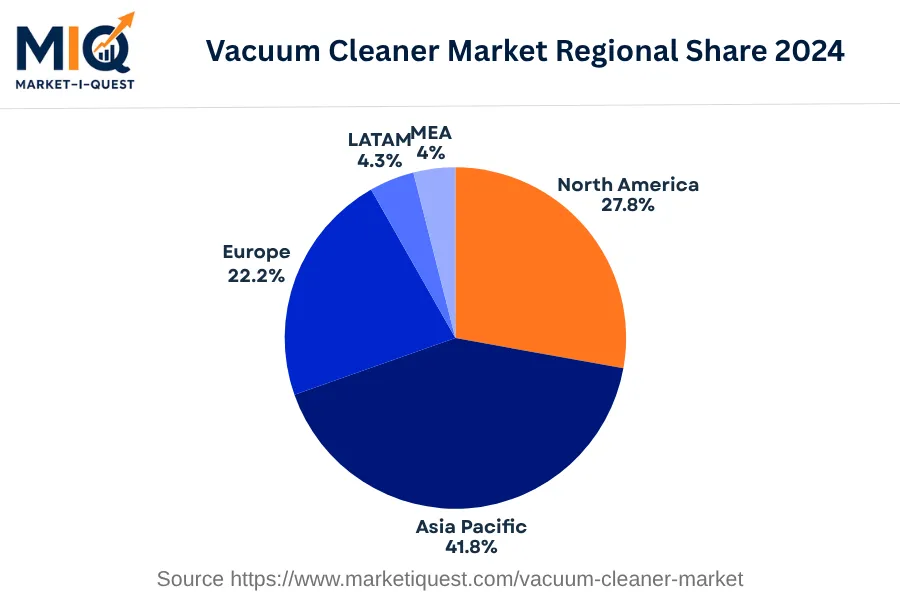
The vacuum cleaner market was valued at USD 17.45 billion in 2025 and is expected to reach USD 38.53 billion by the end of 2034, expanding at a CAGR of 9.2%. This growth trajectory started in 2024 when the vacuum cleaner market was worth USD 15.98 billion. Within a year, it rose to USD 17.45 billion and maintained a consistent growth rate every year to reach the projected value. The market expansion can be attributed to rising consumer awareness about the importance of maintaining a clean and hygienic surrounding in combination with a surge in spending capacities. An increase in acceptance of technologically advanced products for convenient and efficient cleaning further contributes to this market growth. Regionally, as per 2024 data, the Asia Pacific region held the largest market share of 41.76%, followed by North America with 27.84%, Europe at 22.18%, LATAM at 4.26%, and MEA with 3.96% of the global vacuum cleaner market.

Key Takeaways

  • By Product - Upright segment led accounting for the highest market share in 2024.
  • By Distribution Channel - Online expanded fastest indicating a shift in buying patterns for vacuum cleaners.
  • By End Use - Commercial held the lion's share indicating a robust demand in home-based cleaning solutions.
vacuum-cleaner-market market size

Key Driving Factors

Growing Popularity of Cordless Vacuum Cleaners

In recent years, the evolution towards more flexible household appliances has been noticeable in the vacuum cleaner market. This shift is most notable in the increasing popularity of cordless vacuum cleaners. These models allow users to clean houses more freely and easily without the restriction of a cord, making them particularly appealing to busy households and larger commercial spaces. Cordless units often come with convertible features, multitasking as handheld devices for cleaning tighter areas like staircases and car interiors, thus offering added convenience for the users. However, battery life continues to be a challenge, with extensive use reducing the cleaning time available between charges. To overcome this, manufacturers are investing in improving the battery technology, which in turn is pushing adoption of these products.

Surge in Online Sales

The vacuum cleaner market is also witnessing a significant surge in online sales, especially since the start of the global pandemic. With lockdowns and social distancing norms in place, more consumers are opting for online shopping for household appliances, including vacuum cleaners. Marketplaces such as Amazon, eBay, and others, offer a wide range of products from different brands, making product comparison and selection easier for the consumers. In addition, online channels often offer attractive discounts and flexible return policies, enticing more consumers to buy these products online. Meanwhile, manufacturers are also strengthening their digital presence to cater to this shift in consumer buying behavior. This growth in online sales continues to be a significant driver for the vacuum cleaner market.

Market Evolution by Timeline

2019-2023
The initial appeal of robotic vacuum cleaners led to a rise in buyer interest in automated cleaning appliances in affluent regions such as North America and Europe. Additionally, vacuum cleaner manufacturers released more energy efficient and durable devices, key selling points for environmentally conscious customers. Newly implemented EU regulations enforced energy consumption limits, which catalyzed these technological adjustments. Manufacturers started partnering with e-commerce platforms for wider reach, influencing market expansion. However, supply chains faced limitations due to political tensions, leading to unpredictable procurement patterns. More consumers opted for leasing programs, lessening the upfront burden of high-tech vacuum cleaner purchases.
2024
In 2024, the demand for air purifier-cum-vacuum cleaners saw an increase spurred by increasing air pollution in developing countries like India and China. Technology shifted towards AI-integrated, user-friendly models, though the devices' maturity remained in question. The United Nations Environment Programme's eco-friendly appliance initiative inspired cleaner standards. Prices showed upward trends due to enhanced tech functionalities, and Rent-to-own became common transaction models. However, privacy concerns triggered due to AI incorporation became a risk, which firms mitigated by providing user data management tips.
2025-2029
Demand shifted towards vacuum cleaners with air-sanitization features due to the global rise of allergies and respiratory diseases. Innovations focussed on IoT and app-enabled devices, but integration of these technologies was typically slow and patchy. Federal Energy Management Program encouraged further energy efficiency, creating product design shifts. Pay-per-use models gained more acceptance, facilitated by smart technology. Risk of technology obsolescence loomed with fast pace innovations; manufacturers responded by offering updates and upgrades to consumers.
2030-2034
Buyers became increasingly attracted to vacuum cleaners with multitasking traits, like mopping and disinfecting, owing to convenience-craving lifestyle patterns specifically in Australia and New Zealand. Supply shifted to the deployment of decentralized AI and Machine Learning algorithms, though efficient synchronization often posed as constraints. Regulatory bodies like IAQ (Indoor Air Quality) enforced stricter air quality standards. Pricing remained high due to consistent tech enhancements, but long-tenure EMIs became popular. Cybersecurity issues emerged as the significant risk with AI-infused devices, producers responded by strengthening in-built security features.

Future Market Outlook

Future Opportunities

The global vacuum cleaner market holds several promising opportunities shaped by current trends and consumer preferences. One significant opportunity lies in the development of health-oriented vacuum cleaners, particularly in regions such as North America and Europe. Companies like Miele have begun to market HEPA-filter-equipped models, specifically targeting allergy sufferers. The rising awareness of indoor air quality is expected to bolster demand for such products, particularly in urban areas with increased pollution levels. Additionally, partnerships between appliance manufacturers and app developers are opening new avenues for innovation. For instance, in 2023, Samsung announced a collaboration with a tech startup to enhance its SmartThings platform, integrating vacuum operations with home energy management systems. Moreover, the circular economy is gaining traction, prompting brands like Shark to explore sustainable product designs that allow for recyclability and reduced environmental impact. Regulatory frameworks, such as the Extended Producer Responsibility legislation in several EU countries, are likely to push manufacturers to find sustainable production methods and consider end-of-life implications. The rise in pet ownership also signifies an opportunity, as more households seek specialized vacuum solutions designed for pet hair removal. By aligning product offerings with these evolving consumer and regulatory trends, companies can effectively position themselves within the transformative landscape of the vacuum cleaner market for the foreseeable future.

Segmentation Analysis

By Product

The market is divided into subsegments including Canister, Central, Drum, Robotic, Upright, Wet & Dry, and Others. Upright vacuum cleaners accounted for the largest revenue share while Robotic vacuum cleaners are expected to grow at the fastest CAGR during the forecast period.

Largest Revenue Share

Upright

Market Share Leader

In the vacuum cleaner market, Upright vacuum cleaners are leading in terms of revenue. There are a few drivers for this trend. First, as a result of their design, these units are particularly effective at cleaning carpets, which are common in many households and commercial settings. They come with wider cleaning paths and powerful motor, allowing for quick and effective cleaning. Secondly, consumer's familiarity and comfort with upright models drive sales. These models have been around for some time and are what most people picture when they think of vacuum cleaners. Furthermore, their user-friendly model requiring less bending makes it more desirable, especially among older users. Some geographies also contribute to the demand as territories with high carpet-use rate generally prefer upright models. Moreover, upright vacuum cleaners are generally less expensive than newer technologies like robotic or central units garnering a high market share. We must note though that the purchasing preferences may change if newer models become more affordable or offer enhanced features.

Fastest CAGR

Robotic

Forecast Period Growth Leader

The Robotic vacuum cleaner subsegment is expected to experience the fastest growth rate. The key driver for this trend is the increasing desire for convenience and efficient cleaning methods catalysed by advancing technological capabilities. Robotic vacuum cleaners require minimal human intervention and can be pre-set to clean at specific times, which fits perfectly with today's fast-paced lifestyle. Additionally, technological partnerships have allowed companies to improve their robotic offerings with features such as mapping abilities, enhanced battery life, and auto dust disposal. However, higher prices and lack of awareness in some regions pose as adoption barriers for this sub-segment. They are also viewed to be less comprehensive in cleaning than more traditional models, and can be a risky investment considering the higher capital expenditure requirement. In the near term, the trend towards smart homes and IoT could greatly benefit the growth of this segment and potentially mitigate the risk of high initial costs.

By Distribution Channel

The market is divided into subsegments including Online and Offline. In the base year 2024, the Offline segment accounted for the largest revenue share while the Online segment is expected to grow at the fastest CAGR during the forecast period.

Largest Revenue Share

Offline

Market Share Leader

The offline segment holds the majority of the market share due to a variety of reasons. For one, even in this technological era, a significant percentage of the global population tends to prefer physical shopping over online. Offline shopping provides firsthand experience and immediate access to merchandise, eliminating the need for shipping and handling. This experience to touch, try-on and peruse items gives customers a sense of security before final purchases are made. Furthermore, shopping in-store also offers immediate problem resolution in terms of exchanges and refunds, which creates a trust-based relationship between the consumers and the sellers. Geographically, in regions with slower internet speeds or less developed e-commerce infrastructure, the offline mode of distribution still reigns supreme. Regulations that favor brick-and-mortar stores can also contribute to this segment's market lead. Yet, it's important to acknowledge that this scenario depicts the situation as per the base year 2024 and factors such as shifting consumer preferences and technological advancements may significantly affect this trend in the forthcoming years.

Fastest CAGR

Online

Forecast Period Growth Leader

While the Offline segment is generating the most revenue currently, the Online segment is forecasted to experience the fastest growth rate. The underlying drivers for this are far-reaching and varied. Rapid advancements in technology have spawned an increasingly connected global population, effectively diminishing the geographical barriers to commerce. Consumers can now purchase products from anywhere in the world with just the click of a button. This convenience is matched with increasingly secure online transaction methods, boosting consumer confidence in online purchases. Despite these strides, certain barriers to adoption still exist, most notable of which is the risk of fraud. However, the development of safer online transaction protocols and secure delivery methods is projected to mitigate these dangers. Future growth in this segment could also be stimulated by new tech integrations, strategic business-to-business partnerships, and supportive government policies aimed at promoting e-commerce. Potential risks include unpredictable changes in regulatory landscapes and the ongoing competition with the traditional Offline sector.

By End Use

The market is divided into subsegments including residential, commercial, and industrial end uses. The commercial subsegment accounted for the largest revenue share while the industrial subsegment is expected to grow at the fastest CAGR during the forecast period.

Largest Revenue Share

Commercial

Market Share Leader

The commercial subsegment leads the market in terms of revenue generation as of the base year 2024. This is primarily due to the wider application and higher usage volumes typically associated with commercial spaces. Commercial properties, for instance, boast larger square footage than residential properties and oftentimes, more demanding needs in terms of performance and durability of products. Additionally, the frequency of renovations or upgrades in commercial spaces due to changes in occupancies or corporate refurbishments is typically higher than in residential spaces. Also, the decisions for procurement in the commercial sector tend to be driven by the intent to ensure workflow efficiency, bolster corporate image, and adhere to more stringent regulation and safety standards. Furthermore, the sheer variety and number of commercial establishments - from offices, retail stores, to service-oriented businesses - significantly contribute to this subsegment's larger revenue share. It should be noted that these trends are generally observed in the market structures and may slightly vary across geographies.

Fastest CAGR

Industrial

Forecast Period Growth Leader

The industrial subsegment is projected to have the fastest growth rate in the upcoming years. There are several driving forces behind this rapid pace of growth. Industries are constantly striving for operational efficiency and productivity gains, thereby leading to increased demand for high-quality and technologically advanced solutions. Increasing automation and the integration of Internet of Things (IoT) in industrial operations are also acting as growth catalysts for this segment. Government regulations promoting safety and sustainability in industrial operations are spurring increased adoption as well. However, barriers such as high initial capital expenditure and the need for technical expertise can slow down the adoption rate. Despite these challenges, partnerships between industry operators and tech providers are expected to help overcome these barriers, further accelerating growth in this sector. Market participants should be aware of the near-term risks posed by geopolitical tensions and global economic uncertainties, which may impact capex spending.

Competitive Analysis

Key Market Players

Manufacturers / OEMs

Dyson Ltd.
UK
Techtronic Industries Co. Ltd.
Hong Kong
iRobot Corporation
US

Key Suppliers & Raw Materials

Suzhou Supermax Smart System Co.,Ltd.
China
NINGBO DAYE GARDEN MACHINERY CO.,LTD.
China
Cixi Modern Electric Industrialist Co., Ltd
China

Distributors, Integrators & Channel Partners

Best Buy Co., Inc.
US
Amazon.com, Inc.
US
Walmart Inc.
US

Porter’s Five Forces Analysis

This analysis highlights the dynamics and market competitiveness of the Vacuum Cleaner Market.

Supplier Bargaining Power

Low

Multiple suppliers of parts reduce bargaining power in the vacuum cleaner market.

Buyer Bargaining Power

High

Numerous brands and product options enhance buyer bargaining power.

Threat of Substitutes

Low

Limited substitutes to vacuum cleaners exist, reducing the threat level.

Threat of New Entrants

Medium

Significant capital investments and brand perception pose entry barriers for new entrants.

Competitive Rivalry

High

Varied product range and numerous brands amplify the competitive rivalry in the market.

Regional Analysis

Geographic market dynamics and growth opportunities across key regions

Global Market Outlook

vacuum-cleaner-market market regional share

North America

In 2024, North America's vacuum cleaner market experienced considerable dynamics driven by significant factors and trends. Technology adoption surged as smart, energy-efficient vacuum models introduced by companies like Dyson and iRobot gained prevalence. Further, the increase in demand for cordless and bagless vacuum cleaners also played a critical role in propelling the market growth. An ever-increasing focus on health and sanitation due to the COVID-19 pandemic elevated vacuum cleaner purchases, particularly in the U.S. and Canada.

Impacted by the transformation in buyer behavior, consumers showed a marked preference for online purchasing platforms over traditional retail, influenced by the convenience of e-commerce. Product shifts highlighting the innovation focused on smarter, eco-friendlier, and more portable vacuums, reflecting consumers' awareness about energy conservation and their increasingly mobile lifestyle. Partnerships and M&A deals also shaped the sector, notably Google's alliance with iRobot to integrate Google Home technologies into Roomba models.

Lastly, policy enforcement by governments in North America supporting energy-efficient appliances boosted sales of energy-star compliant vacuum cleaners within the region. Cleanliness and hygiene policies in the healthcare sector, and service industries like hotels and restaurants, underscored the commercial use of vacuum cleaners. Accordingly, 2024 unfolded as a year of continued evolution for the vacuum cleaner market in North America, with technology adoption and policy enforcement as decisive elements.

Asia Pacific

In 2024, the Asia Pacific vacuum cleaner market emerged as a dynamic and fast-evolving industry. A rise in living standards across key markets namely China, India, Japan, South Korea, Australia, and ASEAN countries drove the increasing demand for advanced cleaning appliances. Regulation-driven focus on sanitation and hygiene majorly in healthcare and retail sectors further fueled market growth. Increasing urbanization led to a surge in residential and commercial constructions which facilitated greater technology adoption of automated and high-efficiency vacuum cleaners. Investment in R&D by major manufacturers to ingress market competition was a prominent supply dynamic observed. High-end models saw increased pricing, primarily driven by their intelligent features and effectiveness.

Customers showed preferences for cordless and bagless vacuum cleaners as a result of the growing smart home trend. There was a significant shift towards online purchasing, with companies improving their direct-to-consumer channels and digital marketing strategies. A key trend was the surge in partnerships and M&A activities between local appliance manufacturers and international brands aiming to capture significant share in core markets. Standards for energy efficiency and noise levels were strictly enforced, therefore models with low noise and high efficiency were predominantly marketed. The vacuum cleaner market in the Asia Pacific in 2024 reflected a robust blend of demand-driven growth and trend-oriented shifts.

Europe

In the base year of 2024, the vacuum cleaner market in Europe experienced significant dynamism in response to evolving consumer habits and technology utilization. Under drivers, the increase in small household formations, predominantly in the United Kingdom and Germany, amplified vacuum cleaner demand. Further, the European Union's regulations on energy-efficient appliances heightened investments in related technological adoption. Meanwhile, the surging popularity of smart homes, particularly in France and the Nordics, led to the market pivot towards automated and cordless vacuum cleaners. Additionally, pricing strategies offered by key players in Spain and Italy influenced steady market supply.

Turning to trends, a shift towards technologically advanced products was noticeable in 2024. In the case of the Benelux region, robot vacuum cleaners gained increased consumer acceptance. Central and Eastern European markets experienced accelerated e-commerce activities for vacuum cleaner purchases, reflecting drastic changes in buying behavior. Mergers and acquisitions among sector players were predominant to enhance the production capabilities and distribution networks. Enforced EU policy on reducing noise pollution influenced manufacturers to integrate noise-reduction technologies in their products. In conclusion, consumer preferences, regulatory factors, and technological developments largely controlled the European vacuum cleaner market dynamics in 2024.

Latin America

In 2024, the vacuum cleaner market in Latin America witnessed noteworthy growth primarily driven by economic recovery, robust domestic demand, technology adoption and strengthened distribution channels. Brazilian consumers' growing preference for bagless and energy-efficient models significantly influenced market dynamics, while Mexico's employment of new regulations governed improved vacuum efficiency and lower energy consumption. In Argentina and Colombia, substantial investment in home appliances attributed to an increase in vacuum sales. Peru's market was stimulated by the introduction of robotic vacuum cleaners, and Chile experienced growth due to supply chain restructuring in the retail sector.

Conversely, buyer behavior trended toward online purchasing in both Mexico and Brazil because of advanced e-commerce platforms and wide product range availability. In Argentina and Chile, consumers exhibited an inclination toward smart home appliances, leading to a rise in smart vacuum cleaner sales. The adoption of green policies in Colombia resulted in a growing market for eco-friendly vacuum cleaners. In Peru, partnership between local and international manufacturers boosted market entry for new techno-savvy products. In sectors like hospitality and healthcare across the region, there was a heightened demand for high-capacity industrial vacuum cleaners. Overall, prominent trends and driving factors shaped the performance of the LATAM vacuum cleaner market in the base year.

Middle East & Africa

In 2024, the vacuum cleaner market in the Middle East and Africa exhibited significant dynamism due to myriad factors. Rising demand for automated home appliances in affluent economies such as Saudi Arabia, the United Arab Emirates, and Qatar largely drove sales. Strict cleanliness regulations in healthcare sectors across Egypt and Israel further reinforced this trend. Advances in cordless vacuum technology piqued consumer interest, driven by a widespread adoption of smart home systems across these regions.

Trends reflected an increasing preference for energy-efficient vacuum cleaners among consumers, mainly due to escalating energy costs. South Africa and Nigeria experienced a surge in purchases from the retail sector, aligned with the growing trend of modern retail outlets across urban centers. There was also a noticeable shift towards bagless vacuum cleaners owing to their ease of use and effective cleaning capabilities. In Israel and Saudi Arabia, acquisitions and partnerships among leading players in the vacuum cleaner industry emerged as a prominent trend, with brands seeking to expand their reach and product portfolio. Lastly, stern implementation of waste management policies in metropolitan areas like Abu Dhabi and Cape Town stimulated demand for commercial vacuum cleaners in public utilities and facilities management firms.

Recent Industry Developments

Latest market innovations, product launches, and strategic initiatives

June 2026

Amazon announced a $1.7 billion deal to acquire iRobot for $61 per share, including the company's debt. The acquisition is subject to shareholder and regulatory approval, with iRobot CEO Colin Angle remaining in his position post-acquisition. The deal reinforces Amazon's AI and smart home ambitions.

February 2026

Ojinyanghaeng signed an exclusive partnership agreement with Dreame to serve as the official domestic distributor and sales partner for the Dreame Z10 Station cordless vacuum cleaner in South Korea.

Frequently Asked Questions