
V2X Communication Module Market Snapshot

Key Players

  • Qualcomm (United States)
  • NXP Semiconductors (Netherlands)
  • Autotalks (Israel)
  • Huawei (China)
  • Bosch (Germany)
  • Hitachi (Japan)
  • Continental (Germany)
  • Veniam (United States)
  • Cohda Wireless (Australia)
  • Savari (United States)

Market Size

Base Year 2024
$ 1.21 Bn
CAGR
15.6%
Forecast 2034
$ 5.16 Bn

Market Segments

By Component
Hardware, Software, Services
By Communication Mode
Vehicle-to-Vehicle (V2V), Vehicle-to-Infrastructure (V2I), Vehicle-to-Pedestrian (V2P), Vehicle-to-Device (V2D), Others
By Deployment
Onboard Unit (OBU), Roadside Unit (RSU), High-Precision Positioning System, Others
By Application
Fleet Management, Autonomous Driving, Collision Avoidance Intelligent Traffic System, Lane-Keeping Assistance, Obstacle Detection, Others
By End Use
Passenger Cars, Commercial Vehicles

Market Dynamics

Drivers
  • Growing adoption of connected vehicles
  • Rising government smart infrastructure initiatives
Restraints
  • High infrastructure deployment costs
  • Limited standardization across regions
Opportunities
  • Increasing autonomous vehicle adoption
  • Smart city infrastructure development

Market Size

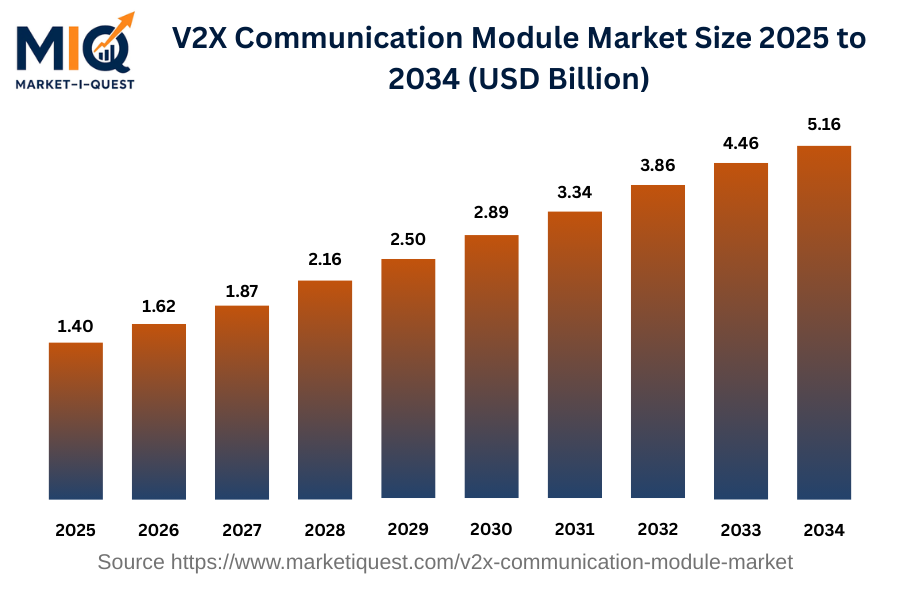
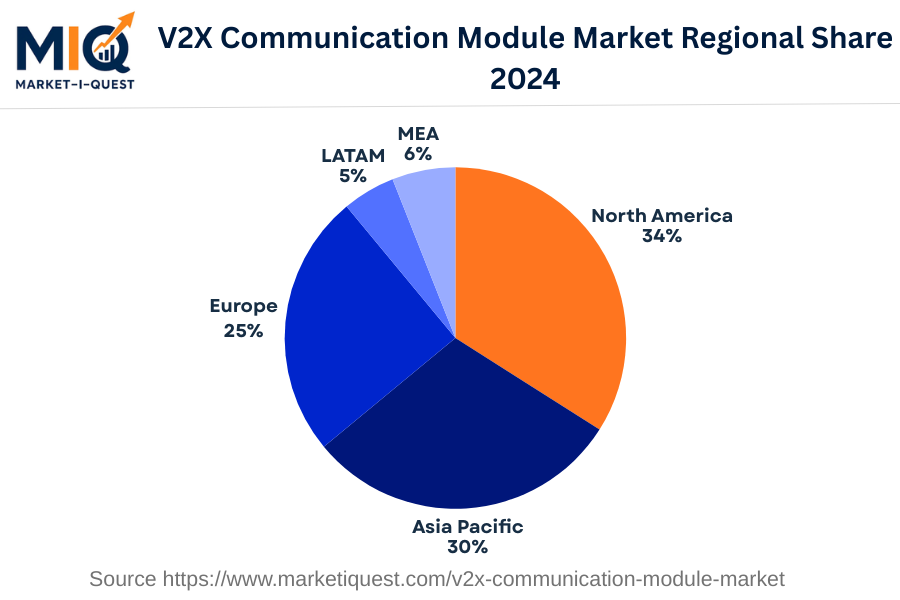
The V2X Communication Module Market is valued at USD 1.40 Billion in 2025 and reaches USD 5.16 Billion by 2034, with a CAGR of 15.6%. The market begins at USD 1.21 Billion in 2024 and shows consistent growth in subsequent years, driven by advancements in vehicle-to-everything technology and increasing demand for connected vehicles. The regional share in 2024 is distributed as follows: North America at 24.3%, Asia Pacific at 24.8%, Europe at 17.9%, LATAM at 3.9%, and MEA at 4.9%.

Key Takeaways

  • By Component - Hardware led the market accounting for the largest share in 2024.
  • By Communication Mode - Vehicle-to-Vehicle (V2V) grew fastest indicating significant potential for future expansion in safety features.
  • By Deployment - Onboard Unit (OBU) held a notable position as the preferred choice for most installations.
  • By Application - Autonomous Driving accounted for a significant share reflecting growing investment in advanced technologies for driving innovation.
  • By End Use - Passenger Cars dominated the segment highlighting strong consumer demand for enhanced connectivity features.
v2x-communication-module-market market size

Key Driving Factors

Implementation of Stringent Vehicular Safety Regulations

Governments worldwide have been introducing strict vehicle safety regulations, consequentially propelling the V2X Communication Module Market forward. Regulatory bodies such as the National Highway Traffic Safety Administration (NHTSA) in the United States and the European New Car Assessment Programme (Euro NCAP) in Europe are emphasizing collision avoidance systems, pushing carmakers to adopt V2X modules to ensure compliance. These high-level safety regulations require vehicles to be equipped with technology facilitating vehicle-to-vehicle (V2V) and vehicle-to-infrastructure (V2I) communication, to mitigate road accidents by alerting drivers about potential hazards and improve overall traffic flow. This requirement forms a concrete driving factor for the V2X Communication Module Market as original equipment manufacturers (OEMs) are compelled to incorporate this technology in vehicles to meet safety standards.
Accelerated Advancement Towards Autonomous Vehicles

Another significant driver propelling the V2X Communication Module Market demand is the intensified stride towards autonomous or self-driving vehicles. Automakers such as Tesla, Waymo, and Uber, among others are heavily investing in this futuristic mode of transport that hinges on highly sophisticated methods of communication between vehicles and their surroundings. This situation presents a ripe opportunity for the V2X Communication module market, as these modules form a crucial part of the complex network ecosystem within an autonomous vehicle, facilitating intercommunication with other cars and infrastructure. Consequently, the expansion and success of autonomous vehicles set ground for an increased demand for V2X Communication Modules substantiating the growth of its market.

Market Evolution by Timeline

2019-2023
During the period from 2019 to 2023, the V2X communication module market saw demand primarily from automotive manufacturers in North America and Europe. Major buyers included OEMs like Ford and BMW, looking to enhance vehicle safety features and traffic management systems. Pilot programs, such as the DSRC (Dedicated Short Range Communications) initiative in Michigan, tested V2X modules for intersection safety. Suppliers like Qualcomm and Intel expanded their offerings, integrating V2X capabilities into existing platforms. The integration maturity faced hurdles from varying standards, including NHTSA guidelines in the U.S. and the EU's eCall regulations, which led to fragmented adoption rates. Contract types shifted towards subscription models as municipalities sought long-term partnerships for infrastructure development. Pricing dynamics varied widely, influenced by the complexity of use cases and the scale of deployment. Risks included cybersecurity threats and regulatory delays, prompting some players to invest in secure communications frameworks and engage in collaborative industry efforts to establish unified standards.
2024
In 2024, the market began experiencing a shift as larger-scale deployments gained traction, particularly in urban areas like San Francisco and Tokyo. Municipalities increasingly adopted V2X solutions for smart city initiatives aimed at reducing congestion and improving public safety. Tech partnerships, such as the collaboration between Amazon and local governments for vehicle-to-infrastructure integration, emerged to drive innovation. Integration efforts focused heavily on C-V2X (Cellular Vehicle-to-Everything) technology, which offered enhanced performance over previous DSRC solutions. The policy landscape continued to evolve, with new regulations in the EU mandating V2X capability in electric vehicles by 2025. Price pressures for V2X modules persisted as competitors entered the market, leading to lower costs for end-users. Typical contracts shifted towards public-private partnerships, allowing for shared investment in infrastructure. However, challenges remained around varying regional regulatory frameworks, which often complicated deployment timelines. These factors led stakeholders to advocate for unified standards and best practices to streamline future growth.
2025-2029
From 2025 to 2029, V2X communication modules became standard in new vehicle models launched in major markets, including Australia and Germany. Leading automotive firms like Volkswagen and Toyota began including V2X capabilities as a differentiator in their product offerings. The supply side saw advancements in chipset technology, notably from companies like NXP and Huawei, which improved the efficiency and reliability of V2X communication. The regulatory environment solidified, with the establishment of global standards like ISO 21217 for V2X communications. This offered a clearer framework for manufacturers and developers. The commercial model shifted further towards performance-based contracts, allowing cities to pay based on the effectiveness of implemented solutions. Collaboration between tech companies and local government increased, fostering an ecosystem where data sharing was essential for success. The primary risks during this period revolved around interoperability issues, as legacy systems struggled to integrate with new V2X technologies. Continued education efforts and integration services aimed to mitigate these risks, while case studies from cities like Amsterdam demonstrated successful models.
2030-2034
Between 2030 and 2034, the V2X communication module market evolved into a mature segment of the smart transportation ecosystem. Major urban hubs in China, like Beijing and Shanghai, expanded their V2X infrastructure as part of national initiatives promoting autonomous vehicle integration. This led to increased demand from both automotive OEMs and technology providers focused on AI and machine learning solutions capable of processing massive datasets from V2X communications. Technological maturity allowed for seamless integration across different vehicle types, with partnerships emerging between automakers and tech giants like Google for data analytics. Policy frameworks, such as the U.S. Infrastructure Investment and Jobs Act, incentivized investment in V2X technologies, providing tax credits and funding for pilot projects. Pricing strategies became more dynamic, incorporating revenue-sharing models based on traffic efficiency improvements. The main practical blocker remained the need for widespread infrastructure investment. Initiatives aimed at mitigating barriers, including public awareness campaigns and pilot funding, aimed to encourage broader adoption and long-term viability of V2X communication systems.

Future Market Outlook

Future Opportunities

The evolving landscape of V2X communication technology presents numerous opportunities across various sectors. In 2023, the global automotive industry faced pressures to enhance vehicle safety and connectivity, driven by regulations like the EU's General Safety Regulation, which mandates advanced safety features in new vehicles by July 2024. Consequently, stakeholders can harness the burgeoning demand for V2X technologies in both passenger and commercial vehicles. Deployment of smart city initiatives in regions such as Singapore, which is developing a comprehensive network of interconnected vehicles and traffic systems, indicates robust future demand for V2X communications. Additionally, partnerships between companies like BMW and various tech firms to integrate artificial intelligence into V2X systems are likely to facilitate better traffic management and accident prevention. Furthermore, with the increasing implementation of autonomous vehicles, there is a growing need for reliable V2X connectivity to ensure safe and efficient operations. Regulatory bodies such as the U.S. National Highway Traffic Safety Administration are prioritizing the deployment of connected vehicle technologies by supporting pilot programs. Companies specializing in V2X communication will find opportunities in developing secure, robust systems that comply with international standards like ITS-Safety, intended to safeguard against cyber threats in future implementations.

Segmentation Analysis

The V2X communication module market is segmented by Component (Hardware, Software, Services), by Communication Mode (Vehicle-to-Vehicle (V2V), Vehicle-to-Infrastructure (V2I), Vehicle-to-Pedestrian (V2P), Vehicle-to-Device (V2D), Others), by Deployment (Onboard Unit (OBU), Roadside Unit (RSU), High-Precision Positioning System, Others), by Application (Fleet Management, Autonomous Driving, Collision Avoidance, Intelligent Traffic System, Lane-Keeping Assistance, Obstacle Detection, Others), and by End Use (Passenger Cars, Commercial Vehicles).

By Component

The market is divided into subsegments including Hardware, Software, and Services. Hardware accounted for the largest revenue share while Services is expected to grow at the fastest CAGR during the forecast period.

Largest Revenue Share

Hardware

Market Share Leader

The Hardware subsegment leads the market due to increasing demand for advanced tech solutions across various industries, driven primarily by digital transformation initiatives. Enterprises are investing heavily in physical infrastructure, such as servers and networking equipment, to support cloud computing and Internet of Things (IoT) applications. Major drivers include the need for robust cybersecurity measures and high-performance computing, particularly in financial services, healthcare, and logistics. Geographically, North America and Asia-Pacific are significant contributors to hardware revenue, fueled by leading technology hubs and a high concentration of manufacturing facilities. Stringent regulations around data handling and security are prompting businesses to upgrade their hardware capabilities to remain compliant. Additionally, customers are influenced by purchasing criteria such as reliability, performance, and vendor reputation, which contribute to higher switching costs in the hardware sector. Lastly, distribution channels such as direct sales and online platforms play a crucial role in reaching diverse customer bases, ensuring that hardware solutions are accessible to enterprises of all sizes. This multifaceted demand solidifies hardware's position as the largest revenue-generating subsegment boosting the V2X Communication Module Market size.

Fastest CAGR

Services

Forecast Period Growth Leader

The Services subsegment is poised for the fastest growth rate, primarily driven by the rapid adoption of cloud-based solutions, consulting, and managed services. Organizations are increasingly looking to outsource IT functions to improve efficiency and reduce costs, propelling the demand for professional services. Additionally, advancements in technologies like AI and machine learning are creating opportunities for specialized services, enhancing operational capabilities. However, adoption barriers, such as concerns over data security and vendor lock-in, persist. Catalysts for growth include supportive government policies promoting digital innovation and partnerships between technology providers and businesses to facilitate service adoption. These alliances often lead to tailored service offerings that meet specific industry needs, further boosting market penetration. Near-term risks include economic downturns that might lead enterprises to scale back on discretionary IT spending. Nevertheless, as organizations recognize the long-term value of investing in IT services, the overall trend points towards sustained growth in this subsegment, making Services an attractive area for investment and development.

By Communication Mode

The market is divided into subsegments including Vehicle-to-Vehicle (V2V), Vehicle-to-Infrastructure (V2I), Vehicle-to-Pedestrian (V2P), Vehicle-to-Device (V2D), and Others. Vehicle-to-Infrastructure (V2I) accounted for the largest revenue share while Vehicle-to-Pedestrian (V2P) is expected to grow at the fastest CAGR during the forecast period.

Largest Revenue Share

Vehicle-to-Infrastructure (V2I)

Market Share Leader

Vehicle-to-Infrastructure (V2I) leads the market in revenue largely due to its critical role in enhancing traffic management and improving road safety. Municipalities and transportation authorities are investing heavily in V2I technologies, driven by governmental policies encouraging smart city initiatives and the integration of advanced communication systems. These technologies allow vehicles to communicate with traffic signals, signs, and other infrastructure, resulting in improved traffic flows and reduced congestion. Major urban centers are adopting V2I solutions to address increasing urbanization and the growing number of vehicles on the road. Additionally, the rise of electric vehicles and their integration with smart infrastructure has further fueled investment in V2I systems. Industries, including automotive manufacturers and telecommunications providers, are forming strategic partnerships to create interoperable systems that enhance customer experience and operational efficiency. The push for CO2 emissions reduction also drives public funding towards advanced transportation technologies, elevating V2I adoption across cities. As cities continue to modernize their infrastructure, V2I remains a top priority in both government and private sector budgets, solidifying its position in the V2X Communication Module Market growth.

Fastest CAGR

Vehicle-to-Pedestrian (V2P)

Forecast Period Growth Leader

Vehicle-to-Pedestrian (V2P) is poised for the fastest growth due to increasing urban congestion and heightened awareness of pedestrian safety. As cities evolve towards smarter ecosystems, V2P technology facilitates communication between vehicles and pedestrians, employing mobile applications and wearable devices that alert drivers and walkers to each other's presence. Growth drivers include regulatory mandates focused on improving pedestrian safety and the rising adoption of automated vehicles, which necessitate effective communication to avoid accidents. However, adoption barriers such as technology integration, privacy concerns, and the need for robust infrastructure can hinder rapid implementation. The technology landscape is evolving, with partnerships between automotive companies, tech firms, and city planners aiming to create effective V2P solutions that maximize safety and convenience. While these collaborations serve as a catalyst for growth, there are near-term risks encompassing changes in regulatory frameworks and potential cybersecurity concerns associated with connected devices. Addressing privacy issues effectively and ensuring seamless interactions among components are crucial for realizing V2P's full potential quickly. Nevertheless, advancements in app technologies and public engagement initiatives are likely to support V2P solutions' adoption, paving the way for a more pedestrian-friendly urban experience.

By Deployment

The market is divided into subsegments including Onboard Unit (OBU), Roadside Unit (RSU), High-Precision Positioning System, and Others. The Onboard Unit (OBU) accounted for the largest revenue share while the High-Precision Positioning System is expected to grow at the fastest CAGR during the forecast period.

Largest Revenue Share

Onboard Unit (OBU)

Market Share Leader

Onboard Units (OBUs) lead the market in revenue share primarily due to their pivotal role in vehicle communication systems. The increasing demand for advanced driver-assistance systems (ADAS) and the push towards vehicle automation have created a substantial customer base for OBUs. Major automotive manufacturers are integrating these systems to enhance safety features, navigate traffic congestion, and fulfill regulatory requirements regarding emissions and safety standards. Geographically, North America and Europe are significant markets bolstered by stringent government regulations related to vehicle safety and environmental concerns. Furthermore, the OBU market benefits from established distribution channels, including partnerships with automotive suppliers. These units are often viewed as necessary investments for fleet operators looking to achieve efficiency and compliance, leading to lower switching costs compared to alternatives. Thus, while technology advancements in terms of capabilities and functionalities are essential, it is the foundational integration of these systems in modern vehicles that drives the sustained revenue growth for OBUs.

Fastest CAGR

High-Precision Positioning System

Forecast Period Growth Leader

The High-Precision Positioning System subsegment is on a trajectory for rapid growth due to the increasing need for accuracy in various applications, including autonomous vehicles, agriculture, and construction. Factors spurring this growth include technological advancements in positioning accuracy, which have begun to surpass traditional GPS capabilities. Partnerships between tech firms and automotive manufacturers are catalyzing the development of integrated solutions, driving broader adoption across industries. However, adoption barriers do exist; the high costs of implementation and the need for specialized skills can deter some organizations from transitioning to these advanced systems. Regulatory frameworks are evolving to support these technologies, which mitigates some risks associated with deployment. Near-term risks such as supply chain disruptions or fluctuating demand caused by economic factors may pose challenges, but the underlying demand for precision and efficiency remains strong. As industries continue to move towards automation and data-driven decision-making, the High-Precision Positioning System segment stands poised for significant growth, driven by both market needs and supported policy environments.

By Application

The market is divided into subsegments including Fleet Management, Autonomous Driving, Collision Avoidance, Intelligent Traffic System, Lane-Keeping Assistance, Obstacle Detection, and Others. Fleet Management accounted for the largest revenue share while Autonomous Driving is expected to grow at the fastest CAGR during the forecast period.

Largest Revenue Share

Fleet Management

Market Share Leader

Fleet Management remains the leading subsegment in terms of revenue due to its essential role in optimizing logistics and reducing operational costs. Companies across various industries are increasingly relying on fleet management solutions to enhance efficiency, comply with regulations, and ensure safety. The demand is driven by the rise of e-commerce and the need for real-time data analytics in transportation. Key customers include logistics firms, delivery services, and rental agencies that seek to maximize asset utilization and minimize downtime. Geographically, regions with advanced infrastructure and stringent regulatory measures, such as North America and Europe, have a higher adoption rate. Furthermore, the integration of telematics and IoT has enabled sophisticated tracking and management capabilities, elevating customer expectations. The competitive landscape is characterized by the presence of established vendors and new entrants, increasing the pressure on companies to innovate and offer value-add features. As organizations recognize the importance of fleet optimization in sustainability efforts, the value proposition of fleet management solutions continues to strengthen, solidifying its position as the revenue leader in the market.

Fastest CAGR

Autonomous Driving

Forecast Period Growth Leader

The Autonomous Driving subsegment is poised for the fastest growth due to technological advancements and increasing investment in connected and automated vehicle systems. Several factors are catalyzing this trend, including supportive government policies and regulations aimed at promoting safer and more efficient transportation. Private companies and public partnerships are accelerating development through substantial capital expenditure on research and innovative projects. However, adoption is not without challenges, such as regulatory hurdles, safety concerns, and high development costs, which may impede the pace of implementation. Consumer willingness to embrace autonomous features depends on assurances of safety and enhanced mobility solutions. As technology matures, partnerships between automotive manufacturers and tech companies are strategic for accelerating deployment, further driving market engagement. Near-term risks include potential cybersecurity threats and public perception issues that could impact consumer trust. Despite these barriers, the combination of smart infrastructure investments and evolving consumer preferences positions autonomous driving as a front-runner in market growth, revealing its potential to redefine transportation landscapes.

By End Use

The market is divided into subsegments including Passenger Cars and Commercial Vehicles. Passenger Cars accounted for the largest revenue share while Commercial Vehicles are expected to grow at the fastest CAGR during the forecast period.

Largest Revenue Share

Passenger Cars

Market Share Leader

Passenger Cars dominate the market due to their widespread adoption and critical role in personal transportation. The significant consumer preference for passenger vehicles stems from their versatility, range of models, and the increasing focus on fuel efficiency and electrification. Urbanization and rising disposable income levels have fueled demand across various geographies, especially in emerging economies where car ownership is rapidly increasing. Furthermore, regulatory frameworks pushing for reduced emissions are leaning towards developing more eco-friendly passenger vehicles. The increased convenience provided by passenger cars makes them the preferred choice for daily commutes, long-distance travel, and leisure activities. Additionally, the availability of various financing options lowers the barriers to ownership, further propelling sales. OEMs are constantly innovating with features that enhance safety and connectivity, which solidifies consumer loyalty and drives repeat purchases. This subsegment also benefits from strong retail distribution channels and service networks that assure consumers of easy access to maintenance and support, ensuring sustained customer satisfaction and repeated purchases.

Fastest CAGR

Commercial Vehicles

Forecast Period Growth Leader

Commercial Vehicles are expected to exhibit the fastest growth due to a surge in demand for logistics and last-mile delivery services driven by e-commerce expansion. The shift towards online shopping has necessitated investments in commercial transportation solutions, as businesses seek efficient ways to distribute goods. However, challenges such as high upfront investments in fleet management and regulatory hurdles regarding emissions standards pose significant barriers to entry for new players. Technological advancements, including electric and autonomous commercial vehicles, are catalyzing this growth by improving efficiency and reducing operational costs. Partnerships between logistics companies and vehicle manufacturers are likely to drive innovation and adoption speed. Additionally, government incentives promoting clean energy and efficient transportation solutions are expected to bolster growth by lowering barriers for companies willing to invest in new fleets. While the outlook is positive, risks such as fluctuating fuel costs and changes in regulatory policies could affect short-term growth. Stakeholders must be prepared to navigate these dynamics to capitalize on the expanding market opportunities in this subsegment.

Competitive Analysis

Key Market Players

The V2X Communication Module industry is competitive, with a mix of large established companies and smaller regional players. Most companies focus on improving their products/services, keeping prices attractive, and strengthening relationships with key customers. They also use partnerships, acquisitions, and new launches to expand their presence in existing and new markets. Overall, players compete on quality, reliability, and value, and competition is expected to remain strong over the forecast period.

Manufacturers / OEMs

Continental AG
Germany
Bosch Mobility Solutions
Germany
Denso Corporation
Japan

Key Suppliers & Raw Materials

NXP Semiconductors
Netherlands
Qualcomm Technologies, Inc.
US
Texas Instruments
US

Distributors, Integrators & Channel Partners

Harman International
US
Ericsson
Sweden
AT&T Inc.
US

Porter’s Five Forces Analysis

The V2X Communication Module Market is shaped by supplier dynamics, buyer influence, and competitive conditions. Understanding these forces is essential for strategic positioning.

Supplier Bargaining Power

Medium

Limited suppliers with specialized technology create moderate power over pricing and terms.

Buyer Bargaining Power

High

Buyers face low switching costs, enhancing their power in negotiating prices and services.

Threat of Substitutes

Low

Few viable alternatives exist, as V2X is specialized and crucial for automotive communication.

Threat of New Entrants

Medium

Entry barriers exist due to high capital requirements and regulatory certifications but are not insurmountable.

Competitive Rivalry

High

Numerous players compete intensely, driven by rapid technological advancements and innovation demands.

Regional Analysis

Geographic market dynamics and growth opportunities across key regions

Global Market Outlook

v2x-communication-module-market market regional share

North America

In 2024, the V2X (Vehicle-to-Everything) communication module market growth in North America is characterized by significant technological advancements and regulatory support aimed at enhancing road safety and efficiency. The growing demand for connected vehicles, alongside rising incidents of road accidents, drives investment in V2X technologies across the U.S., Canada, and Mexico. Federal regulations, such as the U.S. Department of Transportation's initiative to integrate connected vehicle technologies, further stimulate market growth by mandating safety standards and offering funding for pilot projects.

In terms of trends, there is a notable shift toward collaborative partnerships among automotive manufacturers and technology firms, as seen in alliances like the one between General Motors and Verizon to enhance vehicle connectivity. Additionally, buyers are increasingly favoring vehicles equipped with advanced communication capabilities, influencing manufacturers to prioritize V2X in product development. The market is also witnessing stricter adherence to connected vehicle standards, driven by policies such as the Canadian government's "Canada's Vision for Connected and Automated Vehicles." These dynamics reflect a concerted effort from the private sector and government agencies to promote sustainable mobility and improve traffic management across urban environments, encompassing sectors like transportation, automotive, and infrastructure.

Asia Pacific

In 2024, the V2X Communication Module Market expansion in Asia Pacific is shaped by several significant drivers influencing demand and technology deployment. Increasing urbanization in countries like China and India fuels the need for advanced transportation solutions, enhancing vehicle safety and traffic efficiency. Government regulations, such as Japan's initiatives for Smart Mobility and South Korea's investment in autonomous vehicle infrastructure, further promote V2X technologies. Investment in 5G networks supports high-speed data transmission, essential for real-time vehicle-to-everything communication. Additionally, rising consumer preferences for connected vehicles are steering manufacturers to adopt V2X systems, with notable interest from automotive sectors in Australia and ASEAN markets.

Trends indicate a shift in buyer behavior toward more integrated technology solutions, with partnerships between automakers and telecommunications providers becoming increasingly common. Collaborations are evident in Japan, where leading automotive companies are aligning with tech firms to create seamless V2X ecosystems. The sector is also witnessing a push for standardized communication protocols, driven by policy enforcement and regulatory alignment in multiple countries. As smart city initiatives gain traction across Asia Pacific, the V2X market is expected to align closely with urban infrastructure development, particularly in major cities across China, India, and key ASEAN markets.

Europe

In 2024, the V2X Communication Module Market size in Europe is characterized by a growing emphasis on enhancing road safety and reducing traffic congestion through advanced vehicle communication technologies. Key drivers include stringent European Union regulations aimed at improving road safety, such as the implementation of the General Safety Regulation, mandating vehicle connectivity features. This regulatory environment is spurring investments from both automotive manufacturers and technology providers, particularly in Germany and France, where automotive sectors are robust. Additionally, rising consumer demand for smart mobility solutions is fostering increased technology adoption and development of advanced communication modules.

Current trends highlight a shift towards direct partnerships between automotive OEMs and tech firms to enhance product offerings, with notable collaborations emerging in the UK and the Nordics. Buyers are increasingly prioritizing solutions that integrate seamlessly with existing infrastructure, driving demand for interoperable devices. Furthermore, standards such as ETSI ITS, which define communication protocols, are being more rigorously enforced, influencing product development cycles. The participation of government entities in testing and deployment of V2X systems is also evident, as seen in various pilot projects across Spain and Italy, affirming the role of public sector investments in shaping the market landscape.

Latin America

In 2024, the V2X communication module market in Latin America is characterized by increasing investment in intelligent transportation systems aimed at enhancing road safety and traffic management. The demand for V2X technology is driven by escalating urbanization, particularly in Brazil and Mexico, where high traffic congestion urges municipalities to adopt connected vehicle solutions. Regulatory frameworks are evolving, with initiatives such as Brazil's National Policy on Urban Mobility emphasizing the need for advanced traffic management technologies, thereby promoting V2X deployment.

Furthermore, the adoption of 5G technology is facilitating the integration of V2X systems, improving data transmission speeds crucial for vehicle communication. This technological shift influences buyer behavior, as both government entities and automotive manufacturers prioritize investments in connected infrastructure. Partnerships between automotive companies and telecommunications providers are becoming increasingly common, particularly in Colombia and Chile, to enhance the functionality of V2X applications.

Standards for communication protocols are evolving as local and regional entities work towards harmonizing V2X systems, ensuring interoperability between devices. The regulatory environment, with enforcement of safety standards, drives both compliance and innovation in product offerings across sectors such as transportation and logistics, contributing to the overall market dynamics in LATAM.

Middle East & Africa

In 2024, the V2X communication module market trends in the Middle East and Africa is significantly influenced by rapid advancements in intelligent transportation systems and increasing investments in smart mobility solutions. Drivers include rising urbanization in Saudi Arabia and the UAE, prompting demand for enhanced traffic management and safety, while regulatory frameworks like Saudi Arabia’s Vision 2030 support smart city initiatives. In Egypt, government investments in infrastructure improvements further stimulate demand for V2X technologies. Additionally, technological adoption is accelerated by regional telecom operators like Etisalat and STC upgrading networks to support 5G, facilitating V2X applications.

Trends highlight a shift towards collaborative partnerships between automotive manufacturers and tech firms, with an emphasis on developing software solutions for V2X applications. Local governments are enforcing policies that require lower emissions, driving investments in electric vehicles equipped with V2X capabilities. Buyer behavior is also evolving, as consumers in South Africa and Nigeria seek vehicles that integrate automated safety features. Notably, standardization efforts by the Gulf Cooperation Council (GCC) aim to establish uniform protocols for V2X communications, enhancing interoperability across the region. These factors collectively shape a competitive landscape in the V2X communication module market for 2024, particularly in urban centers across the region.

Recent Industry Developments

Latest market innovations, product launches, and strategic initiatives

Apr 2025

Murata updated its V2X module line, emphasizing support for both DSRC and C‑V2X in compact modules designed for automotive and roadside units, enabling OEMs and infrastructure suppliers to target multiple regional standards with a single hardware platform. The company positions these modules for use in vehicle‑to‑vehicle, vehicle‑to‑infrastructure, and vehicle‑to‑pedestrian safety applications, reflecting growing demand for multi‑standard V2X hardware.

Frequently Asked Questions