
V2X Communication Market Snapshot

Key Players

  • Qualcomm (United States)
  • Huawei (China)
  • Nokia (Finland)
  • Continental (Germany)
  • Autotalks (Israel)
  • Samsung Electronics (South Korea)
  • Harman International (United States)
  • ZTE (China)
  • Kapsch TrafficCom (Austria)
  • Cohda Wireless (Australia)

Market Size

Base Year 2024
$ 2.68 Bn
CAGR
42.6%
Forecast 2034
$ 93.18 Bn

Market Segments

By Component
Hardware, Software
By Communication Type
V2V (Vehicle-to-Vehicle), V2I (Vehicle-to-Infrastructure), V2P (Vehicle-to-Pedestrian), V2N (Vehicle-to-Network), V2G (Vehicle-to-Grid), V2C (Vehicle-to-Cloud), V2D (Vehicle-to-Device), V2H (Vehicle-to-Home)
By Connectivity Type
DSRC, Cellular
By Propulsion Type
Internal Combustion Engine, Electric
By End Use
Passenger Cars, Commercial Vehicles

Market Dynamics

Drivers
  • Increased demand for road safety
  • Government investments in smart infrastructure
Restraints
  • High infrastructure deployment costs
  • Lack of standardized communication protocols
Opportunities
  • Infrastructure investment in smart cities
  • Expansion of autonomous vehicle testing

Market Size

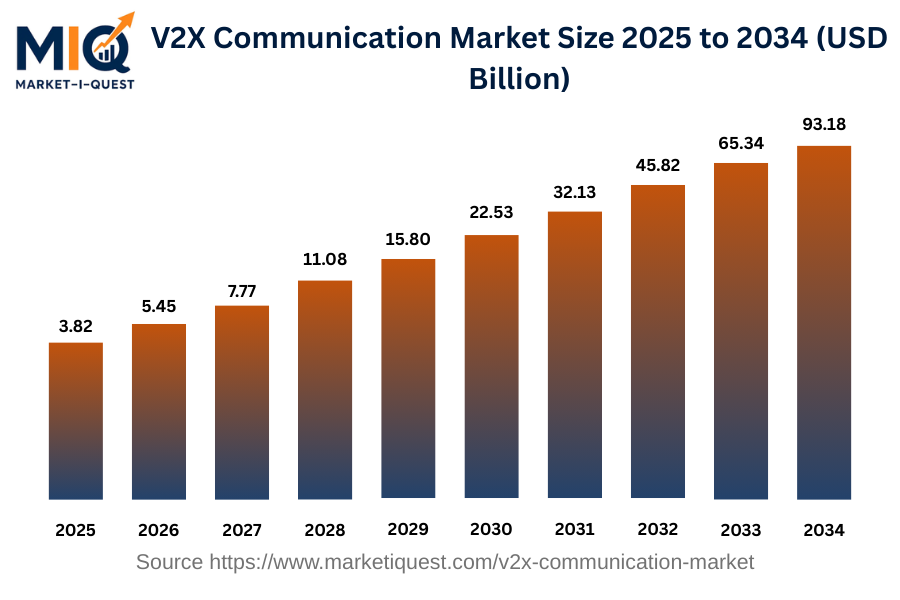
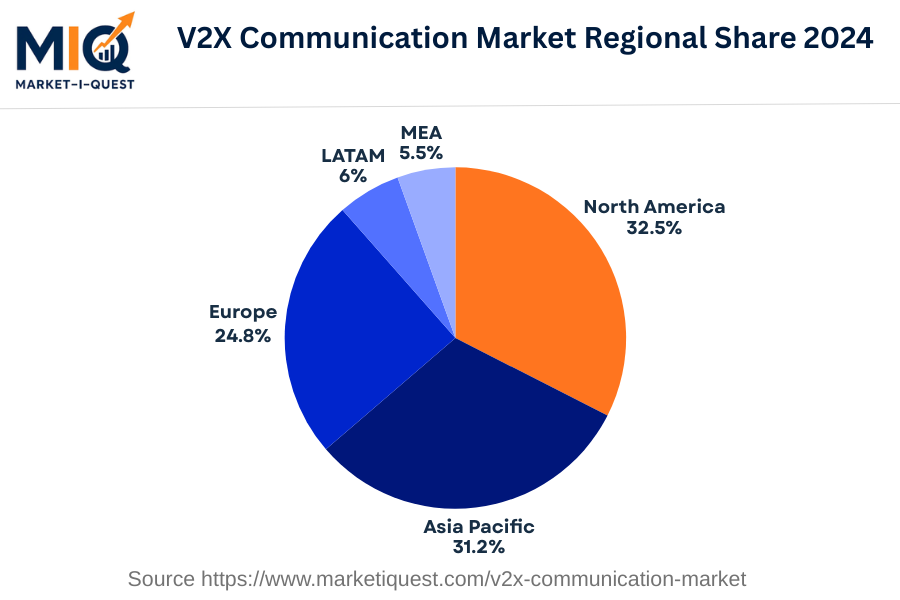
The V2X Communication Market is valued at USD 3.82 in 2025 and is projected to reach USD 93.18 in 2034, with a CAGR of 0.4%. The market is expected to grow from USD 2.68 in 2024 to USD 3.82 in 2025, reflecting an incremental increase that leads to substantial growth over the following years. Factors contributing to this growth include advancements in communication technology and increased investment in smart transportation systems. In 2024, the regional share mix consists of North America at 32.5%, Asia Pacific at 31.2%, Europe at 24.8%, LATAM at 6.0%, and MEA at 5.5%.

Key Takeaways

  • By Component - Hardware led the market accounting for a significant share in 2024.
  • By Communication Type - V2V held the largest share establishing its dominance in connected vehicle networks.
  • By Connectivity Type - Cellular emerged as the fastest-growing option addressing the evolving demands of V2X communications.
  • By Propulsion Type - Electric vehicles are gaining traction reflecting the industry's shift towards sustainable mobility solutions.
  • By End Use - Passenger Cars accounted for the majority share showcasing the increasing consumer interest in V2X capabilities.
v2x-communication-market market size

Key Driving Factors

Implementation of V2X for Advanced Traffic Management

One of the primary drivers propelling the V2X communication market growth is the incorporation of this technology in advanced traffic management systems to reduce congestion and improve road safety. Cities worldwide are increasingly becoming smart with the adoption of IoT and intelligent transport systems, requiring real-time data analysis for efficient traffic management. V2X communication technology offers precise and extensive data sharing between vehicles and infrastructure, which can be effectively used by traffic management systems to provide real-time alerts, manage traffic flow, and reduce accident rates. The technology thus promises safer and more efficient urban mobility solutions. Such profound utility has led many urban planning authorities to explore and implement V2X communication systems. This targeted application is influencing the expansion of the V2X communication market.
Compliance with Regulatory Mandates for Vehicle Safety

Regulatory bodies such as the European New Car Assessment Programme (Euro NCAP) and the National Highway Traffic Safety Administration (NHTSA) in the United States have laid stringent vehicle safety guidelines which indirectly promote the adoption of V2X communication. Euro NCAP's 'Roadmap 2025' presents a vision towards zero road traffic deaths by 2050 and encourages the use of V2X communication technology for collision avoidance. Similarly, based on the proposal by NHTSA, future vehicles could be mandated to have V2X capabilities. These regulatory requirements compel automakers to equip their vehicles with V2X systems, thus boosting the demand in the market. Additionally, the potential for V2X to facilitate autonomous driving provides another incentive for original equipment manufacturers (OEMs) to integrate V2X communication in their upcoming models.

Market Evolution by Timeline

2019-2023
During the period from 2019 to 2023, the V2X communication market growth saw significant developments primarily driven by automotive manufacturers and smart city initiatives. Key buyers included cities such as Los Angeles and Paris, which focused on enhancing traffic management systems. Pilot projects like the European C-Roads initiative aimed at improving interoperability among vehicles and infrastructure. The technology saw integration with existing platforms, primarily within the intelligent transportation systems landscape. Standards such as IEEE 802.11p became basis for several implementations, while constraints included the lack of uniform regulation across regions. Commercial models typically involved public-private partnerships, with funding being a mix of government grants and private investments, like those seen in Japan. Pricing tended to be project-based with variable costs depending on the scale of deployment. Practical blockers included concerns about cybersecurity and data privacy, prompting responses such as robust encryption methods and compliance with GDPR in Europe.
2024
In 2024, the V2X communication market demand was characterized by the increased adoption of 5G technology, enabling enhanced vehicle-to-everything interactions in urban settings. Cities like Shenzhen and Amsterdam began deploying 5G infrastructure to support real-time data exchange among vehicles, which improved safety and efficiency. Manufacturers, including BMW and Ford, accelerated the integration of V2X capabilities into new vehicle models, leading to better user experiences. The European Union's Connected and Automated Mobility initiative pushed for harmonized standards, facilitating smoother cross-border communication. Pricing models began transitioning toward subscription services for ongoing support and updates, marking a shift from traditional one-time purchases. Partnerships among tech companies, automotive manufacturers, and telecom providers gained traction to share resources and mitigate costs. Challenges still existed, particularly around infrastructure readiness and public acceptance, necessitating ongoing education and outreach efforts from stakeholders to ensure successful implementation.
2025-2029
From 2025 to 2029, the V2X communication market experienced broad expansion with a focus on integration into autonomous vehicle technology. Companies like Waymo and Telematics based in the U.S. led trials in urban areas such as San Francisco and Austin, demonstrating capabilities in real-time decision-making based on V2X data. The U.S. Department of Transportation introduced initiatives encouraging states to adopt V2X frameworks, while the upcoming IEEE standards continued to evolve to address new use cases. Growth in supply chains reflected a rise in hardware, such as Dedicated Short Range Communication (DSRC) and cellular V2X modules, fostering competitive pricing. The prevalent commercial model involved longer-term contracts with municipalities and logistics companies seeking efficiency gains. A significant risk during this period was the fragmentation of technology, which led to interoperability issues. Various stakeholders had to ensure compatibility across different systems, prompting collaborative efforts that included testing with multiple vehicle types and communication protocols.
2030-2034
Between 2030 and 2034, the V2X communication market trend is expected to settle into a phase of mature adoption, where the technology becomes commonplace in smart transportation ecosystems. Regions such as Singapore and Scandinavia are likely to lead the implementation of fully integrated V2X systems that incorporate real-time data for traffic coordination and accident prevention. Regulations would likely become more standardized globally, possibly through frameworks set by the International Telecommunication Union (ITU) and the IEEE. The predominant commercial models could shift towards integrated service offerings that encompass data analytics and system maintenance, moving away from purely hardware-centric approaches. Pricing could exhibit stability as competition increases among service providers, facilitating more cost-effective solutions for cities and automotive companies. Risks might involve new cybersecurity threats as reliance on V2X systems grows, necessitating continuous updates and patches to ensure data integrity. Responding to these threats will be critical for sustaining trust among users and stakeholders.

Future Market Outlook

Future Opportunities

Future opportunities in the V2X communication space are poised to expand, particularly in light of regulatory support and technological developments. In 2022, the US National Highway Traffic Safety Administration announced initiatives to promote V2X technologies as a standard feature in new vehicles, thereby providing a robust framework for the market. Concurrently, the European Union has mandated the introduction of Cooperative Intelligent Transport Systems, encouraging member states to adopt V2X capabilities by 2025. This regulatory push creates a fertile environment for startups and established companies aiming to innovate within this domain. Partnerships, such as that between Toyota and the City of San Jose in 2021, signal a commitment to developing smart city infrastructures that leverage V2X solutions for improved urban mobility. Emerging markets, particularly in Asia, present opportunities for sustainable transportation initiatives as countries like India and China actively pursue smart city frameworks. Additionally, advancements in artificial intelligence for traffic system optimization are creating synergies with V2X capabilities, where data sharing between vehicles and infrastructure can lead to more efficient traffic flows. The integration of electric vehicles into V2X communication networks offers potential for energy management and collaboration between vehicles and the grid, contributing to more sustainable urban ecosystems. This alignment of technological, regulatory, and market forces suggests that the V2X communication sector is set for considerable evolution, with diverse applications shaping its future landscape.

Segmentation Analysis

The V2X communication market is segmented by Component (Hardware, Software), by Communication Type (V2V (Vehicle-to-Vehicle), V2I (Vehicle-to-Infrastructure), V2P (Vehicle-to-Pedestrian), V2N (Vehicle-to-Network), V2G (Vehicle-to-Grid), V2C (Vehicle-to-Cloud), V2D (Vehicle-to-Device), V2H (Vehicle-to-Home)), by Connectivity Type (DSRC, Cellular), by Propulsion Type (Internal Combustion Engine, Electric), and by End Use (Passenger Cars, Commercial Vehicles).

By Component

The market is divided into subsegments including Hardware and Software. The Hardware subsegment accounted for the largest revenue share while the Software subsegment is expected to grow at the fastest CAGR during the forecast period.

Largest Revenue Share

Hardware

Market Share Leader

The Hardware subsegment leads in revenue primarily due to the pervasive demand for physical devices across various industries. This includes computing systems, networking equipment, and other essential infrastructure that underpins technology operations. Customers in sectors such as telecommunications, healthcare, and manufacturing prioritize hardware investments to bolster their operational efficiency and ensure reliable system performance. Geographically, regions with high investments in technology infrastructure, such as North America and parts of Asia-Pacific, significantly contribute to the robust revenue generation in the Hardware subsegment. Regulatory factors also play a role, as compliance with industry standards often necessitates updated hardware solutions. Businesses are compelled to invest in hardware to meet these regulations and maintain competitive edges. Additionally, purchasing criteria heavily favor proven reliability, longevity, and performance, which often leads to higher switching costs for companies already embedded in a specific hardware ecosystem. This market dynamic fosters customer loyalty and creates substantial barriers for new entrants, ultimately solidifying Hardware as the revenue leader.

Fastest CAGR

Software

Forecast Period Growth Leader

The Software subsegment is projected to exhibit the fastest growth due to a surge in digital transformation initiatives across enterprises seeking to enhance productivity and streamline operations. Modern software solutions, particularly cloud-based applications and artificial intelligence tools, are becoming indispensable for organizations aiming to stay competitive. Key growth drivers include the increasing adoption of subscription models, which provide flexibility and scalability to businesses of all sizes. However, challenges such as integration complexities and data security concerns could temper growth. Enterprises may face barriers when trying to migrate from legacy systems to modern software solutions, leading to cautious adoption rates. To mitigate these challenges, partnerships between software vendors and IT service providers are taking shape, facilitating smoother transitions and accelerating software adoption. Despite these hurdles, governmental policies supporting digital initiatives are acting as catalysts, fostering favorable conditions for software growth. Near-term risks include economic uncertainties that could lead to budget constraints, yet the imperative for cloud adoption and operational efficiencies remains a strong motivator for companies investing in software solutions.

By Communication Type

The market is divided into subsegments including V2V, V2I, V2P, V2N, V2G, V2C, V2D, and V2H. V2I accounted for the largest revenue share while V2V is expected to grow at the fastest CAGR during the forecast period.

Largest Revenue Share

V2I

Market Share Leader

The vehicle-to-infrastructure (V2I) subsegment leads in revenue due to its critical role in enhancing traffic management and safety. V2I systems facilitate the seamless communication between vehicles and surrounding infrastructure, such as traffic lights, road signs, and parking facilities. This connectivity allows for improved traffic flow, reduced congestion, and enhanced safety measures, making V2I highly appealing to municipalities and transport agencies. The increasing investments in smart city initiatives globally are driving the adoption of V2I technology. Regions with advanced public transport systems and high vehicle density, such as North America and Europe, present the largest markets as they prioritize modernizing urban infrastructure. Additionally, regulatory frameworks advocating for intelligent transport solutions and safety improvements further bolster this subsegment's revenue. Customers prioritize reliable performance and interoperability with existing infrastructure, leading to increased demand for standardized solutions. As municipalities seek to optimize existing resources and improve public safety, the V2I subsegment becomes a focal point for investment and innovation in the transportation sector.

Fastest CAGR

V2V

Forecast Period Growth Leader

The vehicle-to-vehicle (V2V) subsegment is predicted to exhibit the fastest CAGR due to its transformative potential in enhancing road safety and advancing autonomous driving technologies. With significant investments pouring into connected vehicle systems, V2V communication reduces the likelihood of accidents by allowing vehicles to share real-time information about their speed, location, and direction. The proliferation of connected vehicles spurred by consumer demand for safety features is a major catalyst for growth in this sector. However, adoption barriers include the need for robust communication protocols, concerns about data privacy, and the challenge of achieving widespread industry standards. Technology partnerships among automotive manufacturers, telecommunications companies, and software developers are critical to overcoming these challenges. Additionally, supportive government policies aimed at promoting vehicle connectivity can act as a significant growth driver. Near-term risks include regulatory hurdles and compatibility issues between different vehicle brands and models. If managed effectively, these challenges present opportunities for innovation and collaboration, driving the V2V subsegment toward significant expansion in the coming years.

By Connectivity Type

The market is divided into subsegments including DSRC and Cellular. DSRC accounted for the largest revenue share while Cellular is expected to grow at the fastest CAGR during the forecast period.

Largest Revenue Share

DSRC

Market Share Leader

DSRC, or Dedicated Short Range Communications, leads the market by providing reliable, low-latency communications essential for applications such as vehicle-to-vehicle (V2V) and vehicle-to-infrastructure (V2I) communication. Key drivers of its revenue include its robust application in intelligent transportation systems, where regulatory bodies have mandated the technology for safety and traffic management. The strong adoption in urban areas, where traffic congestion is prevalent, drives demand as municipalities seek effective solutions to enhance road safety. Furthermore, existing investments from government and public-private partnerships bolster coverage and infrastructure for DSRC systems. Its adoption is further supported by rigorous standards established by organizations, facilitating increased manufacturer and customer trust. The established technological framework also minimizes switching costs for customers, who benefit from a well-understood ecosystem. Overall, DSRC's established use cases and regulatory backing allow it to dominate the current landscape, appealing prominently to automotive manufacturers and public service entities seeking sustainable solutions.

Fastest CAGR

Cellular

Forecast Period Growth Leader

The Cellular subsegment is poised for the fastest growth largely due to the proliferation of 5G technology, which offers significantly enhanced data rates, lower latency, and increased capacity compared to previous generations. This evolution enables real-time communication for emerging applications in autonomous driving and smart cities. Partnerships between telecommunications companies and automotive manufacturers are accelerating the deployment of cellular technology on a large scale. Despite the potential, adoption faces barriers such as infrastructure investment and the necessity for regulatory frameworks to ensure interoperability. However, recent governmental initiatives promoting the installation of 5G networks are anticipated to lessen these barriers, catalyzing rapid industry transformation. The trend towards more connected vehicles with robust data requirements is also a catalyst driving interest and investment in Cellular technology. Moreover, the somewhat complex technological transition to 5G and differing standards between regions pose near-term risks that industry players must manage diligently. Stakeholders focusing on building strategic alliances and enhancing network infrastructure will be key to capitalizing on the expected growth in this segment.

By Propulsion Type

The market is divided into subsegments including Internal Combustion Engine and Electric. Internal Combustion Engine accounted for the largest revenue share while Electric is expected to grow at the fastest CAGR during the forecast period.

Largest Revenue Share

Internal Combustion Engine

Market Share Leader

The Internal Combustion Engine (ICE) subsegment leads in revenue share primarily due to its entrenched position in various transportation applications, including automotive, aviation, and marine sectors. Established manufacturing ecosystems support its dominant status, with a significant share of consumers tied to traditional fuel sources. Additionally, ICE vehicles benefit from extensive refueling infrastructure, which continues to underpin customer loyalty and reliance. In many regions, particularly in developing markets, regulations favor existing ICE technology, bolstered by governmental incentives for the oil industry. Moreover, the relatively lower upfront costs of ICE vehicles compared to electric alternatives drive purchasing decisions. Customer bases in rural and semi-urban areas are particularly driven by availability and cost-effectiveness, favoring ICE over emerging alternatives. As a result, the growth of aftermarket services and associated industries continues to reinforce revenue streams linked to ICE technology. While the advent of electric vehicles is gradually penetrating the market, ICE remains the preferred choice for many consumers who prioritize reliability and convenience.

Fastest CAGR

Electric

Forecast Period Growth Leader

The Electric subsegment is projected to achieve the fastest growth due to several transformative factors propelling its adoption. Technological advancements in battery efficiency and affordability are reducing operational costs, enticing both consumers and manufacturers. Furthermore, intensifying regulatory measures aimed at reducing carbon emissions are creating a favorable policy landscape for electric vehicles (EVs) and stimulating investment in this sector. Partnerships between automotive manufacturers and tech companies are fostering innovative solutions, enhancing the overall performance and attractiveness of electric options. Despite its rapid ascent, the Electric subsegment faces adoption barriers including initial purchase costs, infrastructure deficits, and range anxiety among potential users. However, incentives such as tax rebates and expanding charging networks are catalyzing consumer confidence. As more manufacturers unveil competitive models and governments push stricter emissions targets, electric vehicles are poised to capture greater market share. Near-term risks, such as fluctuating raw material costs for batteries and maintaining supply chain stability, could impact growth; however, the long-term trajectory appears strongly positive as consumer awareness and willingness to transition increase.

By End Use

The market is divided into subsegments including Passenger Cars and Commercial Vehicles. Passenger Cars accounted for the largest revenue share while Commercial Vehicles are expected to grow at the fastest CAGR during the forecast period.

Largest Revenue Share

Passenger Cars

Market Share Leader

Passenger Cars lead the market in terms of revenue due to a combination of sustained consumer demand, extensive product offerings, and a significant push towards electrification. Consumers are increasingly prioritizing vehicles that embody not just utility but also lifestyle aspirations, driving demand for various models, including SUVs and sedans. Geographically, regions such as North America and Europe dominate due to higher disposable incomes and consumer inclination towards advanced vehicle technologies. Regulatory frameworks that emphasize emissions reductions further support the demand for fuel-efficient and electric vehicles, incentivizing purchases through tax breaks and rebates. The automotive supply chain has also adapted to meet these regulations, ensuring that the supply of compliant vehicles is robust. Additionally, purchasing criteria have evolved, with buyers considering factors such as safety features, connectivity options, and brand reputation, all of which are strong in the Passenger Car segment. The distribution channels have effectively employed online sales platforms, enhancing convenience for consumers and enabling manufacturers to reach a broader audience.

Fastest CAGR

Commercial Vehicles

Forecast Period Growth Leader

Commercial Vehicles are poised for rapid growth driven by the escalation in e-commerce and the consequent demand for logistics and delivery services. As businesses increasingly prioritize efficient transportation solutions, the sector has seen a marked uptick in demand for light and heavy-duty vehicles, particularly those that support last-mile delivery. However, the growth is not without challenges. Barriers to adoption include high initial capital expenditures and the need for specialized financing options for businesses to invest in fleet upgrades. Technological advancements, such as electric and autonomous driving capabilities, are catalysts for growth, attracting interest from companies seeking to enhance operational efficiency and reduce long-term costs. Partnerships among manufacturers, technology providers, and regulatory agencies are crucial to navigating the evolving landscape, ensuring compliance with increasingly stringent regulations. Additionally, near-term risks such as supply chain disruptions could pose challenges to production timelines. Addressing these risks through diversified sourcing and strategic foresight can help companies capitalize on this growth while mitigating potential setbacks.

Competitive Analysis

Key Market Players

The V2X communication market is competitive, with a mix of large established companies and smaller regional players. Most companies focus on improving their products/services, keeping prices attractive, and strengthening relationships with key customers. They also use partnerships, acquisitions, and new launches to expand their presence in existing and new markets. Overall, players compete on quality, reliability, and value, and competition is expected to remain strong over the forecast period.

Manufacturers / OEMs

Qualcomm
US
Intel Corporation
US
Bosch
Germany

Key Suppliers & Raw Materials

NXP Semiconductors
Netherlands
Texas Instruments
US
STMicroelectronics
Switzerland

Distributors, Integrators & Channel Partners

Cisco Systems
US
Ericsson
Sweden
Harman International
US

Porter’s Five Forces Analysis

The V2X Communication Market exhibits significant competitive dynamics influenced by various forces. Understanding these forces helps to evaluate market attractiveness.

Supplier Bargaining Power

Medium

Equipment manufacturers face moderate pressure due to occasional switching costs for vehicle OEMs.

Buyer Bargaining Power

High

Customers have high bargaining power, driven by low switching costs and multiple available communication solutions.

Threat of Substitutes

High

Alternatives like cellular networks and other vehicle communication technologies are readily available.

Threat of New Entrants

Medium

Barriers exist due to high capital requirements and regulatory certifications, but tech advancements lower some hurdles.

Competitive Rivalry

High

The market sees intense competition among established players striving for technological leadership and partnerships.

Regional Analysis

Geographic market dynamics and growth opportunities across key regions

Global Market Outlook

v2x-communication-market market regional share

North America

In 2024, the V2X communication market expansion in North America is defined by its potential to enhance vehicular safety and efficiency through real-time data exchange. Demand is steadily increasing due to a growing emphasis on road safety, spurred by rising traffic accidents and fatalities. Legislative measures, such as the U.S. Infrastructure Investment and Jobs Act, catalyze funding for V2X technologies to improve infrastructure resilience. Technological advancements in vehicle-to-everything communication systems prompt significant investment from automotive manufacturers, fostering greater adoption.

Trends reflect a shift towards smart city initiatives, where municipalities increasingly integrate V2X technologies to improve traffic management and reduce emissions. Partnerships between automotive companies and telecommunications providers are becoming common, facilitating the rollout of 5G networks critical for effective V2X communication. Additionally, standardization initiatives by organizations like SAE International are establishing benchmarks to ensure interoperability among different vehicle brands and technology providers. Governmental policies, such as California's Automated Vehicle Program, are reinforcing the importance of V2X communication. Enterprises focused on logistics and transportation are also investing in these technologies to enhance fleet efficiency and safety, thereby driving market growth across sectors.

Asia Pacific

In 2024, the V2X Communication Market oppotunities in Asia Pacific are primarily driven by increasing government initiatives aimed at enhancing road safety and traffic efficiency. In China, substantial investments in smart city infrastructure and supportive regulations, such as the National Intelligent Vehicle Innovation and Development Strategy, are fostering V2X deployment. India’s growing demand for connected vehicles and government programs like the FAME scheme are promoting electric and connected transport technologies.

Japan and South Korea are experiencing heightened competition among automotive manufacturers to integrate V2X capabilities, driven by advancements in 5G technology and public-private partnerships that facilitate infrastructure development. Australia’s regulatory environment is also shaping the market, with the National Transport Commission advocating for standards around connected and automated vehicles.

Trends in buyer behavior show increasing preference for vehicles equipped with advanced communication technologies, reflecting heightened consumer awareness of safety features. In the ASEAN region, collaboration among tech companies and automotive manufacturers is leading to innovative service offerings, while governments are enforcing stricter emissions and safety regulations. Furthermore, the emergence of global standards for V2X communication continues to influence market dynamics, ensuring interoperability among different systems across these nations, underscoring the importance of a unified approach to vehicle connectivity.

Europe

In 2024, the V2X communication market in Europe is characterized by increasing investments and regulatory support aimed at enhancing vehicle connectivity and safety. Key drivers include stringent EU regulations and initiatives such as the European Mobility Strategy, which mandate higher connectivity standards in new vehicles. This regulatory landscape fuels demand for V2X technologies among manufacturers in Germany and France, encouraging innovation and adoption. Additionally, rising investments from automotive giants towards C-V2X technologies, particularly in the UK and Germany, bolster supply chains and domestic production capabilities.

Trends reflect a notable shift toward collaborative ecosystems, with partnerships between automotive and tech companies becoming more prevalent, especially in the Nordics and Benelux. Buyer behavior is leaning towards integrated solutions that enhance safety and efficiency, triggering advancements in infrastructure compatibility. Standards set by key organizations, including the European Telecommunications Standards Institute, are shaping market dynamics by establishing uniform communication protocols. Furthermore, municipalities across Spain and Italy are increasingly implementing smart city initiatives that necessitate V2X solutions, thus engaging both public and private sectors in concerted efforts to enhance urban mobility. Overall, the V2X communication market in Europe is positioned at the intersection of innovation, regulation, and collaborative growth.

Latin America

In 2024, the V2X Communication Market in Latin America is characterized by growing investment and regulatory support aimed at enhancing transportation safety and efficiency. Key drivers include the increasing adoption of smart traffic management systems in urban centers like São Paulo and Mexico City, spurred by government initiatives promoting intelligent transportation networks. Regulatory frameworks, such as Brazil's new transportation policies, are fostering collaboration between automotive manufacturers and tech companies to accelerate V2X technology implementation. Additionally, the rising demand for electric and autonomous vehicles is driving investments in communication infrastructure, enhancing connectivity capabilities.

Trends in the region reflect a shift towards increased collaboration among stakeholders. Partnerships between automotive companies and telecommunications providers are becoming prevalent, as seen in collaborations between major players like Volkswagen and local tech firms. There is also a noticeable shift in buyer behavior, with municipalities in Colombia and Chile actively seeking advanced V2X solutions to improve public transport safety. Standardization efforts are underway, as governments push for uniform protocols, which is critical for widespread adoption. The growing interest from utility companies in integrating V2X capabilities into their operations further highlights the trend of diversification in target sectors, making V2X communication increasingly relevant across various industries in LATAM.

Middle East & Africa

In 2024, the V2X (Vehicle-to-Everything) communication market size in the Middle East and Africa is driven by the increasing demand for smart transportation solutions to improve road safety and traffic management. Government initiatives, such as the UAE’s Vision 2021 and Saudi Arabia’s National Transport Strategy, are spurring investment in connected vehicle technologies. The rising adoption of 5G networks further enhances real-time data exchange among vehicles, infrastructure, and users, addressing urban congestion issues. Additionally, partnerships between automotive manufacturers and technology firms are facilitating the integration of V2X capabilities into new vehicle models, with major players like Etisalat and Deutsche Telekom participating in pilots.

There is a notable trend in buyer behavior, with fleet operators in South Africa and logistics companies in Nigeria seeking advanced V2X systems for efficiency and cost reduction. The increasing emphasis on road safety standards is prompting regional governments to enforce regulations mandating V2X implementation in commercial transportation. Furthermore, technology shifts are evident as electric vehicle markets in Israel and Kenya align with V2X systems to optimize energy consumption. The ongoing collaboration across sectors, including government and telecommunications, is establishing a more cohesive ecosystem for V2X communications throughout the region.

Recent Industry Developments

Latest market innovations, product launches, and strategic initiatives

Sep 2025

At ITS World Congress 2025, 5GAA and partners created the first “Day One Deployment District” in Atlanta, showcasing the largest live C‑V2X deployment in a real urban traffic environment with production‑ready applications such as emergency vehicle pre‑emption, vulnerable road‑user protection, smart tolling, and digital parking.

Apr 2025

BMW launched the all‑new BMW 5 Series in China with integrated V2X technology supplied by JOYNEXT, marking BMW’s first model with built‑in V2X for vehicle–road–cloud communication and proactive safety alerts in regular customer vehicles.

Frequently Asked Questions