
Unified Communication (UC) & Business Headsets Market Snapshot

Key Players

  • Plantronics (United States)
  • Jabra (Denmark)
  • Logitech (Switzerland)
  • Sennheiser (Germany)
  • Microsoft (United States)
  • Avaya (United States)
  • Cisco Systems (United States)
  • Polycom (United States)
  • Yealink (China)
  • Alcatel-Lucent (France)

Market Size

Base Year 2024
$4.56 Bn
CAGR
14.5%
Forecast 2034
$17.66 Bn

Market Segments

By Product Type
Earphones, Headphones
By Technology
Wired, Wireless
By Sales Channel
Online, Offline
By End Use
BFSI, Corporate, Education, Retail and E-Commerce, Others

Market Dynamics

Drivers
  • Rising remote work trend
  • Improved team collaboration needs
Restraints
  • High equipment costs
  • Slow adoption rate
Opportunities
  • Rising remote workforce trend
  • Increasing digital transformation initiatives

Market Size

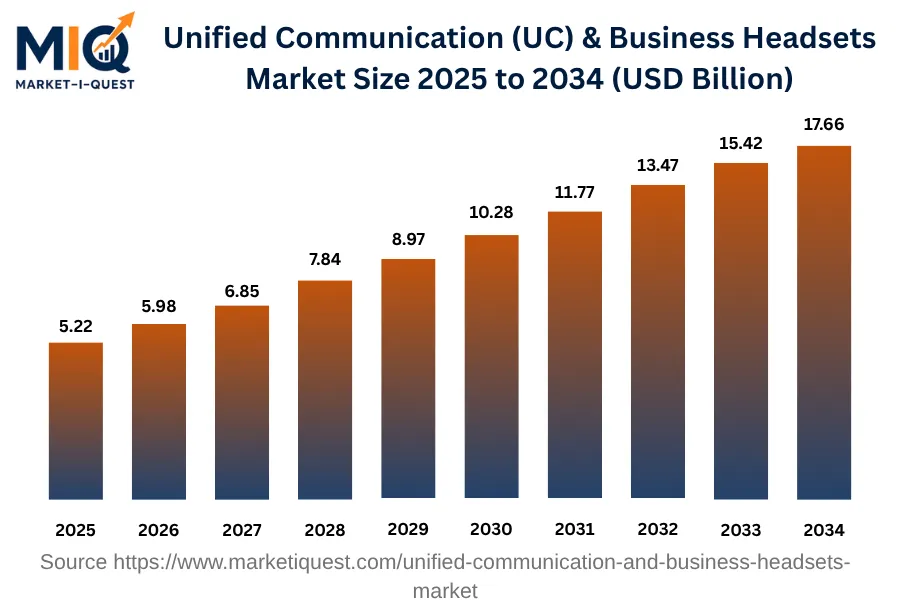
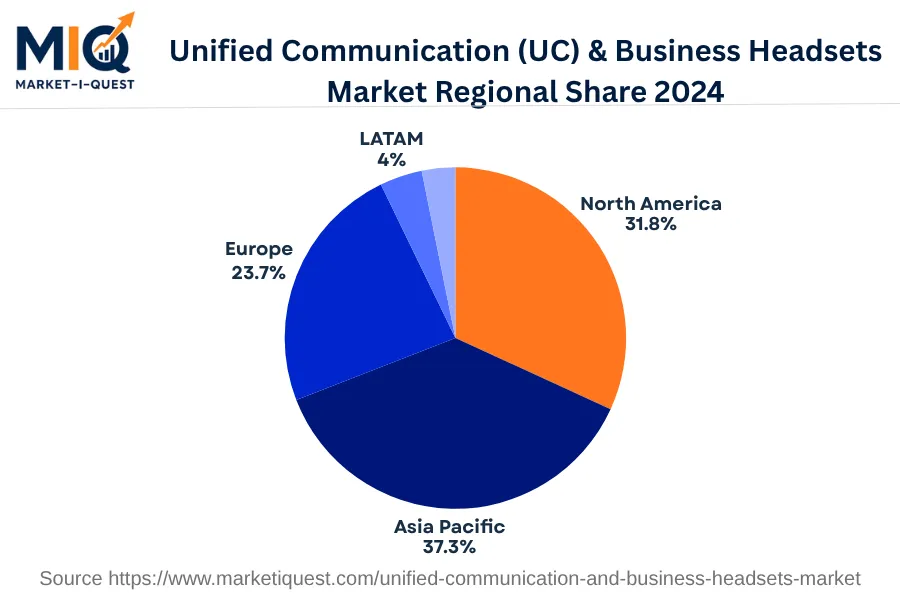
The Unified Communication (UC) & Business Headsets Market was valued at approximately $5.22 billion in 2025, and is projected to reach $17.66 billion by 2034, growing at a CAGR of 14.5%. The market witnessed consistent growth from $4.56 billion in 2024. Increased adoption of UC & Business Headsets due to rising demand for better communication and collaboration tools in businesses, primarily drove growth throughout this period. Furthermore, improvements in audio technology that enabled high-quality sound for better conferencing helped to boost market size as well. As of 2024, relative market shares by region were as follows: North America held 31.8%, Asia Pacific held a slightly larger share at 37.3%, Europe contributed 23.7%, while LATAM, and MEA accounted for 4.02% and 3.17% respectively.

Key Takeaways

  • By Product Type - Headphones held a prominent position in the base year.
  • By Technology - Wired solutions led the market in terms of share percentage during the base year.
  • By Sales Channel - Offline accounted for the largest part of the overall sales in the period under review.
  • By End Use - BFSI maintained a significant lead in terms of market share in the base year.
unified-communication-and-business-headsets-market market size

Key Driving Factors

The Shift to Remote and Hybrid Workplace Structures

A significant driver for UC and Business Headsets market is the ongoing global paradigm shift from traditional office environments to remote and hybrid workplace structures. This transition has been accelerated by the recent COVID-19 pandemic, necessitating businesses to adapt quickly. UC and business headsets effectively facilitate communication and collaboration amongst distributed teams spread across different locations and time zones. These tools have become vital in ensuring effective communication, thereby enhancing productivity, efficiency, and workflow continuity. Different industries, including IT, education, healthcare, and retail, have been leveraging UC and headsets for virtual meetings, online classes, telehealth services, and customer support, respectively. Consequently, this broad application across various sectors is driving the demand for UC and business headsets.
Increasing Need for Efficient Customer Service Practices

Growing emphasis on efficient customer service is another specific driver in UC & Business Headsets market. In the current competitive business environment, delivering excellent customer experience has become a vital differentiator. Organizations are practically mandated to invest in quality headsets combined with Unified Communication tools to facilitate clear, effective communication between their customer service representatives and customers. Without optimal combination of these tools, misunderstandings and miscommunications can ensue, negatively impacting customer satisfaction, retention, and ultimately, profitability. Thus, mounting requirement for superior customer communication and service practices heavily influences adoption and spend on UC solutions and business headsets in the present market scenario.

Market Evolution by Timeline

2019-2023
In this period, businesses in North America and Europe were leading users of UC and business headsets, driven by need for improved communication and collaboration in remote working setups. Key providers included Plantronics, Logitech, and Cisco, with integration often performed in-house. Supply constraints were typically from component shortages. In this phase, standardization was still forming, with proprietary technologies often causing integration issues. Pricing generally followed software as a service (SaaS) models, with some providers moving towards value-based pricing. Risks typically revolved around adoption resistance due to initial setup complexity and cost.
2024
In 2024, adoption spread to Asia-Pacific businesses, particularly in tech hubs like India and China. New market entrants piloted AI technology to streamline UC management. High demand led manufacturers to expand facilities, mitigating component shortfall risks. The trend moved towards unified communications as a service (UCaaS) following established cloud-based models. Long term partnerships between tech firms and hardware providers were formed, stimulating market growth. Regulatory bodies, particularly in Europe, introduced data protection regulations to address UC vulnerabilities. The single largest risk was cybersecurity threats, leading to surge in integrated UC-security packages.
2025-2029
During this period, government institutions, particularly in developing economies, bolstered demand. Providers supplemented products with training and support resources to encourage adoption. UC's interoperability improved due to broadening standardization. This period witnessed alliances between software companies and telecom operators, creating cost-effective solutions under revenue sharing models. Governments across regions introduced policies to promote the digital economy, heavily favoring UC adoption. But training and support for users posed a risk, with some organizations defaulting to older, more familiar systems.
2030-2034
In these years, UC and business headsets became ubiquitous, especially in sectors with higher mobility. The market moved towards a mature phase, leading to competition based on service quality, features, and reliability. Prevalent supply was from 'all-in-one' solution providers offering complete in-house integration. Subscription models were dominant, moving towards flexible, personalized plans. Regulations evolved to balance data protection and surveillance needs. Businesses became dependent on UC solutions, making outage risks critical. Providers, thus, heavily invested in redundancy and fault tolerance.

Future Market Outlook

Future Opportunities

As various sectors adjust to hybrid work models, significant opportunities arise in UC and business headsets market. For instance, by 2024, many industries are expected to prioritize headsets that integrate advanced noise-cancellation features, catering to users in bustling environments. Companies like Logitech are already tailoring their products to accommodate these needs, aligning with trends in remote working. Additionally, standardization of security protocols, like ISO 27001, is likely to drive demand for compliant UC solutions. Growing emphasis on secure communications offers a pathway for headset manufacturers to broaden product lines that meet regulatory compliance. Moreover, as market players consider hybrid workplace requirements, integrations with existing enterprise systems become crucial. As of 2023, partnerships between software providers and headset manufacturers, like Jabra's collaboration with Microsoft, reflect demand for interoperable devices. This trend signals a clear opportunity for innovation in UC technologies that prioritize user experience and seamless integration. With expansion of 5G networks anticipated in various countries, including United States and India, headsets capable of leveraging these advancements are poised to enhance data transmission and connectivity. Therefore, ongoing evolution of the UC landscape, coupled with societal shifts in work patterns, presents fertile ground for growth in product innovations and market expansions.

Segmentation Analysis

By Product Type

The market is divided into subsegments including earphones and headphones, with headphones accounting for the largest revenue share while earphones are projected to grow at the fastest CAGR during the forecast period.

Largest Revenue Share

Headphones

Market Share Leader

In today's market, headphones represent category earning largest revenue share. This strong position in terms of revenue can be attributed to various influencing factors. First and foremost, customer base for headphones is diverse, spanning across different age groups, professions and geographies. People use headphones for leisure, for work, during commuting, or even in professional settings like studios. Hence widespread use leads to higher revenues. Government regulations or supply disruptions don't particularly impact this market, allowing for uninterrupted sales. In terms of purchasing criteria, consumers often seek high-quality sound, noise cancellation features, comfort, and brand reputation; areas where headphones typically outperform earphones. Switching costs are minimal as consumers are known to own multiple devices. Finally, robust distribution channels comprising of online and offline retail stores support easy accessibility for consumers, further driving sales for the headphone segment.

Fastest CAGR

Earphones

Forecast Period Growth Leader

Though earphones might not hold the major revenue share currently, they are identified as the fastest-growing subsegment. Several factors are catalysts for their expected high growth rate. Technological advancements continue to augment the quality of earphones to a stage where they can compete with headphones for sound quality, but at a lower price. Also, the rising popularity of fitness activities and sporty lifestyle has led to an increased demand for earphones since they are more compact and easier to use while working out. Although headphones offer superior sound quality, their bulky size remains a barrier to adoption by more mobile or physically active consumers. Lastly, the potential risks to the growth of earphones could be a sudden change in consumer preferences, or a drastic breakthrough in headphone technology that can potentially combine the benefits of both products. The listed factors substantially indicate the considerable growth prospects for the earphone subsegment.

By Technology

The market is divided into subsegments including Wired and Wireless technologies. In 2024, the Wired technology accounted for the largest revenue share while Wireless technology is expected to grow at the fastest CAGR during the forecast period.

Largest Revenue Share

Wired

Market Share Leader

Wired technology in 2024 has largest share of revenue primarily due to its reliability and speed. Wired networks provide more stability and typically deliver data faster than wireless networks. They are more robust and deliver consistent speed regardless of distance between devices, which is not always the case with wireless technology. Additionally, wired networks are less susceptible to disruptions from other wireless devices and have superior security measures, which are critical for businesses managing sensitive data. Large corporations, telecommunication companies, and data centers contribute significantly to revenues of wired technology due to their inherent need for speed, capacity, and security. Furthermore, regions with advanced ICT infrastructure such as North America and Europe are major contributors to this subsegment's revenue.

Fastest CAGR

Wireless

Forecast Period Growth Leader

Despite the strong performance of wired networks, wireless technology is expected to exhibit the fastest CAGR during the forecast period. The proliferation of smartphones and tablets, increased adoption of IoT devices, and the advancement of wireless technologies such as 5G are projected to drive this growth. This technology provides the convenience of mobility and flexibility, which is becoming increasingly valuable in modern residential, commercial, and industrial settings. However, obstacles regarding security concerns and data breaches could slow down its momentum. Moreover, policies and regulations around radio frequency use and the capital required to build and maintain wireless networks constitute near-term risks. Partnership with technology firms and telecommunications companies and continuous research and development efforts could provide a solution to these challenges and further propel the growth of this subsegment.

By Sales Channel

The market within the sales channel is bifurcated into two key subsegments - online and offline. In the base year of 2024, the offline segment accounted for the largest revenue share, while the online segment is poised to register the most robust growth during the forecast period.

Largest Revenue Share

Offline

Market Share Leader

The Offline segment, in 2024, accounted for the lion's share of the revenue in the sales channel. This is primarily a result of a combination of factors, including ingrained consumer habits, vast retailer networks, and personal touch in selling. The predilection for offline shopping stems from the ability to physically verify products before purchase, the immediate gratification of instant possession, and the assurance of retailer accountability. In specific markets that value tradition and personal interactions, offline outlets retain a dominant presence. A multitude of businesses continue to rely on expansive offline distribution networks that allow them to tap into even remote markets. Regulatory complexities for online sales in certain regions also give an inadvertent boost to offline channels. Furthermore, promotional tactics, such as in-store experiences and point-of-sale marketing, give offline outlets an edge over their online counterparts.

Fastest CAGR

Online

Forecast Period Growth Leader

While offline sales dominated in terms of revenue in 2024, the online subsegment is projected to grow at a faster pace in subsequent years. This anticipated growth is driven by the increase in internet penetration, rise in comfort with digital payments, and improvement in delivery logistics. Technological advancements improve search capabilities and recommendation algorithms, enhancing user shopping experience and fostering repeated engagement. The convenience of shopping from the comfort of one's home, ability to compare prices across platforms, and a wider range of product availability are key catalysts pushing consumers towards online channels. Challenges remain, such as cybersecurity threats and issues with return and refund policies. However, companies are making significant investments in addressing these issues, through partnerships with cybersecurity firms and improving customer service, making the online segment well-positioned for robust growth in the years to come.

By End Use

The market is divided into subsegments including BFSI, Corporate, Education, Retail and E-Commerce, and Others, among which BFSI accounted for the largest revenue share while Education is expected to grow at the fastest CAGR during the forecast period.

Largest Revenue Share

BFSI

Market Share Leader

The Banking, Financial Services, and Insurance (BFSI) subsegment generates the highest revenue in many markets due to two main factors. First, the base size of the BFSI segment is significantly larger than other segments due to the broad needs for financial services across all demographics and corporate sectors. This allows for a wider reach and higher potential revenue from a range of customers. Second, BFSI has a higher purchasing power due to the lucrative nature of this sector. The complexity and critical importance of financial transactions demand the highest levels of security and service quality, creating purchasing discretion for best-in-class offerings and driving premium pricing. Furthermore, this market enjoys solid expansion across geographies as financial services are fundamental in every economy, regardless of its maturity level. Their digital transformation also propels demand for new tools and services. However, customer acquisition costs and regulatory compliance might pose challenges to this segment.

Fastest CAGR

Education

Forecast Period Growth Leader

The Education subsegment is projected to grow at the quickest rate in the upcoming years. Digitalization efforts in the education sector predominantly drive this growth worldwide. Technological advancements like cloud computing, AI, and Machine Learning are facilitating more engaging and effective means of education delivery. This tech-led expansion is further supported by significant capital investment from both public and private sectors, fostering the growth of numerous edtech start-ups and encouraging partnerships between industry players. However, slow tech adoption due to lack of infrastructure and skills, especially in emerging markets, might limit this growth to some extent. Also, there could be near-term risks associated with data privacy and cybersecurity as educational institutions increasingly operate online.

Competitive Analysis

Key Market Players

Manufacturers / OEMs

Plantronics Inc.
US
Jabra
Denmark
Sennheiser electronic GmbH & Co. KG
Germany

Key Suppliers & Raw Materials

Amphenol Corporation
US
Foxconn Technology Group
Taiwan
Dow Inc.
US

Distributors, Integrators & Channel Partners

Tech Data Corporation
US
Ingram Micro Inc.
US
SYNNEX Corporation
US

Porter’s Five Forces Analysis

A detailed analysis of competitive forces within the Unified Communication & Business Headsets Market.

Supplier Bargaining Power

Medium

Suppliers have moderate leverage due to minimal differentiation of components & increasing raw material costs.

Buyer Bargaining Power

High

Buyers enjoy high power due to the low switching costs and a wide range of available alternatives.

Threat of Substitutes

High

The existence of affordable substitutes like free communication apps intensifies substitution threat.

Threat of New Entrants

Medium

Entry barriers are moderate with high initial investment but low regulatory restrictions.

Competitive Rivalry

High

Highly competitive market with many established players and constant innovation.

Regional Analysis

Geographic market dynamics and growth opportunities across key regions

Global Market Outlook

unified-communication-and-business-headsets-market market regional share

North America

In 2024, the North American Unified Communication (UC) & Business Headsets Market found itself navigating a transformative landscape.

Drivers enhancing market growth included robust demand from sectors like enterprise, healthcare, and retail. Widespread adoption of UC solutions owing to expansion of remote work models fueled this demand. Regulation-wise, stricter data protection policies incited firms to invest in secure UC tools, indirectly revving up headset sales. Technological advancements, particularly in noise-cancelling features and comfort, spurred supply-side enthusiasm from manufacturers. Additionally, competitive pricing served to lure in cost-sensitive constituents.

Shifting trends were visible in customer behaviors and product dynamics. With rise of BYOD policies across industries, UC solutions and compatible headsets grew in popularity. This shift saw users prioritize easy-to-operate models boasting high audio quality. Notably, market witnessed keen interest in wireless headsets, an inclination kindled by convenience factor. In terms of channels, online retail took the trophy, offering wide product range coupled with customer reviews. Lastly, 2024 marked several partnerships across the industry; prominent examples include collaborations to integrate UC software with native headset controls for seamless user experience.

Public policy emphasis on data integrity and privacy mandated companies to invest in UC infrastructure fueling additional growth in business headsets market.

Asia Pacific

In 2024, Unified Communication (UC) & Business Headsets Market of Asia Pacific was characterized by robust growth and innovation driven by digital transformation. Enhanced connectivity, increased mobility, and rise of remote working due to COVID-19 pandemic created high demand for UC and business headsets. China and India, with their fast-growing IT and service sectors, led the market, while Australia, Japan, South Korea, and key ASEAN markets also saw surge in consumption.

Market drivers included efforts by Asian governments towards 5G rollout and digitalization, proliferation of cloud-based services initiated by tech giants like Alibaba and Tencent, new investments and lower pricing from supply-chain reconfiguration following US-China trade tensions.

On trend front, the emphasis was on personalization and user-friendly interfaces. Noise-cancelling and wireless headsets became increasingly popular, as did flexible UC solutions compatible with various devices and platforms. Additionally, notable partnerships and mergers were observed in regional market, like Jabra and HP, aimed at creating enhanced UC solutions.

The sectors driving demand were predominantly IT services, telecommunication, and government's e-governance initiatives. However, healthcare, utilities, manufacturing, and retail also significantly contributed, following the shift to remote operations and services. Thus, the UC and Business Headsets Market in Asia Pacific saw a dynamic year in 2024, driven by development on several fronts.

Europe

In 2024, Unified Communication (UC) and Business Headsets Market in Europe demonstrated expansion driven by both technological advancements and enterprise demands. Surging remote work culture across Germany, United Kingdom, France, Italy, Spain, the Nordics, Benelux, Central & Eastern Europe necessitated seamless communication solutions. Government initiatives in countries like UK advocated for digital transformation within public and private sectors, increasing UC and business headset adoption. Investment in UC solutions spiked following wider 5G deployment, supporting faster and more reliable communication.

Trends notably indicated an increased preference for cloud-based UC systems because of its cost-effectiveness and scalability. In response, telecom giants like Deutsche Telekom forged partnerships to offer integrated UC solutions. Shifting buying behavior demonstrated a growing demand for wireless and noise-cancelling headsets, due to health and safety concerns posed by traditional corded options. Regulatory enforcement like General Data Protection Regulation (GDPR) in EU dictated need for secure UC systems, prompting manufacturing and retail sectors to prioritize vendors adhering to stringent privacy standards. The healthcare sector, in its endeavour to improve patient care, exhibited increased adoption of UC solutions, specifically telemedicine consultations. Thus, while technology uptake fuelled the market, regulatory standards and sector-specific requirements shaped the demand trends in 2024.

Latin America

In 2024, Unified Communication (UC) and Business Headsets Market in Latin America showcased dynamic growth, facilitated by technological adoption and favorable market conditions. Key drivers included robust demand from sectors such as enterprise, healthcare, and retail, escalating need for efficient communication tools. Regulations advocating transparency and clarity in telecommunication escalated adoption of advanced UC services and business headsets. Furthermore, intensified investment in telecommunication infrastructure, particularly in Brazil and Mexico, stimulated market growth.

Significant trends included changing buyer behavior, with an increased preference for wireless and noise-cancelling headsets, primarily in Argentina and Chile. The shift towards cloud-based UC services was prominent, driven mainly by corporate entities seeking improved scalability and flexibility. Use of UC applications and services surged in healthcare and utility sectors, emphasizing real-time collaboration and faster decision-making. Regarding channel dynamics, Omni-channel marketing made significant inroads, redefining customer engagement strategies. Notable partnerships occurred amongst leading UC providers aiming for comprehensive service portfolios, exemplified by Argentina's adoption of Microsoft Teams and Cisco WebEx. Moreover, strict enforcement of data privacy regulations steered providers towards enhanced security measures, creating a safer communication environment.

Middle East & Africa

In 2024, the Unified Communication (UC) and Business Headsets Market within the Middle East and Africa experienced significant traction. The surge in digital transformation projects across sectors, particularly in Saudi Arabia's Vision 2030 and the UAE's Strategy for the Fourth Industrial Revolution, propelled demand for UC solutions. Strong investments in telecommunication infrastructure in economically robust countries like Qatar and UAE fueled the market. Moreover, increasing cloud penetration in South Africa and Nigeria established favorable conditions for UC market growth.

Significant trends observed included shift towards wireless headsets, driven by need for enhanced mobility and communication efficacy in sectors like healthcare, manufacturing, and retail. Further, tendency for mergers and acquisitions, visible in Logitech's purchase of Jaybird, bolstered market's competitive landscape in Israel and Egypt. Virtual workspaces trended in the region, encouraging enterprises, notably in financial services sector, to adopt UC solutions for seamless internal and external communication. Operational efficiency and cost savings provided by UC system's became a key point for the energy sector, especially for oil and gas companies in Saudi Arabia and UAE. Lastly, widespread implementation of remote work policies across various industries in response to changing work paradigms further boosted the UC and Business Headsets Market in 2024.

Recent Industry Developments

Latest market innovations, product launches, and strategic initiatives

March 2026

EPOS released its strategic market framework, heavily emphasizing expansion of its proprietary BrainAdapt technology. This psychoacoustic development uses hybrid adaptive noise cancellation specifically tuned to reduce the cognitive load and mental fatigue associated with continuous, all-day headset use in open-plan offices.

February 2026

HP debuted the Poly Mission Series headsets at the ISE 2026 conference. This development focused on a new family of corded USB devices equipped with on-device AI noise reduction, designed specifically to simplify procurement and management for IT departments outfitting Microsoft Teams and Zoom environments.

January 2026

Jabra launched Evolve3 series, a crossover headset lineup that completely removes traditional microphone boom arm. By utilizing deep neural networks to isolate voice data instead of relying on physical mic proximity, this development signals a major shift toward blending consumer-styled aesthetics with enterprise-grade audio.

Frequently Asked Questions