Traction Transformer Market Snapshot

Key Players

  • ABB (Switzerland)
  • Siemens (Germany)
  • Alstom SA (France)
  • Mitsubishi Electric Corporation (Japan)
  • Bombardier (Canada)
  • Emco Limited (India)
  • Zhuzhou CRRC Times Electric (China)
  • General Electric (United States)
  • Hyundai Rotem (South Korea)
  • Skoda Transportation (Czech Republic)

Market Size

Base Year 2024
$1.32 Bn
CAGR
6.45%
Forecast 2034
$2.47 Bn

Market Segments

By Type
Tap Changing, Rectifier
By Overhead Line
AC System, DC System
By Mounting Position
Underframe, Machine Room And Roof
By Rolling Stock
Electric Locomotives, Metros, High-Speed Trains, Others

Market Dynamics

Drivers
  • Increasing electrification of railways
  • Rising urbanization demand
Restraints
  • High maintenance cost
  • Tough installation processes
Opportunities
  • Growing electric railway networks
  • Increasing urbanization rates

Market Size

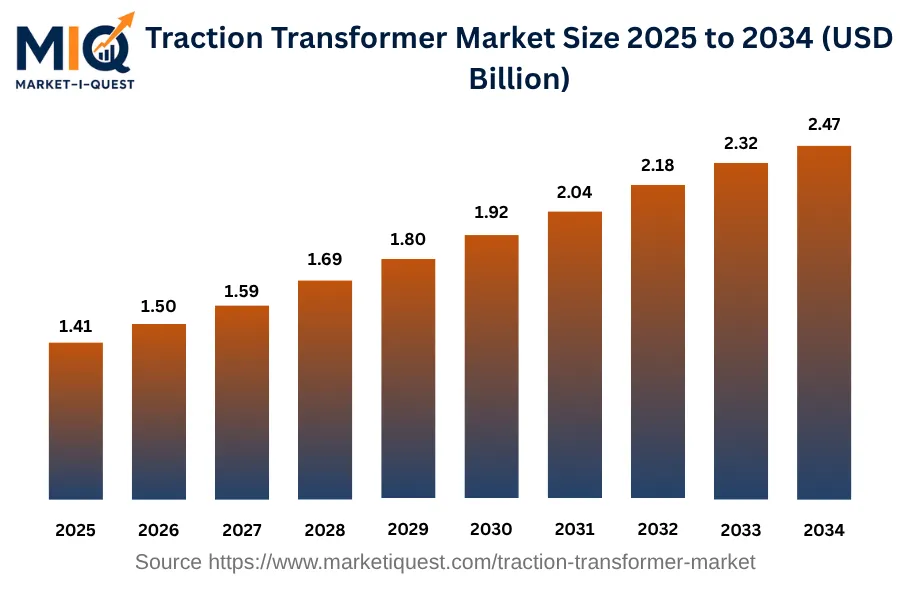
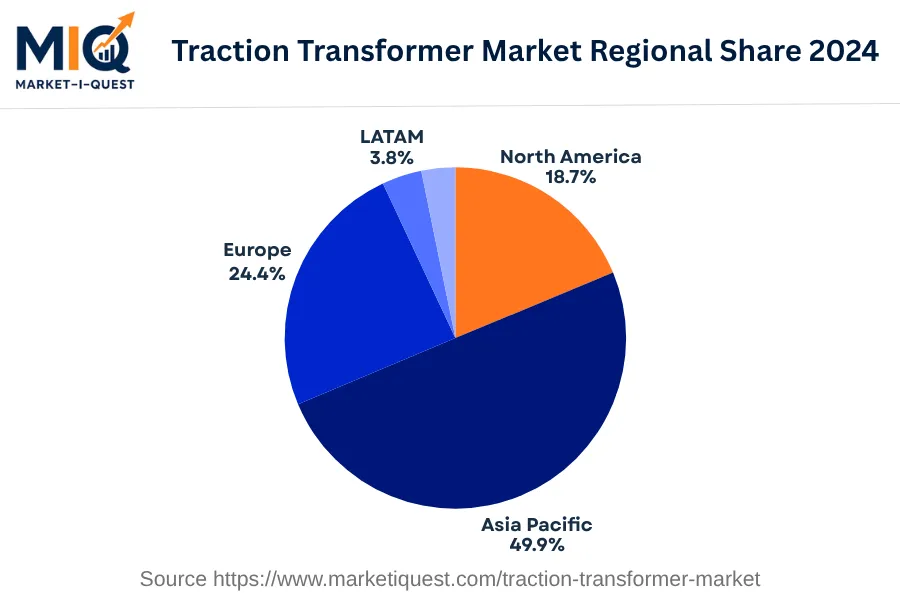
The Traction Transformer Market sized at USD 1.41 billion in 2025 and is projected to reach market size of USD 2.47 billion by 2034, expanding at CAGR of 6.45%. The regional share mix analysis in 2024 shows distribution across different regions. North America held 18.74%, followed by Europe at 24.36%. Whereas Asia Pacific region held the largest portion of market share at 49.92%, while shares of LATAM and MEA stood at 3.77% and 3.21% respectively.

Key Takeaways

  • By Type - Tap Changing segment held a significant position in the Traction Transformer Market.
  • By Overhead Line - AC System segment demonstrated a robust growth.
  • By Mounting Position - Machine Room stood as the leading category.
  • By Rolling Stock category - Electric Locomotives held the largest share of the market share.
traction-transformer-market market size

Key Driving Factors

Implementation of Low Carbon Rail Transport Policies

Globally the government initiatives are focused on promoting eco-friendly transportation systems for reducing the carbon emissions. Notably, the European Union has adopted regulations for introducing rail transport as a significant component of their long-term transport strategy for sustainable development. This policy shift drove railway companies to invest more in electric traction systems, which heavily based on traction transformers. Similarly, countries like India and China are shifting towards electrification of the railway lines, driving substantial demand for traction transformers. Whereas, increased demand for low carbon footprints in public transportation is supporting the demand for modern and efficient rail systems hence driving the traction transformer market.
Upgradation and Replacement of Ageing Railway Infrastructure

A large portion of railway networks especially in developed economies such as USA and Europe with immediate requirement for upgrades or replacements due to degrading infrastructure of the market. With the focus on renovating the rail infrastructure to enhance efficiency, reliability and safety. Replacement of conventional transformers with advanced traction transformers is a crucial part of these improvements. Traction transformers are preferred over traditional counterparts due to enhanced performance in railway applications due to features such reduced size and weight, enhanced noise immunity and improved energy efficiency. As railway sectors in these regions continue to replace their decades-old infrastructure components, traction transformers demand will remain driving the growth.

Market Evolution by Timeline

2019-2023
The primary buyers of traction transformers in this period were railways and rapid transit systems in fast-growing Asian countries, mainly China and India for meeting the rising infrastructure requirements. Europe, was a significant market due to major rail upgrades. The supply side was driven by the launch of compact, lightweight traction transformers known for low energy loss. Despite mature integration systems, supply constraints arose from limited manufacturing capabilities. Policies under European Union's Fourth Railway Package, focusing on interoperability and safety, influenced adoption. Contracts typically involved long-term partnerships between railway companies and manufacturers due to crucial role and life cycle of products. The major risks lay in high costs and technical challenges posed by new, more efficient transformer models.
2024
In 2024, the focus shifted towards green transportation, with environmental regulations encouraging use of electric and hybrid locomotives that needed traction transformers. High-speed rail projects in Asia, particularly in Japan and China, continued to drive demand. Technology-wise, flexible and modular traction transformers became standard, reducing logistical and maintenance complications. The Green Traction program in the European Union pushed cleaner energy policies, prompting rail sector to go green. Meanwhile, manufacturing firms entered strategic partnerships with local rail operators, supporting bespoke transformer construction. However, major barrier remained high initial, albeit necessary, green investment costs.
2025-2029
Over these years, the demand for traction transformers increased in North America due to extensive infrastructure upgrades in both freight and passenger rails. This was driven by urbanization trends and a push towards cleaner ways of transport. Li-ion traction transformers started gaining popularity for their efficiency and compactness despite the high costs. The North American Rail Safety and Modernization Act introduced new safety and performance standards. Contract structures evolved with manufacturers now providing comprehensive after-sales services, including maintenance and repair. An impending risk was the heavy reliance on critical rare-earth material supplies from politically unstable regions.
2030-2034
This period experienced a surge in demand from emerging economies adapting to electrified and semi-high speed rail networks for better connections. In the technology spectrum, additive manufacturing technologies like 3D-printing became a standard production method for efficient and economical transformer production. The International Electric Traction Committee's standardization protocols were instrumental in driving wider adoption. Commercial models generally involved shared-risk contracts between railways and manufacturers due to high investments in new technologies. The main risk was high operational and repair costs of these complex transformer systems, thus requiring contingency plans for unexpected breakdowns.

Future Market Outlook

Future Opportunities

The evolving landscape of traction transformers presents vast opportunities, especially in enhancing energy efficiency and integrating renewable energy sources. Push for sustainable transport systems in Europe, highlighted by European Commission’s 2021 initiatives for climate action, suggests a heightened demand for eco-friendly transformer solutions. Companies like Schneider Electric are already focusing on developing technologies to optimize energy use in traction applications, aligning with global goals for emissions reduction. Regions such as North America and Asia-Pacific are actively investing in modernizing their rail infrastructure, as seen in U.S. Infrastructure Investment and Jobs Act passed in 2021, which includes provisions for upgrading electrical systems. Strategic partnerships, like collaboration between Bombardier and Hitachi Rail in 2022, aim to develop next-generation traction systems powered by sustainable energy sources. Furthermore, increasing focus on urban transportation solutions, supported by governmental policies in countries like Japan where sustainable urban mobility is prioritized, points to necessity for advanced transformer technologies capable of supporting electric and hybrid rail systems. Additionally, urbanization trends in regions like Southeast Asia underscore the demand for efficient electrified public transportation systems, creating further incentive for companies to innovate in this space. As these trends continue to unfold, opportunities in design, manufacturing, and installation of traction transformers that meet robust regulatory standards are likely to multiply, aligning with the growing global emphasis on clean energy solutions.

Segmentation Analysis

By Type

The market is divided into subsegments including Tap Changing and Rectifier, with Tap Changing accounting for the largest revenue share, while Rectifier is expected to grow at the fastest CAGR during the forecast period.

Largest Revenue Share

Tap Changing

Market Share Leader

The Tap Changing subsegment dominates the market due to a frequent need for voltage regulation and stability in power transmission and distribution infrastructures. With increasing global electricity consumption and expanding grid infrastructures has subsequently increased the demand for transformers with on-load tap changers to adapt with voltage fluctuations. Meanwhile tap changers have been experiencing extensive adoption with a larger revenue. Diverse customer base ranging from local electrical distributors to large industries depending on tap changing technology for increasing efficiency in operation of their electrical equipment. With the increasing need for continual operation without high power consumption and requirement for safe, reliable electricity represent significant purchasing criteria. Switching costs for customers are relatively high with technical implementation and compatibility of alternative solutions creating barriers. Thus, tap changing subsegment accounted for largest revenue share in 2024.

Fastest CAGR

Rectifier

Forecast Period Growth Leader

The Rectifier subsegment is projected to grow at the fastest CAGR in the forecast period. This growth is attributed to the increasing need for shift of AC to DC power in various applications ranging from consumer electronics to high-end industrial machinery. The widespread digitization and reliance on digital devices demands the usage of rectifiers for power supply highlighting increasing adoption. Drivers for growth include technological advancements with increased Capex into energy-efficient power solutions and strategic partnerships among key players. With a highlighting increased rate of adoption from a relatively small base, which motivates high growth percentages. Thus highlighting rectifiers as the fastest growing subsegment.

By Overhead Line

The overhead line market is divided into subsegments including AC and DC systems. The AC system accounted for the largest revenue share, while the DC system is expected to grow at the fastest CAGR during the forecast period.

Largest Revenue Share

AC System

Market Share Leader

The AC is dominating the market due to features including ease in stepping up or down using transformers, allowing for more flexibility in terms of energy transmission and distribution. With the increased adoption of this technology due to it's ability for servicing a large number of customers over considerable distances, benefiting electrical utilities with broad geographies bases. Moreover, increased security within AC power resulting in reduced power loss, thus bringing better efficiency. It is also supported by regulatory frameworks favoring reliability and increased capacity in transmission and distribution infrastructures. Customer purchasing decisions for AC systems are commonly driven by legacy installations and established industry standards. Thus, AC’s entrenched position also benefits from well-established supply chains and maintenance services.

Fastest CAGR

DC System

Forecast Period Growth Leader

DC systems are projected to experience the fastest growth. The model shift towards DC power due to technological advancements, improving its efficiency and reliability. Moreover, DC lines are more suitable for long-distance underground and subsea transmission, thus driving its demand for interstate and international power sharing projects. While the drive towards renewable energy and electric vehicles is also fueling adoption as solar panels and batteries essentially generating and storing DC power. Thus, Policies that support green energy and technology partnerships that lower costs could accelerate adoption.

By Mounting Position

The market is divided into subsegments including Underframe, Machine Room, and Roof with the Machine Room subsegment accounting for the largest revenue share while the Roof subsegment is expected to grow at the fastest CAGR during the forecast period.

Largest Revenue Share

Machine Room

Market Share Leader

The Machine Room subsegment has utilized a significant share of the market's revenue, primarily due to it is an crucial part within various machineries. These rooms typically holds various primary mechanical equipment, making them essential for a smooth functioning of operations. These rooms serves various industries like manufacturing, construction and transportation while contributing to their large share in market revenue. The demand to improve performance, durability and efficiency of these rooms has created a for investing in superior machine room equipment and technologies. Moreover, various regulations necessitate proper maintenance and regular inspection of machine rooms, further driving their demand. Additionally, rise in industrial automation and newly developed complexes require machine rooms adhering to certain standards, leading to increased purchasing, ensuring steady growth trajectory for this subsegment.

Fastest CAGR

Roof

Forecast Period Growth Leader

The Roof subsegment is expected to witness the fastest CAGR in the forecast period. With the increasing urbanization at a rapid pace, the demand for advanced and sustainable roofing solutions has grew substantially . While trends within architecture sector are driving towards integration of rooftop equipment and amenities such as HVAC systems and leisure spaces which reflects a promising future for this subsegment. Furthermore, technological advancements are allowing development of smart and energy-efficient roofing systems. Policies and regulations encouraging energy-efficient infrastructure are also key catalysts in driving the demand for technologically advanced and green roofing solutions. Thus, rising awareness on environment and sustainability have subsequently increased the adoption of eco-friendly roofing solutions.

By Rolling Stock

The Rolling Stock market is categorized into Electric Locomotives, Metros, High-Speed Trains, and Other segments. Among these, the Electric Locomotives accounted for the largest revenue share whereas the High-Speed Trains is expected to grow at the fastest CAGR during the forecast period.

Largest Revenue Share

Electric Locomotives

Market Share Leader

Electric Locomotives held the largest revenue share stood out as the segment with the most substantial revenue in the Rolling Stock market in 2024. The growth is driven by several factor. The environment-friendly nature of electric locomotives, as they produce less pollution compared to their diesel counterparts, made them the first choice among rail transportation entities. Governments are providing favorable policies and regulations, encouraging the adoption of electric locomotives that align with their green initiatives. Moreover, increased demand for energy-efficient and cost-effective transportation for bulk goods, mainly in developed countries like US, Canada, Germany, and Japan, significantly contributed to the massive revenue of electric locomotives. Additionally, electric locomotives have lower operating and maintenance costs, making them an attractive purchase choice for many rail operators. The vast existing rail infrastructure, combined with an increasing willingness to upgrade to cleaner technology, further added to the appeal of electric locomotives.

Fastest CAGR

High-Speed Trains

Forecast Period Growth Leader

The growth of High-Speed Trains subsegment is predicted to outpace other sectors within the Rolling Stock market. The drivers behind this expected high growth include the increasing demand for faster commuting options, growing population densities in urban areas, and the desire for environmentally sustainable transport choices. Moreover, substantial investments in developing high-speed rail corridors globally and technological advancements that ensure safe, efficient, and faster rail travel propel this subsegment's quick growth. Governments and public transport bodies worldwide are increasingly recognizing the efficiency and sustainability benefits of high-speed trains, leading to a greater focus on their adoption. However, the high capital and operational costs and stringent safety regulations could momentarily impact the smooth adoption of high-speed trains. Strong public-private partnerships and government funding for infrastructure development are mitigating these barriers and shaping up a promising landscape for this subsegment.

Competitive Analysis

Key Market Players

Manufacturers / OEMs

Siemens AG
Germany
ABB Ltd
Switzerland
Hitachi Ltd
Japan

Key Suppliers & Raw Materials

Wilson Transformer Company
Australia
Cam Tran Co. Ltd
Canada
PEC Manufacturing
US

Distributors, Integrators & Channel Partners

Miracle Electronics Devices Pvt. Ltd
India
JST Transformateurs
France
CHINT Group
China

Porter’s Five Forces Analysis

This analysis aims at studying the Traction Transformer market's competitiveness and attractiveness.

Supplier Bargaining Power

Medium

Suppliers for unique parts can demand premium prices, but standard components face price competition.

Buyer Bargaining Power

High

Buyers like auto & railway OEMs with huge volumes drive hard price negotiations.

Threat of Substitutes

Low

Rail and heavy-duty electrification demand specific solutions, leaving fewer substitute options.

Threat of New Entrants

Medium

High capital expenditure acts as a barrier, but growth in electric vehicles opens opportunities.

Competitive Rivalry

High

The market has several established players, causing intense competition and price wars.

Regional Analysis

Geographic market dynamics and growth opportunities across key regions

Global Market Outlook

traction-transformer-market market regional share

North America

In the base year 2024, the North American Traction Transformer market was shaped by various forces. Drivers like the increasing demand for energy-efficient transport systems, regulatory emphasis on reducing carbon emissions, and accelerated investments in rail infrastructure bolstered the market. For instance, US government's stringent regulations on vehicular emissions spurred adoption of traction transformers in railway locomotives. Additionally, pervasive implementation of advanced technologies like IoT in the rail sector provided a significant push to the market.

Several noteworthy trends emerged in 2024. A substantial shift was seen in buyer behavior with many railway operators prioritizing low energy consumption and reduced operational costs, amplifying demand for traction transformers. Technological advancement in traction transformers industry did not stall, with more compact and lightweight models favored due to ease of installation and space-saving efficiencies, impacting both manufacturing and retail sectors. There was also an increased focus on partnerships and mergers to develop state-of-the-art products and gain a competitive edge. In terms of regulation enforcement, the emphasis remained on stricter adherence to environmental standards, with railways in US, Canada, and Mexico investing heavily in eco-friendly technologies. These combined elements shaped the North American Traction Transformer market in the base year.

Asia Pacific

The Traction Transformer Market in Asia Pacific witnessed substantial market movements in 2024. The market's main drivers included rising demand for electric locomotives and high-speed trains in major markets like China, India, and Japan. In China, government's substantial investment in developing a robust railway infrastructure significantly amplified the demand. Similarly, India's ambitious 'Make in India' initiative, emphasizing localized production of traction transformers, also fueled the market. Meanwhile, Japan's high technology adoption rate led to demand for mature traction transformer products.

The market trends in 2024 pointed to a paradigm shift towards energy-efficient solutions. Incorporation of high-capacity transformers in high-speed trains, especially in markets like South Korea and Australia, was noticeably on rise. There were dynamic channel shifts as companies in China and key ASEAN markets increasingly partnered with local manufacturers, aiding technology transfer and reducing operation costs. The enforcement of stringent energy efficiency norms in Australia was a notable policy affecting the market. The primary consumers of traction transformers were from sectors like utilities, with increasing interest from manufacturing as well.

Overall, interaction of these drivers and trends led to significant developments in the Traction Transformer market across the Asia Pacific region in 2024.

Europe

In 2024, the Traction Transformer Market showed robust performance in Europe, with strong contributions from key regions like Germany, UK, France, Italy, Spain, the Nordics, Benelux, and Central & Eastern Europe.

Three primary drivers powered market growth: increased investments in railway modernization projects, notable advances in traction transformer technology, and enhanced supply dynamics. Investments in modernizing existing railway infrastructures, primarily in Germany and UK, significantly boosted demand for efficient traction transformers. Simultaneously, advancements in traction transformer technologies sparked higher market adoption across Europe, with France, Italy, and Spain leading in technological uptake. Improved supply dynamics, especially from Nordic countries, provided ample traction transformers to meet the escalating demands.

Several key trends defined market behavior, like changes in buyer behavior, increased partnerships, and regulations enforcement. Buyers predominantly from enterprise sector, showed growing preference for efficient and cost-effective traction transformers, impacting market's product portfolio. An increased frequency of partnerships and mergers between enterprises illustrated market's strategic focus on strengthening supply chains and obtaining competitive advantages. Moreover, rigorous enforcement of energy-efficient policies in countries like Germany and UK pushed manufacturers to develop and deploy greener traction transformers. Overall, these elements solidified the market position of traction transformers in Europe in 2024.

Latin America

In 2024, the Traction Transformer Market in Latin America (LATAM), with significant focus on countries like Brazil, Mexico, Argentina, Colombia, Chile, and Peru, exhibited a surge in demand arising from many drivers and trends. Regulatory push towards modernizing railway infrastructure drove demand, particularly in countries like Colombia and Chile where significant investments were made in upgrading rail networks. Additionally, increased adoption of advanced technologies like energy-efficient traction transformers fueled the market growth in countries like Brazil and Argentina.

Alteration in buyer behavior played a pivotal role as more utilities and manufacturing companies opted for traction transformers due to their efficiency and longevity in nations including Mexico and Peru. A significant technological shift was observed towards lightweight and compact traction transformers, further stimulating market growth. Notably, strategic partnerships and M&A activities were prevalent, especially within enterprise sector, facilitating technology transfers and market penetration in countries like Brazil and Argentina.

Enforcement of stringent energy efficiency standards by respective governments in LATAM region further reinforced the market growth. Specifically, the push from governments and regulatory bodies towards a lean energy mix, with a focus on electricity, led to increased uptake of traction transformers, particularly within the utilities sector. Overall, the traction transformer market in the LATAM region exhibited robust growth in 2024, underpinned by a combination of regulatory drives, technological adoption, and changing market dynamics.

Middle East & Africa

The Traction Transformer Market in Middle East and Africa in 2024 presented steady growth driven by rapid infrastructure development and urbanization. Increased governmental investment in public transport systems, particularly in Egypt, South Africa, Saudi Arabia, and Israel, and need for energy-efficient solutions, led to a heightened demand for traction transformers. Simultaneously, robust growth of railway sector in United Arab Emirates, Nigeria, and Kenya augmented this demand further.

Trends that shaped the market included shift towards adopting low-noise, sustainable technology, and compact, lightweight designs, driven predominantly by the health sector and telecom industries' high convergence to energy-efficient practices. Policies such as the South African government's Green Transport Strategy encouraged the use of eco-friendly transport systems, gradually leading to increased traction transformer deployments.

Moreover, an increased public-private partnership for railway advancements, such as the Riyadh Metro project in Saudi Arabia, has further fostered the market growth. A notable trend was the stringent enforcement of standards like the IEC 60076 for railway transformers, particularly in Qatar and Israel, aiming to maintain the quality of these transformers and ensure safety in operations. The traction transformers were adopted mainly by governments, utilities sectors, and railway constructors extensively. Over 2024, the market for traction transformers in the Middle East and Africa consolidated around these key drivers and trends.

Recent Industry Developments

Latest market innovations, product launches, and strategic initiatives

January 2025

Siemens Energy finalized testing phase and began commercial integration of its medium-frequency Power Electronic Traction Transformers (PETT) utilizing Silicon Carbide (SiC) technology. By replacing conventional low-frequency iron-core transformers with solid-state SiC technology, they achieved a massive reduction in physical footprint and weight of the onboard traction system, directly improving trains energy efficiency.

November 2024

Alstom deployed a redesigned series of traction transformers that use biodegradable synthetic ester fluids instead of traditional mineral oils for its Coradia Stream train platforms. This development was driven by strict new European regulations regarding fire safety and soil contamination, allowing the trains to operate through environmentally sensitive regions without the risk of toxic oil spills.

September 2024

Hitachi Energy initiated operational rollout of its latest generation of RESIBLOC dry-type traction transformers for a new series of European regional electric multiple units (EMUs). This development shifts away from traditional oil-filled transformers to eliminate the risk of leaks, drastically reducing environmental hazards and routine maintenance overhead for operators.

Frequently Asked Questions