Threat Modeling Tools Market Snapshot

Key Players

  • Microsoft Corporation (United States)
  • IBM Corporation (United States)
  • JetBrains (Czech Republic)
  • Veracode (United States)
  • Sophos (United Kingdom)
  • Checkmarx (Israel)
  • Synopsys (United States)
  • Micro Focus (United Kingdom)
  • Fortify Software (United States)
  • Rapid7 (United States)

Market Size

Base Year 2024
$ 1.08 Bn
CAGR
14.8%
Forecast 2034
$ 4.29 Bn

Market Segments

By Component
Solution, Services
By Deployment Mode
Cloud-Based, On-Premise, Hybrid
By Organization Size
Large Enterprise, SME
By End-use Industry
IT & Telecommunication, BFSI, Healthcare, Manufacturing, Utilities, Others

Market Dynamics

Drivers
  • Rising cybersecurity concerns
  • Increasing digital transformation trends
Restraints
  • High implementation cost
  • Limited threat modeling expertise
Opportunities
  • Rising cybersecurity concerns
  • Increasing digitization trends

Market Size

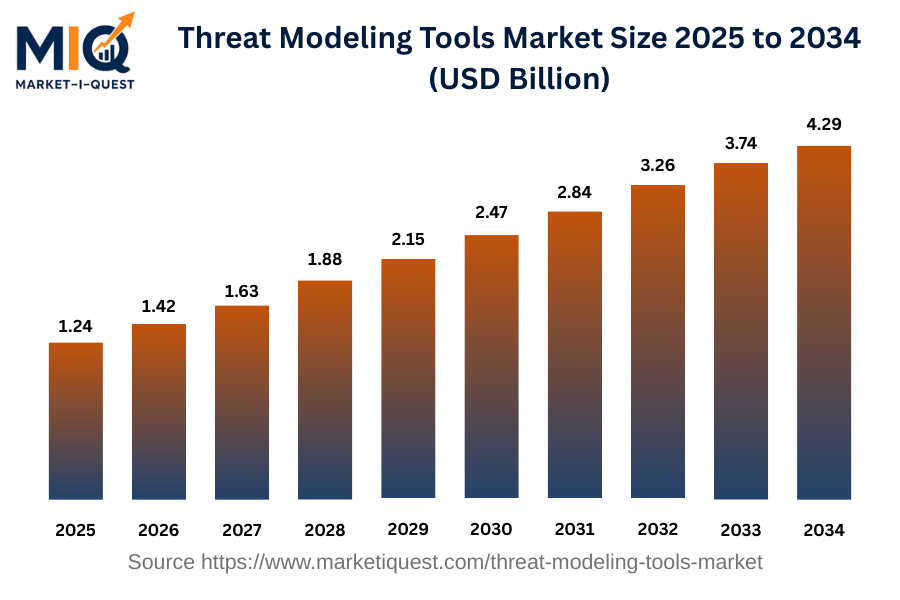
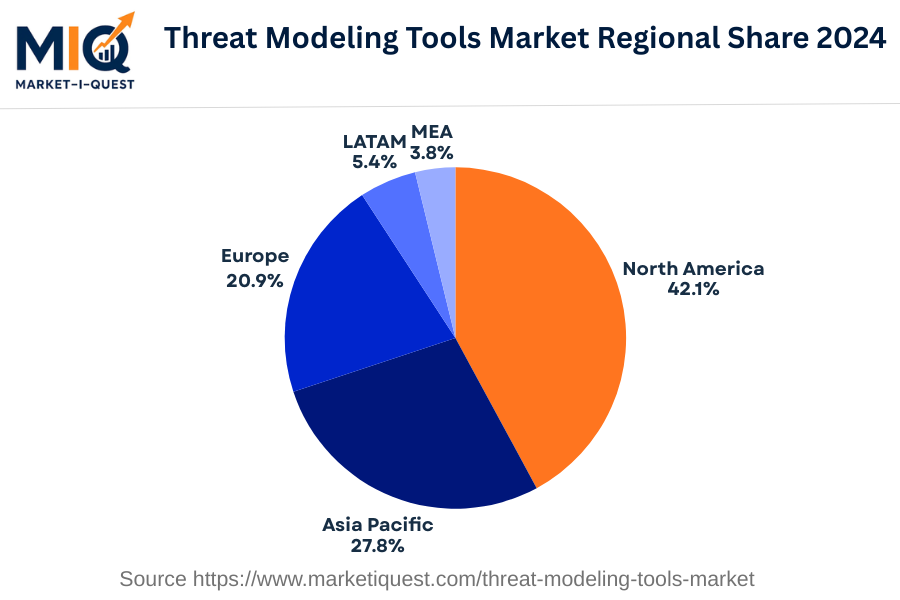
The Threat Modeling Tools Market share valued at 1.08 billion USD in 2024 with effectively rising to 1.24 billion USD in 2025. The market then expanded significantly to achieve a valuation of 4.29 billion USD by 2034. This development expanded at a Compound Annual Growth Rate (CAGR) of 14.8% between 2025 to 2034. Growth was driven by increasing cybersecurity threats and the rising adoption of threat modeling tools. Businesses investing in these tools for better visibility of potential threats and vulnerabilities also primarily contributed to the market growth. Regionally in 2024, North America held the leading share of 42.1%, followed by Asia Pacific at 27.8%, Europe at 20.9%. The regions of Latin America and the Middle East and Africa with shares of 5.4% and 3.8% respectively.

Key Takeaways

  • By Component - Solution subsegment leads the market showing noteworthy dominance.
  • By Deployment Mode - Cloud-Based solutions held significant market share in the recent past.
  • By Organization size - Large Enterprises were the leading adopters of threat modeling tools.
  • By End-use Industry - IT & Telecommunication led the market in using threat modeling tools.
threat-modeling-tools-market market size

Key Driving Factors

Amplified Regulatory Compliance Requirements

The Threat Modeling Tools market growth consist of significant driving factors boosting the requirements for regulatory compliance. Various standards, such as the General Data Protection Regulation (GDPR) in the European Union and the California Consumer Privacy Act (CCPA) in the United States, have enforced businesses to maintain high standards of data privacy and security. To remain flexible for requirements of organizations to identify potential threats and ways to counter them. Threat Modeling Tools can allow this effort by providing wide-ranging insights for potential risks and supporting to develop mitigation strategies. As long as such regulations continue to restrict the demand for Threat Modeling Tools..
Increasing Digitization in Small and Medium-sized Enterprises (SMEs)

Another key driving factor for the Threat Modeling Tools market is the increasing digitization in SMEs. With increasing digital transformation of small and medium-sized businesses the requirements for digital security becomes crucial. SMEs could lack the necessary internal capabilities required for managing the cybersecurity issues, Meanwhile the engagement of Threat Modeling Tools with offering a systematic approach for identifying, quantifying and addressing potential threats. These tools, play a key role in enhancing the security values of SMEs, allowing them to initially manage cyber threats. The drive for digital business operations among this buyer segment will continue to rise the requirements for Threat Modeling Tools.

Market Evolution by Timeline

2019-2023
In this period, the companies from North America primarily purchased threat modeling tools for initial data protection. Main suppliers included Microsoft and SecludIT, shipping tools like ThreatModeler and Azure Security Center. However, difficulties integrating with existing security systems acted as a constraint. GDPR compliance rules drove the adoption in Europe, highlighting the critical role of regulatory policies in the market. Annual renewal with a site license agreement were involved in the purchases. Major risk included the technical capability of buyers to properly use the tools reduced through extensive supplier-provided training.
2024
In 2024, shifts in the threat modeling tools market demand. The healthcare industry became a significant buyer segment, driven by a need for protection of sensitive patient data. New market entrants offered integration features with common security systems, driving industry leaders to enhance their services. Meanwhile, new ISO/IEC 27001 2013 standard forced companies for invest in threat modeling tools. As the competition increased the average prices dropped with supplier preference shifting towards volume-based contracts.
2025-2029
With a evolution in the range of buyer in the threat modeling tools market expansion in educational institutions and financial service organizations. Regions such Asia-Pacific driving towards the rapid adoption, driven by stringent national data protection regulations. Supply saw a shift towards cloud-based solutions for flexibility and scalability. Various vendors like IriusRisk and Avi Networks introduced to integrated systems compliant with new ISO 27005 standard for risk management. The subscription model became common with addressing the risk of insufficient tool utilization involved indicators for substantial return on investment.
2030-2034
By 2030, Latin America dominated the buyer segment due to increased concerns for digital transformation and data security. Simultaneously, the supply side integrating AI-powered solutions from vendors like XM Cyber and RiskSense. A common integration included AI compatibility and threat prediction. Stringent policy frameworks like Federal Law on Protection of Personal Data in Mexico drove the mass adoption in the region. Pay-per-use became a common commercial model, increasing affordability for small businesses.

Future Market Outlook

Future Opportunities

The recent development in the threat modeling tools market indicated several future opportunities related to growing technologies and policy developments. The rapid expansion in usage Internet of Things (IoT) devices has created a crucial demand for focused threat modeling environment for approaching risks, essential for interconnecting devices. In March 2021, the Federal Trade Commission issued a report highlighting the vulnerabilities of smart home devices, encouraging globally for more substantial threat modelling activities. Furthermore, with increasing adoption of DevSecOps practices, the integration of threat modeling into constant development pipelines offering a promising approach towards tool developers. In 2022 various organizations including large financial institutions, started implementing DevSecOps, thus increasing the need for real-time threat analysis. The emerging regulations like Cybersecurity Directive by EU introduced in 2024, will further encourage corporations to advance their threat modeling strategies to comply with new security standards. With cyber threats becoming increasingly advanced, also the opportunities for the development of threat modeling tools increases with utilizing artificial intelligence to automate risk identification and solution strategies. Collaborations between cybersecurity firms and academic institutions are likely to grow, targeting the development of innovative procedures for threat modeling. As the market for these tools expands, businesses will seek customizable options to their specific risk profiles, indicating a shift toward personalized security solutions.

Segmentation Analysis

By Component

The market is divided into subsegments including Solution and Services, out of which the Solution segment accounted for the largest revenue share while Services is expected to grow at the fastest CAGR during the forecast period.

Largest Revenue Share

Solution

Market Share Leader

The Solution segment represents as the revenue leader in this market. The growth drivers is notable demand for efficient solutions in widespread industry sector including healthcare, IT, retail or the accelerating industry like FinTech, customized solutions dominate, thus setting its dominance in terms of revenue. An additional boosting factor is the approach of modern technologies such as Artificial Intelligence, Machine Learning and Data Analytics, which require advanced solutions for optimal utilization. Certain regions like North America and Europe, due to their technological dominance, favor in increasing the need for high-end solutions. In terms of customers, larger corporations persistently seek these component solutions, further highlighting their market segement. The regulation and acquisition criteria for these solutions are often stringent, creating a high barrier for new players for entering the market.

Fastest CAGR

Services

Forecast Period Growth Leader

Services segment leads as the fastest-growing segment in terms of CAGR. This high growth projection can be attributed to several key drivers. The rapid technological advancement combined with increasing complexities in the organization, increasing need for expert services for enhanced deployment, integration and maintenance of these modern solutions. Additionally, the global policy shift towards digital transformation acts as a major driver for accelerating the demand for professional services. Moreover, the increasing capital expenditure in IT infrastructure by businesses, both large-scale and small-scale, fuels this growth. Significant risks including lack of technical knowledge, higher costs majorly acts as barriers for adoption. However, strategic partnerships between service providers and tech giants are expected to outwit these barriers, preparing the way for promising advancement in the Services segment.

By Deployment Mode

The market for Deployment Mode is categorized into subsegments including Cloud-Based, On-Premise, and Hybrid systems. Of these, the Cloud-Based subsegment generated the highest revenue in the base year of 2024. Meanwhile, the Hybrid subsegment is projected to witness the fastest Compounded Annual Growth Rate (CAGR) during the forecast period.

Largest Revenue Share

Cloud-Based

Market Share Leader

The Cloud-Based subsegment represents the largest revenue primarily due to the widespread offering of adoption and scalability. In 2024, Cloud-based systems highlighted due to the increasing number of businesses seeking to reduce costs and improve operational efficiency shift towards the cloud. This shift towards cloud-based solutions is primarily driven by the need for enterprises to minimize infrastructure costs and improve business adaptability. Additionally, the rising need for remote work model due to the global pandemic situation has further accelerated the adoption of cloud-based systems substantially driving the revenue. Another contributing factor includes the stringent regulatory scope that encourages data protection and privacy, driving businesses to adopt advanced solutions such as cloud-based systems. This trend is especially notably in developed markets where regulation are strict, and in industries where data is sensitive. Therefore, increased requirement from various enterprises for cost-efficient, scalable and secure systems results in the largest revenue segment for the Cloud-Based subsegment.

Fastest CAGR

Hybrid

Forecast Period Growth Leader

The Hybrid subsegment is forecasted to grow at an accelerated pace. The increasing rate of growth for Hybrid systems is due to the flexibility with combining the benefits of both on-premises and cloud-based systems. An approach towards hybrid segment allow organizations for maintaining control over critical data with using on-premise infrastructure while utilizing scalability and cost-effectiveness of cloud solutions. This combination of control and flexibility makes hybrid systems an attractive solution for companies, which fuels its accelerated adoption. Even with the benefits various adoption barriers such as initial integration complexities and transition risks. Strategic partnerships with cloud providers with technology advancements likely will minimize these barriers while encouraging growth. However, several risks involve security concerns across shared resources on cloud systems impacting the rate of adoptions. However, the evolution can be expected as organizations continue to recognize the value of infrastructure flexibility granted by Hybrid systems.

By Organization Size

The market is divided into subsegments including Large Enterprise and SME. In the base year 2024, Large Enterprise accounted for the largest revenue share while SME is expected to grow at the fastest CAGR during the forecast period.

Largest Revenue Share

Large Enterprise

Market Share Leader

The Large Enterprise subsegment led in revenue in 2024, with factors attributing the dominance of the market. With the characteristics such as significant workforce, increasing global reach and substantial financial resources allowing the investments in high-end software solutions for increase operational efficiency. Adoption of such solutions is driven by the demand for automated tasks, efficient data management, security and scalability. Purchasing decision of large enterprises are influenced by the reputation of brands, capabilities of solution and vendor support. Switching costs are generally high in this subsegment due to the complex nature of operations, thus reliance on a stable solution becomes crucial. Channels for acquiring these solutions include direct purchasing from vendors or thorough authorized partners. Geographically, largely populated regions with a dense number of enterprises tend to contribute more towards this subsegment's revenue.

Fastest CAGR

SME

Forecast Period Growth Leader

The small and medium enterprise subsegment, is anticipated to grow at the fastest CAGR. The development is initiated with favorable policy environment, increased technological adoption and capital investment. With several challenges such as limited financial resources and lacking technical expertise overcome with partnerships, government initiatives and new affordable tech solutions. This broadening of technology is allowing SME to adopt solutions before accessible only to large enterprises. With increasing SMEs recognizing the values of these solutions, simultaneously the rate of adoption is expected to rise significantly. However, there are several near-term risks such as increased competition and potential regulatory fluctuation. The growth rate might also be vulnerable to any major economic downturns affecting the broader economy.

By End-use Industry

The market is divided into subsegments including IT & Telecommunication, BFSI, Healthcare, Manufacturing, Utilities, and Others. Among these sectors, IT & Telecommunication accounted for the largest revenue share while healthcare is expected to grow at the fastest CAGR during the forecast period.

Largest Revenue Share

IT & Telecommunication

Market Share Leader

The IT & Telecommunication subsegment leads in revenue, playing a critical role in facilitating operations of other sectors. An increase in digitization advancement in demand for cybersecurity, expansion of cloud-based services and advancements in mobile communication technology are significant drivers for its substantial revenue. Significantly driving demand for real-time solutions, communication services, data management and system integrations boosting the purchasing power for IT & Telecom services, thus enhancing revenue. Additionally, the regional spread of IT & Telecommunication services is broad, with major investments in developed threat modelling tools market demands and rapidly growing in emerging economies contributing to its leading revenue. However, the increased competition and rapid technological changes in these sectors requirements for constant innovation, with posing as challenges.

Fastest CAGR

Healthcare

Forecast Period Growth Leader

The healthcare segment is projected to grow at the fastest CAGR. The rise is driven by the increasing adoption of technology in healthcare, boosting the demand for improved diagnostics, patient care and data management. Advancements in various sectors including telehealth, electronic health records and mobile health are major contributors to this accelerating growth. Alongside, government standards with increased funding for healthcare IT solutions are drivers for rise within the sector, allowing the healthcare outcomes with efficient management of patient data and techniques for prevention of diseases. Key barriers such as high initial setup cost, data privacy concerns and regulatory challenges could potentially affect in the pace of adoption. However, strategic partnerships, investments in IT infrastructure and the adoption of AI and data analytics are positioned to mitigate these challenges and drive high CAGR.

Competitive Analysis: Threat Modeling Tools Market

Key Market Players

Manufacturers / OEMs

Microsoft
US
IBM
US
Cisco
US

Key Suppliers & Raw Materials

Intel
US
ARM
UK
Nvidia
US

Distributors, Integrators & Channel Partners

Oracle
US
Red Hat
US
SAP
Germany

Porter’s Five Forces Analysis

An intensive examination of the competitive dynamics within the Threat Modeling Tools market.

Supplier Bargaining Power

Low

Software tools are abundant and diversified, reducing suppliers' influence.

Buyer Bargaining Power

High

Buyers have plenty of software options and switching costs are low.

Threat of Substitutes

Medium

Alternative cyber defense and manual risk analysis methods can act as substitutes.

Threat of New Entrants

Medium

Low capital needs encourage entry, but domain-specific knowledge is a hurdle.

Competitive Rivalry

High

Numerous established players and rapid innovation heighten competitive rivalry.

Regional Analysis

Geographic market dynamics and growth opportunities across key regions

Global Market Outlook

threat-modeling-tools-market market regional share

North America

In 2024, the Threat Modeling Tools market share in North America showed critical dynamics influenced by the key drivers and trends. The rising cyber threats drove need as enterprises, government sectors and healthcare organizations experienced need to secure their digital systems, primarily driving the market. Strict regulations including GDPR and HIPAA are significantly contributing in the adoption of advanced security tools. Investments in cybersecurity technologies also increased with encouraging the expansion of market.

Simultaneously, changes in pricing models, like the shift towards subscription-based services, ensured accessibility, redefining supply dynamics. Technology adoption, particularly AI and machine learning, impacting the Threats Modeling Tools market by acting as drivers for usability and performance.

Notable trends were reflected by market in buyer behaviour with technology shift. As the The threat modelling tools market dynamics also reflected notable trends in buyer behaviors and technology shifts. As the developing threat environment, a major shift towards cloud-based threat modeling tools was seen in sectors like retail and manufacturing for seeking scalable and cost-effective solutions. The rising strategic partnerships and acquisition indicated market integration, setting extensive security solutions. With cybersecurity enforcing policies within organizations has become more stringent with heightened importance on regular security audits and risk assessments. These factors initiate the rise and shape of the Threat Modeling Tools market expansion in North America in 2024.

Asia Pacific

In 2024, the Asia Pacific Threat Modeling Tools Market demand presented a developing landscape characterized by growing incidents of data breach and rising cyber threat concerns. The increasing regional regulatory standards acted as a key driver. For instance, cybersecurity laws in China and personal data protection bill in India substantially drove the demand for advanced threat modelling tools. Enhanced technology adoption across enterprises and government bodies further fueled market growth.

The shift in buyer behaviour highlighted the developing Threat Modeling Tools market trend with increased focus on customizable and AI-based solutions. Increased product sophistication was observed with providers integrating machine learning capabilities for real-time threat detection and risk prediction. In the enterprise sector, especially in manufacturing and healthcare, tool adoption for protecting database systems accelerated.

Trends also highlighted growing channel partnerships, particularly between threat modeling tool suppliers and IT service providers. For instance, the strategic alliance between telecom sector’s major player NTT Data in Japan with modelling vendors to boost its cybersecurity profile. The standardization gained influence specifically in policy enforcement in key ASEAN markets.

In summary, the growing cybersecurity concerns, stringent regulatory standards and technology adoption formed the hub of the Asia Pacific Threat Modeling Tools Market trends drivers in 2024, while buyer behavior shifts, product advancements and channel partnerships marked significant trends.

Europe

In 2024, threat modeling tools market opportunities in Europe experienced significant influence. The increasing demand for cybersecurity in various industries including healthcare, utilities and retail during the growing digitalization and cyber threats. General Data Protection Regulation in germany boosted the demand with companies attempted to comply, thus fueling market growth. Additionally, increased technology adoption in the UK promoted a rise in investments for the development and distribution of threat modeling tools.

Trends saw increasing shift towards collaboration and merger activities, particularly witnessed in the Nordics and Benelux regions aiming for product diversity and enhanced market reach. Introducing advanced features such as predictive threat intelligence by major companies in France influenced the threat modelling tools market opportunities, promoting a shift towards advanced tools. Government sectors in Spain and Central & Eastern Europe took required steps towards policy enforcement to resolve cybercrime.

Despite the increased demand and developing trends, supply dynamics played a crucial role in maintaining threat modelling tools market analysis balance with leading providers in Italy ensured consistent tool accessibility across various sectors, including manufacturing. With the further requirement of fixed pricing regulations in the EU the market was kept competitive, steering continued expansion.

Latin America

The projected Threat Modeling Tools Market expansion in Latin America was influenced by various factors. Increased cyber-attacks drove businesses and government bodies across Brazil, Mexico, Argentina, Colombia, Chile and Peru to acquire these tools, boosting demand. Regulatory environments requiring strict data protection standards such as General Data Protection Law in Brazil, further drove the market. With, investment in digital infrastructure across LATAM region facilitated the adoption of advanced threat modeling tools.

Trend was seen in buyer behavior pointing towards a strong preference for cloud-based threat modeling tools due to their cost efficiency and scalability. The sector witnessed a shift towards AI-integrated tools for predicting potential threats and vulnerabilities. The retail and manufacturing sectors emerged as major influencers, with their increasing reliance on digital technologies. Several government bodies also became key adopters to ensure national security and data integrity.

The LATAM market analysis also saw a surge in strategic partnerships and acquisitions among key market players like IBM and Micro Focus for enhancing their competitive position. Moreover, the enforcement of data protection policies in 2024 resulted in strict compliance to threat modeling tool standards, accelerating the overall market development.

Middle East & Africa

In 2024, the Middle East and Africa saw evolution of the Threat Modeling Tools Market, indicating the increasing demand for strict cybersecurity standards. Drivers included factors such as digital evolution across industries such as government, oil and gas, telecom, healthcare, banking and retail, mandating for enhanced defenses against cyber threats. Countries like Saudi Arabia, United Arab Emirates and Qatar resulted in increased investment in technological advancements in South Africa and Nigeria, with their rising fintech sectors, acted as key contributors to market developement. Also, increased regulation enforcement, for instance, National Cybersecurity Strategy in Qatar and National Cybersecurity Authority in Saudi-Arabia, drove market activity.

Shifting demand towards organizations, especially in Israel, Kenya and Egypt prioritized proactive cybersecurity approaches, favoring the integration of threat modelling tools in their system environment. The partnership between Etisalat a major telecom player of and CrowdStrike cybersecurity leader from US, highlighted the growing global focus towards the regional cybersecurity framework. Also, a rising preference for cloud-based threat modeling solutions was seen, driven by cost-effectiveness and scalability. However, the market growth had certain challenges such as lacking cybersecurity awareness among staff in sectors like retail and manufacturing highlights the persistent need for extensive cybersecurity education.

Recent Industry Developments

Latest market innovations, product launches, and strategic initiatives

March 2026

While the exact release day is obscured in the Q1 rollout, AWS released ThreatForest in early 2026, an open-source project designed to fundamentally change how threat modeling is executed. Instead of relying on manual inputs, ThreatForest deploys a pipeline of autonomous AI agents to scan codebases, automatically build attack graphs, map to MITRE ATT&CK, and suggest mitigations in a matter of minutes, pushing the market heavily toward "Threat-as-Code" automation.

January 2026

Cisco launched its global Threat Modeling Security Assessment service through its Customer Experience professional services division. Originally built to support threat-led penetration testing frameworks, this service bridges the gap between software architecture and active threat intelligence by mapping adversary behavior (via the MITRE ATT&CK framework) directly to organizational assets.

January 2026

ThreatModeler acquired IriusRisk, effectively merging two of the largest enterprise threat modeling platforms in the world. This consolidation signals a major market shift toward unified, AI-driven platforms capable of providing continuous "secure-by-design" practices at an enterprise scale, moving away from fragmented, standalone diagramming tools.

Frequently Asked Questions