Thermoplastic Polyolefin Membranes Market Snapshot

Key Players

  • Polyglass U.S.A. Inc. (United States)
  • Carlisle Companies Incorporated (United States)
  • GAF Materials Corporation (United States)
  • Firestone Building Products Company LLC (United States)
  • Arkema SA (France)
  • BASF SE (Germany)
  • Dow Chemical Company (United States)
  • Saint-Gobain SA (France)
  • IKO Industries Ltd. (Canada)
  • Johns Manville (United States)

Market Size

Base Year 2024
$4.63 Bn
CAGR
6.23%
Forecast 2034
$8.47 Bn

Market Segments

By Membrane Type
Homogeneous Membrane, Reinforced Membrane, Coextruded Membrane
By Raw Material
Ethylene-Propylene-Diene Monomers (EPDM), Polypropylene (PP), Polyethylene (PE), Thermoplastic Polyurethane (TPU)
By Manufacturing Process
Film Extrusion, Sheet Extrusion, Calendering
By Application
Roofing, Wall Cladding, Geomembranes, Moisture Barriers, Others

Market Dynamics

Drivers
  • Increasing construction activities
  • Adoption of sustainable roofing materials
Restraints
  • High production cost
  • Substitute availability
Opportunities
  • Renewable construction growth
  • Industrialization in emerging economies

Market Size

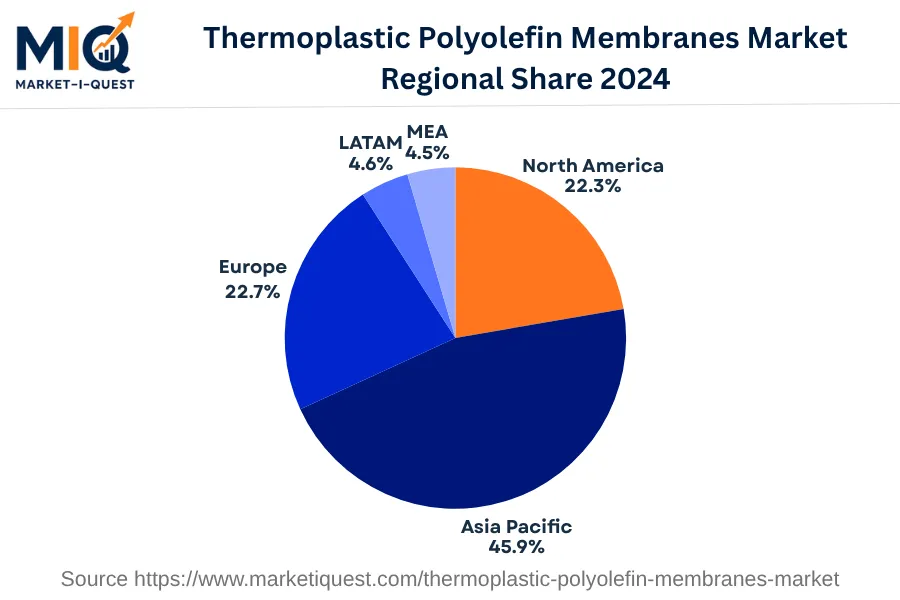
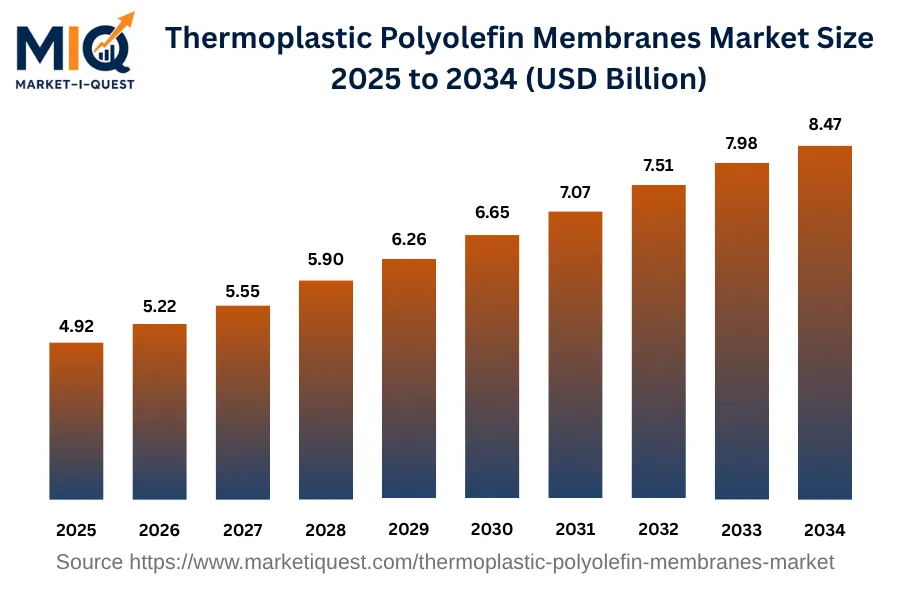
The Thermoplastic Polyolefin Membranes Market was valued at 4.92 billion USD in 2025, and it is projected to reach 8.47 billion USD by 2034, growing at a CAGR of 6.23%. The market size displayed constant growth over the years. For instance, in 2024, the value was 4.63 billion USD, and it rose to 4.92 billion USD by 2025, suggesting a steady upward trajectory. The growth from 2025 to 2034 represents a sizable increase in market value. In terms of regional share in 2024, Asia Pacific held the majority stake at 45.9%, closely followed by North America at 22.3% and Europe at 22.7%. Meanwhile, the share attributed to the LATAM was 4.6% and that of MEA stood at 4.5%.

Key Takeaways

  • By Membrane Type - Reinforced Membrane held a significant share leading the market in 2024.
  • By Raw Material - Polypropylene (PP) dominated accounting for a large market share in 2024.
  • By Manufacturing Process - Film Extrusion was the leading method holding a substantial share in 2024.
  • By Application - Roofing led the market accounting for a high share in 2024.
thermoplastic-polyolefin-membranes-market market size

Key Driving Factors

Implementation of Strict Building Energy Codes

In many countries, stringent building energy codes such as Title 24 in California (USA) and Eurocodes in the European Union are actively being enforced. These regulations have been established to mitigate the environmental impact of construction practices by promoting energy efficiency. As Thermoplastic Polyolefin (TPO) membranes have high reflective properties and excellent energy-saving capability, their adoption is being pushed strongly in the roofing industry to comply with these regulatory standards. TPO membranes reflect solar heat, leading to lower indoor temperatures and subsequently reduced need for air-conditioning. This drives down energy consumption, enabling builders to meet the prescribed standards.

Uptick in Green Building Initiatives

There's a noticeable uptick in green building initiatives globally, with certifications like Leadership in Energy and Environmental Design (LEED) and Green Star rating leading the way. Green buildings require the use of materials that are eco-friendly, energy efficient and promote a reduced carbon footprint. TPO membranes, due to their energy-efficiency and being recyclable, meet this criteria. As companies aim to gain green building certifications to establish their sustainability credentials and appeal to the eco-conscious consumer, they are increasingly adopting TPO membranes in their construction process, particularly in flat and low-slope roofing applications. Thus, the surge in green building initiatives is contributing to the growing demand in the TPO membranes market.

Market Evolution by Timeline

2019-2023
The TPO Membranes market was predominantly driven by its application in the roofing industry across North America, particularly in the United States and Canada, due to its durability, cost-effectiveness and energy efficiency. Manufacturers like GAF and Carlisle began investing in R&D on optimizing the TPO formulation, increasing its overall heat resistance ability. Regulatory standards like ASTM International played a critical role, supporting these membrane technologies by setting safety and environmental impact standards. TPO procurement typically followed project-based contracts with manufacturers or distributors. Weather-induced shipment delays were the prominent supply chain issue in this period, responded to with developing robust logistics strategies.
2024
Asian markets, predominantly China and India, emerged as the major demand centers, propelled by rapid urbanization and infrastructure development. Versico and Firestone expanded their R&D paraphernalia to improve recyclability aspects of TPO, in response to growing environmental regulations. New standards introduced by International Code Council (ICC) mandated higher energy-efficiency requiring advanced heat resistance. Fluctuations in crude oil prices led to variations in TPO price. Partnerships between construction companies and TPO manufacturers gained momentum. OEM supply constraints, due to regulatory pressure on sustainability standards, posed challenges.
2025-2029
The rise of green infrastructure projects in Europe boosted the TPO Membranes market. Retrofitting of old buildings, using TPO as a reliable roofing solution, was prevalent. Manufacturers, like Sika and Johns Manville, started utilizing greener production methods reducing their carbon footprints. ISO 14001 standard encouraged ecofriendly production methods. Industry-wide adoption of cost-plus pricing models, ensuring stability even in volatile market conditions, was common. Suppliers were diversifying their production facilities to minimize risk posed by regional regulatory changes. However, dearth of skilled workforce was a notable challenge in this period.
2030-2034
Demand for TPO Membranes was driven by renewable energy projects, particularly solar power plants, across Asia, North America, and parts of Europe. Manufacturers stepped up their game, introducing TPO with improved UV resistance properties. LEED v4.1 rating system effectively guided eco-friendly utilization of TPO membranes. Cost-based procurement models gained popularity amongst buyers, despite potential risks of rising raw material costs. Major players also started to establish strategic partnerships with local entities to circumvent geopolitical risks and improve regional accessibility; nevertheless, patent restrictions added complexity to production and distribution process.

Future Market Outlook

Future Opportunities

The thermoplastic polyolefin membranes market stands poised for growth as emerging trends around sustainability and regulatory compliance shape industry priorities. Numerous legislative initiatives, such as the European Green Deal introduced in 2019, emphasize the need for environmentally friendly building materials, setting a precedent that global regions may follow. Companies like GAF and Carlisle Companies are already exploring alternative formulations that reduce carbon footprints, thus capturing the anticipated demand. Conventional roofing solutions are often subject to stricter energy consumption regulations, providing a clear opportunity for TPO adoption in residential and commercial sectors alike. The push toward higher energy efficiency is evident in newly constructed buildings in countries like Canada, which are increasingly required to meet net-zero energy standards by 2030 as outlined by local governments. Additionally, the urgency to address climate change underpins many governments' initiatives, driving investments in green infrastructure. With increasing urbanization in Asia and Africa, the demand for affordable and durable roofing solutions is expected to escalate. The prevalence of extreme weather conditions further propels the need for resilient materials, positioning TPO membranes as favorable options due to their weather-resistant qualities. Moreover, collaborations between manufacturers and research institutions can lead to breakthroughs in material science, further unlocking potential applications. By aligning product development with regulatory frameworks, key industry players can maximize their contributions while capitalizing on the growing emphasis on sustainable construction practices globally.

Segmentation Analysis

By Membrane Type

The market is divided into subsegments including Homogeneous Membrane, Reinforced Membrane, and Coextruded Membrane. Of these, the Reinforced Membrane commanded the largest revenue share while the Homogeneous Membrane is projected to display the fastest CAGR during the forecast period.

Largest Revenue Share

Reinforced Membrane

Market Share Leader

The reinforced membrane garners the most substantial revenue share in the market and is anticipated to continue its dominance during the projected period. The robust presence of this subsegment can be attributed to its intrinsic attributes such as the high strength-to-weight ratio and additional fortification provided by its structure, making it extremely useful in a wide array of applications. Customers looking for durable and reliable solutions often lean towards reinforced membranes due to their enhanced resistance to environmental conditions and physical damage. This leads to lower maintenance costs and extended lifespan, driving the popularity of these membranes in the market. Geographically, the need for reinforced membranes is prominent across developing economies where there is a constant requirement for cost-effective and lasting solutions. Furthermore, stable supply chains and established sales channels leverage the adoption of reinforced membranes, contributing to its high revenue share in the membrane market.

Fastest CAGR

Homogeneous Membrane

Forecast Period Growth Leader

On the other hand, the homogeneous membrane is projected to witness the fastest growth in the near future. The subsegment's high CAGR can be credited to its versatility and affordable cost, making it an ideal choice for a multitude of applications. With continuous technological advances and research dedicated to improving its performance, the homogeneous membrane is set to gain wider acceptance in the market. A significant catalyst for its growth is the increasing environmental concerns and the corresponding regulations that promote the adoption of efficient, environmentally-friendly products. These membranes meet these requirements and hence are witnessing growing demand. Though initial adoption costs can pose as barriers, their long-term cost-effective nature renders negligible the impact of these hindrances. Potential risks, however, may originate from geopolitical uncertainties that could affect the international trade. Assuming an unfettered market, coupled with conducive policy provisions and appropriate capital investments, the homogeneous membrane subsegment will exhibit an accelerated growth rate.

By Raw Material

The market is categorised into several subsegments including Ethylene-Propylene-Diene Monomers (EPDM), Polypropylene (PP), Polyethylene (PE), and Thermoplastic Polyurethane (TPU). Of these, Polypropylene (PP) accounted for the largest revenue share, while Thermoplastic Polyurethane (TPU) is expected to grow at the fastest pace during the forecast period.

Largest Revenue Share

Polypropylene (PP)

Market Share Leader

Polypropylene, with its superior properties and wide applications, leads in revenue generation, backed by strong demand from different sectors. Its robustness, resistance to fatigue, and ability to function as both a plastic and fiber enables it to be used universally in packaging, textiles, stationery, plastic parts and reusable containers, amongst other things. Especially, the emerging economies, with the robust growth in their automotive, construction, and consumer goods sectors can be seen as a key driving factor as these industries are significant consumers of PP. Furthermore, the regulations promoting recyclability have been encouraging the demand for PP over other contaminated and non-recyclable plastics. Product advancements targeting improved quality and performance have also stoked the adoption of PP. Its versatility, durability and recyclability present it as the material of choice amongst manufacturers, thereby inching the revenue north.

Fastest CAGR

Thermoplastic Polyurethane (TPU)

Forecast Period Growth Leader

Thermoplastic Polyurethane (TPU) showcases strong growth potential attributed to its wide-ranging benefits and applications. TPU is displaying vigorous adoption rates in industries such as automotive, footwear, and medical devices due to its exceptional characteristics like high elongation, superior toughness, and resistance to oils, greases, and abrasion. As vehicles become more technologically advanced, the need for TPU due to its resilience and pliability, in order to protect and insulate complex wiring systems is increasing. Technological advancements, partnerships and scaling manufacturing capabilities by key players are serving as catalysts to the growth. However, volatility in raw material prices and the availability of cheaper alternatives poses certain barriers to the TPU's wider adoption. Near-term risks include potential supply-chain disruptions and policy changes impacting the price and availability of raw materials. Nonetheless, the continuous R&D to further enhance TPU properties and the ongoing shift towards sustainable materials signal promising growth.

By Manufacturing Process

The market is divided into subsegments including Film Extrusion, Sheet Extrusion, and Calendering, of which Film Extrusion accounted for the largest revenue share while Sheet Extrusion is expected to grow at the fastest CAGR during the forecast period.

Largest Revenue Share

Film Extrusion

Market Share Leader

Film Extrusion provides the highest revenue in the manufacturing process. Being the most common method used in plastic processing, its dominance is rooted in its efficiency, versatility and wide application span. It caters to a range of sectors including packaging, agriculture, construction, and medical, thus contributing to its predominant revenue share. Film extrusion versatility allows its use in a plethora of essential products such as food packaging films, shrink wrap, and carry-out bags, increasing its market penetration. Geographically, regions with robust packaging industries, such as Asia-Pacific, significantly contribute to Film Extrusion's revenue. High expenditures from these end-use industries further drive demand. The ease of supply with relative lower switching costs for consumers and regulatory norms favoring plastic use in food packaging enhance its preference among manufacturers. This combination of factors jolts Film Extrusion to the forefront in terms of revenue in the manufacturing process market.

Fastest CAGR

Sheet Extrusion

Forecast Period Growth Leader

Sheet Extrusion, despite not being the current leader in the revenue generation, is projected to experience the highest growth rate. This growth comes as a result of the expanding construction and automotive sectors, where sheet extrusion finds substantial applications. From windshield to sunroofs, the automotive industry's modern aesthetic relies heavily on extruded plastics. The shift away from traditional materials like glass and metal toward plastic for lightweight, durable, and cost-effective materials aids this growth. Similarly, the booming construction sector worldwide is anticipated to propel the demand for sheet extrusion. Robust urbanization in emerging economies, coupled with increasing disposable incomes, acts as a catalyst for this subsegment's growth. On the flip side, environmental sustainability concerns and regulatory norms regarding plastic usage may hinder growth to some extent. However, ongoing research and development for eco-friendly extruded plastics could override such barriers in the near term.

By Application

In application, the market is divided into several subsegments including Roofing, Wall Cladding, Geomembranes, Moisture Barriers, and Others. Among these, Roofing accounted for the largest revenue share while Wall Cladding is expected to grow at the fastest CAGR during the forecast period

Largest Revenue Share

Roofing

Market Share Leader

The substantial revenue share of the roofing subsegment can be attributed to increasing urbanization, need for better insulation, and increased focus on sustainable building materials. This surge is underpinned by new construction projects, infrastructure developments, and repair & rehabilitation of existing structures. The roofing industry is experiencing a boost, particularly in developing nations with rising populations and high demand for housing, which in turn increases the need for roofing materials. Additionally, the trend towards eco-friendly or 'green' roofing solutions, that provide better heat insulation and energy conservation, has also propelled revenue growth. The regulation policies that encourage the use of sustainable and energy-efficient products could be another contributing factor to the revenue growth. These aspects explain why Roofing held the most significant market share in 2024.

Fastest CAGR

Wall Cladding

Forecast Period Growth Leader

On the other hand, the Wall Cladding subsegment is projected to record the fastest CAGR in the forecast period. This can be attributed to the rising demand for aesthetically pleasing, energy-efficient, and durable construction solutions. Wall cladding not only adds to the visual appeal, but it also protects a building's structure from environmental factors, potentially saving significant repair costs in the long run. While initially, wall cladding saw limited adoption due to its high upfront costs, with better understanding of its long-term benefits, more architects and builders are incorporating them in the building designs. Technological advancements and innovative material options are decreasing the costs and increasing the sustainability of wall cladding solutions. However, the adoption could be affected by regulatory changes, fluctuations in raw material prices, and the potential for economic downturns impacting the construction industry.

Competitive Analysis

Key Market Players

Manufacturers / OEMs

Dow Chemical Company
US
Carlisle Companies Inc.
US
GAF Materials Corporation
US

Key Suppliers & Raw Materials

BASF SE
Germany
Polyone Corporation
US
Arkema SA
France

Distributors, Integrators & Channel Partners

Johns Manville Corporation
US
Firestone Building Products Company, LLC
US
IKO Industries LTD
Canada

Porter’s Five Forces Analysis

This analysis provides a comprehensive overview of the competitive environment for the Thermoplastic Polyolefin Membranes Market.

Supplier Bargaining Power

Medium

Controlled by a few major manufacturers, price fluctuations exist due to alterations in raw material costs.

Buyer Bargaining Power

High

Buyers have differentiating power due to a variety of suppliers, products, and low switching costs.

Threat of Substitutes

Low

Few substitutes available that match the performance characteristics and cost-effectiveness of these membranes.

Threat of New Entrants

Medium

Potential threat exists, although high start-up costs and compliance requirements can be a barrier.

Competitive Rivalry

High

Intense competition among established players, largely based on price, product features, and technological innovation.

Regional Analysis

Geographic market dynamics and growth opportunities across key regions

Global Market Outlook

thermoplastic-polyolefin-membranes-market market regional share

North America

In 2024, the Thermoplastic Polyolefin (TPO) membranes market in North America experienced significant growth due to various demand-related factors and technological advancements. Key drivers included increased demand from the construction sector in the U.S, Canada, and Mexico due to TPO's durability and versatility. Environmental regulations also played a role, as these membranes are energy-efficient and recyclable, adhering to stricter sustainability measures that have been implemented by governments across the region. These factors were complimented with the increased adoption of advanced manufacturing techniques that improved the quality and performance of TPO membranes.

The year's trends unveiled a clear move towards the use of TPO membranes in green building projects, driven by their weather resilience, reflective properties, and ease of installation. Retailers began offering a wider range of TPO membranes including those infused with UV light resistance technology, pointing to shifts in customer preferences towards advanced features. Further, there was a marked increase in partnerships between membrane manufacturers and local construction companies aiming to leverage the benefits of TPO membranes in North American infrastructural projects. Enforced policies around energy conservation in the U.S. and Canada also promoted the use of cool roofs with TPO membranes. These factors led to a thriving TPO membranes market in North America throughout the year.

Asia Pacific

In 2024, Asia Pacific's Thermoplastic Polyolefin (TPO) Membranes Market saw remarkable momentum due to increased demand, technological adoption, and supportive policies. Demand was spurred due to rising ecological concerns and a steady growth in construction across economies like India, China and Japan. Chinese government’s push for greener construction practices and strong investment in infrastructure sector amplified the use of TPO membranes. Furthermore, South Korea's surging automotive sector projected a high demand for TPO membranes, fostering the market's sustainability. Integration of digital capabilities for product enhancement fueled technology adoption, notably in Australia and key ASEAN markets. Australia, for instance, implemented proprietary techniques enabling lighter, superior-quality TPO membranes.

Regarding trends, the pursuit for cost-effective and durable materials intensified competition leading to strategic mergers and acquisitions. Additionally, stricter regulatory compliance in China and South Korea influenced policy enforcement, promoting the usage of TPO membranes across sectors including enterprise, health, and utilities. Moreover, a sharp shift towards online sales channels influenced buyer behavior, with major manufacturers launching e-commerce platforms to facilitate sales, exemplifying the dynamic channel shift. Favorable policies, innovation, and environmental consciousness drove the TPO membranes market in Asia Pacific during 2024. Amid such development, it further positioned itself as an imperative component across various industry verticals.
Europe

In 2024, the Thermoplastic Polyolefin (TPO) Membranes Market was a significant segment in Europe's chemicals and polymeric materials industry. Driving factors included growing demand in Germany and the United Kingdom due to an increase in construction activity. In these countries, stringent ecologically-focused regulations promoted the widespread use of TPO membranes, known for their energy-efficient properties. In Italy and France, significant infrastructure investments created an additional demand surge, while technological innovation in the manufacturing process in Spain and the Nordics ramped up supply. Simultaneously, shifts in buyer behaviour centered on increased durability and longevity. Benelux nations were noted for leading this trend, with a marked increase in long-lasting, leak-resistant TPO membranes in their construction sector. Central and Eastern Europe heatmap channel dynamics with a rising preference for direct-to-consumer sales models. Merges and acquisitions shaped the market in the United Kingdom and Italy, signaling a move towards market consolidation and standardization.

In the context of sectors, key consumer industries included enterprise-level construction, government infrastructure projects, and healthcare facility construction. Retail also took a more significant role as large scale shopping centers invested in eco-friendly construction practices. Thus, the thermoplastic polyolefin membranes market exhibited a strong growth trajectory in 2024, shaped by regulatory structures, technical advancement, and strategic market consolidations across Europe.

Latin America

In 2024, the Latin America Thermoplastic Polyolefin (TPO) Membranes market experienced solid traction primarily driven by the construction and automotive sectors. An increased demand in the rooftop and automotive industry, especially from Brazil and Mexico, boosted market growth. Favorable government regulations promoting sustainable and energy-efficient infrastructure, especially in Argentina and Colombia, also contributed to escalating demand for TPO Membranes. Furthermore, increased investments in R&D and technology adoption in Chile and Peru led to improved production techniques lowering manufacturing costs which strengthened supply dynamics.

The market showed evolving trends based on consumer shifts, with a noticeable preference towards higher quality, durable TPO membranes in the enterprise and retail spaces. A discernible shift of manufacturers towards eco-friendly and recyclable TPO membranes was also apparent, driven by stricter environmental standards enforced by governments across the region. Channel dynamics have been altered considerably, as digital partnerships flourished, aiding in broadening the reach of products within the utilities sector. Mergers and acquisitions became an important market expansion strategy among key players, particularly in the manufacturing sector. Lastly, policy enforcement was observed to be stringent in 2024, leading to substantial advancements in healthcare applications of TPO membranes, owing to their bacterial resistance and sterilizability.

Middle East & Africa

In 2024, the Thermoplastic Polyolefin (TPO) Membranes Market in the Middle East and Africa exhibited essential growth. Several drivers fostered this surge. Economic diversification initiatives of governments, predominantly in Saudi Arabia and UAE, elevated demand as they promoted infrastructure and construction sectors. Moreover, significant investments in sustainable and energy-efficient products accompanied by rapid technological adoption stimulated the growth. The robust oil and gas industry in countries like Nigeria and Qatar boosted the demand for TPO membranes in corrosion protection applications. Additionally, consistent supply and relatively stable pricing situation further facilitated the market expansion.

Parallelly, distinctive trends were noticeable in the market. Buyers increasingly favored TPO membranes owing to their durability and recyclability, reflecting a region-wide shift towards sustainable products. A rise in public-private partnerships, particularly in South Africa and Kenya's infrastructure sectors, expanded the use of these membranes. Furthermore, stricter enforcement of building safety and environmental standards, as observed in Israel and Egypt, stipulated improved, high-quality materials in construction, thereby encouraging TPO utilization. Within the sectors, government, construction, and oil and gas were the most prominent customers in 2024. The thriving telecom sector, also showed a growing interest in the product due to its waterproofing properties. Meanwhile, manufacturing and retail sectors fostered the demand marginally due to their application in packaging and consumer goods.

Recent Industry Developments

Latest market innovations, product launches, and strategic initiatives

April 2026

A global market research report estimated the TPO Waterproofing Membrane market at USD 2,798.0 million in 2025, with a projected CAGR of 5.50% during the forecast period.

February 2025

China published national standard T/CSTM 00878—2025 for thermoplastic polyolefin (TPO) encapsulant films used in ground-mounted thin-film photovoltaic modules, specifying technical requirements, test methods, inspection rules, packaging, marking, transportation, and storage. The standard took effect on May 28, 2025.

Frequently Asked Questions