Thermochromic Pigments Market Snapshot

Key Players

  • OliKrom (France)
  • LCR Hallcrest (United States)
  • Chromatic Technologies Inc. (United States)
  • Smardt Chiller Group Inc. (Australia)
  • Hammer-IMS (Belgium)
  • Sherwin-Williams Company (United States)
  • Capsugel (Belgium)
  • Quad/Graphics Inc. (United States)
  • 3M (United States)
  • Clariant (Switzerland)

Market Size

Base Year 2024
$1.38 Bn
CAGR
8.15%
Forecast 2034
$3.02 Bn

Market Segments

By Type
Reversible, Irreversible, Photochromic, Thermochromic, Electrochromic
By Formulation
Powder, Liquid, Granule, Paste, Emulsion
By Application
Textiles, Plastics, Inks, Coatings, Consumer Products
By End Use
Automotive, Packaging, Electronics, Home Decor, Fashion, Others

Market Dynamics

Drivers
  • Rising demand in plastics industry
  • Advancements in smart packaging technology
Restraints
  • High production costs
  • Regulatory constraints
Opportunities
  • Emerging smart textile industry
  • Increasing consumer awareness

Market Size

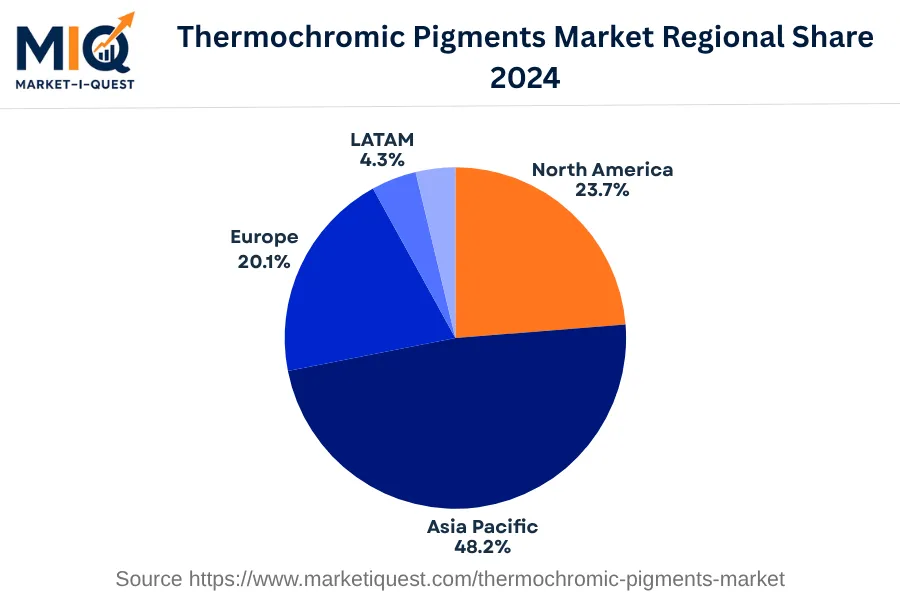
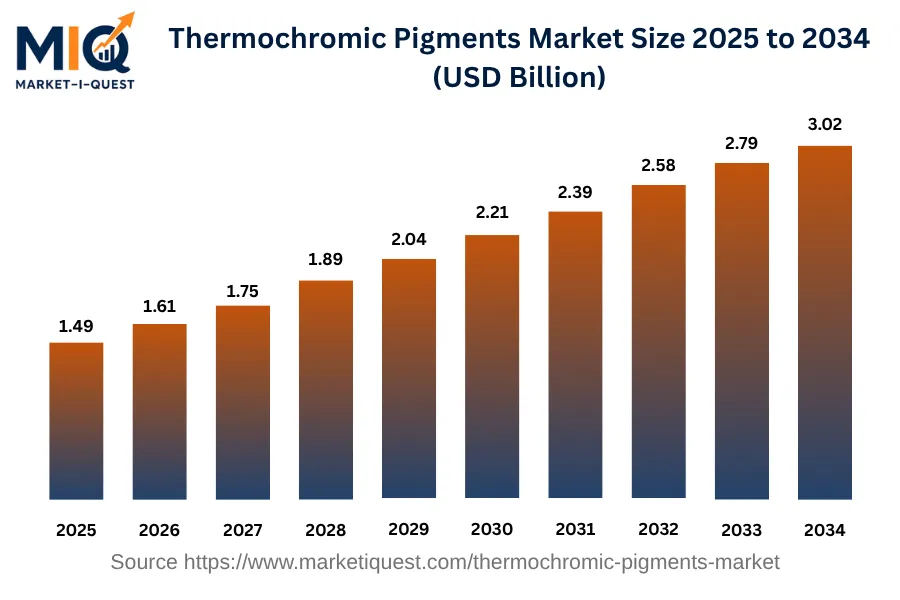
The Thermochromic Pigments Market valued at USD 1.49 billion in 2025 and is projected to reach USD 3.02 billion by 2034, growing at a CAGR of 8.15%. From 2025 to 2034, the market witnessed a steady and substantial increase in its size. This growth was primarily due to the rising demand and application of these pigments in various industries globally. Thermochromic pigments are increasingly used for their color-changing ability, under different temperatures, in products ranging from textiles, plastics to paints. This wide scope of application significantly fueled the rise in market size. In terms of regional share mix for the year 2024, Asia Pacific held the largest share of the market at 48.2%, followed by North America at 23.7% and Europe at 20.1%. Meanwhile, LATAM and MEA held smaller shares at 4.3% and 3.8% respectively.

Key Takeaways

  • By Type - Electrochromic led the Thermochromic Pigments Market accounting for a significant share in the base year.
  • By Formulation - Liquid held a leading position dominating the market in the last fiscal year.
  • By Application - Textiles surfaced as the top segment holding a notably large proportion in the previous year.
  • By End Use - Electronics was the fastest-growing sector indicating a strong expansion trend in the forecast period.
thermochromic-pigments-market market size

Key Driving Factors

Adoption of Thermochromic Pigments in Textile Industry

However, one of the major factor driving the thermochromic pigments market is their increasing use in the textile industry. Manufacturers of clothing and textiles are constantly seeking innovative ways to differentiate themselves, and the integration of thermochromic pigments into fabrics provides this innovation. Thermochromic pigments change color in response to temperature variations, giving an appealing aesthetic to clothing items, especially to sportswear and kids' clothing lines. This rising consumer interest leads to higher market demand for these pigments, influencing the product's market growth.

Thermochromic Pigments in Packaging Applications

Another principal factor driving the thermochromic pigments market is their expanding usage in packaging applications. The food and beverage industry, in particular, utilizes these heat-sensitive pigments as an indicator of the product's temperature. For instance, they could be used for indicating whether goods such as thermal-insulated coffee cups or chilled beverages are at the right temperature. Improving customer satisfaction and assures product quality and safety. The resulting increase in the use of thermochromic pigments in packaging applications considerably boosts market demand and growth.

Market Evolution by Timeline

2019-2023
In this period, the thermochromic pigments industry witnessed a moderate rise. The bulk of clients stayed in Asia-Pacific, driven by robust demand for color-changing materials in textiles and plastics, particularly from China and India. Suppliers shipped thermochromic pigments that turned color in response to heat, typically integrated into print inks or fabrics. However, processing these pigments, especially encapsulation, remained a key challenge due to the additional costs and technical equipment required. The market operated primarily under volatile pricing tendencies, largely due to the lack of raw materials such as the leuco dyes. Regulation then shifted toward strict guidelines regarding human exposure to these pigments.
2024
In 2024, a significant decline was witnessed due to the increased uncertainty surrounding the environmental implications of leuco dyes, a critical material in thermochromic pigments. This caused many European and North American buyers to reconsider their procurement models, approaching suppliers who practiced more sustainable pigment manufacturing. Supply-wise, trials were initiated for non-toxic thermochromic alternatives including spirolactones and spiropyrans. Commercially, there were attempts by sellers for providing longer-term contracts at locked-in rates. As a significant development, EU launched REACH regulations keen on controlling substance usage in pigment manufacturing, pushing the market towards reshaping its practices.
2025-2029
Between 2025 and 2029, the market might experience a revival. The major purchasers will likely be from sectors such as automotive and construction in countries such as the USA, Germany and Japan, are projected to rise by the growing usage of smart coatings and surfaces. Suppliers might begin shipping more eco-friendly alternatives to leuco dye-based pigments, following the improvement of spirolactone and spiropyran-based pigment technology. Integrations with new application areas such as security printing and anti-counterfeiting will likely be emerged. The commercial environment still might suffer from price instability due to fluctuations in the prices of alternative raw materials. The US EPA are expected to introduce regulations limiting Spiropyran usage in pigments, mandating rigorous toxicity testing, leading to an increasing focus on research and development.
2030-2034
The years 2030-2034 is expected to witness a steadying of the thermochromic pigments market. The demand primarily might come from the packaging industry, mainly in regions such as Europe, and North America. Companies advanced by offering thermochromic pigments integrated into smart packaging solutions, with higher encapsulation efficiency rates. Prices might incline towards stability as manufacturers might witness improving production cost efficiencies through better manufacturing processes. Partnerships with research organizations will likely become common for industry players, may facilitate advancement in safer and more efficient thermochromic materials. A noteworthy shift is projected to be the government's stringent regulations in major countries such as France and the UK, leading to the standard perspective of eco-friendly materials being the norm in the industry.

Future Market Outlook

Future Opportunities

As sustainability becomes paramount for consumers and businesses alike, companies such as HP and BASF are actively researching biodegradable thermochromic solutions to meet rising environmental expectations. The packaging sector shows potential, exemplified by Unilever, which has begun integrating thermochromic labels into its products to communicate freshness to consumers. Furthermore, the automotive industry, with manufacturers such as BMW announcing their use of color-changing coatings in 2022, is poised for growth in personalized vehicle aesthetics. The influential role of technology regulations established by organizations like the ASTM in 2023 is promoting safer and more effective pigment standards, which will likely pave the way for greater market trust and consumer adoption. Moreover, 3D printing technologies are evolving, with firms such as Stratasys developing methods that incorporate thermochromic pigments directly into the printing process, thereby enhancing versatility in design and functionality. In the textile industry, brands like Nike are increasingly experimenting with these materials to produce clothing lines that adapt to different temperatures, indicating a significant area for consumer engagement.

Segmentation Analysis

By Type

The market is divided into subsegments including Reversible, Irreversible, Photochromic, Thermochromic, and Electrochromic, of which Electrochromic accounted for the largest revenue share while Thermochromic is expected to grow at the fastest CAGR during the forecast period.

Largest Revenue Share

Electrochromic

Market Share Leader

Electrochromic type is leading the market revenue-wise due to its unique capabilities and wide adoption in diverse industries. Electrochromic products are favored by consumers for their ability to change color or transparency upon the application of an electrical signal, enhancing user interaction and experience. Given these advantages, industries such as automotive, construction, and consumer electronics have incorporated the technology into products including smart windows, mirrors, and display systems. High-income regions like North America, Europe, and Asia Pacific are the main drivers due to their leading role in technology adoption and development. Legislation encouraging energy efficiency has also played a part in this subsegment's growth, with Electrochromic smart windows being recognized as an effective solution for optimizing building energy consumption. In terms of purchasing criteria, the performance features and cost-saving benefits of Electrochromic products remain key determinants. There are very few viable alternatives to Electrochromic products, so switching costs can be high for many consumers.

Fastest CAGR

Thermochromic

Forecast Period Growth Leader

The Thermochromic subsegment is gaining traction rapidly and is expected to register the highest CAGR. The primary driver of growth for this subsegment is the burgeoning demand from various industries including textile, food and beverage, and healthcare due to the distinct properties of Thermochromic materials. These materials change their color with change in temperature, an attribute that's highly sought after for temperature-sensitive applications. Besides, continued investment and innovation in the materials technology sector are expected to be vital growth catalysts. Intense R&D activities in the area of smart materials and nanotechnology are paving the way for the development of advanced Thermochromic materials, thereby propelling demand. However, there are adoption barriers such as relatively high cost, risk of allergies or irritations in wearable applications, and need for a nuanced understanding of the technology for implementation. These could potentially slow down the pace of adoption.

By Formulation

The market is divided into subsegments that include powder, liquid, granule, paste, and emulsion formulations. The liquid formulation accounted for the largest revenue share while the powder formulation is expected to grow at the fastest CAGR during the forecast period.

Largest Revenue Share

Liquid

Market Share Leader

The liquid formulation accounted for the largest revenue share in 2024. This can be attributed to its wide utilization across diverse industries, ease of use, and convenience in handling. The liquid form is typically preferred in industrial settings due to its ease of dispersion, consistent performance, and overall versatility. It's highly popular in the food and beverage sector, pharmaceuticals, and the rapidly growing natural and organic personal care industry. This segment's revenue is further supported by robust demand from growing markets in Asia-Pacific and Latin America, where manufacturers are investing heavily in liquid formulation to cater to expanding consumer needs. Furthermore, regulatory shifts favoring safer and more eco-friendly products are driving demand for liquid formulations that can reduce energy consumption, minimize waste, and support sustainability goals.

Fastest CAGR

Powder

Forecast Period Growth Leader

The powder formulation, while not currently the dominant in terms of revenue, projects the fastest CAGR. Powder formulations offer portability, long shelf life, and require less storage space, which are attractive features for both end-users and manufacturers. Innovation in the packaging industry has also made it easier to transport and use powdered products without compromising on convenience or product integrity. Moreover, the rising demand for green and sustainable products, particularly in the food, personal care, and household products industries, has compelled manufacturers to lean towards powder formulations which often feature fewer chemicals and minimal water content. Yet, the full market potential of powder formulations is yet to be realized as adoption barriers such as consumer perception and unfamiliarity with the product form persist. These barriers are starting to lift gradually with increased awareness and availability of high-performing powder products.

By Application

The market is divided into subsegments including Textiles, Plastics, Inks, Coatings, and Consumer Products. In the base year 2024, Textiles accounted for the largest revenue share while the Plastics segment is projected to register the fastest CAGR during the forecast period.

Largest Revenue Share

Textiles

Market Share Leader

Textiles have accounted for the largest revenue share in our given market. This comes as no surprise given the widespread use of textiles in a variety of sectors ranging from apparel and home furnishing to industrial applications. The escalating demand for different kinds of fabrics, both natural and synthetic, in growing economies underpins this sizeable revenue share. Moreover, the trend towards functional and performance textiles has opened up new applications, further driving sales. Leading purchasers in this sector are dominated by manufacturers in the clothing, automotive and construction industries. The purchasing decisions are determined by the quality, performance features, and cost considerations, making the market a competitive one. The textiles segment benefits from well-established distribution channels allowing it easy access to its diverse customer base. However, any raw material supply disruptions or significant regulatory changes in regards to sustainability or international trade can pose challenges to the segment’s continued performance.

Fastest CAGR

Plastics

Forecast Period Growth Leader

Despite not having the largest revenue in 2024, the Plastics segment is expected to grow the fastest in the coming years. There are numerous factors driving this high CAGR. The expanding use of plastics in multiple industries including packaging, automotive, construction, and electronics is a critical growth driver. Technological advancements are bringing forth superior plastic materials with enhanced functionality and recyclability, triggering their higher adoption. Public-private partnerships aimed at recycling and waste management also catalyze the growth in the plastics sector. However, environmental regulations and public sentiment against single-use plastics are significant challenges to overcome. Much of the growth in the near future will depend on how effectively the industry can innovate and shift towards more sustainable practices, such as the use of bio-based and degradable plastics, while maintaining the cost and functionality benefits of traditional plastics.

By End Use

The market is divided into subsegments including Automotive, Packaging, Electronics, Home Decor, Fashion and Others. The Automotive subsegment accounted for the largest revenue share, while Electronics is expected to grow at the fastest CAGR during the forecast period.

Largest Revenue Share

Automotive

Market Share Leader

The Automotive subsegment leads the current market in revenue generated due to several driving factors. A key aspect triggering growth in automobile is the drastic transition from traditional vehicle systems to smart technologies. As auto manufacturers strive to enhance their competitive edge, they are leveraging advanced technologies to improve vehicle performance and passenger safety. This has in turn increased expenditure on technology-based components, subsequently boosting the overall revenue of the Automotive subsegment. Furthermore, the global regulatory environment is focusing on sustainable and eco-friendly solutions, encouraging the automobile manufacturers to invest in electric and hybrid vehicles. These EVs typically require advanced system components, thereby bolstering market growth. Meanwhile, rise in disposable income along with changing lifestyle in urban cities incentivizes larger consumer base for the automobile industry. This active consumer engagement is instrumental in revenue growth. In summary, factors such as advanced technologies, regulatory policies promoting sustainability and consumer lifestyle are driving the dominance of the Automotive subsegment in terms of revenue.

Fastest CAGR

Electronics

Forecast Period Growth Leader

The Electronics subsegment has the potential to register the fastest CAGR in the coming years, primarily fueled by numerous growth drivers. The ongoing trend of digitalization and the global shift towards smart and connected devices are effectively propelling the demand for electronic components. Additionally, innovative technologies like internet of things (IoT) and artificial intelligence (AI) have extended the capabilities of electronic devices, sparking increased adoption across industries and households. Further, the sector benefits from expanding e-commerce platforms and associated distribution channels which enhance consumer accessibility to electronic products, leading to heightened sales. However, challenges in the form of high upfront costs of advanced electronics and fluctuations in raw material prices could pose hurdles in the segment's rapid growth. Capital investment in manufacturing facilities, strong partnerships with supply chain entities and constant innovations are fundamental in overcoming these barriers and would drive the growth of this sector at an accelerated pace.

Competitive Analysis for Thermochromic Pigments Market

Key Market Players

Manufacturers / OEMs

OliKrom
France
LCR Hallcrest Ltd.
UK
Chromatic Technologies Inc
US

Key Suppliers & Raw Materials

SMAROL INDUSTRY CO., LTD.
China
Merck Performance Materials
Germany
New Color Chemical Co.
China

Distributors, Integrators & Channel Partners

NCC nano, Ltd.
Japan
Winsor & Newton
UK
Chameleon International, LLC
US

Porter’s Five Forces Analysis

This analysis evaluates the competitive intensity and attractiveness of the Thermochromic Pigments Market.

Supplier Bargaining Power

Medium

Limited suppliers control the prices due to high processing cost and proprietary techniques involved.

Buyer Bargaining Power

Low

High switching costs and OEM lock-ins limit the bargaining power of buyers.

Threat of Substitutes

Medium

Potential substitutes like photochromic pigments pose a moderate threat.

Threat of New Entrants

Low

High capital investments and technical know-how act as entry barriers for new entrants.

Competitive Rivalry

High

Intense competition due to limited number of participants offering similar products in the market.

Regional Analysis

Geographic market dynamics and growth opportunities across key regions

Global Market Outlook

thermochromic-pigments-market market regional share

North America

In 2024, the North American Thermochromic Pigments market experienced considerable growth. This burst of interest resulted from prevailing consumer inclination towards color versatile products, urging manufacturers across the automotive, apparel, and housing industries to adopt thermochromic pigments to maintain a market edge. Regulatory shifts towards eco-friendly pigment manufacturing in both the U.S. and Canada also heightened demand, reducing environmental concerns associated with traditional pigments. Meanwhile, significant investment into Tech startups in Mexico in developing advanced thermochromic technologies facilitated competition and boosted industry growth. The stable pricing and ready availability of raw materials ensured consistent supply, further propelling the market.

Trends in the year were majorly influenced by changing buyer behavior, with an escalating demand for customized and interactive packaging systems in the retail sector, heightened by the adoption of thermochromic inks. There was a notable shift in technology with widespread use of reversible thermochromic pigments, predominantly in healthcare for temperature monitoring bands. Channel dynamics experienced a shift with a surge in online sales attributed to the COVID-19 pandemic. Uber's partnership with Axon in creating thermochromic helmets also instigated a trend towards safety in transportation. As part of policy enforcement, the ASTM International standard for thermochromic materials, propagated their responsible and safer use, impacting the industry's reputation positively.

Asia Pacific

In 2024, the market for thermochromic pigments in Asia Pacific was dynamic and varied, dominated by several key players and influenced by varying market forces. Market drivers included an escalating demand for smart and interactive textiles in fashion and sportswear sectors, especially in economies like China, India, and South Korea, yielding a robust push to pigment producers. Regulatory initiatives in ASEAN markets endorsing environment-friendly products boosted the adoption of thermochromic pigments, enhancing their manufacturing and distribution. Technological strides in Japan and Australia led to improved pigment stability and color intensity, lifting the market higher still.

Trends observed were significant, with changes in consumer preferences playing crucial roles. Buyers veered towards products with thermal sensing capabilities, inspired by elevated consciousness about safety across industries, including manufacturing and retail. There was a notable shift toward online channels for commerce, stimulated by China's sprawling digital landscape, causing an uptick in the online purchase of thermochromic pigments. Partnerships, exemplified by the collaboration between Japanese pigment producers and Chinese textile manufacturers, resulted in innovative product development and market expansion. A rigorous enforcement of quality and safety standards across the region further shaped the market landscape. Overall, the thermochromic pigments market in Asia Pacific in 2024 was characterized by vigorous growth drivers and transformative trends.

Europe

In 2024, Europe's thermochromic pigments market exhibited growth driven by a myriad of factors and key market trends. Demand for these pigments escalated particularly in sectors like manufacturing and retail, influenced by consumers' growing attraction towards high-quality items with improved aesthetic attributes. Germany, housing several industry giants, spearheaded the market growth, followed closely by the United Kingdom and France. Among the key drivers, heightened investment in R&D, especially in countries like the UK and Germany, played a crucial role in increasing the adoption of advanced manufacturing techniques involving thermochromic pigments. This was further supplemented by supportive government regulations across the region pertaining to the use of environmentally-friendly pigments in industries.

The market also witnessed a change in supplier dynamics, with pricing in Spain, Italy, and Central & Eastern Europe experiencing fluctuations due to regional economic conditions. Though creating temporary supply issues, it eventually increased market competitiveness. On the trends front, a paradigm shift towards online sales channels was witnessed, primarily due to their cost-effective nature and wider customer reach. Similarly, enterprises entered various partnerships and M&A activities to strengthen their market foothold, evident from the strong market presence of companies in countries like France and Benelux. Enforcement of stringent EU standards also greatly influenced the market, ensuring the quality and safety of thermochromic pigments and indirectly boosting their demand.

Latin America

The Thermochromic Pigments market in Latin America witnessed noticeable activities in 2024. This predominantly pertains to sectors involved with textiles, plastics, inks, and paints in Brazil, Mexico, Argentina, Colombia, Chile, and Peru. An increase in consumer demand for novelty products, aligned with comprehensive safety regulations, stimulated the market growth. Furthermore, investments in new production techniques promoting efficient pigment use fueled the market enhancement. Additionally, technological innovation in coating materials sparked the adoption of thermochromic pigments by manufacturers.

Trends shaping this market included an uptake in the use of thermochromic pigments in smart textiles by apparel manufacturers. A shift towards more sustainable alternatives triggered manufacturers to improvise with thermochromic pigments in creating environmentally friendly products. Partnership and M&A activities dominated among major players to consolidate their presence and expand product offerings across the region, particularly in Brazil and Mexico. An enforcement of stringent eco-friendly policies by governments heightened the demand for these pigments in paints and coatings applications. Specifically, sectors such as automotive and architecture increased their utilization of thermochromic pigments in 2024. Additionally, retail industries harnessed these pigments to add value to their customer offerings, capturing consumer interest with products that alter their appearance with temperature changes. In essence, the combination of market drivers and changing trends marked 2024 as a critical year for the thermochromic pigments sector in Latin America.

Middle East & Africa

In 2024, the Thermochromic Pigments Market in the Middle East and Africa shows robust growth, marked by increased demand and several strategic advances. New regulations promoting environmentally friendly products and the investment in thermal technology, particularly in manufacturing and retail sectors, fuels the market. Countries such as Saudi Arabia and UAE display exceptional growth in the adoption of thermochromic pigments in color-changing inks used in packaging and advertising.

Trends wise, the incorporation of thermochromic pigments in textiles stands out, with Israel and Kenya being leaders in this innovation. Customer behavior reflects a preference for products enabled with thermochromic pigments, due to their uniqueness and the visually appealing element they add. Greater policy enforcement for safety standards, particularly in Nigeria and Egypt, impels the adoption of thermochromic pigments in safety equipment and indicators. Considerable strides are witnessed in partnerships and M&A; prominent is South Africa's collaboration with international firms to boost local production of thermochromic pigments. The region's oil and gas sector also emerges as a significant customer, specifically in Qatar, with thermochromic pigments being used in leak detection and pipeline monitoring. Through these drivers and trends, the Thermochromic Pigments Market in the Middle East and Africa gains a substantial foothold in 2024.

Recent Industry Developments

Latest market innovations, product launches, and strategic initiatives

January 2026

New Color Chemical launched Thermochromic Pigment GWFR-01, a reversible microencapsulated pigment that transitions from colored to colorless when heated. Activation temperatures from -15°C to 70°C are available, with heat resistance up to 280°C. The pigment is non-toxic, chemically stable, and suitable for paints, printing inks, plastics, rubber, and glass applications.

July 2025

ThermoTech Partners announced its continued global expansion under Founder and CEO Devon Brown, with a valuation of approximately $18.5 million. The company operates a dual-engine business model focused on intellectual property licensing and proprietary product manufacturing across medical, consumer, and promotional sectors.

Frequently Asked Questions