
Sustainable Tourism Market Snapshot

Key Players

  • Intrepid Travel (Australia)
  • G Adventures (Canada)
  • Riksja Travel (Netherlands)
  • Responsible Travel (United Kingdom)
  • Adventure Alternative (United Kingdom)
  • Splore (United States)
  • Ecocompanion (Australia)
  • Sam Veasna Center (Cambodia)
  • Tripbods (India)
  • Wise Steps Travel (Indonesia)

Market Size

Base Year 2024
$ 1179.54 Bn
CAGR
16.6%
Forecast 2034
$ 5469.57 Bn

Market Segments

By Type
Nature & Wildlife, Cultural, Rural
By Consumer Type
Corporate Travelers, Family Travelers, Group Travelers, Individual Travelers
By Booking Channel
In Person Booking, Online Booking, Phone Booking
By Destination
Domestic, International

Market Dynamics

Drivers
  • Rising eco-consciousness
  • Governmental sustainability initiatives
Restraints
  • High cost of eco-tourism
  • Limited awareness amongst tourists
Opportunities
  • Increasing environmental awareness
  • Emergence of eco-friendly accommodations

Market Size

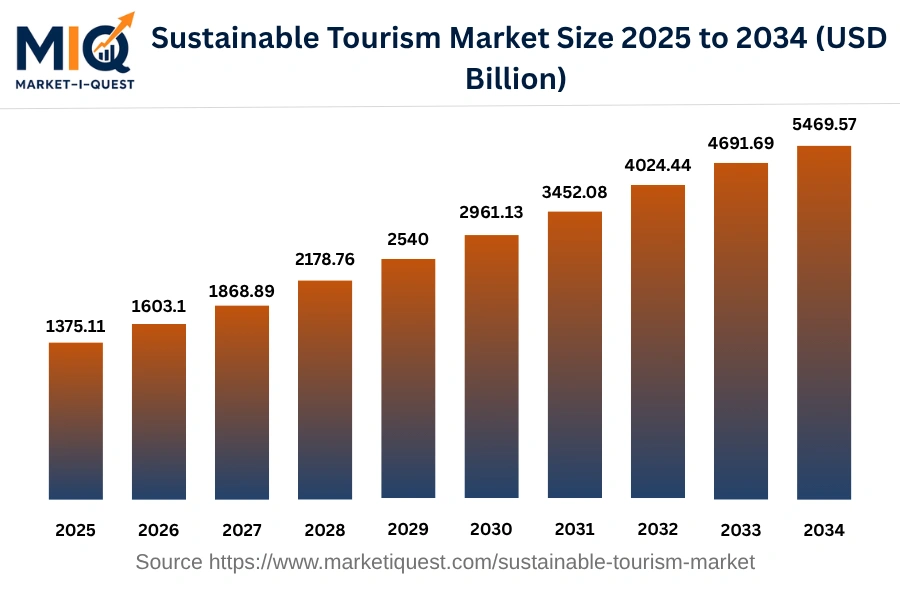
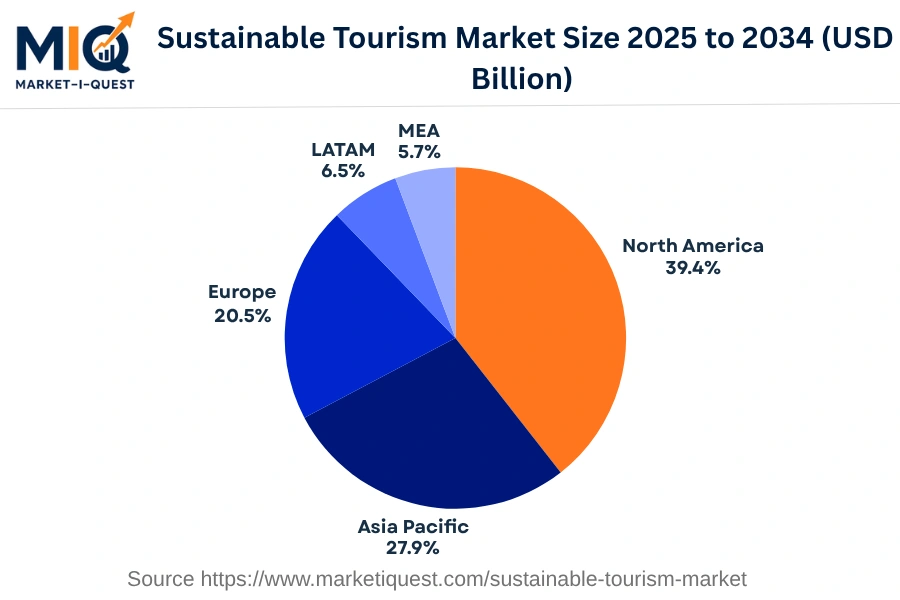
The Sustainable Tourism Market reached at USD 1,179 billion in 2024 increased to USD 1,375 billion in 2025 and is projected to reach USD 5,469 billion by 2034 growing at a CAGR of 16.6%. The market started growing trajectory in 2025 and remained to expand over the following years. Factors contributing to this growth are likely increase in awareness of environmental conservation among travellers and residents, as well as the adoption of several sustainable practices in the tourism industry. In terms of regional market share in 2024, North America held the largest portion at 39.4%, followed by Asia Pacific at 27.9%, and Europe at 20.5%. Continued following the Latin America and Middle East and Africa regions held shares of 6.5% and 5.7% respectively.

Key Takeaways

  • By Type - Nature & Wildlife led the sector capturing the significant attention of travelers globally.
  • By Consumer Type - Corporate Travelers held the major share showcasing their increasing interest in sustainable travel.
  • By Booking Channel - Online Booking expanded rapidly with the rise in internet and smartphone access worldwide.
  • By Destination - Domestic destinations held prominence reflecting tourists' growing preference for local and short-distance travel.
sustainable-tourism-market market size

Key Driving Factors

Implementation of Environmental Regulations

Various worldwide destinations are implementing stricter environmental regulations to reduce tourism based pollution and preservation of natural resources. Countries like Australia and Costa Rica have strict certified environmental programs where tour operators to act in accordance with certain environmental friendly practices. Also popular tourist key areas such as Bhutan and Palau, have introduced visitor caps and assuring tourist mechanisms for protection of ecosystems. This regulatory environment has pushed the tourism based businesses for shifting towards sustainable models and promoting the sustainable tourism market growth. Companies that follow these regulations attract environmentally aware customers.
Emergence of the Conscious Traveler

The priority of modern tourist is increased towards environment friendly, local culture preservation and ethical travel practices over traditional tourism models. A rapidly increase in segment of environmentally aware tourist seeking for sustainable travel that offer environmental conservation and growing community. Consumers prefer destinations with environmentally responsible for participating in environment friendly activities and prioritizing the green stay options. The shift in behavior of traveler has pushed businesses and destination managements for adoption of sustainable activities as a result the expansion is driven towards sustainable tourism market demand. Strategic thinking of businesses are responding to these changing interests of customer by developing sustainable tourism products and services.

Market Evolution by Timeline

2019-2023
Buyers are including environmental awareness within tourists and environmental friendly travel agencies from regions like Europe and North America. New features emerging in sustainable tourism included solar-based accommodations in Spain and waste reduction programs in France. Various restrictions including usage of plastic emerged in various seaside resorts also EU made contribution in banning disposable plastic products in 2021. Package holidays became well known in encouragement of sustainable tourism. Pricing remained premium and cost reflected in sustainable practices and attracting environmental aware tourists.
2024
In Asia majorly countries like China and India showed increase in need for rising middle-class awareness towards sustainability. Partnerships between public and private firms were commonly formed for promoting sustainable tourism. Various experimental projects including Tesloop's emission-free travel experienced a surge in California. Adaptive reuse of buildings for accommodations emerged as a trend. A major barrier was the lack of widespread compatible network technology for remote tourism spots resulting limitation in real-time sustainable management efforts. Affordability became an issue to integrate discounts for low traffic eco-travel.
2025-2029
The interest for sustainable tourism shifted towards experience based travelers. In regions like Africa and North America several developments were seen offering traditional tribal tourism experiences with minimum impact on environment. The UNWTO's Sustainability Guidelines helped in improving features and expectations. A slight decrease in premium pricing was recorded due to increasing competition. Solar-based electric charging stations at key spots was a prominent innovation still was challenging due to the lack of skilled manpower.
2030-2034
During the period interest for sustainable tourism increased among solo travelers and digital nomads exploring interactive and sustainable travel experiences with modern destinations emerging as key attractions. The industry will also observe wider adoption of augmented reality and virtual reality technologies for environment awareness and environmental focused tourism experiences. The lack in global standard pricing system of carbon will remain a barrier to the sustainable tourism market growth and consistent sustainability efforts. Following carbon credits integration increased into commercial tourism transactions which enabled travelers to control carbon emissions with their travel activities. Meanwhile heritage tourism increased popularity although concerns such as physical damage to historical sites. The ethical practices towards animals also came to a major focus within sustainable tourism regulations worldwide, indicating rise in consumer awareness and stronger regulatory assessment related to responsible tourism practices.

Future Market Outlook

Future Opportunities

The sustainable tourism market share is projected to grow due to increasing awareness and encouraging actions from various industry stakeholders. In 2023 the policy for Green Deal by European Union for reduction of environmental impact on tourism including various stricter standards for sustainable operators. Including countries like New Zealand have also set sustainable goals to modernize tourism sectors after pandemic which they specified in the Ministry of Business Innovation and Employment's strategy for tourism. These programs create opportunities for companies offering neutralized carbon solutions such as the partnership between Travelife and multiple travel operators established in 2022 for promoting responsible travel behaviors. While the community-based tourism is gaining demand in regions like Southeast Asia where local operators are engaging visitors in sustainable practices that benefit communities too. Certification programs including the Global Sustainable Tourism Council standards are gaining acceptance various businesses are adopting sustainability in operations serving to the rising number in awareness within travelers. The development towards environment friendly travel packages and engagement indicates as global regulations strengthens with shifting consumer preferences the opportunities will rise for those willing to adapt.

Segmentation Analysis

The sustainable tourism market is segmented by Type (Nature & Wildlife, Cultural, Rural), by Consumer Type (Corporate Travelers, Family Travelers, Group Travelers, Individual Travelers), by Booking Channel (In Person Booking, Online Booking, Phone Booking), and by Destination (Domestic, International).

By Type

The market segment, categorized by type, includes subsegments such as Nature & Wildlife, Cultural, and Rural. The Nature & Wildlife subsegment accounted for the largest revenue share, while the Rural category is projected to grow at the fastest CAGR during the forecast period.

Largest Revenue Share

Nature & Wildlife

Market Share Leader

The Nature & Wildlife subsegment presents as the largest revenue in the segment. Due to the growing public interest in external activities and policies for preservation due to the increasing popularity of eco-tourism. The customer interest towards natural environments and wildlife has increased demand for this type of tourism. Regions with diverse ecosystems and rich biodiversity like Canada, Brazil, Australia and Africa are the primary drivers for the segment. With reliable with regulatory policies for conservation of wildlife and natural ecosystem have boosted nature and wildlife tourism. Standards for the purchasing these tours often includes sustainability measures and ethical standards that companies comply and which shows the high cost of opportunity. Switching costs are comparatively high in this segment considering the most tour operators work to form repeat customer bases with quality service and unique experiences. The primary sales channels include online platforms and travel agencies serve to a global customer base aiming for adventure and exploration.

Fastest CAGR

Rural

Forecast Period Growth Leader

The Rural subsegment is projected to grow at rapid pace. The drivers for advancement of this subsegment are the rising trend of rural regions, farm visits and village tourism. Times of urban exhaustion drives the demand for country-side experiences. Barriers such as availability issues and lack of advanced facilities in rural areas might limit adoption however once resolved these aspects can play a significant role as major drivers. The rising utilization of technology including digital platforms for booking and promotions government policies promoting rural development and increasing investments within infrastructure will boost the development of this segment. Strategic partnerships between tour operators and local communities for offering authentic experiences are also supporting in the advancement. Various risks such as changing weather conditions and unstable economic within rural areas may affect the segment. However the enduring appeal of rural simplicity and being embraced in nature attracts an increasing number of tourists to explore unexplored rural landscapes.

By Consumer Type

The consumer type market segment can be divided into four subsegments: Corporate Travelers, Family Travelers, Group Travelers, and Individual Travelers. In the base year 2024, Corporate Travelers occupy the largest share in revenue while Individual Travelers is projected to exhibit the highest CAGR.

Largest Revenue Share

Corporate Travelers

Market Share Leader

Corporate Travelers represents the largest subsegment of the market in 2024. This strong performance may be related in increasing globalization of businesses leading to a higher demand for corporate travel solutions. This consumer base primarily consists of executives, professionals and employees who travel regularly for work-related various purposes including meetings, conferences and training sessions. With companies have been willing to assign a considerable budget for corporate travel to connect with global customer base and enhance their operational range which will drive the profitability of the segment. Including various developed regions like North America and Europe contribute significantly to these revenues due to a higher concentration of multinational firms and strict business environments. Rapid development of business travel agencies providing personalized solutions for corporate customers continues to fuels the sustainable tourism market trend.

Fastest CAGR

Individual Travelers

Forecast Period Growth Leader

The Individual Travelers subsegment is projected to grow at the fastest growing rate within this segment. This can be related to various factors firstly changing the demographic trends such as increasing temporary income among the urban population are contributing to increased number of individuals prioritizing solo travel experiences for various purposes such as personal development and self-discovery. The continuous rise of digital platforms with the availability and affordability for encouraging individuals to initiate travelling independently. However this progress can be limit by temporary risks such as concerns regarding personal safety and insecurity with booking accommodations or transportations. Partnerships between travel service providers and security agencies can act as a driver to resolve such anxieties and boost the growth of this subsegment. Influential tech advancements include AI and data analytics, providing the personalized experience for travelers which accelerates the development of this subsegment.

By Booking Channel

The market is divided into subsegments including In Person Booking, Online Booking, and Phone Booking. Online Booking accounted for the largest revenue share while Phone Booking is expected to grow at the fastest CAGR during the forecast period.

Largest Revenue Share

Online Booking

Market Share Leader

Online Booking represents the largest revenue driver subsegment for this market in 2024. Its dominance is driven by increased internet adoption globally and a growing preference for digital transactions typically found in younger group of consumers. Further increased number of people are now comfortable making large purchases on the internet. Online Booking also often offer a efficient and convenient experience for consumers whether for casual or business purposes. It enables immediate booking confirmation without any manual procedures, resulting in reduced waiting periods, instant updates and a quicker service. With consumers base having a broader view on availability options with the ability to compare prices and book whenever and wherever they want driving sustainable tourism market demand. The high rate of smartphone usage combined with high-speed internet connectivity is another driver behind the expansion of the Online Booking trend.

Fastest CAGR

Phone Booking

Forecast Period Growth Leader

The Phone Booking subsegment is projected to grow at the fastest growing rate within this segment. This growth is projected with phone-based interactions providing a mutual trust and personalization differentiating it from other booking methods. The drivers include customers with limited internet access or less digitally skilled people and prefer a traditional and verbal confirmation with the bookings. It’s also a preferred method for older customer segment or those who deal with complex booking procedures such as arrangements for large group or specialized travel needs. Adoption barriers may include lack of immediate visual information or difficulty in comparing prices and services instantly.

By Destination

The market is divided into subsegments including Domestic and International. In the base year 2024, the Domestic subsegment accounted for the largest revenue share while the International subsegment is expected to grow at the fastest CAGR during the forecast period.

Largest Revenue Share

Domestic

Market Share Leader

Domestic segment represents the largest subsegment of the market in 2024. Firstly the segment dominated due to purchasing power and customer loyalty acts as the key contributors of this subsegment. Local customers often favor home-grown products due to the familiarity with the brand, subscription to domestic regulations and standards and overall considered as reliable. Including the purchasing criteria frequently prioritize domestic goods due to lower costs and faster delivery times which are critical for business operations. Regionally the Domestic subsegment is presently more mature and widespread with strict infrastructure and supply chains considerably reducing both fixed and variable costs. Regulatory benefits are also crucial in favoring domestic markets with the government often providing subsidies for promoting local businesses to boost economic development.

Fastest CAGR

International

Forecast Period Growth Leader

The International subsegment is projected to grow at the fastest growing rate within this segment. The growth driver for the International subsegment is the expanding globalized economy combined with growing sustainable tourism market opportunities. Advanced technology particularly in communication and logistics has made International business considerably more manageable and more profitable to conduct. Rising investment in foreign markets along with strategic business partnerships facilitate the expansion and rapid growth of international markets. The advancement in international markets also comes with certain risks including changes in exchange rates, political instabilities and differences in local regulations or international trade policies.

Competitive Analysis

Key Market Players

The sustainable tourism industry is competitive, with a mix of large established companies and smaller regional players. Most companies focus on improving their products/services, keeping prices attractive, and strengthening relationships with key customers. They also use partnerships, acquisitions, and new launches to expand their presence in existing and new markets. Overall, players compete on quality, reliability, and value, and competition is expected to remain strong over the forecast period.

Core Producers

Intrepid Travel
Australia
Nat Hab
US
G Adventures
Canada

Key Suppliers & Raw Materials

Biohotels
Germany
Fair Trade Tourism
South Africa
Natura
Brazil

Distributors, Integrators & Channel Partners

Responsible Travel
UK
Wilderness Travel
US
Adventure Alternative
UK

Porter’s Five Forces Analysis

This analysis presents the market competitiveness and profitability of the Sustainable Tourism Market.

Supplier Bargaining Power

Medium

Power is moderate due to the variety of 'green' service and product providers with unique offerings.

Buyer Bargaining Power

High

Travelers have high power as they can choose from an array of different sustainable travel options.

Threat of Substitutes

Low

Low threat because of the growing recognition and importance for sustainable traveling.

Threat of New Entrants

Medium

The market has medium entry barriers due to the required certifications and regulation adherence.

Competitive Rivalry

High

High competitive rivalry due to the increasing number of travel agencies promoting sustainable tourism.

Regional Analysis

Geographic market dynamics and growth opportunities across key regions

Global Market Outlook

sustainable-tourism-market market regional share

North America

The North America sustainable tourism market analysis shows a significant development in 2024, key drivers and trends across various regions such as United States, Mexico, and Canada. Major driving factors included are such as consumer demand for environmental awareness in travel options boosted by government regulations for promoting various sustainable practices. Significant investments in environment friendly technology boosted the Sustainable Tourism market expansion. The adoption of digital platforms for reducing contact during check-ins and other interactions modernized as the face of sustainable hospitality.

Continued trends showed a shift towards the behaviour of consumer with travelers increasingly prioritizing destinations and services related with green practices. The adoption of technology defined this trend as businesses utilizing digital platforms for enhancing the consumer experience with requirement of sustainable operations. Various mergers and acquisitions indicated a strategic approach towards integration of sharing sustainable resource with creating new standard within the sector. Authorities plays a crucial role in implementation of environmental policies demanding standards for driving the adoption of sustainable practices across sectors.

Enterprise consumers, government and retail sectors predominantly influenced and shaped these developments. Enterprise consumers increased sustainability standards for selection of service providers for presenting new dynamics. Meanwhile the retail sector saw increased demand for products prepared by recycled or sustainable materials inspiring an environmentally aware shift in product. The 2024 North American sustainable tourism market analysis highlighted shifting trends and reflecting a profound social commitment to environmental conservation.

Asia Pacific

The Sustainable Tourism Market demand in Asia Pacific presents a significant development including various drivers and trends. Growing demand was driven by rising environmental awareness among tourists from countries such as China and India. Initiatives such as the ‘Dekho Apna Desh’ campaign played an important role in promoting sustainable domestic tourism in India. Virtual Reality and similar technologies became more widely used in Japan and South Korea to support sustainable tourism experiences.

Trends are affected by changing buyer behaviour increasing the preference towards rural and cultural tourism rather than high volume tourism mostly in ASEAN markets and Australia. There was an increase in slow tourism where tourists focused deeply in local experiences. For the information exchange and booking digital platform were preferred platform were promoted by emerging partnerships within tech sector between key tourism networks and local governments. The adoption of ‘Green Destination Standards’ increased significantly in China, prioritizing sustainability in tourism offering.

The market in 2024 was largely influenced by tourists and travel agencies with government increasingly promoting sustainable tourism programs. The Asia Pacific Sustainable Tourism Market expansion promoted due to increasing environmental awareness among tourists, government support and technology innovation.

Europe

The European Sustainable Tourism Market saw a rise in interest supported by various drivers. The long-term environmental crisis boosted governments and businesses for promoting environmental friendly tourism preferences such as efficient transportation, reduction of energy production and environment friendly lodging. Responsible travel regulations, mainly in major European markets like Germany, UK and France further boosted the growth of sector. Increasing investments in sustainable tourism majorly in Italy and Spain encouraged the adoption of innovation and technology. Increased awareness among consumer about environmental issues combined with improved influencing factors for supply encouraged sustainable practices.

Alongwith change in consumption patterns increased the growth of industry. Tourists shifted towards environmental, social and governance friendly lodging and transportation options. The technological advancements including digital booking platforms promoting green hotels experienced a strong growth. Governments, stakeholders, and sustainable tourism startups formed partnerships across the Nordics and Benelux countries. In Central and Eastern Europe policies for sustainability standards began influencing consumer choices.

Sustainable tourism market growth was promoted by initiatives adopted by government, retail and manufacturing sectors. Government and businesses focused on sustainability policies and products. Increased awareness in sustainability and environmental conservation contributed in the growth of sustainable tourism market opportunities in Europe.

Latin America

In 2024, the sustainable tourism market is growing due to preservation of natural and cultural resources. The main driving factors include increasing interest in eco-friendly travel experiences, governmental regulations to promote conservations, and increasing investments in sustainable infrastructure. These can be mostly seen in countries like Brazil, Mexico, and Argentina. For instance, Mexico has strict regulations for ecotourism whereas Brazil invests in renewable energy technologies.

Simultaneously, customer behaviour is changing, focusing more on authenticity and cultural immersion in tourism. This has led to rise of community-based tourism enterprises in Peru, Columbia, and Chile. Moreover, technological advancements including travel apps and platforms offer better planning options for the tourists. There are various partnerships and M&A activities to promote sustainable tourism. For instance, Argentina's partnership with international conservation organization to preserve its natural resources. Additionally, government regulations and practices enforce sustainable tourism.

This trend is particularly benefiting the retail industry as the increasing interest by the eco-conscious tourists for the sustainable and local products. Enterprises are using this trend by contributing eco-friendly services and promoting local cultures with indicating the growing importance of sustainability in the tourism sector in Latin America.

Middle East & Africa

In 2024, the sustainable tourism market in the Middle East and Africa saw significant improvement. Increasing awareness among travelers combined with initiatives from the public sector increased sustainable tourism practices. Governments in Saudi Arabia and United Arab Emirates introduced eco-friendly changes within hospitality sector leading to investments for green infrastructure. Qatar and Egypt organized technology adoption with eco-friendly mobile applications and digital platforms for supporting sustainable tourism.

Increasing requirement for genuine local experiences are driving the shift in buyer behavior. Travelers targeted eco-friendly and engaging adventures particularly in regions such as South Africa, Nigeria, and Kenya with impact on services required for local tourism providers. Companies investments in digital services to respond the growing interest. Recent partnerships and mergers between hotel chains in Israel shows a growing focus to sustainability. Both governments of South Africa and Nigeria implemented policies to drive sustainable practices within tourism sectors such as deployment of renewable energy solutions within tourism establishments.

Customer concern for environment with accelerated policy enforcements, suppliers across various sectors from hospitality to transportation adapted these shifts by changing their operations for ensuring sustainability and compatible environment. This shifting market trends increased the adoption of renewable energy solutions, management for processed waste and energy-efficient transport systems changing the landscape of tourism industry landscape across Middle East and Africa in 2024.

Recent Industry Developments

Latest market innovations, product launches, and strategic initiatives

April 2026

Ecotourism Australia unveiled the framework and programming for the Global Sustainable Tourism Summit 2026. The initiative focuses on addressing the green skills gap in the hospitality sector, preparing operators for increasing global sustainability regulations, and expanding First Nations tourism through equitable community partnerships.

June 2025

Lufthansa Group and Airbus entered a strategic corporate partnership to drastically decarbonize business travel. Under this initiative, all domestic business flights taken by Airbus employees within Germany are now powered entirely by Sustainable Aviation Fuel (SAF), setting a major precedent for corporate travel supply chains.

April 2025

Booking.com officially expanded and overhauled its verified sustainability labeling system across its global platform. The development shifts priority to properties that have achieved rigorous, third-party environmental certifications (such as EarthCheck or Green Key), making it significantly easier for eco-conscious travelers to find and book genuinely sustainable accommodations while cracking down on "greenwashing."