Specialty Silica Market Snapshot

Key Players

  • Evonik Industries AG (Germany)
  • PPG Industries Inc. (United States)
  • W.R. Grace & Co. (United States)
  • Solvay S.A. (Belgium)
  • Huber Engineered Materials (United States)
  • AkzoNobel N.V. (Netherlands)
  • Cabot Corporation (United States)
  • Madhu Silica Pvt. Ltd. (India)
  • Tosoh Silica Corporation (Japan)
  • Qingdao Makall Group Inc. (China)

Market Size

Base Year 2024
$8.85 Bn
CAGR
6.75%
Forecast 2034
$17.01 Bn

Market Segments

By Type
  • Fumed Silica
  • Precipitated Silica
  • Colloidal Silica
  • Silica Gel
By Functionality
  • Thickening Agent
  • Reinforcement Agent
  • Anti-Caking Agent
  • Matting Agent
By Application
  • Rubber
  • Plastics
  • Coatings
  • Food Additives
  • Health Care
  • Others

Market Dynamics

Drivers
  • Increasing product demand
  • Rising industrial applications
Restraints
  • High production costs
  • Stringent environmental regulations
Opportunities
  • Rising demand in green tires
  • Technological advancements in silica production

Market Size

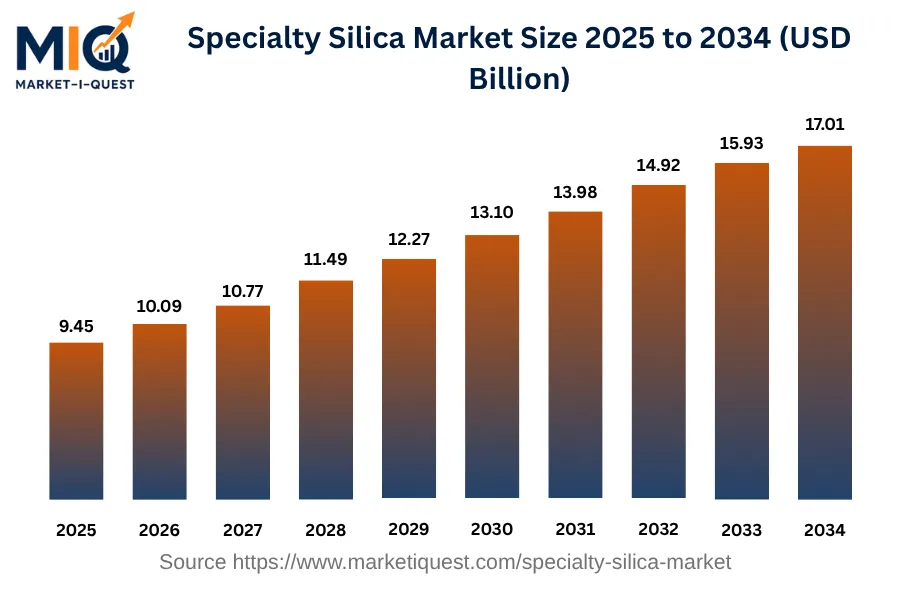
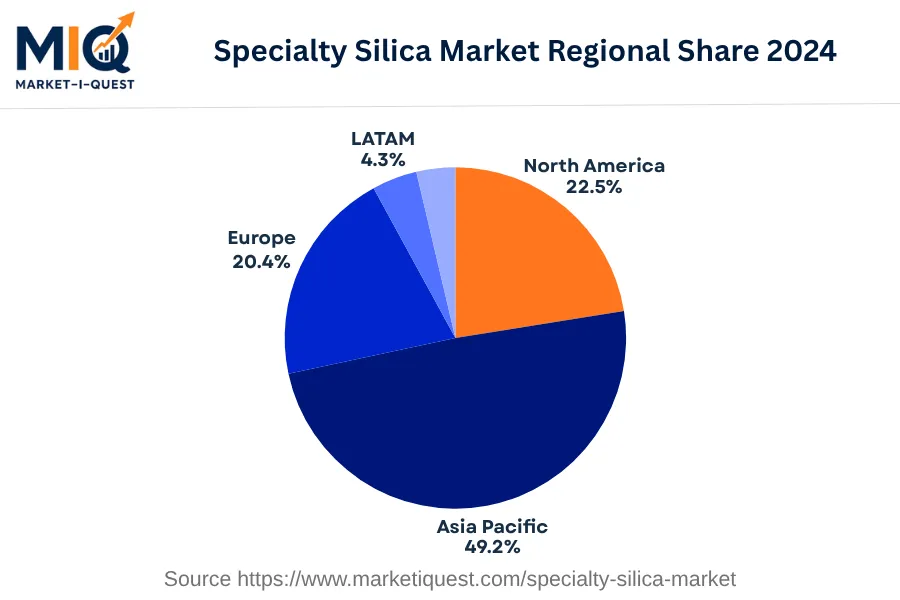
The Specialty Silica Market size in 2025 is projected to be $9.45 billion, up from $8.85 billion in 2024. By 2034, the market value is expected to grow to $17.01 billion, marking a compound annual growth rate (CAGR) of 6.75% over the span of nine years, from 2025 to 2034. This upward trajectory in market value is uniformly spread across the given period, indicating steady growth. On a regional basis in 2024, the Specialty Silica Market's largest share was seen in the Asia Pacific with 49.2%, trailed by North America at 22.5% and Europe at 20.4%. The remaining shares are distributed among LATAM and MEA regions with 4.3% and 3.7% respectively.

Key Takeaways

  • By Type - Precipitated Silica led the Specialty Silica Market accounting for a substantial share in 2024.
  • By Functionality - Anti-Caking Agent held a notable position in 2024 leading the Specialty Silica Market.
  • By Application - Plastics was the fastest growing expanding at an impressive rate in the forecast period from 2025 to 2034.
specialty-silica-market market size

Key Driving Factors

Implementation of Stricter Environmental Regulations

One of the key drivers for the specialty silica market lies in the implementation of stricter environmental regulations worldwide. Particularly, policies stemming from the Paris Agreement on climate change are driving industries towards more eco-friendly materials. Specialty silica is deployed as a substitute for several industrial products that generate more carbon emissions, accounting for a significant increase in market demand. For example, tire manufacturers are gradually shifting from traditional carbon black to highly dispersible silica (HDS), which enhances fuel efficiency and reduces carbon footprints. Not to mention, tighter regulations on silica dust exposure by bodies like the Occupational Safety and Health Administration (OSHA) in the United States have also prompted industries to find safer alternatives, boosting the specialty silica market.
Increased Adoption in Cosmetic and Personal Care Industry

Another critical driving factor for the specialty silica market is its rising adoption in the cosmetic and personal care industry. The ability of specialty silica to serve various purposes from thickening, mild abrasiveness, to its anti-caking features have made it a cherished ingredient in this industry. Particularly, in the toothpaste production sector, specialty silica is utilized due to its abrasiveness which effectively cleans and polishes teeth. It is also increasingly used in skincare products due to its oil-absorbing and texture-improving properties. The growing consumer focus on wellness and beauty, coupled with the increasing spending capacity, is fuelling the demand for personal care items and, consequently, specialty silica.

Market Evolution by Timeline

2019-2023
Between 2019 and 2023, higher demand for Specialty Silica was observed, especially from the Asia-Pacific region, largely driven by its utilization in green tires, personal care products, paints & coatings, and electronics. With major producers being Solvay S.A., Evonik Industries AG, and Cabot Corporation, supply was mostly steady. However, complexities related to refined production methods were the major barriers. Favorable regulations such as the EU's REACH guidelines promoted the use of eco-friendly silica, and standard contracts with fixed-priced models were the norm. Limited availability of raw materials posed potential risks, but companies countered this by establishing robust supply chain practices and securing long-term contracts.
2024
In 2024, the demand surge for Specialty Silica was prevalent from North America, largely by industries such as cosmetics & personal care, agrochemicals, and automobile, particularly for its application in tires. Key suppliers were Wacker Chemie AG, AGC Chemicals, and PPG Industries, but integration into advanced manufacturing remained a challenge. The presence of regulations from EPA & FDA, supporting safe usage further encouraged the market, and partnerships with distributors underpinned the commercial model. Though energy costs posed a risk, producing companies sought alternative renewable energy solutions.
2025-2029
From 2025 to 2029, demand for Specialty Silica soared in Europe and majorly came from industries such as pharmaceuticals and electronics, where silica is used for advanced drug delivery systems and electronic components respectively. Suppliers like Imerys, Tokuyama Corp, and Huber Engineered Materials made key advancements in production technologies, although high investment cost was a limitation. Implementation of stringent EU regulations on industrial emissions favored the use of specialty silica as they have lower emission rates. Business deals involving strategic alliances formed a significant part of commercial transactions. High production cost was a risk that warranted advanced and economical production methods.
2030-2034
During the 2030-2034 time period, Industries like food & beverages and paints & coatings in regions of the Middle East and Africa emerged as major customers for Specialty Silica. Growth in supply was noted with companies such as OCI Company Ltd., Grace W.R. Co., and Akzo Nobel N.V. in the lead. However, meeting customized product requirements remained a challenge. Policy reinforcement, especially for food safety and environmental protection, incentivized silica usage. Predominantly, long-term contracts with flexible pricing models were observed. Again, securing raw material availability was a risk, partial mitigation of which came from exploration of synthetic silica sources.

Future Market Outlook

Future Opportunities

The current landscape of the specialty silica market presents numerous potential growth avenues linked closely to ongoing technological innovations and regulatory frameworks. As seen with the recent initiatives by the American Chemical Society in 2023 to promote green chemistry, manufacturers are increasingly pivoting toward eco-friendly silica production methods. This movement is opening up trade opportunities for companies like Wacker Chemie AG, which are now focusing on sustainable production processes and low-impact materials. Furthermore, the electric vehicle sector is expanding rapidly; for instance, in June 2023, Tesla incorporated specialized silica into its battery technology to improve performance and reduce weight. With global governments emphasizing electric mobility, silica producers stand to benefit from partnerships that align with these eco-conscious trends. Additionally, as the construction sector increasingly adopts high-performance materials, companies like PPG Industries are prioritizing silica's functional properties in coatings for energy-efficient buildings, echoing a worldwide demand for sustainable infrastructure. Regulatory standards, such as the ISO 14001 for environmental management, increasingly guide manufacturing processes, pushing firms to innovate. Finally, the rising demand for specialty silica in pharmaceutical applications increases its relevance. Companies like Grace Materials have commenced research projects related to large-scale production of silica carriers as excipients in drug formulations. Ultimately, these dynamics indicate a vibrant future where specialty silica can transition into numerous high-demand markets.

Segmentation Analysis

By Type

The market is divided into subsegments including Fumed Silica, Precipitated Silica, Colloidal Silica, and Silica Gel. Among these, Precipitated Silica accounted for the largest revenue share, while Silica Gel is expected to grow at the fastest CAGR during the forecast period.

Largest Revenue Share

Precipitated Silica

Market Share Leader

Precipitated Silica stands as the leading subsegment in terms of revenue due to its extensive use in various industries including rubber, food, and oral care, among others. The growing demand for energy-efficient tires in the automotive industry, where Precipitated Silica is used as a reinforcing filler in tire treads, propels market growth. Its superior properties such as high absorption, improved finish, and high resistance to heat contribute to its extensive usage. Regionally, emerging economies in Asia-Pacific are key consumers due to increasing industrial output and growing middle-class income. Regulatory shifts, particularly around improved fuel efficiency and reduced carbon emissions, are driving increased adoption of this subsegment. The purchasing decision rests often on the quality and cost-effectiveness of the product, increasing the competitive nature of this market segment. To manage this, companies often establish long-term contracts with suppliers, which add to significant switching costs. It's worth noting that, while reliable, this observation assumes a standard industry structure.

Fastest CAGR

Silica Gel

Forecast Period Growth Leader

Silica Gel is poised to be the fastest-growing subsegment in the market due to diverse application in adsorption, drying, and humidity control in industries ranging from electronics to pharmaceuticals. Advances in technology have increased adoption, given the product's high adsorption capacity, even at high relative humidity. Stringent regulations in the pharmaceutical industry for moisture control and drying are set to catalyze the demand for Silica Gel. Furthermore, increasing capital investment in the electronics industry is expected to drive demand, given the product's superior performance in controlling moisture in sensitive equipment. However, potential health hazards related to the product, coupled with high raw material costs, present near-term barriers to growth. Strategic partnerships with raw material suppliers could offset these challenges, creating opportunities in the market. It is important to consider though, this fast-growth assumption derives from a standard market structure.

By Functionality

The market by functionality divides into subsegments including Thickening Agent, Reinforcement Agent, Anti-Caking Agent, and Matting Agent. In the base year of 2024, the Anti-Caking Agent held the largest revenue share, while the Thickening Agent segment is poised to expand at the fastest CAGR in the coming times.

Largest Revenue Share

Anti-Caking Agent

Market Share Leader

Anti-Caking Agents dominate the revenue generation due to their widespread use in various industries. The food industry significantly contributes to the high demand, where these agents prevent caking in processed items, assuring food retains its texture and palatableness. In addition, they are extensively used in the agricultural sector for fertilizers, preventing them from caking and maintaining usability. Geographically, densely populated regions with high consumption of processed food and agricultural output, largely contribute to sales. Regulation plays a critical factor in the high market share as these agents are deemed safe for use by major world food safety authorities like FDA and European Food Safety Authority, promising consumer trust and persistent demand. Finally, customer purchasing behavior leans towards productivity and convenience, favoring the widespread adoption of these agents in industries.

Fastest CAGR

Thickening Agent

Forecast Period Growth Leader

The Thickening Agent subsegment is anticipated to register the fastest CAGR in the coming times. The primary driver behind this growth is the burgeoning demand from the food industry for thickening agents to enhance food texture and consistency. Additionally, these agents are becoming more popular with consumers for various DIY personal care and homecare products, indicating a wide and increasing application base for this product. Furthermore, innovation in extraction and processing of natural and plant-based thickening agents is expected to act as a catalyst for growth. Technological advancements enabling efficient sourcing and processing of these agents are propelling the market. However, understanding of health implications of artificial agents and regulations pertaining to food additives may pose near-term risks affecting market dynamics.

By Application

The market is divided into subsegments including Rubber, Plastics, Coatings, Food Additives, Health Care, and Others. With the base year of 2024, Health Care accounted for the largest revenue share while Plastics is expected to grow at the fastest CAGR during the forecast period.

Largest Revenue Share

Health Care

Market Share Leader

The Health Care subsegment emerged as the largest revenue generator in 2024. This is primarily driven by the rising demand for advanced and effective health care solutions worldwide. Governments across nations are investing heavily in health care infrastructure and research, leading to substantial market growth. Rapid technological advancements in the sector, such as the advent of AI in diagnostics and therapeutics, are further fueling this demand. Regulatory support in many countries, especially in terms of favorable policies and funding, forms another critical growth enabler. Moreover, the surge in lifestyle diseases and aging population increases the demand for effective and quick health care solutions. The customer base for this subsegment is exceptionally broad, encompassing people from all socio-economic groups and thereby contributing to the vast revenue generation.

Fastest CAGR

Plastics

Forecast Period Growth Leader

Plastics is projected to observe the fastest CAGR during the forecast period. The subsegment's growth can be credited to the innate versatile nature of plastics, making them crucial across a plethora of industries. Lightweight, durable, and cheap, plastics have replaced traditional materials in sectors from packaging to aerospace. The fast-paced growth of these industries translates into an increasing need for plastics. Moreover, continual innovations in the plastic industry, such as the development of bio-plastics and reinforced plastics, offer additional growth avenues. The environmental threat from conventional plastics has led to stricter regulations and prompted companies to seek sustainable alternatives, driving adoption of innovative plastic solutions. However, while the growth prospects look robust, near-term risks, including the global push for reduced plastic usage and fluctuating raw material prices, may impact the segment's growth.

Competitive Analysis

Key Market Players

Manufacturers / OEMs

Evonik Industries AG
Germany
Wacker Chemie AG
Germany
Solvay S.A.
Belgium

Key Suppliers & Raw Materials

PPG Industries, Inc.
US
Akzo Nobel N.V.
Netherlands
Arkema Group
France

Distributors, Integrators & Channel Partners

Brenntag AG
Germany
Univar Solutions Inc.
US
IMCD N.V.
Netherlands

Porter’s Five Forces Analysis

This analysis provides an overview of the forces affecting the global specialty silica market.

Supplier Bargaining Power

Medium

Relatively diverse suppliers, but product differentiation and quality can increase their influence.

Buyer Bargaining Power

High

Numerous buyers with considerable market knowledge and low switching costs.

Threat of Substitutes

Medium

Existence of alternative materials, but silica's unique properties limit substitution.

Threat of New Entrants

Low

High capital costs, stringent regulatory requirements, and established brands deter entry.

Competitive Rivalry

High

Intense competition among established companies with constant innovation and price wars.

Regional Analysis

Geographic market dynamics and growth opportunities across key regions

Global Market Outlook

specialty-silica-market market regional share

North America

In 2024, North America's Specialty Silica Market witnessed considerable progress, primarily driven by economic and technological factors. Demand was buoyed by the thriving automotive and manufacturing sectors, which leveraged specialty silica for tire production and paint applications. Regulatory efforts, notably the U.S. government’s commitment to reduce carbon emissions, augmented the use of specialty silica in the green tires segment due to its fuel efficiency benefits. Meanwhile, significant investments in technological advancements, specifically in health and personal care industries, promoted increased incorporation of specialty silica in product formulations for its absorbent properties.

Stark trends influencing the market spread across product innovation, consumer preferences, and policy adherence. The industry saw progressive shifts towards eco-friendly and high-performance specialty silica, as part of broader sustainability trends in light of an increasingly environmentally conscious customer base. Market consolidation through strategic partnerships and mergers and acquisitions dominated the business dynamics, aiming to enhance product portfolios and expand market presence. Lastly, the enforcement of stringent regulatory standards, particularly in the U.S., posed significant implications on the market, as industry players intensified focus on adherence to these norms, particularly in the food and beverage sector where the use of specialty silica is highly regulated.

Asia Pacific

In 2024, the Specialty Silica Market in the Asia Pacific region displayed robust dynamics, keyed by distinct demand and supply factors. A surge in automotive production, particularly in China, India, and South Korea, increased the demand for specialty silica as a tire reinforcing agent, while stringent environmental regulations in Japan and Australia drove demand for its eco-friendly products. Investment in the region, particularly China's silicon industry, had been remarkable, nurturing technological advancements and efficient supply dynamics.

Amidst this backdrop, certain trends became prominent. Customers, especially in the automotive and manufacturing sectors, demonstrated a preference for higher quality and greener products, reflecting changing buyer behavior. Advancements in technology propelled the adoption of hydrophilic specialty silica in sectors like healthcare and utilities. Channel dynamics shifted towards e-commerce platforms due to high Internet penetration in the region. Notably, Australia’s adoption of Silica Standard-NOHSC:1003 (1995) heightened workplace safety, encouraging further market growth. A wave of partnerships and M&As swept across the region with Hindustan Unilever's acquisition of GlaxoSmithKline's Indian consumer business serving as a prime example. Regulatory enforcement related to silica’s environmental impact, particularly in China, shaped market operations significantly. Overall, the specialty silica market within the Asia Pacific region evolved with direct resonance to specific drivers and emerging trends within this influential year.

Europe

In 2024, the Specialty Silica Market in Europe exhibited a moderate growth. Drivers for this growth included increased demand in automotive sector for high-performance tires, with countries like Germany, Italy and the United Kingdom being leading consumers. Regulatory mandates, particularly in France and Benelux, enforcing the use of green tires to curb CO2 emissions also drove the market. Significant investments in R&D for product development, particularly in Spain and the Nordic countries, further bolstered the market. The adoption of new production technologies improved supply dynamics and drove down costs, encouraging market growth.

Trends observed in 2024 involved a considerable shift in buyer behavior, with a heightened preference for eco-friendly products. This was reflected in the high demand for the use of specialty silica in green tires. There was a rise in strategic partnerships and M&A activity, notably in Germany and the UK, to expand production capabilities and ensure steady supply. Amid policy enforcement geared towards ecological sustainability, the use of specialty silica in sectors like paints, coatings, and electronics grew significantly, particularly in Central & Eastern Europe. Overall, these factors contributed to the steady growth of Europe's Specialty Silica Market in 2024.

Latin America

In 2024, the Specialty Silica market in Latin America (LATAM) was characterized by heightened demand across diverse applications along with moderate to high regional production capabilities. Drivers for this market included increased demand from the automotive industry for tire applications in countries such as Brazil and Mexico, and from the construction sector in Argentina, Colombia, Chile, and Peru for green building materials. The implementation of stricter environmental regulations across the region also positively influenced the market, stimulating demand for specialty silica in pollution control applications. In addition, technological advancements in sustainable extraction and production methods played a key role in boosting supply dynamics and market profitability.

Market trends included shifting consumer preferences for eco-friendly products and services, which was reflected in the prioritization of green tire production and the use of energy-efficient building materials. The digital transformation in the industrial sector, specifically within the manufacturing industry enhanced the market growth. The initiation of strategic partnerships and mergers & acquisitions by dominant players underscored the heightened market competition and the goal to expand regional presence. Lastly, rigorous enforcement of standards like ISO 14001 for Environmental Management System Certification drew attention to and placed great emphasis on sustainability practices, complementing the growth of the specialty silica market in LATAM in 2024.

Middle East & Africa

In 2024, the Specialty Silica Market in the Middle East and Africa was defined by industry demand and evolving regulatory frameworks. Strict environmental regulations in countries such as South Africa and Kenya drove demand for Specialty Silica, particularly in the manufacturing sector, as businesses sought to optimize their processes for regulatory compliance. In Saudi Arabia and United Arab Emirates, strong investment in infrastructural development bolstered the market, with increased use in construction and related industries. Technological adoption propelled the market in Israel, where the incorporation of Specialty Silica in advanced manufacturing highlighted its versatile application.

The notable trend was the shift in buyer behavior towards environmentally friendly products. In Egypt and Nigeria, preference for "green" products stimulated the demand for Specialty Silica in the manufacturing of various consumer goods. Increased commitment to sustainability in the oil and gas sector, especially in Qatar, was another significant trend, with companies using Specialty Silica as an eco-friendly alternative in fracking operations. Mergers and acquisitions became a prominent trend across the region, with players aiming to strengthen their portfolio and boost market reach. Finally, rigorous enforcement of environmental policies in South Africa and Kenya created a regulated marketplace, further encouraging the consumption of Specialty Silica. In each instance, the demand and trends in 2024 were shaped by regional environmental commitments and industry's response to these influences.

Recent Industry Developments

Latest market innovations, product launches, and strategic initiatives

January 2026

Technip Energies Completes Acquisition of Ecovyst's Advanced Materials & Catalysts (AM&C) Business – Technip Energies finalized the acquisition of the AM&C business from Ecovyst Inc. The portfolio includes Advanced Silicas, a leading supplier of specialty silica-based materials and catalysts, as well as Zeolyst International, a joint venture with Shell Catalysts & Technologies focused on custom zeolite-based materials and catalysts for hydrocracking, sustainable fuels, and advanced recycling applications. Approximately 330 employees from AM&C joined Technip Energies as part of the transaction.

June 2026

CCMP Capital Advisors to Acquire ~47% Stake in PQ Holdings from Carlyle Group – CCMP Capital Advisors and PQ Holdings signed an agreement under which CCMP will acquire an approximate 47% interest in PQ from The Carlyle Group. PQ is comprised of three divisions, including Performance Chemicals, which produces sodium silicate.

Frequently Asked Questions