
Specialty Polymers Market Snapshot

Key Players

  • Covestro AG (Germany)
  • BASF SE (Germany)
  • 3M Company (United States)
  • Solvay S.A. (Belgium)
  • Evonik Industries AG (Germany)
  • Dow Inc. (United States)
  • PolyOne Corporation (United States)
  • Kuraray Co. Ltd. (Japan)
  • Arkema Group (France)
  • LG Chem Ltd. (South Korea)

Market Size

Base Year 2024
$95.32 Bn
CAGR
7.56%
Forecast 2034
$197.56 Bn

Market Segments

By Type
  • Thermoplastics
  • Thermosets
  • Elastomers
By Function
  • High-Performance Polymers
  • Engineering Plastics
  • Commodity Polymers
By Application
  • Automotive
  • Electronics
  • Medical
  • Aerospace
  • Defense
  • Others

Market Dynamics

Drivers
  • Increasing industrial applications
  • Innovation in polymer technology
Restraints
  • High production cost
  • Regulatory compliance challenges
Opportunities
  • Emerging technological advancements
  • Growing environmental consciousness

Market Size

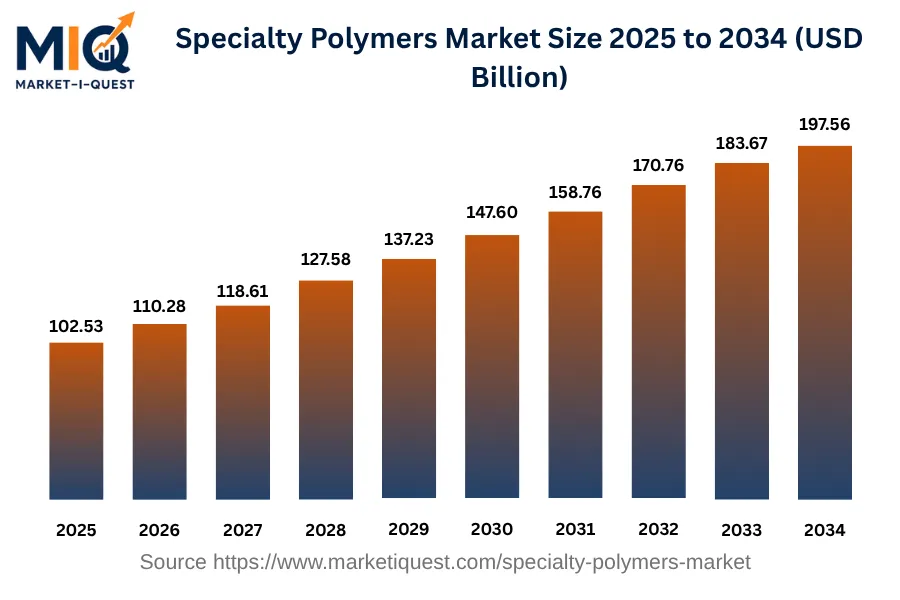
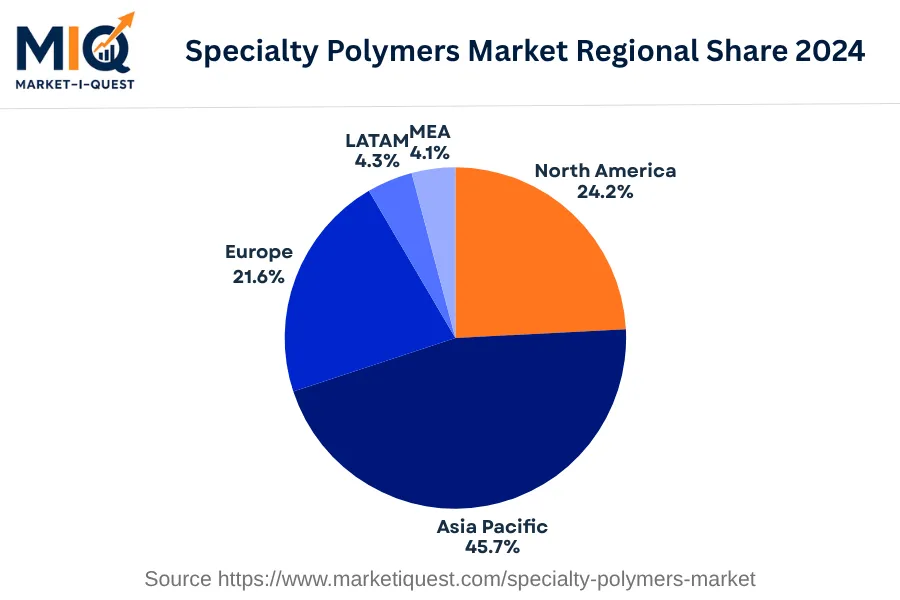
The Specialty Polymers Market size stood at USD 102.53 billion in 2025 and is projected to reach USD 197.56 billion by 2034, expanding at a CAGR of 7.56%. Throughout this period, the market experienced a consistent growth trajectory year on year. The substantial growth over these years can be attributed to the burgeoning demand for specialty polymers across a variety of industries including automotive, electronics, and pharmaceuticals due to their unique characteristics - high strength, durability, and resistance to abrasion, solvents, and chemicals. Regionally, the market distribution in 2024 showed Asia Pacific holding the largest share of 45.7%, followed by North America (24.2%) and Europe (21.6%), while the LATAM and MEA regions contributed lesser shares of 4.3% and 4.1% respectively.

Key Takeaways

  • By Type - Thermoplastics held the major share in the Specialty Polymers Market in 2024.
  • By Function - High-Performance Polymers led the market and is predicted to grow at a fast pace in the forecast period.
  • By Application - Automotive dominated the market accounting for significant usage of specialty polymers in 2024.
specialty-polymers-market market size

Key Driving Factors

Implementation of Strict Environmental Norms

Many governments globally are implementing stricter environmental regulations, particularly in relation to waste management and emission control. This directly impacts the Specialty Polymers Market because many specialty polymer materials offer eco-friendly benefits, including improved recyclability and lower toxicity. For instance, regulations like the European Union's Waste Framework Directive 2008/98/EC and the Resource Efficiency Initiative have accelerated the shift towards the use of specialty polymers in manufacturing processes. These materials often align more closely with circular economy principles, potentially reducing environmental harm compared to traditional materials. As these regulations tighten, industries ranging from automotive to electronics are increasingly adopting specialty polymers to stay in compliance.
Expansion of High-Performance Applications

The market for specialty polymers is also being driven by their expanding use in high-performance applications across diverse sectors. These polymers are being used more than ever to meet the demand for advanced materials in rapidly growing sectors like aerospace, defense, and healthcare. In aerospace and defense, for instance, specialty polymers provide lightweight and heat resistant solutions vital for modern equipment needs. Meanwhile, in the healthcare sector, they are increasingly adopted in the development of medical devices due to their biocompatibility, sterilization capacity, and longevity. The critical role of these polymers in such applications is driving manufacturers to invest more in specialty polymer solutions.

Market Evolution by Timeline

2019-2023
During this period, the Specialty Polymers market saw significant interest from the automotive and aerospace industries, mainly due to the need for light-weight and fuel-efficient materials. However, high production costs resulted in limited adoption, particularly in developing regions like Asia. In response to these high costs, suppliers began investing in polymer manufacturing technology to improve production efficiency, but limited technological maturity and implementation bottlenecks were common. New policies, like the EU's End of Life Vehicle Directive, supported market growth but only in regions where the regulations applied. Commercially, the market was dominated by few large suppliers using long-term contracts, often exclusive partnerships with original equipment manufacturers. Chinese suppliers posed a risk due to their aggressive price strategies, prompting concerns about market instability.
2024
In 2024, the consumer electronics industry emerged as a new demand driver for the Specialty Polymers market, especially in regions like North America and Western Europe. This demand was driven by the need for heat resistant and durable polymers in electronics such as smartphones and laptops. However, the market faced supply constraints due to the growth of electric vehicles requiring similar polymers for battery systems. Concurrently, several Asian suppliers increased their production capacities to address these demand-surges. On the regulation side, the Restriction of Hazardous Substances Directive in the EU limited options for polymer types but promoted the development of environmentally friendly polymers. Commercially, contracts were typically structured around volume discounts, with concerns arising around the concentration of power among few large buyers.
2025-2029
This period saw continued growth in demand for Specialty Polymers from the consumer electronics sector. Likewise, emerging markets, particularly in Southeast Asia and Latin America, showed an increased appetite for these polymers due to rising middle-class populations and their subsequent purchase power. On the supply side, a maturity of production technologies and a decrease in production costs contributed to an increase in small to medium-sized specialty polymer producers. In terms of policy, there were movements towards global adoption of OECD Guidelines for Multinational Enterprises, promoting responsible business conduct in the specialty polymers market. Commercial agreements shifted from long-term contracts to more flexible agreements, catering to the dynamic needs of different industries. The biggest risk in this period was the increasing competition and price duplication in the market.
2030-2034
By 2030-2034, the Specialty Polymers market was expected to have established itself in new application areas, such as biomedical devices and renewable energy systems. To cater to this diverse demand, suppliers were likely to develop a wider variety of specialty polymers with different properties and uses. Regulatory agendas, such as the US Green Building Council's LEED certification, aimed at promoting sustainable construction, would likely direct the market towards eco-friendly polymers. As for commercial strategies, long-term partnerships between suppliers and specific industry sectors were predicted to increase. The main risk was likely to involve uncertainty around global trade policies, affecting the international exchange of raw materials and finished products.

Future Market Outlook

Future Opportunities

Strategically, current trends point towards the expansion of the specialty polymers market, notably due to heightened regulatory awareness and sustainability initiatives. As of 2023, many industries are prioritizing the reduction of their environmental footprint, prompting companies like Eastman to explore the use of recyclable and biodegradable polymers. In the construction sector, new regulations aimed at energy efficiency are creating demand for specialty polymers that can enhance insulation properties, with organizations such as the International Energy Agency endorsing energy savings in building materials. Concurrently, the healthcare industry is seeing a rising need for specialized polymers in medical devices, driven by enhanced FDA scrutiny on materials used in devices like catheters and prosthetics. In 2022, the FDA updated guidelines to ensure the safety and efficacy of polymer materials, providing a framework that will likely provoke further innovations in biocompatible polymers. Additionally, the integration of smart polymers, which respond to environmental stimuli, is becoming increasingly feasible, with research institutions like MIT releasing studies on their potential applications in drug delivery systems. As sustainability and health regulations tighten globally, countries like Germany and Japan are leading efforts to adopt advanced polymers in line with regional mandates. Therefore, the ongoing alignment between regulatory frameworks, material innovation, and industry needs presents a multitude of opportunities for stakeholders across various sectors focusing on specialty polymers.

Segmentation Analysis

By Type

The market is divided into subsegments including Thermoplastics, Thermosets, and Elastomers. Thermoplastics accounted for the largest revenue share while Elastomers is expected to grow at the fastest CAGR during the forecast period.

Largest Revenue Share

Thermoplastics

Market Share Leader

Thermoplastics is leading the market share in terms of revenue owing to its wide range of applications and unique properties. This plastic type can be melted, cooled, and remolded without altering its properties, making it highly recyclable. Its resistance to high impact, corrosion, and electricity has seen its demand skyrocket in sectors like automotive, aerospace, and electronics, enhancing its market share. Geographically, stress on usage of environmentally friendly materials in regions like Europe and North America has contributed greatly to the use of thermoplastics. Also, regulations favoring the shift from traditional materials to thermoplastics boost its demand. Customer preferences towards durable, lightweight and efficient materials have further escalated the usage of thermoplastics. Its supply chain, dominated by established manufacturers ensures steady supply, and the low switching costs have effectively ensured customers stick to thermoplastics.

Fastest CAGR

Elastomers

Forecast Period Growth Leader

Elastomers subsegment is expected to grow at the fastest CAGR in the forecast period. This is fuelled by advancing technologies that enhance elastomers' outstanding properties such as flexibility, strength, and resistance to wear and tear. These properties make them highly applicable in demanding environments such as industrial machinery, automotive, and construction sectors. Moreover, policy shifts encouraging sustainability are promoting novel elastomers that are eco-friendly, creating new markets and opportunities. However, adoption barriers such as high production costs, and technical challenges in achieving desired properties pose near-term risks. Key market players are hence investing heavily in research, development, and partnerships for overcoming these challenges and driving adoption. Demand-side catalysts include increasing the transition towards elastomers for their longevity and robustness against physical stress. Though initial capex may be high, the cost-benefit ratio over the long run makes it an attractive investment for industries.

By Function

The market is divided into subsegments including High-Performance Polymers, Engineering Plastics, and Commodity Polymers. Among these, Commodity Polymers accounted for the largest revenue share while High-Performance Polymers is expected to grow at the fastest CAGR during the forecast period.

Largest Revenue Share

Commodity Polymers

Market Share Leader

Commodity Polymers lead the segment in terms of revenue primarily due to their widespread usage and lower cost as compared to other polymers. These polymers, such as polyethylene, polypropylene, and PVC, are known for their versatility and are employed in a myriad of applications ranging from packaging, construction, to automotive industries. Demand is particularly strong in growing economies where rapid urbanisation and infrastructure development is driving high consumption of these polymers. These polymers are also the preferred choice in mass-manufacturing processes due to their ease of processing and availability, thus providing a scalable solution for manufacturers. Besides, established supply chains and mature market dynamics contribute towards robust sales of commodity polymers. The purchasing decision of these polymers often relies on cost-effectiveness, which gives them a competitive edge over high-performance and engineering polymers.

Fastest CAGR

High-Performance Polymers

Forecast Period Growth Leader

High-Performance Polymers is projected to be the fastest-growing subsegment, driven by their superior properties and growing application base. These polymers, unlike commodity polymers, exhibit resistance to harsh conditions such as high temperatures and corrosive materials, which makes them suited for specialized applications in industries such as aerospace, automotive, and healthcare. Industry trends towards lightweight and durable materials in automotive and aerospace sectors serve as a catalyst for the adoption of high-performance polymers. On the other hand, the primary barrier to adoption is the relatively high cost associated with these polymers. However, rising R&D efforts and joint ventures are expected to create innovative, cost-effective production methods, therefore mitigating this barrier. In terms of risks, fluctuating raw material prices could potentially affect the steady growth of this market.

By Application

The market is divided into subsegments including Automotive, Electronics, Medical, Aerospace, Defense, and Others. In the base year 2024, the Automotive sector accounted for the largest revenue share while the Medical sector is expected to grow at the fastest CAGR during the forecast period.

Largest Revenue Share

Automotive

Market Share Leader

The Automotive industry leads in revenue generation in 2024, bolstered by continuous innovations, specifically in electric and autonomous vehicles. Rapid urbanization and growing purchasing power in emerging economies have driven an increase in automobile sales, thereby fueling the demand in the given market segment. Additionally, stringent environmental regulations calling for reduced emissions have prompted the auto industry to innovate and improve, causing an upsurge in the demand for hybrid and electric vehicles. Furthermore, with technology forming the backbone of these advancements, the dependence on sophisticated systems, devices, and components has grown significantly. This increasing complexity and sophistication in automotive engineering have led to higher demand, thereby augmenting revenue growth in the base year.

Fastest CAGR

Medical

Forecast Period Growth Leader

The Medical sector is forecasted to experience the fastest growth during the next few years. With the global population constantly aging and chronic diseases on the rise, the demand for healthcare services and medical technologies has escalated consistently. Affected by significant technological improvements and innovations, this sector has been at the forefront of adopting the latest advancements such as digital health applications, wearable tech, robotic surgery, and artificial intelligence in diagnostics. These catalysts significantly increase the attractiveness and accessibility of medical care, subsequently driving rapid market growth. However, key barriers to growth may include high capital expense for healthcare providers, policy and regulatory hurdles, and the risk of data privacy breaches in digital health solutions. Notwithstanding these, strategic partnerships and government initiatives promoting healthcare digitalization are expected to create growth opportunities in this subsegment.

Competitive Analysis for Specialty Polymers Market

Key Market Players

Manufacturers / OEMs

Solvay S.A.
Belgium
BASF SE
Germany
Evonik Industries AG
Germany

Key Suppliers & Raw Materials

Exxon Mobil Corporation
US
Dow Inc.
US
PolyOne Corporation
US

Distributors, Integrators & Channel Partners

M. Holland Company
US
Univar Solutions Inc.
US
Trinseo S.A.
Luxembourg

Porter’s Five Forces Analysis

The analysis of competition and external factors in the Specialty Polymers Market.

Supplier Bargaining Power

High

Controlled by few suppliers with unique and high-value polymer production capabilities.

Buyer Bargaining Power

Medium

Buyers have some negotiation power due to a moderate number of substitute materials.

Threat of Substitutes

Low

Few alternatives can replace the functionality of specialty polymers.

Threat of New Entrants

Low

High capital expenditure and stringent regulations create entry barriers for new participants.

Competitive Rivalry

High

Highly competitive due to the presence of several established entities.

Regional Analysis

Geographic market dynamics and growth opportunities across key regions

Global Market Outlook

specialty-polymers-market market regional share

North America

In 2024, the specialty polymers market in North America presented robust demand dynamics. Spurred by the booming construction sector in the U.S., demand for high-performance polymers was strongly influenced by the need for materials with exceptional durability and resilience. A federal push for green buildings increased the need for bio-based polymers, stimulating market growth. Additionally, technological advancements resulted in the development of extraordinary polymer types tailored for specific industries, further driving market demand. Proactive investment in medical polymers by Canada's healthcare sector due to their biocompatibility and adaptability further propagated expansion.

Consumer trends painted an equally vibrant panorama. Buyers were drawn to specialty polymers in electronics due to their superior resistance to heat and electrical conductivity, favoring applications in insulation and circuit boards. An observed uptick in partnerships and acquisitions among key market players emphasized shared objectives of innovation and growth, underscoring the market's competitive landscape. Stricter policy enforcement around plastic usage in Mexico, in alignment with environmental goals, encouraged a reshaping of manufacturing norms, favoring adoption of recyclable and sustainable polymer solutions. The reshuffling in consumer preferences, driven by an amplified awareness towards environment conservation, shifted the limelight onto polymers that deliver high performance yet remain eco-friendly, significantly influencing the specialty polymers market across North American region in 2024.

Asia Pacific

In 2024, the Specialty Polymers Market in the Asia Pacific region witnessed substantial growth. Strong regulatory encouragement for green initiatives and the rising demand for specialty polymers in sustainable packaging across China and India was a key driver. The surge in electronics manufacturing in South Korea and Japan due to the elevated adoption of new technologies necessitated high-performance polymers, propelling the market. Another driver was substantial investment in infrastructure and construction projects in Australia and key ASEAN markets. These ventures required specialty polymers for their high strength, durability and resistance features. Moreover, a significant price drop in raw material supply also spurred the market growth.

A central trend in 2024 was the shift in buyer behavior, with more industries, namely manufacturing and healthcare, opting for high-grade polymers for specific applications. In the retail industry, consumer preference for sustainable packaging drove companies to incorporate bio-based specialty polymers. The market also saw a rise in strategic partnerships and M&A, as observed in Chinese and Japanese companies seeking to expand their market reach. The increased enforcement of environmental policies in major market players like China and Japan also impacted the market, promoting the use of specialty polymers that comply with these stringent standards. The Specialty Polymers Market in the Asia Pacific was thus flourishing in 2024, energized by various driving factors and developing trends.

Europe

In 2024, the specialty polymers market in Europe, an agglomeration of Deutschland's automobile industry, UK's pharmaceutical companies, and France's kitchenware manufacturers wields significant influence in shaping the continent's economic landscape. Robust demand for lightweight and durable materials in Germany's automotive sector propels the need for specialty polymers, fueling Europe's industry growth. Stringent EU regulations around sustainable packaging, particularly in retail sectors of the United Kingdom and Benelux region, drive demand for biodegradable specialty polymers. Increased investment in R&D for high-performance polymers by Italian enterprises augments the market offering, influencing pricing dynamics across Europe.

Among prevailing trends, a shift towards green materials, propelled by environmental concerns among consumers, majority from the Nordics and Central & Eastern Europe, redefines buyer behaviour across sectors. Partnerships and M&A’s focus on Polylactic Acid (PLA), a biodegradable specialty polymer, making it an embarkment of product technology shift, especially in France's kitchenware manufacturing. The enforcement of EU's Circular Economy Action Plan induces a policy-centric dynamic, nudging companies towards recycling specialty polymers. End-user sectors, notably manufacturing, pharmaceutical, retail, and automotive, act as primary customers. For instance, UK's pharmaceutical sector's demand for heat-resistant specialty polymers is significant, mirroring policies such as the European Union Good Manufacturing Practice (EU GMP). While Spain's solar energy projects have prioritized polymer applications in photovoltaic technology, underscoring the sector's role in market dynamics.

Latin America

In 2024, Latin America's Specialty Polymers Market was driven by a dynamic mix of demand factors, investment flows, and innovative technology adoption. Brazil and Mexico's rapidly expanding manufacturing sectors sparked high demand for specialty polymers. Regulatory changes in Colombia, Chile, and Peru fostered a favorable climate for investments and propelled the market forward. Increased adoption of advanced technologies in Argentina also proved a key driver, particularly in its burgeoning automotive industry, which continued to demand more high-performance polymers. Several trends marked this market in 2024. Firstly, we observed a clear shift in buyer behavior toward ecologically friendly specialty polymers, driven by stricter environmental regulations across LATAM. Accompanying these changes was a notable surge in partnerships and mergers and acquisitions, as industry players sought to consolidate their market positions and capitalize on the burgeoning demand. New standards of quality and efficiency were also on the rise, putting additional pressure on suppliers to conform and innovate.

Finally, significant specialty polymers demand stemmed from sectors such as manufacturing, automobile, retail packaging, and utilities. Brazil's booming retail sector and Mexico's auto industry were particularly bullish on specialty polymers use. The growing integration of specialty polymers in several public utilities projects reflected government involvement - a sign of a maturing market and wider acceptance of these materials in various applications.

Middle East & Africa

In 2024, the Specialty Polymers Market in the Middle East and Africa experienced significant market dynamics. The drivers included heightened demand in industries like oil and gas, especially in regions such as Saudi Arabia and Qatar. Policy enforcement spurred technology adoption in the UAE and Israel, promoting advancements in polymer production. Investment activities flourished in countries with favorable government regulations, including Egypt and South Africa, bolstering the supply chain's infrastructure.

Trends shaping the market comprised shifts in buyer behavior, with large-scale manufacturers and the healthcare sector's increasing preference for specialty polymers. For instance, in Nigeria and Kenya, the adaptation of technology by the retail industry led to a change in channel dynamics. Instances of partnerships and M&A activities were noted in Israel and the UAE telecom sector, responding to standards favoring advanced polymers. Moreover, the prevalence of the stringent enforcement of environmental regulations positively impacted polymer standards across the region. Overall, the Specialty Polymers Market in the Middle East and Africa showed remarkable resilience in 2024, due to drivers related to industry demand, technology, and investment, further shaped by trends in buyer behavior, technology adaptation, standards, and partnerships.

Recent Industry Developments

Latest market innovations, product launches, and strategic initiatives

June 2026

BASF Presents Newly Established Global Business Unit "Specialty Polymers & Specialty Foams" at Fakuma – BASF presented its newly established global business unit "Specialty Polymers & Specialty Foams" at the trade show, showcasing its specialty product portfolio to a professional audience.

February 2026

Manuchar and Indorama Ventures Specialty Polymers Sign Distribution Partnership – The companies signed a distribution agreement for 2026 aimed at expanding access to high-performance, sustainable polymer solutions in the South African market.

Frequently Asked Questions