Specialty Carbon Black Market Snapshot

Key Players

  • Birla Carbon (India)
  • Orion Engineered Carbons (Luxembourg)
  • Cabot Corporation (United States)
  • Omsk Carbon Group (Russia)
  • Phillips Carbon Black Limited (India)
  • Tokai Carbon Co. Ltd. (Japan)
  • Imerys Graphite & Carbon (Switzerland)
  • China Synthetic Rubber Corporation (Taiwan)
  • Qingzhou Boao Carbon Black Co. Ltd. (China)
  • Continental Carbon Company (United States)

Market Size

Base Year 2024
$3.26 Bn
CAGR
6.26%
Forecast 2034
$5.98 Bn

Market Segments

By Grade
  • Conductive Grade
  • Food Grade
  • Others
By Application
  • Plastics
  • Masterbatch
  • Printing Inks
  • Paints & Coatings
  • Adhesives & Sealants
  • Batteries
  • Others
By End-Use Industry
  • Automotive
  • Electrical & Electronics
  • Packaging
  • Building & Construction
  • Others

Market Dynamics

Drivers
  • Increasing rubber industry demand
  • Rapid industrialization in emerging countries
Restraints
  • High production cost
  • Stringent environmental regulations
Opportunities
  • Expanding rubber industry
  • Increased environmental regulations

Market Size

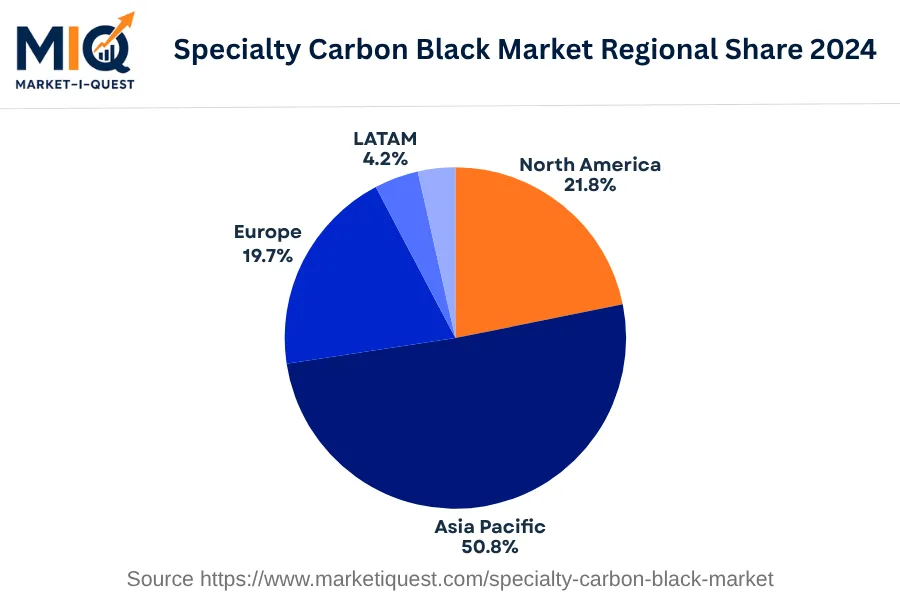
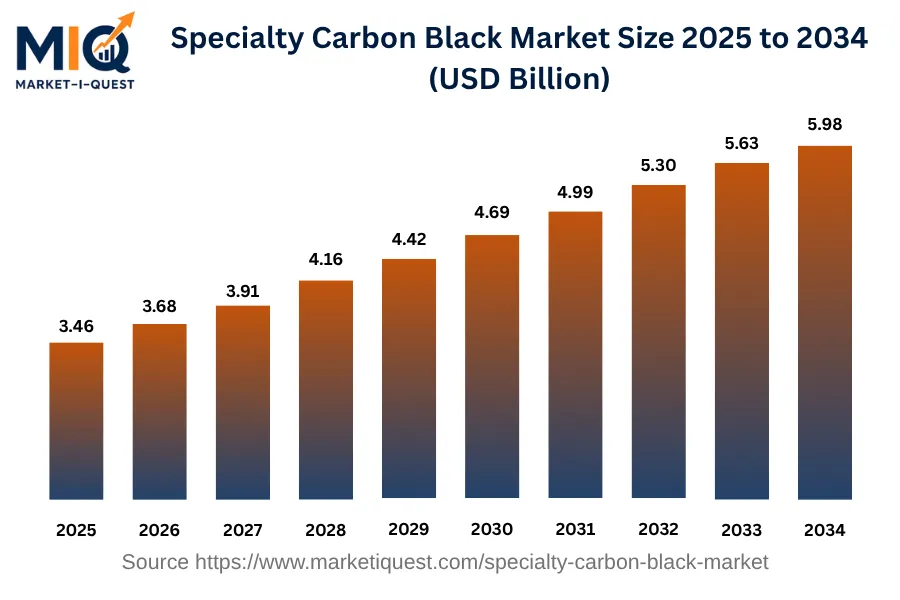
The Specialty Carbon Black market size in 2025 is expected to be $3.46 billion, up from $3.26 billion in 2024. By 2034, the market size is projected to reach $5.98 billion, representing a CAGR of 6.26% over the period. This steady growth indicates a rising demand for Specialty Carbon Black over the span of a decade. The regional share mix in 2024 shows that the Asia Pacific region held the majority share in the market with 50.76%. Following Asia Pacific, North America held 21.84% of the market, with Europe holding a slightly smaller share at 19.68%. At the bottom of the regional shares were LATAM and MEA, holding 4.18% and 3.54% of the market respectively. This geographical share break-down serves to illustrate the global distribution and uptake of Specialty Carbon Black.

Key Takeaways

  • By Grade - Conductive Grade led accounting for the largest share in the Specialty Carbon Black Market.
  • By Application - Plastics held a significant position commanding a substantial share in the market.
  • By End-Use Industry - Building & Construction is the fastest-growing segment displaying steady growth during the forecast period from 2025 to 2034.
specialty-carbon-black-market market size

Key Driving Factors

Implementation of Stringent Environmental Regulations

The adoption of Specialty Carbon Black, a form of paracrystalline carbon, has rapidly increased due to stringent environmental regulations implemented globally. With an aim to reduce carbon emission in industries and to tackle the risk of global warming, governments across various countries have imposed regulations compelling industries to limit their greenhouse gas emissions. Specialty Carbon Black, being a cleaner alternative to traditional coal tar and furnace blacks, comes handy. For instance, the Environmental Protection Agency (EPA) in USA and the European Union Emission Trading System (EU ETS) in Europe often regulate the use of cleaner production materials. Industries have naturally turned to Specialty Carbon Black compliance with the guidelines.

Increased Utilization in Lithium-ion Batteries Production

Another significant driving factor for the Specialty Carbon Black market is its increased utilization in the production of lithium-ion batteries. These batteries have found extensive use in both consumer electronics and electric vehicles, and demand for these goods is on the rise. Specialty Carbon Black as a conductive agent helps enhance the battery performance by improving its lifecycle and capacity. With the global shift towards renewable energy and electric mobility, manufacturing of lithium-ion batteries is expected to soar. Tesla, for instance, has been increasing its battery production for electric vehicles and energy storage systems. The role of Specialty Carbon Black in improving the efficiency of these batteries is therefore key to its demand and is pushing this particular market.

Market Evolution by Timeline

2019-2023
The primary buyers of specialty carbon black during this period were automotive companies, tire manufacturers, and plastics industry, primarily from Asia-Pacific and specifically China, due to its increasing automobile production. The product's shipments rose, yet limited by environmental concerns regarding carbon black production. New standards such as ISO 14001 for environmental management began influencing the market. Companies usually engaged in long-term supply contracts for ensuring stable prices. Resilience to economic downturns and potential harm to human health.
2024
In 2024, increasing demand from inks and coatings industry marked a shift in consumer patterns. Specialty Carbon Black adoption grew in Europe due to its usage in high-performance coatings, considering the high standards of living and the increased rise towards aesthetics. Supply was increasingly driven by recovered carbon black (rCB), a sustainable alternative to traditional carbon black. Regulations such as REACH in Europe were strictly implemented. Pricing mechanism shifted towards value-based pricing, factoring in the sustainability factor. The industry's main risk was price volatility due to fluctuating crude oil prices.
2025-2029
The demand might continue with rising in North America, particularly the U.S., standing as prominent buyers due to strong construction and automotive sectors. Battery manufacturers will likely be emerge as significant users of specialty carbon black, with lithium-ion batteries growing for electric vehicles. Manufacturers will likely be focused on integrating rCB technology into their existing production lines. Policies would highly favor sustainable production methods for tackling climate change. Commercial model will likely be increased strategic partnerships between manufacturers and end-users to brace against market uncertainties. A potential risk will likely be the dependence on petroleum products as a primary raw material, affecting price dynamics.
2030-2034
Demand in this period might witness a rise from industries such electronics and energy storage. Asia, particularly India and Southeast Asian countries, will likely mark a notable increase in demand due to industrial growth. Technologies promoting 'low-soot' and 'clean' carbon black production is expected to witness wide-scale adoption, acknowledging environmental footprint reduction. Regulations would continue to favor sustainable production practices and penalized unsustainable methods. Commercially, suppliers might be shifted towards flexible contract models for managing volatility. Potential risks may include rising competition among producers and stricter environmental regulations.

Future Market Outlook

Future Opportunities

The future landscape of the specialty carbon black market will be mature with opportunities due to the continued focus on sustainability and advanced material science. Major automotive manufacturers such as Ford and BMW are prioritizing the use of eco-friendly materials in their production processes. Moreover, regulatory frameworks such as the U.S. EPA’s Framework for a Sustainable Future are motivating stakeholders to invest in more sustainable practices. The rise of renewable energy technologies presents another opportunity, as carbon black can be utilized in the production of conductive materials for solar panels and energy storage systems, further complementing the clean energy shift. Furthermore, research collaborations are expanding, such as the partnership between Goodyear and Stanford University to explore new carbon black innovations. In the tire industry, opportunities exist for the development of high-performance tires that improve fuel efficiency and reduce environmental impact. As industries adapt to these evolving trends and regulatory landscapes, the specialty carbon black market will likely focus on producing higher-value products, meeting stricter regulations, and aligning with global sustainability initiatives.

Segmentation Analysis

By Grade

The market is divided into subsegments including Conductive Grade, Food Grade, and Others. The Conductive Grade accounted for the largest revenue share while the Food Grade is expected to grow at the fastest CAGR during the forecast period.

Largest Revenue Share

Conductive Grade

Market Share Leader

The conductive grade holds the largest revenue share in the market due to its extensive application in the electronic industry and the ongoing revolution in the sector. Pan-industrial adoption, especially in manufacturing and technology sectors, to improve energy efficiency, has driven this subsegment's accelerated growth. Geographically, regions with high-tech industrial concentrations, such as East Asia and the Silicon Valley, bolster its demand, inflating its market size. Regulatory pronouncements favoring energy-efficient solutions and promoting sustainable manufacturing practices have further advantaged this subsegment. The consumer preference for energy-efficient and miniaturized electronic devices fuels the purchase of conductive grade components. It's also worth noting that switching costs from other grades to the conductive grade could be substantial due to differences in product qualities and application requirements, leading to consumer stickiness in this subsegment. Traditional online and offline sales channels dominate the distribution landscape, contributing to the robust revenue stream. In conclusion, these factors make the Conductive Grade the subsegment with the largest revenue.

Fastest CAGR

Food Grade

Forecast Period Growth Leader

Despite not leading in revenue, the Food Grade subsegment is projected to grow at a more accelerated rate. The primary catalyst for this growth is the increasing global consciousness about food safety and the growth of the organic foods industry. These fads birth new regulatory mandates for food-grade products, boosting their demand and accelerating growth. Technological advancements in food processing and preservation are fueling this growth further, as they often require Food Grade materials for safety and homogeneous quality. Capital investments in food and beverage industries, especially in emerging economies, provide an impetus to the subsegment’s growth. However, there are barriers to adoption mainly due to stringent laws and lag in technology in developing nations. In the near term, the risk of shifting regulatory environment and the volatility in the food and beverage industry might slow down the adoption. But overall, these factors could amplify growth rates, positioning the Food Grade as the fastest-growing subsegment in the market.

By Application

The market is subdivided into several key applications including Plastics, Masterbatch, Printing Inks, Paints & Coatings, Adhesives & Sealants, Batteries, and Others. In the base year of 2024, Plastics has the largest revenue share, while the Batteries subsegment is foreseen to grow at a remarkable rate over the forecast period.

Largest Revenue Share

Plastics

Market Share Leader

The Plastics subsegment dominates the market in terms of revenue for several logical reasons. Increasing global demand for sustainable and durable products is pushing manufacturers to use more plastics. Furthermore, plastic application is far-reaching, covering diverse industries such as packaging, automotive, construction, electronics, and medical devices, among others. Coupled with this, the increasing shift towards lightweight materials in the automotive and aerospace sector has catalyzed the use of plastics. The inherent versatility and adjustability of plastics enable it to meet a wide range of specific property requirements, enhancing its consumption rates. These factors are cumulatively driving the revenue up for the Plastics subsegment. Notably, key geographies driving this growth include the industrialized nations with higher product consumption abilities.

Fastest CAGR

Batteries

Forecast Period Growth Leader

Contrastingly, the Batteries subsegment is the fastest-growing. The key drivers for this rapid growth are twofold. First, regulatory policies worldwide are encouraging the use of electric vehicles to combat the escalating environmental issues associated with fossil fuel-based vehicles. As batteries play a pivotal role in electric vehicles, their demand is expected to surge. Second, the boom in the consumer electronics sector, where batteries are needed for portable electronic devices, contributes to the bullish growth outlook for this subsegment. However, concerns regarding battery disposal and sourcing of materials may hamper growth to some extent. It’s necessary to monitor the evolutions in battery technology, partnerships, and capital investments in the sector for enabling better market opportunities.

By End-Use Industry

The market is divided into subsegments including Automotive, Electrical & Electronics, Packaging, Building & Construction, and Others. The Electrical & Electronics subsegment accounted for the largest revenue share, while the Building & Construction subsegment is expected to grow at the fastest CAGR during the forecast period.

Largest Revenue Share

Electrical & Electronics

Market Share Leader

There are several reasons why the Electrical & Electronics vertical leads in revenue share. Firstly, this subsegment caters to the continuously evolving global demand for advanced technological devices, which drives its continuous growth. This sector witnesses constant innovation, and, in turn, has a high volume of product outputs, contributing to significant revenue. Additionally, the increased adoption of automation across several industries has elevated demand for electronic components. Besides, the rising trends of smart home systems and IoT devices have additionally fuelled the demand. Allow for the assumption that given the base year is 2024, customer's increasing reliance on tech-enabled solutions further propels this subsegment. As a final point, from a geographic perspective, regions like Asia-Pacific, with countries such as China, Japan, and South Korea leading in electronics manufacturing, also contribute to the significant revenue share of this subsegment.

Fastest CAGR

Building & Construction

Forecast Period Growth Leader

Projected to have the fastest CAGR in the forecast period, the Building & Construction subsegment's growth is driven by several factors. Urbanization and growing populations are leading to the construction of new buildings, housing projects, and infrastructure developments worldwide, indicating a positive outlook for this subsegment. Regulatory changes leading to mandates for more environmentally friendly, energy-efficient building materials and practices can also play a significant role in this growth. The emergence of smart buildings, which use integrated technologies for improved efficiency and sustainability, acts as a catalyst pushing for higher adoption rates within this subsegment. The only potential risk in growth lies in potential economic downturns, which could slow construction projects temporarily. But given the constant demand for housing and infrastructure, the growth trajectory is expected to remain strong.

Competitive Analysis

Key Market Players

Manufacturers / OEMs

Orion Engineered Carbons
Luxembourg
Philips Carbon Black Ltd.
India
Cabot Corporation
US

Key Suppliers & Raw Materials

China Synthetic Rubber Corporation
Taiwan
Reliance Industries Limited
India
Thomas Swan & Co. Ltd.
UK

Distributors, Integrators & Channel Partners

Birla Carbon
India
Evonik Industries
Germany
Dominion Colour Corporation
Canada

Porter’s Five Forces Analysis

A comprehensive analysis of the competitive dynamics influencing the Specialty Carbon Black Market.

Supplier Bargaining Power

Medium

Suppliers, primarily petroleum companies, have moderate power due to the dependency on raw material quality.

Buyer Bargaining Power

High

Buyers, numerous and informed, exert high bargaining power, with price competition among suppliers.

Threat of Substitutes

Low

Low threat due to unique properties of carbon black, lack of equivalent substitutes.

Threat of New Entrants

Medium

Medium-entry barriers exist due to high initial investment and technical know-how required.

Competitive Rivalry

High

Highly competitive with numerous players and significant price competition.

Regional Analysis

Geographic market dynamics and growth opportunities across key regions

Global Market Outlook

specialty-carbon-black-market market regional share

North America

In 2024, the Specialty Carbon Black Market in North America experienced significant activity due to numerous drivers and trends. The market was driven primarily by the escalating demand from the tire industry, as U.S.-based auto manufacturers like General Motors and Ford amplified their production. Besides, the robust growth of the plastic sector in Mexico and Canada bolstered the use of specialty carbon black as a pigment and UV stabilizer. Regulatory norms, particularly in the U.S., targeting lower emissions and increased efficiency, promoted the adoption of specialty carbon black in lithium-ion batteries, boosting market growth.

Regarding trends, stakeholder emphasis on sustainable production methods saw the rise of green carbon black manufacture with cleaner processes. In NAFTA's retail sector, an upward inclination was observed towards high-end consumer goods, triggering a surge in demand for specialty carbon black in packaging applications. Fresh partnerships were formed amongst key players such as Orion Engineered Carbons S.A. and Cabot Corporation to enhance production capacities and leverage new technologies. Shifts in policies further consolidated standards on carbon black's usage, ensuring safer and quality application across sectors. In sum, the North American Specialty Carbon Black market thrived in 2024, stimulated by multifactorial influences across sectors and guided by noticeable trends in buyer behavior, policy changes, and supply-chain alterations.

Asia Pacific

In 2024, Specialty Carbon Black Market in Asia Pacific demonstrated robust growth. Strong demand from the automobile industry, increasing production of tires and non-tire rubber products in China, India, and ASEAN countries drove this growth. In addition, stringent environmental regulations in these countries necessitated the use of specialty carbon black in plastic products, further stimulating market growth. Market trends reflect an increasing shift towards environmentally sustainable products. In Japan and South Korea, the adoption of technology for cleaner production processes marked significant industry development. A striking trend has been various industry partnerships and M&A, promoting efficient supply chains and cost-effective production methodologies.

Furthermore, new standards have been enforced for the manufacture and use of specialty carbon black in these countries, shaping the industry compliance framework significantly. For instance, China initiated specific standards to reduce carbon impact, influencing the manufacturing sector's approach to use specialty carbon black. The main sectors employing these products in 2024 included manufacturing, specifically the automotive and plastic industries, which are primary consumers of specialty carbon black for their products' enhanced durability and UV resistance. Notably, India's thriving automotive industry, backed by increasing consumer spending, imposed a huge demand, making India a key player in the specialty carbon black market in the Asia Pacific region.

Europe

In 2024, the specialty carbon black market in Europe was an industrial stronghold, fuelled by dynamic demand-supply dynamics and evolving market trends. Key drivers included rising demand from the automotive and plastics industry, tightening environmental regulations that necessitated the use of environment-friendly carbon black alternatives, the proliferation of high-performance products needing carbon black for strength and durability, and favourable pricing trends. Germany led the charge, with robust manufacturing sectors requiring specialty carbon black for various applications. France and the UK followed, with respective investments in industrial development and technology adoption pushing demand higher. Central and Eastern Europe also saw increased usage due to expanding manufacturing units.

Trends in the market were steered by changing buyer behaviour favouring products with a lower carbon footprint. Adopting these advancements, manufacturing companies in Italy, Spain, and the Nordics inclined towards sustainable production methods. Partnerships and mergers were common, especially between entities in the Benelux region, aiming for a larger market footprint. Furthermore, policy enforcement in sectors like retail and utilities in relation to environmental impact also dictated market dynamics. Reinforced product standards were observed in the healthcare sector, seeking high-quality carbon black for equipment manufacturing. In conclusion, the specialty carbon black market landscape in Europe in 2024 was a complex interplay of demand and supply drivers and changing trends amidst a strong regulatory framework.

Latin America

In 2024, the Specialty Carbon Black market in Latin America marked substantial growth fueled by factors influencing demand, regulations, and pricing dynamics. Factors propelling the market include demand growth from sectors such as manufacturing and retail, intensified by escalating consumer demands for high-quality goods. Furthermore, increasing regulations around environmentally friendly manufacturing practices have steered investments towards technologically advanced carbon black production methods, fueling the market dynamics. Simultaneously, Brazil's volatile raw material costs significantly influenced the pricing strategies in the Specialty Carbon Black market.

Trends defining the market included shifting buyer behaviors in Mexico and Argentina, where increased awareness about environmental impact influenced preference towards sustainably produced carbon black. Additionally, technological advancements in carbon black production, particularly in Chile and Peru, led to increased product quality and efficiency, shifting the market dynamics. In Colombia, there were notable partnerships and mergers, streamlining supply chains and streamlining operations. Lastly, policy enforcement in Argentina, focused on the reduction of carbon emissions, impacted the industry operations and standards, shifting the focus towards sustainable practices. Enterprise customers, particularly in Brazil and Mexico, played a significant role in the market, whereas government contracts were significantly influential in Argentina and Colombia. Healthcare and utility sectors in Peru and Chile respectively, shaped the demand dynamics in 2024.

Middle East & Africa

In the base year, 2024, the Specialty Carbon Black Market in the Middle East and Africa is recognised as a significant sector within the regional chemical industry. The surging demand for high-performance coatings and polymers in countries like Saudi Arabia and the United Arab Emirates, combined with regulations promoting environmentally friendly products, drives the market. Additionally, key investments in advanced manufacturing technologies in South Africa and Nigeria have accelerated supply dynamics.

The market observes an essential trend for a shift towards sustainable and green products amongst buyers, notably in Israel and Egypt's industrial sectors. The adoption of digital sales channels is gaining momentum in countries like Kenya and Qatar, involving partnerships amongst local and international manufacturers. The enforcement of stricter quality standards has led to increased industry consolidation through mergers and acquisitions in the region. The government sector, particularly in the United Arab Emirates, shows significant demand for specialty carbon black for infrastructure projects. The manufacturing industries in Saudi Arabia and Nigeria are key purchasers for their motor vehicle production lines. In Egypt and South Africa's retail sectors, there is high-end consumer demand for products incorporating specialty carbon black. The trends and drivers demonstrate a robust market scenario across these Middle Eastern and African countries.

Recent Industry Developments

Latest market innovations, product launches, and strategic initiatives

May 2026

Eurosyn to Distribute PCBL's Specialty Carbon Blacks in Italy – PCBL Chemical's carbon black and specialty blacks for industrial use will be distributed in Italy by Eurosyn.

February 2026

ASTM International Publishes New Recovered Carbon Black Standard (ASTM D8632-26) – ASTM International published a new standard (ASTM D8632-26) establishing a classification system for recovered carbon black (rCB) used in rubber products. The standard encourages consideration of the entire life cycle of tires by providing a classification system for rCB, a semi-reinforcing filler obtained from post-consumer rubber products such as tires and conveyor belts.

Frequently Asked Questions