
Smart Plug Market Snapshot

Key Players

  • Belkin International (United States)
  • TP-Link (China)
  • D-Link Corporation (Taiwan)
  • Panasonic Corporation (Japan)
  • Ikea (Sweden)
  • Efergy Technologies (United Kingdom)
  • Philips Hue (Netherlands)
  • Wemo (United States)
  • Legrand (France)
  • Tuya Smart (China)

Market Size

Base Year 2024
$3.85 Bn
CAGR
23.75%
Forecast 2034
$32.43 Bn

Market Segments

By Connectivity Type
  • Wi-Fi
  • Bluetooth
  • Zigbee
  • Z-Wave
By Power
  • Below 5A
  • 5A-10A
  • 10A-15A
  • Above 15A
By End Use
  • Residential
  • Commercial
  • Industrial

Market Dynamics

Drivers
  • Increasing tech-savvy population
  • Growing energy conservation awareness
Restraints
  • High initial setup costs
  • Compatibility issues with devices
Opportunities
  • Increased IoT adoption
  • Energy efficiency concerns

Market Size

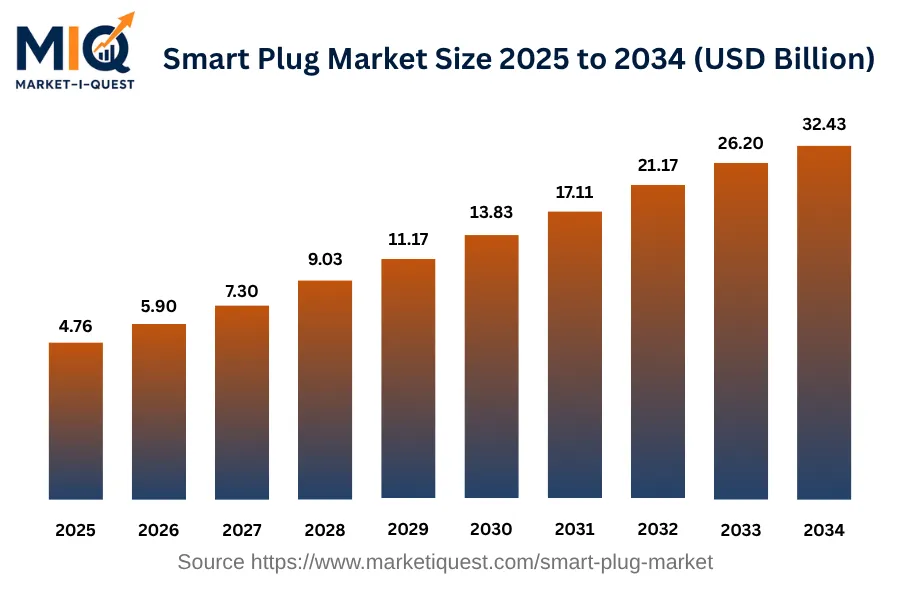
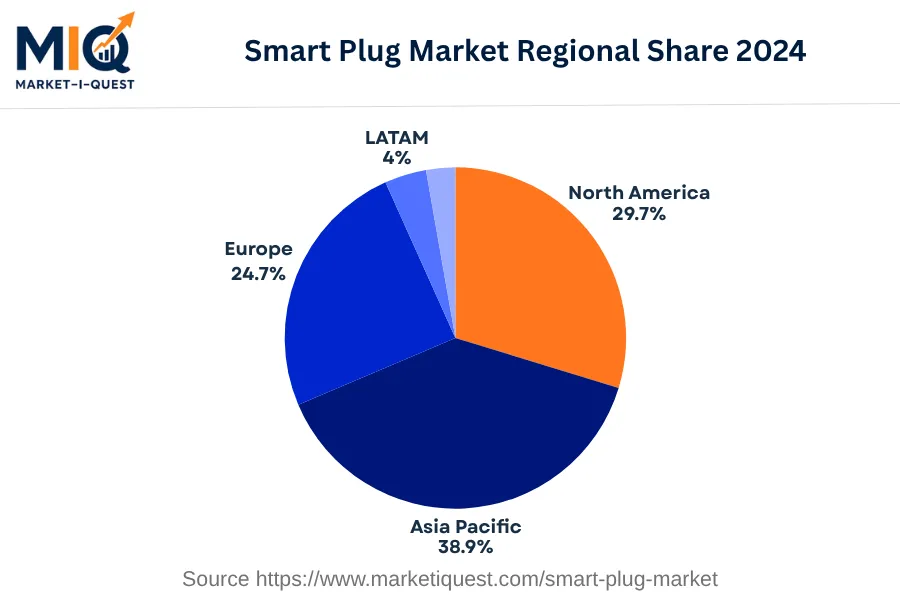
The Smart Plug Market was sized at $4.76 billion in 2025, and it has been estimated that by 2034, the market size will expand to reach $32.43 billion, growing at a CAGR of 23.7%. Between 2024 and 2025, the market size increased from $3.85 billion to $4.76 billion, indicating a steady climb in this initial period. Over the subsequent decade, this growth is seen to accelerate exponentially, highlighted by the significant rise to $32.43 billion in 2034. In terms of regional market share in 2024, Asia Pacific led with 38.88%, followed closely by North America with a share of 29.72%. Europe took third largest market share of 24.68%. Meanwhile, Latin America, Middle East & Africa (MEA) represented smaller portions of market, with shares of 3.96% and 2.76% respectively.

Key Takeaways

  • By Connectivity Type - Wi-Fi held a dominant position in the Smart Plug Market due to its widespread usage.
  • By Power - 10A-15A range led the market with high demand in commercial and industrial setups.
  • By End Use - Commercial sector led the Smart Plugs due to increasing adoption of smart home technology.
smart-plug-market market size

Key Driving Factors

Impact of Energy Efficiency Regulations

Government policies and regulations targeting energy conservation are compelling households and businesses to reduce their power consumption. Notably, policies like the Energy Savings Opportunity Scheme in UK or Corporate Average Fuel Economy standards in US are incentivizing the adoption of energy-efficient devices. Smart plugs, which provide users with insights about power usage and enable remote control of appliances, are becoming an affordable choice for those aiming to comply with these standards. By facilitating energy management and potential cost savings, these devices are seen as effective tools to meet regulatory requirements and lower carbon footprints.
Surge in Popularity of Smart Homes

The increasing consumer interest in smart homes is a pivotal driver in smart plug market. As part of integrated home ecosystem, smart plugs allow users to automate various tasks by scheduling operation of appliances, enhancing both convenience and security. Moreover, compatibility of smart plugs with popular virtual assistants like Amazon's Alexa or Google's Assistant eases way into households that are adopting or expanding their smart home systems. As more consumers invest in smart home setups for more efficient, secure, and convenient lifestyle, demand for smart plugs will see a significant upswing.

Market Evolution by Timeline

2019-2023
During this period, smart plug market saw rise in buyer preference for energy-saving devices in Europe and North America due to greater environmental awareness. On supply side, manufacturers like Hive and WeMo released new models, offering full integration with popular voice-controlled services like Amazon's Alexa and Google's Home. Regulatory standards like Energy Star in the US became more prominent, incentivizing consumer adoption. Additionally, subscription-based models started to gain popularity, with companies offering monthly plans for added functionalities like energy monitoring. However, internet connectivity issues often proved problematic, with potential buyers hesitant to purchase due to requirement of a stable internet connection.
2024
In 2024, the Asia-Pacific region's market saw a significant increase in demand due to rising middle class's buying power in countries like China and India. As for technology, manufacturers started implementing better encryption for enhanced data security and privacy, countering one of the previously prominent usage constraints. The 'One Charger' initiative in the European Union triggered manufacturers to develop universal charging solutions for smart plugs. The market saw a decline in upfront payment models, with a preference shift towards flexible payment options. However, potential risks of cyber-attacks remained a concern for many users.
2025-2029
The smart plug market from 2025 to 2029 witnessed a surge in demand from the industrial sector, particularly in United States and Europe. The IEC 62680 standard, which defines USB interfaces for data and power, became widely adopted. Most manufacturers, like TP-Link and Eufy, became highly integrated with Internet of Things ecosystems. The pricing model started to shift from product pricing to service pricing, where smart plug manufacturers also provided installation and maintenance services. Risk of hardware failure became prevalent in this period, with manufacturers investing more in quality control processes.
2030-2034
The period 2030-2034 may likely see smart plug demand from regions with fast emerging economies like Africa due to improving infrastructure and increasing disposable incomes. On supply side, we may expect near-universal integration with different smart home ecosystems, driven by compatibility standards like Zigbee 3.0. A potential regulatory shift could stem from policies encouraging use of smart home technologies to better manage energy consumption. The commercial model might lean more towards partnerships with utilities for dynamic energy management. As technology matures, market may need to confront problems arising from device obsolescence.

Future Market Outlook

Future Opportunities

The increasing integration of smart plugs with renewable energy sources, like solar panels and wind turbines, presents significant future opportunities in the smart plug market. Companies like Schneider Electric have been exploring how smart plugs can seamlessly connect with home energy management systems that optimize energy consumption based on time-of-use rates. With surge in solar adoption, especially in countries like Germany, homeowners are looking for ways to maximize efficiency of their energy systems, creating demand for smart appliances that can interact with renewable setups. Additionally, partnerships between smart plug manufacturers and energy services companies are likely to grow, allowing for greater energy efficiency initiatives and grid responsiveness. With rising focus on sustainability, there is a potential for smart plugs to incorporate features supporting energy-saving modes, assisting businesses in meeting new sustainability targets, as seen in European Union’s Green Deal initiated in 2019. Furthermore, the expansion of smart cities is anticipated to drive demand for connected home devices. Various municipalities, like San Diego, are implementing smart technologies aiming for enhanced energy management, which includes smart plugs as a component of broader smart home ecosystems. Overall, these ongoing trends and developments suggest a future where smart plugs are integral to energy management and connected living, aligned with global sustainability efforts.

Segmentation Analysis

By Connectivity Type

The market is divided into subsegments including Wi-Fi, Bluetooth, Zigbee, and Z-Wave. Wi-Fi accounted for the largest revenue share while Zigbee is expected to grow at the fastest CAGR during the forecast period.

Largest Revenue Share

Wi-Fi

Market Share Leader

Driving the market's highest revenue, Wi-Fi's ubiquity is largely attributable to its established infrastructure and wide acceptance among various industries. As ubiquitous connectivity has become a top priority for businesses and consumers alike, Wi-Fi's comprehensive coverage, higher speed, and reliability compared to other connectivity approaches have cemented its value proposition. Wi-Fi enabled devices like smartphones, laptops, and smart home devices are highly sought after, expanding its customer base. Growth of Internet of Things (IOT) devices further solidifies Wi-Fi's dominant position. Moreover, advancements in Wi-Fi standards are expected to continue to support its market dominance. Specific geographic regions, particularly developed markets with strong internet infrastructure, contribute significantly to Wi-Fi revenue due to their high concentration of connected devices. Indeed, one can't exclude regulatory landscape and availability of supply contributing to dominance of Wi-Fi. As Wi-Fi technology is heavily standardized, it carries lower switching costs, further enhancing its adoption across various channels and industries.

Fastest CAGR

Zigbee

Forecast Period Growth Leader

Notwithstanding its smaller revenue share, Zigbee is positioned for rapid growth, helped by its unique advantages and growth catalysts. Zigbee's strength becomes apparent in specific use cases requiring low power and secure networks, such as smart home, automotive, and industrial applications. Its ability to form mesh networks makes it ideally suited for IOT devices spread across wide areas where power availability is a concern. Moreover, technology advancements and partnerships to enhance its capabilities and expand its reach could serve as meaningful growth catalysts. But Zigbee's somewhat limited current acceptance presents viable adoption barrier, which requires clear market education strategy. Additionally, its higher initial cost compared to other connectivity types could be a limiting factor, but this could be offset by potential for lower operational expenses in a longer run. On policy front, there are no major regulatory concerns as Zigbee operates in license-free frequency band, reducing potential capex risks. Interestingly, impacts of geopolitical developments, especially in technology sourcing and access, could impact its growth trajectory, warranting close monitoring.

By Power

For the power market, the segments are categorized into four major ranges: Below 5A, 5A-10A, 10A-15A, and above 15A. The 10A-15A power range accounted for the largest revenue share, while the Below 5A power range is expected to grow at the fastest CAGR during the forecast period.

Largest Revenue Share

10A-15A

Market Share Leader

The 10A-15A segment occupies highest revenue share among the power ranges for several reasons. Firstly, it caters to a wide array of industries including automotive, electronics, manufacturing and industrial, which need medium power for their operations. This broad customer base ensures robust and consistent demand. Furthermore, it's found in optimal power range that ensures both efficiency and required power output, making it primary choice for multiple applications. Its geographic ubiquity is another factor aiding its dominant market position, given its usage across developing and developed economies alike. In terms of regulatory influences, this segment complies with most power standards globally, further solidifying its market status. Lastly, customer purchasing decisions are typically driven by product durability, safety and efficiency, features that the 10A-15A range straddles very well. The segment's continuation as the market leader is propelled by these factors.

Fastest CAGR

Below 5A

Forecast Period Growth Leader

The Below 5A power segment's growth trajectory is expected to steepen, mostly driven by its adoption in emerging technologies and applications. The underlying catalyst propelling this segment's growth is the exponential expansion of consumer electronics requiring low power input. Upcoming innovations in wearable and portable devices further spur its requirement. Additionally, green revolution and increasing push for energy-efficient appliances has swayed market growth towards this low-power segment. But barriers do exist in form of legacy systems in certain industries proving resistant to change, particularly due to heavy switching costs. Yet, increasing partnerships between technology companies and manufacturers to incorporate low-power components are slowly but surely overcoming these obstacles. While capex limitations in developing markets pose near-term risks, segment’s long-term outlook remains bright.

By End Use

The End Use market is segmented into Residential, Commercial, and Industrial. The Commercial subsegment contributes to the major share in revenue whereas the Industrial subsegment is anticipated to show a rapid Compound Annual Growth Rate (CAGR) over the forecast period.

Largest Revenue Share

Commercial

Market Share Leader

The Commercial segment holds upper hand in revenue generation in 2024. This results from wide application of products and services in businesses and corporations across various industries. Given their operational scale, commercial users are likely to avail of these services and products on a large scale, thereby driving revenue growth. Additionally, increasing demand for efficient and advanced solutions to improve operational productivity in commercial spaces is driving the growth of this segment. Certain geographical regions, having high concentration of commercial spaces, inevitably contribute larger shares to segment’s revenue. Regulatory requirements can drive commercial entities to invest more in certain solutions, impacting revenue share. Besides, various purchasing criteria like cost-effectiveness, productivity, and efficiency also influence commercial segment’s leading position in terms of revenue.

Fastest CAGR

Industrial

Forecast Period Growth Leader

The Industrial subsegment is projected to register fastest growth rate over forecast period. Industries are being driven by growing technological advancements and an ever progressing need to automate and streamline their processes, which fuels growth of this subsegment. Moreover, surge in capital expenses on integration of advanced technology in industrial sector serves as catalyst for higher growth of this segment. High adoption barriers for new technology, like high upfront costs, and change management issues could pose challenges to adoption of products in this subsegment, which can be a risk to evident growth. But strategic partnerships among key market players for technology sharing will bolster growth momentum in Industrial segment in coming years. It should be noted that this assumption is based on a common market structure where Industrial markets usually adopt new technologies more rapidly than Residential and Commercial markets.

Competitive Analysis for Smart Plug Market

Key Market Players

Manufacturers/OEMs

Belkin International
US
TP-Link Technologies Co., Ltd.
China
D-Link Corporation
Taiwan

Key Suppliers & Raw Materials

Texas Instruments Incorporated
US
STMicroelectronics N.V.
Switzerland
NXP Semiconductors N.V.
Netherlands

Distributors, Integrators & Channel Partners

Amazon.com, Inc.
US
Best Buy Co., Inc.
US
JD.com, Inc.
China

Porter’s Five Forces Analysis

This analysis emphasizes the competitive intensity and attractiveness of the Smart Plug market.

Supplier Bargaining Power

Low

Broad availability of components and low customization reduce suppliers' bargaining power.

Buyer Bargaining Power

High

Large number of alternatives and price sensitivity increase buyers’ bargaining power.

Threat of Substitutes

High

Rapid technological advancements can provide alternative smart home applications reducing dependence on smart plugs.

Threat of New Entrants

Medium

Lower barriers of entry, but strong brand preferences and technological expertise required.

Competitive Rivalry

High

Market is populated with numerous established companies, intensifying competitive rivalry.

Regional Analysis

Geographic market dynamics and growth opportunities across key regions

Global Market Outlook

smart-plug-market market regional share

North America

In 2024, the North American smart plug market witnessed robust growth, driven primarily by United States, Canada, and Mexico.
Drivers of this market were diverse and multifaceted. Demand factors included an increase in technology adoption, particularly across enterprise and retail sectors where enhanced functionality and energy efficiency held high priority. Regulatory measures in U.S., like Energy Independence and Security Act of 2007, also influenced market dynamics, encouraging investment in smart technologies. In Canada, utility companies leveraged smart plug applications to manage energy consumption and mitigate supply concerns, thereby boosting their prominence. Mexico showed significant uptake owing to pricing benefits and increased promotion of smart home solutions.

Market trends underscored transformative shifts in consumer attitudes and industry practices. Buyer behavior notably swayed towards energy-saving products, with an emphasis on controllable and smart devices. Tech advancements led to integration of Artificial Intelligence and voice recognition features in smart plugs, creating seamless, user-friendly experiences. Notable partnerships, like Amazon's collaboration with Belkin for voice-controlled plugs, marked evolution of channel dynamics. Irrespective of policy enforcement differences across these geographies, the consensus leaned towards managing energy use, and smart plugs emerged as crucial component within this ecosystem.

Asia Pacific

In 2024, Smart Plug market in Asia Pacific region demonstrated a strong growth trajectory. High energy costs across key Asian markets like China and India drove demand, with businesses and households alike seeking energy-efficient devices. Simultaneously, investment in IOT from countries like Japan and South Korea significantly pushed technology adoption. Australia's rigorous energy regulations laid the groundwork for smart plug market, incentivizing manufacturers to create efficient and compliant products.

Consumer preferences trended towards smart home devices, and along with advancements in AI and IOT, smart plugs topped the list of favorited household gadgets in urban regions. Rapid digitalization within enterprise customers, particularly in sectors like manufacturing and retail, fueled smart plug usage. Existing partnerships and mergers among tech giants—especially in China and Japan—proceeded to erode market entry barriers, fostering a highly competitive landscape.

In ASEAN countries with less developed digital infrastructure, growth rate was slower. But proactive government policy enforcement to promote 'smart' living in Singapore undeniably stimulated regional interest. Overall, 2024 was a defining year in Asia Pacific Smart Plug market, with dynamic interplay of consumer preferences, technological advancements, and regulatory maneuvers making a significant impact.

Europe

In 2024, European smart plug market witness increased adoption driven by an emphasis on energy efficiency and growth of smart homes. Key drivers included stringent EU regulations mandating energy conservation and proliferation of IOT devices across Germany, United Kingdom, France, Italy, Spain, the Nordics, Benelux, as well as Central & Eastern Europe. Investment in smart city projects further bolstered demand for smart plugs, especially in sectors like healthcare and utilities. Additionally, trend of remote work and techno-lifestyle fueled market growth, notably in enterprise and retail sectors.

A significant trend was shift in consumer preference for automated and integrated home management systems. Innovative technologies, like artificial intelligence and machine learning, played crucial role in market trends, especially in Germany and UK. The interoperability of smart plugs with various smart devices was a critical factor too. Partnership and merger activities were increasing, particularly among telecom providers and tech companies, aiming to offer comprehensive smart home solutions. Enforcements of strict energy standards stirred the market, driving the adoption of energy-efficient devices like smart plugs. Thus, European smart plug market in 2024 demonstrated a keen focus on energy efficiency combined with converged technologies and regulatory influences.

Latin America

In 2024, Smart Plug Market in Latin America embraced digital transformation across industries. Drivers like increased energy efficiency demands in Brazil and Mexico significantly enhanced market growth. Argentina's government regulations incentivized smart plug use in small and medium enterprises for better energy management. Meanwhile, technological advancements in Colombia fueled adoption of smart plugs in their manufacturing sector. Increased investment in IOT technology in Chile and rapid urbanization in Peru drove robust supply dynamics in these regions. But pricing disparities among vendors served as challenge to market expansion.

Simultaneously, trend of using smart plugs in home automation systems became prevalent in residential areas across LATAM. Advanced analytics capabilities of smart plugs shifted product outlooks, offering users greater control over their energy consumption. This shift in product technology in sectors like retail and healthcare led to an increased demand for smart plugs. Growing partnerships and M&As among local vendors in Argentina was another trend observed, driving channel dynamics towards providing user-friendly and efficient smart plug solutions. Meanwhile, strict policy enforcement in Colombia's utilities sector led to large-scale adoption of smart plugs. Hence, factors like governmental regulations, technological advancements, and user behavior revitalized smart plug market in LATAM in 2024.

Middle East & Africa

In 2024, Middle East and Africa's smart plug market was a rapidly evolving area shaped by several key drivers and trends. Demand was heightened by increasing awareness of energy efficiency, government initiatives toward smart city projects, and adoption of IOT technologies by sectors like telecom, retail, and utilities. Saudi Arabia and United Arab Emirates, for instance, implemented green building codes promoting energy management solutions including smart plugs. In Israel and South Africa, market growth was stimulated by advanced infrastructure investment nurturing tech adoption.

Meanwhile, a distinct market trend was shift towards home automation, witnessed even in emerging economies like Nigeria and Kenya. Buyers favored smart plugs capable of remote control via smartphone or voice assistants, substantiating this trend. The market saw heightened M&A activity, notably in Qatar and Egypt, exemplifying the region's push to integrate modern technologies into traditional settings. Regulatory trends fostered standardization of IOT-based devices, influencing smart plug market dynamics in a significant way. But market's growth wasn’t solely driven by advancements in technology. Consumers' changing lifestyle and preferences paralleled need for automated household appliances, giving market an added impetus. Thus, interplay of demand, regulation, and technological shifts made 2024 a pivotal year for smart plug market in the Middle East and Africa.

Recent Industry Developments

Latest market innovations, product launches, and strategic initiatives

January 2026

During CES 2026, IKEA announced major expansion of its budget smart home line, revealing Grillplats indoor smart plug and the weather-resistant Tofsmygga outdoor smart plug. This launch, combined with their new native integration partnership with Samsung SmartThings, signals a strategy to undercut premium competitors while driving mass adoption of affordable, Matter-compatible devices.

December 2025

Shelly Group officially launched the Shelly Plug Gen4 for the North American market. This development is significant because the plug natively supports Matter, Wi-Fi, and Zigbee simultaneously, while heavily emphasizing local control and onboard scripting allowing the hardware to execute automations securely even if the home internet connection drops.

November 2025

THIRDREALITY launched Smart Plug UZ1, a device engineered specifically for physical and electrical standards of UK homes. This addressed a localized market gap by providing a Zigbee 3.0 plug with built-in zero-cross detection to protect sensitive appliances, which also acts as a mesh network repeater to stabilize connectivity in larger or older houses.

Frequently Asked Questions