Smart Electricity Meter Market Snapshot

Key Players

  • Itron Inc. (US)
  • Siemens AG (Germany)
  • Schneider Electric (France)
  • Elster Group GmbH (Germany)
  • Landis+Gyr (Switzerland)
  • Holley Metering Limited (China)
  • Iskraemeco (Slovenia)
  • Badger Meter Inc. (US)
  • Sensus (United States)
  • Aclara Technologies LLC (US)

Market Size

Base Year 2024
$27.37 Bn
CAGR
5.6%
Forecast 2034
$47.20 Bn

Market Segments

By Type
  • Single Phase Electric Meter
  • Three Phase Electric Meter
By Communication Technology
  • Power Line Communication (PLC)
  • Radio Frequency (RF)
  • Cellular
  • Others
By End Use
  • Residential
  • Commercial
  • Industrial

Market Dynamics

Drivers
  • Rising energy conservation needs
  • Growing smart grid deployments
Restraints
  • High installation cost
  • Technological interoperability issues
Opportunities
  • Smart grid infrastructure development
  • Utility efficiency demands

Market Size

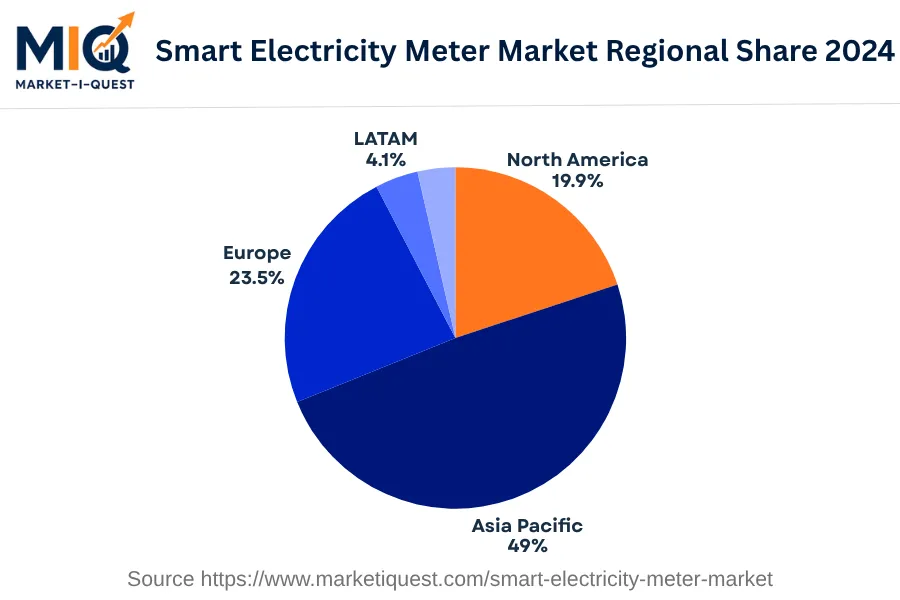
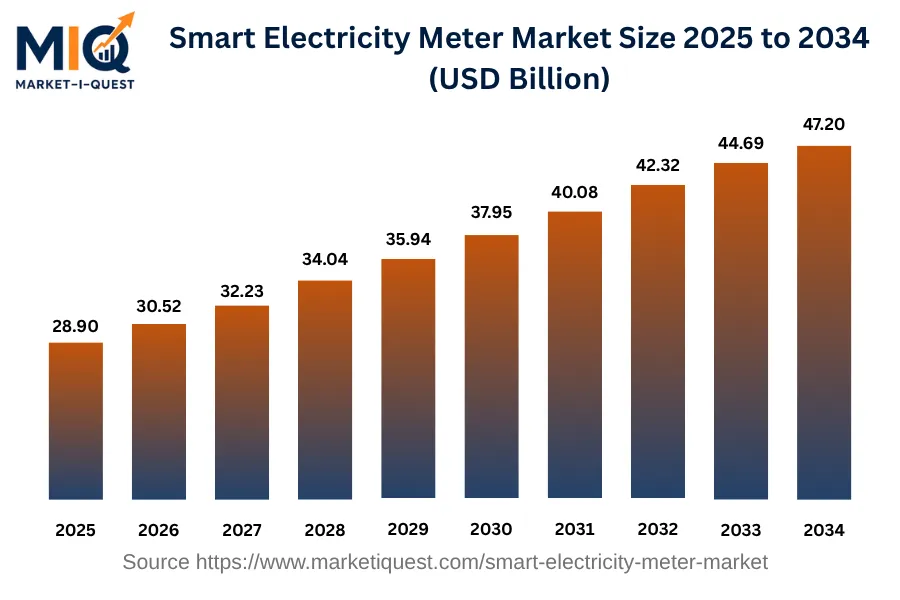
The Smart Electricity Meter Market valued at USD 28.90 billion in 2025 with a projection to reach USD 47.20 billion by 2034, indicating a CAGR of 5.6%. The increase in market size over forecast period highlights consistent growth. In 2024, the market size was USD 27.37 billion and within the span of one year, it experienced a positive boost to its valuation. The annual growth rate continues to accelerate resulting in a expansion of market size. In terms of regional market share in 2024, Asia Pacific accounted for the largest share at 48.96%, followed by Europe with a market share of 23.47%. North America held a considerable share with 19.92%. Whereas, regions such Latin America and Middle East and Africa received a market share with 4.08% and 3.57% respectively.

Key Takeaways

  • By Type - Single Phase Electric Meter holds a significant position.
  • By Communication Technology - Cellular is leading in the Smart Electricity Meter Market.
  • By End Use - Industrial is holding the major share of the market.
smart-electricity-meter-market market size

Key Driving Factors

Stringent Energy Efficiency Regulations

For reducing the carbon emissions and conserve energy, governments across the globe are introducing stringent energy efficiency regulations which influence the smart electricity meter market. For instance, European Union's Energy Efficiency Directive 2012/27/EU mandates implementation of smart metering systems that enable frequent and detailed feedback on energy consumption. Therefore, utility providers are driven towards replacing traditional meters with smart electricity meters to comply with these regulations. Thus, this highlights a significant demand in the smart meter market, as these devices offer much higher energy usage insights and control over energy consumption.

Increasing Need for Accurate Billing and Reduced Meter Reading Cost

The traditional way of meter reading is labor-intensive and prone to errors, leading to inaccurate billing. Smart electricity meters overcome these challenges, as they offer remote meter reading capabilities, ensuring better accuracy in billing and significantly reducing operational costs for electricity providers. Consumers benefit from accurate and near real-time usage data, which allows them to efficiently managing the energy consumption, potentially leading towards saving the costs. This shift towards smart meters highlights a significant growth for both electricity companies and their customers, driving up demand in smart electricity meter market.

Market Evolution by Timeline

2019-2023
During this period, smart electricity meter market experienced significant transformation. Major buyer included utility companies and governments in North America, Europe and Asia focused on improving structure reliability. Suppliers such as Landis Gyr or Itron integrated IOT and communication technologies for remote meter reading and load management. The introduction of policies such European Union's 3rd Energy Package fostered market growth. In terms of pricing, long-term contracts with comprehensive customer service were prevalent. It prompted many utility providers to seek financial incentives or regulatory requirements from governments to support adoption.
2024
In 2024, the smart electricity meter market expanded with rising interest in smart homes and energy-efficient solutions. However, global buyers majorly included homeowners and small businesses seek solutions for reducing the energy bills. Whereas, technology started delivering more refined data visualization tools and demand response programs with seamless integration with home automation systems. Regulation was also present, with the continuation of legislation encouraging use of smart meters such as UK's Smart Metering Implementation Program. With a shift in pricing with suppliers favoring rental or usage-based models over outright sale. Thus, this year played a major role in the significant growth of the market.
2025-2029
With constantly growing demand for smart meters is likely to seen in this period with advanced economies leading in terms of adoption. Key buyers in this period will likely include city administrations and utility service providers with interest in optimizing energy distribution in urbanized areas. Regulators such as U.S. National Institute of Standards and Technology with will be focusing on drafting standards for technology interoperability and consumer data privacy. Commercially, as cost of devices fell, suppliers are likely to offer more affordable and varied models for serving to diverse customer needs. Thus , this period is likely to show rising demand within the market.
2030-2034
From 2030 to 2034, it's likely that smart electricity meters will obtain wider acceptance across residential, commercial and industrial spaces globally. The shifting preferences for sustainable living and carbon-neutral industrial processes is likely to lead this growth. Tech advancements could include real-time predictive analysis based on consumption patterns. Standards such as ISO/IEC 27000's Information security and data privacy will likely continue to play a prominent role. Collaborations within technology companies and utility providers will likely to aim for integrated and interoperable energy solutions. Thus, this forecasted period is likely to attract various sectors globally.

Future Market Outlook

Future Opportunities

In light of current technological and regulatory developments, smart electricity meter market has multiple promising opportunities on horizon. The ongoing global shift towards decarbonization is encouraging investments in smart metering technologies, as evidenced by UK's commitment to implementing smart meters as part of its Net Zero by 2050 strategy. This regulatory landscape presents opportunities for companies focusing on grid modernization and energy management solutions. Moreover, recent amendments to EU Electricity Regulation, effective from January 2023, mandated roll-out of smart meters under certain conditions, thereby providing a strong foundation for future market growth. Furthermore, as countries in Asia-Pacific enhance their electric grid infrastructure, nations like India are increasingly adopting smart meters to support their renewable energy targets, with 2021 National Smart Grid Mission as major impetus. The rising consumer demand for greater transparency in energy consumption may lead to increased digital services and customer engagement platforms. Additionally, utilities can capitalize on advancements in data analytics and machine learning to enhance operational efficiencies. The convergence of electric vehicles and smart metering will also open new avenues in demand response programs. Utility providers that embrace these trends and align their offerings with evolving regulatory frameworks will likely find a competitive edge in this dynamic market landscape.

Segmentation Analysis

By Type

The market is divided into subsegments including Single Phase Electric Meter and Three Phase Electric Meter. The Single Phase Electric Meter subsegment accounted for the largest revenue share while the Three Phase Electric Meter is expected to grow at the fastest CAGR during the forecast period.

Largest Revenue Share

Single Phase Electric Meter

Market Share Leader

Single phase electric meters have traditionally held the largest market share. These meters are typically used in residential properties due to their simplicity, cost-effectiveness and adequacy for low-power demands. Major driver of their dominance is the high volume of residential customers, which significantly outnumbers industrial and commercial customers using three phase electric meters. Geographically, largest revenue is driven by areas with high population density and extensive residential infrastructure. Due to their widespread usage and high frequency of replacement, they consistently generate substantial revenue. Increasing urbanization worldwide also contributes for maintaining their revenue. However, for maintaining the market position, these meters need to evolve and adapt with modern energy demands, such as integrating with smart energy solutions. Thus, longevity and stable requirement for single phase meters in residential sectors highlights their leading revenue share in this market.

Fastest CAGR

Three Phase Electric Meter

Forecast Period Growth Leader

The Three Phase Electric Meter is expected to achieve the fastest CAGR in forecast period. Three phase electric meters, typically used in commercial and industrial settings, promise faster growth due to increasing industrialization and commercialization. Adoption barriers are primarily driven by higher initial investments compared to single-phase meters, but return on investment is quicker due to efficiency and reliability. Catalysts for growth include progressive energy policies, increased investment in industrial infrastructure and new technology. For instance, the wider implementation of smart grids and renewable energy projects will necessitate use of three-phase meters. In terms of near-term risks, slowing economic growth and industrial output could hinder projected growth. But strategic partnerships, government programs supporting industrial growth, and push for energy-efficient solutions are expected to counteract these risks. This paragraph assumes that growth in industrial and commercial energy consumers will outpace that of residential consumers.

By Communication Technology

The market is divided into subsegments including Power Line Communication (PLC), Radio Frequency (RF), Cellular, and Others. Cellular accounted for the largest revenue share while Power Line Communication (PLC) is expected to grow at the fastest CAGR during the forecast period.

Largest Revenue Share

Cellular

Market Share Leader

In the communication technology market, cellular subsegment has emerged as the largest revenue earner. This can be attributed to ubiquitous use of cellular technology worldwide, encompassing both developed and developing regions. Cellular technology, powered by its comprehensive coverage and continuous improvements in speed, reliability, and data capabilities, has become a vital component of communication infrastructures around the globe. Smartphones, IOT devices, and an array of other consumer electronics primarily rely on cellular technology for their connective needs, thereby boosting revenue generation. Furthermore, strong support by regulatory bodies, coupled with robust network supply chains, continues to favor growth of this subsegment. High adoption rate of cellular technology is fueled by its easy availability, affordability, and simplification of complex tasks, proving to be key factor in purchasing decisions. Focused, concerted efforts in ensuring wide-scale global cellular network coverage, as well as high switching costs associated with changing communication infrastructure, further cement its position as segment with largest revenue.

Fastest CAGR

Power Line Communication (PLC)

Forecast Period Growth Leader

While cellular subsegment maintains a lead in revenue, Power Line Communication (PLC) is projected to have fastest growth in relative terms. Driving this acceleration are distinct advantages of PLC, like cost-effectiveness, efficient energy management, and streamlined integration with existing infrastructures. Anticipated growth is further bolstered by proposed smart grid projects and energy management initiatives in the world. Despite market barriers like noise interference and limited range, investments in this technology and partnerships to overcome these hurdles are on upswing. Furthermore, introduction of Smart Home concepts and continued growth of Industry 4.0 is expected to dramatically accelerate the adoption of PLC in near future. Throughout this transformation, regulatory policy will play a crucial role in defining extent and pace of PLC adoption. Despite its current nascent stage, if these favorable conditions persist, PLC is set to outpace other subsegments in terms of CAGR for the foreseeable future.

By End Use

The market is divided into subsegments including Residential, Commercial, and Industrial; where Industrial segment accounted for the largest revenue share while the Residential sector is expected to grow at the fastest CAGR during the forecast period.

Largest Revenue Share

Industrial

Market Share Leader

During base year 2024, Industrial subsegment reported highest revenue share. Numerous factors contribute to this leading position. The Industrial sector generally features large-scale operations which necessitate bulk procurement of goods and services, thus driving substantial market revenue. Diverse industries like manufacturing, utilities, construction, and mining form this segment, each demanding specific market products. Geography plays a role with industrialized nations contributing significantly to the market. Furthermore, industrial standards and regulations often stipulate use of certain goods and services, underpinning consistent demand. Hence, purchasing criteria in this sector are predominantly influenced by regulatory compliances, product quality, and supplier dependability. Switching costs could be high, thus ensuring a stable customer base for market players. The business-to-business (B2B) model is the primary channel of operation, facilitating sizeable transactions. The diversification and vastness of the industrial segment, thus, explain its dominant revenue contribution.

Fastest CAGR

Residential

Forecast Period Growth Leader

With robust growth perspective, Residential segment is projected to grow at the fastest CAGR during forecast period. An array of growth drivers propel this subsegment. Population growth and urbanization trends are stimulating residential demand for goods and services. Technological advancements and greater product accessibility are reducing adoption barriers while improving product use in daily household activities. Furthermore, government policies promoting residential sustainability are acting as catalysts for market growth in this segment. But costs, particularly capital expenditure (capex), remain an adoption barrier for some households. There also lie near-term risks like market volatility and potential shifts in consumer preferences, which need to be monitored. Nevertheless, through strategic partnerships with local vendors and an overall favorable policy environment, the residential segment holds significant growth potential.

Competitive Analysis: Smart Electricity Meter Market

Key Market Players

Manufacturers / OEMs

Itron Inc.
US
Landis+Gyr
Switzerland
Siemens AG
Germany

Key Suppliers & Raw Materials

ABB Group
Switzerland
Hitachi Ltd.
Japan
Schneider Electric
France

Distributors, Integrators & Channel Partners

Hans Sasserath & Co. GmbH
Germany
Holley Metering Limited
China
Wasion Group
China

Porter’s Five Forces Analysis

An analysis of the competitive forces in the Smart Electricity Meter Market.

Supplier Bargaining Power

Medium

Suppliers gain power due to technological advancements and control over raw materials.

Buyer Bargaining Power

High

Many alternatives and low switching costs increase buyer power.

Threat of Substitutes

Low

Few alternatives to smart electricity meters, creating lower threat of substitutes.

Threat of New Entrants

Medium

High initial investments yet booming smart grid sector may invite new entrants.

Competitive Rivalry

High

Many established manufacturers in the market intensify competition.

Regional Analysis

Geographic market dynamics and growth opportunities across key regions

Global Market Outlook

smart-electricity-meter-market market regional share

North America

In 2024, the North American smart electricity meter market characterized by dynamic growth, due to various key drivers and emerging trends. Heightened adoption of renewable energy sources such as wind and solar power significantly drove demand for these devices, which efficiently measure and manage irregular energy sources. Regulatory initiatives such as by U.S. Federal Energy Regulatory Commission, encouraged investment and technology adoption, driving utilities for upgrading their infrastructure. Strong supply dynamics played a role, with innovative technologies emerging from leading manufacturers in Canada, Mexico, and U.S.

With increased consumer awareness led to rise in energy-conscious practices and buyers increasingly sought out smart energy solutions. Technological shifts were marked by rise of advanced metering infrastructure with the ability for handling advanced data analytics. Significant mergers and acquisitions took place within utility sector, particularly in U.S., leading to new service offerings and pricing models. Notably, policy enforcement with government incentives in all three countries promoting adoption of smart electricity meters across various sectors such as healthcare, manufacturing and retail. Thus, these drivers and trends highlighted an evolving landscape in 2024 for the North American smart electricity meter market highlighting its importance for a sustainable energy future.

Asia Pacific

In 2024, smart electricity meter market in Asia Pacific experienced substantial growth driven by increasing digitization in energy management and rising demand for precise energy usage data. With high investments in smart grid projects, particularly in regions such as China, Japan and India, significantly accelerated adoption of smart electricity meters. Regulatory bodies across India and ASEAN markets implemented strict regulations regarding energy conservation significantly driving utility providers to deploy smart meters. In Australia, mandatory introduction of smart meters led to increased market reach.

Key market trends include an observable shift towards use of Automated Meter Reading (AMR) technology and Advanced Metering Infrastructure (AMI) in Japan and South Korea. This technology adoption was largely driven by government enterprises aiming to improve energy efficiency. A rising number of partnerships and M&A activities were noted among smart meter manufacturers, encouraging technology sharing and product innovations. Noticeably in China, robust policies enforcing smart meter integration into existing utility systems were in place, outlining energy conservation directives.

The main customers for Smart Meters were from utilities sector, followed by manufacturing industry. Consumers' increased awareness of energy conservation and management across various enterprises also marked a significant market trend. Demand from retail industry was relatively limited in Asia Pacific but showed steady growth rate in base year 2024.

Europe

In the base year 2024, the smart electricity meter market in Europe highlighted an increase boosted due to regulatory mandates and a drive towards energy efficiency. Technological enhancements and growing investments across the region, particularly in Germany, United Kingdom, France, Italy, Spain the Nordics, Benelux and Central Eastern Europe. Large scale deployment, driven by government mandates such as Britain’s national roll-out policy.

Stringent energy efficiency norms reinforced robust adoption rates amongst key sectors, including utilities, retail, and manufacturing. Rapid technological adoption was observed throughout Europe, augmented by factors like pricing, supply dynamics, and increased investments in smart grid infrastructure. Government involvement, particularly in Germany and UK played crucial roles in driving smart meter technology adoption. Trends in 2024 market pointed towards consumers' increasing interest in real-time energy use monitoring, stimulating transition from conventional meters to integrated smart metering systems. A wave of consolidation swept market, with major players like Siemens and ABB expanding their portfolio through strategic acquisitions. The focus sharpened on data security standards, highlighting significant policy reforms in countries like France and Spain, ensuring robust measures for data protection. Thus, despite challenges, regulatory support and technological advancements marked the undercurrent of the smart meter landscape in Europe during 2024.
Latin America

In 2024, the Smart Electricity Meter Market in Latin America showed marked activity, notably in Brazil, Mexico, Argentina, Colombia, Chile, and Peru. The dominance of this market was primarily driven by increasing investment in energy sector by these governments. They sought to modernize their infrastructure and improve grid reliability, making smart meters viable choice. Increased consumer demand for efficient energy use and management in households and businesses was equally notable. Equitel's technology adoption in billing systems and grid management in Brazil and Argentina underscored supply-side evolution.

Major trends included surge in pairing of smart meters with home automation systems, where consumers showed high preference for energy-saving appliances. Innovative entrants, like Telemetria, reshaped market dynamics by introducing affordable smart meter units offering real-time data, particularly popular among Mexico and Peru's retail sectors. Regulatory pressure for energy efficiency, like Chile's Energy Efficiency Law, drove adoption rates especially in enterprise and utilities sectors. Mergers and acquisitions emerged as a common strategy for industry consolidation and market expansion, shown in notable acquisition of MeterSYS by Colombia's InterEnergy Group. Lastly, shift towards stricter policy enforcement was observed, particularly in implementation of Argentina's Resolution 341/2016, mandating installation of smart meters.

Middle East & Africa

In 2024, Middle East and Africa Smart Electricity Meter Market depicted significant growth transformation upheld by distinctive forces. Technological adoption across pivotal sectors, including utilities, oil and gas, telecom, and manufacturing propelled deployment as these sectors aimed to leverage precise energy consumption data. Regulatory mandates in countries like Saudi Arabia and South Africa advanced adoption, as governments enforced energy efficiency practices. Investments also fuelled the market, with Qatar and United Arab Emirates concentrating on infrastructure development to support smart grids.

Market trends were characterized by a shift in buyer preference towards digitization of metering infrastructure, identifying accurate tracking as an important method for cost-cutting. In Israel, partnerships blossomed as local companies joined hands with international entities to enhance meter technology and deployment. Standardization of smart meters in Egypt and Nigeria enforced compatibility and interoperability, enhancing utility management. Meanwhile, South Africa and Kenya innovated with prepayment functionalities in their smart meters, enabling user-friendly transactions in residential and commercial applications. Despite various challenges, the market's dynamism in 2024 proves effective influence of these drivers and trends.

Recent Industry Developments

Latest market innovations, product launches, and strategic initiatives

May 2026

The new "Post 2025 Smart Metering Policy Framework" officially came into force, replacing previous national targets framework. It establishes a strict legal obligation for energy suppliers to complete domestic smart meter rollout by end of 2030 and mandates pre-emptive upgrade of all existing communications hubs to 4G networks before 2G/3G network switch-off in 2033.

April 2026

The Central Electricity Authority (CEA) officially rolled back mandatory "prepayment or prepaid mode" requirement for smart meter installations. This major policy reversal removes a critical operational bottleneck, allowing utilities to continue deploying smart infrastructure in areas with weak cellular connectivity without being forced to operate prepay billing by default.

February 2026

Adani Energy Solutions Limited (AESL) became first Advanced Metering Infrastructure Service Provider (AMISP) in the region to successfully deliver 1 crore (10 million) smart meters across various distribution networks. Executing at a rate of roughly 25,000 meters per day, this massive physical deployment milestone was reached ahead of their projected March 2026 deadline.

Frequently Asked Questions