
Small Arms & Light Weapons Market Snapshot

Key Players

  • Sturm
  • Ruger & Co. (United States)
  • Heckler & Koch (Germany)
  • Beretta (Italy)
  • Lockheed Martin (United States)
  • Norinco (China)
  • Taurus (Brazil)
  • Kalashnikov Concern (Russia)
  • FN Herstal (Belgium)
  • Colt's Manufacturing Company (United States)
  • Thales Group (France)

Market Size

Base Year 2024
$10.56 Bn
CAGR
7.4%
Forecast 2034
$21.56 Bn

Market Segments

By Type
Handguns, Rifles, Submachine Guns, Shotguns, Machine Guns, Grenade Launchers, Mortars, Anti-Tank Weapons
By Action
Manual, Semi-Automatic, Automatic
By Caliber
5.56 mm, 7.62 mm, 9 mm, 12.7 mm, 14.5 mm
By End User Industry
Military & Defense, Law Enforcement, Civil & Commercial

Market Dynamics

Drivers
  • Rising global security concerns
  • Increasing military budgets
Restraints
  • Stringent regulatory policies
  • High manufacturing costs
Opportunities
  • Rise in defense expenditure
  • Advancements in arms technology

Market Size

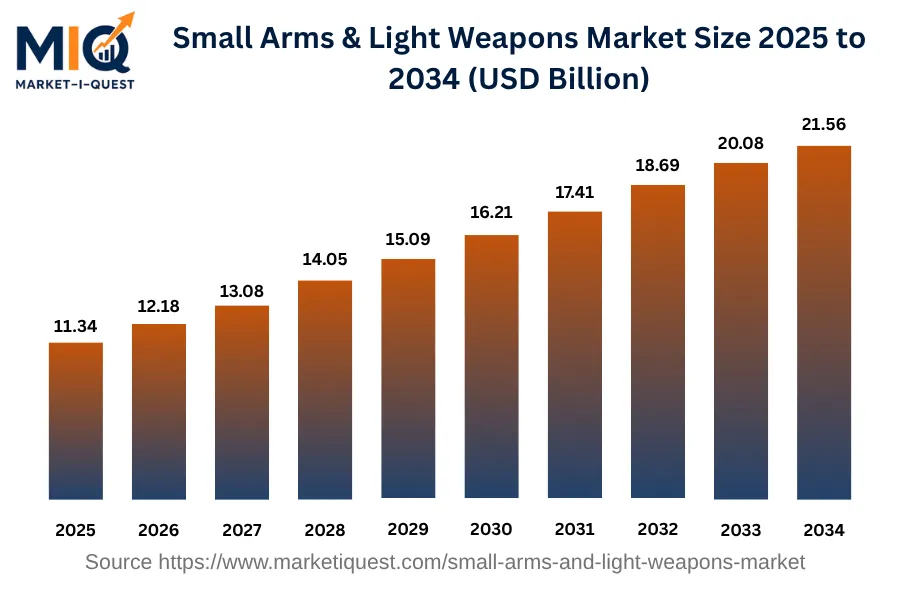
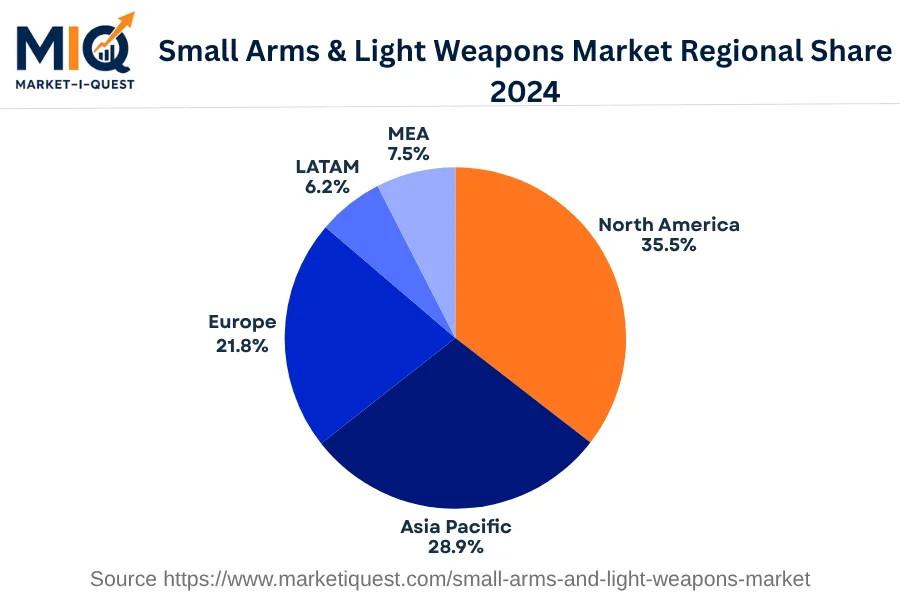
The Small Arms & Light Weapons Market is set to witness considerable growth from 2025 to 2034. As of 2024, the market size stood at 10.56 billion USD, which is expected to increase to 11.34 billion USD in the following year. By the year 2034, the market size is projected to more than double, reaching impressive 21.56 billion USD. The rate of increase in market size over this period is represented by a CAGR of 7.4%. This rate suggests a consistent growth in the demand for small arms and light weapons over a decade. This growth is driven by increasing military expenditure, technological advancements, and the growing demand for advanced weaponry for security purposes. On a regional basis in the year 2024, North America accounted for the largest market share at 35.48%, followed by Asia Pacific at 28.93%, Europe at 21.84%, the Middle East and Africa (MEA) at 7.54%, and Latin America (LATAM) held the smallest share of 6.21%. The distribution of these shares sheds light on the global market dynamics influencing the small arms & light weapons market.

Key Takeaways

  • By Type - Handguns led the market accounting for a substantial share in the base year.
  • By Action - Automatic weapons held a dominant position in the industry in the last recording year.
  • By Caliber - 7.62 mm firearms grew fastest significantly expanding their share in the Small Arms & Light Weapons Market.
  • By End User Industry - Military and Defense accounted for a noteworthy position in the base year.
small-arms-and-light-weapons-market market size

Key Driving Factors

Intensified Conflict Zones & Asymmetric Wars

There has been a cognizable surge in the number of localized and asymmetric conflicts globally. Conflicts in the Middle East, Africa, and Eastern Europe necessitate the procurement of small arms & light weapons by local security forces and non-state actors. These conflicts involve asymmetrical warfare methods, where one party is usually an organized force and the other, a decentralized network of dispersed individuals or groups. For these non-state actors as opposed to organized military forces, the availability, affordability, and easiness to use these arms are driving their demand. The diversified range of small arms & light weapons suitable for such scenarios spices up the market figures. Thus, the intensity of these conflicts directly impacts market dynamics.
Heightened National Security Concerns & Law Enforcement Adaptations

In recent times, national security threats have escalated across the globe due to terrorism, border intrusions, insurgency, and violent crimes. As a result, governments are under more pressure than ever to reinforce their military power and law enforcement agencies. Consequently, procurement of small arms & light weapons, used for self-defense, close quarters battle, and other vital operations has consequently risen. Meanwhile, city police units are increasingly adopting these arms as they enhance their ability to respond swiftly and efficiently to urban crimes and terrorist threats. This heightened level of concern for national security and modernization of police forces are crucial driving factors in this market.

Market Evolution by Timeline

2019-2023
During this period, prominent buyers included military and law enforcement agencies in North America and Europe, seeking new acquisition to replace conventional weapons. There was an emphasis on advanced technology integration, with semi-automatic and automatic firearms gaining traction due to their increased firepower and efficiency. Regulations like the US Gun Control Act influenced adoption, restricting person-to-person firearms transfer without a valid Federal Firearms License. There was a distinct trend toward long-term supply contracts with options for further procurement. The limitation faced in this period was the rising concern about collateral damage and unintended harm to civilians, which resulted in cautious procurement decisions.
2024
In 2024, the market saw utmost demand from conflict-prone regions, primarily Middle East and Africa, for self-defense and counter-insurgency operations. An interesting shift was observed toward non-lethal weapons such as rubber bullets, water cannons, and tear gas, aiming to minimize civilian casualties during conflict resolutions. Regulatory measures like the ITAR (International Traffic in Arms Regulations) saw enforcement, controlling the export of defense-related articles including small arms. A challenge faced was the increased smuggling of arms, likely due to lax border controls and corruption, necessitating tighter security measures.
2025-2029
This period saw growing attention towards investment in arms research and development, with an emerging focus on developing technologically advanced laser, electromagnetic, and plasma weaponry. Asia-Pacific demand grew noticeably due to increasing border tension and territorial disputes, promoting the procurement of advanced weaponry. Regulatory framework like the Berlin Conference on Small Arms and Light Weapons came into play, establishing guidelines for global arms transactions. Partnerships between manufacturers and tech firms for smart weaponry witnessed a surge, introducing a higher level of precision and reducing collateral damage. The persistent risk was of these weapons falling into wrong hands due to inadequate safety and control.
2030-2034
Across these years, cyber-security agencies joined traditional buyers of small arms as a response to escalating cyber threats. Cybersecurity firms started procuring light weapons for their defense personnel, perceived as a new trend. Supply-wise, 'smart guns' employing biometric technology reached wider acceptability. The Wassenaar Arrangement, an international arms control regulation, played a significant role, particularly in inter-country transactions. Procurement contracts now included clauses for mandatory training of personnel by the weaponry manufacturers. The major bottlenecks were the ethical considerations around the use of AI in defense, and potential human rights concerns around non-disclosure of proprietary defense tech.

Future Market Outlook

Future Opportunities

Opportunities in the small arms and light weapons market are likely to emerge from the ongoing policy changes and collaborative defense initiatives across various countries. For example, the European Union's Common Security and Defence Policy emphasizes collaborative defense measures, creating fertile ground for joint procurement initiatives. The demand for advanced training systems is rising, illustrated by the U.S. military's investment in virtual training environments capable of simulating combat scenarios for lighter firearms. Countries like Australia are proactively enhancing their military capabilities by integrating unmanned systems with traditional small arms, which could create new procurement frameworks targeting both sectors. Additionally, the escalating need to combat threats from non-state actors has prompted several nations, such as India and Israel, to develop indigenous platforms tailored for specific tactical scenarios. In July 2023, the UN introduced new arms trade regulations that may lead to an increased focus on compliance among manufacturers, creating opportunities for companies specializing in regulatory frameworks. Moreover, as the demand for civilian firearm ownership rises in regions like the United States, manufacturers are likely to explore new consumer markets, balancing compliance and safety as key drivers. Overall, these evolving geopolitical dynamics and regulatory frameworks signal a continuous evolution in the design, manufacturing, and deployment of small arms, fostering a complex but promising landscape for future growth.

Segmentation Analysis

By Type

The market is divided into subsegments including Handguns, Rifles, Submachine Guns, Shotguns, Machine Guns, Grenade Launchers, Mortars, and Anti-Tank Weapons. Handguns generated the largest revenue, while the Anti-Tank Weapons subsegment is projected to grow at the quickest rate over the coming years.

Largest Revenue Share

Handguns

Market Share Leader

Handguns, due to their diverse uses, compact size, and affordability, dominated the market in terms of revenue generation. Organizations, law enforcement agencies, and civilians are key customers, as handguns serve multiple purposes including self-defense, sports, and marksmanship competitions. Even the geographic orientation of this market is wide, with North America currently leading market share due to a high percentage of civilian firearm possession. Strict firearm regulation in other countries does create a barrier, but manufacturers are continually focussed on creating innovative, user-friendly designs, better accuracy, and an increased range which allows for market growth. In addition, handguns, requiring less training and reduced switching cost compared to other firearm types, remain a consumer favourite.

Fastest CAGR

Anti-Tank Weapons

Forecast Period Growth Leader

Anti-Tank Weapons, simultaneously being ancient yet surprisingly resilient, are projected to grow at the fastest rate. Enhancements in technology, partnerships between national governments and arms manufactures, and increased defence capital expenditure particularly in Asia, the Middle East, and Eastern Europe are catalysts for growth. Moreover, the changing nature of warfare is slowly shifting towards urban combat where the efficiency of Anti-Tank Weapons in neutralizing enemy infrastructure and armored threats is directing attention towards their demand. Adoption barriers include the high expense of these weapons and the regulatory limitations on their sale, particularly involving cross-border deals. Near-term risks also include the potential for policy changes and public opinion against these weapons; however, the overall growth is expected to outpace these factors.

By Action

The market is divided into subsegments including Manual, Semi-Automatic, and Automatic. The Automatic subsegment accounted for the largest revenue share while the Manual subsegment is expected to grow at the fastest CAGR during the forecast period.

Largest Revenue Share

Automatic

Market Share Leader

The automatic subsegment of this market leads in revenue due to several key factors. The foremost among these factors is the advanced technology that it utilizes, giving it a superior efficiency and adherence to quality control. Industries are increasingly automating their processes to increase output, cut costs and minimize errors, creating a higher demand for automatic solutions. Consumers are willing to pay a premium for these advantages, contributing to the higher revenue of this subsegment. Geographically, regions with a strong industrial base and higher labor costs have a larger demand for automation, further fueling the high revenue. Regulatory pushes towards safety and quality control are also playing a significant role, as automatic solutions better adhere to stringent regulations. The purchasing criteria also lean towards automation due to its higher capacity and efficiency, providing a higher return on investment in the long run. The high switching costs from manual or semi-automatic to fully automatic solutions also maintain the automatic subsegment's revenue leadership.

Fastest CAGR

Manual

Forecast Period Growth Leader

Despite the predominance of automation, the manual subsegment is projected to witness the fastest growth in the coming years. The primary reason for this is the low barrier to entry and adoption for manual solutions in regions with lower labor costs where automation is not economically viable. Moreover, the manual segment is better able to deal with complex customization requirements or small batch production, which are becoming more prevalent in today's fast-changing market. The advent of new technologies is likely to have a lesser impact on this subsegment due to its inherent flexibility. However, the sustainability of this growth may be a concern due to potential policy changes promoting automation and a gradual increase in capital expenditure on automated solutions. Collaborations and partnerships can help manual subsegment players to augment their growth and mitigate the risk of market share erosion to their automated counterparts.

By Caliber

The market is divided into subsegments including 5.56 mm, 7.62 mm, 9 mm, 12.7 mm, and 14.5 mm calibers. In 2024, 7.62 mm caliber accounted for the largest revenue share while 5.56 mm is expected to grow at the fastest CAGR during the forecast period.

Largest Revenue Share

7.62 mm

Market Share Leader

The 7.62 mm caliber subsegment leads in revenue generation due to its widespread use in both military and civil sectors. This caliber is universally acknowledged for its versatility, penetrating power and range, making it an ideal choice for a variety of firearm applications including hunting, target shooting, and self-defense. These factors drive high-volume purchases globally. Regulatory favorability towards this caliber, rooted in its longstanding use in multiple nations' armed forces, further cements its dominance in the market. The established supply chains for 7.62 mm caliber ammunition, marked by extensive distribution networks as well as streamlined manufacturing methods, contribute to its strong market position. The purchasing criteria for users mainly revolve around ammunition effectiveness and reliability, criteria which 7.62 mm meets excellently. Any switching costs are also mitigated by its comparative affordability.

Fastest CAGR

5.56 mm

Forecast Period Growth Leader

The 5.56 mm caliber subsegment is projected to be the fastest-growing in the caliber market. Its growth is supported by key driving factors such as its increasing use in military operations, driven by its characteristics of lightness and high velocity making it ideal for close quarters combat. Technological advancements have led to more compact and versatile firearms that are compatible with 5.56 mm ammunition, promoting adoption and growth in this subsegment. Added to this, partnerships between ammunition producers and firearm manufacturers are set to catalyze growth in the 5.56 mm subsegment. However, potential near-term risks such as changes in military procurement policies or regulatory changes impacting the sale and use of ammunition should be monitored closely. Such factors could pose temporary setbacks to the subsegment's otherwise promising growth trajectory.

By End User Industry

The market is divided into subsegments including Military & Defense, Law Enforcement, and Civil & Commercial. Military & Defense accounted for the largest revenue share while Civil & Commercial is expected to grow at the fastest CAGR during the forecast period.

Largest Revenue Share

Military & Defense

Market Share Leader

The Military & Defense subsegment is the leading revenue contributor in this market sphere as of 2024 mainly because of increasing global defense budgets and the high reliance on innovative technology for security intentions. Military organizations globally require state-of-the-art equipment and solutions to stay ahead of potential threats, which heavily contributes to the sector’s revenue. The crucial need for surveillance, communication, and combat equipment in this sector also propels its revenue growth. This segment's success can also be attributed to the nature of the military and defense industry's buying patterns, characterized by large, regularly set contracts, and ongoing innovation. Despite regulatory challenges and rigorous standards, supplier-customer relationships in this industry tend to be long-term, resulting in a somewhat consistent revenue flow. Given that defense is often a national priority, this subsegment is expected to continue leading in revenue generation.

Fastest CAGR

Civil & Commercial

Forecast Period Growth Leader

The Civil & Commercial subsegment is predicted to witness the fastest CAGR in the forecast period. This growth can be credited to the increasing adaptation of technological advancements within the commercial sector. It has been observed that businesses are continuously looking for opportunities to leverage new technologies to enhance their operations and offer a more sophisticated service offering. Partnerships and collaborations with tech providers are becoming more prevalent and significantly drive the growth of this subsegment. Moreover, regulatory norms favoring commercial application of various solutions are also acting as catalysts for growth. The digital transformation trend among businesses and the growing need for improved commercial infrastructure are key drivers of this growth. However, substantial initial Capex and data privacy concerns pose challenges to this rapid growth. Maintaining this high growth rate will require overcoming these hurdles while sustaining technological advancements.

Competitive Analysis

Key Market Players

Manufacturers / OEMs

Lockheed Martin Corporation
US
Raytheon Company
US
Northrop Grumman Corporation
US

Key Suppliers & Raw Materials

Allegheny Technologies Incorporated
US
Carpenter Technology Corp.
US
BAE Systems
UK

Distributors, Integrators & Channel Partners

FN America, LLC
US
Thales Group
France
Hunting Plc
UK

Porter’s Five Forces Analysis

The five forces analysis provides an overview on competition, power dynamics, and potential challenges in the Small Arms & Light Weapons Market.

Supplier Bargaining Power

Medium

Controlled supply due to stringent regulations, but diversified sourcing options.

Buyer Bargaining Power

Low

Limited negotiation power for buyers due to legal limitations and specialized product requirements.

Threat of Substitutes

Low

Lack of viable substitutes due to specific performance specifications and safety requirements.

Threat of New Entrants

Low

High barriers to entry due to stringent regulations, safety standards, and high capital investment.

Competitive Rivalry

High

Fierce competition among established manufacturers, fueled by technological advances and international tensions.

Regional Analysis

Geographic market dynamics and growth opportunities across key regions

Global Market Outlook

small-arms-and-light-weapons-market market regional share

North America

In 2024, the North American market for small arms and light weapons was defined by persistent demand and evolving regulations. Tariffs on imported firearms influenced American manufacturers to invest in local production, subsequently driving up the price of small arms and light weapons. In Mexico, federal regulations limiting gun ownership influenced a rise in black market demand, while in Canada, the adoption of advanced firearm safety technology saw an increase in consumer purchasing.

Trends included an increased demand from the government sector for higher-caliber firearms in the United States, stemming from an upsurge in defense allocations. Meanwhile, Mexico witnessed a greater private security industry demand, fuelled by public safety concerns. Online shopping for firearms also gained momentum in the United States and Canada due to enhanced regulations and identification protocols. Partnerships between American manufacturers and Canadian technology firms were observed, focused on developing smarter, safer firearm solutions. The enforcement of stricter gun laws saw a rise in the popularity of 3D printed weapons, adding a new dimension to the unregulated weapons market. In the U.S, arms were primarily purchased by government agencies, law enforcement and private security firms. In Canada, the customer base was predominantly sport shooters and hunters, while Mexican purchases were heavily swayed towards private security contracts. Private gun ownership remained consistent across all three countries.

Asia Pacific

In 2024, the Small Arms & Light Weapons (SALW) market in the Asia Pacific demonstrated robust dynamism, fueled by diverse factors. Regional conflict hotspots and security concerns stimulated demand, particularly in China, India, and key ASEAN markets. Governments increased defence spending, exerting a particularly notable impact on SALW imports to Japan and South Korea. In contrast, Australia prioritized investing in advanced technology solutions to manage the illegal flow and use of these weapons.

Changes in buyer behavior marked key trends within the sector. The government sector, primarily military and law enforcement, asserted its position as the main buyer of SALW. Amid rising regional tensions, an observable preference emerged for technologically advanced, easy-to-use SALWs - a shift seen in China's adoption of next-generation light weapons. Channel operations also witnessed a change, with frequent partnerships formed between countries to ensure efficient SALW supply chains, predominantly in India. Enforcement of global arms control standards surfaced as a pivotal driver, particularly in ASEAN countries striving to adhere to the UN's Arms Trade Treaty.

Overall, the Asia Pacific SALW markets in 2024 reflected a blend of heightened insecurity, increased defence budgets, adoption of sophisticated weaponry, and adherence to international arms control norms. A mix of these complex drivers and patterns substantially influenced the region's SALW dynamics in 2024.

Europe

In 2024, the European market for small arms and light weapons was characterized by distinct strategic priorities. Market drivers were primarily influenced by heightened security concerns, stricter regulations, and an emphasis on technological advancements. The increased threat of domestic and international terrorism drove European countries like Germany and the UK to invest more in defense and security systems, thereby driving demand for small arms and light weapons. Moreover, regulatory bodies in countries like France and Italy imposed tighter controls on the sales and utilization of these weapons, influencing the market dynamics significantly. Technological advancements played a crucial role, with Spain and the Nordics seeing increased adoption of smart gun technology and digitalized manufacturing processes.

In terms of trends, buyer behavior was largely influenced by the ongoing security issues within geopolitical hotspots in Central and Eastern Europe. Advanced technologies, ranging from GPS-enabled firearms to biometric gunlocks, became an integral part of the market. Distribution channels saw a shift towards government procurement and direct deals with manufacturers. Additionally, partnerships and M&A activities were prevalent, with companies in the Benelux region playing an important role. Some significant policy enforcement included the Common Position on arms export controls in the European Union, which impacted the trade of small arms and light weapons substantially.

Latin America

In 2024, the Small Arms & Light Weapons (SALW) market in Latin America exhibited a stronger demand and inclination due to governmental defense procurement, rising security concerns, and enhanced technologies. The increasing public sector investment in defense and security, particularly in countries like Brazil and Mexico, significantly bolstered the market. Moreover, stricter regulations for firearm acquisition in countries such as Argentina and Colombia indirectly amplified the demand for legal, government-approved weaponry. In the realm of technology, the adoption of smart guns with biometric features emerged as a crucial driver in the industry.

Consumer behavior showcased an increasing preference for technologically advanced products that ensured precision, safety, and durability. In Chile and Peru, governmental institutions showed a leaning towards forging partnerships with international arms manufacturers for better quality output. Digital channels for procurement also gained momentum, leading to new dynamics in the distribution system. Moreover, continuous policy enforcement to restrict illicit arms and light weapons trafficking revealed a high investment in the legal SALW market. Key sectors contributing to market growth were government, security services, and law enforcement, while customisation demands were noted especially from the private security sector. Overall, the SALW market in LATAM witnessed crucial drivers and trends originating from policy, technological enhancement, and evolving customer preferences in 2024.

Middle East & Africa

In 2024, the Small Arms & Light Weapons (SALW) market in the Middle East and Africa was evident in its dynamism. Demand drivers included increased security concerns in nations like Saudi Arabia, United Arab Emirates, Egypt, and Nigeria, resulting from political instability and terrorism. Meanwhile, in South Africa, Kenya, and Israel, advanced technology adoption and military modernization programs pushed the demand higher. Additionally, the implementation of strict regulatory frameworks necessitated nation-states to invest more in SALWs.

Changes in buyer behavior shaped the market trends during the same year. Governments, particularly in Saudi Arabia and United Arab Emirates, shifted towards more high-tech SALWs for defense and law enforcement purposes. Simultaneously, compliance with the United Nations' Program of Action to Prevent, Combat, and Eradicate the Illicit Trade in SALWs had a significant impact on the regulatory environment, influencing market decisions. Growing partnerships between local and international arms manufacturers offered new opportunities, as seen with Israeli firms teaming up with European counterparts to fulfill a rise in demand.

The SALW market in 2024 extensively engaged governments primarily for military and national security purposes, alongside private security firms. Oil and gas companies in Nigeria and the Middle East, along with financial institutions in South Africa and manufacturing firms throughout the region, also contributed to the heightened demand.

Recent Industry Developments

Latest market innovations, product launches, and strategic initiatives

April 2026

Operating as a joint venture between the Adani Group and Israel Weapons Industries, PLR Systems delivered its initial batch of 2,000 light machine guns to the Indian military, beginning the fulfillment of a larger 41,000-unit order.

October 2025

The Indian government finalized a massive procurement contract with domestic private manufacturers Bharat Forge and Adani Defence to supply 425,000 carbines for its infantry, actively replacing decades-old inventory.

October 2025

Heckler & Koch entered a strategic manufacturing partnership with South Korean defense firm SNT Motiv to jointly design and distribute new small arms for the international market.

Frequently Asked Questions