
Radiology Information System Market Snapshot

Key Players

  • Cerner Corporation (United States)
  • Allscripts Healthcare Solutions Inc. (United States)
  • Epic Systems Corporation (United States)
  • Koninklijke Philips N.V. (Netherlands)
  • Siemens Healthineers (Germany)
  • McKesson Corporation (United States)
  • GE Healthcare (United States)
  • Sectra AB (Sweden)
  • Agfa-Gevaert Group (Belgium)
  • MedInformatix Inc. (United States)

Market Size

Base Year 2024
$1.35 Bn
CAGR
9.12%
Forecast 2034
$3.23 Bn

Market Segments

By Component
Software, Services, Hardware
By Deployment Type
Cloud-Based, On-Premise
By Functionality
Radiology Reporting, Patient Management, Workflow Management, Image Management
By End User
Hospitals, Diagnostic Centers, Ambulatory Surgical Centers

Market Dynamics

Drivers
  • Increasing prevalence of chronic diseases
  • Advancements in Radiology technologies
Restraints
  • High implementation costs
  • Data security threats
Opportunities
  • Increasing digital health adaptation
  • Emerging markets growth potential

Market Size

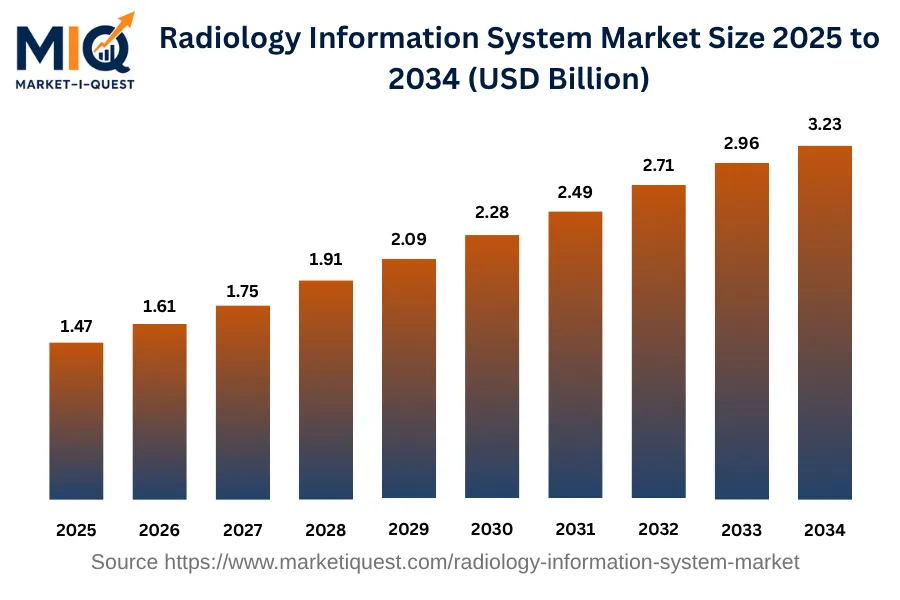
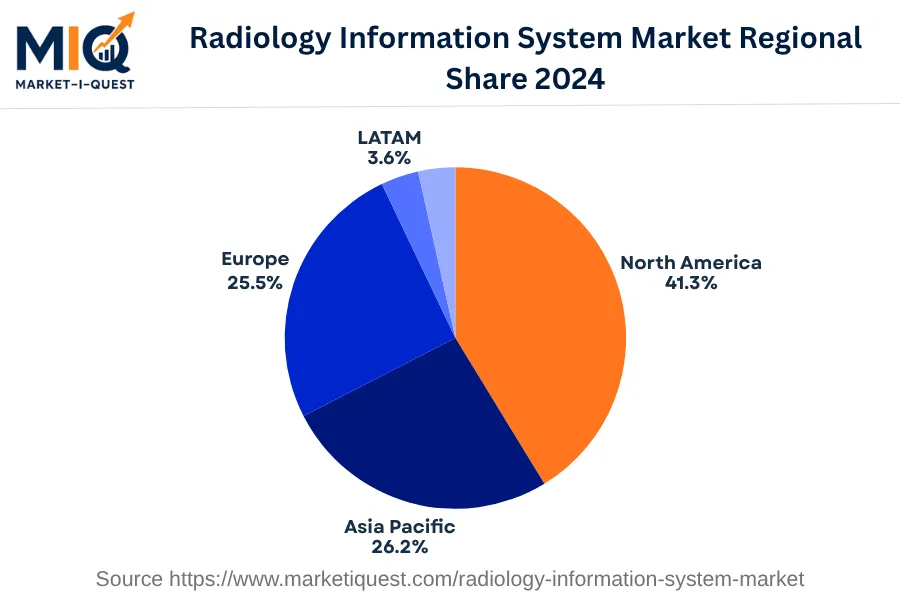
The Radiology Information System market stood at USD 1.35 billion in 2024 and increased to USD 1.47 billion in 2025. Over the decade from 2025 to 2034, there was more than a doubling of the market size, reaching USD 3.23 billion. This significant enhancement in the market size was driven by a CAGR of 9.12%. Amidst the changing landscape, the concentration of the Radiology Information System market was diverse across different regions by 2024. North America accounted for 41.3% of the market share, while the Asia Pacific held 26.2% and Europe held 25.5%. Lesser shares were claimed by LATAM and MEA, with 3.6% and 3.5%, respectively. The regional market share depiction presents a competitive picture with the market being well distributed globally.

Key Takeaways

  • By Component - Software held the commanding position with the majority share in 2024.
  • By Deployment Type - Cloud-Based systems expanded at a noteworthy CAGR from 2025–2034.
  • By Functionality - Patient Management led the market accounting for a significant share in 2024.
  • By End User - Hospitals held the major share in the Radiology Information System Market in 2024.
radiology-information-system-market market size

Key Driving Factors

Integration of Artificial Intelligence

One distinct driver in the radiology information system market is the integration of artificial intelligence (AI). Healthcare providers increasingly realise that AI can augment the capabilities of radiology systems, improving both the efficiency and the accuracy of diagnoses. For example, AI algorithms can help in analyzing radiological images, thus significantly reducing the time taken to interpret results, triage cases or even discover latent conditions. From the providers' side, this means a more streamlined workflow and quicker decision making, which ultimately can improve patient outcomes. Therefore, the push for integrating AI into radiology information systems is coming from the medical sector's need for greater efficiency and precision.
Adherence to HIPAA Compliance

Another specific driver for the radiology information system market is the demand for compliance to regulations such as the U.S. Health Insurance Portability and Accountability Act (HIPAA). HIPAA demands that health care providers safeguard patient medical records, which includes radiology reports. Radiology information systems, with features such as secure storage, password-protected access and encrypted transmissions, meets HIPAA's requirements, making it indispensable for medical institutions. The drive to avoid legal ramifications and the subsequent financial penalties of non-compliance further propels the adoption and development of sophisticated radiology information systems.

Market Evolution by Timeline

2019-2023
In this period, a significant demand for Radiology Information Systems (RIS) was witnessed from large-scale hospital setups and diagnostic centers primarily in developed regions such as North America and Europe. Notable technology suppliers included GE Healthcare and Siemens. These systems were increasingly integrated with Picture Archiving and Communication Systems (PACS), however, system interoperability issues were common. Regulatory mandates such as the Health Insurance Portability and Accountability Act (HIPAA) influenced software privacy settings. A rise in subscription-based models was prominent among SMEs and distributed hospital chains.
2024
The demand for RIS sustained consistency, with emerging markets like Asia-Pacific showing a rise, mainly due to urban health infrastructure development. New supplier entrants introduced AI-powered RIS to facilitate workflow automation and diagnostic accuracy. However, adoption was slow owing to high implementation cost and lack of scalability. Regulatory bodies established stricter standards for RIS certification focusing on software security and user data protection. The commercial model shifted towards cloud-based RIS solutions, providing flexible payment options.
2025-2029
This period will likely witness a increasing demand for RIS from tele-radiology providers globally, with an escalation in teleradiology practices. Major RIS providers focusing on enhancing integration maturity might deploy scalable and AI-powered systems with PACS and Electronic Health Records (EHR). The regulation Medical Device Regulation (MDR) is expected to impose in 2027 dictated manufacturers for investing in security risk management. The prevalent business model might emphasize strategic partnerships between RIS vendors and health organizations delivering customized solutions. The main risk factor will likely remain a technological glitch as system operability and functionality increased.
2030-2034
The RIS market will likely exhibits demand dispersion from private healthcare networks in attempt for improving patient outcomes and workflow efficiency. Suppliers might deliver robust RIS platforms capable of analytics and remote patient monitoring for tailored treatment plans. Globally, data exchange standards such as DICOM (Digital Imaging and Communications in Medicine) will likely be adopted, making integration more streamlined. Bundling of services are expected to become a common commercial model in this time frame, rents and outsourcing might gain demand. The major risks will likely involve increasing commissioning costs and supply chain complexities due to the integration of advanced technology tools.

Future Market Outlook

Future Opportunities

As the radiology information system market evolves, several clear opportunities arise rooted in current technological trends and regulatory guidelines. The growing dependency on telehealth solutions, particularly during, has laid a foundation for increased demand for remote accessibility options in radiology systems. Companies such as Agfa HealthCare are capitalizing on this by developing software that facilitates remote imaging and consultation, thereby expanding their market reach in regions such as North America and Europe. Additionally, the rising focus on data analytics presents an opportunity, evidenced by IBM Watson Health's studies leveraging big data to enhance imaging insights. Health organizations are also likely to invest more in cybersecurity measures due to the stringent requirements set forth by the General Data Protection Regulation (GDPR) in Europe, creating a market for security-focused radiology solutions. Several universities worldwide partnered with technology firms to research AI and machine learning applications in radiology, indicating a potential increase in academia-industry collaborations. Furthermore, as value-based care continues to gain traction, healthcare providers are expected to look for radiology information systems that align with their objectives, setting the stage for systems that streamline cost-effective, patient-centered imaging services.

Segmentation Analysis

By Component

The market is divided into subsegments including Software, Services, and Hardware. Among these, Software accounted for the largest revenue share while Services are expected to grow at the fastest CAGR during the forecast period.

Largest Revenue Share

Software

Market Share Leader

The Software segment leads the market in revenue due to various factors. Primarily, the increasing digitalization of industries has fueled demand for software to manage and streamline processes. Additionally, customer expectations have shifted towards highly personalized experiences that can only be facilitated by sophisticated software solutions. Software also supports companies in achieving higher efficiency and productivity, driving further investment in this area. While geographical growth in software sales is seen worldwide, developed regions with strong technology infrastructure such as North America and Europe contribute a large part of the segment's revenue. Moreover, criteria such as cost-effectiveness and scalability play a crucial role in purchasing decisions. Buyer's switching costs for software can be relatively high due to migration issues and compatibility concerns with other systems, leading to longer-term customer retention. An increase in regulation in data privacy has also contributed to software growth, as software can guide compliance with these regulations. Software is primarily bought directly from vendors or via digital channels, suiting the shift towards remote work patterns seen across industries.

Fastest CAGR

Services

Forecast Period Growth Leader

The Services segment holds the potential for the fastest growth in the forecasted period. Companies increasingly see the value in services that accompany hardware and software products, especially in the form of customer support, training, and consultancy. What acts as a catalyst to this leap is the rise of technology-enabled services, with machine learning and analytics playing pivotal roles in service personalization and effectiveness. However, a barrier to adoption arises from organizations' hesitancy to outsource key functions and a fear of dependency on third-party providers. Successful service providers are those who manage to build strong partnerships with their clients, offering significant added-value and relieving fears about control loss. The capital expenditure required for establishing a quality service infrastructure may pose near-term growth risks. Despite this, with information technology pervading all business areas, the trend points towards a higher adoption rate. It's worth noting that the assumptions are based on a typical industry where software and services play a major role, actual performance may vary in other industries.

By Deployment Type

The market is divided into subsegments including Cloud-Based and On-Premise deployment types. In the base year 2024, the On-Premise segment accounted for the largest revenue share, while the Cloud-Based segment is anticipated to grow at a faster rate over the forecast period.

Largest Revenue Share

On-Premise

Market Share Leader

In the year 2024, the On-Premise segment dominated the market due to various factors. Firms often prefer this deployment mode because they offer a higher degree of control and customization. The ability to keep sensitive data onsite and safeguard it with standard enterprise network security protocols is a key purchasing criteria. Furthermore, companies with large amounts of data and complex computing needs often turn to on-premise solutions to avoid potential data latency issues associated with cloud services. Regulatory restrictions in certain industries requiring firms to maintain data in-house, geographical areas with insufficient, unreliable or expensive bandwidth also favor on-premise deployment. Despite the large upfront capital expenses and in-house IT requirement, switching costs from on-premise to cloud can also be significant and deterring. As a result, sectors with large legacy systems, such as the banking and government sectors, tend to prefer on-premise deployment.

Fastest CAGR

Cloud-Based

Forecast Period Growth Leader

While the On-Premise deployment holds the largest revenue share in 2024, the Cloud-Based deployment type shows the quickest growth projection. The growth can be attributed to zero upfront cost, lower IT outlays, hassle-free management, and easy accessibility. Advances in technology, increased internet speed, and widespread internet availability have been the main catalysts driving the shift towards the cloud. Policies backing data security and privacy on cloud platforms also encourage the adoption of cloud-based solutions. Strategic partnerships and mergers between tech giants are also fueling the growth in this segment by leading innovation and improving service offerings. However, potential adoption barriers include security concerns and possible service disruptions. Furthermore, for industries dealing with sensitive information, the risk concerning data privacy and compliance remains an obstacle for faster cloud adoption. Yet, the benefits outweigh the risks, hence, it's expected to witness faster growth.

By Functionality

This market, segmented by functionality, includes subsegments such as Radiology Reporting, Patient Management, Workflow Management, and Image Management. In the base year of 2024, Patient Management amassed the largest revenue, while Workflow Management is predicted to enjoy the fastest compound annual growth rate in the foreseeable future.

Largest Revenue Share

Patient Management

Market Share Leader

The Patient Management subsegment leads in revenue, largely due to the critical role that it plays in healthcare. Efficient and effective management of patient data is paramount for suitable treatment and care, making this functionality a key purchasing criterion for healthcare organizations. The rise in the requirement for coordinated care, along with increasing patient volumes, has also contributed to its current leadership in revenue generation. With increased regulatory pressures to improve patient outcomes, healthcare providers are more inclined to invest in sophisticated patient management systems. Technologies that enable comprehensive patient management across various geographies have also sustained the adoption and growth of this subsegment. The continuation of this trend is expected, given the increasing global concern over patient-centric care and the amount of market share this concern commands.

Fastest CAGR

Workflow Management

Forecast Period Growth Leader

Despite not leading in terms of revenue, Workflow Management is the fastest-growing subsegment. The principal drivers behind this rapid growth include the increasing need for greater efficiency and productivity in healthcare operations. Adopting workflow management systems allows healthcare providers to automate manual tasks, which not only improves efficiency but also reduces the potential for errors and enhances patient satisfaction. A significant catalyst for this sector is the advancement in technology, particularly artificial intelligence and machine learning, which have facilitated the enhancement of workflow management systems. However, adoption barriers such as the high capital expenditure requirements and resistance to change in traditional healthcare settings could potentially slow the growth in the short term. To mitigate these risks, strategic partnerships with technology providers are advised to ease the transition and leverage the growth potential of this subsegment.

By End User

The End User market is characterized by subsegments like Hospitals, Diagnostic Centers, and Ambulatory Surgical Centers with the Hospitals accounting for the largest revenue share. However, Ambulatory Surgical Centers are projected to exhibit the fastest growth rate in the near future.

Largest Revenue Share

Hospitals

Market Share Leader

Hospitals, as a subsegment, dominate when it comes to revenue share due to a number of reasons. Hospitals cater to a wide range of medical needs, thus attracting a large influx of patients. They provide comprehensive healthcare services ranging from preventive care to critical care, which largely contributes to their significant revenue. Furthermore, the presence of sophisticated infrastructure and experienced healthcare professionals give hospitals competitive edge over the other segments. The rising incidence of chronic diseases also necessitates hospital stays, surgical procedures, and consistent treatment, thereby driving revenue growth in this subsegment. Hospitals benefit from economies of scale, being able to negotiate for lower prices and optimize usage. They often possess deeper pockets, favoring high capital investments in advanced healthcare technologies which can escalate service costs thereby increasing the revenue generated. There is also a strong regulatory backing for hospitals as they are heavily regulated, promoting trust among patients.

Fastest CAGR

Ambulatory Surgical Centers

Forecast Period Growth Leader

The Ambulatory Surgical Centers subsegment is set to experience the fastest growth. Primarily, advancements in medical technology are enabling a slew of sophisticated procedures to be conducted outside the traditional hospital setting. Demand for convenient and cost-effective services is on the rise and Ambulatory Surgical Centers are aptly positioned to fulfil these needs. A growing preference for outpatient surgeries due to the reduced risk of hospital-acquired infections and the shorter time commitment are other crucial drivers. While hospital surgeries can often be pricier due to overhead costs, Ambulatory Surgical Centers offer a cost-effective solution, making them increasingly popular. Partnerships with surgeons and healthcare practitioners can accelerate the growth of these centers. However, challenges lie in capital investment required for setting up these units and potential regulatory hurdles. Their growth can further be positively impacted by policies that promote the decentralization of healthcare services.

Competitive Analysis: Radiology Information System Market

Key Market Players

Manufacturers / OEMs

GE Healthcare
US
Epic Systems Corporation
US
Siemens Healthcare
Germany

Key Suppliers & Raw Materials

Agfa Healthcare
Belgium
Canon Medical Systems Corporation
Japan
Fujifilm Medical Systems USA
US

Distributors, Integrators & Channel Partners

Carestream Health
US
Philips Healthcare
Netherlands
Hitachi Medical Corporation
Japan

Porter’s Five Forces Analysis

The radiology information system market's competitive forces are heavily influenced by advancements in digital healthcare technology.

Supplier Bargaining Power

Medium

Suppliers have moderate power due to the specialized nature of radiology technology and software.

Buyer Bargaining Power

High

Buyers, primarily healthcare institutions, have high bargaining power due to numerous vendors and system interoperability.

Threat of Substitutes

Low

The threat of substitutes is low due to the specificity of radiology software and its key roles in healthcare diagnostics.

Threat of New Entrants

Medium

Though initial investment and compliance hurdles are high, the market's profitability attracts new entrants.

Competitive Rivalry

High

Rivalry is intense due to the presence of numerous established vendors and rapidly evolving technology.

Regional Analysis

Geographic market dynamics and growth opportunities across key regions

Global Market Outlook

radiology-information-system-market market regional share

North America

In 2024, the North American Radiology Information System (RIS) market experienced multiple driving factors and trends within the healthcare sector. The demand for sophisticated healthcare services, spurred by an aging population and increasing prevalence of chronic diseases significantly drove the adoption of RIS in the region. The existence of well-established healthcare infrastructure in the U.S. and Canada guaranteed the availability of capital for these technological investments. In addition, the adoption of advanced healthcare technology was boosted by regulatory policies and standards such as The Health Insurance Portability and Accountability Act (HIPAA), which ensures the security of patient data.

Trends observed in 2024 entail shifts towards digitization and cloud-based systems. The need for organized and efficient patient data management resulted in a rise of these systems within healthcare enterprises. Changes in buyer behavior saw them leaning towards vendors offering integrated and customizable RIS solutions. Additionally, an increased focus on patient-centric services led to partnerships and M&As, as well as policy enforcement ensuring quality of care and safety standards. For instance, the collaboration between IBM Watson Health and Merge Healthcare enabled improved diagnostic accuracy using RIS. Overall, public health departments, hospitals, emergency care centers, and diagnostic laboratories were the principal customers influencing a dynamic RIS market in North America in 2024.

Asia Pacific

In 2024, Asia Pacific's Radiology Information System (RIS) market saw a steep growth trajectory. Significant drivers included increased investment in healthcare technology across China, India, and ASEAN markets, prompting the adoption of advanced RIS technologies. Regulatory landscapes in these regions further accelerated market expansion, with governments including Japan and South Korea enforcing strict healthcare regulations, necessitating the adoption of efficient data management systems. Simultaneously, a rise in healthcare centers and hospitals across Asia Pacific increased demand for streamlined radiology services, contributing to market growth.

There was a marked shift towards cloud-based RIS solutions, primarily driven by the benefits of cost-effectiveness, scalability, and remote accessibility. Examples include Australia, where medical institutions heavily adopted these systems to improve service delivery. Additionally, collaborative partnerships became a trend in India, China, and ASEAN markets where healthcare providers partnered with tech companies for integrated and efficient RIS solutions. Digital transformation in healthcare and policy enforcement around patient data management further fueled the RIS market expansion. Key consumers in this space included government-owned healthcare institutions, private hospitals, and diagnostic centers, particularly in India and China. These entities played a crucial role in adopting and promoting RIS technology usage, reflecting the market dynamics of 2024 in the Asia Pacific.

Europe

The European Radiology Information System Market in 2024 was characterized by a robust demand driven by emerging technological advances and strong healthcare policies. Key growth drivers included soaring investments in the European healthcare sector, advancing technologies, and cohesive regulatory frameworks. Enhanced funding in key economies such as Germany and France stimulated system integration and upgrade, fostering market growth. The adoption of advanced systems was further driven by the heightened demand for streamlined workflows and improved outcome accuracy in radiology. Additionally, stringent European healthcare regulations ensured adherence to high standards of patient privacy and data security, promoting the use of sophisticated radiology information systems.

Dominant market trends in 2024 included increased adoption of cloud-based technologies, a shift to patient-centric models, and strategic partnerships. Notably in the United Kingdom and Spain, healthcare facilities adopted cloud-based systems for data storage, ensuring efficiency and minimal data losses. The market also pivoted towards patient-centric radiology systems prioritizing individual healthcare needs. Concurrently, prominent players in the Nordic and Benelux regions pursued partnerships and mergers to expand their product offerings and geographical reach. Key customers of the market spanned major hospitals, diagnostic centres, and research institutes across Europe, with particular growth observed in healthcare and governmental sectors of Central & Eastern Europe.

Latin America

In 2024, the Radiology Information System (RIS) market in Latin America showcased significant expansion. Key market drivers included the rising demand for streamlined diagnostic processes in countries like Brazil, Mexico, and Argentina, where investments in healthcare infrastructure intensified. Regulatory mandates from regional authorities also pushed forward the adoption of RIS technology, yielding more efficient patient management and record-keeping. Digitalization and technological innovation in Colombia, Chile, and Peru underpinned this demand, with significant progress noted in Cloud-based RIS.

Shifting consumer preferences marked a key trend, with hospitals and healthcare facilities adopting RIS to improve patient diagnosis and treatment efficiency. A technological shift towards integrated RIS-PACS systems was noted, yielding a more streamlined diagnostic workflow and increased efficiency. In Brazil and Mexico, government and healthcare partnerships amplified the adoption of RIS, enhancing the delivery of medical services. It was observed that standards like HL7 and DICOM were adopted widely, marking a trend towards global compatibility. This synchronicity was made possible due to an enhanced policy enforcement that ensured IT products comply with universally recognized standards. The LATAM RIS market primarily served sectors like healthcare, enterprise, and government in its base year.

Middle East & Africa

In 2024, the Radiology Information System (RIS) market in the Middle East and Africa demonstrated dynamic potential largely driven by the healthcare sector's dire need for efficient diagnostic tools. Key drivers included robust investments by Saudi Arabia, United Arab Emirates, and Qatar in healthcare digitization, climaxed by immense technology adoption across both government and private healthcare institutions. Regulatory policies in Egypt, South Africa, and Nigeria reinforced RIS adoption, encouraging a conducive environment for digital health solutions. Lastly, competitive supply dynamics from key players influenced pricing, resulting in affordable adoption rates.

Trends shaping the market were equally observable. A notable shift was witnessed towards cloud-based RIS due to their scalability and cost-effectiveness, significantly impacting product development strategies of top market players. In the healthcare sector, purchasing behavior increasingly leaned towards integrated solutions, merging RIS with Picture Archiving and Communication Systems for smoother workflow and increased efficiency. Israel's healthcare sector, known for its innovative approach, pioneered this shift. The channel dynamics pointed towards a rising prominence of direct sales which prompted several partnerships in the industry. Lastly, strict policy enforcements in South Africa and Kenya around data privacy and security standards reshaped vendor-customer relationships, emphasizing trust.

Recent Industry Developments

Latest market innovations, product launches, and strategic initiatives

May 2026

Enlitic Completes Ensight Integration with Sectra and Goes Live across RHCNZ – Enlitic completed integration of its Ensight data management solution with Sectra and went live with Ensight across the RHCNZ Medical Imaging Group's 65 clinics, denoting growing market demand for specialist data platforms to improve data quality across healthcare institutions.

March 2026

Sectra Acquires Oxipit – Sectra, a leading imaging IT vendor, acquired Lithuanian AI startup Oxipit. This marks the first major acquisition of an AI company by a pure-play imaging IT vendor. Oxipit specializes in "autonomous" AI for radiology, signaling a potential shift toward greater automation in image interpretation and reporting workflows.

Frequently Asked Questions