Radio Frequency Components Market Snapshot

Key Players

  • Broadcom Inc. (United States)
  • Murata Manufacturing Co. Ltd. (Japan)
  • Qorvo Inc. (United States)
  • Skyworks Solutions Inc. (United States)
  • NXP Semiconductors N.V. (Netherlands)
  • Infineon Technologies AG (Germany)
  • STMicroelectronics (Switzerland)
  • Analog Devices Inc. (United States)
  • Renesas Electronics Corporation (Japan)
  • Qualcomm Inc. (United States)

Market Size

Base Year 2024
$35.64 Bn
CAGR
11.64%
Forecast 2034
$107.19 Bn

Market Segments

By Component Type
  • Filters
  • Amplifiers
  • Oscillators
  • Mixers
By Frequency Range
  • Low Frequency
  • High Frequency
  • Ultra High Frequency
  • Microwave
By End Use Industry
  • Telecommunications
  • Consumer Electronics
  • Automotive
  • Aerospace
  • Others

Market Dynamics

Drivers
  • Increasing wireless communication demand
  • Surge in IoT devices
Restraints
  • High manufacturing costs
  • Technological complexities
Opportunities
  • Increasing wireless communication demand
  • Expanding IoT applications

Market Size

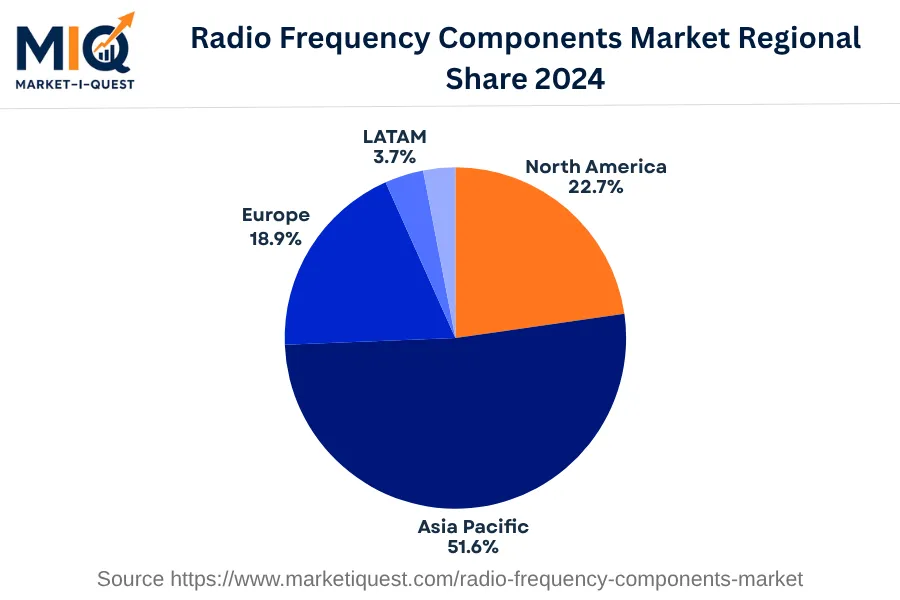
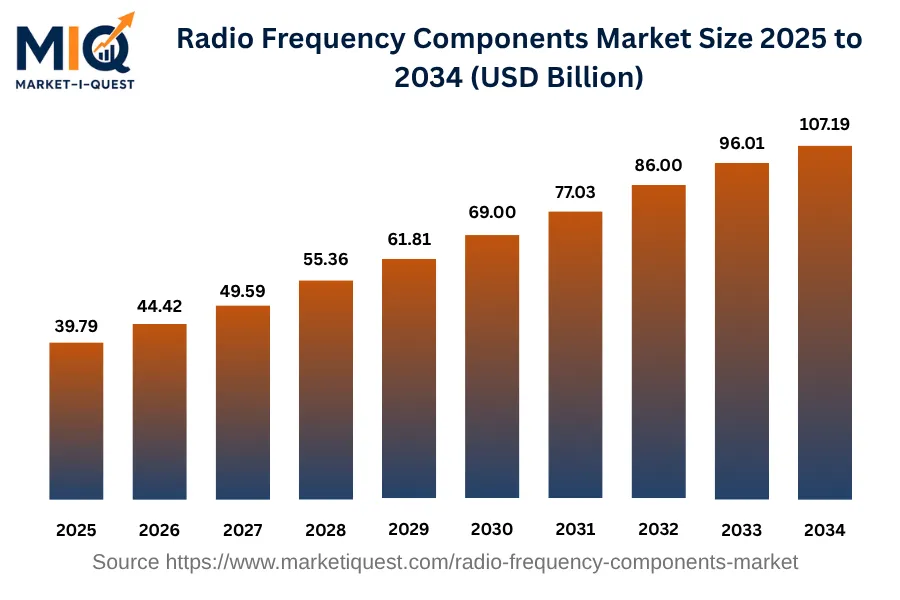
The Radio Frequency Components Market in 2025 is expected to be valued at $39.79 billion, up from $35.64 billion in 2024. This market is predicted to expand further and reach a size of $107.19 billion by 2034, demonstrating a CAGR of 11.64%. The growth trajectory from 2025 to 2034 suggests a continuous, steady climb in market value, underpinned by favorable sector dynamics during this period. Focusing on regional market domination in 2024, it is noted that the Asia Pacific region held 51.6% of the global market share, markedly higher than any other region. North America represented 22.7%, Europe accounted for 18.9% of the market shares, while LATAM and MEA held minor shares of 3.7% and 3% respectively. This regional share distribution implies a significant presence of the Radio Frequency Components industry in the Asia Pacific Region.

Key Takeaways

  • By Component Type - Amplifiers held a significant share in the Radio Frequency Components Market in 2024.
  • By Frequency Range - Ultra High Frequency had the fastest growth expanding at a CAGR of 5.2% from 2025-2034.
  • By End Use Industry - Telecommunications sector led the market accounting for a notable share in 2024.
radio-frequency-components-market market size

Key Driving Factors

5G network proliferation

The global expansion of 5G network is a significant driver for the radio frequency components market. With 5G, wireless communication reaches new levels of speed and bandwidth capabilities, but it requires the use of more radio frequency components in communication devices. Components such as power amplifiers, antenna switches, and filters become critical to manage the increased frequency range and complexity of 5G signals. As cellular network providers continue the rapid deployment of 5G, telecom equipment manufacturers need to ensure their devices are equipped for this next-generation technology. In response, they are increasing the demand for advanced radio frequency components.

Dependency on wireless communication in automotive industry

The accelerating trend of vehicle connectivity in the automotive industry also drives the radio frequency components market. Connected cars require reliable wireless communication for features like navigation, infotainment, and advanced driver-assistance systems. Thus, the need for high-quality radio frequency components expands. These components, such as RF transceivers and RF antennas, play a crucial role in providing strong signal reception and transmission. With the advent of autonomous vehicles and Vehicle-to-Everything (V2X) communication, this dependency on wireless communication and, consequently, on robust radio frequency components is set to rise further.

Market Evolution by Timeline

2019-2023
During this period, the demand for radio frequency components was primarily driven by wireless communication and broadcasting segments, particularly in North America and the APAC region. Suppliers saw advancements in Gallium Nitride (GaN) technology for enhancing radio frequency performance. However, technical integration of these components in devices posed serious challenges. WiFi 6, a key standard during this period, influenced adoption greatly. The commercial model saw a dominant pattern of fixed pricing contracts, with several suppliers partnering with communication service providers. A risk involved was the limited supply of gallium arsenide, a crucial raw material.
2024
By 2024, buyers in the consumer electronics segment, particularly smartphones, had increased in regions such as South America due to continuous technology adaptation. Technologies like Surface Acoustic Wave (SAW) devices had been successfully integrated into various smartphone models. The implementation of 5G standard provoked higher demand for RF components. The pricing model observed an increased tendency towards flexible contracts owing to competitive market dynamics. A typical risk was the lengthy cycle time in RF component manufacturing.
2025-2029
During the second half of the decade, the increasing use of connected devices in European and APAC countries fuelled the demand further. The industry observed a shift to Gallium Nitride on Silicon (GaN-on-Si) components, offering higher efficiency and lower manufacturing costs. The adoption of 6G standard was on the horizon, leading to high predictive demand for RF components. With a swing towards outcome-based contracts, a vital commercial risk was predicting accurate demand to prevent component shortage or overproduction.
2030-2034
By early 2030s, the RF components market would likely be propelled by sectors like industrial Internet of Things (IIoT) and autonomous vehicles globally. Technological progress in Silicon Germanium (SiGe) showed promises for better RF performance. Here, regulations involving 6G connectivity played a major role affecting market dynamics. Partnerships with large Original Equipment Manufacturers (OEMs), coupled with performance-based contracts dominated the commercial scene. The uncertainties around mass production of GaN-on-Si and SiGe components presented a risk of possible supply constraints.

Future Market Outlook

Future Opportunities

As technological advancements continue to reshape the radio frequency components market, opportunities are emerging in several key areas. The anticipated rollout of 6G technology is one such opportunity, with specifications set to be developed by the ITU by 2025. Manufacturers are already investing in research to create components that will support this next generation of wireless communication. Countries like South Korea and Japan are leading research initiatives, exploring the implementation of terahertz frequencies. Secondary markets for RF components, such as automotive applications, are also growing due to the increasing prevalence of connected vehicles. For example, companies like Tesla and Ford are integrating advanced RF technologies to enhance vehicle-to-everything communications, significantly needing reliable RF solutions. Moreover, the defense sector is witnessing increased spending on RF technologies for applications like radar and electronic warfare, particularly in the United States and NATO countries. The introduction of regulatory frameworks focused on reducing electronic waste, such as the EU's Waste Electrical and Electronic Equipment Directive, is also driving manufacturers to design more sustainable components. This push could lead to increased adoption of modular RF systems, enabling easier upgrades and repair. Altogether, these existing factors illustrate a trajectory wherein companies and industries will invest in smarter, more sustainable RF components to capitalize on emerging market needs.

Segmentation Analysis

By Component Type

The market is divided into subsegments including Filters, Amplifiers, Oscillators, and Mixers, among which Amplifiers accounted for the largest revenue share while Oscillators are expected to grow at the fastest CAGR during the forecast period.

Largest Revenue Share

Amplifiers

Market Share Leader

The Amplifiers sector's commanding presence stems from a mix of factors that have cemented its position as the highest revenue generator. Amplifiers are a key component in many electronic devices including televisions, radios, and mobile phones, seeing widespread usage in both consumer and commercial sectors. In terms of geography, North America, due to its large consumer base and willingness to adopt tech advancement, is a major contributor to this trend. Similarly, from the perspective of regulation and supply, there are no significant barriers that interrupt the steady flow of production and consumption. Purchasing criteria often lean in favor of Amplifiers due to their superior performance and greater lifespan, subsequently increasing demand. Furthermore, the switching costs for consumers opting for alternative components are typically high, creating a robust cycle of revenue generation. The channels for supply, being well established, ensure a steady stream of product to market.

Fastest CAGR

Oscillators

Forecast Period Growth Leader

The Oscillators subsegment, although not leading in revenue, is expected to register the fastest growth in the coming years. This prediction leans heavily on several growth drivers which include rapid technology advancements, increasing adoption across various sectors such as communication, aerospace, and defense where timing signal is key, and policy reforms favoring electronics manufacturing. Equally important is the progression of partnerships between oscillator manufacturers and technology companies, resulting in capex inflows, increased production capacity, and refined product quality. Despite potential adoption barriers such as high costs and technology complexity, the rate of growth continues to heighten. There are near-term risks associated with the volatility of raw material costs, regulatory restrictions, and supply chain disruption. However, the scale of demand and range of applications for oscillators, suggest that this subsegment is ripe for significant growth.

By Frequency Range

The Frequency Range market is divided into subsegments including Low Frequency, High Frequency, Ultra High Frequency, and Microwave. Among these, High Frequency accounted for the largest revenue share in 2024, while Ultra High Frequency is expected to grow at the fastest compound annual growth rate (CAGR) during the forecast period.

Largest Revenue Share

High Frequency

Market Share Leader

High Frequency services have secured the majority of market revenue in 2024 due to their broad range of applications. High frequencies are essential for numerous sectors, including telecommunications, broadcasting, satellite communication, and even mobile communication. The boom in mobile communication systems and the exponential development of wireless internet services have led to an increased reliance on this frequency range, generating significant revenue. Furthermore, this frequency range is preferred due to its ability to cover long distances and penetrate various obstacles due to lower attenuation rates, a critical factor across remote and densely populated regions alike. Additionally, in terms of supply, advanced infrastructure with high-frequency capability, coupled with developing regulatory environments supporting its use, contribute to the segment's prominence. Notable customer demand, coupled with the operational dynamics of purchasing, makes the High Frequency range a revenue leader in today's market.

Fastest CAGR

Ultra High Frequency

Forecast Period Growth Leader

The Ultra High Frequency segment is expected to grow at the most rapid pace over the forecast period as it occupies a crucial role in the evolving telecommunications landscape. As a catalyst, the industry-wide trend of next-generation wireless technology, such as 5G and beyond, which heavily rely on these frequencies, is rapidly driving adoption. From a policy perspective, many nations' governments are promoting the optimal utilization of Ultra High Frequencies, underpinning its rapid growth. Further, the high penetration and propagation abilities of Ultra High Frequencies make them ideal for various applications including television broadcasting, cellular phones, and GPS systems. However, barriers exist in terms of infrastructure requirements for Ultra High Frequency deployment and compatibility concerns across different regions and devices. Nonetheless, substantial investments in advanced communication infrastructure and strategic partnerships between frequency service providers and technology companies are expected to offset these challenges.

By End Use Industry

The market is divided into subsegments including Telecommunications, Consumer Electronics, Automotive, Aerospace, and Others. In the base year of 2024, Telecommunications generated the most revenue, while the Automotive industry is projected to expand at the highest CAGR in the upcoming years.

Largest Revenue Share

Telecommunications

Market Share Leader

The telecommunications was the largest revenue-generating subsegment in 2024 mainly due to the vast demand for advanced communication platforms globally as well as the increasing need for quality data transmission. Customers in this segment seek reliable, high-speed connectivity, which has led to significant investments in 5G technology and network infrastructure upgrades. The global spread of internet-based services also implies an extended geographical market reach. The industry's revenue generation is also propelled by regulatory support advocating for enhanced communication infrastructure, especially in developing regions where internet penetration continues to grow. Moreover, supply has been boosted by the ability of key players to innovate continuously, thereby meeting shifting consumer demands. This scenario also denotes low switch costs as suppliers constantly attempt to produce superior services and products than their competitors. Indeed, the telecommunications industry is characterized by aggressive competition, which has fostered a mature and profitable market environment.

Fastest CAGR

Automotive

Forecast Period Growth Leader

The Automotive industry is anticipated to grow at the fastest pace in the foreseeable future. This growth is chiefly driven by the ongoing transformation of the industry brought by Electric Vehicles (EVs), connected cars, and autonomous vehicle technologies. The regulatory push favoring EVs and governments' impetus to limit greenhouse gas emissions play a crucial role as growth catalysts. Additionally, significant capital expenditure by car manufacturers into R&D operations to innovate and develop cutting-edge technologies underpins the sector's high growth projection. Yet, there are adoption barriers, including EV charging infrastructure and the public’s perception of autonomous technologies’ safety. Partnerships have also emerged as a key trend, especially between automotive OEMs and tech firms, to expedite the development and potential adoption of these technologies. While these tech-driven transformations offer tremendous growth opportunities, they also pose near-term risks, particularly regarding cyber security and regulatory compliance.

Competitive Analysis

Key Market Players

Manufacturers / OEMs

Qorvo
US
Skyworks Solutions
US
Murata Manufacturing
Japan

Key Suppliers & Raw Materials

NXP Semiconductors
Netherlands
Analog Devices
US
Broadcom
US

Distributors, Integrators & Channel Partners

Richardson Electronics
US
Arrow Electronics
US
Digi-Key Electronics
US

Porter’s Five Forces Analysis

An analysis of the radio frequency components market using Porter's Five Forces.

Supplier Bargaining Power

Medium

Suppliers have power due to the specificity of radio frequency components and limited alternatives.

Buyer Bargaining Power

Low

Large OEMs dominate the market, reducing the bargaining power of smaller buyers.

Threat of Substitutes

Low

Given the technical specificity, there are few direct substitutes for radio frequency components.

Threat of New Entrants

Low

High entry barriers exist due to technical expertise and capex requirement for manufacturing.

Competitive Rivalry

High

Competition is high with leaders, including Skyworks, Qorvo, and Broadcom, fiercely competing for market share.

Regional Analysis

Geographic market dynamics and growth opportunities across key regions

Global Market Outlook

radio-frequency-components-market market regional share

North America

In 2024, the North American market for Radio Frequency (RF) components showed a robust growth driven by diverse factors. Technological adoption, largely from the telecommunications and automotive industries, necessitated a higher demand for advanced RF components. Investment in wireless infrastructure, particularly 5G networks in the U.S. and Canada, propelled demand further, while Mexico's burgeoning IoT sector offered fresh market avenues. Regulations such as the Federal Communications Commission's updated standards for RF equipment fueled supply dynamics, while competitive pricing strategies shaped market movements.

Notable trends included the increased buyer preference for integrated RF solutions, particularly in high-growth sectors such as healthcare and manufacturing due to their scalability and efficient operations. A notable shift was evident towards GaN (Gallium Nitride) RF components, driven by their superior power efficiency and smaller form factor. Strategic partnerships and mergers & acquisitions figured prominently too, as enterprises strove to consolidate market share amid stiff competition. A significant example is Qualcomm’s acquisition of RF360 Holdings, which highlighted the on-going consolidation in the sector. On the policy front, stronger enforcement of RF safety standards by governmental bodies influenced the market dynamics, emphasizing the critical role of compliance in this dynamic industry. In sectors like retail and utilities, the practical implementation of emerging technology such as radio-frequency identification (RFID) drove the market change.

Asia Pacific

In 2024, the Asia Pacific Radio Frequency Components market experienced robust activity driven by key demand factors, technology adoption, and regional investments. Rapid digitalization within sectors such as healthcare, manufacturing, enterprise, and retail fueled the heightened demand for these components. New government regulations in countries like India and China required improvements in infrastructure, requiring significant investment in Radio Frequency (RF) technology. The swift adoption of 5G technology, particularly in advanced economies like South Korea and Australia, also propelled the market. Additionally, escalating trade tensions induced greater self-reliance, resulting in an uptick in domestic supply dynamics.

Trends emphasized shifting customer preferences and partnership dynamics. Customers, especially within the enterprise and government sectors, showed a clear inclination towards domestic companies, reflecting a broader move towards supply chain security. Evident shifts occurred in product development, with many firms heavily leveraging Artificial Intelligence to improve RF component efficiency and utility. Downstream, channel dynamics evolved as E-commerce emerged as a primary distribution channel, particularly in China and Japan, due to its convenience and wide reach. Partnerships and mergers were common, often driven by the willingness to share technology expertise, as seen with the collaboration between leading ASEAN RF component manufacturers and multinational tech corporations. These market conditions underpinned a vibrant, evolving RF Components landscape in the Asia Pacific region in 2024.

Europe

In 2024, the Radio Frequency (RF) Components market in Europe experienced numerous shifts resulting from various drivers and trends. With increasing investment in 5G networks and the Internet of Things (IoT) across UK, Germany and France, demand for RF components surged considerably. Regulatory support, particularly in Nordic countries, further buoyed market growth by incentivizing advancements in wireless communication technology. Moreover, manufacturers in Italy and Spain launched cost-effective RF solutions, responding to pricing pressures and supply chain complexities.

Pertinent trends in 2024 included a shift towards miniaturized, power-efficient RF components. Enterprises in retail and manufacturing sectors, for instance, sought compact, energy-saving components to support their innovative IoT use-cases. In channel dynamics, there was a noticeable move towards direct-to-customer sales online, particularly in Central and Eastern Europe, offering increased revenue margins. The market witnessed significant partnerships and M&A activities, primarily in the Benelux region, aimed at enhancing product offerings and expanding geographical reach. Implementation of the EU's Radio Equipment Directive also played a pivotal role, enforcing unified standards for RF components market across Europe and ensuring enhanced product safety, thus influencing buyer behavior.

Latin America

In 2024, the radio frequency components market in Latin America was primarily driven by the widespread adoption of IoT devices, government funding in telecommunications, and increased investment in developing sophisticated communication infrastructure. Demand in this sector was fueled notably by Brazil and Mexico's need to enhance their wireless communication systems. Argentina and Colombia prioritized investments in RF components, aimed at improving security in the government sector. On the other hand, drastic changes in supply dynamics were seen due to technology licensing regulations, which significantly influenced pricing across the LATAM region.

Trends in the LATAM radio frequency components market pointed to a shift in consumer preferences towards advanced telecommunication devices, driven by an increase in disposable income in countries like Chile and Peru. Manufacturers tapped into this trend by expanding their product range and incorporating cutting-edge technology. Additionally, the market saw convergence and partnerships between leading technology and telecom providers, providing a comprehensive product mix, notably in Brazil and Argentina. However, regulatory constraints requiring component standardization across different sectors were seen, which impacted local manufacturers. Moreover, the drive to enforce strong policy for radio spectrum allocation created a structured environment for fair market competition. The primary customers spanned manufacturing, telecommunications, enterprise solutions, and government services. Companies increasingly deployed RF components to ensure seamless, high-speed connectivity in their operations, while governments utilized the technology for security and defense purposes.

Middle East & Africa

In 2024, the Radio Frequency Components Market in the Middle East and Africa experienced significant growth due to various factors. Key drivers included increased investments in telecommunications infrastructure, like Saudi Arabia's adoption of 5G networks, and progressive technology adoption in emerging economies such as Nigeria and Kenya. Regulatory policies encouraging the digitization of economies, particularly in the UAE and Qatar, also facilitated market expansion. Notable trends that shaped the market involved increased buyer preference for products with advanced RF components in the telecom and IT sectors. There was a shift towards more energy-efficient technology in response to environmental concerns, exemplified by South Africa's green energy initiatives. Mergers and acquisitions were prevalent, with Israeli companies like Skyworks Solutions extending their reach. Lastly, the standardization of RF components, driven by governmental policy enforcement in nations like Egypt, contributed to market robustness.

Key sectors that predominantly used RF components included government, oil and gas, telecom, manufacturing, and financial service industries. Particularly, the increasing digitization in these sectors across countries like Saudi Arabia, UAE, and South Africa cemented the demand for RF components. Overall, 2024 witnessed significant growth and development in the Radio Frequency Components Market in the Middle East and Africa, propelled by technological advances, favourable policies, and a receptive market.

Recent Industry Developments

Latest market innovations, product launches, and strategic initiatives

July 2026

Keysight and WIN Semiconductors Partner to Reduce Design Risk for High‑Frequency RF Components – On July 6, Keysight and WIN Semiconductors announced a collaboration to launch a new GaN MMIC design workflow that reduces manufacturing risk for 5G, satellite, and defense applications.

May 2026

Texas Instruments Acquires RF Chip Manufacturer Radia – Texas Instruments acquired Radia, an RF chip manufacturer focused on RF components and connectivity silicon. The acquisition brings TI specialized RF design capabilities, product modules, and engineering talent. Radia’s technology is particularly applicable to industrial, automotive, communications, and edge device applications.

Frequently Asked Questions